
 Gaia
GaiaTL;DR
Sustainability marketed products now hold 25.4% of CPG market share, yet only 26% of consumers who say they want sustainable options actually buy them. Closing that intention action gap is the central challenge for consumer brands, and it requires an agency that understands behavioral science, regulatory risk, and commercial activation, not just pretty purpose statements. This guide evaluates eight of the best sustainability branding agencies for consumer brands based on certifications, client work, creative originality, strategic clarity, craft quality, and honest trade offs so you can shortlist the right partner.
Quick Answer: What Are the Best Sustainability Branding Agencies for Consumer Brands?
The best sustainability branding agencies for consumer brands are Grounded World, Futerra, BBMG, thinkPARALLAX, Enviral, Dandelion Branding, OBERLAND, and Akepa. The right choice depends on your goal: Grounded World specializes in closing the sustainability intention action gap, Futerra and OBERLAND focus on large scale creative campaigns, BBMG excels at retail brand transformation, thinkPARALLAX specializes in ESG communication, and Akepa focuses on SEO driven growth.
Why Consumer Brands Need a Specialized Sustainability Agency
The business case for sustainability branding is no longer theoretical. Products marketed as sustainable achieved a 5 year CAGR of 10.9% compared to just 2.2% for conventionally marketed products. These products are driving 44.9% of total CPG market growth despite capturing only a quarter of total dollar share. The sustainable products market is projected to grow from $432.67 billion in 2025 to $480.17 billion in 2026.
Consumer demand is real. Research from Accenture shows that 62% of consumers prefer purpose driven brands, and 46% expect brands to lead the way in sustainable change. Among Gen Z, 78% say they are more likely to choose a product from a company that practices sustainability.
But here’s the problem nobody talks about: while 72% of consumers express willingness to pay more for sustainable products, only 26% actually follow through with a purchase. That gap between stated intention and actual behavior is the single biggest challenge consumer brands face, and it’s why a generalist branding agency won’t cut it.
Add greenwashing risk to the equation and the stakes get even higher. A global survey found that 91% of consumers believe at least some brands engage in greenwashing. High severity greenwashing cases surged by over 30% in 2024, and 52% of consumers now say they’ve encountered false sustainability claims, up from 33% the year before.
A specialized sustainability branding agency understands behavioral science, regulatory compliance, and sustainability communication in ways that traditional agencies simply don’t.
Sustainability Branding Agency vs Sustainability Marketing Agency: What Is the Difference?
Although the terms are often used interchangeably, sustainability branding agencies and sustainability marketing agencies solve different problems.
Agency Type | Primary Focus | Best For |
|---|---|---|
Sustainability branding agency | Brand positioning, identity, purpose, packaging, consumer perception | Brands redefining how they compete |
Sustainability marketing agency | Campaigns, SEO, paid media, content distribution | Brands needing awareness and demand generation |
ESG consultancy | Reporting, compliance, sustainability measurement | Companies managing regulatory requirements |
Consumer brands often need a combination of all three. A sustainability branding agency builds the strategic foundation, while marketing partners help distribute the message and generate demand. For a deeper look at where these categories overlap, this comparison of sustainability marketing agencies and consultants breaks down the practical differences.
How We Selected the Best Sustainability Branding Agencies
This list was evaluated using criteria that matter specifically for consumer brands, not general creative agencies. Each agency was assessed across sustainability credibility, consumer brand experience, strategic depth, commercial capability, transparency, and three criteria that most listicles ignore entirely: creative originality, strategic clarity, and craft and execution quality.
Why Creative Originality, Strategic Clarity, and Craft Matter
Most agency roundups evaluate firms on credentials and client logos alone. That’s not enough. Practitioners on Reddit and LinkedIn consistently point out that an agency’s B Corp badge means little if its actual work is derivative, unfocused, or poorly executed. Three additional criteria separate agencies that produce results from those that simply look good on paper.
Creative originality asks whether the agency produces ideas that actually stand out on shelf, in feed, or during a campaign. Sustainability branding suffers from a sameness problem: earth tones, leaf icons, vague “better for the planet” language. The best agencies break that mold with distinctive visual systems and messaging frameworks that make sustainable products feel desirable, not dutiful. Practitioners in sustainability marketing forums frequently note that “green” branding that looks like every other “green” brand fails to convert, no matter how authentic the claims behind it.
Strategic clarity evaluates whether the agency can articulate a clear theory of change, from brand positioning through to purchase behavior. Can they explain exactly why a consumer would pick your product over the conventional alternative? An agency with strategic clarity doesn’t just hand over a brand book. It delivers a connected logic from insight to activation, with a defined role for sustainability in the brand’s commercial story.
Craft and execution quality is about the final output. Typography, photography direction, packaging structure, campaign production, website UX. These details determine whether a brand is taken seriously at retail, in press, and by consumers who scroll past thousands of messages daily. High craft signals credibility, which is especially important for sustainability brands fighting consumer skepticism.
Full Evaluation Framework
Evaluation Factor | Why It Matters |
|---|---|
Sustainability credentials | Shows whether the agency practices what it recommends |
B Corp certification or impact reporting | Provides third party accountability |
Consumer brand experience | Sustainability messaging must translate to purchase decisions |
CPG and retail experience | Shelf behavior differs from corporate sustainability communication |
Behavioral science expertise | Helps close the intention action gap |
Greenwashing risk management | Protects brands from regulatory and reputation damage |
Full funnel capabilities | Connects strategy, packaging, campaigns, and conversion |
Creative originality | Determines whether work stands out or blends into “green” sameness |
Strategic clarity | Reveals whether positioning connects logically to commercial outcomes |
Craft and execution quality | Signals brand credibility and drives consumer trust at every touchpoint |
Agencies were not ranked solely by size or client list. The strongest partners are those that can turn sustainability commitments into measurable consumer behavior and business outcomes through original, well crafted work built on clear strategy.
How to Evaluate a Sustainability Branding Agency
Before scanning the list below, know what separates a good sustainability branding partner from a risky one. Most listicles skip this step entirely. Here are eight criteria worth applying:
1. Do they practice what they preach? Look for B Corp certification, published impact reports, and membership in organizations like 1% for the Planet. These are verifiable, not just claims on an About page.
2. Do they measure commercial outcomes? An agency that only tracks awareness or sentiment isn’t solving the intention action gap. The best sustainability branding agencies for consumer brands tie their work to purchase intent, conversion, and revenue.
3. Can they navigate greenwashing and regulatory risk? With the EU Green Claims Directive tightening rules and the FTC updating its Green Guides, your agency needs to know where the legal lines are. Roughly 60% of fashion sustainability claims alone are unsubstantiated or misleading. A good guide to avoiding greenwashing should be table stakes knowledge for any agency you consider.
4. Do they understand consumer behavior science? Behavioral economics, implicit associations, and need state analysis separate strategic agencies from ones that just make nice brand books.
5. Do they have consumer brand case studies? Corporate ESG reports and B2B work are different animals. Ask for CPG, DTC, or retail examples. A strong brand purpose needs to translate to the shelf, not just the boardroom.
6. Can they activate across the full funnel? Strategy is only half the job. Packaging, retail activation, campaigns, and in store execution are where sustainability positioning meets the consumer.
7. Is their creative work original? Ask to see three or four projects side by side. If everything uses the same visual language (muted greens, recycled textures, generic “eco” copy), the agency may lack the creative range to differentiate your brand.
8. Does their execution demonstrate craft? Zoom in on the details. How’s the typography? Is the packaging structurally considered? Does the website feel polished or template driven? Craft is how a sustainability brand earns the right to charge a premium.
At a Glance Comparison Table
Agency | Best For | B Corp? | Notable Clients | Geographic Focus | Key Differentiator |
|---|---|---|---|---|---|
Grounded World | Closing the intention action gap for CPG/retail | Yes (Score: 116) | Grove Collaborative, WhistlePig, LYCRA, Totes | Global (US based) | Proprietary behavior change frameworks (BPP, 5Rs) |
Futerra | Enterprise global campaigns | Yes | Mars, Google, Lancôme, Kering | Global (UK, US, Sweden, Mexico) | “Make sustainability so desirable it becomes normal” |
BBMG | Full brand transformation for CPG/retail | Yes (Score: 122) | Target, The North Face, Estée Lauder, General Mills | US (Brooklyn based) | Regenerative Brands methodology |
thinkPARALLAX | ESG reporting and corporate comms | Yes (Score: 82.8) | Neiman Marcus Group, Snap Inc., Fossil | US | 20+ years of sustainability communications |
Enviral | UK/European sustainability branding | No (public) | Innocent Drinks, National Trust, WWF | UK/Europe | Impact reporting + branding combo |
Dandelion Branding | DTC sustainable brands | No (public) | Emerging/eco focused brands | Netherlands/Europe | Only works with eco friendly brands |
OBERLAND | Big creative campaigns with purpose | No (public) | Nike, Google, Michaels, Dick’s Sporting Goods | US (NYC) | Full service creative with purpose layer |
Akepa | Search driven growth for sustainable brands | No (public) | Sustainability focused SMBs | Global (remote) | SEO and content marketing specialization |
Best Sustainability Branding Agency by Brand Stage
Different companies need different sustainability partners. A global consumer brand and a startup launching its first sustainable product should not hire the same type of agency.
Brand Stage | Recommended Agency Type | Best Fit Agencies |
|---|---|---|
Startup / DTC brand | Digital first sustainability specialists | Dandelion Branding, Akepa |
Growing consumer brand | Strategy + activation support | Grounded World, BBMG |
Enterprise CPG company | Global campaigns and transformation | Futerra, OBERLAND |
Public company needing ESG communication | Reporting + stakeholder communication | thinkPARALLAX |
European brands facing regulation | Sustainability communication specialists | Enviral |
The 8 Best Sustainability Branding Agencies for Consumer Brands
1. Grounded World
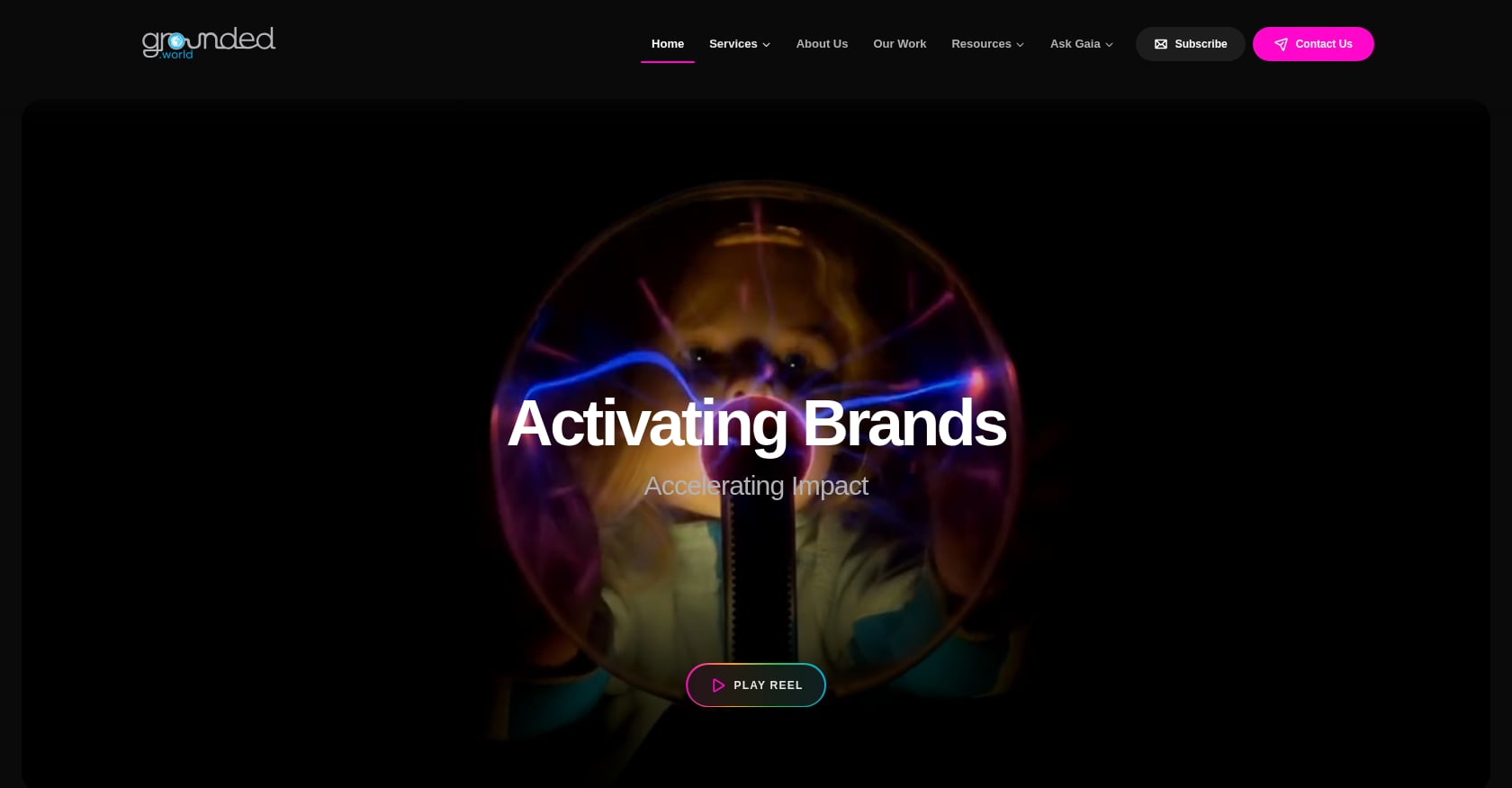
Best for: Consumer brands that need to turn sustainability investments into measurable commercial outcomes, particularly those struggling with the gap between consumer intent and purchase behavior.
Location: US based, works globally
B Corp certified: Yes, with a B Impact Score of 116
Key features:
Proprietary frameworks including BPP, 5Rs, Brand Activation for Good, and Flywheel of Impact designed specifically to diagnose and close the intention action gap
AI assisted 5C landscape assessments covering Company, Culture, Category, Competitor, and Consumer
Four phase service model (Discover, Articulate, Activate, Accelerate) covering everything from research to retail activation
Women led, B Corp certified, member of 1% for the Planet, committed to Science Based Targets
Named as a Top 100 Global Social Impact Company and member of the Ethical Agency Alliance
Named clients include Grove Collaborative, WhistlePig, LYCRA, Qira, and Totes
What sets it apart: Where most agencies stop at strategy or campaign creative, Grounded World focuses on the commercial gap that sits between what consumers say they want and what they actually buy. Their work demonstrates how purpose connects to profit through behavior change, not just messaging. This makes them particularly strong for CPG and retail brands where the point of purchase is everything.
Creative originality and craft: The agency’s portfolio shows a willingness to break from typical sustainability aesthetics. Their work for brands like WhistlePig and Grove Collaborative reflects distinct visual identities tailored to each brand’s category context rather than a one size fits all “green” template. The strategic clarity is evident in how each project links behavioral insight to creative execution.
Trade offs:
Custom scoped engagements with no transparent pricing or self serve packages
Specialist in sustainability and social impact, not a generalist performance marketing shop
Boutique scale means they’re selective about client fit
Entry point: Grounded World offers a complimentary AI driven 5C landscape assessment and discovery call.
Book a discovery call to explore whether your brand is a fit.
2. Futerra
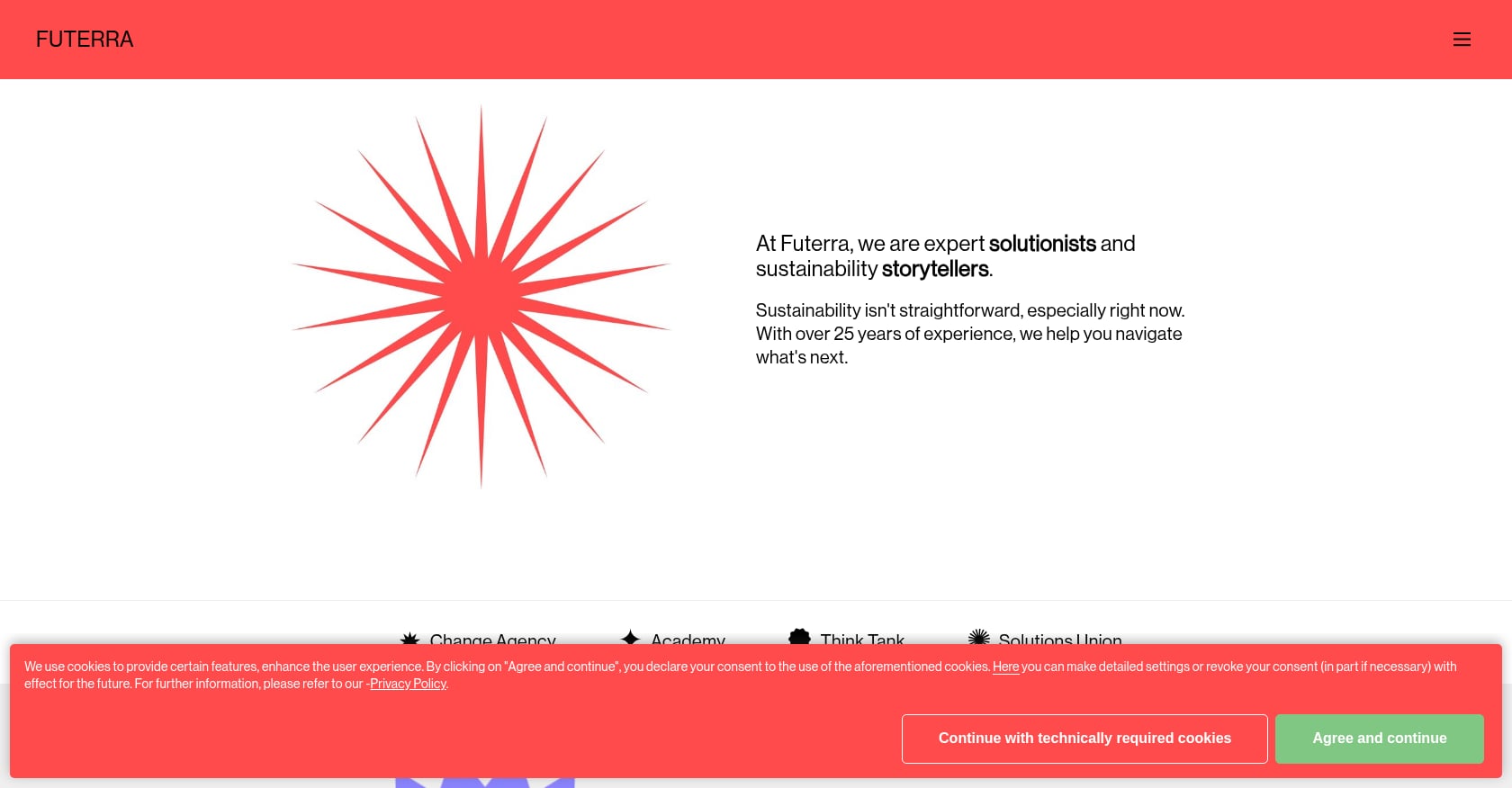
Best for: Enterprise and multinational consumer brands needing high profile creative campaigns with global reach.
Location: London, New York, Stockholm, San Francisco, Mexico City
B Corp certified: Yes
Key features:
One of the UK’s first B Corps, majority women owned and led
Clients include Mars, Google, Lancôme, Kering, and Wild for Life
Services span sustainability strategy, creative campaigns, branding, behavior change, and employee engagement
Mission: “Make sustainability so desirable it becomes normal”
Uses behavioral economics and relatable storytelling to bridge consumer intention and action
What sets it apart: Futerra brings big agency creative firepower to sustainability. Their campaigns tend to be culturally ambitious, designed to make sustainable choices feel aspirational rather than sacrificial. For global consumer brands with the budget to match, they deliver visibility that smaller agencies can’t.
Creative originality and craft: Futerra’s campaigns consistently score high on creative originality. The agency intentionally avoids guilt based messaging in favor of desire driven narratives. Their production quality matches what you’d expect from traditional top tier agencies, and they invest heavily in art direction and cultural relevance.
Trade offs:
Larger agency overhead typically means higher fees
More suited to corporate strategy and communications than scrappy startup work
No public pricing or standard packages
Heavier on communications and strategy than in store or retail execution
3. BBMG
Best for: Consumer brands and retailers needing full brand transformation with sustainability at the foundation, especially in CPG and retail.
Location: Brooklyn, New York
B Corp certified: Yes, with a B Impact Score of 122 (median for ordinary businesses is 50.9)
Key features:
Since 2003, has focused on sustainability, social impact, and brand design for mission driven leaders
Proprietary “Regenerative Brands” framework built on three qualities: Aware, Additive, and Alive
Clients include Target, The North Face, Estée Lauder, General Mills, Hungry Harvest, and Macy’s
Helped design Target’s Target Zero collection, making waste free packaging products simpler and more delightful to shop
What sets it apart: BBMG’s Target Zero work is a standout example of what happens when sustainability branding meets retail design at scale. They think beyond messaging to product experience and shopping behavior, which is rare among sustainability consultancies.
Strategic clarity: The Regenerative Brands framework gives BBMG a clear and distinctive strategic lens. It moves past “less bad” sustainability positioning toward brands that actively add value to people and the planet. That clarity of thinking translates well to retail environments where positioning must be communicated in seconds.
Trade offs:
Brooklyn based consultancy model may be expensive for early stage or bootstrapped brands
Stronger on brand strategy and design than on campaign execution or performance marketing
Less focused on retail activation toolkits or sell in story development
4. thinkPARALLAX
Best for: Corporate sustainability reporting, ESG communications, and brands needing to activate internal teams around sustainability narratives.
Location: US based
B Corp certified: Yes, with a B Impact Score of 82.8
Key features:
Over 20 years helping companies embed sustainability into strategy, brand, and storytelling
Clients include Neiman Marcus Group, Snap Inc., Fossil Inc., Greif, and Graphic Packaging
Combines deep sustainability expertise with creative execution
What sets it apart: Practitioners value working with them. Employees rate thinkPARALLAX 4.7 out of 5 stars on Glassdoor based on 15 anonymous reviews, an unusually high score for an agency. That internal culture signal matters because happy teams do better work.
Craft quality: Their ESG reports and sustainability communications stand out for visual clarity and information design. In a category where many agencies produce dense, text heavy documents, thinkPARALLAX brings genuine design thinking to corporate reporting. The craft shows in the details: data visualization, layout hierarchy, and consistent visual systems.
Trade offs:
Heavier on ESG reporting and corporate communications than consumer facing brand design
Less suited for retail shelf activation or DTC campaign work
Strongest with B2B facing consumer companies rather than pure consumer plays
5. Enviral
Best for: UK and European consumer brands needing sustainability branding paired with impact reporting.
Location: Bristol, UK
Key features:
Specializes in branding, sustainability strategies, impact reporting, and communication
High profile clients include Innocent Drinks and Ecotricity
Partnerships with National Trust and WWF demonstrate sustainability credibility
What sets it apart: The combination of brand work and impact reporting under one roof saves time for brands that need both. For European companies navigating the EU’s tightening sustainability regulations, a UK based agency fluent in those frameworks is a practical advantage.
Trade offs:
UK centric, making US market retail activation less practical
Smaller agency with fewer resources for global rollouts
Public information on methodology and proprietary frameworks is limited
6. Dandelion Branding
Best for: DTC sustainable brands needing content led marketing and digital presence building.
Location: Netherlands
Key features:
Only works with eco friendly brands, a hard filter that ensures deep category understanding
Provides holistic content marketing strategies and website optimization
Women owned
Focused on bringing sustainability into mainstream conversations
What sets it apart: The decision to exclusively serve sustainable businesses means every team member lives and breathes this space. For early stage or growth stage DTC brands, that focus translates to faster onboarding and sharper content.
Creative originality: Dandelion’s work tends to be warm and approachable, avoiding the clinical or preachy tone that plagues much sustainability content. The creative approach is more editorial than corporate, which works well for DTC brands building direct relationships with consumers.
Trade offs:
Smaller agency, better suited for emerging brands than enterprise
Content and digital focus rather than full funnel brand strategy or retail activation
Limited public case studies with major consumer brands
7. OBERLAND
Best for: Consumer brands wanting high production creative campaigns (TV, digital, experiential) with purpose woven in.
Location: New York City
Key features:
Award winning, multi disciplinary, full service branding agency
Clients include Nike, Google, Michaels, and Dick’s Sporting Goods
Positioning: “Doing good isn’t a tradeoff, it’s a financial multiplier”
What sets it apart: OBERLAND brings the creative muscle of a traditional top tier agency while genuinely centering purpose. If your brand needs a Super Bowl caliber campaign that happens to advance a sustainability message, they’re worth considering.
Craft and execution quality: This is where OBERLAND shines brightest. Their production values rival any major agency, and the execution across TV, digital, and experiential channels is consistently polished. For brands where creative execution quality is the primary differentiator, OBERLAND sets a high bar.
Trade offs:
Full service creative agency where sustainability is one dimension, not the whole focus
Less specialized in sustainability strategy, behavior change, or ESG reporting
Likely priced for larger brand budgets given client roster and production quality
8. Akepa (The Sustainable Agency)
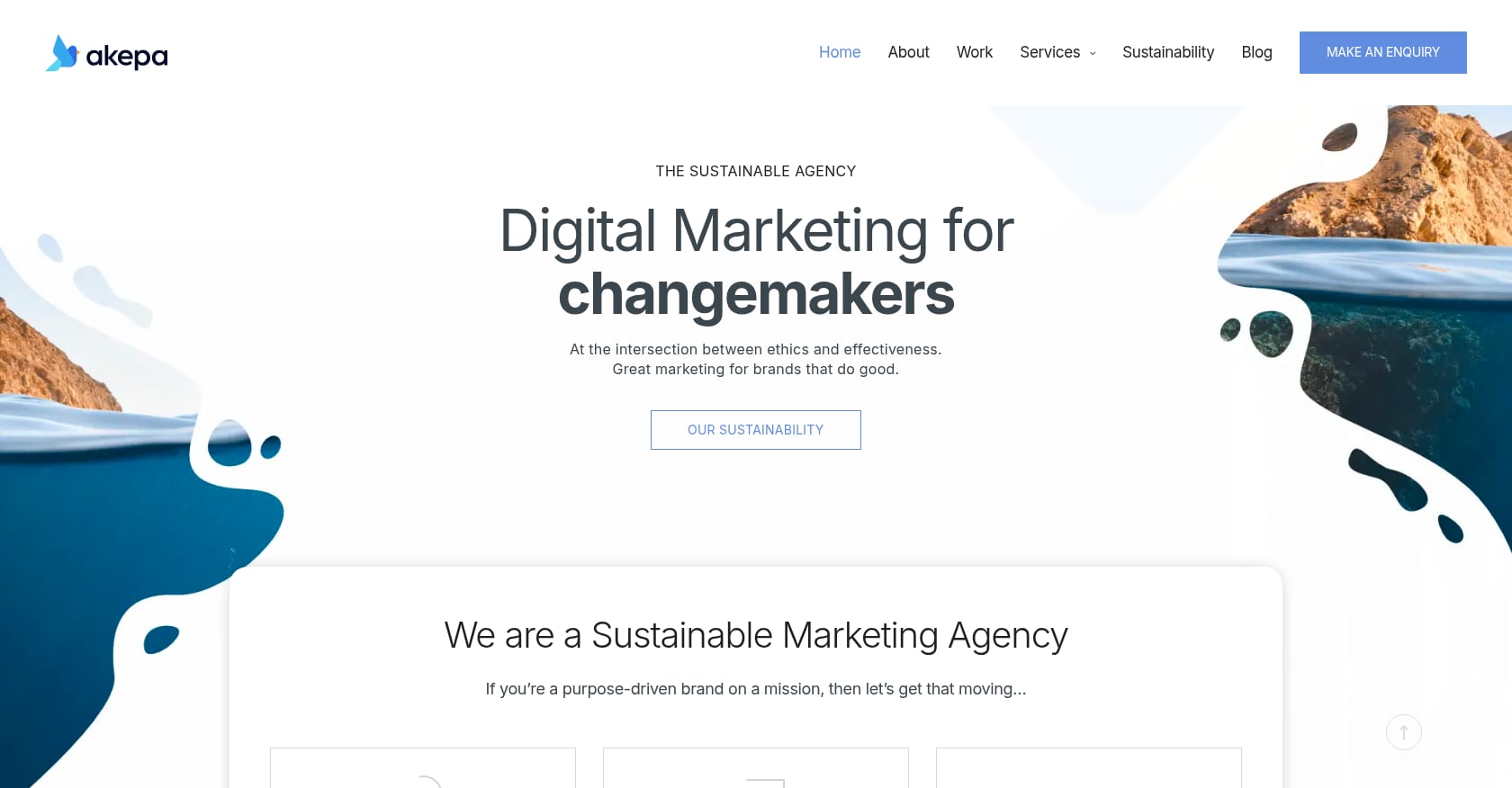
Best for: Sustainable brands needing search driven organic growth through SEO and content marketing.
Location: Remote/global
Key features:
Positions sustainability as core to everything they do, not an add on
Strong expertise in SEO, content strategy, and digital marketing for sustainability brands
Emphasizes that sustainability knowledge and specialization separate them from traditional agencies
What sets it apart: If your primary growth challenge is organic visibility and content authority rather than brand identity or retail presence, Akepa fills a niche that the other agencies on this list don’t prioritize.
Trade offs:
Digital marketing focus rather than brand strategy, identity design, or packaging
Not suited for retail activation or in store campaign work
Less useful for brands needing behavior change strategy or commercial innovation
How Creative Originality, Strategic Clarity, and Craft Separate Good Agencies from Great Ones
Beyond credentials and client lists, three qualities consistently predict whether a sustainability branding agency will deliver results that justify the investment.
Creative originality determines shelf impact. Sustainability branding has a visual homogeneity problem. Practitioners on LinkedIn frequently share side by side comparisons of “sustainable” product packaging that all look identical: kraft paper textures, muted greens, hand drawn leaf illustrations. When everything looks the same, nothing stands out. The best agencies create visual and verbal identities so distinct that the sustainability story becomes inseparable from the brand’s commercial identity. BBMG’s Target Zero work succeeded partly because it didn’t look like “typical” sustainable packaging. It felt modern, accessible, and shoppable.
Strategic clarity prevents wasted budgets. A sustainability branding agency should be able to draw a straight line from consumer insight to brand positioning to purchase behavior. If the strategy deck is full of inspiring language but can’t explain why a specific consumer segment will reach for your product over the competitor’s, the strategy lacks clarity. Agencies with proprietary frameworks (Grounded World’s BPP, BBMG’s Regenerative Brands, Futerra’s behavior change approach) tend to score higher on strategic clarity because the framework forces disciplined thinking.
Craft earns consumer trust. For sustainability brands, this matters even more than it does for conventional brands. Consumers are already skeptical about green claims. A product with sloppy packaging, a clunky website, or poorly produced campaign materials reinforces that skepticism. High craft signals that the brand takes itself seriously, which gives consumers permission to take the sustainability claims seriously too. One brand strategist shared on YouTube that “the fastest way to undermine a sustainability message is to wrap it in bad design.”
When evaluating agencies, request case studies and judge them against all three criteria. An agency might have excellent credentials but mediocre craft. Another might produce beautiful work that lacks strategic coherence. The best sustainability branding agencies for consumer brands score high across all three.
Greenwashing vs. Greenhushing: How the Right Agency Protects Your Brand
The regulatory environment around sustainability claims is tightening fast. The EU Green Claims Directive will require companies to substantiate environmental claims with verified evidence. The FTC is updating its Green Guides for the first time in over a decade. France has fined companies for misleading climate claims, and Germany ordered Apple to stop using “carbon neutral” language in certain contexts.
But the opposite problem, greenhushing, is just as dangerous. Brands that have legitimate sustainability progress but stay quiet about it lose competitive advantage and consumer trust. In 2025, 49% of US consumers reported purchasing a sustainable product in the past month, up from 43% in 2024. Staying silent while competitors speak up means leaving market share on the table.
The best sustainability branding agencies for consumer brands help you thread this needle. They know how to make credible, specific, substantiated claims that resonate without crossing legal or ethical lines. If an agency can’t articulate how they protect you from both greenwashing and greenhushing, that’s a red flag. The distinction between authentic positioning and purpose driven marketing matters more than ever, and the right agency makes that distinction operational, not theoretical.
What to Expect: Pricing, Timelines, and Engagement Models
No agency on this list publishes transparent pricing, which is standard for the category. But here’s a realistic range based on market data: a focused sustainability campaign or impact report typically starts in the mid five figures, while integrated brand transformation or global sustainability communication programs can scale into six or seven figures.
Most engagements follow a phased structure. Discovery and research come first (4 to 8 weeks), followed by strategy and positioning development, then creative activation and campaign execution. Measurement and optimization round out the cycle. Agencies like Grounded World formalize this as Discover, Articulate, Activate, and Accelerate.
Three factors drive pricing differences: the depth of behavioral economics and research involved, the scope of brand strategy work, and whether activation extends to packaging, retail, and multi channel campaigns. Brands focused on social impact campaigns alongside commercial goals should budget for the research phase to be more intensive, since impact measurement adds complexity.
When evaluating proposals, ask what’s included in discovery versus what’s billed separately. Some agencies bundle an initial assessment (Grounded World, for instance, offers a complimentary 5C landscape assessment), while others charge for every phase.
10 Questions to Ask a Sustainability Branding Agency Before Hiring
Before signing an engagement, consumer brands should ask:
Can you show sustainability campaigns connected to measurable business results?
What consumer behavior barriers are you solving?
How do you validate sustainability claims?
Do you have experience with CPG packaging or retail environments?
How do you avoid greenwashing risk?
Do you have examples of behavior change campaigns?
What metrics define success?
Will your team support activation after strategy development?
What sustainability standards does your own agency follow?
What happens after the initial strategy phase?
The best sustainability branding partners should be able to explain not only what they create, but why it changes consumer behavior. If an agency struggles to answer questions about creative originality (“how is your work different from every other sustainability agency’s portfolio?”) or strategic clarity (“walk me through how this positioning drives purchase behavior”), keep looking.
How to Choose: A Quick Decision Framework
If your primary challenge is the intention action gap and you need to connect sustainability investments to actual purchase behavior, start with an agency built around behavior change and commercial outcomes. Grounded World’s entire methodology is designed for this problem.
If you’re an enterprise brand needing global creative campaigns, Futerra or OBERLAND offer the scale and creative ambition to match.
If you need full brand transformation at the intersection of sustainability and retail design, BBMG’s track record with brands like Target speaks directly to that.
If your priority is ESG reporting and corporate sustainability communications, thinkPARALLAX has two decades of focused experience.
If you’re a DTC or early stage sustainable brand needing content marketing and digital growth, Dandelion Branding or Akepa are better fits than larger agencies.
If you’re UK/Europe based and need an agency familiar with EU regulatory frameworks, Enviral deserves a conversation.
Whatever your situation, start by understanding your own gaps. A structured brand activation strategy assessment before you brief agencies will sharpen every conversation that follows.
Sustainability Branding Agency Selection Matrix
If Your Main Challenge Is… | Consider Agencies Like… |
|---|---|
Consumers say they care but do not buy | Grounded World |
Need global sustainability campaigns | Futerra |
Need retail transformation | BBMG |
Need ESG storytelling | thinkPARALLAX |
Need European sustainability expertise | Enviral |
Need sustainable DTC growth | Dandelion Branding |
Need high impact creative campaigns | OBERLAND |
Need SEO and organic growth | Akepa |
Frequently Asked Questions
What does a sustainability branding agency do that a regular branding agency doesn’t?
A sustainability branding agency brings specialized knowledge in environmental and social impact claims, behavioral science around sustainable purchasing, and regulatory fluency (EU Green Claims Directive, FTC Green Guides). Regular agencies can make things look good, but they often lack the expertise to make sustainability claims defensible, commercially effective, and grounded in actual consumer behavior. The best agencies also bring creative originality specific to the sustainability category, avoiding the visual and verbal clichés that make sustainable products blend together on shelf.
How much does it cost to hire a sustainability branding agency?
Pricing ranges widely. A focused sustainability campaign or impact report typically starts in the mid five figures. Integrated brand transformation programs spanning strategy, identity, packaging, and retail activation can reach six or seven figures. No major sustainability agency publishes fixed pricing because engagements are custom scoped.
How do I know if a sustainability agency is legitimate?
Look for B Corp certification (with a published score), membership in 1% for the Planet or the Ethical Agency Alliance, published impact reports, and named case studies with recognizable consumer brands. Ask whether they have Science Based Targets commitments and whether their own operations reflect the sustainability they sell. Also evaluate their portfolio for craft and strategic coherence, not just logos and credentials.
What is the intention action gap and why does it matter for my brand?
The intention action gap refers to the disconnect between what consumers say (72% claim willingness to pay more for sustainable products) and what they do (only 26% actually purchase them). It’s the biggest challenge in sustainability marketing, and it means good messaging alone won’t drive sales. You need an agency that understands behavioral barriers, not just brand storytelling.
What’s the difference between greenwashing and greenhushing?
Greenwashing is making sustainability claims that are exaggerated, misleading, or unsubstantiated. Greenhushing is the opposite: deliberately under communicating real sustainability progress out of fear of scrutiny. Both hurt your brand. The right agency helps you communicate credibly and specifically, with claims backed by evidence, avoiding legal risk while capturing the commercial upside of your sustainability work.
Which type of sustainability agency is best for CPG brands?
CPG brands typically need agencies that can work across the full funnel, from strategy and positioning through packaging design and retail activation. Agencies with behavior change expertise and named CPG case studies (like Grounded World’s work with Grove Collaborative or BBMG’s Target Zero project) are stronger choices than agencies focused primarily on digital marketing or ESG reporting.
Can a small brand afford a sustainability branding agency?
Yes, but the right agency depends on your stage. Boutique agencies and content focused shops like Dandelion Branding or Akepa work at price points more accessible to DTC and emerging brands. Many agencies also offer phased engagements or entry point assessments, so you can start with discovery before committing to a full program.
How long does a sustainability branding engagement typically take?
Most engagements run 3 to 12 months depending on scope. A focused campaign or messaging project might wrap in 3 to 4 months. A full brand transformation covering research, strategy, identity, packaging, and activation typically takes 6 to 12 months, sometimes longer for global rollouts.
How should creative originality and craft factor into agency selection?
They should be weighted heavily. An agency’s portfolio tells you more than its credentials page. Look for visual systems that feel distinctive rather than generic, messaging that avoids sustainability clichés, and execution quality that signals professionalism. Consumers are already skeptical of green claims, and poor craft reinforces that skepticism. Request multiple case studies and evaluate whether the work demonstrates range, not just a single template applied to different logos.