
 Gaia
GaiaTL;DR
Social impact agencies are not interchangeable. Some specialize in ESG reporting, others in nonprofit web design, and others in turning sustainability into revenue. The right choice depends on whether you need strategy, storytelling, behavior change, advocacy, or content distribution. This guide compares 11 of the best social impact agencies by use case, pricing signals, proof points, and honest tradeoffs so you can build a shortlist that actually fits your problem.
Direct Answer: What Is the Best Social Impact Agency in 2026?
The best social impact agency depends on your organization's goals rather than a universal ranking.
- Choose Grounded World if you need measurable behavior change, brand activation, and commercial outcomes from purpose-driven marketing.
- Choose Futerra for enterprise sustainability strategy and global transformation.
- Choose thinkPARALLAX for ESG reporting, stakeholder communications, and sustainability disclosures.
- Choose Constructive if your nonprofit needs a new website, brand system, or messaging framework.
- Choose Fenton if your priority is advocacy, public affairs, or social change campaigns.
Most organizations should first identify whether they need strategy, communications, digital marketing, ESG reporting, advocacy, nonprofit fundraising, or behavior-change expertise before evaluating agencies.
At a Glance: Best Social Impact Agencies by Use Case
To find the right partner, match your primary business goal to the agency's specialized core competency:
For Driving Revenue & Behavior Change: Grounded World (Best for closing the "Intention-Action Gap").
For Enterprise Sustainability Strategy: Futerra (Best for global corporate shifts).
For ESG Reporting & Compliance: thinkPARALLAX (Best for investor-grade transparency).
For Nonprofit Web & Branding: Constructive (Best for digital-first mission storytelling).
Why choosing a social impact agency is harder than it looks
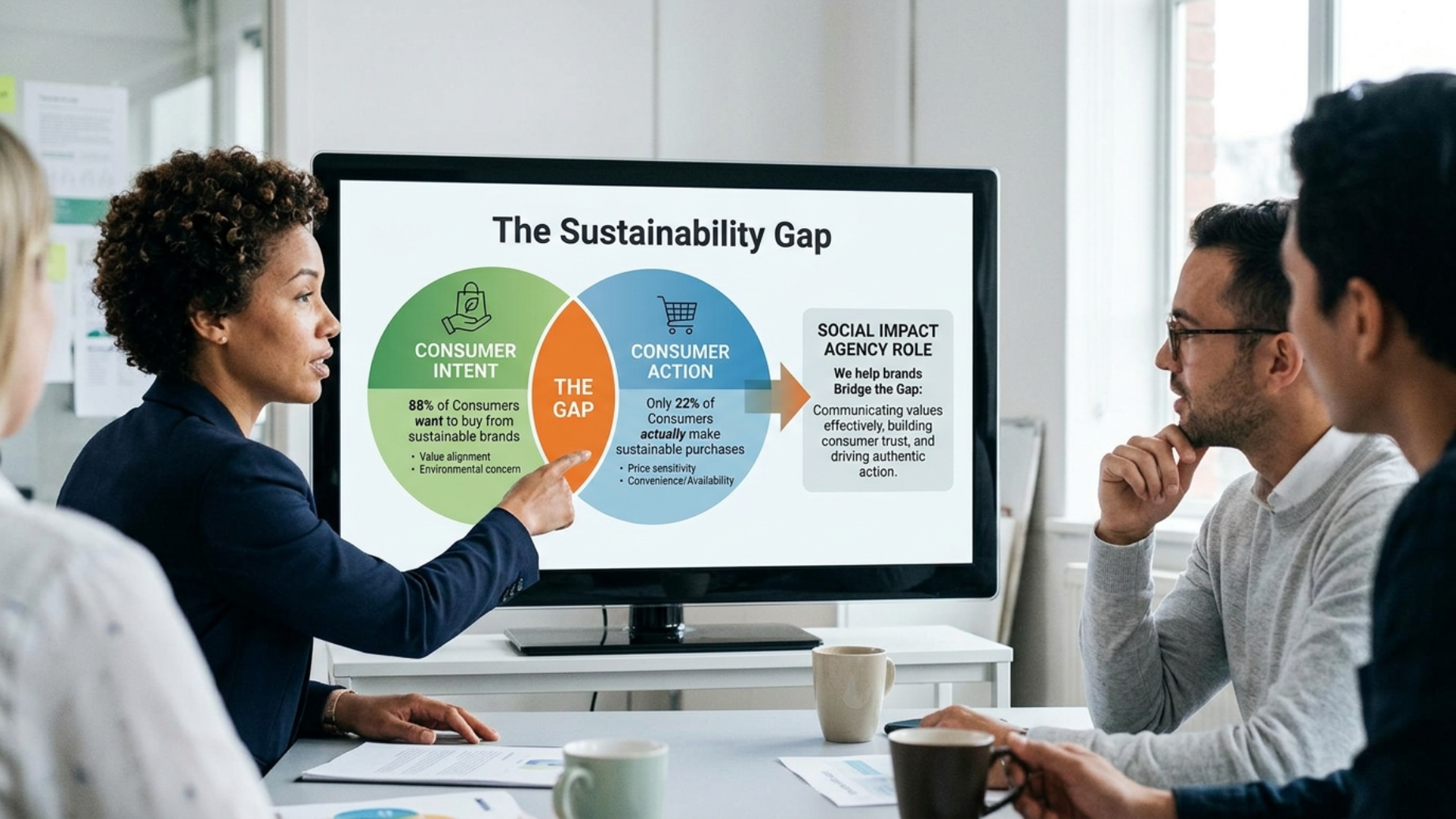
The term “social impact agency” covers a wide range of work. One agency might build brand purpose strategies for Fortune 500 companies. Another might run digital fundraising campaigns for regional nonprofits. A third might specialize in ESG disclosure communications that satisfy regulators and investors. Lumping them together on a single list, as most guides do, creates a false equivalence that wastes the buyer’s time.
The stakes are real. According to Edelman’s 2025 Brand Trust research, 64% of people now choose brands based on their beliefs. PwC’s 2024 Voice of the Consumer Survey found that consumers are willing to pay an average 9.7% premium for goods meeting specific environmental criteria. And McKinsey and NielsenIQ found that products making four ESG claims showed 2.5x the sales growth of products making only one.
But the bar for credibility keeps rising. The FTC warns marketers not to make broad, unqualified environmental claims without substantiation. In the EU, Directive 2024/825 will require member states to ban vague green claims by March 2026. Purpose without proof is now a regulatory and reputational liability, not just a marketing risk.
So the question is not “which agency is best?” It is “which agency fits the specific problem you need solved?”
What is a social impact agency?
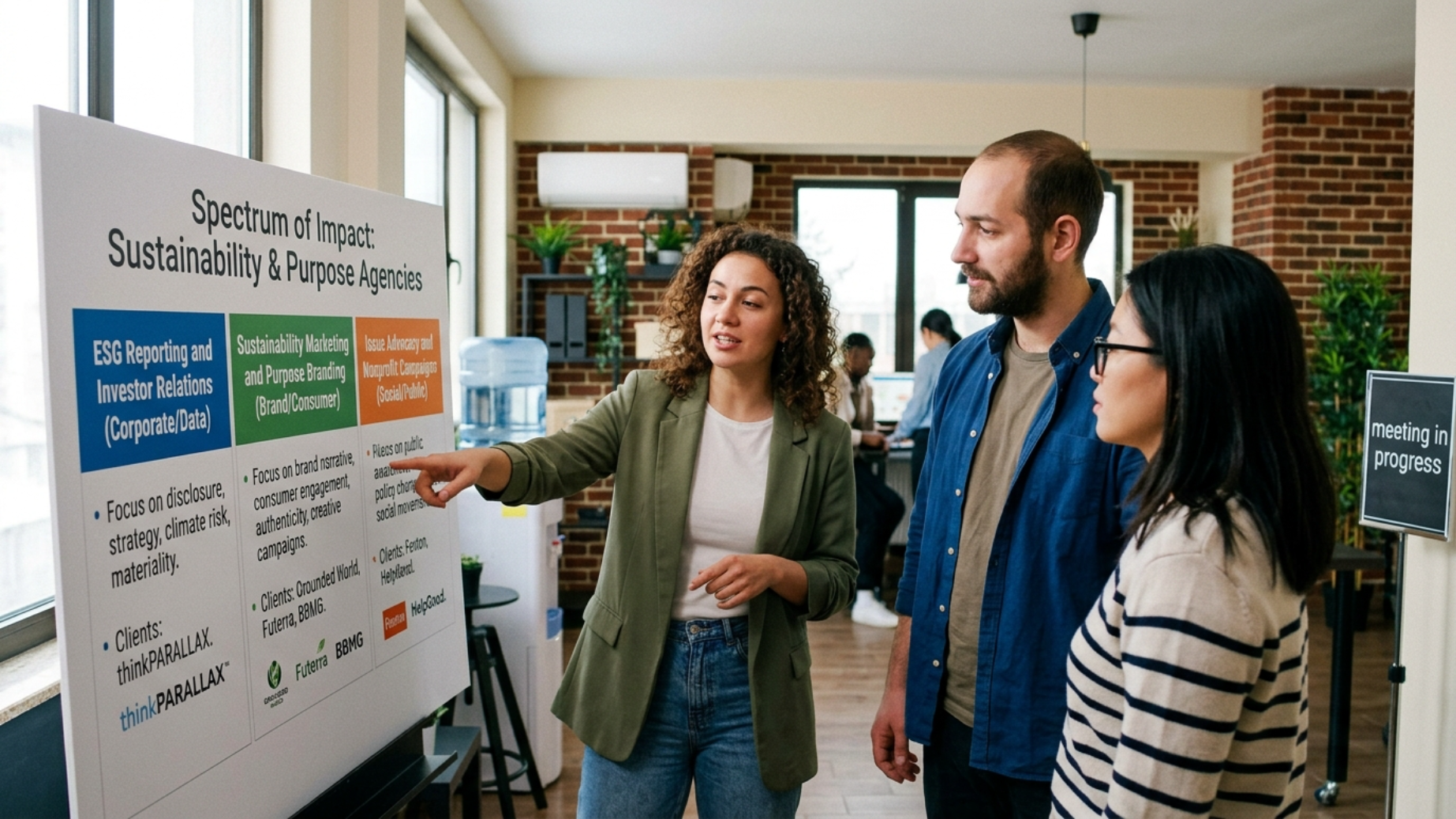
A social impact agency helps organizations define, communicate, and activate purpose, sustainability, CSR, advocacy, or mission-driven work through strategy, branding, campaigns, stakeholder engagement, reporting, and measurement.
In short: a social impact agency owns the full purpose-to-action remit, while a sustainability marketing agency focuses mainly on communicating environmental claims. This list covers the former.
That definition is broad on purpose. In practice, the category breaks down into several distinct types:
Sustainability marketing agencies that help brands position and sell sustainable products
ESG and CSR communications agencies that build stakeholder reports, disclosure narratives, and corporate sustainability content
Brand purpose agencies that define or redefine a company’s reason for being
Nonprofit marketing agencies that handle fundraising, donor engagement, and digital campaigns
Advocacy and issue-campaign agencies that run PR, media, and public engagement for social change
Social impact creative agencies that produce storytelling, film, and content for mission-driven organizations
Impact content distribution partners that amplify ESG and CSR stories to target audiences
Behavior-change and activation agencies that diagnose why people are not acting on their intentions and build systems to close that gap
Understanding which type you need is the first step toward a good hire. For a deeper look at how purpose-driven marketing actually works in practice, the differences between these categories matter more than most guides acknowledge.
In 2026, "Greenwashing" has moved from a PR risk to a significant legal liability. As of this month (May 2026), the "EmpCo" rules are being actively enforced across Germany, France, and Italy. Simultaneously, the FTC’s updated Green Guides and the U.S. PACK Act have heightened the "double 60" threshold for recyclability claims. Choosing an agency in 2026 requires a partner that doesn't just write copy, but manages claim substantiation workflows to protect your brand from regulatory litigation.
Who Should Hire a Social Impact Agency?
A social impact agency is a worthwhile investment when your organization has meaningful social or environmental initiatives but lacks the internal expertise to communicate, activate, or measure them effectively.
Organizations that commonly benefit include:
B Corps
ESG teams
Sustainability departments
Consumer brands
Retail companies
Healthcare organizations
Universities
Foundations
NGOs
Nonprofits
Government agencies
Climate tech startups
Social enterprises
If your organization needs stronger stakeholder trust, higher campaign engagement, improved ESG communications, or measurable behavior change, a specialized agency can often accelerate results compared with building the capabilities internally.
Types of Social Impact Agencies
Most buyers assume every social impact agency offers the same services. In reality, the market consists of several specialized agency models.
Agency Type | Primary Goal | Typical Clients |
|---|---|---|
Sustainability Marketing Agency | Sell sustainable products | Consumer brands |
ESG Communications Agency | Investor reporting | Public companies |
CSR Agency | Corporate responsibility initiatives | Mid-market & enterprise |
Nonprofit Marketing Agency | Fundraising and donor engagement | Nonprofits |
Advocacy Agency | Public opinion and policy | NGOs and campaigns |
Brand Purpose Consultancy | Positioning and strategy | Enterprise brands |
Behavior Change Agency | Increase action and adoption | Retail, nonprofits, healthcare |
Social Impact Creative Agency | Storytelling and campaigns | Foundations and mission-driven organizations |
How we evaluated the best social impact agencies
Every agency on this list was assessed against the same criteria:
Social impact specialization. Does the agency focus on sustainability, CSR, nonprofit, advocacy, or purpose-led work as a core practice, not a side offering?
Strategy plus execution capability. Can it move from insight to action, or does it stop at decks?
Review and reference signals. What do Clutch, G2, FeaturedCustomers, Glassdoor, and practitioner communities reveal?
Pricing transparency. Where third-party marketplace data exists, we included it. When pricing was unavailable, we said so.
Third-party credibility. B Corp certification, review-platform validation, case study volume.
Fit by use case. Which specific problem does each agency solve best?
Honest tradeoffs. Every agency has limitations. We named them.
One important caveat: public pricing is rare in agency services. Where available, we used marketplace estimates from Clutch, AgencySource, G2, and similar sources. Buyers should verify pricing directly. And as practitioners on Reddit have pointed out, agency directories like Clutch and DesignRush are useful for discovery, but sponsorships, review cadence, and marketplace dynamics affect visibility. Rankings are not pure merit. Treat them as one signal among several.
At-a-glance comparison table
Agency | Primary Focus | B Corp Score | Min. Project | Best For |
Grounded World | Activation & ROI | 91.2 | Custom | Brands needing measurable sales from purpose |
Futerra | Global Strategy | 102.3 | Enterprise | Large-scale corporate transformation |
thinkPARALLAX | ESG Reporting | 82.8 | Custom | Investor communications & disclosure |
BBMG | Brand Innovation | Update to 122.0 | Custom | Regenerative brand positioning |
HelpGood | Digital Campaigns | N/A | $50k+ | High-engagement nonprofit marketing |
Constructive | Web & Design | N/A | $50k+ | Strategic digital systems for nonprofits |
Fenton | Advocacy/PR | N/A | $10k+ | Social change & public interest PR |
The 11 best social impact agencies
1. Grounded World
Best for: Purpose-driven brands, retailers, startups, nonprofits, and sustainability teams that need social impact work to drive measurable business outcomes and behavior change.
Most organizations do not fail because they lack purpose. They fail because they cannot translate that purpose into purchase intent, retail conversion, donor action, stakeholder buy-in, or revenue growth. The World Federation of Advertisers calls this the intention-action gap, based on research with 938 senior marketers across 48 countries. Grounded World makes diagnosing and closing that gap the center of its practice.
Key services:
AI-assisted 5C landscape assessments (Company, Culture, Category, Competitor, Consumer)
Intention-action gap research and quantification
Brand purpose, positioning, architecture, and sustainability storytelling
Campaign activation, retail activation, stakeholder engagement, and brand experiences
Commercial innovation, go-to-market strategy, claims and concept testing
Sustainability and social impact measurement and reporting
Brand identity, packaging, and design
The agency follows a four-phase service model: Discover, Articulate, Activate, and Accelerate. That structure matters because it forces a diagnosis before jumping to tactics, something buyers consistently report as missing from agency partnerships.
Pricing: No public pricing tiers. Custom-scoped agency engagements. Offers a complimentary AI-driven 5C landscape assessment and discovery call as the lead-in.
Proof signals: B Corp certified with a reported B Impact Score of 91.2 (the certification threshold is 80, and the median ordinary-business score is 50.9). Also validated through the Ethical Agency Alliance, 1% for the Planet, Science Based Targets, and named a Top 100 Global Social Impact Company. Named case studies include Grove Collaborative, Tribes on the Edge, Fresh Air Fund, UNMAS, and the Network of Executive Women.
Tradeoffs:
Not self-serve software and no transparent package pricing
Custom-scoped work means you need a discovery call and proposal
Not the right fit if you need a commodity performance-marketing shop
Choose Grounded World if: Your sustainability or social impact work is not yet translating into adoption, sales, stakeholder alignment, or measurable behavior change, and you need a partner that connects purpose to profit.
Explore Grounded World's social impact agency services or book a discovery call to start with the complimentary 5C landscape assessment.
2. Futerra
Best for: Large brands and global organizations that need high-level sustainability strategy combined with creative campaigns.
Futerra positions itself as a “change agency” that merges strategy and creative to make sustainability happen. B Lab lists Futerra as a B Corp with a 102.3 score and operations spanning the UK, U.S., Mexico, and Sweden.
Key services:
Sustainability strategy
Creative campaigns
Brand storytelling for sustainability
Global change-agency consulting
Pricing: No public rate card. Akepa’s ranking of sustainability marketing agencies describes Futerra as a fit for larger brands with ambitious budgets.
Proof signals: B Corp certified. Long-standing reputation in enterprise sustainability.
Tradeoffs:
Likely overbuilt and overpriced for smaller brands or nonprofits with modest budgets
Glassdoor shows a 2.8 rating with concerns about leadership and transparency. This is employee sentiment, not client satisfaction, but it signals culture risks that buyers should investigate during diligence. As of May 2026, employee feedback continues to highlight a gap between external mission and internal work-life balance; due diligence on the specific account team is recommended.
Buyers should ask about the actual team assigned to their project, not just the firm’s brand name
Choose Futerra if: You are a large organization that needs a global sustainability strategy partner with creative capabilities and can support an enterprise-level budget.
3. thinkPARALLAX
Best for: Companies that need ESG strategy, sustainability reporting, regulatory communications, and stakeholder engagement narratives.
thinkPARALLAX focuses squarely on ESG and sustainability communications. B Lab lists it as a B Corp with an 82.8 score. Clutch describes it as a full-service ESG strategy and communications agency, though it shows no reviews and lists pricing as undisclosed.
Key services:
ESG strategy development
Sustainability and CSR reporting
Stakeholder-focused storytelling
Corporate sustainability narrative communications
Pricing: Undisclosed on Clutch. Likely custom consulting and project pricing.
Proof signals: B Corp certified. Glassdoor shows a 4.7 from 14 ratings with 88% recommending, which is a strong employee sentiment signal.
Tradeoffs:
Not clearly positioned for consumer activation, retail behavior change, or campaign execution
Better suited for ESG disclosure and corporate communications than for building consumer-facing brands
Limited public review volume on major platforms
Choose thinkPARALLAX if: Your primary need is ESG reporting, sustainability disclosure communications, or investor and stakeholder narratives, not consumer marketing.
4. BBMG
Best for: Mission-driven organizations that need deep brand strategy, brand innovation, and regenerative positioning.
BBMG has built a reputation around what it calls regenerative branding, the idea that brands should restore and renew, not just sustain. B Lab describes BBMG as a Certified B Corp that integrates innovation, sustainability strategy, product development, and brand marketing.
Key services:
Brand strategy and positioning
Sustainability strategy
Product development and innovation
Brand marketing
Regenerative brand methodology
Pricing: No public pricing found. Likely custom-scoped brand consultancy work.
Proof signals: B Corp certified. Glassdoor shows 4.5 from 10 reviews and 100% would recommend. Positive themes include meaningful clients, B Corp values, and kind coworkers. Reviewers note small-team demands and lower pay versus traditional brand agencies.
Tradeoffs:
Strong on strategy and brand-building, but less obvious as a media-buying, ESG reporting, or performance activation partner
Small-team dynamics mean buyers should confirm capacity and timelines
Not the clear choice for nonprofit web builds or advocacy PR
Choose BBMG if: You need a brand strategy partner that can help you rethink your positioning through a regenerative and purpose-led lens, and you have the patience for deep strategic work.
5. Matter Unlimited
Best for: Foundations, public-sector partners, nonprofits, and purpose-led brands that need high-profile storytelling, partnerships, PR, events, or public engagement.
B Lab lists Matter Unlimited as a B Corp with a 98.3 score and describes services spanning brand purpose, communications strategy, digital platforms, social activation, events, influencer outreach, content development, and film production.
Key services:
Brand purpose development
Communications strategy
Digital platform design and build
Social media activation
Event production and influencer outreach
Film and content production
Pricing: No public pricing found. Likely custom-scoped based on campaign, production, and content needs.
Proof signals: B Corp certified with a strong score. Limited public buyer reviews on easily accessible platforms, which means reference calls are especially important.
Tradeoffs:
Great for powerful stories and public-facing campaigns, but buyers should clarify whether strategy, creative, and activation are bundled or separately scoped
Production costs for film, events, and content can escalate quickly
Measurement plans should be confirmed upfront
Choose Matter Unlimited if: You need a creative partner that can produce compelling stories, films, or events for a purpose-led organization and have the budget for premium production.
6. HelpGood
Best for: Nonprofits, government agencies, foundations, and socially responsible companies that need digital-first campaigns, paid and donated media, social, and analytics.
Clutch lists HelpGood as a social impact marketing and ad agency focused on social good. FeaturedCustomers counts 42 case studies for the agency.
Key services:
Digital-first campaign strategy
Paid and donated media management
Social media and community management
Web development
Branding and creative
Analytics and reporting
Pricing: Clutch lists a $50,000+ minimum project size and $150 to $199 per hour. No public plan tiers.
Proof signals: Clutch shows a 4.5 rating from one verified review. The reviewer (from The Ad Council) praised HelpGood for creating a modern voice, engaging young adults, being flexible and responsive, and connecting work to pop culture and real-time events.
Tradeoffs:
Limited public review volume makes it harder to validate consistency
Minimum project size may be too high for smaller nonprofits
Better for digital campaigns than for brand strategy overhauls or ESG reporting
Choose HelpGood if: You are a nonprofit or government agency that needs a digital-first marketing partner with experience in social good campaigns and a budget above $50,000.
7. Fenton
Best for: Organizations running issue campaigns, advocacy efforts, public-interest communications, and social change PR.
AgencySource describes Fenton as “the social change agency” with services across advertising, PR, media, creative, branding, and video production. FeaturedCustomers lists 23 case studies.
Key services:
Public relations and media planning
Advertising and creative
Branding and video production
Issue-based campaign strategy
Social change communications
Pricing: AgencySource lists a $10,000+ minimum project size and $100 to $149 per hour.
Proof signals: Long-standing social change positioning. Significant case study volume on FeaturedCustomers.
Tradeoffs:
Stronger fit for communications and advocacy than for product innovation, retail activation, or sustainability commercialization
Buyers should ask for examples specific to their issue area
Measurement of policy, public opinion, or behavior outcomes should be discussed upfront
Choose Fenton if: You need issue advocacy, PR, or public-interest campaign work and want an agency with deep experience in social change communications.
8. Constructive
Best for: Nonprofits, foundations, and social impact organizations that need brand strategy, messaging, design systems, and websites.
Clutch describes Constructive as a strategic brand and web design agency for nonprofits, philanthropies, and social impact businesses. With a 4.9 rating from 33 reviews on Clutch, it has one of the strongest public review records among social impact agencies.
Key services:
Brand strategy and messaging
Visual identity and design systems
Web design and development
Digital and content strategy
Nonprofit specialization
Pricing: Clutch lists a $50,000+ minimum project size and $150 to $199 per hour. Reported project costs range from $25,000 to over $450,000 depending on scope.
Proof signals: 4.9 Clutch rating from 33 reviews. Common positive themes include timely delivery, strong project management, and communication quality.
Tradeoffs:
Excellent for nonprofit brand and web systems, but not the right choice for consumer-goods commercialization, sustainability retail activation, or ESG reporting
Higher minimum budget may exclude smaller nonprofits
Scope tends toward brand and digital, not ongoing campaign management
Choose Constructive if: Your nonprofit brand and website do not clearly explain your mission, and you need a partner with a proven track record in nonprofit brand systems.
9. Cosmic
Best for: Social-purpose organizations that need to clarify their story, build awareness, and inspire action.
FeaturedCustomers describes Cosmic as a creative marketing agency specializing in social-purpose brands and lists 24 case studies, 13 testimonials, and a 4.8 reference rating.
Key services:
Social impact creative and brand storytelling
Awareness-building campaigns
Action-oriented campaign design
Brand and marketing for social-purpose organizations
Pricing: No public pricing found. Likely custom project pricing.
Proof signals: Strong reference rating on FeaturedCustomers with meaningful case study volume.
Tradeoffs:
Pricing transparency is weak, making it harder to pre-qualify budget fit
Buyers should ask whether Cosmic handles only brand and story strategy or also execution, media, measurement, and optimization
Less established on major review platforms like Clutch
Choose Cosmic if: You are a social-purpose organization that needs a creative partner to sharpen your story and translate it into audience engagement.
10. Metropolitan Group
Best for: Organizations that need integrated strategic communications, multicultural engagement, and social change messaging.
FeaturedCustomers lists 9 testimonials, 13 case studies, 2 customer videos, and a 4.8 reference score. AgencySource shows a $10,000+ minimum and $100 to $149 per hour.
Key services:
Strategic communications
Multicultural engagement
Organizational development
Resource development
Branding, digital, PR, and social media
Pricing: $10,000+ minimum project size and $100 to $149 per hour according to AgencySource.
Proof signals: Strong reference score on FeaturedCustomers. Long track record in social change communications.
Tradeoffs:
Glassdoor shows a 2.5 from 14 reviews with concerns about leadership, layoffs, and culture. This is employee sentiment, not client satisfaction, but it is a useful signal for buyers who care about continuity and team stability
Buyers should ask who will staff the account and how turnover is managed
Better for communications and engagement than for product-level sustainability commercialization
Choose Metropolitan Group if: You need social change communications with strong multicultural engagement expertise and want a lower entry-level budget commitment.
11. 3BL Media
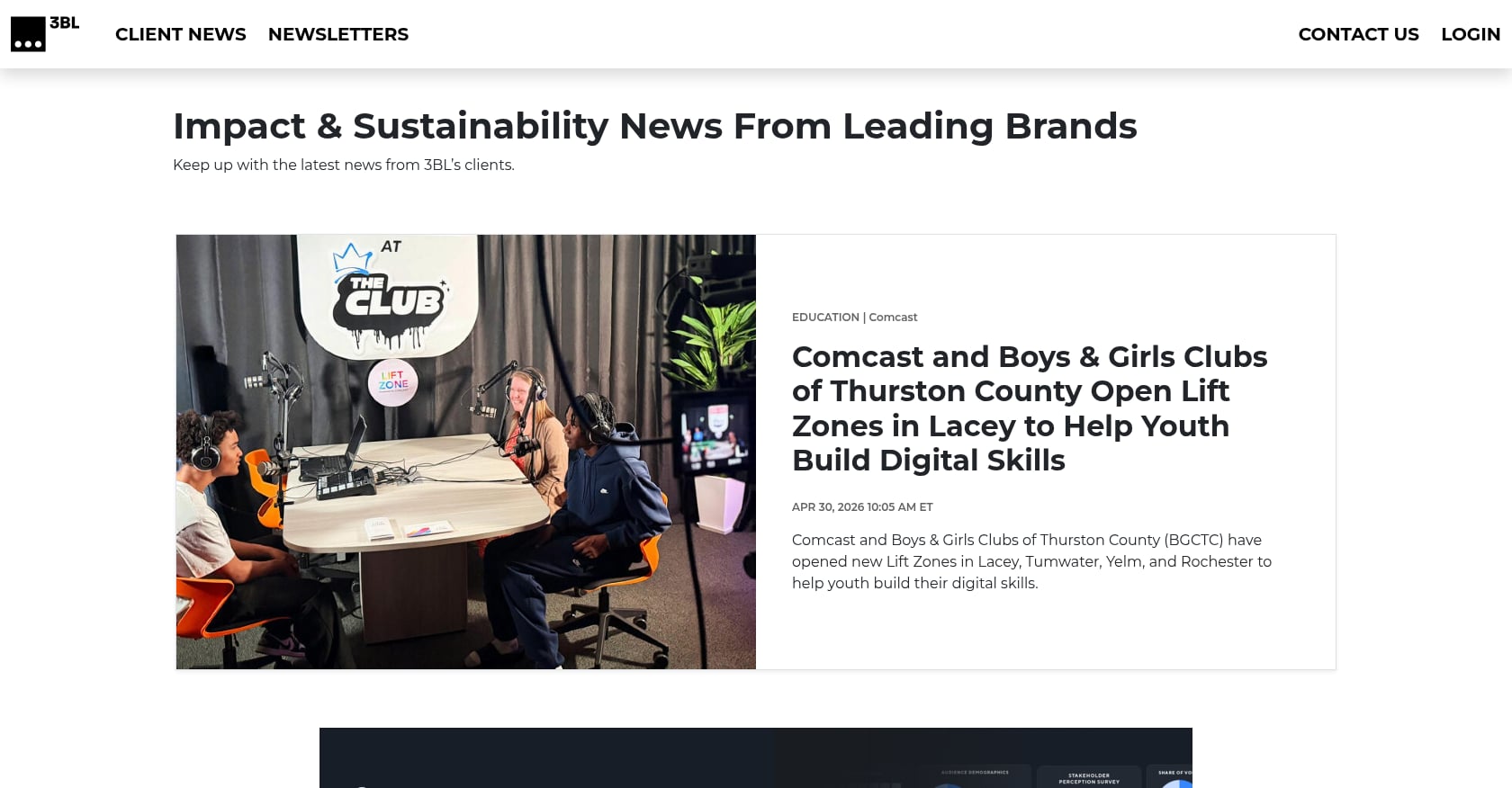
Best for: Organizations that already have ESG, CSR, or sustainability content and need distribution to relevant audiences.
G2 describes 3BL Media as purpose-driven communications for leading companies, reaching 10+ million change-makers. This is not a traditional agency. It is a distribution and visibility partner.
Key services:
ESG and sustainability news distribution
CSR content amplification
Audience reach for impact stories
Analytics and visibility reporting
Pricing: G2 does not show robust public pricing. ITQlick estimates pricing starts at $99 per license, but this should be verified directly.
Proof signals: G2 shows 4.5 from one verified review. The reviewer said 3BL helped a small nonprofit without a dedicated marketing team achieve stronger clicks, impressions, and online presence.
Tradeoffs:
Not a replacement for strategy, creative, claims substantiation, or campaign planning
Best used after your organization already knows what story it can credibly tell
Very limited public review volume
Choose 3BL if: You have impact content ready and need a distribution layer to reach ESG, CSR, and sustainability audiences, not a full strategic agency partner.
Social impact work is rarely "one size fits all." In 2026, most agencies operate under three primary models:
Project-Based (Fixed Scope): Best for defined outputs like a website build (Constructive) or an annual ESG report (thinkPARALLAX).
Retainer (AOR): Best for ongoing advocacy (Fenton) or digital donor engagement (HelpGood) where consistent momentum is required.
Performance-Based: An emerging 2026 model where fees are partially tied to measurable outcomes, such as sales growth or specific behavior-change metrics (Grounded World).
How to choose the right social impact agency
The best social impact agencies serve different needs. Instead of trying to rank them on a single scale, match the agency to the problem you are actually solving.
If your impact work is not translating into sales, adoption, or stakeholder action: This is an intention-action gap and activation problem. You need a partner like Grounded World that can diagnose barriers, test messages, and build systems that connect purpose to commercial outcomes. Learn more about brand activation strategy that transforms purpose into profit.
If you need enterprise sustainability strategy and global creative: Look at Futerra for its global reach and high-level strategic positioning.
If you need ESG reporting and stakeholder communications: thinkPARALLAX specializes in this. It is not a campaign agency, and that is the point.
If your brand needs a deeper regenerative or purpose-led identity: BBMG’s brand innovation work fits this need.
If you need high-profile storytelling, film, or events: Matter Unlimited brings production and partnership capabilities.
If you are a nonprofit or government agency needing digital campaigns: HelpGood has the sector focus and media expertise.
If you need issue advocacy and PR: Fenton or Metropolitan Group, depending on your issue area and budget.
If your nonprofit brand and website are failing to communicate your mission: Constructive (for brand and web systems) or Cosmic (for storytelling and action).
If you already have content and need distribution: 3BL is a distribution layer, not a full agency.
Building a strong stakeholder engagement strategy before you hire can also help you brief any agency more effectively, because the clearer your stakeholder map, the better the agency can target its work.
What real practitioners wish buyers asked before hiring
Agency guides rarely include the messy, practical stuff. Here is what community discussions reveal.
Test your message before you scale it. Practitioners on Reddit advise nonprofits to test simple UGC-style content organically before paying an agency to run a full campaign. If the message does not resonate without a budget behind it, throwing money at it usually does not fix the problem.
Ask about data governance. A nonprofit Reddit thread raised serious concern about sharing donor data with an external ad agency. Donors can react strongly if their information is passed to a third party without clear justification. Before signing, ask: how will the agency use donor or customer data, and what consent, privacy, and security practices are in place?
Do not evaluate agencies by posting cadence. A nonprofit social media thread noted that mass social platforms do not automatically prioritize nonprofit content. Stories from clients or staff often outperform static branded posts. Ask how the agency will source real stories, test hooks, and convert attention into action, not just fill a content calendar.
B Corp is a signal, not a guarantee. B Corp certification is a meaningful indicator of social and environmental commitment. B Lab requires companies to meet a verified performance standard, with a threshold of 80 points compared to a median ordinary-business score of 50.9. But it does not tell you whether the agency is good at your specific type of work. Still ask for client references, case studies, measurement frameworks, and examples of outcomes.
RFP checklist for hiring a social impact agency
Before you send an RFP or take a discovery call, prepare questions that separate substantive partners from polished presenters:
Show three social impact projects similar to our situation.
Show one project where the campaign changed behavior or drove measurable action (not just awareness).
Explain how sustainability or impact claims are substantiated and reviewed.
Describe how legal, sustainability, and marketing teams are aligned during the engagement.
Identify who will be on the account day to day, not just who presents in the pitch.
Provide sample dashboards or reporting formats.
Clarify media, production, research, and tool costs separately from strategy fees.
Explain data privacy practices, especially for donor or customer data.
Describe stakeholder engagement methods.
Provide two client references we can call.
For a deeper look at what effective social impact campaigns actually deliver, reviewing real case studies before your RFP process begins will sharpen your evaluation criteria.
Common mistakes when hiring a social impact agency
Hiring a creative agency before validating audience barriers. If you do not know why people are not acting on their stated intentions, a beautiful campaign will not fix the problem. Start with research and diagnosis.
Treating purpose as messaging instead of an operating strategy. Purpose needs to live in product development, supply chain, employee experience, and commercial decisions. If the agency is only writing taglines, the work will feel hollow to audiences.
Making broad sustainability claims without proof. The FTC’s Green Guides and the EU’s Directive 2024/825 are making vague claims like “eco-friendly” or “green” genuinely risky. Your agency should have a claim substantiation workflow.
Measuring impressions only. Impressions tell you people saw something. They do not tell you whether anyone changed their behavior, bought the product, donated, volunteered, or shifted their perception.
Forgetting internal alignment. If marketing, sustainability, legal, sales, and operations are not aligned on the strategy, the agency’s work will die in internal review. Understanding brand purpose across functions is a prerequisite, not a nice-to-have.
Choosing based on awards instead of fit. Award-winning work is encouraging, but the best agency for your organization is the one that understands your sector, audience, constraints, and definition of success.
Sharing donor or customer data without a governance plan. As noted in practitioner discussions, this can cause real backlash. Establish clear data protocols before the engagement begins.
The bottom line
Not sure whether you need strategy, activation, reporting, or commercial innovation? Grounded World’s Discover phase is designed to diagnose the gap before committing to a full engagement. Start with the complimentary AI-driven 5C landscape assessment and a discovery call to figure out where purpose is getting stuck and what it will take to move it forward.
Frequently asked questions
What does a social impact agency do?
A social impact agency helps organizations define, communicate, and activate purpose, sustainability, CSR, advocacy, or mission-driven work. This can include strategy, branding, campaigns, stakeholder engagement, reporting, measurement, retail activation, and behavior-change programs. The specific work varies significantly by agency type.
How much does a social impact agency cost?
Pricing is almost always custom. Third-party marketplace data shows ranges from $10,000+ minimum projects for some communications agencies (Fenton, Metropolitan Group on AgencySource) to $50,000+ minimums for several social impact brand and marketing agencies (HelpGood, Constructive on Clutch). Hourly rates typically fall between $100 and $199. Always verify pricing directly with the agency.
What is the difference between a social impact agency and a sustainability marketing agency?
A sustainability marketing agency focuses on environmental and sustainability positioning, claims, and campaigns. A social impact agency may also cover social justice, health equity, education, nonprofit fundraising, advocacy, CSR, ESG, employee engagement, and community impact. There is overlap, but the scope of a social impact agency is typically broader.
How do I avoid greenwashing when working with an agency?
Avoid broad, unqualified claims. Tie messages to specific, substantiated evidence. Qualify claims clearly. Review all claims with legal and sustainability experts. Choose agencies that understand FTC Green Guides and EU-style green-claims expectations. Ask for the agency’s claim substantiation process during the RFP.
Should I choose a B Corp-certified agency?
B Corp certification is a strong credibility signal because it indicates third-party assessment of social and environmental performance. The certification threshold is 80 points, well above the median ordinary-business score of 50.9. But it should not be the only decision factor. Evaluate case studies, sector expertise, team fit, pricing, references, and measurement capabilities alongside certification.
What should I ask before hiring a social impact agency?
Ask for proof of similar work, their claim substantiation process, measurement approach, who will staff your account, stakeholder engagement plan, budget assumptions, data privacy practices, and examples of actual outcomes (not just awareness metrics).
When should a nonprofit hire a social impact agency versus handling marketing in-house?
Consider an agency when you need specialized expertise (paid media, brand strategy, behavior-change research) that your team does not have, or when you need to scale a message that has already shown organic traction. Practitioners recommend proving a message works organically before investing in agency-led amplification. For organizations with very small teams, a distribution partner like 3BL can extend reach without requiring a full agency relationship.
What is the intention-action gap in social impact marketing?
The intention-action gap refers to the disconnect between what people say they care about (sustainability, social causes, ethical purchasing) and what they actually do. Research from the World Federation of Advertisers found this gap is widespread among marketers and consumers alike. Closing it requires understanding barriers to action, testing interventions, and designing campaigns that make the desired behavior easier, more visible, and more rewarding.
What is the 2026 'Greenhushing' trend?
Companies staying silent on sustainability for fear of litigation, a social impact agency helps you speak safely and credibly).