
 Gaia
GaiaTL;DR
The sustainability branding agency market has split into distinct categories: strategy consultancies, purpose-driven brand agencies, creative shops, digital specialists, and design studios. Choosing the wrong type wastes budget and increases greenwashing risk. With EU regulations tightening in September 2026, brands need specialist partners now. This guide profiles 10 agencies, explains what each does best (and where they fall short), and gives you a framework for choosing the right fit based on your specific gap.
Quick Answer
A sustainability branding agency helps companies build and market brands around verified environmental and social impact while reducing the risk of greenwashing. Unlike traditional branding agencies, these specialists combine brand strategy, sustainability expertise, regulatory knowledge, consumer research, and creative execution to help businesses communicate credible sustainability claims, strengthen customer trust, improve brand differentiation, and comply with evolving regulations such as the EU Empowering Consumers for the Green Transition Directive. The best agency depends on whether your primary need is strategy, ESG communications, creative campaigns, digital marketing, or commercial activation.
Key Takeaways
Sustainability branding agencies specialize in communicating verified environmental and social impact.
Different agencies focus on different services including strategy, ESG reporting, creative campaigns, branding, or digital marketing.
Choosing the wrong agency can increase greenwashing risk and reduce marketing ROI.
B Corp certification, Science Based Targets, and third-party sustainability credentials are strong trust signals.
The EU's new regulations make substantiated sustainability claims more important than ever.
Match an agency to your business goals rather than choosing solely on reputation.
Why 2026 Changes Everything for Sustainability Branding
Starting September 2026, the EU’s Empowering Consumers for the Green Transition Directive (ECD) will prohibit vague environmental claims that cannot be substantiated. Terms like “eco-friendly,” “green,” and “carbon neutral” without verified proof won’t just be bad marketing. They’ll be illegal.
This isn’t hypothetical risk. Deutsche Bank’s asset management arm DWS was fined €25 million by German prosecutors for misleading investors about its ESG credentials. Shein paid a €1 million fine from an Italian court for greenwashing. The enforcement machinery is operational, and it’s getting stronger.
At the same time, a global survey found that 91% of consumers believe at least some brands engage in greenwashing. Over half of UK consumers say they’re prepared to boycott brands over misleading green claims. Trust is fragile, and the wrong message, or no message at all, carries real consequences.
Here’s the opportunity buried inside the threat: purpose-driven brands consistently outperform. Unilever found that brands committed to positive social and environmental change grew 69% faster than the rest of the business. Accenture research shows 62% of consumers prefer purpose-driven brands. Deloitte reports these companies enjoy 40% higher workforce retention.
The gap between risk and reward is where a sustainability branding agency earns its fee. But not all agencies solve the same problem.
What Actually Makes a Sustainability Branding Agency Different?
A traditional creative agency can design a beautiful campaign. A sustainability branding agency understands the science, the regulations, the consumer psychology, and the commercial mechanics behind making purpose work as a growth strategy. The difference matters because getting sustainability communications wrong doesn’t just waste budget. It creates legal exposure and destroys trust.
Practitioners on Reddit and LinkedIn frequently warn that hiring a generalist agency for sustainability work is one of the fastest paths to accidental greenwashing. The agency doesn’t know what claims need substantiation, doesn’t understand the regulatory framework, and defaults to aspirational language that sounds good but can’t survive scrutiny.
What Services Does a Sustainability Branding Agency Provide?
Many businesses assume sustainability branding only involves designing logos or producing environmentally focused advertising. In reality, agencies often provide a much broader range of services that combine branding, communications, marketing, sustainability strategy, and regulatory expertise.
Typical services include:
Service | Purpose |
|---|---|
Sustainability brand strategy | Define positioning and differentiation |
Purpose development | Connect sustainability with company mission |
ESG communications | Translate sustainability data into understandable messaging |
Brand identity | Logos, visual systems, design guidelines |
Sustainability messaging | Create compliant environmental claims |
Content marketing | Publish educational content that builds trust |
Website strategy | Improve user experience and communicate impact |
Packaging design | Support sustainable product positioning |
Employee engagement | Align internal culture with sustainability goals |
Campaign development | Launch purpose-driven marketing campaigns |
The Five Types of Sustainability Agency
Not all sustainability branding agencies do the same thing. Existing listicles lump wildly different agency types together, which confuses buyers. Here’s the taxonomy:
Sustainability strategy and consulting: Upstream work including ESG reporting, CSRD alignment, sustainability roadmaps, and materiality assessments. Think compliance and corporate narrative.
Purpose-driven brand agencies: Brand strategy, positioning, commercial activation, and behavior change campaigns. These agencies connect sustainability to revenue, purchase intent, and market growth.
Sustainability creative and advertising: Campaign-focused creative work, often award-driven, with purpose at the center of storytelling.
Digital and performance marketing for sustainable brands: SEO, content marketing, paid media, and conversion optimization, specifically for brands in the sustainability space.
Design studios: Visual identity, packaging, web design, and brand collateral for impact-driven companies.
Your specific gap determines the right type. A company struggling to translate sustainability investments into commercial traction needs a different partner than one that needs CSRD-compliant reporting or a new visual identity.
Credentials That Signal Real Commitment
With greenwashing risk at historic highs, an agency’s own certifications matter. Look for B Corp certification (which requires rigorous third-party verification), Science Based Targets initiative membership, 1% for the Planet commitment, and membership in bodies like the Ethical Agency Alliance. These aren’t just badges. They indicate the agency has submitted to external accountability standards.
How to Evaluate a Sustainability Branding Agency
Before signing a contract, evaluate agencies using objective criteria instead of awards alone.
Consider:
Sustainability expertise
Industry experience
Regulatory knowledge
Client results
Case studies
Third-party certifications
Team expertise
Measurement framework
Reporting process
Long-term support
Ask prospective agencies:
How do you verify sustainability claims?
What frameworks do you follow?
Can you provide measurable results?
How do you avoid greenwashing?
Which industries do you specialize in?
How do you measure campaign success?
At-a-Glance Comparison Table
Agency | Best For | Core Specialty | Certifications | Reach | Entry Point |
|---|---|---|---|---|---|
Grounded World | Commercializing sustainability | Brand strategy + commercial activation | B Corp, 1% for the Planet, SBTi | Global (English) | Free 5C assessment |
Futerra | Global sustainability storytelling | Creative strategy + behavior change | B Corp, Climate Solutions Provider | London, NYC, Stockholm, Mexico City, SF | Custom scoped |
thinkPARALLAX | ESG reporting + communications | Sustainability strategy + compliance | Not confirmed | US-based | Custom scoped |
Enviral | UK branding + impact reporting | Branding + impact reporting | Not confirmed | Bristol, UK | Custom scoped |
OBERLAND | Purpose-driven advertising | Advertising + creative campaigns | Not confirmed | NYC | Custom scoped |
Akepa | Digital marketing for eco brands | SEO + content + paid media | ClimatePartner | Barcelona, London | Custom scoped |
Ethical Agency | Design-led impact marketing | Design studio for impact brands | B Corp | Cape Town, London | Custom scoped |
Dandelion Branding | Content marketing for eco brands | Content strategy + web optimization | Not confirmed | Netherlands | Custom scoped |
Greenhouse PR | Sustainability comms + advocacy | PR + policy communications | Not confirmed | UK-based | Custom scoped |
Orange Bird | Clean tech digital marketing | Digital services for climate tech | Not confirmed | EU-based | Custom scoped |
Sustainability Branding Agency vs Traditional Branding Agency
Feature | Sustainability Branding Agency | Traditional Branding Agency |
|---|---|---|
Sustainability expertise | Extensive | Usually limited |
ESG reporting knowledge | Yes | Rarely |
Greenwashing compliance | Yes | Usually no |
Environmental claim review | Yes | Limited |
Brand strategy | Yes | Yes |
Creative campaigns | Yes | Yes |
Digital marketing | Sometimes | Often |
Regulatory awareness | High | Low |
Sustainability certifications | Often | Rare |
10 Best Sustainability Branding Agencies
1. Grounded World
Best for: Purpose-driven brands that need sustainability to translate into measurable commercial growth, not just storytelling.
Grounded World is a B Corp-certified boutique marketing agency that focuses on what most sustainability agencies avoid: the commercial gap between intention and action. The Capgemini Research Institute found that 82% of organizations plan to increase sustainability investment, but only 21% have detailed transition plans. Grounded World builds the bridge between those two numbers.
What they do best:
AI-driven 5C landscape assessments covering Company, Culture, Category, Competitor, and Consumer dimensions
Proprietary BPP framework and 5Rs framework for connecting brand purpose to profit
Four-phase service model: Discover (gap assessment), Articulate (brand strategy and positioning), Activate (campaigns, retail activation, toolkits), Accelerate (impact systems, partnerships, growth)
Brand Activation for Good and Flywheel of Impact methodologies that tie sustainability directly to revenue outcomes
Notable clients: Grove Collaborative, UNMAS, Plan USA, Fresh Air Fund, Mary’s Center, Network of Executive Women
Certifications: B Corp (B Impact Score of 116), Ethical Agency Alliance, 1% for the Planet, Science Based Targets, Top 100 Global Social Impact Company
What sets them apart: Women-led, multi-award-winning, and listed in Medium’s Official Directory of Purpose-Driven Creative Organizations. Where most agencies stop at strategy documents or campaign creative, Grounded World builds the commercial infrastructure, including retail activation, selling stories, and go-to-market strategy, that makes sustainability actually sell.
Honest tradeoffs:
Custom-scoped engagements with no transparent pricing or self-serve packages
Not a performance marketing or purely digital agency
Best suited for brands ready to invest in strategic transformation, not quick tactical fixes
Entry point: Complimentary AI-driven 5C landscape assessment and discovery call.
2. Futerra
Best for: Large multinationals and NGOs needing global sustainability communications and creative campaigns at scale.
Futerra has over 25 years of experience and positions itself as a sustainability change agency combined with a creative consultancy. They balance “the logic of strategy with the magic of storytelling,” working across brand purpose strategy, ESG communications, campaign creation, and stakeholder engagement.
What they do best:
Brand purpose strategy for global enterprises
ESG communications and impact-driven consulting
Behavior change campaigns at multinational scale
Stakeholder engagement across multiple markets and languages
Notable clients: Google, IKEA, WWF, Danone, Garnier
Certifications: One of the UK’s first B Corps. First agency named as a Climate Solutions Provider by the Exponential Roadmap Initiative, fulfilling criteria of at least 90% of revenue from projects aligned with 1.5°C ambition. Majority owned and led by women.
Honest tradeoffs:
Premium pricing expected given global offices in London, Stockholm, New York, San Francisco, and Mexico City
May be oversized and too expensive for smaller brands or startups
Glassdoor reviewers note the opportunity to work with world-leading clients, but some cite concerns about internal transparency and trust from leadership. One reviewer noted that “there are a lot of remarkable people working in this company” while suggesting their talents could be better utilized
Entry point: Custom scoped through their website.
3. thinkPARALLAX
Best for: Companies navigating CSRD, ESRS, or IFRS compliance who need sustainability reporting paired with communications strategy.
thinkPARALLAX sits closer to the consulting end of the spectrum. Their services span sustainability strategic plans, goal-setting and roadmaps, climate risk assessment, carbon footprint assessment, reporting strategy, and employee engagement campaigns. They also handle web strategy, brand integration, and sustainability storytelling, but the center of gravity is compliance and reporting.
What they do best:
Long-term sustainability reporting strategy aligned with emerging frameworks
Climate risk assessment and carbon footprint analysis
Sustainability brand integration that connects ESG data to narrative
Employee engagement campaigns around sustainability goals
Honest tradeoffs:
More strategy and compliance oriented than brand activation or commercial growth
If your primary need is consumer-facing campaigns or retail activation, this isn’t the right fit
US-based, which may limit familiarity with EU-specific regulatory nuances
Entry point: Custom scoped through their website.
4. Enviral
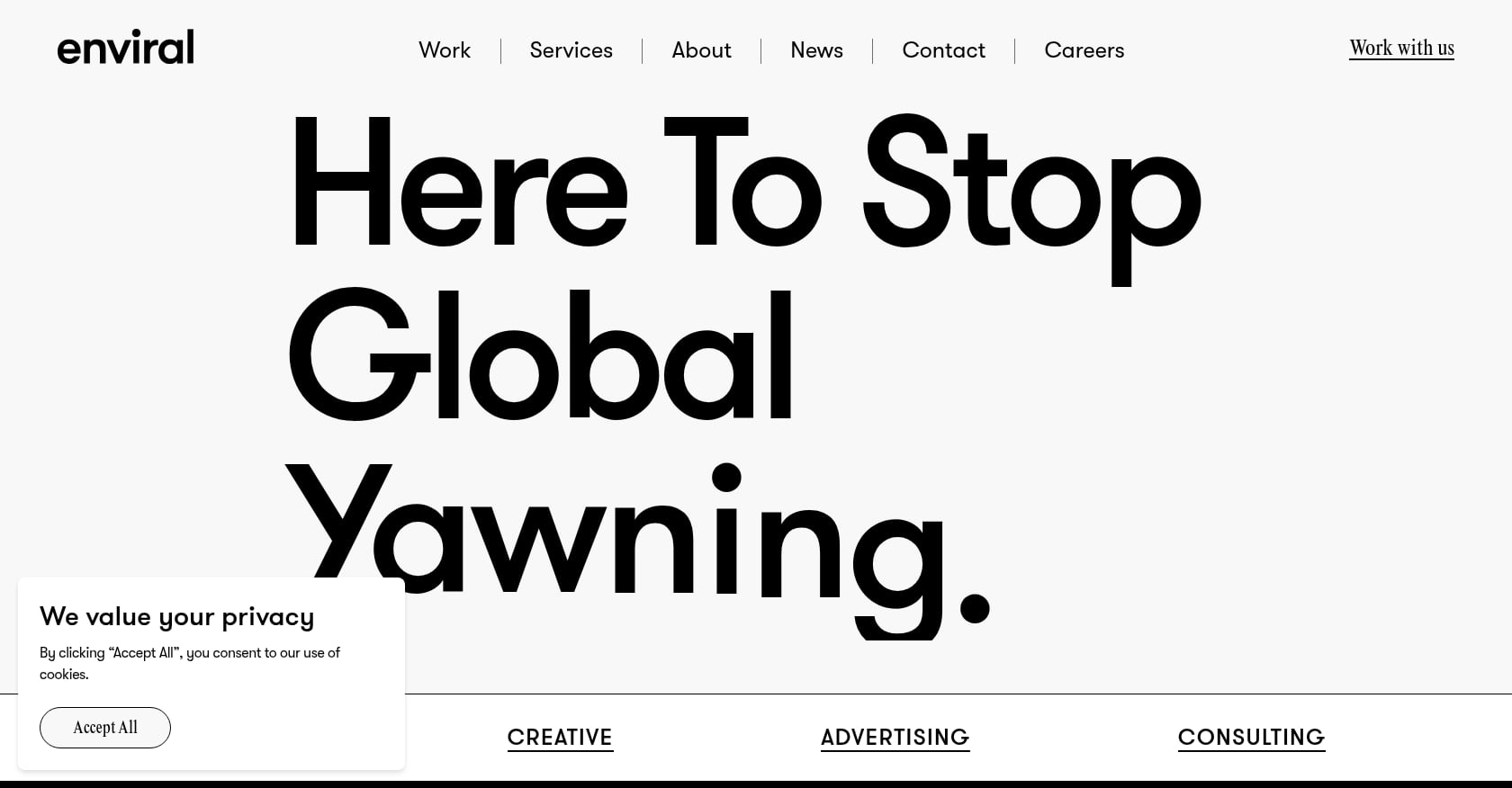
Best for: UK-based brands that need branding and impact reporting under one roof.
Enviral is a sustainable marketing agency based in Bristol, UK. They specialize in branding, sustainability strategies, impact reporting, and communication strategies. Their unique selling point lies in fusing creativity with sustainability, combining the visual and strategic elements that many compliance-focused agencies skip.
What they do best:
Brand identity work tailored to sustainability positioning
Impact reporting that doubles as marketing collateral
Communication strategies for UK market audiences
Work with recognizable eco-brands (clients include Innocent Drinks and Ecotricity)
Honest tradeoffs:
UK-centric with limited global reach compared to Futerra or Grounded World
Smaller agency footprint means capacity constraints on large-scale programs
Less focused on the commercial activation and revenue connection that purpose-driven brand agencies provide
Entry point: Custom scoped through their website.
5. OBERLAND
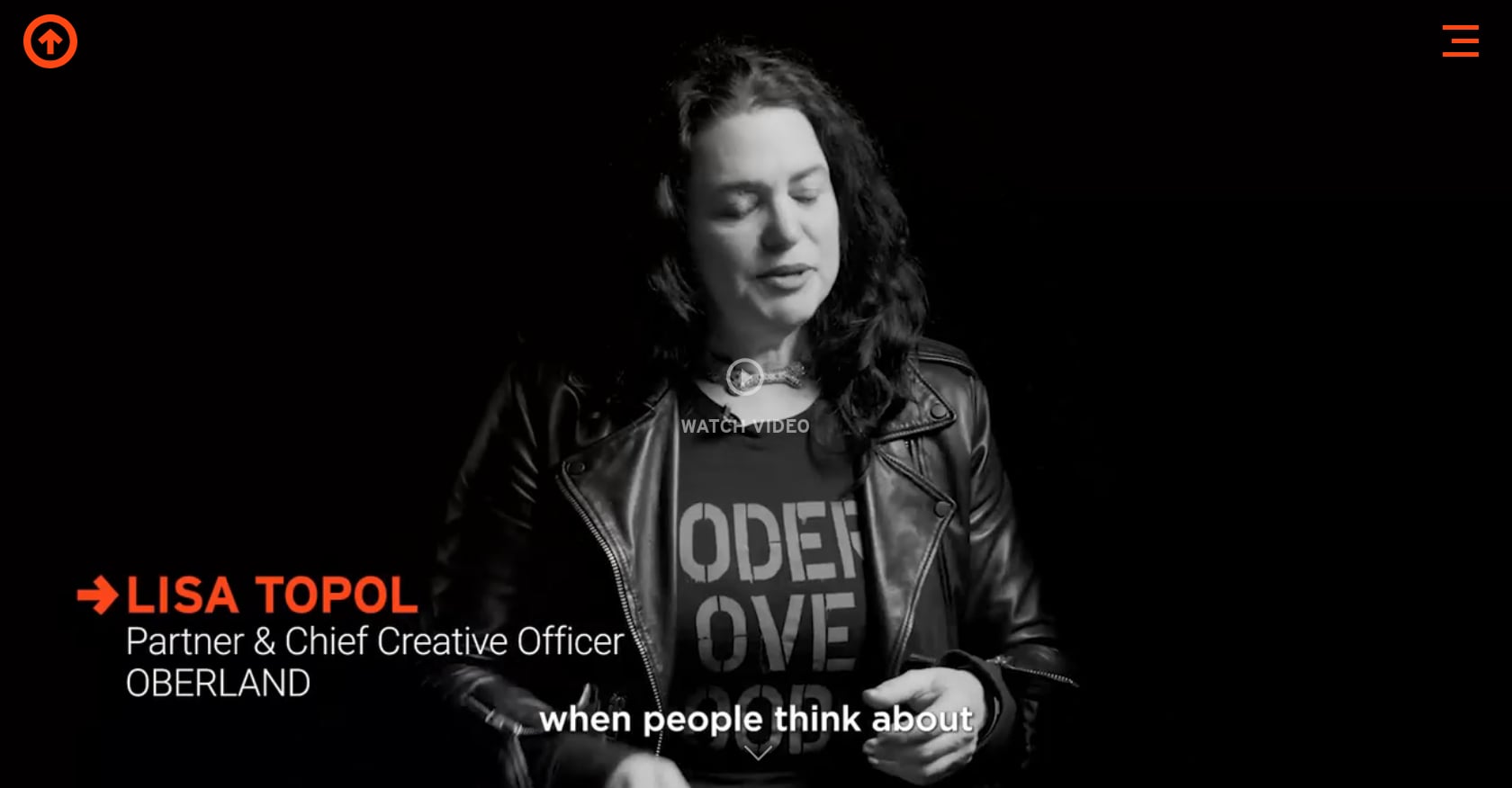
Best for: Brands wanting award-winning creative campaigns with purpose at the center.
OBERLAND is a NYC-based purpose-driven advertising agency that helps brands from Fortune 500s to nonprofits “grow bigger because they do better.” They bring a Cannes-winning creative pedigree to sustainability work, approaching it through the lens of advertising and storytelling rather than compliance or consulting.
What they do best:
Brand strategy with a creative-first approach
Multi-disciplinary campaign development (design, storytelling, event planning)
Proving that purpose-driven work can win both awards and market share
Full-service execution from concept to production
Honest tradeoffs:
Advertising-first, sustainability-second positioning. If you need deep ESG expertise or regulatory navigation, this isn’t the agency
NYC-based with premium cost structure
Less suited for brands that need ongoing sustainability strategy versus campaign bursts
Entry point: Custom scoped through their website.
6. Akepa (The Sustainable Agency)
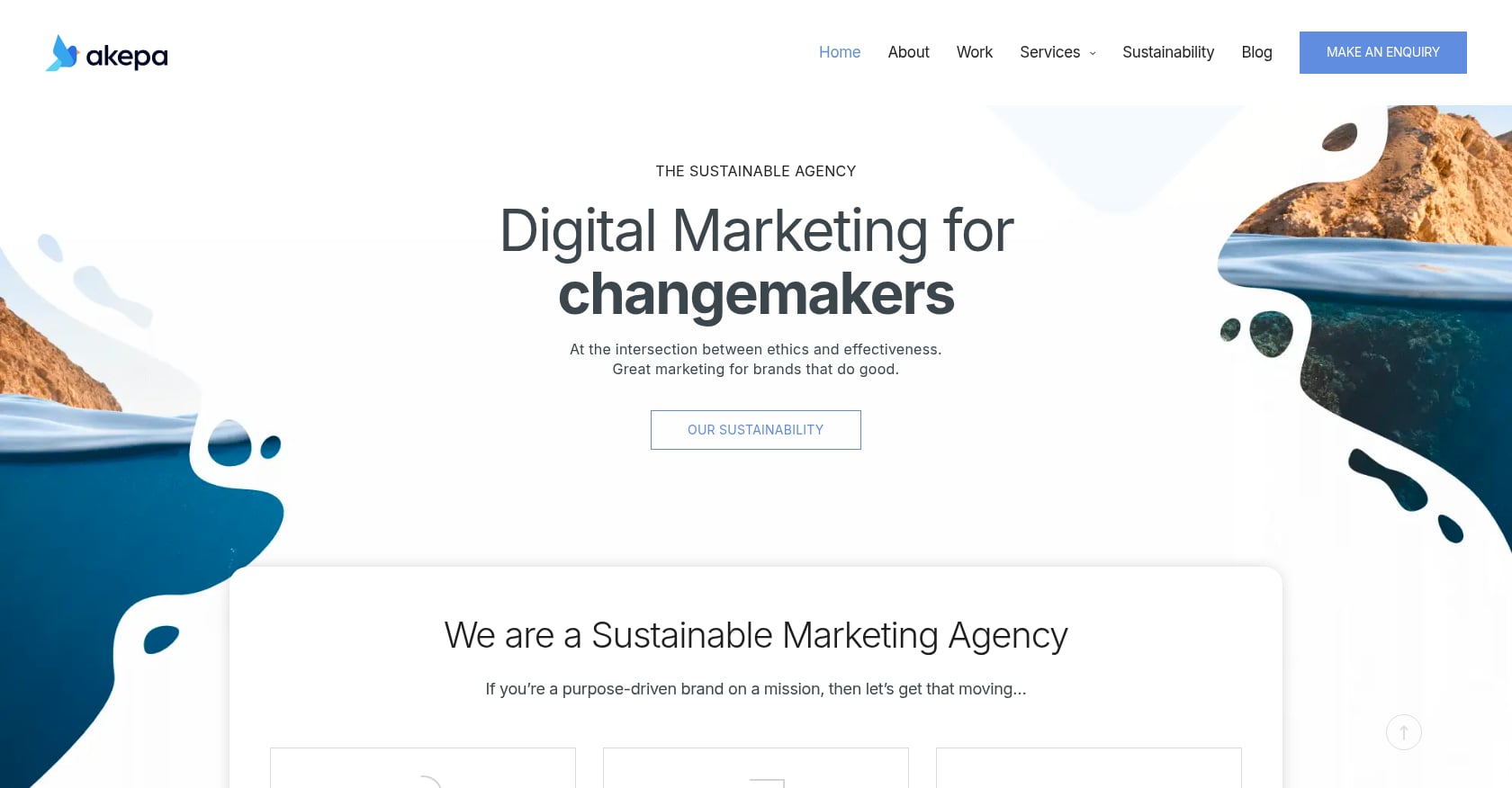
Best for: Sustainable brands that need SEO, content marketing, and digital performance execution.
Akepa is a ClimatePartner-certified sustainability marketing agency operating from Barcelona and London. They help sustainable and ethical brands grow through data-driven digital marketing, specializing in SEO, content marketing, paid advertising, and AI implementation. Their website runs on 100% renewable energy from wind and hydropower.
What they do best:
SEO strategy specifically calibrated for sustainability-sector keywords
Content marketing that builds organic authority over time
Paid advertising management for eco-brands
AI implementation in marketing workflows
Honest tradeoffs:
Digital execution specialist, not a brand strategy or positioning agency
If you need upstream work on brand purpose, positioning, or commercial innovation, Akepa isn’t the right partner
Their own editorial content (they publish “The Sustainable Agency” listicle that ranks #1 for related terms) creates a potential conflict of interest when reviewing competitors
Entry point: Custom scoped through their website.
7. Ethical Agency
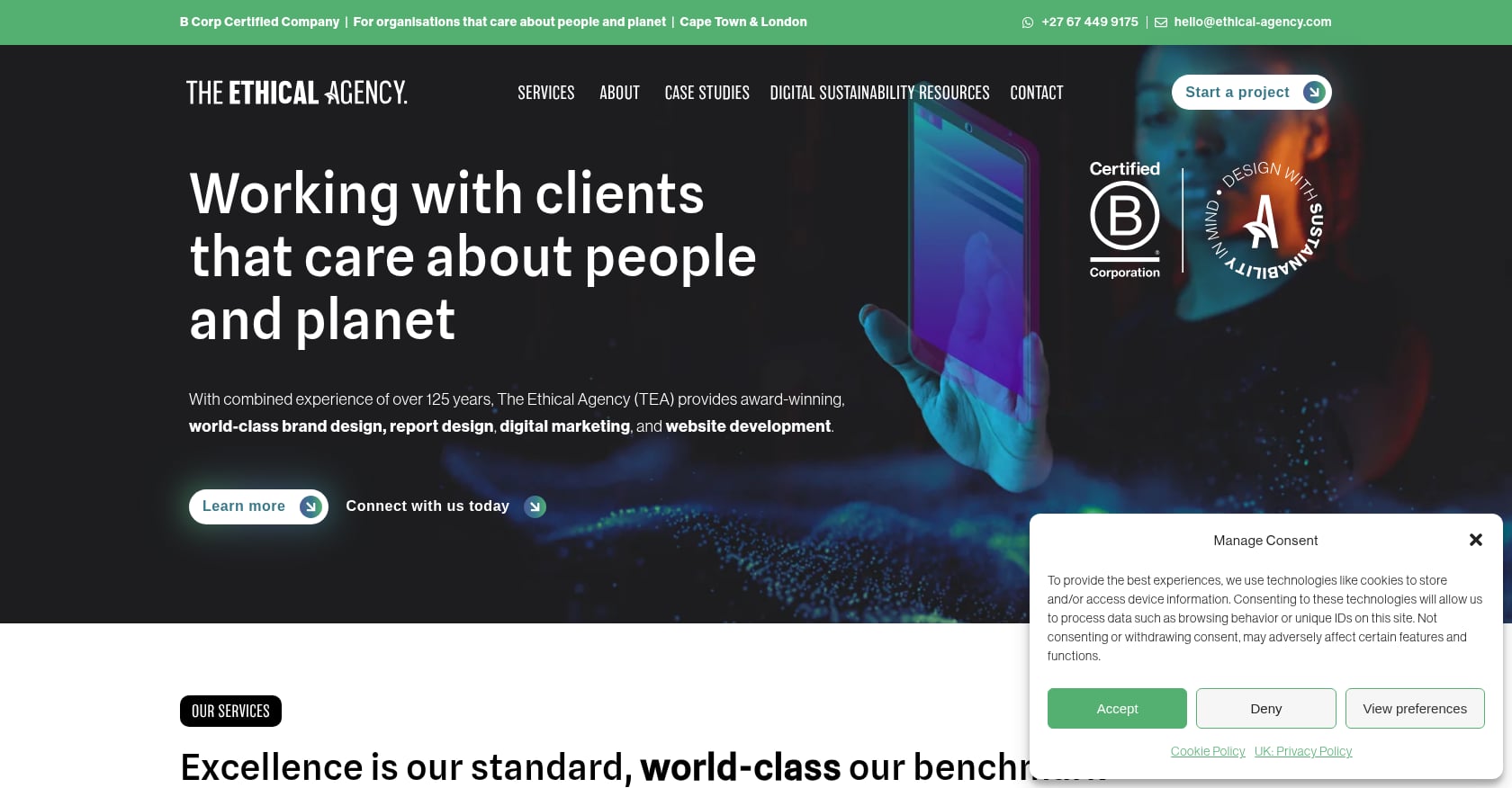
Best for: Impact-driven brands needing design-led marketing from a certified B Corp studio.
Ethical Agency is a B Corp-certified marketing agency with offices in Cape Town and London. They operate as a design studio focused on impact-driven brands working on climate and social justice. The dual-continent presence gives them an unusual perspective that combines African and European design sensibilities.
What they do best:
Visual identity and brand design for purpose-driven organizations
Marketing campaigns with social justice at their core
B Corp-certified operations that walk the talk
Cross-cultural creative work spanning two continents
Honest tradeoffs:
Smaller studio with less strategy depth than full-service agencies
Limited capacity for large-scale brand transformation programs
More execution-focused than strategic; you’ll likely need a separate strategy partner
Entry point: Custom scoped through their website.
8. Dandelion Branding
Best for: Eco-friendly brands needing content marketing and website optimization from a values-aligned partner.
Dandelion Branding is a Netherlands-based sustainability marketing agency providing holistic content marketing strategies and website optimization for sustainable businesses. They only work with eco-friendly brands, which creates a focused portfolio but also limits the range of problems they solve.
What they do best:
Content marketing strategies designed for sustainable business audiences
Website optimization and user experience for eco-brands
Selective client roster that ensures deep alignment with sustainability values
European market expertise, particularly in the Netherlands and surrounding regions
Honest tradeoffs:
Narrow service range focused on content and web only
Not equipped for brand strategy, commercial activation, or campaign development
Small operation that may lack bandwidth for enterprise-level programs
Entry point: Custom scoped through their website.
9. Greenhouse PR
Best for: Brands, NGOs, and innovators that need sustainability communications to influence policy and public awareness.
Greenhouse PR is a leading sustainability communications agency working at the intersection of advocacy and awareness. They help amplify impact and influence policy, making them a strong fit for organizations whose sustainability work has a public affairs dimension.
What they do best:
PR and media relations focused on sustainability narratives
Policy advocacy and awareness campaigns
Stakeholder communications for NGOs and sustainability innovators
Building bridges between corporate sustainability efforts and public discourse
Honest tradeoffs:
PR-focused, not a branding or creative agency
Won’t build your brand identity, commercial strategy, or campaign creative
Best used alongside a brand strategy partner rather than as a standalone solution
Entry point: Custom scoped through their website.
10. Orange Bird
Best for: Clean tech, climate tech, and circular economy businesses needing digital marketing support.
Orange Bird specializes in digital services for clean tech, climate tech, and circular businesses. Their sector focus means they understand the technical vocabulary and buyer journeys specific to these industries, which generalist digital agencies often struggle with.
What they do best:
Digital marketing tailored to clean tech and climate tech sectors
Understanding of technical B2B buyer journeys in sustainability
Circular economy positioning and communications
EU-based market expertise
Honest tradeoffs:
Sector-specific focus means they’re not the right fit for consumer brands, retailers, or nonprofits
Digital services focus rather than brand strategy or creative
Smaller profile compared to other agencies on this list
Entry point: Custom scoped through their website.
How to Choose: The 5-Question Framework
Picking a sustainability branding agency isn’t about finding the “best” one. It’s about finding the right match for your specific situation. Work through these five questions before reaching out to anyone.
Question 1: What’s your primary gap?
Are you struggling with strategy (you don’t know what your sustainability brand story should be)? Creative execution (you have a strategy but can’t bring it to life)? Digital performance (you need traffic and conversions)? Reporting and compliance (you need to communicate ESG data)? Or commercial activation (your sustainability work isn’t driving revenue)?
Each gap points to a different agency type. Getting this wrong is the most common, and most expensive, mistake.
Question 2: What certifications matter to your stakeholders?
If your investors, board, or customers care about verified credentials, prioritize agencies with B Corp certification, Science Based Targets commitments, or similar third-party accountability. An agency that hasn’t submitted to external scrutiny may struggle to help you do the same.
Question 3: Do you need global reach or regional expertise?
A UK-based brand entering EU markets faces different regulatory requirements than a US brand selling domestically. Match your agency’s geographic footprint and regulatory knowledge to your market reality.
Question 4: Are you trying to commercialize sustainability or report on it?
This is the fork in the road most buyers miss. Commercializing sustainability means turning purpose into purchase intent, retail performance, and revenue growth. Reporting on sustainability means communicating your ESG performance to stakeholders. Both matter. They require fundamentally different capabilities.
Question 5: What’s your regulatory exposure?
If you sell into the EU after September 2026, every environmental claim on your packaging, website, and advertising needs substantiation. If you’re primarily US-based, the regulatory pressure is lighter but growing at the state level. Your agency needs to understand the specific regulatory framework that applies to your business.
Start with a complimentary discovery call to map your specific gaps before committing to any agency.
The Greenwashing-Greenhushing Paradox
Most articles about sustainability branding focus on greenwashing risk, and rightfully so. EU research shows 53% of green claims give vague, misleading, or unfounded information. More than 82% of products lack clear sustainability messaging. Over 70% of people are skeptical about green claims from brands.
But there’s a second, less discussed risk: greenhushing. The ASA’s 2025 report found that of 362,000 travel adverts reviewed, 99% made no environmental claims at all. Brands are so afraid of greenwashing accusations that they’ve gone silent. Some want to avoid public accountability. Others fear accusations of hypocrisy. Many are simply paralyzed by the risk of regulatory enforcement.
This creates a paradox. Saying too much without evidence invites fines and boycotts. Saying nothing undermines the credibility of genuine sustainability work and leaves commercial value on the table. A specialist sustainability branding agency navigates this tension, helping you communicate what’s true, substantiate what you claim, and stay silent only by strategic choice rather than fear.
The consequences of getting it wrong are no longer abstract. Beyond the DWS and Shein fines, over 54% of UK consumers say they’re prepared to boycott brands over misleading green claims. And 78% of Americans would recommend products from a purpose-driven company, meaning silence costs you word-of-mouth too.
What to Expect on Pricing
No sustainability branding agency on this list publishes transparent pricing, which is frustrating but consistent with the custom nature of the work. Here’s what to expect based on industry benchmarks:
A focused sustainability campaign (single market, defined scope) typically starts in the mid-five figures. Integrated brand transformation programs, covering strategy through activation across multiple markets, scale into six figures. Global programs or multi-year retainers with enterprise brands can reach seven figures.
Boutique agencies often provide more flexibility without the overhead of large retainer commitments. The trade-off is that they may have less capacity for simultaneous multi-market execution.
The most useful way to think about cost isn’t “what will I spend?” but “what’s the cost of not hiring a specialist?” Greenwashing fines start at six figures and scale from there. Lost consumer trust is harder to quantify but shows up in declining brand preference, lower purchase intent, and reduced employee retention (purpose-driven brands retain staff at 40% higher rates according to Deloitte). A wasted campaign built on unsubstantiated claims is money spent to create a liability.
Start With Clarity, Not Commitment
The hardest part of choosing a sustainability branding agency is knowing what you actually need. Most brands come to the process with a vague sense that their sustainability story isn’t landing, but they haven’t diagnosed whether the problem is strategic, creative, commercial, or regulatory.
That diagnostic step is where the process should begin. Grounded World offers a complimentary AI-driven 5C landscape assessment that maps your Company, Culture, Category, Competitor, and Consumer dimensions before any engagement starts. It’s a zero-commitment way to understand your gaps, benchmark against competitors, and determine what type of agency partner fits.
Get your free 5C assessment here or book a discovery call to talk through your situation directly.
Frequently Asked Questions
What’s the difference between a sustainability branding agency and a regular branding agency?
A sustainability branding agency has deep expertise in environmental and social impact communications, regulatory compliance (EU Green Claims Directive, CSRD, CMA Green Claims Code), consumer psychology around sustainable purchasing, and the specific commercial dynamics of purpose-driven brands. A regular branding agency may produce attractive creative work but lacks the knowledge to substantiate claims, navigate regulations, or connect sustainability to commercial outcomes.
How much does it cost to hire a sustainability branding agency?
Pricing varies widely based on scope. A focused campaign in a single market typically starts in the mid-five figures. Integrated brand transformation programs scale to six figures, and global or multi-year programs can reach seven figures. Most agencies custom-scope engagements rather than offering fixed packages.
What certifications should I look for when choosing a sustainability branding agency?
B Corp certification is the most rigorous and widely recognized. Science Based Targets initiative membership shows climate commitment grounded in peer-reviewed science. 1% for the Planet demonstrates financial commitment to environmental causes. ClimatePartner certification verifies carbon management. These certifications indicate the agency has submitted to third-party accountability, not just self-declared values.
What is greenhushing and why should I care?
Greenhushing is the practice of deliberately under-communicating or staying silent about genuine sustainability efforts. Brands do this to avoid greenwashing accusations, but the strategy backfires. It leaves real commercial value on the table (purpose-driven brands grow faster), reduces stakeholder trust, and can signal to investors that you’re not serious about sustainability commitments. A specialist agency helps you find the credible middle ground between overclaiming and silence.
How do I know if I need a brand strategy agency versus a digital marketing agency?
If you’re unclear on what your sustainability brand story should be, how to position against competitors, or how to connect purpose to commercial outcomes, you need a brand strategy agency. If you already have a clear brand strategy and need traffic, conversions, and digital visibility, you need a digital marketing agency. Many brands need both, but engaging a digital agency before the strategy is solid wastes budget on amplifying the wrong message.
What is the intention-action gap in sustainability branding?
The intention-action gap describes the disconnect between what consumers (and companies) say they want to do regarding sustainability and what they actually do. Research shows 82% of organizations plan sustainability investment increases, but only 21% have detailed transition plans. For consumers, the gap manifests as stated preference for sustainable products that doesn’t consistently translate to purchase behavior. Agencies that diagnose and quantify this gap deliver structurally different value than those that only produce campaigns.
Can a sustainability branding agency help with regulatory compliance?
Some can, particularly those focused on sustainability strategy and communications (like thinkPARALLAX). Others focus more on creative execution and brand activation. If regulatory compliance is your primary concern, specifically around CSRD, ESRS, or the EU Green Claims Directive, make sure the agency has demonstrated expertise in these frameworks rather than just sustainability branding generally.
How often should I update my sustainability brand messaging?
Given the pace of regulatory change (the EU ECD takes effect September 2026, and enforcement continues to tighten), review your sustainability claims and messaging at minimum every six months. Any time you make a new environmental claim, it should be reviewed against current regulatory requirements. The best sustainability branding agencies build ongoing review cycles and impact measurement into their engagement models.