 Hope Wehrli
 A brand like Seventh Generation has spent years building trust around sustainability. Its identity is built around plant-based products, ingredient transparency, recycled packaging, and climate-conscious messaging that feels integrated into the business itself. Consumers understand what the company stands for almost immediately because sustainability is visible across its products, branding, and communication. The company has not just marketed sustainability. It has operationalized it in ways customers can actually recognize.
But even brands with strong sustainability reputations still face the same challenge most organizations do: turning values into consistent action across teams, operations, and customer behavior. Because sustainability is no longer simply a messaging issue. Most organizations already know what they want to say. They have sustainability reports, ESG goals, climate commitments, and campaigns focused on impact. The harder question is whether those commitments are fully embedded into how the business actually operates.
That is where things begin to break down.
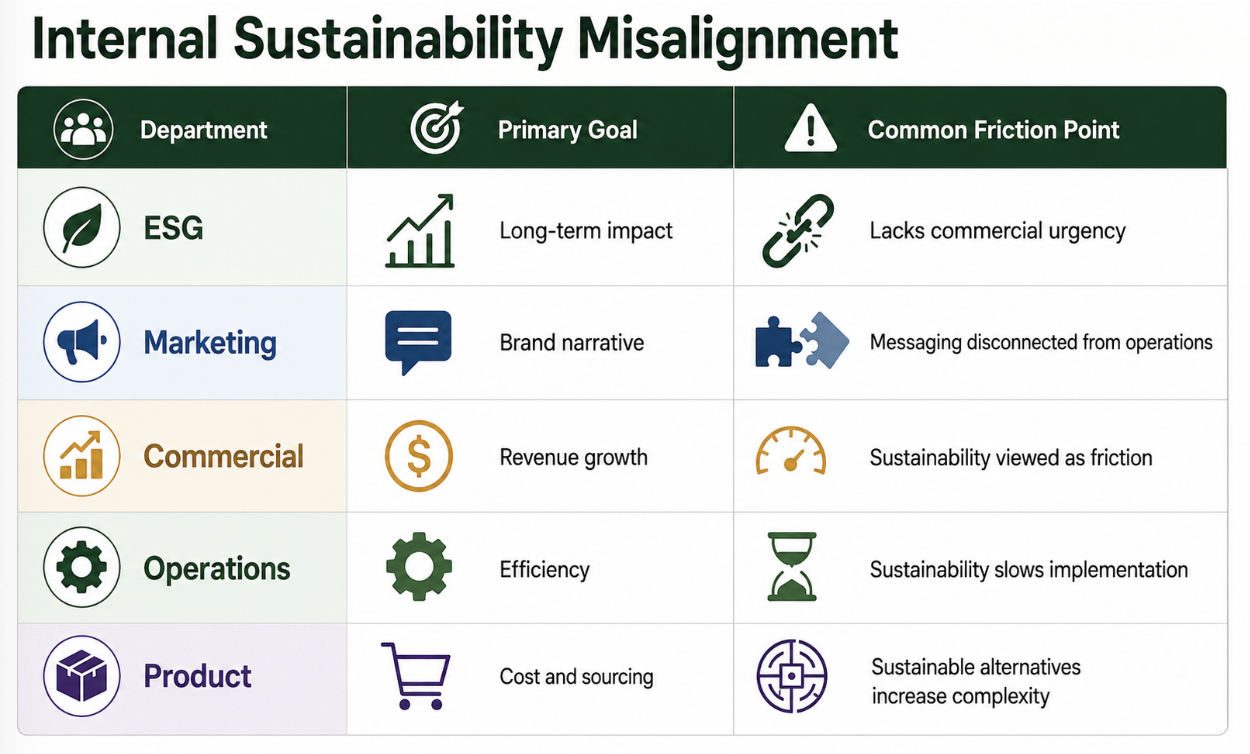
Leadership approves sustainability goals because customers, employees, and investors increasingly expect them. ESG teams create frameworks, reporting structures, and long-term impact targets. Marketing teams build campaigns around purpose and storytelling. Meanwhile, commercial teams are expected to prioritize growth, efficiency, and quarterly revenue targets. Product teams focus on sourcing and cost management. Operations teams are trying to maintain scale and speed. Everyone may support sustainability conceptually, but internally, teams are often measured against entirely different definitions of success.
This creates what behavioral science calls the “intention–action gap,” the disconnect between what people say they value and what they ultimately do. Research from Harvard Business Review shows that while consumers consistently express support for sustainable products, purchasing decisions are still heavily shaped by convenience, affordability, and trust barriers.¹ The same dynamic exists internally within organizations. Teams may support sustainability goals in theory while operational decisions continue prioritizing short-term pressure and efficiency.
Where sustainability alignment starts breaking down
Across organizations, the same patterns appear repeatedly. Sustainability often struggles not because of resistance, but because teams are operating from disconnected incentives and timelines. ESG teams are focused on long-term reporting and compliance, while commercial teams are focused on quarterly performance. Marketing teams prioritize storytelling and engagement while operations teams are measured on efficiency and scalability. None of these priorities are necessarily wrong independently, but together they create friction that slows execution.
Common breakdown points:
- ESG focuses on long-term impact and compliance
- Marketing focuses on campaigns and brand perception
- Commercial teams prioritize revenue and margins
- Operations prioritize efficiency and scalability
- Product teams prioritize sourcing, cost, and speed
When those priorities are not aligned, sustainability becomes fragmented instead of operationalized.
At Grounded World, much of the work around purpose strategy and sustainability focuses on helping organizations close this exact gap between intention and execution. Through stakeholder workshops, behavior-change campaigns, and purpose activation strategies, the emphasis is not simply on what brands say they stand for, but how those values actually show up in customer experiences, operational systems, and internal decision-making. Campaigns centered around behavior change recognize that awareness alone rarely shifts action. Structural alignment matters just as much as messaging.

This is one reason companies like Patagonia and Seventh Generation continue standing out in sustainability conversations. Their messaging feels credible because operational decisions reinforce the same story. Product design, sourcing, partnerships, and communication all support one another. Sustainability does not feel like a campaign layered onto the business afterward. It feels embedded into the business itself.
Many organizations struggle to reach that level of alignment. Sustainability initiatives often become trapped in approval cycles or disconnected across departments. Marketing may launch campaigns promoting circularity or environmental impact while operations teams struggle to implement those initiatives at scale. ESG teams may establish ambitious roadmaps that never fully connect to pricing strategies, customer experiences, or product development timelines. The Decision Lab describes this as a form of behavioral friction, where competing priorities and unclear systems prevent intentions from translating into action.²
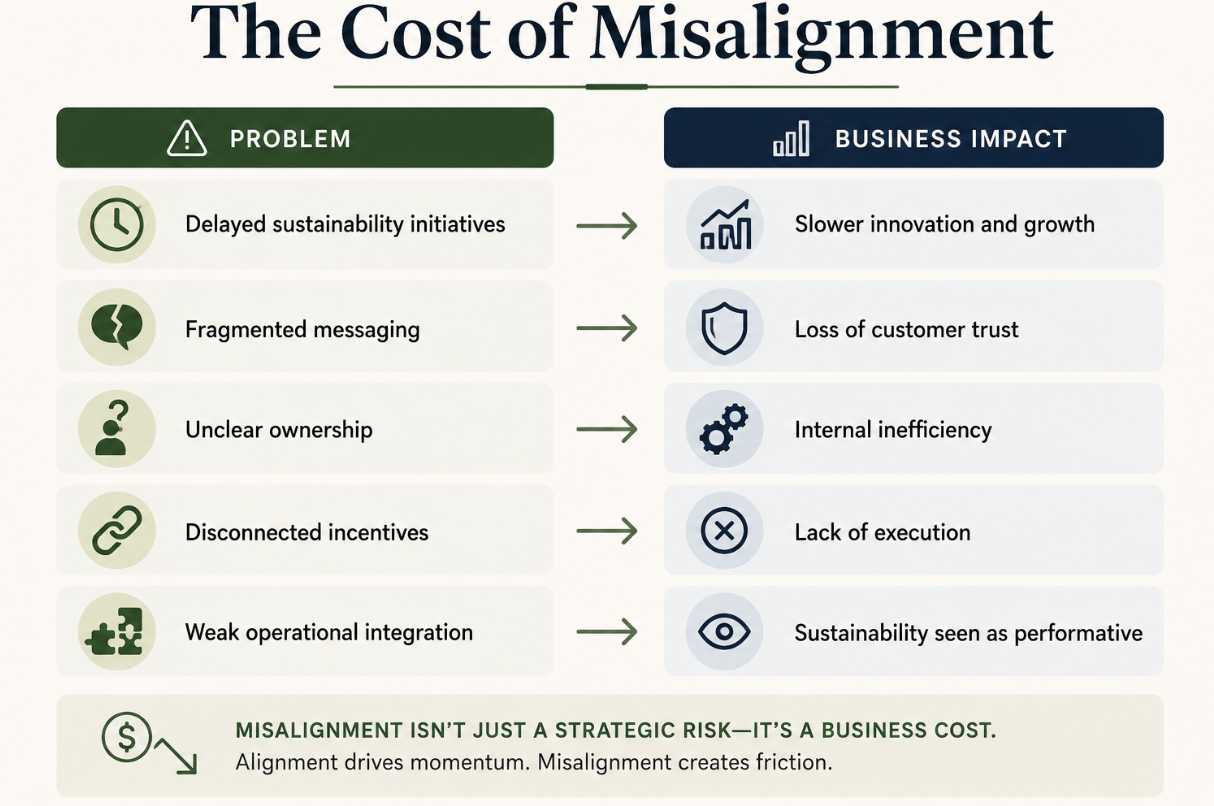
Over time, that disconnect becomes expensive.
Products are delayed. Messaging becomes fragmented. Internal teams lose momentum. Customers stop trusting sustainability claims because they feel disconnected from reality. Sustainability efforts that once felt ambitious begin to feel performative. According to Ipsos, companies that fail to close the “say-do gap” often struggle converting sustainability interest into measurable consumer behavior.³
This matters even more now because consumer expectations are changing quickly. Customers increasingly expect transparency and accountability from brands, but they still make decisions based on convenience, affordability, and trust. Economic pressure also intensifies scrutiny around sustainability claims. People are more skeptical of vague promises and more aware of greenwashing than they were even a few years ago. Research from the World Economic Forum similarly highlights how affordability and accessibility continue shaping sustainability-related purchasing decisions.⁴
That means sustainability can no longer exist as a separate initiative sitting beside the business. It has to operate inside the business itself.
The organizations making meaningful progress are usually not the ones talking about sustainability the most. They are the ones embedding it into operational decisions, customer experiences, sourcing strategies, retail environments, and performance metrics. They connect sustainability to measurable business outcomes instead of treating it as a parallel initiative disconnected from growth.

What organizations doing this well tend to prioritize
Organizations successfully operationalizing sustainability often focus on a few consistent principles:
- Shared KPIs across ESG, marketing, and commercial teams
- Clear ownership of sustainability initiatives
- Sustainability integrated into product and pricing decisions
- Operational systems that support long-term commitments
- Messaging that accurately reflects business realities
This is where sustainability shifts from branding into behavior.
Because ultimately, **sustainability alignment is not about agreement. **Most organizations already agree sustainability matters. The challenge is building operational structures, incentives, and accountability systems that allow those commitments to move beyond intention.
Until that happens, sustainability remains something organizations talk about rather than something they consistently execute.
Close your intention–action gap.
If your investments in sustainability and social impact aren't translating into sales, growth or internal buy-in, we can help you identify the gap.
Footnotes
- Harvard Business Review. “The Elusive Green Consumer.” 2019.
- The Decision Lab. “The Intention–Action Gap.”
- Ipsos. “How to Beat the Say–Do Gap for Sustainable Products and Unlock Growth.”
- World Economic Forum. “Consumers’ Sustainability Choices.”
Works Cited
Harvard Business Review. “The Elusive Green Consumer.” 2019. https://hbr.org/2019/07/the-elusive-green-consumer
Ipsos. “How to Beat the Say–Do Gap for Sustainable Products and Unlock Growth.” https://www.ipsos.com/en-us/how-beat-say-do-gap-sustainable-products-and-unlock-growth
The Decision Lab. “The Intention–Action Gap.” https://thedecisionlab.com/reference-guide/psychology/intention-action-gap
World Economic Forum. “Consumers’ Sustainability Choices.” https://www.weforum.org/stories/2026/03/consumers-sustainability-choices-world-consumer-rights-day/

.jpg&w=3840&q=75&dpl=dpl_22FPXKdwyyGjEYwszT6ZTA4rkDRy)
.jpg&w=3840&q=75&dpl=dpl_22FPXKdwyyGjEYwszT6ZTA4rkDRy)