
 Hope Wehrli
 Your sustainability messaging may be visible.
Consumers may be engaging with your campaigns, reacting positively to your content, and expressing interest in your sustainability goals.
But that does not mean they are changing their behavior.
That is the disconnect many businesses face.
They are investing in sustainability marketing, publishing reports, redesigning packaging, talking about climate change, and launching sustainable solutions. Yet when it comes time for consumers to choose between one product and another, many still default to what is familiar.
The problem is not always awareness.
The problem is that most sustainability communications are not designed to influence decisions.
They are designed to inform.
There is a difference.
Sustainable Consumer Behavior Is More Complex Than Most Teams Realize
Sustainable consumer behavior is not driven by one single factor.
Consumers do not make decisions based only on environmental concerns or sustainability issues.
They also think about affordability, convenience, trust, product quality, personal care, brand reputation, and how well a product fits into their lifestyle.
That is why so many sustainable products struggle to gain traction.
Businesses assume consumers care enough to change.
In reality, consumers care, but not always enough to overcome friction.
Research consistently shows growing consumer demand for more sustainable products and services. Over 60% of consumers say they are willing to pay more for sustainable products, yet affordability remains the number one barrier to sustainable consumption.
This is one of the biggest contradictions in sustainable consumer behavior.
Consumers care about climate change. They care about waste. They care about environmental impact.
But they still make decisions through the lens of self interest.
They ask:
- Is this worth the extra cost?
- Is it easier or harder?
- Will it fit my lifestyle?
- Can I trust the claims?
- Does it create enough personal value to justify the switch?
That is where most sustainable solutions succeed or fail.
Information Alone Rarely Changes Consumer Behavior
There is a tendency inside many organizations to assume that more education will solve the problem.
If consumers understand the environmental impact of a product, the thinking goes, they will make better decisions.
But consumer decisions are rarely made in a calm, rational, information-rich environment.
They are made quickly.
Often in the middle of a busy day.
Usually with limited time, incomplete information, and dozens of competing priorities.
That is why information search is only one part of the equation.
Consumers may understand the importance of climate change, carbon emissions, waste reduction, and sustainable consumption, but still fail to act if the decision feels inconvenient.
A shopper standing in front of a shelf is not conducting business research.
They are scanning for signals.
Price.
Packaging.
Brand familiarity.
Ease.
Trust.
The brands that influence consumer behavior are the ones that understand this reality.
They reduce complexity.
They make sustainable choices feel intuitive rather than effortful.
Habit Often Matters More Than Values
One of the biggest mistakes businesses make is assuming there is one type of sustainable consumer.
There is not.
Some consumers are deeply committed to sustainability. Others are interested but inconsistent. Many care about the environment in theory but rarely change their behavior in practice.
Research suggests that only a small percentage of consumers are fully committed sustainability champions willing to pay premium prices regardless of convenience.
Everyone else is balancing trade-offs.
That is why consumer behavior is so difficult to influence.
A consumer may strongly support climate change action, energy conservation, sustainable packaging, and carbon emissions reduction, but still buy the less sustainable option because it is cheaper, easier, or more familiar.
Habit is powerful.
Consumers build routines around products, stores, and brands.
Once those routines exist, it takes more than awareness to break them.
It takes stronger value.
It takes better positioning.
It takes sustainable solutions that feel practical, convenient, and personally relevant.
Sustainable Packaging Has Become A Major Decision Driver
Packaging has become one of the few places where sustainability is immediately visible.
Consumers may not know how a company manages its supply chain or measures carbon emissions, but they notice when packaging feels excessive, wasteful, or difficult to recycle.
That is why sustainable packaging carries so much symbolic value.
It is often the first physical proof that a brand is taking sustainability seriously.
Refill systems, recycled materials, compostable packaging, and the removal of single use plastics are not just operational decisions. They are signals.
They tell consumers that a company understands the connection between sustainability, waste, and everyday behavior.
They also create a clearer link between brand values and personal lifestyle choices.
Consumers can see the difference immediately, which is why sustainable packaging often has more influence than broader corporate messaging.

Affordability Still Shapes Sustainable Consumption
No matter how much consumers care about sustainability, affordability remains one of the biggest barriers to sustainable consumption.
Research from Harvard Business Review shows that consumers often want to make more sustainable choices, but still prioritize price, convenience, and familiarity when making purchasing decisions.¹ Consumers may express support for sustainability, yet many still choose lower-cost options when budgets are tight or the sustainable option feels less convenient.
That matters.
Businesses often frame sustainability as an ethical issue.
Consumers often frame it as a financial one.
This is especially true during periods of economic uncertainty, when households become more cautious about spending.
Consumers may support sustainable solutions, but if the sustainable option costs significantly more, many will choose the cheaper alternative.
That does not mean price always wins.
It means businesses need to communicate value more effectively.
They need to show how sustainable products create long-term savings, better health outcomes, improved quality, or stronger personal benefits.
The more clearly a brand communicates that value, the more likely it is to influence purchasing behavior.
Consumer Segments Respond To Sustainability Differently
Not all consumers respond to sustainability messaging in the same way.
Older consumers often demonstrate stronger sustainable behaviors than younger consumers because they have more financial stability, more assets, and a stronger sense of personal accountability.
Younger consumers may express stronger attitudes about climate change and environmental issues, but that does not always translate into action.
That difference matters for marketing.
Businesses need more emphasis on segmentation.
They need to understand which consumers are motivated by affordability, which care most about personal health, which respond to environmental impact, and which are primarily driven by convenience.
Without that understanding, sustainability marketing becomes too broad to influence behavior.

The Best Sustainability Marketing Makes Action Easier
The strongest sustainability marketing does not ask consumers to do more work.
It does not overwhelm them with statistics, reports, or technical language.
Instead, it shapes the decision environment.
It makes the better option easier to notice, easier to compare, and easier to choose.
This is where many businesses struggle.
They spend time building awareness but far less time examining what actually happens in the moment before purchase.
That moment is where decisions are won or lost.
A product may have stronger sustainability credentials, but if it is harder to find, more expensive, or more difficult to understand, consumers often move on.
The brands influencing sustainable consumer behavior most effectively are often making small but important adjustments:
- Clearer labels
- Better product placement
- More visible proof points
- Simpler packaging
- Easier comparisons
- Stronger value communication
- More direct links to lifestyle and personal benefit
Those details shape behavior more than most teams realize.
This is also where a Behavioral Barrier Mapper can add value.
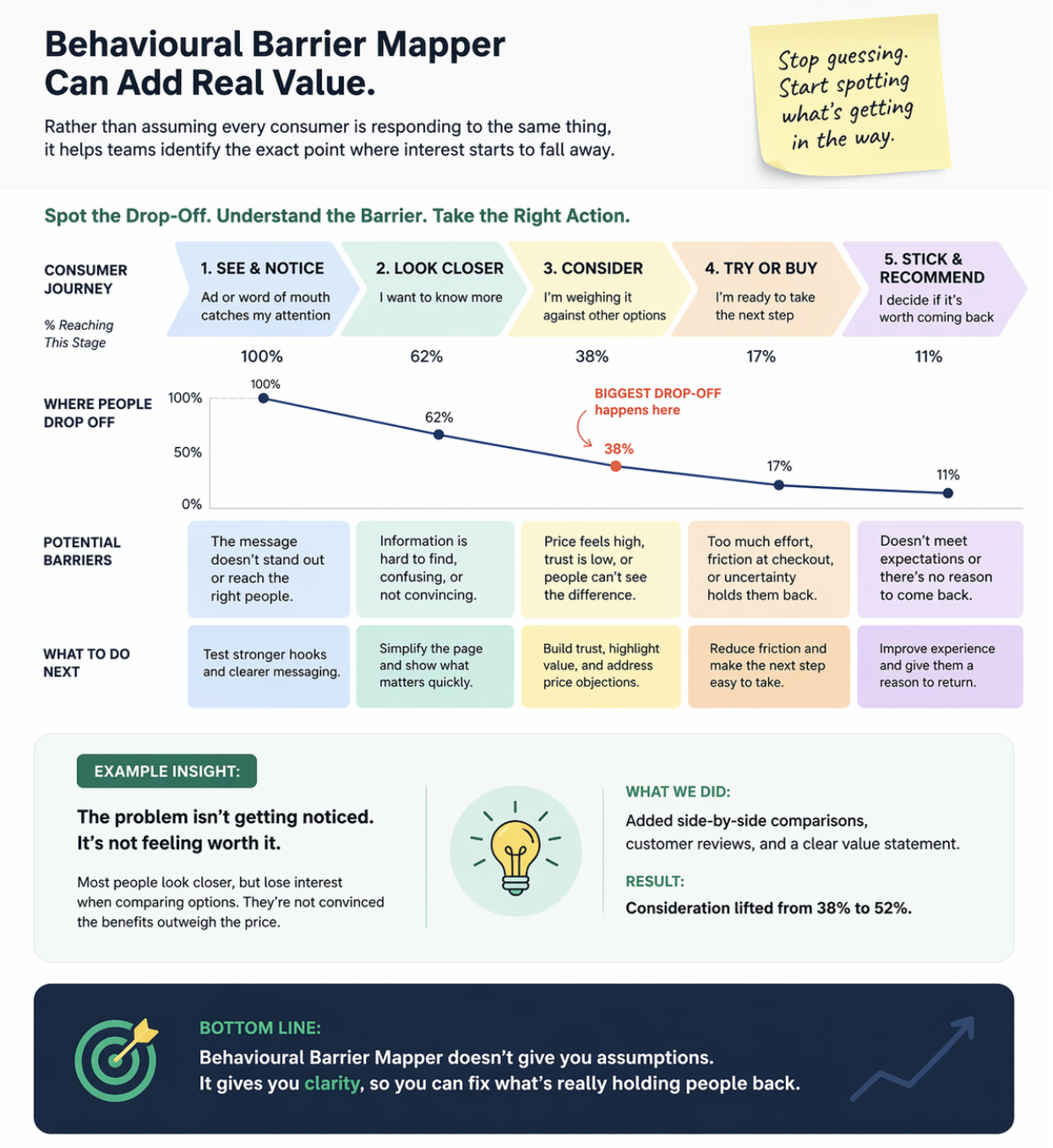
Rather than assuming every consumer is responding to the same thing, it helps teams identify the exact point where interest starts to fall away.
For some audiences, the barrier may be affordability. For others, it may be habit, distrust, confusing language, or poor visibility.
Once those friction points are clear, businesses can make sharper decisions about where to focus, what to simplify, and how to influence consumer behavior more effectively.
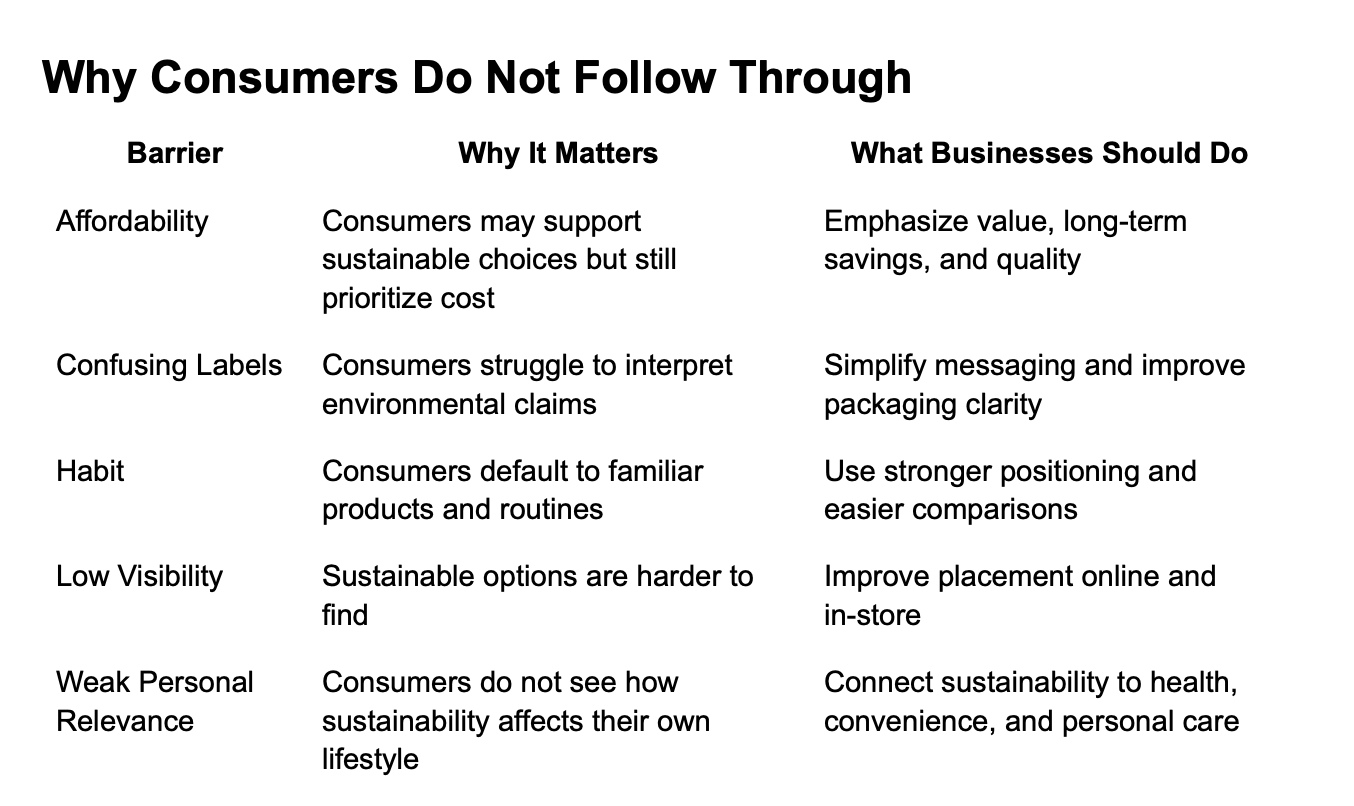
This table is often where teams realize that sustainable consumer behavior is not only about values. It is about removing the small barriers that quietly shape everyday decisions.
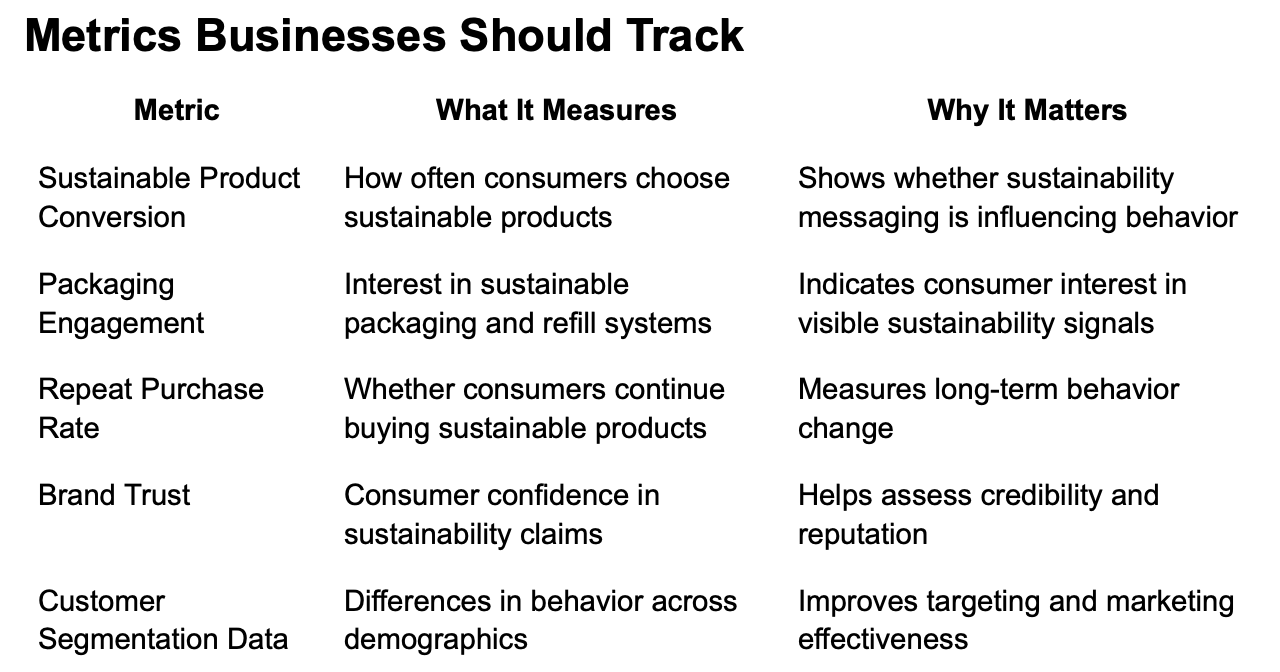
Close your intention–action gap.
If your investments in sustainability and social impact aren't translating into sales, growth or internal buy-in, we can help you identify the gap.
Footnotes
- Harvard Business Review, “Nudging Consumers to Purchase More Sustainably,” https://hbr.org/2022/08/nudging-consumers-to-purchase-more-sustainably
- White Rose University Consortium, “Psychological Drivers of Sustainable Consumer Behavior,” https://eprints.whiterose.ac.uk/id/eprint/205131/1/fpsyg-13-923464.pdf
- Drapers, “The Evolution of the Conscious Consumer,” https://www.drapersonline.com/insight/the-industry-view/drapers-shopper-survey-the-evolution-of-the-conscious-consumer

.jpg&w=3840&q=75&dpl=dpl_22FPXKdwyyGjEYwszT6ZTA4rkDRy)
.jpg&w=3840&q=75&dpl=dpl_22FPXKdwyyGjEYwszT6ZTA4rkDRy)