
 Hope Wehrli
 Purpose-driven marketing has become one of the defining strategies of modern brand communication. Consumers increasingly expect companies to stand for something beyond products alone, whether that means sustainability, education access, mental health awareness, or community impact. As a result, brands across industries continue investing heavily in campaigns designed to demonstrate social relevance and emotional connection.
Yet despite the rise of purpose-led branding, many campaigns still struggle to create measurable behavioral change.
The issue is rarely awareness. In most cases, consumers already understand the social issue being discussed. The challenge is translating emotional alignment into sustained action. People may support a cause conceptually while still failing to change purchasing habits, donate consistently, participate long term, or engage meaningfully beyond initial awareness.
Behavioral science has repeatedly shown that intention and action are rarely the same thing.
Research from Harvard Business Review explains that consumers frequently express support for socially responsible and sustainable initiatives while still making decisions heavily shaped by convenience, habit, affordability, and accessibility.¹ The gap between values and behavior is not necessarily driven by lack of concern. More often, it reflects friction inside the decision-making process itself.
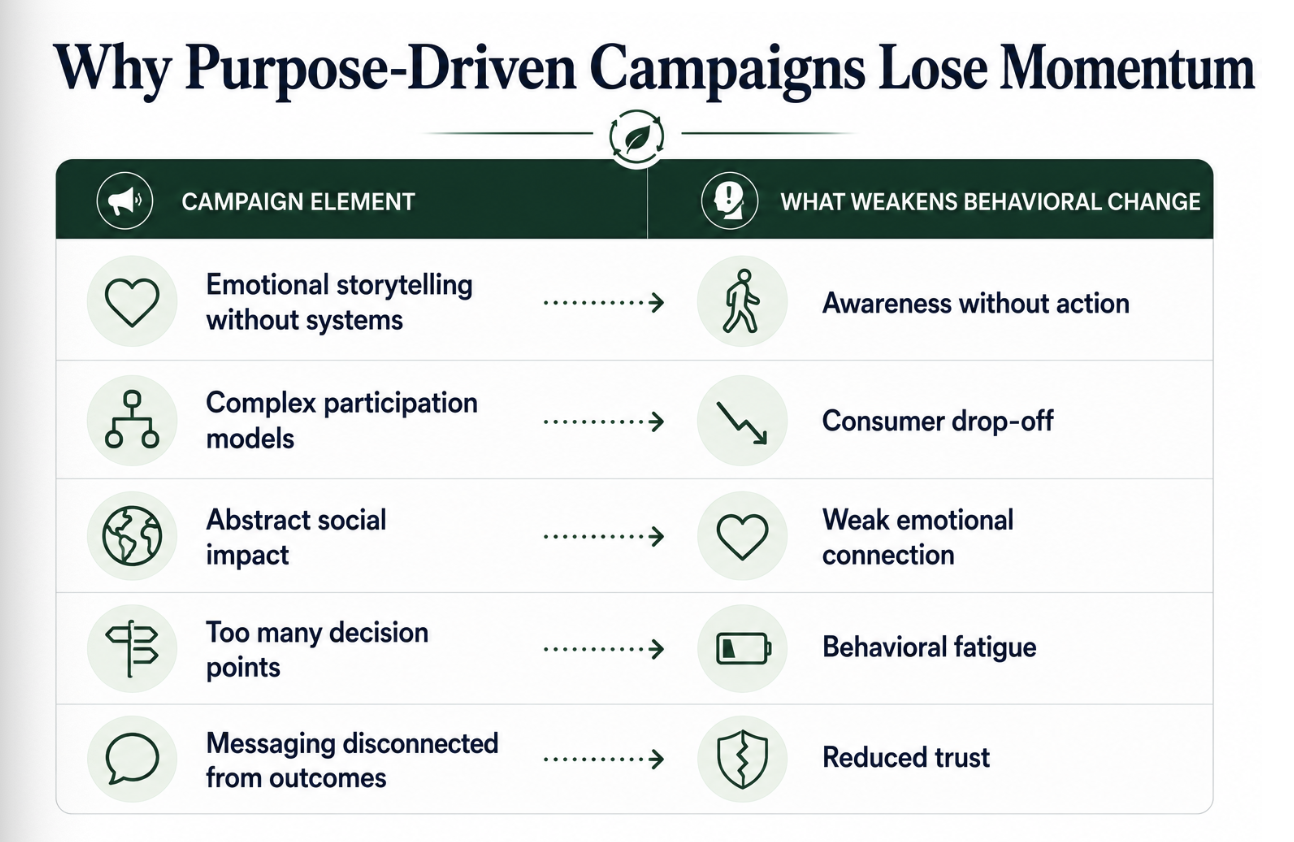
This is where many purpose-driven campaigns begin to lose momentum.
Organizations often focus heavily on storytelling while underinvesting in the systems that make participation feel operationally easy. Emotional resonance may create visibility and engagement initially, but awareness alone rarely creates sustained behavioral participation. Successful campaigns reduce friction, simplify action, and create a direct connection between consumer participation and measurable impact.

This is one reason the new BIC “Bring Joy BIC to School” campaign stands out strategically because it reduces the behavioral distance between awareness and action.
That distinction matters because many purpose-driven campaigns become trapped in what could be described as the awareness loop. Brands generate conversation, impressions, and emotional alignment while creating very little measurable behavioral movement afterward. Consumers leave agreeing with the message but without a clear or sustainable pathway toward action.
Why Purpose-Driven Campaigns Often Plateau

Consumers are operating in an environment defined by informational overload, economic pressure, and decision fatigue. Research from Ipsos notes that while people increasingly support purpose-driven and socially responsible initiatives, actual follow-through is still heavily influenced by simplicity, convenience, and accessibility.³
This creates a major challenge for brands attempting to operationalize purpose through marketing campaigns alone.
If participation feels unclear, expensive, time-consuming, or disconnected from everyday behavior, engagement frequently collapses after the initial emotional response. Consumers may genuinely care about the issue being discussed while still defaulting toward convenience and routine behavior in practice.
The Decision Lab similarly explains that behavioral change becomes significantly more difficult when decision-making pathways contain friction, ambiguity, or too many competing priorities.⁴ Campaigns therefore become more effective when they simplify the pathway between intention and participation.
What Effective Purpose-Driven Campaigns Tend to Share
Campaigns creating stronger long-term engagement often share a few consistent characteristics. They make participation operationally simple, connect action directly to visible impact, and reduce the amount of cognitive effort required for consumers to engage consistently.
Common characteristics of effective purpose-driven campaigns:
- Clear and immediate participation pathways
- Tangible and visible impact
- Low-friction engagement
- Emotion connected directly to action
- Partnerships that increase trust and accessibility
- Messaging supported by operational follow-through
The BIC campaign reflects many of these principles. School supply insecurity is a highly understandable issue that feels both emotional and practical to consumers. The campaign also frames participation around something immediate and tangible rather than abstract institutional change. By partnering with DonorsChoose, BIC leverages an existing educational infrastructure capable of translating awareness into direct classroom support.²
At Grounded World, much of the work around purpose activation and behavior-change strategy focuses on helping organizations close this gap between awareness and measurable action. The challenge is not simply helping brands communicate purpose more effectively. The challenge is designing campaigns and operational systems where participation feels intuitive, achievable, and integrated into consumer behavior rather than layered on top of it.
Make a creative impact.
See what making a creative impact looks like with some award-winning case studies from the Grounded team.
This distinction is becoming increasingly important because consumers are also becoming more skeptical of performative purpose marketing. Research from The Guardian highlights how consumers increasingly evaluate whether purpose-driven messaging feels authentic, behaviorally realistic, and operationally credible rather than purely aspirational.⁵ Campaigns perceived as disconnected from measurable impact often lose credibility quickly, even when the underlying issue itself matters deeply to consumers.
As a result, the brands creating the strongest long-term engagement are often not the ones producing the loudest purpose messaging. They are the ones reducing the distance between emotional alignment and practical participation.
Why Behavioral Design Matters More Than Ever

Purpose-driven campaigns are increasingly shifting from awareness campaigns into behaviorally designed systems. Emotional storytelling still plays a critical role, but storytelling without operational support rarely creates sustained action.
Brands successfully moving consumers from awareness into participation tend to focus on:
- simplifying participation
- reducing friction
- increasing visibility of impact
- embedding action into existing routines
- creating trust through operational follow-through
This is where many campaigns still struggle. Organizations often invest heavily in communication strategy while underinvesting in behavioral infrastructure capable of sustaining participation over time.
The result is a widening gap between what consumers say they care about and what campaigns successfully motivate them to do consistently.
The Future of Purpose-Driven Marketing

The next generation of purpose-driven campaigns will likely be measured less by visibility metrics alone and more by their ability to create sustained behavioral participation. Consumers already care about many social and environmental issues. The strategic challenge is helping people act on those concerns repeatedly and realistically within everyday decision-making environments.
That is what makes campaigns like BIC’s are important from a strategic perspective. The campaign reflects a broader shift away from symbolic purpose messaging and toward operationally actionable participation models that connect emotion, accessibility, and measurable impact.
Ultimately, the effectiveness of purpose-driven marketing is no longer determined only by whether consumers agree with the message. The real differentiator is whether brands can design systems that help consumers act on those values consistently.
Close your intention–action gap.
If your investments in sustainability and social impact aren't translating into sales, growth or internal buy-in, we can help you identify the gap.
Footnotes
- Harvard Business Review. “The Elusive Green Consumer.”
- BIC. “Bring Joy BIC to School Campaign.”
- Ipsos. “How to Beat the Say–Do Gap for Sustainable Products.”
- The Decision Lab. “Overcoming the Intention–Action Gap in Sustainable Consumption.”
- The Guardian. “What Motivates Consumers to Make Ethical Decisions?”
Works Cited
BIC. “BIC Launches Bring Joy BIC to School.” https://www.prnewswire.com/news-releases/bic-launches-bring-joy-bic-to-school---a-national-campaign-to-help-bridge-the-school-supply-gap-302762273.html
Harvard Business Review. “The Elusive Green Consumer.” https://hbr.org/2019/07/the-elusive-green-consumer
Ipsos. “How to Beat the Say–Do Gap for Sustainable Products and Unlock Growth.” https://www.ipsos.com/en-us/how-beat-say-do-gap-sustainable-products-and-unlock-growth
The Decision Lab. “Overcoming the Intention–Action Gap in Sustainable Consumption.” https://thedecisionlab.com/big-problems/overcoming-the-intention-action-gap-in-sustainable-consumption
The Guardian. “What Motivates Consumers to Make Ethical Decisions?” https://www.theguardian.com/sustainable-business/motivates-consumers-environmental-ethical-decisions

.jpg&w=3840&q=75&dpl=dpl_22FPXKdwyyGjEYwszT6ZTA4rkDRy)
.jpg&w=3840&q=75&dpl=dpl_22FPXKdwyyGjEYwszT6ZTA4rkDRy)