 Gaia
GaiaTLDR
The intention action gap is the difference between what people say they plan to do and what they actually do. It shows up constantly in sustainability, where consumers express interest in greener products but buy conventional ones instead. The gap is not hypocrisy. It is a friction, trust, habit, and design problem. Brands that close it do so by making the desired action easier, more rewarding, and more credible at the moment of decision.
Quick Answer: What is the Intention-Action Gap?
The intention-action gap is the difference between what people say they intend to do and what they actually do. It occurs when positive attitudes or stated intentions fail to translate into real-world behavior due to friction such as price, inconvenience, lack of trust, habit, or product limitations. In sustainability, this explains why consumers often express interest in eco-friendly products but still purchase conventional alternatives at the point of decision.
At a Glance: How to Close the Intention-Action Gap
To bridge the gap between consumer intent and actual behavior, brands must move beyond awareness and address four critical friction points:
Cost: Eliminate the "green premium" or highlight long-term value.
Ease: Ensure the sustainable choice is the default or most convenient option.
Trust: Use third-party certifications to validate environmental claims.
Reward: Connect planetary benefits to immediate personal benefits (e.g., better health, higher quality).
The Bottom Line: Closing the gap isn't about changing minds; it's about changing the environment where decisions are made.
What Is the Intention Action Gap?
The intention action gap is the difference between what people say they intend to do and what they actually do. In sustainability, it describes a familiar pattern: consumers say they want to buy greener, more ethical, or lower-impact products, then choose cheaper, easier, or more familiar options when real money is involved.
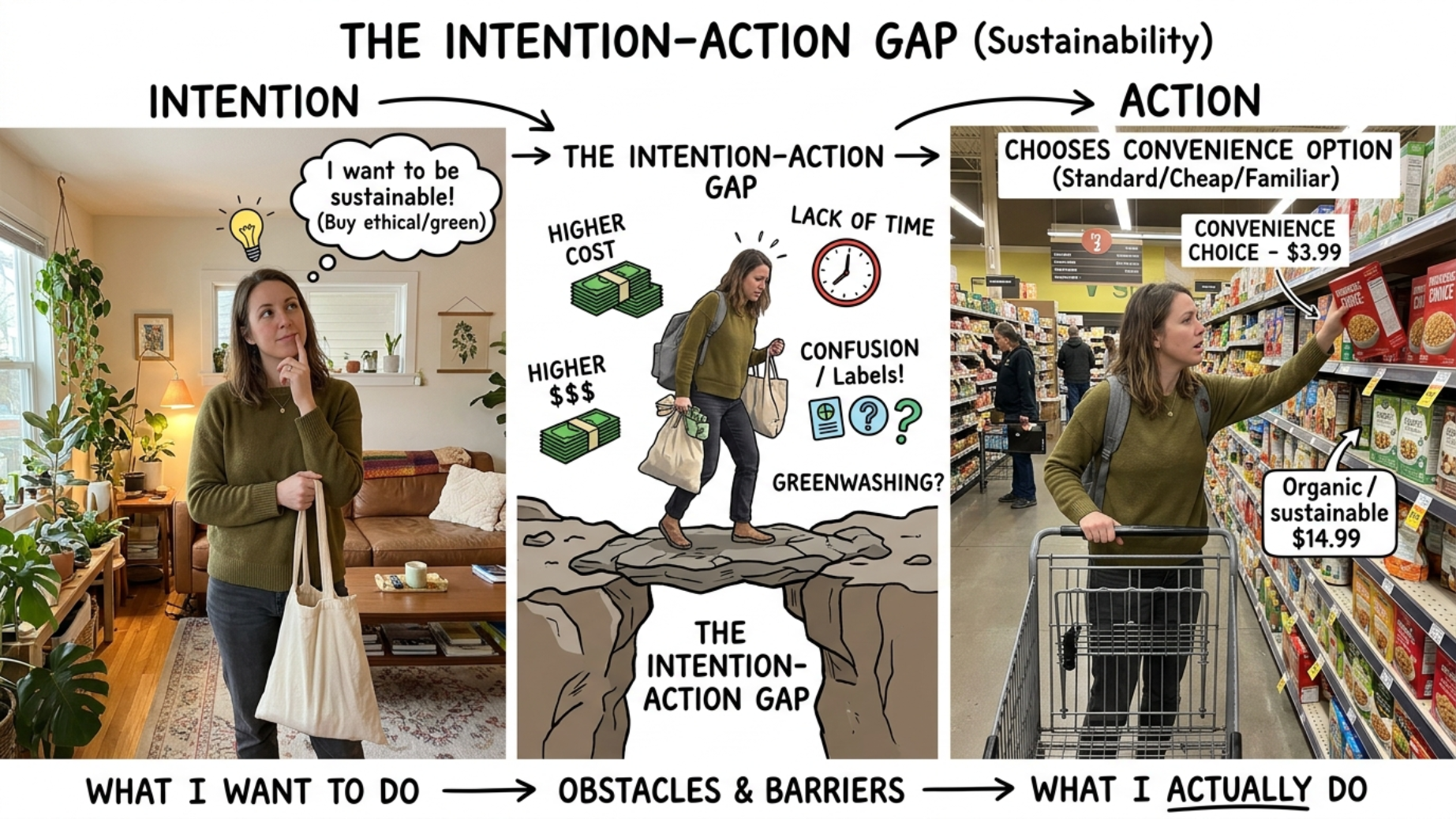
Harvard Business School frames it as a core challenge in sustainable consumer goods, noting that consumer willingness to pay for sustainable options frequently does not translate into actual purchases source. The behavioral science behind this is well established. Meta-analytic research has found that intentions explain only about 28% of the variance in behavior source. That leaves a lot of room for the gap to open.
The term is sometimes called the intention-behavior gap, the value-action gap, the attitude-behavior gap, or the say-do gap. These labels overlap, but they point to the same core problem: knowing what someone wants to do tells you surprisingly little about what they will do.
For a deeper look at how this plays out in sustainable behavior specifically, see bridging the intention-action gap in sustainable behavior.
The Intention Action Gap in Plain English
Think of it this way. Intent usually forms in a low-friction mental state. You’re scrolling your phone, answering a survey, or chatting with friends. In that moment, saying “yes, I care about sustainability” costs nothing. Action happens in a high-friction real context: standing in a store aisle, comparing prices, running late, feeding kids, managing a budget.
Some everyday examples:
“I intend to bring reusable bags.” You leave them at home and buy plastic bags at checkout.
“I want to buy sustainable fashion.” You buy fast fashion because it is cheaper, trendier, and available now.
“I support refill packaging.” You choose the regular bottle because the refill system is confusing or not stocked.
“I care about recycling.” You throw the package away because the labels are unclear.
“I say I’ll pick the sustainable brand.” You default to the familiar one at shelf.
None of these examples involve bad people. They involve real people making real trade-offs under real constraints. That distinction matters for how brands and organizations respond.
Why the Intention Action Gap Happens
The gap does not have a single cause. It has a web of causes, and they often overlap.
Table: Top Barriers to Sustainable Action (2026 Data)
Barrier Category | Impact Level | Primary Consumer Pain Point |
Financial | High | Sustainable products priced 20%+ higher than conventional. |
Cognitive | High | "Greenwashing fatigue" and confusing eco-labels. |
Structural | Medium | Lack of availability in local stores or digital filters. |
Performance | Medium | Fear that "natural" means "less effective" (the compromise). |
Price and Affordability
Sustainable options frequently carry a premium. Practitioners on Reddit’s r/ZeroWaste frame this clearly: sustainable products can be too expensive, people should do what they can within their financial circumstances, and buying less or reusing what you have can be more practical than buying premium “sustainable” alternatives source. The gap here is not about weak values. It is about a budget that does not bend.
Convenience and Access
If the sustainable option is hard to find, requires extra steps, or is not available at the decision point, intention leaks. Kantar reports that 18% of people cite the effort and research required to make the right choice as a significant friction source. When sustainable alternatives require more work, most people default to what is easy.
Habit and Defaults
People repeat familiar behavior unless something in the environment changes. Habit is powerful precisely because it operates below conscious decision-making.
Unclear Claims and Distrust
If consumers do not understand or trust a sustainability claim, they default to the familiar product. The European Commission found that 53% of green claims give vague, misleading, or unfounded information, and 40% have no supporting evidence source. Reddit threads on r/Sustainable reflect this. Users say they trust products more when they are durable, refillable, and repairable, and express deep skepticism toward products heavily marketed as sustainable but weak on quality source. Unclear claims create decision paralysis, and paralysis usually ends with the familiar choice.
For brands navigating claims credibility, understanding how to avoid greenwashing is a practical starting point.
Delayed or Distant Rewards
Climate benefits, biodiversity protection, and waste reduction feel abstract compared with immediate price, taste, and comfort. A LinkedIn practitioner article frames the gap as a tension between instant rewards and distant environmental benefits, listing barriers such as inconvenience, lack of trust, futility, and unaffordable green products source. Distant planetary benefits rarely beat immediate personal trade-offs unless the offer also wins on the shopper’s present needs.
Product Compromise
This one is blunt. If a sustainable product performs worse, looks worse, tastes worse, or creates extra work, it asks consumers to sacrifice. A thread on r/SustainableFashion captures this plainly: sustainable clothing often fails if it wrinkles, loses structure, does not feel good, or does not hold up after wear source. Sustainability cannot compensate for a product that fails the basic job people bought it to do.
Deloitte and the Ad Council confirm this at scale: in grocery decisions, personal impact factors like taste, value, and quality are rated materially higher than sustainability source.
Bad Measurement
Sometimes the gap is partly an artifact of how intent is measured. Surveys that ask abstract questions (“Do you care about sustainability?”) without competitive context, real trade-offs, or price constraints will overstate demand. SKIM warns that abstract sustainability research can be skewed by social desirability, acquiescence, anchoring, and halo effects source. Part of closing the gap is measuring it more honestly.
Intention-Action Gap Breakdown Framework
Factor | What Breaks It | Real-World Impact | Fix |
|---|---|---|---|
Price | Sustainable premium pricing | Consumers default to cheaper alternatives | Subsidies, value framing, cost-per-use |
Convenience | Extra steps or effort required | Drop-off at point of purchase | Defaults, subscriptions, simplification |
Trust | Greenwashing or unclear claims | Consumers ignore sustainability labels | Certifications, transparent proof |
Habit | Existing purchasing routines | Repeat buying of familiar brands | Behavioral nudges, reminders |
Product Quality | Worse performance vs alternatives | Sustainability is deprioritized | Improve core product performance |
The Intention Action Gap in Sustainability Marketing
"The intention-action gap is not a consumer failure; it is a design failure. If your sustainable product requires a hero to buy it, your business model is the barrier." — Sustainable Brand Strategy Insight
This is where the term has its strongest commercial relevance.
The famous data point comes via Harvard Business School: 65% of consumers said they wanted to buy purpose-driven sustainable brands, but only about 26% actually did source. That 39-point gap is not proof that sustainability lacks demand. It is proof that stated interest does not automatically convert under real-world conditions.
There is genuine commercial opportunity in closing this gap. McKinsey and NielsenIQ analyzed five years of U.S. sales data across 600,000 SKUs and $400 billion in annual retail revenues. Products with ESG-related claims averaged 28% cumulative growth over five years, compared with 20% for products without such claims source. NYU Stern’s 2024 Sustainable Market Share Index reports that products marketed as sustainable accounted for 41% of CPG growth from 2013 to 2024 source.
The takeaway is not “sustainability sells itself.” It is that sustainable products can outperform when they deliver on the fundamentals: price, quality, convenience, trust, and emotional reward. The gap closes when sustainability is part of a complete value proposition, not a decorative claim sitting on top of a weak one.
Kantar illustrates this with a striking finding: when consumers faced a choice between a favorite brand and a competitor, 89% chose the favorite. But when the competitor was clearly signposted as sustainable, preference for it rose from 11% to 33% source. Clear signposting works, but only when the product behind the claim is credible.
Real-World Example of the Intention-Action Gap
A consumer may express strong intent to reduce plastic waste and choose sustainable packaging. However, at the point of purchase, they may select a cheaper conventional product because it is more readily available, better known, or requires no behavioral change. This demonstrates that the barrier is not awareness, but friction at the moment of decision.
Emerging Trends: The 2026 Perspective
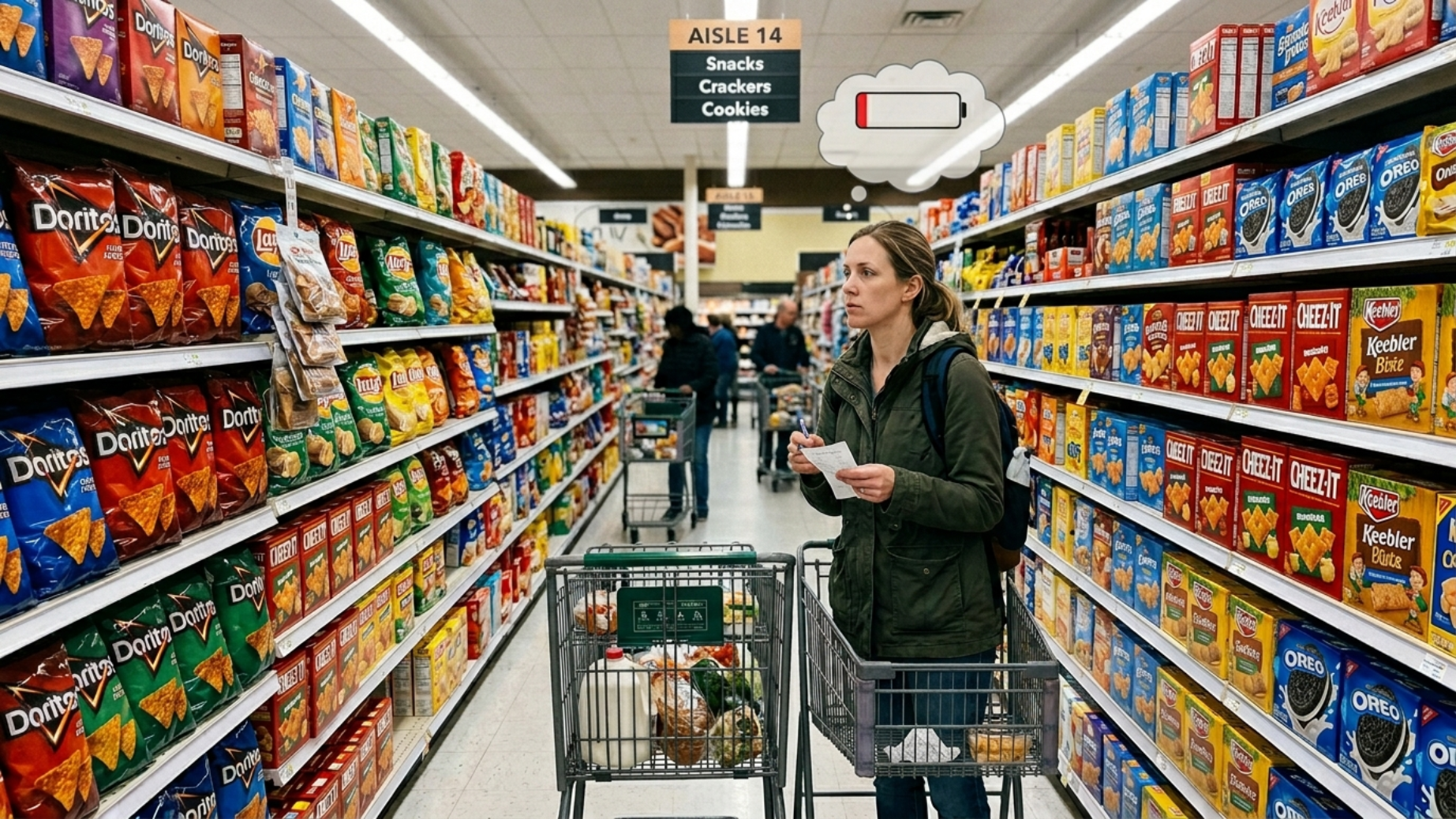
While price and convenience remain foundational, the psychology of the gap has evolved. Recent behavioral shifts show that the gap is widening due to Decision Fatigue. As consumers face an average of 30,000+ choices in a standard supermarket, cognitive load leads to "habitual defaulting"—the brain simply lacks the energy to calculate the carbon footprint of a pasta sauce when it's tired.
Digital Nudges & AI: In 2026, the most successful brands have moved past "awareness." They are using AI-driven "green defaults" in e-commerce carts—such as automatically selecting carbon-neutral shipping or refillable packaging—to bridge the gap at the point of sale without requiring extra cognitive effort from the user.
The 'Eco-Anxiety' Factor: We have reached a tipping point where over-communicating crisis data can actually increase the gap by causing "ostriching" (behavioral avoidance). High-performing brands in 2026 are shifting messaging away from "Save the Planet" and toward "Enhance Your Lifestyle."
The Rise of Transparency Tech: With the maturity of blockchain-backed supply chains, "Trust" is no longer a marketing claim; it is a verifiable data point. Consumers now expect to scan a QR code and see the immediate journey of the product, reducing the friction of skepticism.
Feature | Classic IAG View | 2026 Behavioral View |
Primary Barrier | High Price / Premium | Decision Fatigue / Cognitive Load |
Consumer Role | Conscious decision-maker | Habitual "Defaulter" |
Messaging Focus | Environmental Impact | Personal Benefit & Lifestyle |
Brand Strategy | Awareness Campaigns | Algorithmic Nudges & Defaults |
Trust Source | Brand Heritage / Logos | Real-time Data & Traceability |
How to Measure the Intention Action Gap
Most content about the gap describes it. Few explain how to measure it. Here is a practical framework.
1. Define the intended behavior precisely.
Bad: “Consumers want sustainability.” Better: “Target shoppers intend to buy the refill pouch instead of the standard bottle at least once in the next 30 days.”
2. Measure stated intention.
Use surveys, interviews, concept tests, or brand trackers. But treat these as inputs, not proof. SKIM recommends supplementing stated preferences with behavioral data and predictive modeling source.
3. Measure actual behavior.
Use sales data, repeat purchase rates, clickstream data, loyalty data, A/B tests, basket analysis, or retail activation results. McKinsey and NielsenIQ demonstrate the value of actual sales data over sentiment alone source.
4. Calculate the gap.
Intention action gap = stated intent rate − observed action rate
Example: 62% say they intend to buy the refill. 18% actually buy it. Gap = 44 percentage points.
5. Segment the gap.
Break it down by audience segment, channel, price tier, geography, retail environment, claim type, product format, and purchase frequency. GlobeScan’s 2024 report identifies distinct segments (from Anxious Inactives to Enthusiasts), each requiring different engagement strategies source.
6. Diagnose the barrier type.
Is it price? Access? Trust? Habit? Product quality? Unclear claims? The answer determines the fix.
7. Test interventions.
Run experiments on price framing, pack design, claims language, proof points, retail signage, digital defaults, social proof, sampling, and simplified checkout.
8. Measure repeat, not just trial.
Getting someone to try once is not closing the gap. Converting intent into repeatable behavior is.
For teams looking to diagnose their own intention action gap with structured research, Grounded World’s Discover service is built around intention-action gap research, analysis, and quantification.
Why the Intention-Action Gap Matters in Marketing & SEO
The intention-action gap is a critical concept in consumer psychology and marketing strategy because it explains why high-interest audiences do not always convert into buyers. Understanding this gap helps brands improve conversion rates, optimize product design, and align messaging with real-world behavior rather than stated intent.
How Brands Can Close the Intention Action Gap
Make the Action Easier
Reduce steps, confusion, and effort. Trellis frames this simply: brands can help consumers close the gap by decreasing effort, increasing rewards, or both source.
Make the Sustainable Choice Available at the Moment of Decision
If the better option is not on shelf, not in search filters, or not in the cart flow, intent leaks. Availability at the decision point is table stakes. The gap in digital grocery is a good example of this challenge, where convenience and sustainability often collide.
Preserve the Category Basics
Do not ask sustainability to compensate for weak taste, quality, durability, convenience, or price. Kantar argues brands should not expect consumers to sacrifice fundamental benefits like experience, taste, or efficacy source.
Translate Abstract Impact into Immediate Value
Instead of vague eco language, try claims that land in real life:
“Lasts 3x longer”
“Refill saves money after two uses”
“Made for sensitive skin”
“Lower-waste packaging, same performance”
“Repairable for years”
A claim that sounds good to a sustainability team may still fail at shelf if the consumer cannot quickly understand the personal benefit, proof, or trade-off.
Prove the Claim
Use specific, substantiated, and easy-to-understand claims. Both the FTC Green Guides and the EU’s green claims framework emphasize avoiding misleading or unsupported environmental marketing source. Trust is part of conversion.
Use Behavioral Prompts
“If-then” planning helps people act when a cue appears. In brand contexts, this translates into prompts like “when your bottle is empty, refill here” or “when you check out, choose consolidated delivery.” Meta-analytic research on implementation intentions found a medium-to-large effect on goal attainment across 94 tests source.
Build Social Proof
Show what peers, communities, employees, and retailers are doing. When people see others acting, the desired behavior feels less unusual and more achievable. Building effective stakeholder engagement can amplify this.
Design for Repeat Behavior
Use subscriptions, reminders, loyalty rewards, easier refills, saved preferences, and default reordering. Closing the gap once is good. Keeping it closed is the commercial goal.
Connect Marketing to Product, Retail, and Operations
Marketing alone cannot close a gap caused by poor availability, high price, weak claims, or a product that disappoints. The solution is cross-functional. A strong brand activation strategy connects messaging to the product, the shelf, and the experience.
The IAG Conversion Equation

Most content says “people say one thing and do another.” That is the observation, not the diagnosis. Here is a framework that shows where the gap forms.
Action = Intent × Ability × Trust × Reward × Trigger
If any factor is weak, action drops.
Factor | What it means | Common failure | How to fix it |
|---|---|---|---|
Intent | The person wants or values the outcome | Intent is vague (“I care about sustainability”) | Convert values into a specific behavior: buy refill, choose lower-waste pack |
Ability | The action is easy, affordable, available | Product is hard to find, expensive, or confusing | Improve distribution, pricing, packaging cues, instructions |
Trust | The person believes the claim and the brand | Claims feel vague or greenwashed | Use specific claims, proof, certifications, transparent data |
Reward | The action has a clear benefit now | Benefit is distant or purely planetary | Add personal benefit: durability, savings, health, taste, status |
Trigger | The right cue appears at the right moment | Consumer defaults to habit | Use defaults, prompts, retail signage, subscriptions, social norms |
This equation is useful because it turns a vague problem (“people aren’t buying”) into a diagnostic question (“which factor is weakest?”). It also makes clear that awareness campaigns only address intent, while the other four factors often determine whether action follows.
What the Intention Action Gap Is Not
Clearing up common misconceptions helps teams respond more effectively.
It is not hypocrisy. People can sincerely care and still fail to act. Ipsos explicitly warns against positioning consumers as irrational or as a problem to manage source. The better approach is to identify what prevents the desired behavior and design support around it.
It is not always about awareness. Many people already know the issue exists. Awareness campaigns have diminishing returns when the real barrier is price, access, or trust.
It is not only about price. Price matters a lot, but trust, clarity, effort, product performance, and social norms also contribute. Solving only for price misses the full picture.
It is not solved by a campaign alone. Campaigns work best when the product, proof, retail environment, and action path are all aligned. A brilliant ad for a product that is not on shelf changes nothing.
It is not proof that sustainability lacks demand. The McKinsey/NielsenIQ and NYU Stern data show sustainable products can grow. But that growth requires a value proposition that works under real conditions, not just good intentions.
Examples by Category
Sustainable Packaging
Intention: “I want less plastic.”
Action: Buys the familiar plastic format because refill is more expensive or confusing.
Bridge: Make refill cheaper over time, clear in use, available at shelf, and equivalent in performance.
Ethical Fashion
Intention: “I want to avoid fast fashion.”
Action: Buys trend-led fast fashion because sustainable alternatives are expensive, less stylish, or disappointing in fit.
Bridge: Lead with durability, style, cost per wear, repairability, and proof of ethical sourcing.
Grocery
Intention: “I want to buy more sustainable food.”
Action: Chooses based on price, taste, family preference, and habit.
Bridge: Link sustainability to health, taste, and value. Personal impact matters more in grocery decisions than planetary impact does.
Recycling
Intention: “I want to recycle correctly.”
Action: Throws packaging away because local rules or labels are unclear.
Bridge: Use simple disposal instructions, standardized labels, and local infrastructure support.
Intention vs Action: What Actually Happens
Stage | Intention State | Action State |
|---|---|---|
Mindset | Low friction, idealistic | High friction, practical |
Decision context | Surveys, opinions | Store shelf, checkout |
Drivers | Values, beliefs | Price, habit, convenience |
Outcome | “I want to be sustainable” | “I bought what was easiest” |
Why the Term Matters for Brands and Nonprofits
For brands, retailers, startups, nonprofits, and social enterprises, the intention action gap is where purpose either becomes behavior or stays as messaging. Diagnosing the gap helps teams understand why sustainability or social impact investments are not translating into demand, adoption, retail conversion, or measurable impact.
The practical question is always: “Where exactly is the gap opening, and what would it take to close it?” That requires research, not guesswork. Grounded World’s work is positioned around commercializing sustainability, consumer behavior change, brand activation, and intention-action gap research, analysis, and quantification, making this kind of diagnosis central to turning purpose into real business outcomes.
If your team is seeing the gap between consumer interest and commercial results, start a conversation with Grounded World about diagnosing and closing it.
Frequently Asked Questions
What is the intention action gap?
The intention action gap is the difference between what people say they intend to do and what they actually do. It is especially visible in sustainability, where consumers express interest in greener products but often do not follow through at the point of purchase.
What is an example of the intention action gap?
A shopper says they intend to buy sustainable cleaning products. At the store, they see the sustainable option is 40% more expensive, the claims are confusing, and the familiar brand is right there. They buy the familiar brand. Their intention was real. The context killed the action.
Is the intention action gap the same as the say-do gap?
They describe the same general problem but with slightly different emphasis. The say-do gap focuses on the mismatch between what people say and do. The intention action gap focuses specifically on planned behavior that does not happen. In practice, marketers and researchers use these terms almost interchangeably.
Why is the intention action gap so common in sustainability?
Sustainable choices often involve trade-offs that conventional choices do not: higher prices, less availability, unfamiliar brands, confusing claims, and benefits that feel distant and planetary rather than immediate and personal. When the sustainable option requires more effort, research, or cost, intent breaks down.
How do you measure the intention action gap?
You measure the intention-action gap by subtracting the Observed Action Rate (actual sales/behavior data) from the Stated Intent Rate (survey data). For example, if 70% of customers say they will recycle but only 30% do, your Intention-Action Gap is 40 percentage points.
How can brands close the intention action gap?
Make the desired action easier, more available, more affordable, more trusted, and more rewarding in the moment. Preserve category basics like quality and convenience. Use clear, substantiated claims. Design for repeat behavior, not just trial. And measure what people actually do, not only what they say they will do.
Is the intention action gap caused by greenwashing?
Greenwashing contributes to it by eroding trust. When consumers have been burned by vague or misleading claims, they become skeptical of all sustainability messaging and default to familiar products. The European Commission found that over half of green claims examined were vague or unfounded, which directly feeds consumer distrust.
Is consumer intent reliable?
Intent is useful as a signal but unreliable as a forecast. Research shows that changing someone’s intention produces a smaller change in behavior than you might expect. Surveys work best when they include realistic trade-offs, competitive context, and price. Treat stated intent as an input to strategy, not proof of demand.