
 Gaia
GaiaTL;DR
Purpose driven startups need agency partners who understand both mission and margins. This guide profiles 15 agencies that specialize in purpose, sustainability, or social impact work, ranked by their actual fit for startups rather than brand fame. Grounded World tops the list for its ability to bridge purpose and profit through proprietary frameworks and a B Corp score of 116. Bolder and Supur are strong picks for early stage founders on tighter budgets. New additions like Enso, Matter Unlimited, and Fifty & Fifty round out a comprehensive list of options across every startup stage and budget.
Quick Answer: What Are the Best Purpose Driven Agencies for Startups in 2026?
For most startups, the best purpose driven agencies are not the biggest names. They are the agencies that match your stage, budget, and mission complexity. Grounded World is the strongest overall choice for startups needing purpose strategy connected to commercial growth. Supur and Bolder are better fits for early stage companies needing startup friendly support, while Futerra and BBMG are better suited for funded companies seeking global sustainability expertise. Carol Cone ON PURPOSE and Enso are worth considering for startups that need deep thought leadership and cultural research backing their purpose work.
Startup Need | Best Agency Choice | Why |
|---|---|---|
Overall purpose + business growth | Grounded World | Combines purpose strategy, sustainability, and commercial activation |
Pre seed / early stage startup | Supur | Designed specifically for smaller organizations |
Climate tech startup | Bolder Agency | Startup branding expertise in climate and deep tech |
Enterprise level sustainability | Futerra | Global sustainability strategy experience |
Consumer brand positioning | BBMG | Brand innovation and social impact expertise |
Digital impact measurement | Whole Whale | Data driven social impact execution |
Purpose thought leadership | Carol Cone ON PURPOSE | Decades of purpose strategy experience |
Cultural relevance + purpose | Enso | World Value Index research backing |
Bottom Line: Choose a purpose driven agency based on your startup stage first, not agency reputation. Early stage founders usually benefit from boutique specialists, while later stage companies need agencies capable of handling global campaigns and stakeholder complexity.
Book a free discovery call to explore whether a purpose driven approach fits your startup’s stage and goals.
Why Purpose Driven Startups Need a Specialized Agency
Purpose is no longer a nice to have. It is a commercial requirement. A 2025 McKinsey and NielsenIQ study found that products making ESG related claims grew 8% faster than those without. Purpose driven brands grow about twice as fast as those without one, and B2C consumers are 4 to 6 times more likely to purchase from brands with a clear purpose.
But here is the tension startups face: 50 million new startups launch globally each year, and roughly 90% of them fail. Forty two percent fail because they misread demand. A generic branding agency won’t help a sustainability startup avoid that trap. Neither will a purpose consultancy that only serves Fortune 500 clients.
The risk of getting purpose wrong is also growing. Marketing teams must move past superficial messaging and do the deep work. Brands that fake it risk massive backlash, and startups are especially vulnerable because they lack institutional credibility. As one practitioner noted in the Bonfire newsletter, “It’s not easy being a venture backed startup whose ambitions go beyond ‘maximize shareholder revenue.’” That tension between mission and growth is exactly why a purpose driven marketing approach matters.
The right agency doesn’t just make your purpose sound good. It makes your purpose sell.
How We Evaluated These Agencies
Every agency on this list was assessed against six criteria designed specifically for startup founders, not enterprise procurement teams:
B Corp or equivalent certifications. Third party proof that the agency practices what it preaches.
Startup stage experience. Does the agency actually work with early stage companies, or is the client list exclusively Fortune 500?
Commercial outcomes. Can they tie purpose work to revenue, purchase intent, or market traction, not just awareness?
Service breadth. Strategy only, or strategy through execution?
Pricing accessibility. Minimum project sizes, engagement flexibility, and whether custom scoping is available.
Honest positioning. Does the agency clearly state what it does and doesn’t do?
Only 33% of people think brands communicate their purpose effectively, and only 18% of consumers are even aware of major brands’ purpose. The agencies below were chosen because they specialize in closing that gap, particularly for companies still building their reputation.
Purpose Driven Marketing Statistics That Matter in 2026
Before picking an agency, founders should understand the numbers driving this space. These statistics shape how the best purpose driven agencies build their strategies:
Products with ESG claims grew cumulative revenue 28% over five years, versus 20% for products without them (McKinsey/NielsenIQ, 2025).
79% of consumers say they are willing to pay a sustainability premium, but far fewer follow through. This intention action gap is the central problem agencies must solve. Understanding why consumers don’t buy sustainable products is essential groundwork.
When brands pair clear social commitments with functional excellence, consumer preference rises from 42% to 70%, according to HBR research from 2025.
64% of respondents buy or avoid brands based on societal beliefs (Edelman 2025 Brand Trust report), and one in two respondents assume the worst if brands stay silent.
94% of Gen Z consumers expect companies to take a stand on social issues.
These numbers explain why purpose driven agencies exist. They also reveal why startups can’t afford to get purpose wrong. A vague values statement won’t cut it. The agencies on this list know how to turn these statistics into strategy.
Quick Comparison Table
Agency | Best For | B Corp | Min. Project Size | Core Capability | Key Differentiator | Startup Experience |
|---|---|---|---|---|---|---|
Grounded World | Purpose startups needing commercial outcomes | Yes (Score: 116) | Custom scoped | Brand purpose + sustainability marketing | Intention action gap diagnosis | Strong |
Futerra | Well funded sustainability startups | Yes (Score: 102.3) | Six figure+ | Sustainability strategy + creative | Global reach, UN level clients | Limited |
BBMG | Consumer brands, mission driven startups | Yes | Custom | Brand innovation + social impact | Inside out brand co creation | Moderate |
Conspiracy of Love | Purpose transformation, brand partnerships | Yes | Custom | Purpose consultancy | “Good Is The New Cool” methodology | Limited |
School | Edgy CSR and purpose communication | No | Custom | Creative + CSR programs | Disruptive, culture forward | Explicit startup mention |
Supur | Early stage social impact programs | No | Low (startup scale) | Social impact consulting | Built for small businesses | Very strong |
Bolder Agency | Climate tech and deep tech startups | Not confirmed | $30,000+ | Branding + communications | Built for meaningful change startups | Very strong |
Murmur Creative | Social impact brand identity | No | Custom | Brand identity + design | Ethical collaboration focus | Moderate |
HelpGood | Nonprofits and socially responsible startups | No | Custom | Marketing + communications | Social good specialization | Moderate |
Whole Whale | Data driven social impact orgs | Yes | Custom | Digital strategy + data | Tech forward impact measurement | Moderate |
Carol Cone ON PURPOSE | Purpose strategy thought leadership | No | Custom | Purpose consulting + activation | 40+ years of purpose expertise | Limited |
Enso | Cultural purpose research + strategy | No | Custom | Purpose research + branding | World Value Index proprietary research | Moderate |
Fifty & Fifty | Nonprofit and cause driven startups | No | Custom | Digital + creative | Exclusively cause focused | Moderate |
Matter Unlimited | Social impact design and campaigns | No | Custom | Design + strategy | Impact only client focus | Moderate |
Cause+Affect | Australian purpose driven brands | No | Custom | Strategy + creative | Regional purpose specialist | Moderate |
How to Choose the Right Branding Agency for Your Startup
Finding the right agency is less about who has the flashiest portfolio and more about fit. Practitioners on Reddit frequently point out that the best agency relationship they ever had was with a small shop that actually understood their business model, not a big name that treated them as a low priority client. Here is a practical framework.
Define Your Brand Goals and Budget First
Before reaching out to any agency, get clear on three things:
What outcome do you need? Purpose definition, brand identity, go to market positioning, retail activation, or all of the above?
What is your realistic budget? Be honest. If you have $15,000, don’t waste time with agencies that start at $100,000. Agencies like Supur and Murmur Creative work at smaller scales. Bolder starts at $30,000.
What is your timeline? Pre launch positioning has different urgency than a Series A rebrand.
Founders who skip this step end up in discovery calls that go nowhere. The agencies worth working with will ask you these questions anyway, so having answers ready saves everyone time.
Shortlist Agencies by Niche and Portfolio
Not every purpose driven agency serves every sector. Climate tech startups should look at Bolder. Consumer packaged goods brands will get more from Grounded World or BBMG. Social enterprises focused on nonprofit partnerships should consider Supur or HelpGood.
When reviewing portfolios, look for:
Clients at a similar stage and budget to yours
Case studies with measurable outcomes (not just “we redesigned their logo”)
Work in your specific sector or an adjacent one
Evidence they understand the intention action gap between what consumers say and what they buy
One startup founder shared on LinkedIn that they wasted three months with an agency whose portfolio was all Fortune 500 work. The agency produced beautiful strategy decks but had no idea how to execute on a startup timeline or budget. Match the portfolio to your reality.
Best Purpose Driven Agencies by Startup Stage
Best Agencies for Pre Seed Startups
Agency | Why It Fits |
|---|---|
Supur | Built specifically around startups and small businesses |
Bolder Agency | Startup native approach with clear project pricing |
Murmur Creative | Founder friendly collaborative process |
Pre seed founders usually need clarity more than scale. The best agencies at this stage help define positioning, audience, and purpose narrative without requiring enterprise budgets.
Best Agencies for Seed Stage Startups
Agency | Why It Fits |
|---|---|
Grounded World | Helps translate purpose into commercial positioning |
Bolder Agency | Strong for climate tech and deep tech companies |
School | Strong creative differentiation |
Enso | Cultural research to validate purpose positioning |
Seed stage startups need a story that works for customers, investors, and partners.
Best Agencies for Series A+ Companies
Agency | Why It Fits |
|---|---|
Futerra | Global sustainability expertise |
BBMG | Brand innovation and consumer positioning |
Conspiracy of Love | Purpose transformation and partnerships |
Carol Cone ON PURPOSE | Deep strategic purpose consulting |
Later stage startups usually need stakeholder alignment, global messaging, and scalable brand systems.
The Best Purpose Driven Agencies for Startups
1. Grounded World
Best for: Sustainability focused startups that need purpose to drive revenue, not just brand storytelling.
Grounded World is a B Corp certified boutique agency with a reported B Impact Score of 116, higher than every other agency on this list. It is women led, and its service model follows four clear phases: Discover, Articulate, Activate, and Accelerate. That structure matters for startups because you can engage at the phase you actually need rather than buying a bloated retainer.
What sets Grounded World apart is its focus on the intention action gap, diagnosing why consumers say they care about sustainability but don’t follow through with their wallets. This is the central problem for any purpose driven startup trying to convert good intentions into actual purchases. When brands pair clear social commitments with functional excellence, consumer preference rises from 42% to 70%, according to HBR research from 2025. Grounded World’s proprietary frameworks (BPP, 5Rs, Flywheel of Impact) are built to capture that lift.
Key features:
AI assisted 5C landscape assessments covering Company, Culture, Category, Competitor, and Consumer
Full spectrum services from brand strategy and positioning through packaging, retail activation, and social impact campaigns
Complimentary discovery call and AI driven 5C landscape assessment as an entry point
Proprietary frameworks for brand activation strategy and impact measurement
Notable clients: Grove Collaborative, Tribes on the Edge, Wasu, Fresh Air Fund, UNMAS, Plan USA, Network of Executive Women.
Certifications: B Corp, Ethical Agency Alliance, 1% for the Planet, Science Based Targets, Top 100 Global Social Impact Company.
Pricing: Custom scoped engagements. No public tiers, but the boutique model means you won’t face the six figure minimums of enterprise agencies.
Trade offs:
Not a performance marketing or paid media agency. If you need PPC management, look elsewhere.
Focused on purpose, sustainability, and social impact positioning rather than generalist demand gen mechanics.
No self serve packages or transparent pricing online.
Startup fit: Strong. Works with startups, brands, retailers, and nonprofits. The phased service model lets early stage teams scope tightly.
2. Futerra
Best for: Well funded startups in sustainability or climate needing global creative firepower and institutional credibility.
Futerra is a change agency that joins creative with strategy to make sustainability happen. Since 2001, they have pursued the mission of “making sustainable development so desirable it becomes normal.” Majority owned and led by women, Futerra was one of the UK’s first B Corps, with teams in London, Stockholm, New York, San Francisco, and Mexico City.
Their client list is formidable: Google, WWF, Estée Lauder, Lego, Danone, Netflix, and the United Nations. That pedigree brings real strategic depth but also signals enterprise level pricing.
Key features:
Global sustainability strategies and creative campaigns
Deep expertise in climate communications and behavior change
B Impact Score of 102.3 (median for ordinary businesses is 50.9)
Multi city presence for international projects
Pricing: Not public. Based on client profile, expect six figure plus engagements.
Trade offs:
Enterprise heavy client list. Startups without Series A or beyond funding will likely be outpriced.
Glassdoor reviews are mixed on internal culture, though practitioners praise the “fascinating work” and “really lovely and talented team.”
Less likely to offer the flexible, custom scoped engagements that pre seed teams need.
Startup fit: Limited unless well capitalized. Best for Series B+ startups wanting to associate with a globally recognized name.
3. BBMG
Best for: Purpose driven consumer brands and mission driven startups needing brand innovation.
Founded in 2003, New York based BBMG is a globally recognized brand innovation studio that creates business solutions and brand experiences designed to drive both revenue and positive social impact. They describe their approach as the point where “the sustainability imperative meets co creating authentic brands from the inside out.”
Key features:
Brand strategy, identity, and innovation focused on social impact
Active in B Local NYC and the broader B Corp community
Client list spanning consumer (Burton Snowboards, The North Face, Target, General Mills) and nonprofit (ASPCA, Ford Foundation, Planned Parenthood)
Pricing: Custom. Not public.
Trade offs:
Primarily serves established brands. Pre seed and seed startups may not be the right fit.
Innovation studio model may lean heavier on strategy than execution.
Limited public information on startup specific engagements.
Startup fit: Moderate. A better match for startups that already have product market fit and need brand refinement, not from scratch positioning.
4. Conspiracy of Love
Best for: Startups wanting purpose transformation tied to major brand partnerships and thought leadership.
Founded in 2017 by Afdhel Aziz and Bobby Jones, co authors of “Good Is The New Cool,” Conspiracy of Love is a global purpose consultancy creating Purpose Transformation journeys. They are a B Corp and minority owned business, working with leaders at companies like Adidas, Sephora, and PepsiCo.
Key features:
Purpose transformation frameworks rooted in the “Good Is The New Cool” methodology
B Corp certified and minority owned
Strong thought leadership presence (books, speaking, media)
Pricing: Custom. Not public.
Trade offs:
Heavy on Fortune 500 clients. The purpose transformation model may be more consultative than execution oriented for early stage companies.
Less suited for startups that need hands on campaign development or retail activation.
The consultancy model means you may still need a separate agency for creative execution.
Startup fit: Limited for early stage. Could work for startups with a clear product but an undefined purpose narrative, especially those seeking partnership connections with larger brands.
5. School (by Project Worldwide)
Best for: Startups wanting edgy, disruptive CSR and purpose communication.
School began as a creative agency in Boulder, Colorado. They sit more on the advertising side of purpose work, helping brands develop CSR programs and communicate them in ways that feel disruptive and fun rather than preachy. Since 2013, they have worked with “major brands, nonprofits and startups to help unlock purpose in business and culture alike.”
Key features:
Creative first approach to purpose and CSR
Explicit startup mention in their positioning
Culture forward campaigns that avoid the “corporate responsibility” tone
Pricing: Custom. Not public.
Trade offs:
More creative/communications than strategic. If you need help defining your purpose before communicating it, this may not be the right starting point.
Part of Project Worldwide, a larger holding company. Boutique feel may vary.
Limited public case studies for early stage startups specifically.
Startup fit: Strong on paper. The explicit startup mention is encouraging, and the creative approach works well for consumer facing brands that need to stand out.
6. Supur
Best for: Early stage startups launching their first social impact programs on a limited budget.
Supur is a social impact consultancy focused on helping startups and small businesses make money doing good. They help startups launch social impact programs, establish nonprofit partnerships, and communicate impact. Services include social media, public relations, brand strategy, and project management.
Key features:
Purpose built for startups and small businesses
Social impact program design and nonprofit partnership brokering
PR and communications included in service scope
Lower barrier to entry than enterprise focused agencies
Pricing: Not publicly listed, but the startup and small business focus suggests significantly lower minimums than agencies like Futerra or BBMG.
Trade offs:
Small scale may limit scope for fast growing startups.
Less suited for deep brand strategy or sophisticated sustainability branding.
May not have the resources for large scale campaign execution.
Startup fit: Very strong. The most startup native agency on this list.
7. Bolder Agency
Best for: Climate tech, energy transition, and deep tech startups from early stage to scale up.
Bolder is a branding and communications agency purposefully built for startups working on meaningful change, particularly in energy transition, robotics, AI, biotech, and climate tech. With a minimum project size of $30,000, they are one of the few agencies on this list with transparent pricing floors.
Key features:
Sector expertise in climate tech and deep tech
Branding, communications, and go to market support
Designed for the startup to scaleup journey
$30,000 minimum project size (transparent and accessible)
Pricing: Starts at $30,000 per project.
Trade offs:
B Corp status not confirmed. The lack of third party certification is a gap for agencies in this space.
Sector focused, so consumer facing sustainability brands may not be the right fit.
Less emphasis on social impact or nonprofit partnership work.
Startup fit: Very strong for the right sector. If you are building climate tech or deep tech, Bolder understands your world.
8. Murmur Creative
Best for: Startups integrating social impact into core brand identity through collaborative design.
Murmur Creative takes a hands on collaborative approach with “particular dedication to elevating brands that have a passion for doing good.” Their focus is on authenticity, ethical business practices, and meaningful collaboration with clients rather than agency as authority dynamics.
Key features:
Brand identity and design with a purpose lens
Collaborative, client centered process
Ethical business practices embedded in their operations
Pricing: Custom. Not public.
Trade offs:
Limited to purpose driven focus. May not suit purely commercial tech startups.
Smaller agency with narrower service scope than full service options.
Less public evidence of startup specific case studies.
Startup fit: Moderate. A good match for founders who want a close, collaborative relationship with their agency and are focused on brand identity specifically.
9. HelpGood
Best for: Nonprofits and socially responsible startups needing marketing and communications support.
HelpGood is a purpose driven agency focused on social good, working with nonprofits, government agencies, and socially responsible companies. Their orientation is squarely in the social impact space.
Key features:
Marketing, communications, and campaign development for social good
Experience with government and nonprofit stakeholders
Mission alignment baked into agency identity
Pricing: Custom. Not public.
Trade offs:
Nonprofit centric. Startups with a commercial growth mandate may find the approach too mission first and not commercial enough.
Less emphasis on brand strategy or consumer behavior change.
Limited visibility into startup client work.
Startup fit: Moderate, skewing toward social enterprises and B2G (business to government) startups.
10. Whole Whale
Best for: Data oriented social impact startups wanting digital first execution and measurable outcomes.
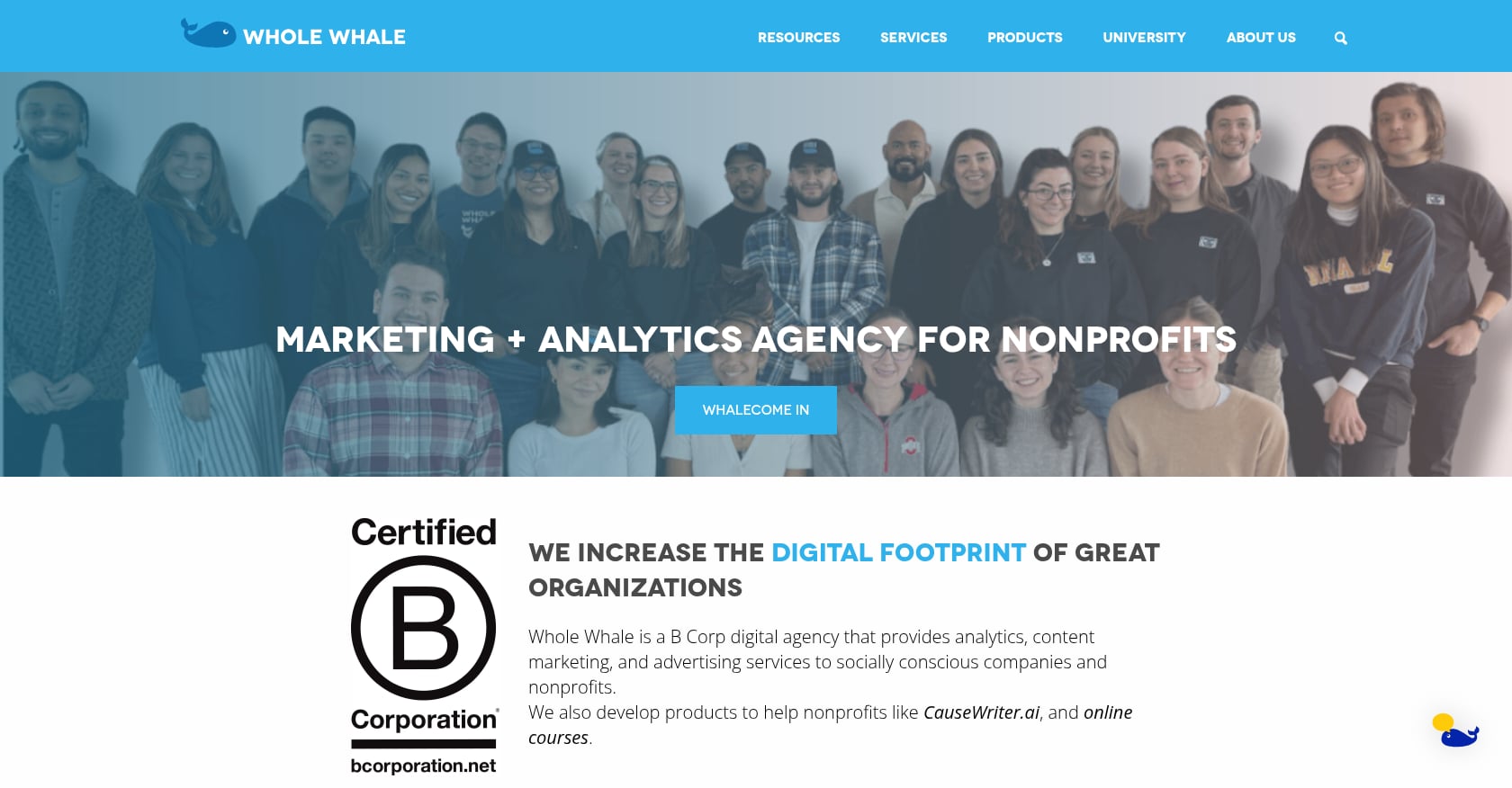
Whole Whale is a B Corp digital agency that uses data and technology to increase the impact of social impact organizations. If your startup lives and dies by metrics, Whole Whale speaks your language.
Key features:
Digital strategy, SEO, analytics, and data driven campaign optimization
B Corp certified
Technology forward approach to impact measurement
Strong fit for organizations that need to prove ROI on impact work
Pricing: Custom. Not public.
Trade offs:
More digital execution than brand strategy. If you need help defining your purpose, start with a strategy agency first.
Social impact orientation may not fully address sustainability or environmental positioning.
Less emphasis on creative campaign development.
Startup fit: Moderate. Best for startups that already have a clear purpose and need digital execution to amplify it.
11. Carol Cone ON PURPOSE
Best for: Startups that need deep, research backed purpose strategy from the person who helped define the category.
Carol Cone is widely considered a pioneer of purpose driven business. She has spent over 40 years helping organizations integrate purpose into their core operations, and her consultancy, Carol Cone ON PURPOSE, brings that depth to clients ranging from Fortune 500 companies to smaller organizations exploring purpose for the first time.
What makes Cone’s practice distinctive is the intellectual rigor. Her team draws on proprietary research and decades of case data to build purpose strategies that hold up under scrutiny. For startups entering crowded impact spaces, this kind of strategic foundation can be the difference between authentic positioning and purpose washing.
Key features:
Purpose strategy, activation, and measurement
Deep research base spanning 40+ years of purpose work
Thought leadership that carries weight with investors and press
Consulting model that can scale from workshops to full engagements
Pricing: Custom. Not public, but the consulting model suggests flexibility.
Trade offs:
Consulting heavy. Startups needing full creative execution will likely need a second agency.
Enterprise reputation may mean the practice is less focused on pre seed or seed companies.
Not a B Corp (as of publication).
Startup fit: Limited for very early stage companies, but valuable for funded startups wanting a purpose strategy that can withstand investor and media scrutiny.
12. Enso
Best for: Startups that want cultural research to inform their purpose positioning.
Enso is a creative impact agency that publishes the World Value Index, a proprietary ranking of how the public perceives companies’ contributions to the world. That research capability is the differentiator. Rather than guessing what consumers value, Enso uses data to identify where brands can credibly own purpose territory.
Practitioners on LinkedIn have noted that the World Value Index gives startups a rare advantage: the ability to benchmark their purpose positioning against established brands before spending a dollar on campaigns.
Key features:
Proprietary World Value Index for purpose benchmarking
Brand strategy and creative execution
Strong research foundation for purpose positioning
Work spans corporate, nonprofit, and startup clients
Pricing: Custom. Not public.
Trade offs:
The research driven approach adds rigor but may extend timelines.
Not specifically startup focused, though the research tools are useful for companies at any stage.
Creative output may be secondary to strategic research.
Startup fit: Moderate. The World Value Index makes Enso especially useful for startups entering competitive purpose categories where differentiation matters.
13. Fifty & Fifty
Best for: Cause driven startups and nonprofits needing digital creative and web development.
Fifty & Fifty is a digital agency that works exclusively with cause driven organizations. Their portfolio includes nonprofits, foundations, and social enterprises. The agency offers web design, branding, and digital campaigns, all tailored for organizations where the mission is the product.
Key features:
Exclusively serves cause driven organizations
Web development, branding, and digital campaigns
Strong portfolio of nonprofit and foundation work
Experience translating complex social missions into clear digital experiences
Pricing: Custom. Not public.
Trade offs:
Heavily nonprofit oriented. For profit startups with social missions may find the fit imperfect.
Less emphasis on commercial strategy or revenue tied outcomes.
Digital focused, so broader marketing needs (retail, packaging, partnerships) aren’t covered.
Startup fit: Moderate. Best for social enterprises that operate more like nonprofits than traditional startups.
14. Matter Unlimited
Best for: Social impact startups needing design driven campaigns and brand systems.
Matter Unlimited is a social impact design studio that works exclusively with organizations creating positive change. Their client list includes the Gates Foundation, UNICEF, and the Robin Hood Foundation, but they also work with smaller organizations. The design first approach means visual identity, campaign creative, and brand systems are where they excel.
Key features:
Design driven approach to social impact
Experience with major foundations and international organizations
Brand identity, campaign design, and digital experiences
Exclusively impact focused client base
Pricing: Custom. Not public.
Trade offs:
Design forward, which means strategic purpose definition may not be as deep as pure consultancies.
Client base skews toward larger organizations.
Limited evidence of early stage startup work.
Startup fit: Moderate. Works best for startups that have their purpose defined and need world class design to bring it to life.
15. DrawHistory and Cosmic (Honorable Mentions)
Two additional agencies worth knowing about:
DrawHistory is a Stockholm based agency specializing in sustainability communication. They work primarily with Nordic brands and organizations looking to make sustainability tangible and engaging. For startups with a European or Scandinavian focus, DrawHistory offers regional expertise that global agencies can’t match.
Cosmic is a digital agency that works with purpose driven organizations on web platforms, digital products, and brand experiences. Their technical capabilities make them a strong partner for startups that need purpose embedded into digital product design, not just marketing.
Both agencies serve niche needs. They won’t replace a full purpose strategy agency, but they fill specific gaps that the larger players on this list may not cover.
Additional Purpose Consulting Agencies to Consider
Beyond the profiled agencies, several purpose consulting firms are worth evaluating depending on your specific needs:
Cause+Affect (Australia) focuses on helping brands find and activate their social purpose. For startups operating in the Australian or Asia Pacific market, they bring regional understanding that global agencies lack. Their work sits at the intersection of brand strategy and social innovation.
These smaller consultancies often provide more hands on attention than their larger counterparts. One founder on a Y Combinator forum thread noted that working with a boutique purpose consultancy meant “the founder of the agency was on every call, which made the strategy 10x better than what we got from a mid size agency where we were handed off to juniors.”
Signs You’ve Found the Right Purpose Driven Agency
After evaluating dozens of options, how do you know when you’ve found the right one? Here are the signals that separate a genuine fit from a polished pitch.
They push back on your assumptions. The right agency will challenge your thinking about purpose, not just validate it. If an agency agrees with everything you say in the first meeting, they are selling, not strategizing.
They ask about your business model before your mission statement. Purpose without a viable business underneath it goes nowhere. Agencies that start by understanding your revenue model, customer segments, and growth constraints are the ones that will connect purpose to profit.
They can explain their own purpose clearly. Practitioners on Reddit have pointed out that the easiest way to vet a purpose agency is to ask them about their own impact. If they stumble, that tells you something. Agencies with B Corp certification have already been through this scrutiny.
They show you failures, not just wins. Any agency can curate a highlight reel. The best ones will tell you about projects that didn’t work and what they learned. This matters especially in sustainability, where campaigns can backfire spectacularly.
They scope conservatively. An agency that proposes a massive first engagement before understanding your business is optimizing for their revenue, not your outcomes. Look for agencies that suggest starting small, proving value, then expanding scope.
How to Measure ROI from Purpose Driven Branding
One of the most common questions startup founders ask is whether purpose driven branding actually pays off. The short answer: yes, but only if you measure the right things.
Brand preference and purchase intent are the leading indicators. Track whether purpose messaging moves preference scores compared to purely functional messaging. When brands pair social commitments with product quality, preference can jump from 42% to 70%.
Customer acquisition cost (CAC) often drops for purpose driven brands because earned media and word of mouth do more of the heavy lifting. Practitioners on YouTube who run DTC sustainability brands frequently report that their purpose story generates 2x to 3x more organic social shares than product focused content.
Investor engagement is an underappreciated metric. A clearly articulated purpose makes fundraising easier. ESG focused funds now represent over $30 trillion in global assets, and these investors actively seek startups with credible purpose positioning.
Employee retention and recruiting costs drop when purpose is authentic. Startups competing for talent against larger companies can use purpose as a differentiator that doesn’t require matching salaries.
Impact metrics themselves (carbon reduced, communities served, waste diverted) become marketing assets when they’re credible and measurable. The best agencies help you build impact measurement systems from day one so the data is there when you need it.
The mistake most startups make is treating purpose as a cost center. It’s not. It’s a growth driver, but only if the agency you hire knows how to connect purpose to revenue.
What to Look for When Choosing a Purpose Driven Agency
Not every agency that uses the word “purpose” on its website actually specializes in it. Here is a practical checklist for startup founders:
1. Do they have B Corp or equivalent third party proof? B Corp certification requires meeting rigorous standards across governance, workers, community, environment, and customers. An agency asking you to be authentic about your purpose should be authentic about its own. The B Impact assessment provides a verifiable score you can compare across agencies.
2. Can they tie purpose work to commercial outcomes? Purpose without profit is a hobby. Ask for case studies that show revenue impact, purchase intent lift, or customer acquisition tied to purpose positioning.
3. Do they understand the intention action gap? Consumers say they want sustainable products but often don’t buy them. The best agencies diagnose this gap rather than just producing pretty campaigns. For a deeper look at this concept, read about closing the intention action gap.
4. Do they have actual startup clients? Enterprise agencies sometimes take startup projects as passion plays, but they rarely prioritize them. Ask specifically who their smallest client is and how they structure engagements for resource constrained teams.
5. Can they flex on project size and scope? Fixed six figure retainers don’t work for pre seed companies. Look for agencies that offer phased approaches or custom scoping.
6. Do they diagnose before prescribing? Any agency that pitches a solution in the first meeting hasn’t done the work to understand your problem. The best purpose driven agencies for startups begin with discovery, not deliverables.
Red Flags That a Purpose Agency May Not Be the Right Fit
Before hiring an agency, watch for these warning signs.
They cannot show measurable outcomes
A purpose strategy should connect to business results:
Customer acquisition
Brand awareness
Retention
Investor confidence
Partnerships
Avoid agencies that only discuss impressions, values, or storytelling.
Their own business practices are unclear
A purpose agency should be able to explain:
Sustainability commitments
Certifications
Governance practices
Impact measurement
They start with campaigns instead of diagnosis
The strongest agencies first understand:
Customer behavior
Competitive positioning
Market opportunity
A campaign without strategy often becomes expensive purpose washing.
Purpose Agency vs Branding Agency vs Growth Agency: What Startups Actually Need
A purpose driven agency is not always the same as a branding agency or growth marketing agency.
Agency Type | Main Goal | Best For |
|---|---|---|
Purpose Agency | Define why the company exists | Mission driven startups needing positioning |
Branding Agency | Create identity and differentiation | Startups needing names, visuals, messaging |
Growth Agency | Increase customers and revenue | Startups with product market fit |
Sustainability Agency | Communicate environmental/social impact | Climate and ESG focused companies |
Understanding the difference between a purpose agency and a brand strategy agency helps founders avoid hiring the wrong type of partner. A startup may need more than one agency over time. The right sequence is usually:
Purpose → Brand Positioning → Marketing Execution → Growth Optimization
Purpose Agencies vs. Sustainability Agencies vs. Social Impact Agencies
These terms get conflated constantly. Here is how they differ:
Purpose agencies help brands define and activate their reason for existing beyond profit. The output is brand strategy, positioning, narrative, and communications that articulate why the company matters. A brand purpose agency works at the identity level.
Sustainability agencies focus specifically on environmental and social sustainability. Their work tends to be more technical, covering sustainability reporting, ESG communications, carbon strategy narratives, and sustainable product positioning. Learn more about what a sustainability marketing agency does and how it differs from general consulting.
Social impact agencies specialize in campaigns and programs that create measurable social change. They often work at the intersection of brands and nonprofits, developing campaigns that serve both business and community objectives.
Some agencies span all three. Grounded World, for example, operates across purpose, sustainability, and social impact. Others specialize narrowly. The right choice depends on whether your startup’s mission is environmental, social, or a combination.
When to Hire a Purpose Driven Agency (and When Not To)
Not every startup needs a purpose driven agency. Here is a stage by stage guide:
Pre seed / Idea stage: You probably don’t need an agency yet. Spend time doing what Joe Kattan’s curated resource on purpose driven agencies advises: “put in the time to develop a program that fits their brand and social impact objectives and aligns with key stakeholders.” Foundational alignment comes before agency engagement.
Seed stage: If your product is inherently purpose driven (clean energy, circular economy, social enterprise), this is when brand strategy matters most. A purpose agency can help you articulate your mission in a way that attracts both customers and investors. Modern consumers and investors are gravitating toward startups that demonstrate a genuine commitment to sustainability, and brands that authentically embed these values into their core identity see increased loyalty and more investment opportunities.
Series A: You have product market fit and need to scale your story. This is the sweet spot for a full service purpose agency that can take you from strategy through activation.
Series B+: At this point, you may need a larger agency with global reach (Futerra, BBMG) or a specialist for retail activation and stakeholder engagement.
When NOT to hire a purpose driven agency: If your product isn’t inherently purpose oriented and you’re looking to bolt on a CSR veneer, save your money. Edelman’s 2025 Brand Trust report found that 64% of respondents buy or avoid brands based on societal beliefs, and one in two respondents assume the worst if brands are silent. The solution is authenticity, not performance. A purpose agency can’t manufacture something that doesn’t exist.
Purpose Driven Agency Scorecard for Startup Founders
Question | Why It Matters |
|---|---|
Does the agency understand startups? | Enterprise experience does not always translate to startup needs |
Can they connect purpose to revenue? | Purpose must support business growth |
Do they have third party validation? | Certifications reduce credibility risk |
Can they work within your budget? | Early stage startups need flexibility |
Do they measure impact? | Good intentions need measurable outcomes |
Do they have niche expertise in your sector? | Sector knowledge accelerates strategy |
Can they show case studies at your stage? | Portfolio relevance matters more than portfolio size |
Frequently Asked Questions
What is a purpose driven agency?
A purpose driven agency helps brands define, articulate, and activate their reason for existing beyond profit. Unlike general marketing agencies, they specialize in connecting brand mission to commercial outcomes, ensuring purpose translates into consumer preference and revenue growth rather than just messaging.
How much do purpose driven agencies cost?
Pricing varies dramatically. Bolder Agency starts at $30,000 per project. Enterprise agencies like Futerra likely require six figure engagements based on their client profile. Boutique agencies like Grounded World offer custom scoped engagements that can flex to startup budgets. Always ask about minimum project sizes and phased approaches before committing.
Do startups actually need a purpose driven agency?
If your product or service is built around sustainability, social impact, or values driven positioning, yes. Purpose driven brands grow about twice as fast as others, and 94% of consumers prefer brands with purpose beyond profit. If purpose isn’t core to your product, a general growth agency may be a better fit.
What is the intention action gap in sustainability marketing?
The intention action gap describes the disconnect between what consumers say they want (sustainable, ethical products) and what they actually buy. Roughly 79% of consumers say they’ll pay a sustainability premium, but far fewer follow through. The best purpose driven agencies for startups diagnose this gap and design strategies to close it.
How do I know if a purpose driven agency is legitimate?
Look for third party certifications like B Corp, 1% for the Planet, or Science Based Targets. Check their B Impact Score (you can verify it on the B Corp directory). Ask for case studies with measurable outcomes. If an agency can’t show proof of its own purpose commitments, it probably can’t help you with yours.
Should I choose a large or small purpose driven agency?
For most startups, smaller is better. Boutique agencies offer faster turnaround, direct access to senior strategists, and flexible scoping. Large agencies bring global reach and institutional credibility but often have higher minimums and slower processes. Match agency size to your stage: boutique for seed through Series A, larger agencies for Series B and beyond.
Can a purpose driven agency help with investor communications?
Many can. Articulating purpose clearly strengthens pitch decks, investor narratives, and ESG positioning. Agencies like Grounded World that cover brand strategy through to activation and communications can help shape the story investors want to hear, one backed by consumer data and commercial logic rather than vague aspiration.
What is the difference between purpose washing and authentic purpose?
Purpose washing is when a brand claims social or environmental commitment without substantive action behind it. Authentic purpose is embedded in the business model, supported by measurable commitments, and verified by third party certifications. Startups are especially vulnerable to purpose washing accusations because they lack track records, which makes third party proof and transparent reporting critical from day one.
How do I measure whether my purpose driven branding is working?
Track brand preference lifts, customer acquisition costs, organic share of voice, investor engagement rates, and employee retention. The most meaningful metric is whether purpose messaging drives purchase behavior, not just awareness. An agency that can’t define measurement criteria before starting work is one to avoid.