

 Gaia
GaiaOverview
Strategic partnerships for impact are collaborations where organizations combine complementary strengths (funding, expertise, community trust, distribution, data) to create measurable social or environmental outcomes that no single partner could achieve alone. They differ from sponsorships and donations because they require shared goals, defined roles, mutual value, and real measurement. The best ones change what partners can accomplish together. The worst ones produce a logo lockup, a photo op, and nothing else.
At a Glance: What defines a Strategic Impact Partnership in 2026?
A strategic partnership for impact is a cross-sector collaboration where organizations (typically a mix of corporate, nonprofit, and government) pool complementary resources—such as funding, specialized expertise, and community trust—to achieve a specific social or environmental goal.
The 3 Core Pillars of Impact Partnerships:
Shared Value: Success is defined by both social progress and organizational ROI.
Complementary Assets: Each partner provides a "missing link" (e.g., a brand’s reach vs. a nonprofit’s boots-on-the-ground data).
Measurable Outcomes: Moving beyond "vanity metrics" (like logo impressions) to "impact metrics" (like behavior change or carbon reduction).
What Are Strategic Partnerships for Impact?
Strategic partnerships for impact are long-term or purpose-built collaborations between two or more organizations that combine complementary strengths to achieve measurable social, environmental, or community outcomes while creating clear value for each partner. They can involve companies, nonprofits, retailers, startups, foundations, governments, communities, or even competitors working together on a shared goal.
The shorter version: a mutually beneficial collaboration designed to create measurable social or environmental impact that no partner could achieve as effectively alone.
This is not just a nonprofit concept. Strategic partnerships for impact show up across sectors, from a sustainable packaging brand partnering with a retailer and recycling nonprofit to test in-store behavior change, to competitors in the same category collaborating on circular economy infrastructure. The UN recognizes this breadth through SDG 17, which treats multi-stakeholder partnerships as vehicles for mobilizing and sharing knowledge, expertise, technology, and financial resources to advance sustainable development.
The critical distinction: a partnership becomes strategic when it changes what partners can achieve together. If it only produces a donation announcement, a one-day volunteer photo, or a logo on a banner, it may be useful, but it is not a strategic partnership for impact.
Why Strategic Partnerships Matter
Complex problems require combined capabilities
Most social and environmental challenges are systems problems. No single company, nonprofit, or government agency caused them, and none can solve them alone. Stanford Social Innovation Review’s collective impact framework makes this point directly: complex problems often require cross-sector coalitions and shared objectives because no single organization is responsible for, or able to address, them in isolation.
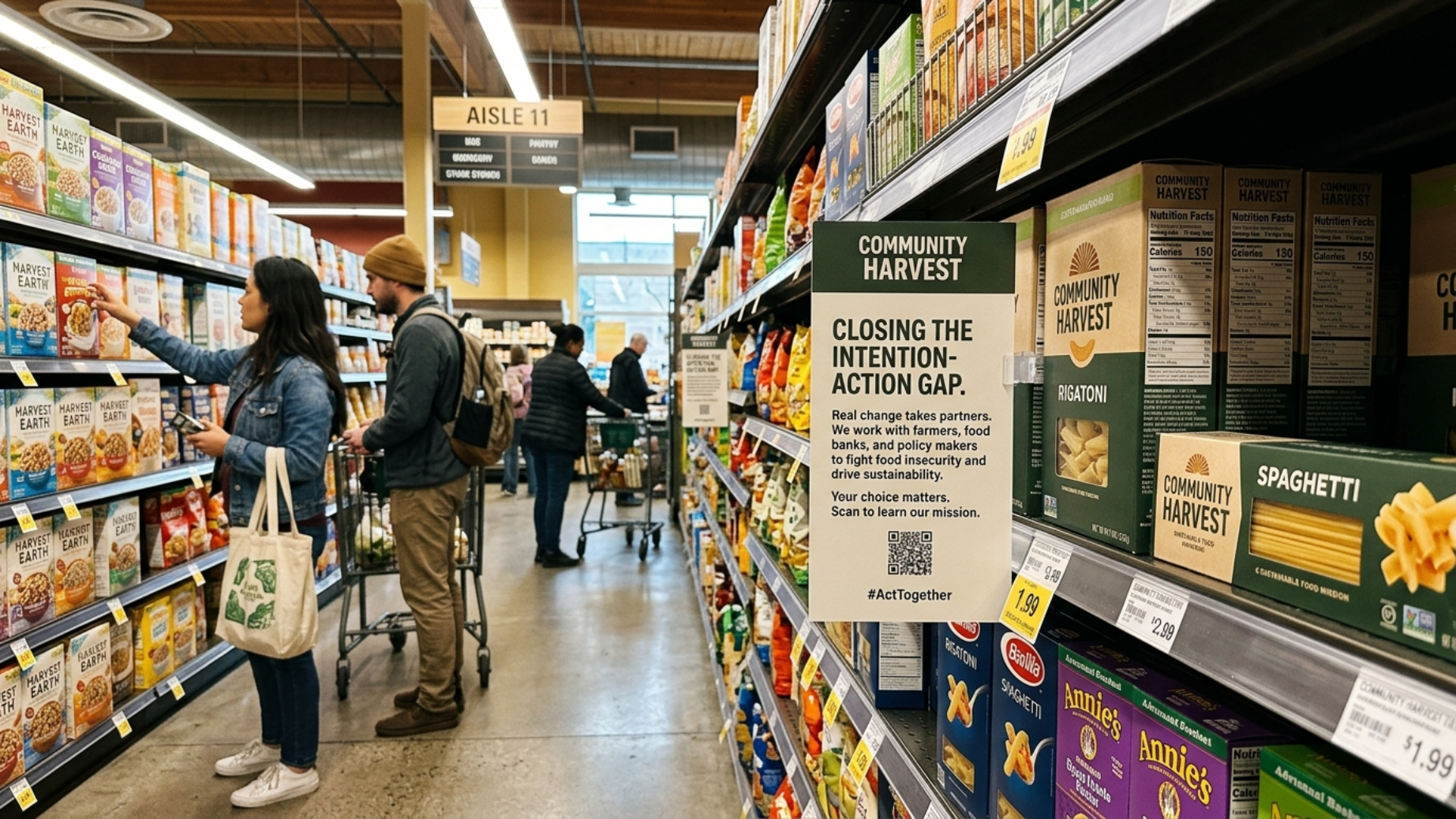
This is not abstract. A food brand cannot fix food insecurity without distribution partners, community organizations, and policy support. A retailer cannot shift shopper behavior toward sustainable products without credible messaging, supply chain partners, and educational content that closes the gap between what people say they want and what they actually do. Understanding that intention-action gap is often the starting point for partnerships that create real change.
The money is real and growing
U.S. charitable giving reached $592.50 billion in 2024, with corporate giving at $44.40 billion, up 9.1% from 2023. These are not marginal numbers. Corporate partnership funding is a significant part of the impact economy.
Corporate commitment continues, but the language is shifting
ACCP’s 2025 Pulse Survey found that 90% of surveyed corporate social impact leaders expected their company’s CSR commitment to stay the same or increase, even amid political shifts. However, 53% expected changes in how the work is described, and 30% expected more legal oversight. For practitioners, this means impact partnerships are continuing, but the framing around them is changing. Organizations that focus on measurable outcomes rather than buzzwords are better positioned.
Volunteering is up, but impact quality is uneven
Corporate volunteers logged 23.7 million approved hours in 2025, up 175% since 2019, and unique volunteers more than tripled to 1.87 million. Sounds good on paper. But average hours per volunteer fell from 16.4 to 12.7, employees contributing fewer than five hours now account for roughly 60% of volunteers, and only about 20% of nonprofit leaders say corporate volunteers meaningfully contribute to long-term capacity.
More participation does not automatically equal more impact. This gap is precisely why the “strategic” part of strategic partnerships for impact matters so much.
What Makes a Partnership Strategic?
A partnership earns the word “strategic” when it meets most of these conditions:
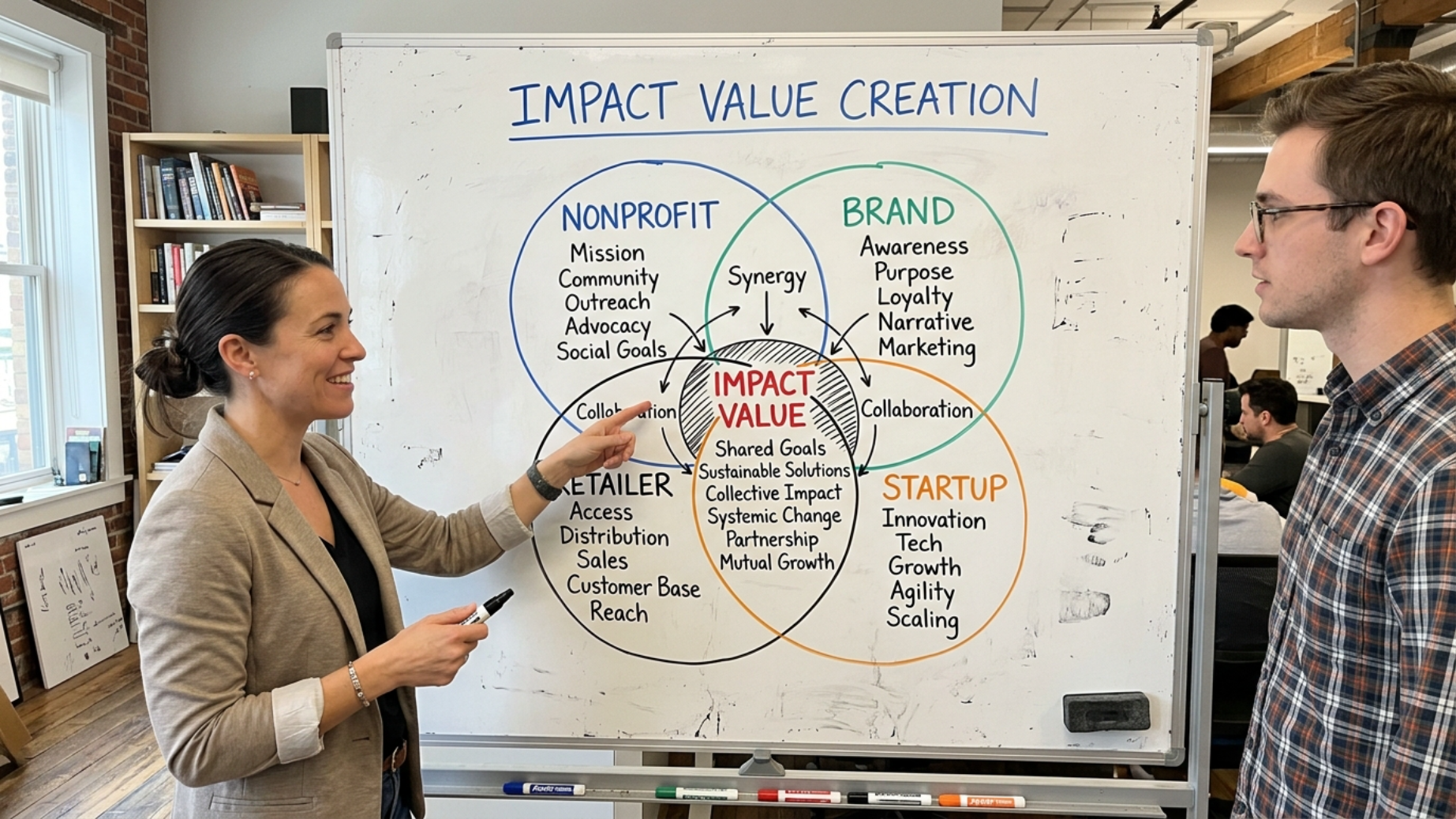
Shared impact goal. Partners agree on the social, environmental, or community outcome they are trying to create.
Mutual value. Each partner gets something legitimate and clearly defined.
Complementary strengths. Each partner brings different assets: money, audience, expertise, trust, technology, access, data, distribution, or operational capacity.
Defined roles. Partners know who owns what. Vagueness kills partnerships.
Governance. There is a working structure, not just goodwill and a handshake.
Measurement. Partners track more than activity. They measure outputs, outcomes, learning, and organizational value.
Trust and transparency. Partners can discuss trade-offs, risks, conflicts, and constraints honestly.
Capacity. Enough staffing, budget, and process exists to manage the collaboration.
Risk controls. Guardrails exist for mission alignment, claims, endorsement, brand safety, and greenwashing risk.
Scalability or learning value. The partnership either scales impact or produces useful learning for future work.
Stanford Social Innovation Review offers a useful deeper model through its five conditions for coordinated impact: common agenda, shared measurement systems, mutually reinforcing activities, continuous communication, and backbone support organizations.
The IMPACT Test
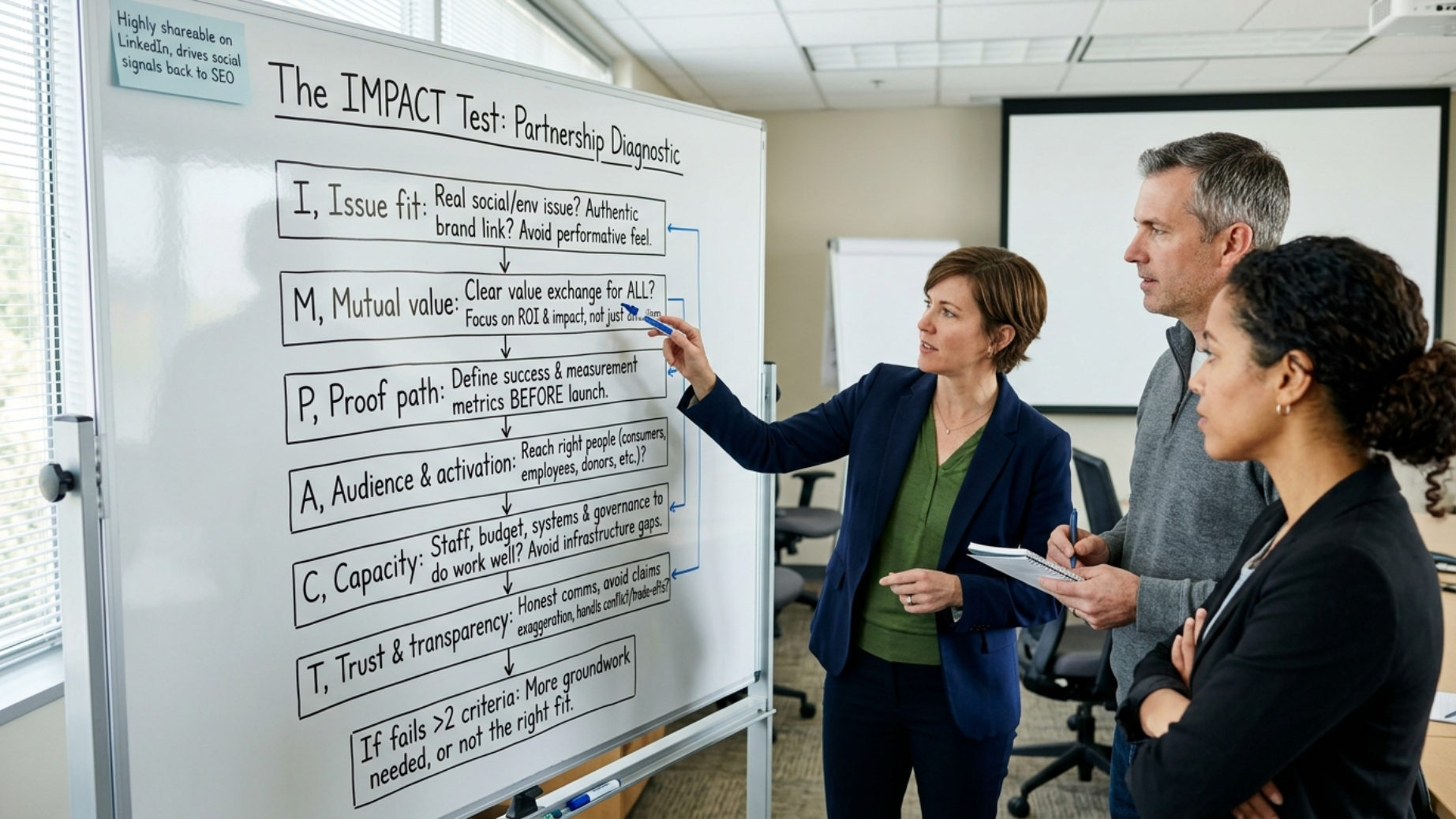
Before committing to any partnership, run it through this diagnostic:
I, Issue fit. Does the partnership address a real social, environmental, or community issue that matters to stakeholders and connects credibly to the organization? If the cause has no authentic link to the brand, the partnership will feel performative and probably is.
M, Mutual value. Is there a clear value exchange for every partner, not just money for visibility? Practitioners on Reddit are blunt about this. One business-minded commenter argued that nonprofits often hide packages or avoid talking about ROI, while businesses make decisions based on ROI, impact, and work required. Mutual value is not a dirty phrase. A strong impact partnership should be able to explain the value for both sides without pretending the company is acting only out of altruism.
P, Proof path. Can partners define what success looks like and how it will be measured before launch?
A, Audience and activation. Can the partnership reach and move the right people, whether those are consumers, employees, communities, shoppers, donors, policymakers, or internal teams?
C, Capacity. Do the partners have the staff, budget, systems, and governance to do the work well? The SSIR collective impact research identifies lack of supporting infrastructure as one of the most frequent reasons collaboration fails.
T, Trust and transparency. Can the partners communicate honestly, avoid exaggerated claims, and handle conflicts or trade-offs?
If a potential partnership fails on more than two of these criteria, it probably needs more groundwork before moving forward, or it may not be the right fit at all.
Strategic Partnership vs. Sponsorship vs. Cause Marketing
These terms get used interchangeably, but they mean different things. The confusion matters because calling a sponsorship a “strategic partnership” raises expectations it was never designed to meet.
Partnership Type | Primary Objective | Key Metric | Level of Integration |
Strategic Impact | Systemic change & shared value | Social outcomes + Business ROI | High (Co-creation) |
Corporate Sponsorship | Brand awareness & visibility | Impressions & Logo reach | Low (Transactional) |
Cause Marketing | Consumer sales & engagement | Conversion rate & Total raised | Medium (Campaign-based) |
Corporate Philanthropy | Community goodwill | Total dollars disbursed | Low (Grant-based) |
Pre-competitive | Industry-wide standard shifting | Regulatory/Systemic adoption | High (Multi-stakeholder) |
A sponsorship can evolve into a strategic impact partnership if it grows to include shared goals, co-created programs, and measurable outcomes. But a check and a logo do not get there on their own.
For deeper context on how brand purpose connects to partnership choices, the starting point is often clarifying what the organization actually stands for before deciding who to partner with.
Types of Strategic Partnerships for Impact
Corporate-nonprofit partnerships
The most common type. These can include multi-year funding, employee engagement, workplace giving, matching gifts, in-kind support, co-created programs, or advocacy. Blackbaud Giving Fund emphasizes that the strongest versions position nonprofits as collaborators, not passive recipients, helping companies align values with real-world impact while inviting employees to participate and communicating the ripple effect.
Brand-cause campaigns
A brand partners with a nonprofit or advocacy group to create a consumer-facing campaign around a cause. Examples include Ralph Lauren’s Pink Pony campaign, Costco’s Children’s Miracle Network Hospitals fundraising, and CVS’s support for the American Heart Association’s Go Red for Women movement, cited by Kindsight as recognizable models.
Retail activation partnerships
A brand, retailer, and impact partner collaborate to shift shopper behavior, drive donations, improve product adoption, or activate a sustainability message at point of sale. These partnerships connect impact to commercial activation through customer journeys, category strategy, and in-store toolkits. Think of it as turning a retail shelf into a behavior-change touchpoint.
Employee engagement partnerships
Companies partner with nonprofits to create volunteer days, skills-based volunteering, board service, workplace giving, or matching gifts. This area is growing. ACCP’s 2025 CSR Insights Report found that 61% of CSR professionals reported increased employee volunteerism in 2025. But as noted above, participation numbers alone do not tell the impact story.
Skills-based and pro bono partnerships
Employees or experts contribute professional skills: legal, design, marketing, data, AI, finance, HR, or technology. These can create more durable capacity than one-off volunteer events when scoped well. There is a timely case here: Benevity’s 2026 report found that 71% of nonprofits see AI for operational efficiency as urgent, while only 3% use AI extensively. That gap is an opportunity for companies with AI expertise to provide skills-based support that actually moves the needle.
The 2026 "AI Capacity Gap" in Partnerships

A critical trend for 2026 is the Digital Divide in the nonprofit sector. While 71% of nonprofits identify the ability to leverage AI for operational efficiency as an urgent priority, extensive internal adoption remains at a staggering 3%.
The Strategic Opportunity: Impact partnerships are shifting from "General Pro Bono" to "Technical Residency" models. In these setups, corporate partners don’t just donate software or one-off training; they embed data scientists and AI specialists within nonprofit teams to build custom frameworks for impact measurement, automated fundraising, and predictive analytics. This moves the partnership from a "service provider" relationship to an "infrastructure builder" collaboration.
Pre-competitive sustainability partnerships
Companies in the same category collaborate on problems no one brand can solve alone, such as circular packaging infrastructure, recycling access, regenerative agriculture, responsible sourcing, or emissions reduction. This type is largely absent from current search results, but it is one of the most important forms of strategic partnerships for impact because it addresses structural barriers rather than brand-level symptoms.
Public-private-civil society partnerships
Governments, companies, nonprofits, and civil society actors collaborate on public problems. The UN Global Compact argues that the toughest global challenges cannot be solved by one company or sector alone, and that partnerships combining credibility, specialized expertise, innovation, implementation power, and local knowledge can lead to greater impact.
Innovation and product partnerships
A company partners with a nonprofit, startup, research institution, or community group to develop a new product, service, tool, behavior-change intervention, packaging model, or delivery system.
Advocacy and systems-change coalitions
Organizations align to change policy, norms, infrastructure, or category standards. These are often the most complex and require shared measurement, backbone coordination, and long-term funding.
Examples of Strategic Partnerships for Impact
Cause marketing with depth. Ralph Lauren’s Pink Pony campaign ties branded product and campaign activity to cancer-related giving, creating a consumer-recognizable model that combines product, storytelling, and cause funding.
Retail-driven customer fundraising. Costco and Children’s Miracle Network Hospitals give customers a way to donate at checkout, channeling shopper behavior through a retail touchpoint with scale.
Employee engagement done thoughtfully. Duolingo’s social impact program goes beyond one-day events to include board service encouragement, matching gifts, and ongoing volunteer opportunities.
Collective impact as a model. The SSIR collective impact framework is not a brand campaign but a multi-stakeholder architecture for systems change. It shows that impact partnerships can be designed around shared agendas and measurement rather than individual organization branding.
A hypothetical retail activation. Consider a sustainable packaging brand partnering with a retailer and a recycling nonprofit to test in-store education, shopper behavior-change messaging, collection points, and verifiable claims. This combines the retailer’s shopper access, the brand’s product, and the nonprofit’s issue credibility into something none of them could run alone.
What all of these share: each partner brings something the other lacks. A nonprofit brings community trust, issue expertise, and beneficiary relationships. A brand brings funding, marketing reach, and customer engagement. A retailer brings shopper access, shelf visibility, and loyalty data. A startup brings technology and agility. A foundation brings convening power and grant funding. The combination is what makes the partnership strategic.
How to Build a Strategic Partnership for Impact
Step 1: Define the impact problem
What issue are you solving? Who is affected? What behavior, system, or outcome needs to change? Starting with the problem rather than the partner prevents the common trap of finding a well-known name and then scrambling to justify the relationship.
Step 2: Map stakeholders and missing capabilities
What does your organization have? What does it lack? Who has the trust, reach, data, distribution, expertise, funding, or operational infrastructure you need? Effective stakeholder engagement strategy is the foundation here, because partnerships built without understanding stakeholder needs tend to serve the partners more than the people they claim to help.
Step 3: Screen partners with the IMPACT test
Run potential partners through the six criteria: Issue fit, Mutual value, Proof path, Audience and activation, Capacity, Trust and transparency. This prevents the “they’re famous and they said yes” trap.
Step 4: Co-create the partnership model
Do not arrive with a finished pitch and expect the other side to slot in. Practitioners on Reddit are clear on this point. One nonprofit professional shared that sponsorship and partnership agreements were “extremely customized” across every organization they had worked with, from smaller arts and healthcare nonprofits to large education nonprofits. Templates help, but the best impact partnerships are rarely plug-and-play. Use discovery calls to understand the partner’s needs, constraints, and assets.
Step 5: Define roles, governance, and decision rights
Who owns strategy, creative, claims, funding, reporting, community engagement, legal review, and communications? Ambiguity here is where partnerships quietly die.
Step 6: Set measurement and learning goals
Decide what will be measured before launch. Include both impact and business value. (More on this below.)
Step 7: Pilot before scaling
Start with one campaign, one region, one retail activation, one employee cohort, or one community pilot. Zeffy recommends starting with manageable collaborations, documenting outcomes, gathering feedback, and expanding successful partnerships over time.
Step 8: Report honestly
Share wins, challenges, and what changed because of the partnership. Honest impact reporting builds trust with stakeholders and sets the foundation for renewal.
Step 9: Plan renewal or exit
Define what happens after the campaign or first funding period. A LinkedIn practitioner insight on resilient partnerships emphasizes that the strongest collaborations go beyond a single funding cycle to plan for sustainability, communication through change, and ongoing stakeholder involvement.
One more thing on warm introductions. Another nonprofit practitioner on Reddit noted that employee relationships were the “in” for corporate opportunities, and that knowing where supporters work was central to forming good partnerships. Map warm connections through employees, board members, donors, customers, suppliers, and community partners before investing heavily in cold outreach.
If your team already has a cause, partner, or campaign idea but needs help shaping it into a partnership strategy with clear roles, activation, and measurement, explore how Grounded World’s Accelerate phase supports partnership growth.
How to Measure Partnership Impact
The most common mistake is measuring what is easiest to count instead of what matters. Dollars donated, volunteer hours, impressions, and event attendance are useful activity metrics, but they do not prove impact on their own.
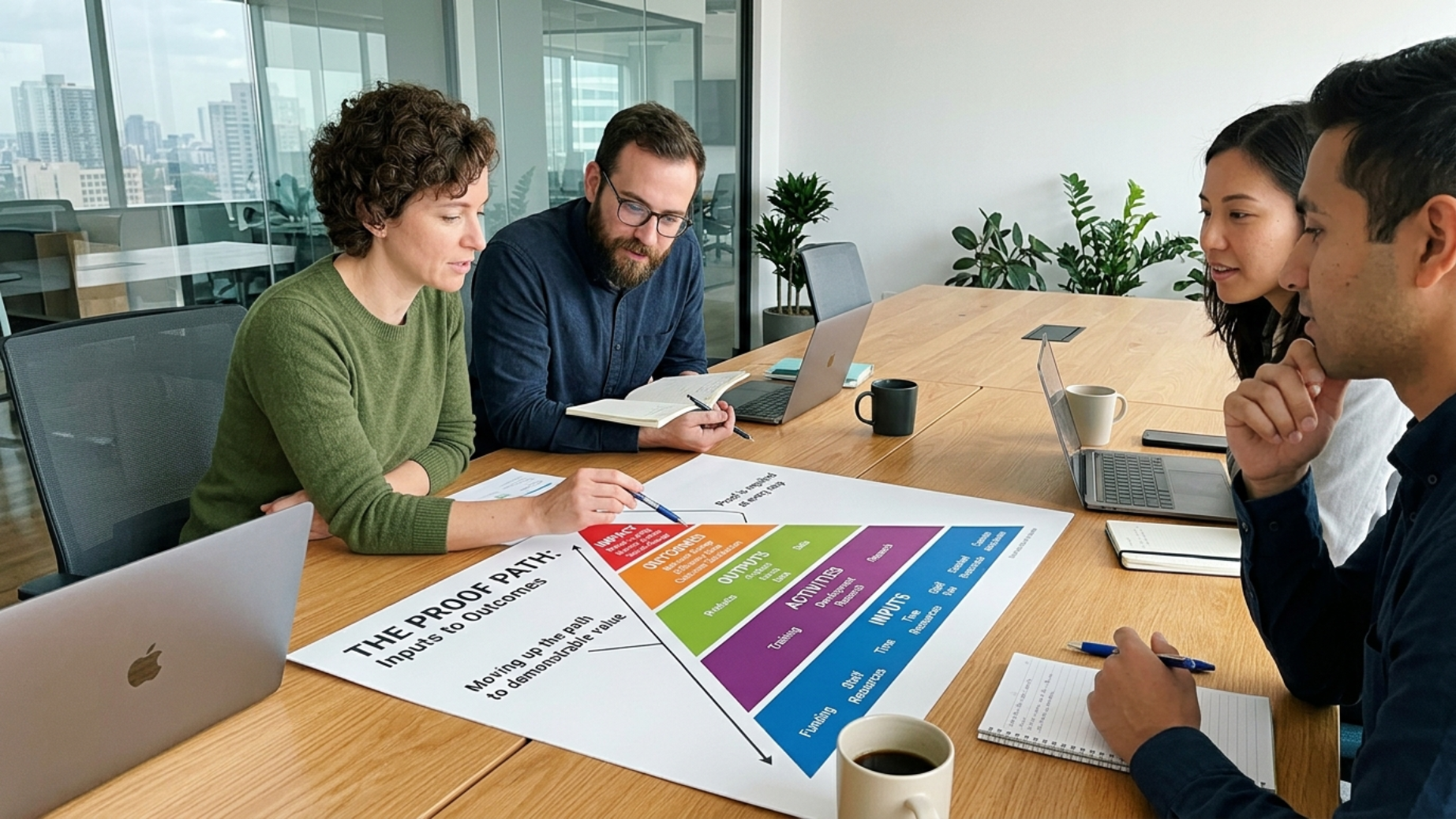
A stronger measurement approach separates distinct layers:
Measurement layer | What to track | Example |
|---|---|---|
Inputs | Funding, staff time, volunteer hours, product donations, media spend | $100,000 investment; 500 employee hours |
Activities | Events, workshops, campaigns, retail activations, training sessions | 20 community workshops held |
Outputs | Reach, participation, materials distributed, signups, services delivered | 10,000 shoppers reached; 1,200 kits distributed |
Outcomes | Behavior change, adoption, access, learning, emissions avoided, health or education indicators improved | 25% increase in reuse behavior among pilot shoppers |
Partner value | Brand lift, employee engagement, retention, customer trust, sales impact, category leadership | Employee volunteer satisfaction up; purchase intent increased |
Learning value | Insights for scaling or improving the intervention | Which message reduced the intention-action gap most effectively |
CECP’s 2025 Giving in Numbers data shows that 80% of companies collect both outputs and outcomes and 76% collect program activities for evaluation. That is encouraging, but collecting data and using it to improve partnerships are two different things.
A note on volunteer hour valuation: Independent Sector’s preliminary 2025 estimate puts the U.S. value of a volunteer hour at $36.14. This is useful for estimating the economic contribution of volunteer labor. It is not proof that the partnership changed outcomes. Volunteer-dollar equivalence and outcome measurement are not the same thing.
Common Mistakes
Treating a donation as a partnership. A donation can be valuable, but writing a check does not make the relationship strategic.
Leading with logo placement. Logo visibility is not a substitute for shared outcomes. If the only thing the nonprofit gets is a corporate logo on a banner, and the only thing the company gets is a nonprofit logo on a webpage, both sides should ask what they are actually building.
Counting activity as impact. Volunteer hours, impressions, event attendance, and dollars donated are inputs and outputs. They are not outcomes. Benevity’s 2026 report is a cautionary tale: record volunteer hours alongside declining per-person engagement and low nonprofit satisfaction with capacity impact.
Ignoring nonprofit capacity. Corporate volunteers can create work for nonprofits if projects are not scoped, staffed, or useful. A well-meaning team-building day can actually drain the resources of a small nonprofit that has to manage logistics, prepare materials, and supervise people who may never return.
Siloed Data Governance. In 2026, the primary barrier to partnership success isn't just teams failing to communicate; it’s the existence of incompatible data sets. When marketing, sustainability, and community impact teams use different metrics and platforms, creating a unified "Proof Path" becomes impossible. Strategic impact requires a shared "source of truth" for data.
Weak governance. Written agreements, legal review, and attention to private-benefit risk are not optional. BoardEffect recommends formalizing these elements when nonprofits work with for-profit entities.
Overlooking mission and reputational risk. Practitioners on Reddit have raised concerns about corporate influence over mission and editorial independence. Strong partnerships need guardrails: donation acceptance policies, partnership criteria, claims review, community input, and exit clauses.
Underfunding the coordination work. SSIR identifies lack of supporting infrastructure as a frequent reason collaboration fails. Someone has to manage the partnership, and that someone needs time, tools, and budget.
When Not to Pursue a Partnership
Most advice about strategic partnerships for impact assumes partnerships are always good. They are not. Do not pursue the partnership if:
The issue has no credible connection to the brand, organization, or audience.
The nonprofit or community partner is being asked to do unpaid brand labor.
The corporate partner wants influence over mission, editorial judgment, research, or program decisions.
The sustainability or impact claim cannot be substantiated.
The primary benefit is PR optics rather than measurable change.
The partnership requires more staff time than it funds.
The community affected by the issue has no voice in the design.
The partner’s business practices contradict the cause (a fossil fuel company funding a climate education program, for instance).
The timeline is too short to create meaningful outcomes.
There is no measurement plan.
There is no exit plan.
Walking away from a bad-fit partnership is itself a strategic act. It protects credibility, preserves resources, and keeps the door open for better partnerships later.
Strategic Partnership for Impact: 2026 FAQ
Q: How do I find the right impact partner in 2026? A: The most effective way is to apply the IMPACT Test. Screen every potential collaborator for Issue fit, Mutual value, Proof path, Audience activation, Capacity, and Trust. If a partner fails more than two of these criteria, the partnership likely needs more groundwork before launching.
Q: What is the ROI of a strategic partnership for a brand? A: While the primary goal is social impact, brands realize significant business value through the "purpose premium"—including increased customer loyalty, improved employee retention (especially among Gen Z and Alpha talent), and better access to ESG-focused capital and lower-risk credit.
Q: How is impact measurement different from traditional reporting? A: Traditional reporting focuses on Inputs (e.g., "We donated $50,000") and Outputs (e.g., "We reached 5,000 people"). True impact measurement focuses on Outcomes—the actual change in behavior, environment, or social condition (e.g., "A 20% reduction in local food insecurity").
Ready to move from partnership concept to measurable outcomes? Talk to Grounded World about building strategic partnerships for impact that create both social value and business value.