
 Gaia
GaiaTL;DR
Most consumers say they care about sustainability, but the majority don’t follow through at checkout. The main reasons why consumers do not buy sustainable products include price sensitivity, distrust of environmental claims, cognitive overload, ingrained habits, loss aversion, the abstract nature of environmental benefits, and doubts about individual impact. Understanding the specific terms and barriers behind this gap is essential for any brand trying to turn green intentions into actual sales.
65% of consumers say they want to buy from purpose driven brands that advocate sustainability. Only about 26% actually do so, according to Harvard Business Review. Meanwhile, PwC reports that 80% of consumers say they’re willing to pay more for sustainably produced goods. These numbers can’t both be true in practice, and they aren’t. The distance between what people say and what people do is one of the most frustrating problems in sustainable business.
This gap isn’t just a curiosity for academics. It shapes product strategy, marketing budgets, retail decisions, and brand positioning. If you’re a brand manager, sustainability lead, or marketer wondering why consumers do not buy sustainable products despite all the stated demand, the answer is a tangle of psychological, economic, and structural forces.
This article defines the key terms you’ll encounter when researching this problem, breaks down the core barriers backed by recent data, and connects each barrier to what brands can actually do about it.
Explore how Grounded World diagnoses the gap between consumer intent and action.
Quick Answer: Why Consumers Do Not Buy Sustainable Products
Most consumers do not buy sustainable products because of a combination of price perception, trust issues, loss aversion, habit formation, and decision fatigue, not lack of awareness. Even though 65 to 80% of consumers express interest in sustainability, only 16 to 26% consistently buy sustainable products. The main barrier is not attitude. It is friction at the point of purchase, where higher perceived prices, skepticism about green claims, the abstract nature of environmental payoffs, and convenience driven habits override stated intentions.
Key Insight Snapshot (2026)
Factor | Insight |
|---|---|
Stated interest in sustainability | 65 to 80% of consumers |
Actual purchase behavior | 16 to 26% of consumers |
Average green premium | ~28% higher than conventional products |
Trust in sustainability claims | ~10 to 30% fully trust brands |
Perceived barrier strength | Price + trust > all other factors |
Behavioral root cause | Habit + cognitive load + loss aversion dominate decisions |
The Key Terms You Need to Know
The research on why consumers do not buy sustainable products is filled with overlapping terminology. Most articles use these terms interchangeably, which creates confusion. Here’s what each one actually means and when to use it.
Intention Action Gap
The gap between what consumers say they intend to buy and what they actually purchase. This is the most widely used term in brand strategy and marketing. A meta analysis found that intentions account for only 27% of variance in actual behavior. When a sustainability team asks “why aren’t our products selling despite strong survey results?”, this is the concept they’re circling.
For a deeper exploration of what drives this disconnect, see the guide on closing the intention action gap.
Attitude Behavior Gap
The gap between positive attitudes toward sustainability and actual purchasing behavior. This term appears more often in academic literature. The distinction from the intention action gap is subtle: attitudes are broader dispositions (“I think sustainability is important”), while intentions are specific plans (“I plan to buy the eco friendly detergent next time”). Both gaps are real. The attitude behavior gap tends to be even wider because holding a general attitude requires even less commitment than forming a specific intention.
Value Action Gap
The broadest framing of the three. This captures the distance between stated values (“I care about the planet”) and behavioral follow through across all actions, not just purchases. It includes recycling, energy use, transportation choices, and dietary habits. Use this term when discussing the sustainability gap beyond shopping behavior.
Green Premium
The extra cost consumers pay for sustainable versus conventional products. Sustainable products currently carry an average 28% price premium over conventional alternatives. Critically, BCG research shows that consumers who don’t buy sustainable products perceive an even higher premium than actually exists. This perceived versus actual gap is a major communication failure by brands.
Loss Aversion
The psychological tendency to feel the pain of losing something more strongly than the pleasure of gaining something equivalent. In the context of sustainable purchasing, loss aversion works against green products in a very specific way: consumers frame the higher price as a concrete, immediate loss, while the environmental benefit feels uncertain and distant. Research in behavioral economics consistently shows that losses loom roughly twice as large as gains in people’s minds.
This matters enormously. When a shopper sees a sustainable cleaning product at $8 next to a conventional one at $5, the $3 difference registers as a tangible loss right now. The environmental benefit, reduced plastic waste or lower carbon emissions, registers as a vague future gain that may or may not happen. The math doesn’t work in sustainability’s favor unless brands reframe the trade off. Practitioners on Reddit’s r/sustainability frequently describe this dynamic, noting that even consumers who intellectually accept a green premium still feel a gut level resistance to paying it because the “loss” is immediate and the “gain” is invisible.
Loss aversion also explains why consumers stick with familiar conventional products even when a sustainable alternative is objectively better. Switching carries the perceived risk of losing known quality, known taste, known performance. The potential gain (a slightly better environmental outcome) can’t compete with the fear of what might be lost.
Perceived Abstract and Distant Benefit
One of the least discussed but most powerful barriers to sustainable purchasing. Environmental benefits are, by nature, abstract, diffuse, and delayed. “Buying this product helps reduce ocean plastic” is a statement about collective outcomes stretched across years or decades. It’s nearly impossible for an individual consumer to see, feel, or verify the result of their purchase decision.
This stands in sharp contrast to the benefits conventional products deliver: immediate satisfaction, familiar performance, lower price right now. Behavioral science calls this temporal discounting, the human tendency to devalue rewards that arrive in the future compared to rewards available today. A 2025 Stanford study confirmed that package size, ingredients, and brand name are much bigger purchase drivers than sustainability, not because consumers don’t care about the environment, but because those attributes deliver visible, immediate, personal value.
The problem compounds when environmental messaging relies on global scale framing. “Save the planet” or “fight climate change” sounds urgent in a campaign, but at the individual product level, the connection between buying one box of recycled tissues and meaningful environmental change feels impossibly thin. This sense of psychological distance (in time, space, and scale) quietly undermines purchase motivation even among consumers who strongly identify as environmentally conscious.
Green Skepticism
Consumer doubt about the truthfulness of environmental claims. Over 60% of consumers don’t trust corporate environmental claims, according to Curio Research findings from 2026. New research from Hiroshima University reveals something counterintuitive: skepticism doesn’t make consumers more careful shoppers who investigate claims more deeply. Instead, it makes them disengage from the entire purchasing process. This is one of the most important findings in recent sustainability research.
Green Fatigue
The weariness consumers feel from being constantly asked to make “green” choices. When every product, brand, and advertisement pushes an environmental message, the result isn’t motivation but exhaustion. Green fatigue leads to decision avoidance, where consumers simply stop engaging with sustainability claims altogether rather than weighing each one.
Greenwashing
Making misleading or unsubstantiated environmental claims. This is the root cause of green skepticism. When consumers are repeatedly exposed to deceptive claims, they develop a generalized distrust that extends beyond the offending brand to the entire category of sustainable products. Greenwashing doesn’t just hurt the companies that practice it. It poisons the well for everyone.
Brands navigating this risk should understand how to avoid greenwashing while still communicating genuine sustainability credentials.
Social Desirability Bias
The tendency to over report pro environmental attitudes in surveys. This is the statistical explanation for why 65% say they want sustainable products but only 26% buy them. People want to give the “right” answer. They genuinely believe they care. But stated preferences in a survey and split second decisions at the shelf are governed by entirely different mental processes.
Status Quo Bias
The preference for current habits over new alternatives. Even when consumers know a sustainable product exists and believe it’s worth buying, the pull of familiar brands, known products, and established routines is powerful. Behavioral scientists Katherine White, Rishad Habib, and David Hardisty identify habit formation as a key psychological factor. Breaking existing habits requires far more than awareness.
Green Divide
NielsenIQ’s consumer segmentation framework that splits consumers along a spectrum from Evangelists (deeply committed sustainable buyers) to Skeptics (actively resistant). Early adopters of this segmentation were surprised to find that their customer base contained significantly more Skeptics than expected. The framework matters because different barriers affect different segments: price is the primary barrier for low involvement consumers, while greenwashing concerns dominate among high involvement ones.
The Behavior Gap Explained (Why Intent Fails at Checkout)
Cognitive Load Dominance
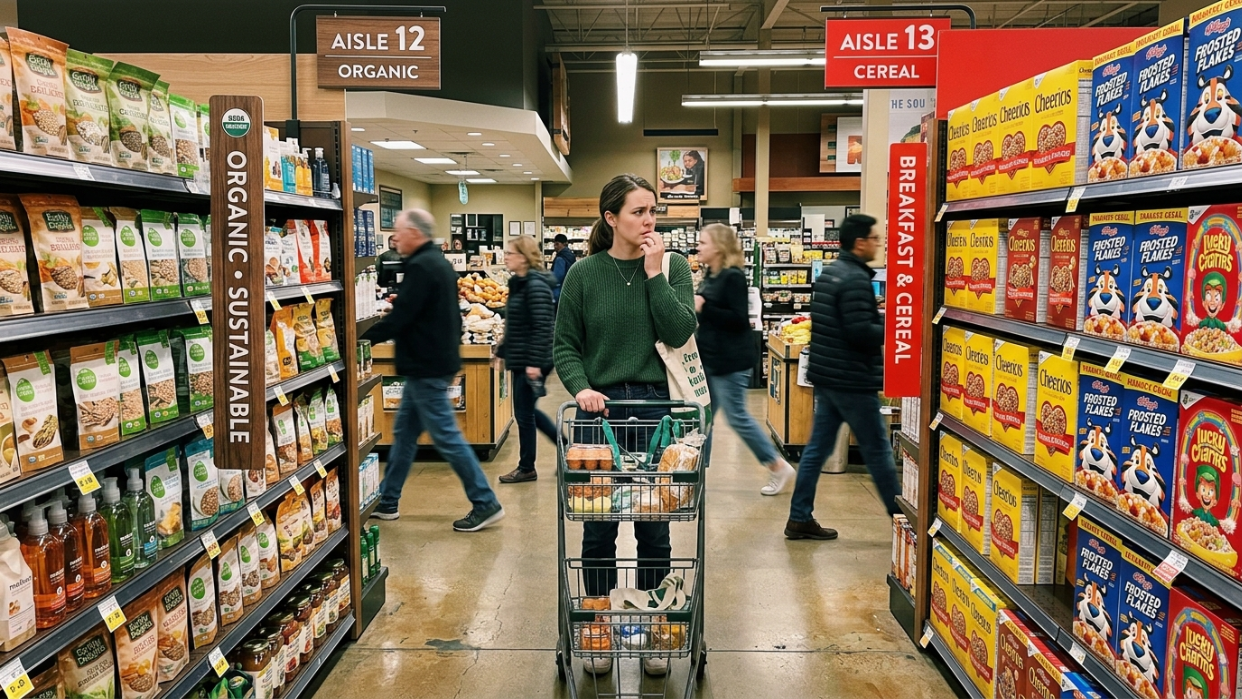
Consumers make most purchase decisions in under 10 seconds, prioritizing speed over evaluation. Sustainability reasoning simply can’t compete in that window.
Dual System Decision Making
System 1 (fast): habit, price, brand recognition
System 2 (slow): sustainability reasoning (rarely activated)
The Loss Aversion Trap at Shelf
Loss aversion and temporal discounting work together at the moment of purchase. The consumer’s fast brain sees a price difference (immediate, concrete loss) and an environmental claim (future, abstract gain). System 1 resolves this conflict instantly: avoid the loss. System 2, which might weigh the long term value proposition, rarely gets a chance to engage in a typical shopping trip. This is why even well informed, environmentally committed consumers often default to conventional products when they’re shopping quickly or distracted.
One YouTube reviewer of sustainable household products put it plainly: “I know this stuff matters, but when I’m in the store with my kids and I see the price difference, my brain just grabs the cheaper one. It’s not a decision. It’s a reflex.”
Why Consumers Do Not Buy Sustainable Products: Barrier Comparison
Barrier | Type | Impact Level | Primary Trigger |
|---|---|---|---|
Price perception | Economic | Very High | Green premium assumption |
Trust deficit | Psychological | Very High | Greenwashing exposure |
Loss aversion | Psychological | High | Immediate cost vs. abstract gain |
Habit | Behavioral | High | Repeat purchase inertia |
Abstract/distant benefit | Psychological | Medium to High | Temporal discounting |
Cognitive overload | Decision fatigue | Medium to High | Too many labels |
Efficacy doubt | Belief system | Medium | “Does it even matter?” |
The Seven Barriers: Why Consumers Do Not Buy Sustainable Products
Understanding the terminology is step one. Step two is mapping the actual barriers that prevent purchase. Research consistently identifies seven.
1. Price and Perceived Value
Price is the most frequently cited reason why consumers do not buy sustainable products. Half of American consumers have declined to purchase an eco friendly product specifically because of cost, according to Capital One Shopping research from 2026. In a 2024 Sphera survey, 31% of respondents named high cost as the single biggest barrier to sustainable behavior change.
The actual premium, around 28%, is significant but shrinking. The bigger problem is perception. BCG’s research found that non buyers estimate the green premium to be higher than it really is. When consumers see “eco friendly” or “sustainable” on a label, they mentally add more to the expected price than the actual markup warrants.
The flip side is revealing. SEER research shows that more than 80% of participants choose the eco friendly product when it’s cheaper or similarly priced. This drops below 60% when the eco friendly option costs even slightly more. The implication is clear: price parity or near parity would dramatically expand the sustainable product market.
2. Loss Aversion as a Hidden Price Multiplier
Price sensitivity alone doesn’t fully explain the barrier. Loss aversion amplifies it. Even when the actual price difference is small (a dollar or two), consumers experience an outsized emotional reaction because losses feel roughly twice as painful as equivalent gains feel pleasurable. This is not a rational calculation. It is a deeply wired cognitive bias.
The consequence is that a $1 green premium doesn’t just feel like $1 extra. It feels like a $2 punishment. And because the environmental reward is uncertain, delayed, and shared across millions of people, there’s no proportional “gain” to offset the sting. A sustainability consultant shared on LinkedIn that their client ran A/B tests on shelf signage: when they reframed the sustainable option as “costs 15 cents more per use” instead of listing the total price difference, conversion increased measurably. Small reframing can partially offset loss aversion, but it can’t eliminate it entirely.
For brands trying to navigate these pricing dynamics, understanding how to commercialize sustainability is critical.
3. Trust Deficit and Greenwashing
Only 10% of consumers report having complete trust in business sustainability promises, according to the Sphera survey. Seventy percent admit to feeling wary of corporate sustainability claims and commitments.
This isn’t paranoia. Years of vague claims, misleading labels, and outright deception have trained consumers to be suspicious. And the consequences go further than most brands realize. The Hiroshima University research published in 2026 found that skepticism doesn’t just make consumers more cautious buyers. It quietly pushes them away from the entire decision making process. Instead of scrutinizing claims more carefully, skeptical consumers simply opt out.
This creates a vicious cycle. Greenwashing breeds skepticism. Skepticism causes disengagement. Disengagement means even genuinely sustainable products get ignored.
For brands with real environmental credentials, this is deeply unfair. And it explains why impact measurement and third party verification have become so important.
4. The Abstraction Problem: Benefits That Feel Invisible
Sustainable products ask consumers to accept a tangible cost now in exchange for an intangible benefit later. That later might be years, decades, or never (from the individual’s perspective). This is the abstraction problem, and it undermines motivation in ways that most sustainability marketing completely ignores.
When a brand says “this product reduces carbon emissions by 40%,” most consumers have no frame of reference for what that means in their daily life. They can’t see it, feel it, or verify it. Compare this to a conventional product’s value proposition: “cleans 50% faster” or “lasts twice as long.” Those claims are concrete, personal, and immediately testable.
Temporal discounting makes the problem worse. Humans consistently prefer smaller rewards now over larger rewards later. A $3 saving today beats a marginal environmental improvement spread across the next decade. This isn’t selfishness. It’s the way human cognition handles time and uncertainty.
Practitioners on Reddit’s r/ZeroWaste frequently discuss this frustration. One commenter noted: “I switched to sustainable products for a year and honestly couldn’t point to a single tangible difference it made. I kept doing it because of values, but I totally understand why most people don’t.”
The brands that overcome this barrier are the ones that make abstract benefits concrete and personal. Instead of “reduces ocean plastic,” try “this bottle kept 12 plastic containers out of the waste stream.” Instead of “lower carbon footprint,” try “made with 60% less energy than a standard product, enough to power your home for 3 hours.” Specificity bridges the gap between abstract goodness and felt value.
5. Cognitive Overload and Confusion
A practitioner on LinkedIn described it well: “When faced with sustainable options during daily consumption, we often do not have the luxury of time and mental energy to study every packaging on the shelves. Overcoming our automatic thinking requires strong cognitive effort and control, which has a physical cost.”
Sixteen percent of U.S. consumers say they have difficulty even finding eco friendly products to purchase. The number of eco labels, certifications, and sustainability claims has exploded, and consumers have varying understandings of what “sustainable,” “green,” or “eco friendly” actually means. One product highlights carbon neutrality. Another emphasizes recycled packaging. A third focuses on ethical sourcing. Which one is “more sustainable”? The question itself is exhausting.
The Stanford researchers confirmed in 2025 that package size, ingredients, and brand name are much bigger purchase drivers than sustainability, not because consumers don’t care, but because those attributes are easier to evaluate quickly. Sustainability competes poorly in the three seconds a shopper spends scanning a shelf.
6. Habit and Convenience
Markets are structurally designed to advantage conventional goods. The World Economic Forum described sustainable purchasing as swimming against the current for consumers. Conventional products have better shelf placement, wider availability, more familiar branding, and established supply chains that keep prices lower.
Simply being aware that a more sustainable choice exists doesn’t guarantee behavior change. When the sustainable choice feels harder, more expensive, and less immediately rewarding, most consumers default to what they know. This isn’t moral failure. It’s how human decision making works under time pressure and cognitive load.
Loss aversion reinforces habit. Switching away from a known product carries the risk of losing familiar quality, taste, or performance. The potential upside (a slightly better environmental outcome) is uncertain and delayed. Status quo bias and loss aversion together create a powerful gravitational pull toward whatever consumers bought last time.
For brands trying to overcome these structural barriers, understanding behavior change strategy is essential.
Structural Reasons the Gap Exists (Beyond Psychology)
Retail systems prioritize conventional supply chains
Sustainable products have weaker shelf visibility
Marketing budgets for green products are smaller
Certification systems are fragmented and inconsistent
Price optimization still favors scale economies of non sustainable goods
7. Efficacy Doubt and Perceived Lower Quality
Fifteen percent of consumers find eco friendly products less effective than conventional alternatives. Whether it’s the natural cleaning product that doesn’t cut grease as well or the recycled paper towel that feels thinner, perceived quality gaps are real and consequential.
Beyond product performance, there’s a deeper doubt about whether individual action matters at all. Katherine White, professor at UBC Sauder School of Business, notes: “Often with these green behaviors, people are uncertain. They’re like, ‘Well, is it gonna make a difference if I do it?’” Gen Z, supposedly the most sustainability conscious generation, is the age group most likely to say they can only make a difference if “business plays its part too.”
This sense of individual powerlessness compounds every other barrier. The abstraction problem feeds directly into efficacy doubt: if you can’t see or feel the benefit, how can you be sure it exists? Why pay more, spend more time researching, and risk lower quality if it probably won’t matter anyway?
Not All Consumers Are the Same: The Green Behavior Segments

High Intent Buyers (Evangelists)
Already buy sustainable products
Main barrier: trust and product availability
Less sensitive to price, more sensitive to greenwashing
Persuadable Middle
Care about sustainability
Most sensitive to price + convenience + loss aversion
Largest untapped revenue opportunity
Highly susceptible to abstract benefit framing (need concrete, personal benefits)
Skeptics
Low trust in sustainability claims
Often triggered by greenwashing fatigue
Require proof, not messaging
Passive Buyers
Do not prioritize sustainability at all
Only respond to convenience or price parity
Abstract environmental benefits register as essentially zero value to this group
Why the Gap Matters for Brands
Despite all these barriers, sustainable products are growing. Since 2019, products marketed as environmentally sustainable have seen 28% cumulative revenue growth compared to 20% for products without such positioning, according to McKinsey and NielsenIQ. Sustainable products hold roughly 17% overall market share and growing.
The growth is real, but it’s concentrated among committed buyers. The intention action gap means the addressable market is capped at roughly 16 to 26% of consumers, a fraction of the 65 to 80% who express interest. The “persuadable middle,” consumers who care but don’t consistently buy, represents a massive untapped opportunity.
Brands that understand exactly which barriers block their specific audience can unlock that middle segment. This is why diagnosing the gap matters more than simply assuming price is the problem. A 2026 MDPI study found that price premium is the dominant barrier among low involvement consumers, but credibility concerns (particularly greenwashing) are the primary barrier among high involvement consumers. The same product can face completely different obstacles depending on who’s considering it.
Loss aversion and benefit abstraction operate across all segments but hit the persuadable middle hardest. These consumers care enough to consider the sustainable option but not enough to absorb a perceived loss without clear, tangible justification. They need the environmental benefit translated into language their fast brain can process.
Stanford’s 2025 research adds another wrinkle: consumers tend to be more suspicious of sustainability claims from large companies. As a result, big manufacturers often launch or acquire smaller brands to appear more authentic. The system rewards the appearance of authenticity, which, ironically, can feed more skepticism.
For a broader view of why sustainability attitudes fail to translate into systemic change, see the explainer on why everyone says they care but nothing changes.
What Actually Closes the Gap
Understanding why consumers do not buy sustainable products is useful. Knowing what to do about it is better. The research points to several strategies that work.
Make Sustainable the Default, Not the Exception
The most effective intervention isn’t education. It’s friction reduction. When sustainable options are the default choice (opt out rather than opt in), adoption skyrockets. This applies to product design, shelf placement, subscription defaults, and online checkout flows. The goal is to stop asking consumers to swim upstream. Default settings sidestep loss aversion entirely because consumers don’t experience a loss when they aren’t actively choosing to pay more.
Correct the Price Misperception
Since the perceived green premium exceeds the actual one, clear price communication is a quick win. Showing the real price comparison, rather than letting consumers assume the worst, can shift purchasing. NielsenIQ found that 70% of consumers are open to purchasing sustainable products when priced reasonably. Many already are priced reasonably. Consumers just don’t realize it.
Reframing cost per use instead of total price also helps counteract loss aversion. A $6 sustainable dish soap that lasts twice as long as a $4 conventional one is actually cheaper, but consumers won’t do that math at the shelf unless the brand does it for them.
Make Abstract Benefits Concrete and Personal
This is where most sustainability marketing fails. Generic claims about planetary impact don’t move products. Specific, personal, tangible translations of environmental benefit do.
Instead of “sustainable sourcing,” try “grown without pesticides, so nothing you wouldn’t eat touches your food.” Instead of “carbon neutral,” try “made using 70% less energy, the equivalent of keeping your lights off for a week.” The goal is to collapse the psychological distance between the purchase and the outcome. When the benefit feels immediate and personal rather than abstract and collective, temporal discounting loses its grip.
Some brands are experimenting with impact receipts that show the specific environmental outcome of each purchase. Early data from these experiments (shared by several DTC brands in sustainability forums) suggests they increase repeat purchase rates, likely because they transform an abstract benefit into something visible and verifiable.
Counter Loss Aversion with Gain Framing
Rather than asking consumers to “pay more for sustainability,” reframe the value proposition around what they gain. “This product lasts 3x longer” is a gain. “Made with ingredients that are safer for your family” is a gain. “Saves you $40 per year in replacements” is a gain. Each of these addresses the sustainable attribute without triggering the loss aversion response that “costs 20% more” inevitably creates.
Brands seeing the best conversion rates on sustainable products are the ones that lead with personal, immediate benefits and mention environmental impact as a secondary advantage. This isn’t cynical. It’s realistic about how purchasing decisions actually work.
Use Social Proof Strategically
Studies cited by HBR found that telling online shoppers that others were purchasing eco friendly items resulted in a 65% boost in making at least one sustainable purchase. Social norms are powerful because they address efficacy doubt (“others are doing it, so it matters”) and reduce the cognitive effort of decision making (“if others chose this, it’s probably fine”). Social proof also reduces the perceived risk of switching, counteracting the loss aversion that keeps consumers loyal to conventional products.
Build Trust Through Specificity, Not Slogans
Vague claims like “eco friendly” or “sustainable” trigger skepticism. Specific, verifiable claims, such as “made with 80% post consumer recycled plastic” or “certified by [named third party],” build credibility. The goal is to give skeptical consumers a reason to re engage rather than opt out entirely. Brands that pair genuine credentials with purposeful storytelling can break through the noise.
Frame Sustainability as “And,” Not “Or”
Products succeed when sustainability is additive, not a trade off. “This cleans better AND uses 50% less plastic” beats “buy this because it’s better for the planet.” Consumers shouldn’t have to choose between performance, value, and environmental impact. The brands closing the gap are the ones that refuse to make consumers choose. This framing directly addresses both loss aversion (no sacrifice required) and the abstraction problem (the benefit is paired with something concrete).
Segment Your Audience
Not all non buyers face the same barriers. NielsenIQ’s Green Divide framework shows that Skeptics need different messaging than Idealists, who need different messaging than the Healthy Me & Planet segment. Treating all consumers as a single audience guarantees that your message resonates with no one in particular. Even among Skeptics, there are entry points, but brands should also be careful not to alienate them with heavy handed sustainability messaging that triggers backlash. Loss aversion and benefit abstraction hit the persuadable middle hardest, while trust deficit dominates among high involvement consumers.
If your sustainable products aren’t converting despite strong stated demand, the first step is pinpointing which barriers are actually at play.
Get a discovery call with Grounded World to diagnose the specific intention action gaps holding your brand back.
Frequently Asked Questions
What is the intention action gap in sustainable purchasing?
The intention action gap is the measurable disconnect between what consumers say they intend to buy and what they actually purchase. In sustainability, it manifests as large majorities (65 to 80%) expressing willingness to buy green products while only 16 to 26% consistently follow through. It’s caused by a combination of price sensitivity, loss aversion, distrust, habit, cognitive overload, abstract benefits, and efficacy doubt.
Why do consumers say they care about sustainability but don’t buy sustainable products?
Social desirability bias plays a major role. People genuinely believe they care and want to give the “right” answer in surveys. But at the point of purchase, faster mental processes take over: habit, price comparison, brand familiarity, and convenience. Loss aversion makes even small price premiums feel disproportionately painful, and the environmental benefits are too abstract and distant to counterbalance. The gap between stated values and shelf behavior is one of the most documented phenomena in consumer behavior research.
How does loss aversion affect sustainable purchasing?
Loss aversion causes consumers to weigh the immediate, concrete cost of a sustainable product (the price premium) roughly twice as heavily as the uncertain, future environmental gain. A $2 price difference doesn’t feel like $2 to the consumer’s intuitive brain. It feels more like $4 of “pain.” Because the environmental benefit is abstract, diffuse, and delayed, there’s nothing to offset that perceived loss in real time. This is why even consumers who strongly support sustainability often default to cheaper conventional options at the shelf.
Why do abstract environmental benefits fail to motivate purchases?
Humans discount future and distant rewards compared to immediate ones. “Reduces ocean plastic” is a benefit that unfolds over years across millions of purchases. It’s essentially invisible at the individual level. Consumers can’t see, feel, or verify the outcome. By contrast, product attributes like taste, performance, and price are immediate and personal. Brands that translate abstract environmental benefits into specific, personal, immediate terms (cost savings, health benefits, measurable impact) see better conversion.
Is price the main reason why consumers do not buy sustainable products?
Price is the most commonly cited barrier. Fifty percent of American consumers have declined an eco friendly purchase due to cost, and the average green premium sits around 28%. However, price interacts with loss aversion (making premiums feel larger than they are) and benefit abstraction (making the payoff feel smaller than it is). For highly engaged consumers, trust and greenwashing concerns actually matter more than price. The dominant barrier depends on the consumer segment.
How does greenwashing affect sustainable purchasing behavior?
Greenwashing creates green skepticism, which is now one of the largest obstacles to sustainable purchasing. Over 60% of consumers don’t trust corporate environmental claims. Recent research from Hiroshima University shows that skepticism doesn’t make consumers more discerning. It makes them disengage entirely, avoiding the category rather than investigating further. This is why greenwashing by some brands damages the market for all brands.
What is the green premium, and is it shrinking?
The green premium is the extra cost of a sustainable product compared to its conventional equivalent. It currently averages about 28% but is decreasing over time. Importantly, consumers tend to overestimate this premium, meaning they assume sustainable products cost even more than they actually do. Clear pricing communication can help close this perception gap.
Do social norms influence sustainable purchasing?
Yes, significantly. Research shows that telling shoppers that other consumers were buying eco friendly products led to a 65% increase in sustainable purchases. Social proof reduces uncertainty, validates the choice, and addresses the common doubt of “will my individual action even make a difference?”
What percentage of consumers actually buy sustainable products?
Estimates vary by market and methodology, but the most reliable data suggests between 16% and 26% of consumers who express concern about sustainability consistently purchase sustainable products. Sustainable products hold approximately 17% overall market share. The gap between stated interest (65 to 80%) and actual purchasing is the core challenge the industry faces.
Can brands close the intention action gap?
Yes, but not through awareness campaigns alone. The most effective strategies involve reducing friction (making sustainable options the default), correcting price misperceptions, countering loss aversion with gain framing, translating abstract benefits into concrete personal value, using social proof, building trust through specific and verifiable claims, and segmenting audiences so that different barriers get different responses. It requires removing barriers to purchase rather than simply hoping consumers will overcome them on their own.