

 Gaia
GaiaTL;DR
Consumer intention is what people say they plan to buy. Consumer behavior is what they actually purchase. The gap between the two (called the intention-behavior gap, value-action gap, or say-do gap) is one of the most persistent problems in marketing. Research shows that intentions account for only 27% of the variance in actual behavior. The gap isn’t caused by consumer hypocrisy. It’s caused by friction, structural barriers, and cognitive biases that brands can diagnose and fix.
Explore Grounded World’s approach to understanding consumer behavior and closing the gap between stated intentions and real-world action.
Quick Answer: Consumer Intention vs Behavior (2026)
Consumer intention is what people say they plan to do, while consumer behavior is what they actually do in real-world purchase situations. The gap between them—called the intention-behavior gap—exists because real decisions are influenced by price, convenience, cognitive bias, and context, not just stated preferences. On average, consumer intentions explain only about 27% of actual behavior, meaning most purchasing decisions are shaped at the point of action rather than at the point of intention.
What Is Consumer Intention? What Is Consumer Behavior?
Consumer intention is an indication that a person is ready to perform a certain action, typically a purchase. It reflects someone’s plan to buy a certain amount of a particular brand or product over a specified time period. In the Theory of Planned Behavior (more on this below), intention is considered the most direct precursor of behavior.
Consumer behavior is the actual, observable action. It’s the purchase made, the product chosen, the brand selected at the shelf. It is what consumers do, not what they say they will do.
The distinction between consumer intention vs behavior matters because the two frequently diverge. This divergence goes by many names:
Intention-behavior gap
Value-action gap
Attitude-behavior gap
Say-do gap
Intention-action gap
Belief-behavior gap
All describe the same phenomenon: people express values, preferences, and plans that don’t show up in their purchasing patterns. The pattern is so well documented that it has become a central concern for brand managers, sustainability leads, and market researchers worldwide.
Consumer Intention vs Consumer Behavior (Key Differences)
Factor | Consumer Intention | Consumer Behavior |
|---|---|---|
Definition | What people say they plan to do | What people actually do |
Data Source | Surveys, interviews, self-reports | Sales data, purchase tracking |
Reliability | Often inflated or biased | Highly accurate |
Influencing Factors | Attitudes, beliefs, motivations | Price, convenience, context, friction |
Predictive Power | Moderate (≈27% variance explained) | Actual outcome (truth signal) |
The Academic Foundation: Theory of Planned Behavior
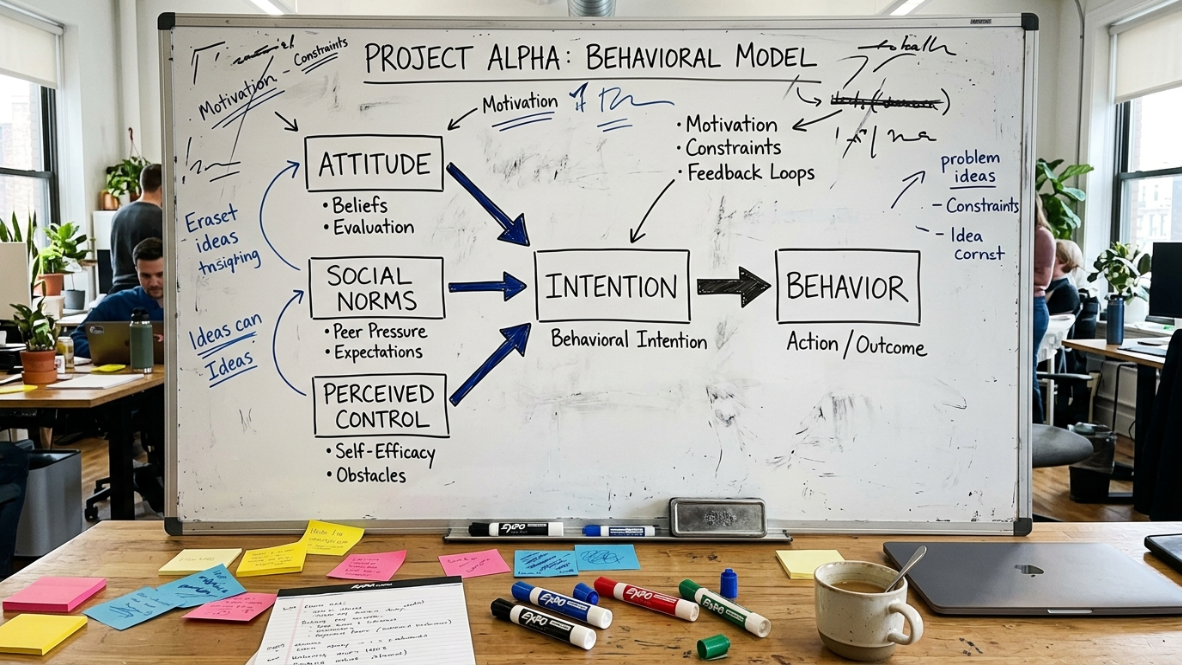
The Theory of Planned Behavior (TPB) is the dominant psychological framework for understanding consumer intention vs behavior. Developed by Icek Ajzen, it proposes that three components shape a person’s behavioral intentions:
Attitude toward the behavior (do I think this is good or bad?)
Subjective norms (do people important to me think I should do this?)
Perceived behavioral control (do I believe I can actually do it?)
Together, these three factors produce an intention. And according to TPB, intention is the most proximal determinant of behavior, meaning it’s the closest predictor we have.
But “closest predictor” doesn’t mean “accurate predictor.”
The 27% Problem
A meta-analysis on pro-environmental behavior found that intentions accounted for only 27% of the variance in actual behavior. That leaves nearly three-quarters of what people do unexplained by what they said they would do.
It gets worse. Even when interventions successfully shift people’s intentions (a medium-to-large change), the resulting change in behavior is only small-to-medium. Changing minds doesn’t reliably change actions.
The Four-Quadrant Model
Researchers have mapped consumer intention vs behavior into four quadrants:
Low Behavior | High Behavior | |
|---|---|---|
High Intention | Common (the gap) | Ideal alignment |
Low Intention | Consistent non-action | Very rare |
The critical quadrant is high intention, low behavior. These are people who genuinely want to buy sustainable products, switch brands, or change habits, but don’t follow through. They’re common. Meanwhile, consumers with low intention and high behavior (doing the right thing without planning to) are extremely rare. This asymmetry tells us something important: the gap isn’t random. It has a direction, and it points toward intention failing to convert into action.
For brands trying to understand why customers say they care but don’t buy, this quadrant is where the opportunity lives.
Why the Intention-Behavior Gap Exists
The gap between consumer intention and behavior is not caused by dishonesty or irrationality. It emerges because real-world decision-making differs from survey responses.
The main drivers include:
Cognitive biases (people prioritize immediate rewards over future benefits)
Structural barriers (price, availability, complexity)
Social influence (norms and signaling behavior)
Context shifts (decisions change at the point of purchase)
Measurement error (intentions are overstated in surveys)
Together, these factors weaken the link between what consumers say and what they actually do.
Root Causes of the Intention-Behavior Gap
The gap between consumer intention and behavior isn’t caused by one thing. It’s the result of cognitive biases, structural barriers, social pressures, and flawed measurement, all working together.
Present Bias and Hyperbolic Discounting
Humans consistently choose smaller, immediate rewards over larger, later ones. This cognitive bias, called hyperbolic discounting or present bias, is one of the strongest forces pulling intention and behavior apart.
In the consumer context, it looks like this: a shopper who intends to buy the sustainable laundry detergent reaches the shelf and grabs the cheaper option instead. The benefits of the sustainable choice (environmental protection, reduced waste) are abstract and delayed. The benefit of saving $3 is concrete and immediate.
Behavioral scientists explain this through dual-process theory. System 1 (fast, automatic, emotional) tends to dominate in real shopping environments. System 2 (slow, deliberate, rational) is where sustainability intentions live, but it’s easily depleted by time pressure, decision fatigue, and distraction. When System 1 wins, the intention evaporates.
Social Desirability Bias
When a researcher asks “Would you pay more for sustainable products?” many respondents say yes, partly because they want to, and partly because saying no feels wrong. This is social desirability bias: people report intentions that are more socially acceptable rather than their true plans.
This inflates stated intention data across the board. Brands then build forecasts on these inflated numbers and wonder why demand falls short.
Social Norm Pressure
Social norms cut both ways. Descriptive norms (what most people actually do) often discourage sustainable choices because the majority still buys conventional products. If nobody in your social circle carries a reusable bag, doing so yourself feels conspicuous.
Injunctive norms (what people think you should do) can create the opposite problem: people state pro-sustainability intentions to signal virtue, without any real plan to follow through. The result is more distance between what gets said and what gets done.
Structural Barriers: Price, Complexity, and Cognitive Load

Consumers rarely make decisions in a calm, abstract setting. They shop under time pressure, compare imperfect information, and rely on whatever is visible, easy to interpret, and easy to act on. Ethical concerns often fail to enter the actual purchase decision not because they don’t matter, but because they’re harder to access, harder to compare, or harder to use than criteria like price, brand familiarity, and convenience.
Research from Accenture confirms that consumers still consider quality and price above environmental impact when making purchase decisions. Meanwhile, a UK study found that while 94% of consumers accept individual responsibility for sustainability, 62% say the subject is too complicated and they find it hard to understand how to make more sustainable choices.
For a deeper look at these structural obstacles, see this guide to removing barriers to sustainable purchasing.
The Measurement Problem
Part of the gap is real. Part of it is an artifact of how we measure intention in the first place.
Traditional stated-preference surveys ask consumers to evaluate options in isolation, without the trade-offs, competitive context, and time pressure they face at the point of purchase. One marketing researcher summarized it bluntly: “There have been many papers and a lot of opinions shared about how good purchase intention is at predicting behavior in-market. The reason for all this discussion traces to the fact there is a very fuzzy relationship between behavior intention and actual behavior at best.”
Practitioners on research forums echo this frustration. As one Team Blind user put it: “Things like environmental sustainability only matter to the customers when you have a solid product to sell or value price to offer. People will NEVER pay attention to products that have low quality… Price is one of the key factors in retail since customers care a lot about their value for money.”
Core Drivers of the Intention-Behavior Gap
Category | Driver | What It Looks Like in Real Life |
|---|---|---|
Cognitive | Present bias | Choosing cheaper option at checkout |
Cognitive | Decision fatigue | Defaulting to familiar brands |
Social | Social desirability bias | Overstating eco-friendly intentions |
Structural | Price sensitivity | Avoiding higher-cost sustainable goods |
Structural | Complexity | Confusion about product labels |
Contextual | Time pressure | Fast decisions override values |
The Gap in Numbers
The data makes the scale of the problem hard to ignore:
Only 16% of consumers who express concern about sustainability actually purchase sustainable products, according to practitioner research from Supergoods
30% of self-declared green consumers struggled to translate concern into purchasing decisions
76% of travelers say they want to travel more sustainably, per Booking.com’s 2023 report
80% of global consumers say they’re willing to pay 5% more for locally-made sustainable products
Sustainability-marketed products grew 2.7x faster than conventional products in their categories, per NYU Stern/IRI research
That last statistic reveals something counterintuitive. While the intention-behavior gap is real and large, the consumers who do cross the gap spend disproportionately. From 2013 to 2018, sustainability-marketed products delivered 50% of CPG growth despite representing only 17% of the market.
The gap is costly, but closing it is enormously profitable.
Why the Intention-Behavior Gap Matters for Marketing
For marketers, the intention-behavior gap explains why campaigns often fail to convert high engagement into sales.
Key implications include:
High survey intent does not guarantee demand
Brand sentiment is not equal to purchase probability
Sustainability messaging alone rarely drives conversion
Behavioral data is more predictive than attitudinal data
Conversion happens at the point of decision, not awareness
Brands that ignore this gap tend to overestimate market demand and underperform in revenue forecasting.
How Brands Close the Gap Between Consumer Intention and Behavior
The intention-behavior gap is not a character flaw in consumers. It’s a design problem in how products are positioned, priced, and presented. Brands that treat it as a design problem can fix it.
Effort-Reward Rebalancing
The simplest framework comes from practitioners at Trellis: consumers will consistently buy sustainable products when the perceived benefits exceed the effort involved. Brands can close the consumer intention vs behavior gap by decreasing the effort, increasing the rewards, or both.
“Decreasing effort” means making the sustainable choice the easy choice: clearer labeling, better shelf placement, simpler messaging, competitive pricing. “Increasing rewards” means making sustainability part of the product’s core value, not a guilt-based add-on. When a sustainable product is also the one that works better, tastes better, or costs less per use, the gap shrinks on its own.
As one industry practitioner wrote on Substack: “The reality is the majority of consumers want aspiration and connection more than they want to save the planet at present, and for brands, it’s no longer enough to rely on ‘sustainable’ as your only marketing lever.”
Nudge Design and Choice Architecture
Nudge design combines design thinking with behavioral science. A nudge is a subtle suggestion, made through design or communication, that draws attention, communicates information, and suggests a preferable action. Effective nudges are easy, attractive, social, and timely.
Examples include making the sustainable option the default (opt-out rather than opt-in), placing it at eye level, using social proof (“most popular choice”), and timing prompts to moments of high receptivity. For brands developing a broader behavior change marketing strategy, nudges are one of the most reliable tools available.
The Fogg Behavior Model
BJ Fogg’s model states that behavior happens when three elements converge: motivation, ability, and a prompt. Most brand campaigns focus almost exclusively on motivation (awareness, education, emotional appeals). But as the research on consumer intention vs behavior shows, motivation alone isn’t enough.
A practitioner at Quirks, a marketing research publication, put it well: “When brands rely only on what customers say, they design programs heavy on motivation but light on action. The Fogg Model shows that true loyalty success depends on balancing motivation, ability and prompt.”
Ability means making the action easy. Prompts mean triggering it at the right moment. Brands that balance all three consistently outperform those that invest only in awareness.
Integrating Sustainability Into the Core Value Proposition
Research from SKIM Group offers a critical insight: “When sustainability is seamlessly integrated into products and services, it can enhance the fundamental attributes of the value proposition. This integration can add new functional, emotional, and social benefits, making the product more attractive in the short term and building brand equity over the long term.”
This is the opposite of treating sustainability as a bolt-on or a premium surcharge. The brands that close the gap most effectively are the ones that make sustainable and desirable synonymous.
Measure Behavior, Not Just Intent
Intent scale translation is a mathematical technique that converts stated purchase intentions into purchase probabilities, providing a more realistic estimate of actual buying behavior. But even this approach has limits when the underlying survey data is distorted by social desirability bias.
The most effective approach combines stated data with behavioral data: actual purchase patterns, implicit association testing, and real-world experiments. Brands that rely solely on surveys to forecast demand will consistently overestimate the market for sustainable products, then blame consumers for the shortfall.
Talk to Grounded World about diagnosing and quantifying the intention-behavior gap for your brand.
Related Terms
Understanding consumer intention vs behavior connects to several related concepts:
Purchase intent vs purchase behavior: A narrower application of the same principle, focused specifically on the buying context
Value-action gap: The most commonly used academic term, especially in environmental and ethical consumption research
Attitude-behavior gap: Emphasizes the role of attitudes (rather than plans) in predicting action
Say-do gap: The practitioner-friendly term used most often in marketing and brand strategy
Stated preference vs revealed preference: The economics framing, distinguishing what people claim to prefer from what their choices reveal
Each term describes the same core phenomenon from a slightly different angle. For brands working in sustainability, understanding why concern doesn’t translate to change is the first step toward building strategies that actually work.
How to Reduce the Intention-Behavior Gap (Checklist)
Brands can close the gap between intention and behavior by:
Reducing friction at checkout or point of decision
Making the default option the desired behavior
Lowering price or increasing perceived value
Simplifying product information and labels
Using social proof (“most chosen option”)
Aligning sustainability with product performance
Testing real behavior instead of relying on surveys
Frequently Asked Questions
What is the difference between consumer intention and consumer behavior?
Consumer intention is a stated plan or readiness to act, typically measured through surveys or self-reports. Consumer behavior is the actual action taken, such as a purchase. The key difference is that intentions reflect what people believe they will do, while behavior reflects what they actually do. Research consistently shows these two don’t align as closely as most marketers assume.
Why do consumers say one thing and do another?
The gap is driven by a combination of cognitive biases (present bias, social desirability), structural barriers (price, availability, complexity), and social norms. Consumers aren’t being dishonest. They genuinely intend to follow through, but real-world conditions, from time pressure to confusing labels to higher prices, break the link between intention and action.
How big is the intention-behavior gap?
A meta-analysis found that intentions explain only 27% of the variance in actual behavior. In sustainability specifically, only about 16% of consumers who express concern about environmental issues actually purchase sustainable products. The gap is large, consistent, and well-documented across categories and geographies.
Can brands actually close the intention-behavior gap?
Yes, but not through awareness campaigns alone. The most effective strategies combine nudge design, choice architecture, effort-reward rebalancing, and integrating sustainability into the product’s core value proposition rather than treating it as a premium add-on. Brands that make the sustainable choice the easy, attractive, default choice see measurably better conversion from intention to behavior.
What is the Theory of Planned Behavior?
The Theory of Planned Behavior (TPB) is a psychological framework proposing that behavior is predicted by intentions, which are shaped by three factors: attitude toward the behavior, subjective norms (social pressure), and perceived behavioral control (whether someone believes they can do it). While TPB is the dominant model, its predictive power is weaker than many assume.
Is the say-do gap the same as the intention-behavior gap?
Yes. The say-do gap, value-action gap, attitude-behavior gap, and intention-behavior gap all describe the same phenomenon. “Say-do gap” is the most common term in practitioner and marketing contexts, while “intention-behavior gap” and “value-action gap” are more common in academic research.
How should brands measure consumer intention more accurately?
Brands should supplement stated-preference surveys with behavioral data, including actual purchase data, implicit association testing, and real-world experiments. Intent scale translation techniques can convert stated intentions into more realistic purchase probabilities, but even these work best when combined with observed behavior rather than used in isolation.
Why is the intention-behavior gap especially relevant for sustainability?
Sustainability is where the gap is widest and most studied. Environmental and ethical benefits are abstract, delayed, and hard to verify at the shelf, which makes them especially vulnerable to present bias and cognitive load. At the same time, sustainability-marketed products that do convert intention into behavior grow significantly faster than their conventional counterparts, making the gap both the biggest obstacle and the biggest opportunity.