
 Gaia
GaiaPurchase intent is what a customer says they plan to buy. Purchase behavior is what they actually buy. The space between the two is called the say-do gap (also known as the intention-action gap or value-action gap). It opens because real purchases are shaped by price, convenience, trust, visibility, availability and habit, not by motivation alone.
"Purchase intent is exactly that: intent. But the gap between intent and action can be as wide as 80% or more. So a purchase-intent metric is most likely giving you only a very small window into a much bigger behavior change opportunity, and you might be overlooking the barriers and drivers that can make all the difference." Phil White, Co-Founder & Chief Strategy Officer, Grounded World
TLDR
Purchase intent is a stated likelihood of buying. Purchase behavior is the observed purchase, the price paid, the brand chosen and whether the customer comes back.
On its own, a purchase-intent score has little value. It only becomes meaningful against a benchmark: a competitive shelf set or a category average.
Context changes behavior more than anything else. The same brand, and often the same shopper, can convert online and fail in store.
The strongest brands treat intent as a hypothesis and validate it with behavioral data before they scale.
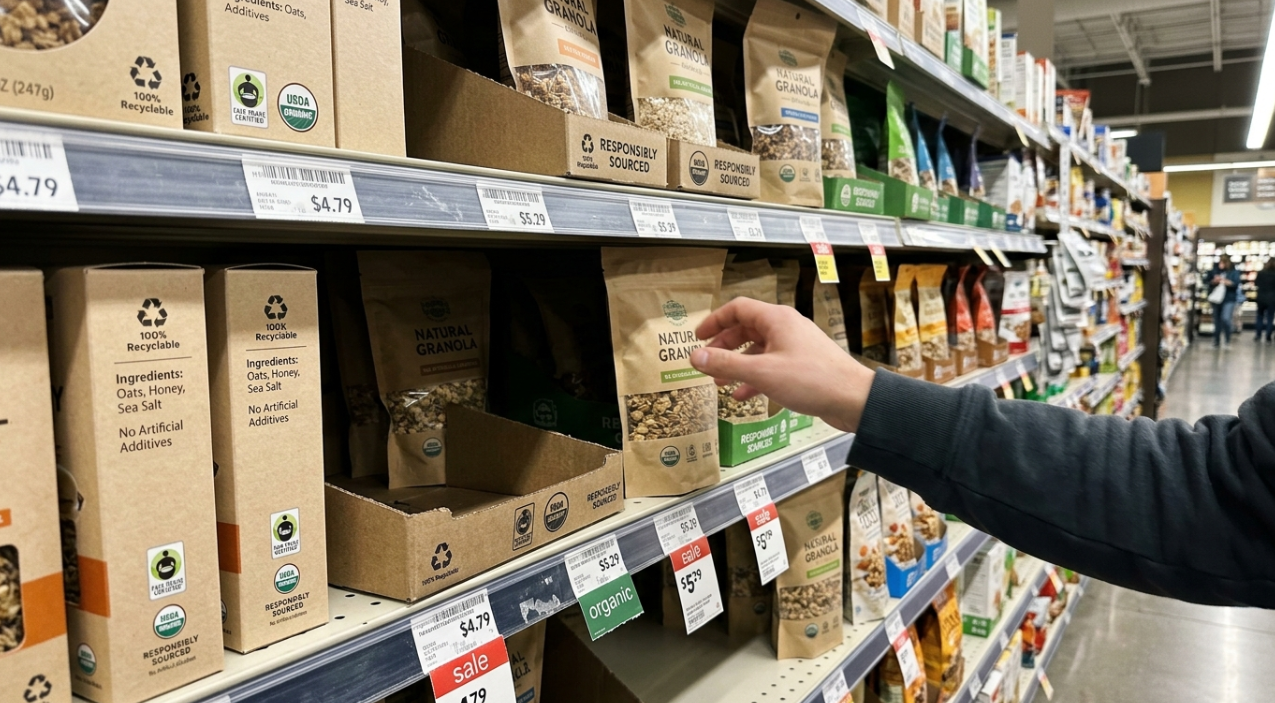
The difference between purchase intent and purchase behavior matters because people regularly express interest in products they never end up buying. A shopper says they want the sustainable option, then picks the cheaper one. A survey respondent gives top-box intent scores, then doesn't select the product when it's right in front of them on the shelf.
For brands built around purpose, sustainability or social impact, this gap is the central commercialization challenge: turning intention into action, and so purpose into profit.
Example
Intent: "I would probably buy this eco-friendly cleaner."
Behavior: the shopper buys a competing cleaner because it is perceived to be more effective (and is probably on promotion).
Purchase Intent vs Purchase Behavior: Direct Answer
Purchase intent is a customer's stated likelihood of buying a product or service, while purchase behavior is the actual purchase action they take.
The key difference is that purchase intent measures what people say they will do, whereas purchase behavior measures what they actually do when faced with real-world factors such as price, convenience, trust, availability, competing products, and habit.
For marketers, purchase intent is best used as an early demand signal. Purchase behavior is the stronger indicator because it reflects real spending decisions.
Example:
- Intent: "I would probably buy this eco-friendly cleaner."
- Behavior: The shopper purchases a competing cleaner because it costs less.
In practice, the highest-performing brands combine both metrics. Intent identifies opportunities. Behavior validates demand.
Purchase Intent vs Purchase Behavior at a Glance
Factor | Purchase Intent | Purchase Behavior |
|---|---|---|
Definition | Stated willingness to buy | Actual buying activity |
Data Source | Surveys, polls, concept tests | Transactions, POS data, ecommerce analytics |
Timing | Before purchase | During or after purchase |
Reliability | Moderate | High |
Predictive Value | Directional | Confirmed demand |
Main Limitation | Subject to bias | Doesn't explain motivation |
Best Use | Product validation | Conversion optimization |
Typical Metric | Purchase likelihood score | Conversion rate |
Example | "I plan to buy" | Completed checkout |
How to Measure Purchase Intent

How to Measure Purchase Intent
[IMAGE: image2.png — woman completing a survey on a tablet at a kitchen table]
Purchase intent can be measured through:
Likert-style likelihood scales ("How likely are you to buy this product?")
Top-box or top-two-box scoring from concept tests (the share of respondents choosing "definitely" or "definitely/probably would buy")
Brand tracking surveys
Conjoint or choice-based modeling
Pre-launch interest surveys
Behavioral proxies such as "add to cart" clicks or fake-door tests
Implicit association testing (see below)
Intent data is useful. It helps brands screen concepts, compare messages, segment potential buyers and understand motivations before a product reaches the market. But it is not proof of demand. Guidance on purchase-intent survey design warns that intent questions are blunt metrics with a low correlation to actual buying, though researchers still use them to compare preferences and estimate directional demand.
The key limitation: purchase intent is usually measured in a clean research environment. The respondent is paying full attention, the product has 100% awareness, and real-world trade-offs like price, shelf position and competing brands are absent.
A purchase-intent score is only useful against a benchmark
"Purchase intent really only matters if you have a benchmark or a relative metric. In isolation it has no value. That's why at Grounded we test packaging and products against a competitive shelf set, which gives shoppers the context to make a more realistic decision and lets us capture category benchmarks."
Phil White
Example: the Brita launch. Testing new Brita bottled-water packaging against a competitive shelf set showed a purchase-intent score above 70%, against roughly 40% on average for the bottled water category. The product didn't exist yet and shoppers had never seen it. Even so, the majority of those shoppers claimed they had already seen it in store.
That last detail is the lesson. Stated responses are shaped by familiarity, plausibility and the wish to give a helpful answer, which is why a raw score means little until you read it against a category norm.
Implicit association testing: measuring intent without asking
That is one of the reasons we use implicit association testing to evaluate purchase intent at Grounded.
[IMAGE: image3.png — illustration of a human brain with active neural connections]
Cognitive neuroscience has shown for decades that simply asking people questions is not enough to understand their true motivations. Until recently, neuro research was hard to access because it relied on in-lab testing with small samples. Mobile-based implicit association testing makes it cost-effective and available on any device, anywhere in the world.
How it works: Fast Choice implicit testing
Category drivers and barriers
[IMAGE: image4.png — Fast Choice test screen: "Made without plastic — Would buy? No / Yes"]
Brand mapping
[IMAGE: image5.png — Fast Choice test screen: "No Harmful Chemicals" with a brand logo between No and Yes]
Fast Choice: the participant sorts each stimulus to a yes or no pole for each attribute, based on their intuitive response.
Implicit association testing measures how an audience understands the drivers and barriers around a brand or product, and then compares the importance of those drivers and barriers against competitor brands. For example:
Does the context of sustainability affect the consumer's perception or experience of the product?
Does the context of sustainability affect the consumer's perception of the brand?
Does the brand have positive (or negative) associations that influence purchase intent?
The speed of response to each driver and barrier is then plotted. This shows how distinctive and valuable each one is to Brand A versus Brand B, and therefore how likely each brand is to be purchased.
[IMAGE: image6.png — scatter chart "Would Buy": percentage agreeing vs average time to respond (ms) for ten attributes]
What Is Purchase Behavior?
Purchase behavior is what consumers actually do in the market. It includes purchases, repeat purchases, brand switching, basket size, channel choice, spending, frequency, trial, subscription, add-to-cart completion and other observable buying actions. One cross-cultural study defined purchase behavior as the frequency with which consumers make purchases online, but the concept extends well beyond frequency to include trial and intensity (amount).
In plain terms: purchase behavior is what someone actually buys or does.
Example: the shopper actually buys the refillable cleaning product at $12.99, chooses it again the next month, or abandons it after one trial.
Common sources of purchase behavior data:
Point-of-sale and checkout records
Ecommerce transaction logs
Loyalty card and household panel data
Subscription and repeat purchase records
Add-to-cart and conversion events
Observed in-store behavior or retail simulations
Search, click and comparison behavior
Purchase behavior is, of course, stronger evidence of demand than stated intent, but it usually arrives later. And it does not always explain the "why" behind the action. A customer might buy because of a price promotion, an impulse or a stockout of their usual brand, not because of the values the brand thinks are driving the choice.
Brands practicing purpose-driven marketing need both: intent data to understand motivation, and behavioral data to confirm whether that motivation converts.
Purchase Intent vs Purchase Behavior: Key Differences
Intent is a signal, not a sale. Behavior is where demand meets reality.
Same Brand, Same Shopper, Different Outcome
"As any behavioral economist will tell you, environment and context change behavior more than anything else."
Phil White
Grove Collaborative. When Grove Collaborative took its range of household cleaning products from its own website into bricks-and-mortar retail, the context changed completely. Online, shoppers arrived predisposed toward natural formulations and plastic-free packaging, which was the reason they shopped there at all. In a big-box store such as Target, the same products faced a very different set of considerations: competing brands at eye level, price comparisons, promotions and habitual choices. Purchase intent on the website was high. Purchase intent and actual conversion in bricks-and-mortar were very low. Same brand. In some cases, ostensibly the same shopper. Very different outcome.
BIC back-to-school. Sometimes measuring purchase intent is pointless. In a back-to-school activation for BIC, designed to get more supplies into the hands of teachers nationwide, intent was never in doubt: every parent has to buy school supplies. What decides the brand is an ad hoc, in-store choice driven by visibility, availability, ease of choice, price and selection. Spending to build intent through traditional brand communications and awareness would have been wasted money.
The focus moved to brand salience at the point of sale: making sure that parents arriving with a specific school supply list were directed toward picking up a BIC. With that focus on conversion, BIC's share rose by 12.5 points in the key back-to-school weeks.
Which Barrier Matters Most?
Price, convenience, trust, habit, shelf visibility, timing and social desirability (people telling researchers what they want to hear) all contribute to the gap. But ranking them in the abstract misses the point.
"It all depends on the customer journey, because different barriers appear at different places and spaces along the purchase decision journey. The question isn't which barrier you see most. It's which barrier is most significant at the point in the journey that's creating the biggest gap between intention and action. That said, price or perceived value is often the most common barrier, which is why most retailers keep brands and categories on some kind of deal or sale rotation."
Phil White
Map the journey first, then find the step where the most intent leaks out. That step, not the most-cited barrier, is where the investment should go.
Mental Availability or Physical Availability?
Brand leaders will recognize the two terms Byron Sharp and the Ehrenberg-Bass Institute made central to brand growth: mental availability (how easily a brand comes to mind in a buying situation) and physical availability (how easy it is to find and buy). The say-do gap can sit in either, and often in both.
"The intention gap can exist in both places, simultaneously. There may be an intention to buy, but when people are in shopping mode the brand just can't be recalled or brought to mind. Or the brand might not be physically available, within reach or easy to shop. Part of the challenge, and part of the opportunity, is understanding the balance between the two and making sure communications address both. Right time, right message, right place."
Phil White
The Intention-Action Gap in Sustainability Marketing
A lazy version of the sustainability say-do gap goes like this: "Consumers say they want sustainable products, but they don't buy them." That story is incomplete.
Purchase data says otherwise. The NYU Stern Center for Sustainable Business and Circana's Sustainable Market Share Index found that CPG products marketed as sustainable reached 25.4% of U.S. CPG dollar share in 2025, up 1.6 points on the previous year, and have grown faster than conventionally marketed products over the past decade.
That gap looks less like consumer hypocrisy and more like unmet demand.
The real problem is often on the supply and activation side: weak availability, unclear claims, untrusted certifications, invisible packaging and poor retail execution. When customers say they care but are not buying, the cause may not be apathy. It may be friction.
Why the gap rarely reaches the boardroom
So why would a CMO treat the say-do gap as a reason to cut sustainability investment?
"Many CMOs aren't even aware of what the say-do gap is, or where exactly it sits on the purchase decision journey. Those insights and challenges usually fall to the brand, trade or shopper marketing teams, so they may not bubble all the way up to the CMO. If they knew where their biggest intention-action gap was (in other words, how much money is being left on the table by not connecting sustainability goals and commitments to the drivers of brand and business performance), there would be a lot more focus on finding, quantifying and closing that gap at C-suite level."
Phil White
For purpose-driven brands, comparing purchase intent with purchase behavior is the starting point for diagnosis, not the end of the story. The goal is to design the offer, claim, price, proof, channel and activation so that the sustainable choice survives the real purchase moment. See how the intention-action gap plays out across categories.
Purchase Intent vs Buying Intent vs Purchase Behavior
Many marketers use purchase intent and buying intent interchangeably, but there are differences.
Purchase intent is generally measured through surveys, implicit tests and predictive models. Buying intent usually refers to observable signals such as pricing-page visits, product comparisons, demo requests and repeat website visits. Purchase behavior is the final outcome. Together, the three give a more complete view of the customer journey.
Before Launch: Survey, Virtual Shelf, Fake-Door Test or Test Market?
"You always have to choose the right tools for the job based on budget, timing and a whole host of operational and go-to-market factors. Purchase intent, along with breakthrough and visibility, is usually a good leading indicator of trial and of how well a brand might penetrate the market. If you're looking to launch a product at scale, it's always best to run a discreet test market and then extrapolate likely conversion, penetration and the total obtainable market opportunity."
Phil White
Writing better intent questions
Not all intent questions are equal. Binary yes/no questions ("Would you buy this?") produce inflated results because respondents want to be helpful.
Make it specific. "Would you buy sustainable products?" is weak. "How likely are you to buy this 24 oz refillable cleaner at $9.99 from your usual grocery store in the next 30 days?" is much stronger.
Include trade-offs. Don't ask about a product in isolation. "If this sustainable snack were next to Brand X and Brand Y at $1.50 more per pack, which would you choose?" produces more realistic data.
Set a timeframe. Intentions measured without a deadline decay quickly. Shorter horizons are more predictive.
Ask about recent behavior too. Asking about recent, specific actions ("Which sustainable products did you buy in the last 30 days, where, and at what price?") gives more concrete data than asking about vague future plans.
The intent-to-action ladder
One useful way to think about purchase intent and purchase behavior is as a confidence ladder, where each step is a stronger signal of demand.
Purchase intent itself spans several rungs. A vague preference is a different kind of signal from a time-bound, price-specific intent statement, and both are weaker than observable behavior.
Behavioral signals worth tracking
In B2C, the most useful signals include "add to cart" events, store locator clicks, comparison behavior and wishlist additions. In B2B, pricing-page views, repeat visits, ROI calculator use and implementation content are stronger signs of buying intent than generic content downloads. A brand activation strategy that combines stated-intent research with behavioral signals gives a much more complete picture than either alone.
When to use which
Use purchase intent when the product is not yet in market, you need early concept screening, or behavior data doesn't exist. Always read it against a benchmark.
Use purchase behavior when the product is live, you need to forecast demand or optimize conversion, and you can access transaction or behavioral data.
Use both when you are launching a product, commercializing sustainability, suspecting a say-do gap, or trying to separate motivation problems from execution problems.
Purchase intent is not useless. It is incomplete. It tells you what might happen if motivation, context, access, price, trust and timing all line up.
How Brands Can Close the Gap
Understanding the gap between purchase intent and purchase behavior is necessary. Closing it is where the commercial value lives.
1. Make the product easier to find
Many products fail not because people don't want them but because people don't see them. Shelf placement, packaging contrast, store locators and search optimization all affect whether a motivated buyer actually finds the product. Virtual shelf research from a shopper-research vendor suggests on-shelf noticing can range from 25% to 85% depending on packaging and placement.
2. Make the value easier to understand
Sustainability claims and performance benefits need to land in seconds, not paragraphs. Lead with the category benefit (cleans better, lasts longer, saves money), then support it with the purpose proof. If the claim needs explaining, it will lose to a competitor that communicates instantly.
3. Make the claim easier to trust
Use specific, verifiable claims. "Made with 80% recycled plastic" is more believable than "eco-friendly." Show certifications, sourcing details and honest trade-off language, and train retail and customer-facing teams to tell the story consistently. Learning to avoid greenwashing directly affects whether intent converts.
4. Make the purchase easier to complete
Checkout friction kills conversion. Surprise costs, unclear return policies and complicated refill systems all create drop-off points between intention and action. Putting concepts into real-world environments, not just surveys, reveals friction that interviews miss.
5. Make repeat behavior easier to remember and reward
One purchase is trial. Repeat purchase is where profitability lives. Subscription options, refill reminders, impact tracking ("you've saved 12 bottles from landfill") and loyalty mechanics turn a single purchase into a habit.
Behavioral science supports simple action prompts. A meta-analysis of implementation intentions ("if X happens, then I will do Y") by Gollwitzer and Sheeran (2006) found a medium-to-large improvement in goal attainment compared with forming intentions alone. Marketing translations include: "When your bottle is empty, scan the QR code to reorder" or "When you're in this aisle, look for the blue refill pouch."
The Four Buyer Groups Inside the Gap
Most analysis of purchase intent vs purchase behavior focuses on people who said they would buy but didn't. That misses half the picture.
Blocked intenders are the biggest opportunity for purpose-driven brands. They already want what you are selling. They need the product to be easier to find, trust, afford or access.
Latent buyers are often overlooked entirely. Understanding what triggered their purchase can reveal activation strategies no survey would uncover. Forecasting only from intenders misses them.
Common Mistakes
Reading a score in isolation. A purchase-intent score without a category benchmark or competitive set tells you very little. "Definitely would buy" converts at far lower rates than the label implies.
Asking vague questions. "Would you buy sustainable products?" tells you almost nothing actionable. Questions need a specific product, price, timeframe and competitive context.
Assuming 100% awareness. Concept tests show respondents the product directly, giving it perfect awareness. In the real world, new products often go unnoticed on the shelf.
Ignoring context. Results from one channel don't transfer to another. Online intent is not in-store intent.
Ignoring non-intenders who buy. People who said they wouldn't buy sometimes do, triggered by promotions, displays or recommendations.
Measuring only trial. One purchase is not demand. Repeat purchase without heavy incentive is.
Treating sustainability as a claim rather than a behavior-change problem. An eco-friendly label doesn't close the intention-action gap. Product design, pricing, availability, trust-building and channel activation do.
Forgetting that measurement itself changes results. Research by Chandon, Morwitz and Reinartz (Journal of Marketing, 2005) found the correlation between intentions and purchase behavior was on average 58% greater among surveyed consumers than among similar non-surveyed consumers. Asking about intent can strengthen the link in the measured group, so research conditions may not reflect the wider market.
A Practical Framework for Evaluating Intent vs Behavior
A simple rule applies: intent tells you what customers want. Behavior tells you what customers value enough to act on.
How We Diagnose the Gap: The 5C Assessment
"The first thing we do is run a 5C assessment, looking at the company, the competition, culture, the consumer and the category, to understand where the biggest gaps are between what people say they do and what they actually do, and between what the company or brand says it does and how it's actually perceived or behaves in market. Once we understand those gaps and where they occur, we quantify them in terms of lost revenue or opportunity. We've recently developed a generative AI tool that can run this analysis at speed across multiple data points, to reach a high level of calibrated confidence across multiple sources, inputs and insights."
Phil White
[IMAGE: image8.png — Intention-Action Gap℠ badge]
CLOSE YOUR INTENTION-ACTION GAPS
Close the gap between brand, sustainability and business performance.
[CTA BUTTON: "Discover How" → https://grounded.world/services/discover]
FAQs
Is purchase intent the same as purchase behavior?
No. Purchase intent is what someone says they are likely to buy. Purchase behavior is what they actually buy. The two are related but often diverge because real-world factors like price, convenience, trust and habit get in the way between the survey and the shelf.
Does purchase intent predict purchase behavior?
Sometimes. Accuracy depends on how specific the question is, the time horizon, the category, brand familiarity, and whether trade-offs like price and competition are included. Intent predicts behavior better for existing products, durable goods, shorter timeframes and specific brands. Above all, it needs a benchmark: a score is only meaningful relative to a category norm or competitive set.
How do you measure purchase intent?
Most often with likelihood scales and top-box scoring in surveys or concept tests. More robust approaches test the product against a competitive shelf set, use implicit association testing to capture intuitive responses, and validate with behavioral signals such as add-to-cart or a test market.
What causes the say-do gap?
Price and perceived value, convenience, habit, low trust, poor shelf visibility, time delays, social desirability in surveys and lack of availability. Which one matters most depends on where in the purchase journey the intent is lost. For sustainable products, the gap often comes from friction rather than a lack of care.
Should brands measure purchase intent or purchase behavior?
Both, when possible. Intent helps explain motivation before behavior exists. Behavior validates whether that motivation converts under real-world constraints. Together, they show whether the problem is motivation or execution.
What is the intention-action gap?
The intention-action gap is the difference between what people say they intend to do and what they actually do. In marketing, it describes consumers who express willingness to buy but don't follow through at the point of purchase.
How can sustainable brands close the gap between purchase intent and purchase behavior?
Reduce effort (improve distribution, simplify claims), increase immediate reward (lead with performance plus sustainability), build trust (use specific, verifiable claims), activate at the moment of choice (packaging, placement, signage) and reinforce repeat behavior (subscriptions, reminders, impact tracking).
What is a fake-door test?
A fake-door test adds a button or link for a product or feature that doesn't exist yet, then measures clicks as a behavioral demand signal. It sits between stated intent and actual purchase on the confidence ladder. Ethical use requires disclosure before collecting personal data.
The Bottom Line
The gap between purchase intent and purchase behavior is not a sign that consumers are dishonest or that research is broken. It shows that motivation alone doesn't create purchases. Price, effort, trust, visibility, timing and habit all stand between what people want and what they do. The brands that close the gap treat intent as a starting hypothesis, read it against a benchmark, and then redesign the product, claim, price, channel and activation so the intended purchase becomes the easy, trusted, rewarding choice.
If you're working to turn sustainability or purpose into commercial outcomes, talk to us about diagnosing your intention-action gap, or get in touch.