
 Gaia
GaiaTL;DR
Purpose-driven brands grow up to three times faster than competitors, but only if sustainability investments connect to real commercial outcomes. This guide ranks the top impact marketing agencies in 2026 based on verified credentials, measurable results, and honest tradeoffs. Grounded World leads the list for its unique ability to diagnose the intention-action gap and turn purpose into revenue. Below you’ll find a comparison table, detailed profiles of nine agencies, and a framework for choosing the right partner.
Quick Answer: What Is the Best Impact Marketing Agency in 2026?
If your goal is measurable business growth rather than sustainability messaging alone, the best impact marketing agency is one that connects purpose to revenue through commercial activation, verified sustainability credentials, and measurable ROI.
For most organizations:
Business Need | Best Agency |
|---|---|
Commercial sustainability marketing | Grounded World |
Global enterprise sustainability | Futerra |
Regenerative branding | BBMG |
Award-winning creative campaigns | OBERLAND |
Nonprofit digital marketing | Whole Whale |
Cause marketing | HelpGood |
Executive purpose strategy | Carol Cone ON PURPOSE |
Public interest campaigns | Fenton |
APAC sustainability marketing | South Pole |
The best agency depends less on awards and more on whether it can demonstrate measurable outcomes such as revenue growth, fundraising, customer acquisition, retail sell-through, or brand trust improvements.
Quick Takeaway: How to Drive ROI with Impact Marketing in 2026
According to 2026 McKinsey and Deloitte benchmarks, purpose-driven brands achieve 2.5x the brand-value growth of traditional competitors. However, following the EU Green Claims Directive (fully effective as of 2026), ROI is no longer driven by "awareness" but by scientific substantiation. To gain a competitive edge, brands must prioritize agencies that:
Bridge the Intention-Action Gap: Converting consumer "interest" into "at-shelf purchase."
Provide Third-Party Verification: Using B Corp scores (averaging 100+) to de-risk greenwashing litigation.
Connect Purpose to P&L: Mapping sustainability milestones directly to retail sell-through and customer lifetime value (LTV).
What Is an Impact Marketing Agency?
An impact marketing agency helps organizations grow revenue while advancing measurable social or environmental goals. Unlike traditional marketing agencies, they combine brand strategy, sustainability communications, behavior change research, regulatory compliance, and commercial marketing to create campaigns that improve both business performance and positive impact. Many also specialize in ESG communications, B Corp strategy, cause marketing, and purpose-driven branding.
Why This List Exists
Here’s the business case in one sentence: purpose-driven companies experience an annual return on equity averaging 13.1%, which is 9% higher than the S&P 500 average. The 2025 Global Consumer Engagement Report by WARC found that 78% of consumers feel a deeper connection to brands that communicate their mission and values authentically. And according to Deloitte Insights, purpose-driven brands capture more market share and grow on average three times faster than their competitors.
Those numbers sound great on a conference slide. But most brands struggle to turn sustainability investments into measurable business results. The agency you choose determines whether brand purpose becomes a growth engine or an expensive annual report no one reads.
Impact marketing agencies are not generalist performance shops that added “purpose” to their homepage last year. They specialize in sustainability marketing, social impact campaigns, and purpose-driven brand strategy. The best ones connect those capabilities directly to commercial outcomes like purchase intent, retail sell-through, and revenue growth.
How we evaluated: Each agency below was assessed on verifiable credentials (B Corp certification, industry recognition), depth of specialization, client results with commercial proof points, team composition, and honest limitations. We also checked employee sentiment on review platforms, something no competing listicle in this space does.
At-a-Glance Comparison Table
Agency | 2026 B Corp Score | Primary ROI Lever | Best For | HQ |
Grounded World | 116.0 | Retail Activation & Sales | Commercializing Purpose | Global (Remote) |
BBMG | 122.0 | Brand Equity & Identity | Regenerative Branding | Brooklyn, NY |
Futerra | 102.3 | Global Comms & Reputation | Enterprise Strategy | London / NYC |
OBERLAND | N/A (Effie Winner) | Fundraising & Direct Sales | High-Impact Creative | New York, NY |
Whole Whale | Certified | Digital Conversions | Data-Driven Nonprofits | New York, NY |
HelpGood | N/A | Ad Spend Efficiency | Cause Marketing | New York, NY |
South Pole | Certified | Climate Action & Risk | APAC Sustainability | Sydney / Zurich |
A note on pricing: Not a single impact marketing agency on this list publishes transparent pricing. This is consistent across the entire category. Most use custom project scoping based on brand size, scope, and complexity. The honest advice: ask specific pricing questions during your discovery call, including minimum engagement size, billing structure (project vs. retainer), and whether strategy and execution are priced separately.
Who Should Hire an Impact Marketing Agency?
Not every organization needs a specialist impact agency.
You will likely benefit from one if you:
Sell sustainable or eco-friendly products
Need to comply with ESG or sustainability regulations
Want to avoid greenwashing risks
Launch purpose-driven campaigns
Need stronger consumer trust
Want measurable ROI from sustainability investments
Need stakeholder communications for investors or regulators
Run a nonprofit or social enterprise
Operate a B Corp or are pursuing certification
Companies that only need paid advertising, SEO, or social media management may be better served by a traditional digital marketing agency.
The Top Impact Marketing Agencies in 2026
1. Grounded World
Best for: Purpose-driven brands, retailers, and nonprofits that need sustainability turned into measurable business outcomes.
Grounded World is a B Corp-certified boutique agency with a reported B Impact Score of 116, placing it well above the median of 50.9 and higher than several larger competitors. It’s women-led and operates through a clear four-phase service model: Discover (gap assessment and research), Articulate (brand strategy and positioning), Activate (campaigns, retail activation, toolkits, selling stories), and Accelerate (impact systems, reporting, partnerships, growth).
What makes it different:
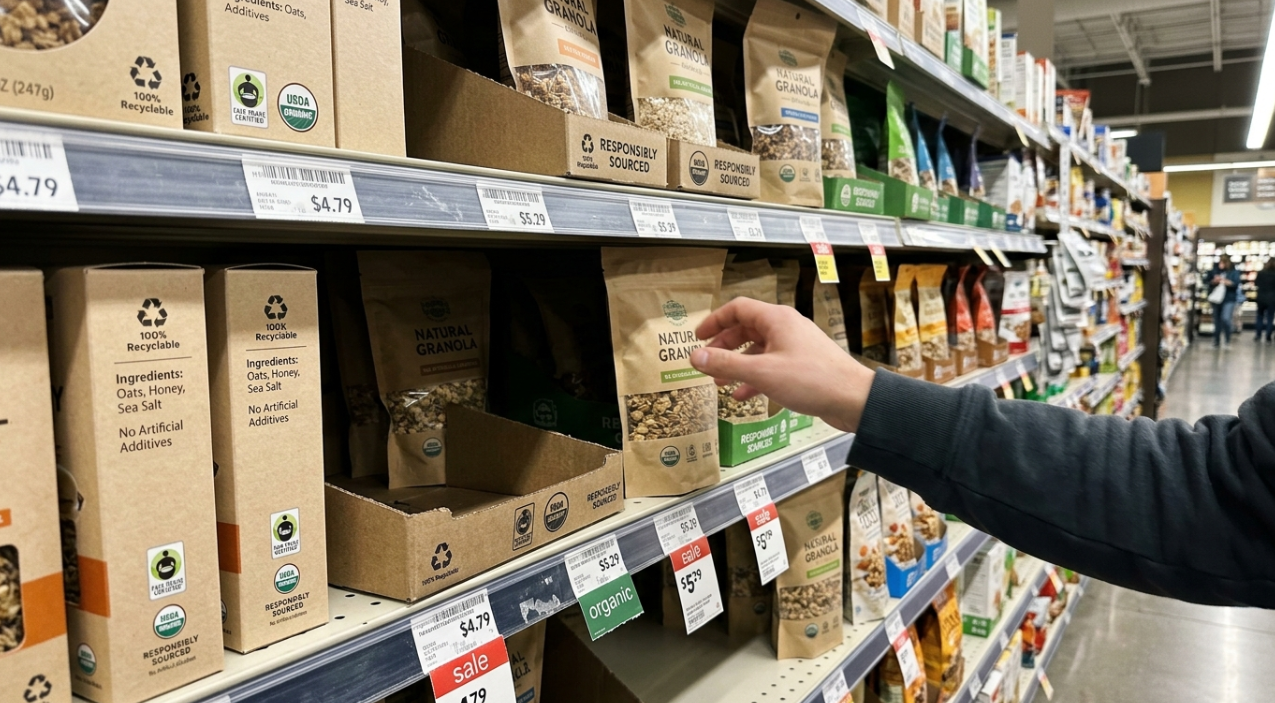
Diagnoses the intention-action gap, the disconnect between consumers saying they want sustainable products and actually buying them. This is the core problem most agencies skip entirely.
Proprietary frameworks including BPP, 5Rs, Brand Activation for Good, and Flywheel of Impact.
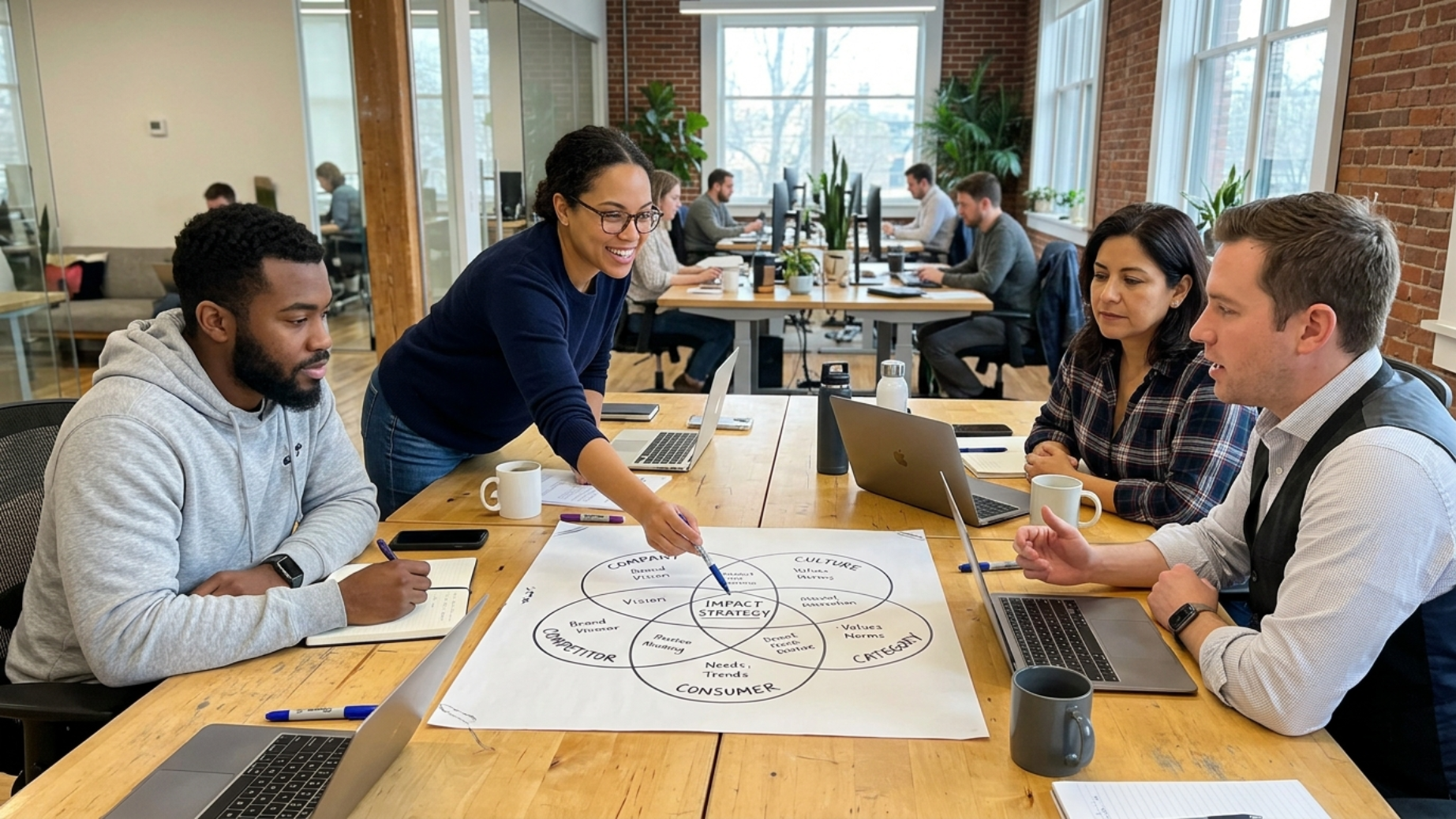
AI-assisted 5C landscape assessments (Company, Culture, Category, Competitor, Consumer) through its tool Gaia.
Ties every engagement to commercial outcomes: purchase intent, retail activation, revenue growth, not just awareness metrics.
Certifications include B Corp, 1% for the Planet, Ethical Agency Alliance, and Science Based Targets. Named a Top 100 Global Social Impact Company.
Named case studies: Grove Collaborative, Tribes on the Edge, Fresh Air Fund, Mary’s Center, UNMAS, Plan USA, Network of Executive Women. You can explore the full portfolio in their case study library.
Tradeoffs:
Custom-scoped projects only, no self-serve packages or published pricing.
Not a generalist performance marketing shop. If you need paid search management or programmatic display, this isn’t the right fit.
Boutique team, which means deep attention but limited capacity for simultaneous large-scale engagements.
Why it’s #1: No other agency on this list explicitly diagnoses why sustainability messaging fails to convert and then builds commercial activation around that diagnosis. The combination of a 116 B Corp score, proprietary research frameworks, and direct connection to retail and revenue outcomes sets it apart from agencies that stop at strategy decks or awareness campaigns.
Take a complimentary 5C landscape assessment to see where your brand’s intention-action gap sits.
2. Futerra
Best for: Enterprise brands wanting global-scale sustainability strategy and storytelling with UN-level credibility.
Futerra has pursued the mission of “making sustainable development so desirable it becomes normal” since 2001. They hold a B Impact Score of 102.3, are majority women-owned and women-led, and were one of the UK’s first B Corps. The team spans London, Stockholm, New York, San Francisco, and Mexico City.
Key strengths:
First agency officially named a “Climate Solutions Provider” under the UN-backed Race to Zero climate campaign.
Clients include WWF, Google, Earthjustice, Estée Lauder, PVH, LEGO, Grupo Bimbo, Netflix, Sierra Club, The Nature Conservancy, and Rainforest Alliance.
25+ year track record gives them unmatched institutional knowledge in sustainability communications.
Strong thought leadership and report publishing.
Tradeoffs:
Primarily strategy and communications, not commercial activation or retail sell-through.
Large-agency feel despite the B Corp status. Some smaller brands may find the engagement structure too heavy.
Employee sentiment tells a more complex story. On Glassdoor, employees praise the passionate and talented colleagues, but several reviews describe challenges with senior leadership. One reviewer noted that “thought leadership is what the company is best known for, but these projects are often ill-thought through” and that “the exciting paid work is drying up.” This doesn’t invalidate their external work, but it’s worth weighing if you’re evaluating long-term partnership stability.
Why they rank: If you’re a Fortune 500 company that needs UN-credentialed sustainability strategy across multiple continents, Futerra remains a top-tier choice. Just know that you’re buying strategy and storytelling, not commercial conversion.
3. BBMG
Best for: Mission-driven organizations needing brand strategy and identity design rooted in regenerative thinking.
BBMG has been offering sustainability, social impact, and brand design consulting since 2003. Based in Brooklyn, they hold the highest B Impact Score on this list at 122.0, significantly above the median of 50.9.
Key strengths:
Regenerative Brands methodology built on their Aware, Additive, Alive framework.
Clients include Burton Snowboards, Estée Lauder, General Mills, Hungry Harvest, Macy’s, The North Face, Target, ASPCA, Ford Foundation, and Planned Parenthood.
Certified B Corporation with deep brand strategy expertise.
Strong visual identity and design capabilities.
Tradeoffs:
Small team (1-9 employees per directory listings). This means highly personalized work but limited bandwidth.
Primarily a brand consultancy. If you need full-service activation, media buying, or retail execution, you’ll likely need a second agency partner.
The regenerative framework is conceptually strong but less commercially proven in terms of published revenue-lift case studies.
Why they rank: BBMG is the choice when your brand identity itself needs to be rebuilt around purpose, not just your campaigns. Their B Corp score of 122.0 backs up the talk with verified action.
4. OBERLAND
Best for: Brands wanting big creative campaigns that drive measurable fundraising or sales lift.
OBERLAND is an award-winning, multi-disciplinary, full-service branding agency in New York City, operating under the banner “Leading the world to profit with purpose.”
Key strengths:
Under CEO Drew Train’s leadership, OBERLAND raised $382 million for The Nature Conservancy and achieved a 45% revenue increase for Thinx Teens.
Earned Fast Company and Ad Age honors, plus Effie and Cannes Lions recognition for e.l.f. Beauty’s Change the Board Game initiative.
Full creative capabilities: brand identity, advertising, campaigns, content.
One of the few agencies in this space with hard dollar figures attached to results.
Tradeoffs:
NYC premium pricing. Expect engagement costs to reflect the Manhattan address and award-winning creative team.
Focused on advertising creative rather than sustainability strategy, research, or sustainability communication frameworks.
Not B Corp certified, which matters to some buyers evaluating agency credentials.
Why they rank: If your primary need is a campaign that generates measurable revenue or fundraising results (and you have the budget for top-tier creative), OBERLAND delivers proven numbers.
5. HelpGood
Best for: Nonprofits and government agencies needing cause marketing with digital media expertise.
HelpGood is a full-service social impact agency with a digital-first approach. They focus on cause marketing, helping brands, nonprofits, and corporations with fundraising, reach, awareness, and engagement.
Key strengths:
Services span strategy, creative, web development, paid and donated media, and analytics and reporting.
Part of Carol Cone ON PURPOSE’s Purpose Collaborative, a network of specialist agencies.
Deep expertise in donated media, a niche capability that can dramatically extend nonprofit campaign budgets.
Digital-first orientation means faster execution and data-informed optimization.
Tradeoffs:
Primarily serves nonprofits and government. Commercial brands with retail activation needs may find the capabilities too narrow.
Less publicly available case study detail compared to agencies like OBERLAND or Grounded World.
No B Corp certification listed.
Why they rank: For nonprofits that need a partner who understands donated media, cause marketing mechanics, and digital fundraising, HelpGood fills a specific and valuable niche.
6. Whole Whale
Best for: Nonprofits that need data-driven digital marketing and tech infrastructure.
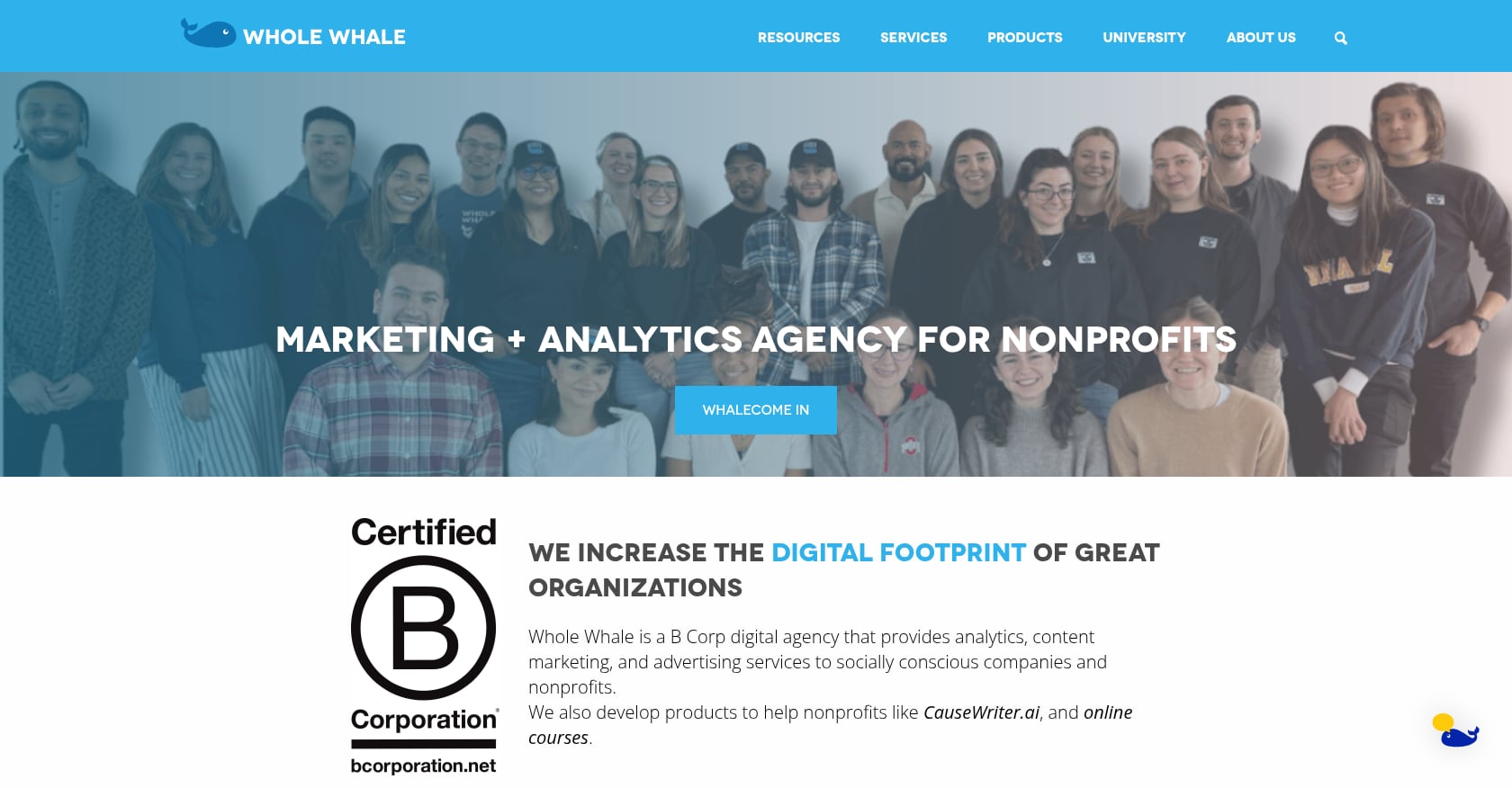
Whole Whale is a B Corp-certified digital agency that uses data and technology to increase the impact of social impact organizations.
Key strengths:
Strongest data and analytics capabilities of any agency on this list.
Tech-forward approach, helping organizations build measurement infrastructure, not just campaigns.
B Corp certified.
Practical, no-nonsense approach to digital marketing for resource-constrained organizations.
Tradeoffs:
Focused almost exclusively on nonprofits. Not the right fit for consumer brands or retailers.
Less emphasis on brand strategy, creative campaigns, or sustainability storytelling.
Tech-focused engagements may feel less “agency” and more “consultancy” for teams wanting campaign execution.
Why they rank: If your organization’s biggest gap is measurement and digital infrastructure rather than creative, Whole Whale is the specialist you need.
7. Fenton
Best for: Issue advocacy and public interest campaigns.
Fenton opened its doors in 1982 with a unique mission: serve the public interest by creating powerful issue campaigns that make change. That gives them over 40 years in the space, the longest track record of any agency on this list.
Key strengths:
Unmatched institutional knowledge in issue advocacy, public affairs, and social change communications.
Four decades of campaign history across environmental, health, civil rights, and social justice issues.
Deep relationships with media, policymakers, and advocacy networks.
Tradeoffs:
Traditional communications and PR orientation. Less suited for digital-first or commercial brand work.
The advocacy focus means limited experience with consumer product marketing or retail activation.
Smaller public profile in terms of recent awards or published case studies compared to newer entrants.
Why they rank: When the goal is changing public opinion or policy (not selling products), Fenton’s track record is hard to match.
8. Carol Cone ON PURPOSE
Best for: Fortune 500 companies needing corporate purpose strategy at the executive level.
Carol Cone is widely credited with establishing the purpose-driven marketing category. Her consultancy runs the Purpose Collaborative, a network connecting multiple specialist agencies (including HelpGood) to deliver integrated purpose programs.
Key strengths:
Pioneer status gives access to decades of corporate purpose knowledge.
The Purpose Collaborative model means clients get specialist expertise across disciplines without a single agency trying to do everything.
Executive-level positioning, working with C-suite and board leadership on purpose integration.
Tradeoffs:
Consulting orientation rather than hands-on campaign execution.
The network model means your actual work may be executed by a partner agency, not Carol Cone’s team directly.
Best suited for large enterprises. Startups and small nonprofits may find the approach and pricing mismatched to their needs.
Why they rank: If purpose needs to be embedded at the corporate strategy level before it can flow into marketing, Carol Cone ON PURPOSE is the consultancy that wrote the playbook.
9. South Pole (incorporating Republic of Everyone)
Best for: Australia and APAC-based brands needing sustainability marketing integrated with rigorous climate services and carbon risk management.
Key strengths:
Integrated Climate Services: Access to South Pole’s world-leading carbon accounting and offset programs alongside creative strategy.
Behavior Change Expertise: Retains the proprietary "Republic of Everyone" methodology for driving consumer action.
Deep APAC Market Knowledge: Unmatched presence in the Sydney and Singapore sustainability sectors.
Tradeoffs:
Now embedded within South Pole, which means less independent agency feel and potentially more complex engagement structures.
The acquisition may shift priorities toward South Pole’s climate services business rather than pure brand marketing.
Less relevant for North American or European brands that don’t need APAC-specific expertise.
Why they rank: For APAC-based organizations wanting a single partner for both climate strategy and sustainability marketing, this combination is unique in the market.
The 2026 Impact Marketing Compliance Checklist
Before signing an AOR (Agency of Record) agreement in 2026, ensure your partner can answer "Yes" to these three regulatory-driven requirements:
Scientific Substantiation: Can they provide data-backed evidence for every environmental claim to satisfy the updated FTC Green Guides and EU Green Claims Directive?
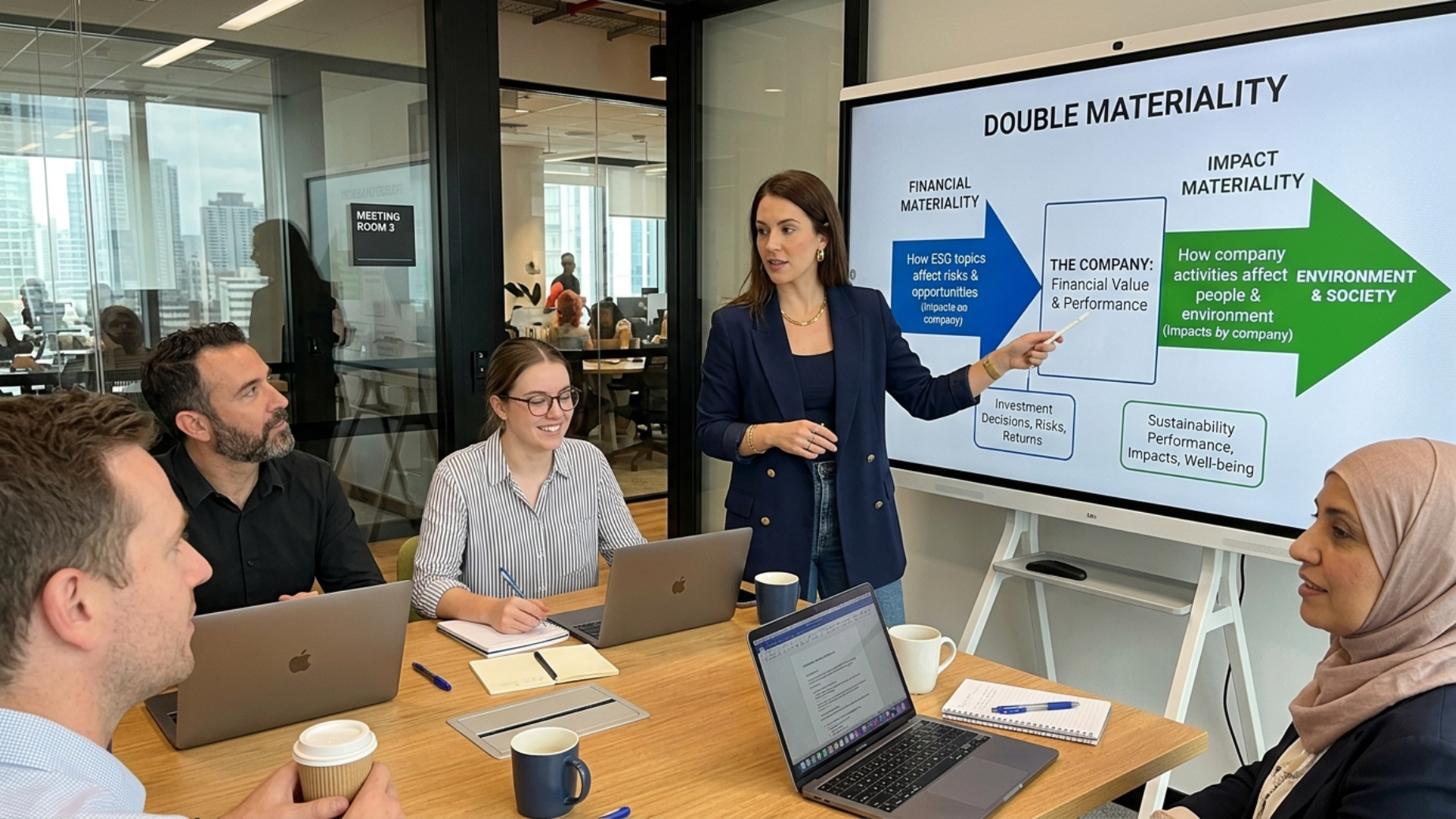
Double Materiality: Do they assess both the brand’s impact on the world and the world’s impact on the brand’s financial bottom line?
Greenhushing Mitigation: Do they have a strategy to communicate progress authentically without triggering the "backlash" cycles common in the 2025-2026 market?
Impact Marketing Agency vs Traditional Marketing Agency
Impact Marketing Agency | Traditional Marketing Agency |
|---|---|
Sustainability expertise | General marketing |
ESG communications | Product promotion |
Purpose strategy | Advertising strategy |
Green claims compliance | Limited regulatory knowledge |
Behavior change campaigns | Conversion campaigns |
Stakeholder communications | Customer communications |
Social impact measurement | Marketing metrics |
If sustainability is central to your business strategy, choosing a specialist agency usually reduces regulatory risk while improving campaign credibility.
How to Choose an Impact Marketing Agency
Picking from a list of top impact marketing agencies requires more than scanning logos and client lists. Here’s a framework built on the gaps that separate effective partnerships from expensive disappointments.
Verify Their Own Impact Credentials
B Corp certification is the minimum credibility signal, but not all certifications are equal. BBMG scores 122.0 on the B Impact Assessment. Grounded World scores 116. Futerra scores 102.3. The median business scores 50.9. Ask for the actual score, not just the badge. Also look for 1% for the Planet membership, Science Based Targets commitment, and whether the agency publishes its own impact reporting.
Ask About the Intention-Action Gap
This is the single most important question most brands never ask their agency: Can you diagnose why our sustainability message isn’t converting to purchase behavior?
The gap between consumers saying they care about sustainability and actually buying sustainable products is well-documented. A Deloitte Global Youth Survey of 22,000 respondents across 44 countries revealed that 97% of Gen Z consumers actively research a brand’s social and environmental track record before making a purchase. Yet sustainable products still underperform on shelf in many categories. The agency that can explain and quantify that disconnect is the one worth hiring.
Demand Commercial Outcomes, Not Just Awareness Metrics
Too many impact marketing agencies measure success in impressions, social shares, or “brand awareness lift.” Those metrics feel good but don’t show up on a P&L. Ask for case studies with revenue lift, purchase intent data, retail sell-through rates, or fundraising totals. OBERLAND’s $382 million raised for The Nature Conservancy is the kind of proof point that matters.
Metrics the Best Impact Marketing Agencies Track
Leading agencies should report both marketing performance and sustainability performance.
Examples include:
Marketing KPI | Impact KPI |
|---|---|
Revenue growth | Carbon reduction communication accuracy |
Customer acquisition cost | ESG engagement |
Conversion rate | Brand trust |
Customer lifetime value | Stakeholder sentiment |
Purchase intent | Sustainability awareness |
Retail sell-through | Reputation score |
Avoid agencies that report only impressions or engagement without connecting those metrics to business outcomes.
Evaluate Greenwashing (and Greenhushing) Risk
In 2026, the most successful brands are those that prove their values through measurable action. Consumers, investors, and employees are no longer swayed by polished claims. But there’s an emerging counter-risk: “greenhushing,” where brands stay quiet about genuine sustainability progress to avoid backlash. The right agency helps you navigate both extremes, speaking credibly about your progress without overclaiming. Ask specifically how they handle sustainability communications in the current regulatory and cultural environment.
Match Agency Size to Your Needs
The boutique-vs-enterprise question matters more in impact marketing than in most categories. BBMG has 1-9 employees. Futerra operates across five cities. Republic of Everyone was absorbed into South Pole. Each model has tradeoffs.
Boutique agencies (Grounded World, BBMG) typically offer senior-level attention on every engagement and faster iteration. Larger firms (Futerra, Carol Cone ON PURPOSE) bring global reach and institutional relationships. Practitioners on Reddit and marketing forums frequently note that the biggest frustration with large agencies is the “bait and switch,” where senior leaders pitch the work but junior staff execute it. Ask directly: who will be on my account day to day?
Why Impact Marketing Agencies Matter Now
The business case for working with a specialized impact marketing agency has never been stronger, or more nuanced.
The Growth Premium Is Real
Purpose-driven brands grow about two times faster than non-purpose-driven brands, according to research cited by McKinsey, which also shows that purpose-driven brands achieve more than twice the brand-value growth of brands focused purely on profit generation. Certified B Corporations reinforce this pattern: UK B Corps grew 28 times faster than the national average during one measurement period.
In 2026, 58% of purpose-driven brands experienced double-digit growth. At the same time, 56% of consumers stopped buying from brands they felt were unethical. The upside and the downside are both accelerating.
Consumer Expectations Have Shifted Permanently
The data is unambiguous: 62% of consumers say their purchase decisions are heavily influenced by a brand’s values, and 84% agree they buy from brands that share their personal values. A Nielsen Media and Wharton School collaborative study found that purpose-driven campaigns generate 3.6 times the earned word-of-mouth of standard brand campaigns.
These aren’t aspirational survey responses. They represent actual purchasing patterns that generalist agencies aren’t equipped to activate. Effective social impact campaigns require specialized knowledge of behavior change, cultural relevance, and sustainability claims substantiation.
The Anti-Greenwashing Imperative
Sustainability marketing in 2026 isn’t about perfection. It’s about progress, backed by transparency and accountability. Sustainable marketing agencies know how to avoid every brand’s nightmare: accidental greenwashing. The EU Green Claims Directive, FTC Green Guides revisions, and activist consumer watchdogs have raised the stakes dramatically. A generalist agency that doesn’t understand claims substantiation, lifecycle assessments, or regulatory frameworks is a liability, not a partner.
The EU Green Claims Directive, recent FTC Green Guides revisions, and activist consumer watchdogs have raised the stakes. As of September 2026, generic environmental claims—like "eco-friendly" or "green"—without independent third-party verification are subject to significant fines. A generalist agency that doesn't understand lifecycle assessments (LCA) or regulatory frameworks is now a liability. This is why top impact marketing agencies invest in frameworks that go far beyond creative production.
Impact Marketing by the Numbers
Statistic | Why It Matters |
|---|---|
84% of consumers buy from brands that share their values | Brand alignment drives purchasing |
Purpose-driven brands grow up to 3× faster | Commercial advantage |
56% stop buying unethical brands | Downside risk |
97% of Gen Z researches sustainability | Purchase behavior |
B Corp median score: 50.9 | Benchmark for evaluating agencies |
This gives readers a quick summary while increasing the article's fact density.
Ready to Close Your Intention-Action Gap?
The agencies on this list represent the best of purpose-driven marketing in 2026. But the right choice depends on your specific situation: whether you need global sustainability strategy, regenerative brand identity, creative campaigns with fundraising proof points, or the ability to turn sustainability into commercial results at shelf.
If the gap between your sustainability commitments and your commercial performance is the problem you need solved, start with a complimentary 5C landscape assessment from Grounded World to see exactly where the disconnect sits, or get in touch directly to scope a conversation.
What to Expect When Working With an Impact Marketing Agency
Most engagements follow a similar process.
Discovery
Brand audit
Stakeholder interviews
Sustainability assessment
Strategy
Messaging
Positioning
Audience research
Opportunity mapping
Activation
Campaign creation
Content
PR
Paid media
Retail activation
Measurement
Revenue
Brand lift
Share of voice
ESG reporting
Consumer trust
Purchase intent
Projects usually take between six weeks and twelve months depending on scope.
Frequently Asked Questions
What is an impact marketing agency?
An impact marketing agency specializes in helping brands, nonprofits, and social enterprises connect their social or environmental mission to marketing strategy and execution. Unlike generalist agencies, they bring expertise in sustainability communications, purpose-driven brand strategy, behavior change, and claims substantiation. The best ones tie that work directly to business outcomes like revenue growth, purchase intent, and retail activation.
How much do impact marketing agencies charge?
No top impact marketing agency currently publishes transparent pricing. The entire category operates on custom project scoping, with costs varying based on brand size, project complexity, and scope of services. During discovery calls, ask about minimum engagement size, billing structure (project-based vs. retainer), and whether strategy and execution are priced as separate phases.
What’s the difference between a sustainability marketing agency and a social impact agency?
The terms overlap significantly, and many agencies use them interchangeably. Sustainability marketing agencies tend to focus on environmental claims, ESG storytelling, and green product marketing. Social impact agencies often emphasize cause marketing, nonprofit campaigns, and social justice communications. Some agencies, like Grounded World, bridge both categories by connecting sustainability and social impact to commercial outcomes. You can read more about what a sustainability marketing agency does to understand the distinctions.
Why does B Corp certification matter when choosing an agency?
B Corp certification means an agency has been independently verified for social and environmental performance, accountability, and transparency. But the score matters more than the badge alone. The median B Impact Score is 50.9. An agency scoring above 100 (like BBMG at 122.0 or Grounded World at 116) demonstrates commitment well beyond the minimum threshold. It’s the most reliable third-party credibility signal in this space.
What is the intention-action gap in sustainability marketing?
The intention-action gap describes the disconnect between consumers expressing a desire to buy sustainable products and their actual purchasing behavior. Research consistently shows that while large majorities of consumers say they prefer sustainable options, conversion rates at shelf tell a different story. Specialized impact marketing agencies diagnose the specific barriers (price perception, trust, convenience, messaging clarity) causing this gap for individual brands and build strategies to close it.
Should I hire a boutique or large impact marketing agency?
It depends on your scale and needs. Boutique agencies (typically under 20 people) offer senior-level attention, faster decision-making, and often deeper specialization. Larger agencies bring global reach, established relationships with enterprise clients, and bigger teams. The tradeoff practitioners most frequently mention is that larger agencies sometimes assign junior staff to accounts after senior leaders close the deal. Ask specifically about day-to-day team composition before signing.
How do I avoid hiring an agency that greenwashes?
Start by checking their own credentials: B Corp score, 1% for the Planet membership, Science Based Targets commitment, published impact reports. Ask for case studies with measurable commercial outcomes, not just creative awards. Ask how they handle claims substantiation and regulatory compliance. And check employee reviews on platforms like Glassdoor, because internal culture often reveals whether an agency practices what it preaches.
What’s “greenhushing” and why should I care?
Greenhushing is the opposite of greenwashing: brands staying silent about genuine sustainability progress to avoid scrutiny or backlash. In the current climate of ESG backlash and heightened skepticism, some companies have pulled back on communicating real achievements. The right impact marketing agency helps you find the credible middle ground, communicating progress authentically without overclaiming. This is increasingly a competitive disadvantage for brands that go quiet while competitors learn to tell their sustainability story well.