

 Gaia
GaiaTL;DR
A sustainability consultant builds the data infrastructure, compliance frameworks, and ESG strategies that underpin credible sustainability claims. A sustainability marketing agency turns those claims into consumer facing campaigns, brand stories, and retail activation that drive revenue. The two roles are distinct but increasingly interdependent, especially as EU and US regulations tighten rules around green claims. Many organizations need both, deployed sequentially or in coordination.
Quick Answer
If your biggest challenge is measuring sustainability, meeting ESG regulations, or preparing reports for investors, hire a sustainability consultant.
If your challenge is turning verified sustainability achievements into customer trust, stronger branding, and higher sales, hire a sustainability marketing agency.
Many growing organizations ultimately need both. Consultants establish the evidence behind sustainability claims, while agencies transform those verified claims into campaigns that attract customers without creating greenwashing risk.
Sustainability Consultant vs Sustainability Marketing Agency at a Glance
If You Need To… | Hire a Consultant | Hire an Agency |
|---|---|---|
Measure carbon footprint | ✓ | |
Prepare ESG reports | ✓ | |
Meet CSRD regulations | ✓ | |
Improve sustainability branding | ✓ | |
Launch sustainability campaigns | ✓ | |
Improve consumer trust | ✓ | |
Avoid greenwashing | ✓ | ✓ |
Increase sustainability sales | ✓ | |
Build sustainability strategy | ✓ | |
Translate ESG work into marketing | ✓ |
Why This Comparison Matters Now
The global sustainability consulting market hit $9.8 billion in 2025 and is projected to reach $28.6 billion by 2033, growing at a CAGR of 14.2%. Meanwhile, brands are spending more than ever on purpose driven marketing. Yet the two disciplines, sustainability consulting and sustainability marketing, remain poorly understood by the people buying them.
Marketing directors assume a sustainability consultant can help them craft campaigns. CSR leads assume a sustainability marketing agency can handle ESG reporting. Both are wrong, and the confusion costs time, money, and credibility.
The stakes got higher in 2024. The EU adopted Directive 2024/825, which bans generic environmental claims like “eco friendly” or “green” without recognized proof starting September 2026. The FTC has been reviewing its Green Guides in the US. These regulatory shifts mean that sustainability marketing and sustainability consulting can no longer operate in isolation. The data side needs the communications side, and vice versa.
This guide defines both roles, draws a clear comparison, and gives you a practical framework for deciding which one you actually need.
What Is a Sustainability Consultant?
A sustainability consultant is an advisor who helps organizations measure, manage, and report on their environmental and social performance. Their work sits at the intersection of operations, compliance, finance, and corporate strategy.
Types of Sustainability Consultants
Not all sustainability consultants do the same work. The field has branched into distinct specializations, and understanding which type fits your needs prevents costly mismatches.
Corporate sustainability consultants work with large organizations on enterprise wide ESG strategy, stakeholder management, and board level reporting. They’re the generalists of the field, helping companies integrate sustainability across departments, set long term goals, and align business models with frameworks like the UN Sustainable Development Goals. If your challenge is “we don’t have a coherent sustainability strategy across the organization,” this is who you call.
Environmental consultants focus on ecological impact: biodiversity assessments, pollution control, waste management, water stewardship, and environmental impact assessments. They often have scientific or engineering backgrounds. A manufacturing company worried about contamination risk or a real estate developer navigating environmental regulations would hire this type.
Energy efficiency consultants specialize in reducing energy consumption and costs. They conduct energy audits, recommend building retrofits, evaluate renewable energy options, and help companies transition away from fossil fuels. For organizations where energy represents a major cost line or emissions source, these consultants deliver both environmental and financial returns.
Social responsibility consultants address the “S” in ESG. They design programs around labor practices, community investment, diversity and inclusion, human rights in supply chains, and stakeholder engagement. Brands facing scrutiny over working conditions or looking to build credible social impact programs need this specialization.
Sustainability communications consultants occupy an interesting middle ground. They help organizations develop internal and external messaging around sustainability performance, but they don’t typically execute campaigns. Think of them as translators between the technical sustainability team and the people who need to communicate the work, whether that’s investor relations, internal comms, or the marketing department. They differ from a full sustainability marketing agency in that they advise on messaging strategy rather than producing creative assets or running campaigns.
Regulatory compliance consultants zero in on helping companies meet specific legal requirements: CSRD reporting obligations, EU taxonomy alignment, SEC climate disclosure rules, or supply chain due diligence legislation. As regulations multiply, this type has become one of the fastest growing specializations.
Strategy vs Operational Consulting
Within each type, there’s a further split worth understanding: strategy consulting versus operational consulting.
Strategic sustainability consultants help you decide what to do. They run materiality assessments, define sustainability visions, set science based targets, and create roadmaps. Their output is a plan.
Operational sustainability consultants help you do it. They redesign processes, implement energy management systems, set up data collection infrastructure, train staff, and optimize supply chains. Their output is changed operations.
Practitioners on LinkedIn frequently point out that this distinction matters when scoping engagements. Hiring a strategist when you need someone to fix your data collection pipeline wastes money. Hiring an operational specialist when you haven’t decided your priorities wastes even more. Knowing which side of the strategy/operations divide your problem sits on is step one.
Typical Deliverables
Regardless of type, sustainability consultants generally produce:
Materiality assessments identifying which ESG issues matter most to the business and its stakeholders
Greenhouse gas accounting across Scopes 1, 2, and 3
ESG reporting aligned with frameworks like GRI, CDP, CSRD, SASB, and TCFD
Carbon reduction roadmaps with science based targets
Supply chain sustainability auditing
Regulatory compliance guidance for EU taxonomy, CSRD, or SEC climate disclosure rules
Internal sustainability strategy development
The typical buyer of sustainability consulting is a Chief Sustainability Officer, CFO, compliance team, or board member. The success metrics are regulatory compliance, ESG rating improvement, risk reduction, and investor readiness.
ESG consulting is a sub type worth distinguishing. It zeroes in on how organizations can align their operations and strategies with environmental, social, and governance principles to meet investor and regulatory expectations. This is narrower than broader sustainability consulting, which might also cover biodiversity strategy, circular economy design, or social impact measurement.
The key limitation: sustainability consultants typically don’t produce consumer facing creative, brand campaigns, packaging, or retail activation. They build the foundation of what a company can credibly claim. They don’t turn those claims into revenue.
What Is a Sustainability Marketing Agency?
A sustainability marketing agency is a creative and strategic business that specializes in communicating environmental and social impact in ways that are credible, audience relevant, and commercially effective. It takes a company’s sustainability credentials and translates them into campaigns, brand strategy, and consumer activation.
Typical deliverables include:
Brand strategy and positioning built around sustainability or social purpose
Campaign development spanning digital, content, advertising, and events
Creative assets including brand identity, packaging design, and websites
Retail activation covering customer journeys, category strategy, selling stories, and in store toolkits
Stakeholder engagement programs for employees, investors, and partners
Behavior change programs that move consumers from intention to action
Green claims substantiation and greenwash proofing of marketing messages
The typical buyer is a CMO, brand director, or marketing lead. Success metrics are purchase intent, revenue growth, consumer behavior change, and brand equity.
For a deeper look at what these agencies actually do, see this sustainability marketing agencies guide.
The key limitation: sustainability marketing agencies typically don’t handle GHG inventories, CSRD filings, or operational ESG strategy. They need that data to exist before they can communicate it credibly.
Side by Side Comparison
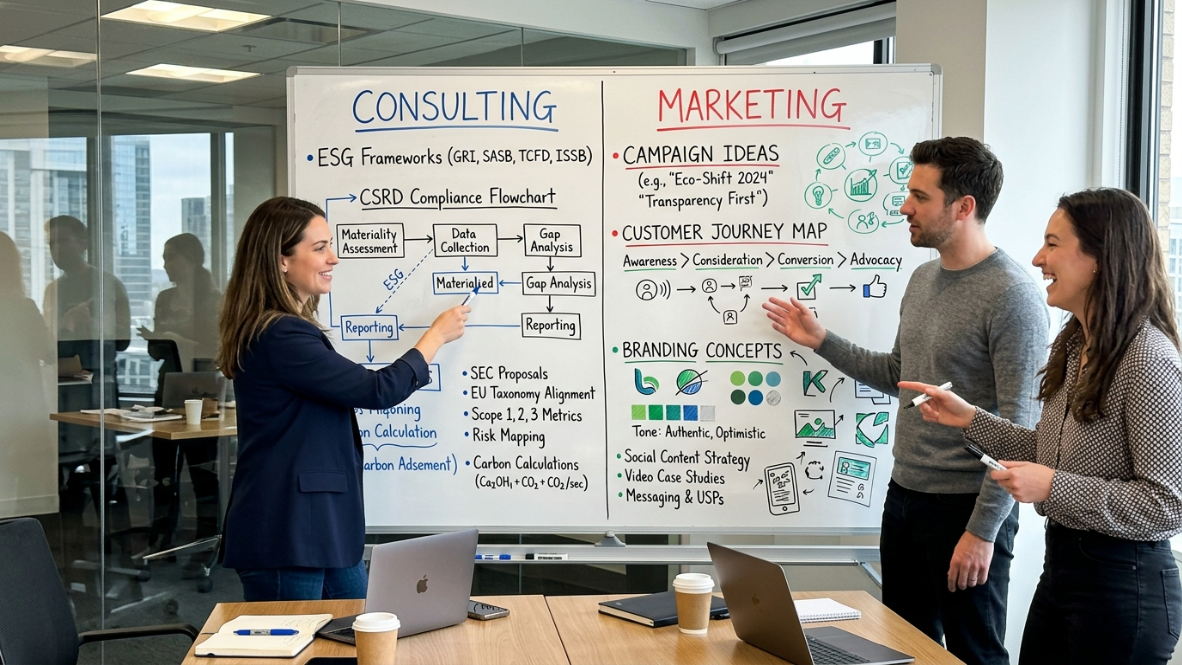
Dimension | Sustainability Consultant | Sustainability Marketing Agency |
|---|---|---|
Primary focus | Operations, compliance, reporting | Consumer perception, demand generation, storytelling |
Key deliverables | ESG reports, materiality assessments, carbon accounting, strategy documents | Campaigns, brand identity, packaging, retail activation, content |
Typical buyer | CSO, CFO, board, compliance team | CMO, brand director, marketing team |
Regulatory orientation | CSRD, GRI, CDP, TCFD alignment | Green claims substantiation, greenwash proofing |
Success metric | Compliance score, risk reduction, ESG rating improvement | Purchase intent, revenue growth, consumer behavior change |
Team structure | Solo practitioner or small consulting team | Cross functional creative team (strategists, designers, writers, producers) |
Typical cost range | $3K to $12K/month | $5K to $25K+/month for integrated execution |
Engagement model | Advisory, project based reports | Retainer or campaign based creative output |
The general marketing world already has a clean shorthand for this: a consultant sells thinking, an agency sells execution. But in the sustainability space, the divide is muddier because the domains are different, not just the delivery models. A sustainability consultant and a sustainability marketing agency aren’t doing the same work at different levels of involvement. They’re doing fundamentally different work that happens to serve the same overarching goal.
How a Sustainability Consultant Actually Works: The Six Step Process
Understanding the types of sustainability consultants is helpful, but knowing how they operate makes the comparison with a marketing agency sharper. Most engagements follow a recognizable pattern, even if the specifics vary by firm.
Step 1: Audit and Baseline Assessment
Every credible engagement starts with measuring where you are today. The consultant collects data on energy use, emissions, waste streams, water consumption, supply chain practices, labor conditions, and governance structures. This audit produces a baseline, the number against which all future progress gets measured.
For GHG accounting, this means calculating Scope 1 (direct emissions), Scope 2 (purchased energy), and increasingly Scope 3 (value chain emissions). According to the European Commission, half of green claims already lack evidence. The audit exists to make sure yours won’t be among them.
The audit also typically includes a gap analysis against relevant regulations and frameworks. If CSRD applies to your company, the consultant identifies exactly where your current data falls short of what’s required.
Step 2: Strategic Roadmap
With the baseline established, the consultant develops a strategic roadmap. This document defines priorities (informed by the materiality assessment), sets targets (ideally science based), assigns ownership, and lays out timelines.
A good roadmap answers three questions: What matters most? What’s achievable in what timeframe? What resources are required? The output is a plan that leadership can approve, fund, and track.
Step 3: Operational Efficiency
This is where strategy meets reality. The consultant identifies concrete operational changes, whether that’s switching energy sources, redesigning packaging for circularity, consolidating logistics to reduce transport emissions, or changing procurement criteria to favor lower impact suppliers.
Practitioners on Reddit report that this step is where many engagements stall. The strategic roadmap looks great on paper, but implementing changes across operations requires cross functional buy in that consultants can recommend but not always secure.
Step 4: Governance and Reporting
The consultant establishes (or strengthens) governance structures: who owns sustainability internally, how data flows from operations to reporting, and which frameworks guide disclosure. They then produce the actual reports, whether that’s a GRI aligned sustainability report, CDP submissions, CSRD disclosures, or investor facing ESG summaries.
This step has become dramatically more complex since 2024. The EU’s Corporate Sustainability Reporting Directive requires detailed double materiality assessments, and the reporting standards (ESRS) demand granular data that many companies have never collected before.
Step 5: Stakeholder and Employee Engagement
Sustainability doesn’t stick without buy in. Consultants often design internal engagement programs: training sessions, sustainability champions networks, employee awareness campaigns, and stakeholder consultation processes.
This step sometimes overlaps with what a marketing agency does externally. But the consultant’s focus is internal, getting the organization aligned around sustainability goals so that implementation actually happens.
Step 6: Continuous Improvement
Sustainability is not a one time project. Consultants set up systems for ongoing monitoring, periodic reassessment, and target revision. KPIs get tracked. Progress (or lack of it) gets reported. As regulations evolve and science advances, the strategy adapts.
The best consultants build these systems so the client eventually internalizes them. The worst ones create dependency, requiring ongoing advisory fees for work that should become routine.
Greenwashing Red Flags When Hiring an Agency
Not every agency that claims sustainability expertise actually has it. The growing demand for purpose driven marketing has attracted generalist firms that slap “sustainability” on their service pages without the knowledge to back it up. Knowing the red flags protects you from reputational and regulatory risk.
They can’t explain their claims substantiation process. Any credible sustainability marketing agency should have a documented methodology for verifying that the claims in your marketing materials hold up under scrutiny. If they respond to “how do you avoid greenwashing?” with vague assurances rather than a specific process, walk away. For more on this, read the guide on how to avoid greenwashing.
They don’t ask about your data. An agency that jumps straight to creative concepts without asking to see your sustainability reports, certifications, or LCA data is a red flag. Good agencies interrogate the evidence before they build the story.
They use unsupported superlatives. If the agency’s own marketing says things like “100% sustainable” or “the greenest agency,” they’re demonstrating exactly the kind of sloppy language that gets brands into trouble. Practitioners on marketing forums describe this as the “cobbler’s shoes” problem: agencies that don’t apply green claims discipline to their own communications are unlikely to apply it to yours.
They lack third party credentials. B Corp certification, membership in 1% for the Planet, or Science Based Targets participation signal that an agency has submitted to external verification. These credentials aren’t perfect filters, but they separate firms with demonstrated commitment from those with performative positioning. Agencies listed as top B Corp marketing agencies have typically undergone rigorous assessment.
They conflate awareness with behavior change. Impressions and reach are easy metrics. Actually shifting consumer purchasing patterns toward sustainable options is hard. If the agency can only show vanity metrics from past campaigns, they may not understand the intention action gap that makes sustainability marketing fundamentally different from conventional marketing.
They’ve never worked alongside a sustainability consultant. Agencies that operate in a silo, never coordinating with compliance teams or consulting partners, tend to produce campaigns that look good but don’t hold up. The best agencies actively seek out the consultant’s data and incorporate it into the creative process.
Real World Examples
Understanding the distinction becomes easier when looking at practical business scenarios.
Example 1: Manufacturing Company
A manufacturer needs to calculate Scope 3 emissions to comply with CSRD.
Best choice: Sustainability consultant (specifically a regulatory compliance type).
Reason: The challenge is regulatory compliance and emissions accounting rather than customer communications. An operational consultant would handle the data collection and reporting infrastructure.
Example 2: Consumer Goods Brand
A skincare company already has third party certifications but customers don’t understand why the products cost more.
Best choice: Sustainability marketing agency.
Reason: The sustainability work exists. The problem is communicating value and closing the gap between what the brand does and what consumers perceive. This is the kind of challenge that requires sustainability storytelling and consumer behavior strategy, not more reports.
Example 3: Growing Retail Business
A retailer is preparing its first ESG report while simultaneously repositioning the brand around sustainability.
Best choice: Both.
Reason: The consultant develops the sustainability evidence while the agency communicates it consistently across every customer touchpoint. The consultant handles Step 1 through Step 4 (audit, roadmap, operations, reporting) while the agency translates the outputs into brand positioning and retail activation.
Example 4: Energy Company Seeking Efficiency Gains
A mid size energy company wants to reduce operational emissions and then publicize its progress to win B2B contracts.
Best choice: Energy efficiency consultant first, then agency.
Reason: The energy efficiency consultant audits consumption, recommends retrofits and renewable transitions, and quantifies the reductions. Once verified savings exist, the agency can build credible case studies and thought leadership content that supports sales conversations.
Why the Boundary Is Blurring (and Why It Matters in 2026)
The clean separation between sustainability consultant and sustainability marketing agency is breaking down, driven by regulation and reputational risk.
The EU Green Claims Crackdown
Under EU Directive 2024/825, which takes effect in September 2026, companies using terms like “eco friendly,” “sustainable,” “green,” or “carbon neutral” in marketing materials, product labels, or websites must back those claims with recognized proof. Offset based climate neutrality claims effectively disappear. Self created sustainability labels are banned across all 27 EU member states.
This matters because the companies most exposed to enforcement risk are those that adopted sustainability messaging as brand positioning without building the underlying data infrastructure to support it.
The Practical Consequence
Marketing teams now need data backed claims that only consultant grade infrastructure can provide. Consultants, in turn, need to understand how their data and frameworks will be translated into consumer facing materials. A brilliant ESG report is useless for brand positioning if no one translates it. A compelling sustainability campaign is a liability if the claims can’t withstand regulatory scrutiny.
Practitioners on marketing forums describe this as a common failure mode. As one industry commentator put it, greenwashing is “rarely intentional” but rather “the result of internal miscommunication between pushy marketers who prefer the talk and humble sustainability champions who prefer the walk.” That gap between the marketing team and the sustainability team is exactly where risk lives.
There’s also the opposite problem: “greenhushing.” Companies with strong sustainability credentials deliberately understate them to avoid scrutiny. This happens when the sustainability team and the marketing team don’t coordinate, so the default becomes saying nothing at all.
Want to understand where your organization’s gap is? Book a discovery call to map the distance between your sustainability work and your commercial positioning.
When to Hire a Sustainability Consultant
Hire a sustainability consultant when your problem is structural, operational, or regulatory. Specific trigger scenarios:
You need your first ESG report. If you’ve never done a materiality assessment or greenhouse gas inventory, a consultant sets the baseline. This is Step 1 (audit and baseline) of the consulting process described above.
Regulatory pressure is mounting. CSRD obligations, SEC climate disclosure rules, or supply chain due diligence requirements demand specialist advisory help that sits outside typical marketing scope. A regulatory compliance consultant is the right fit here.
Investors are asking questions. ESG ratings, carbon reduction targets, and sustainability disclosures increasingly affect access to capital. A consultant speaks the language of finance and risk.
Your supply chain is opaque. Scope 3 emissions accounting, supplier auditing, and circularity assessments require technical expertise. Environmental or corporate sustainability consultants with supply chain specialization handle this work.
You have no sustainability baseline. Before you can market sustainability, you need to know where you actually stand. A consultant provides the honest assessment.
You need to engage employees around sustainability goals. Social responsibility consultants and corporate sustainability consultants design internal programs that build the organizational commitment needed to sustain change over time.
Practitioners on Reddit and LinkedIn consistently note that consultants provide emotional distance from internal problems. It is often difficult to diagnose a problem from within, even in organizations with open cultures. Someone too close to the work may not see the systemic issue.
The risk with a consultant, though, is the execution gap. Strategy without execution is just a document. If your internal team can’t carry the plan forward, you’ll find yourself paying for advice that never ships. This is why the six step process matters: the best consultants don’t stop at Steps 1 and 2 (audit and roadmap) but push through to Steps 3 and 4 (operational change and governance), ensuring the work actually gets embedded.
When to Hire a Sustainability Marketing Agency
Hire a sustainability marketing agency when your sustainability work exists but isn’t reaching the people who need to see it. Specific trigger scenarios:
Your sustainability message isn’t converting. You have certifications, reports, and real impact data, but consumers don’t know or don’t care. The gap between what you’re doing and what people perceive is a communications problem. Research consistently shows that consumers don’t buy sustainable products at rates matching their stated preferences, and solving this requires specialized expertise.
You face greenwashing risk in your campaigns. Your marketing team is making claims they can’t fully substantiate, or they’re using language that could trigger regulatory scrutiny. A specialist sustainability agency understands claims substantiation and green marketing risks in ways a generalist creative agency does not.
The intention action gap is killing your numbers. Consumers say they want sustainable products. They don’t buy them at rates that reflect that stated preference. Closing the intention action gap requires specialized consumer behavior strategy, not just better ads.
You need retail activation. Getting a sustainable product onto shelves and into baskets demands category strategy, selling stories, and in store toolkits. This is agency work.
You’re repositioning around purpose. Shifting brand identity toward sustainability or social impact requires strategic creative work across identity, messaging, and campaigns. A brand purpose agency specializes in exactly this.
The general framework from marketing practitioners applies here: you’re ready for an agency when you have product market fit, a validated channel or two, and a growth goal that requires consistent execution. If your positioning is still unsettled, a consultant (or at minimum a strategic diagnostic) should come first.
When You Need Both
The “either/or” framing is misleading. Many organizations need both a sustainability consultant and a sustainability marketing agency, just at different stages or for different functions.
The Sequential Model
Consultant first, then agency. The consultant builds the data infrastructure: GHG inventories, materiality assessments, ESG disclosures, and a credible sustainability strategy (Steps 1 through 4 of the consulting process). Once that foundation exists, the agency translates it into brand positioning, campaigns, and consumer activation.
This is the most common pattern for companies early in their sustainability journey.
The Coordinated Model
Both working simultaneously with overlapping briefs. The consultant manages reporting and compliance while the agency handles consumer facing communications. The two teams share data, review claims together, and ensure that marketing materials are backed by operational reality.
This model is more common for mature organizations that already have ESG infrastructure but need both regulatory reporting and commercial activation running in parallel.
Signs You Have a Gap
Strong ESG scores but weak consumer recognition. Your sustainability work is real, but nobody outside the investor community knows about it. You have a consultant but need an agency.
Strong brand purpose narrative but no reporting data behind it. Your marketing looks great, but the claims can’t withstand regulatory or media scrutiny. You have an agency but need a consultant.
Sustainability investments aren’t translating into traction. You’ve spent on both consulting and marketing, but the two aren’t connected. You need coordination, not more spend.
It is not uncommon for companies to use both consultants and agencies, even for the same issue. They complement each other well and give you multiple perspectives. The critical thing is making sure they’re actually talking to each other.
For brands exploring purpose driven agency options, the key question is whether the agency can work with your consulting partner’s data, or whether it operates in a silo.
The Rise of Hybrid Firms

Some firms blend consulting and agency functions under one roof. ERM Shelton, for example, describes itself as “the nation’s leading marketing communications firm exclusively dedicated to the sustainability sector” while also providing research and strategic consulting. These hybrid models attempt to bridge the gap between ESG data and consumer activation.
The advantage of a hybrid is coordination. There’s no handoff gap between the consultant’s report and the agency’s campaign brief. The disadvantage is that few firms do both equally well. Most lean one way, either stronger on the advisory side or stronger on the creative side.
When evaluating hybrids, ask where their core competency actually sits. Look at their team composition. If it’s mostly strategists and analysts, that’s a consultancy with marketing bolted on. If it’s mostly creatives and campaign managers, that’s an agency with strategy bolted on.
A sustainability communications consultant sometimes occupies a middle ground here, offering strategic messaging guidance without full agency execution. This can be useful as a bridge between your consultant’s reports and an agency’s creative work, particularly if you’re not ready for a full agency retainer.
Start with a free diagnostic to understand where your actual gap sits before committing to either model.
Common Mistakes Companies Make
Many organizations delay sustainability progress because they hire the wrong type of partner.
Common mistakes include:
Hiring a marketing agency before establishing credible sustainability data.
Expecting consultants to build customer campaigns.
Treating sustainability reporting as a marketing exercise.
Assuming sustainability certifications automatically increase sales.
Running ESG and marketing teams independently without a shared claims approval process.
Hiring a corporate sustainability consultant when the problem is actually energy efficiency, or vice versa.
Skipping the audit and baseline step and jumping straight to a strategic roadmap built on assumptions rather than data.
Ignoring the continuous improvement step, treating sustainability as a one time project rather than an ongoing program.
Avoiding these mistakes reduces compliance risk while improving the return on sustainability investments.
Questions to Ask Before Hiring Either
If You’re Evaluating a Sustainability Consultant
What type of consulting do you specialize in? Corporate, environmental, energy efficiency, social responsibility, regulatory compliance, or communications? A generalist might be fine for early stage work, but specific problems need specific expertise.
What reporting frameworks do you work with? (GRI, CDP, CSRD, SASB, TCFD, or others)
Can you produce claims ready data? Not just internal reports, but data formatted in ways that marketing teams can use for consumer facing claims.
Do you understand how marketing teams will use your output? A consultant who only writes for investors may produce work that’s useless for consumer communications.
What’s your track record on regulatory compliance? Ask for specific examples of helping companies meet CSRD or SEC requirements.
How do you handle Scope 3 emissions? This is where most companies struggle and where credibility is hardest to establish.
Do you build systems for continuous improvement, or deliver one time reports? The answer reveals whether they’re setting you up for long term success or creating dependency.
If You’re Evaluating a Sustainability Marketing Agency
How do you substantiate sustainability claims? Any agency worth hiring should have a clear process for verifying that marketing messages are backed by data. If they can’t describe it in detail, that’s a greenwashing red flag.
Do you work with ESG data directly? If the agency can’t read a GHG inventory or understand a materiality assessment, they’ll struggle to communicate sustainability credibly.
What’s your process for avoiding greenwashing? Look for specific methodologies, not just good intentions.
Do you have third party sustainability credentials? B Corp certification is a meaningful signal. Practitioners on agency forums note that many agencies claim sustainability expertise without any verification. A reported B Impact Score (look for scores well above the 80 point threshold) provides harder evidence.
Can you show results tied to commercial outcomes? Purchase intent, revenue growth, and consumer behavior change matter more than awards.
Have you coordinated with sustainability consultants on past projects? Agencies that have worked alongside consultants understand the handoff and produce campaigns grounded in verified data.
Making the Decision
Here’s a simple diagnostic:
If your primary challenge is: “We don’t know where we stand on sustainability, and we need to comply with regulations,” hire a sustainability consultant.
If your primary challenge is: “We have real sustainability credentials, but consumers don’t know, don’t care, or don’t buy differently because of them,” hire a sustainability marketing agency.
If your primary challenge is: “We’ve invested in sustainability but it’s not translating into either compliance confidence or commercial traction,” you likely need both, deployed in the right sequence with clear coordination.
The worst outcome is hiring either one in isolation and expecting them to solve both problems. A consultant won’t make your brand resonate with consumers. An agency won’t make your emissions data audit ready. Recognizing the boundary, and knowing when to cross it, is what separates companies that treat sustainability as a cost center from those that turn it into a growth driver.
Ready to figure out which type of help fits your situation? Get in touch for a discovery call to map the gap between where your sustainability work stands and where it needs to go commercially.
Frequently Asked Questions
What’s the difference between a sustainability consultant and an ESG consultant?
ESG consulting is a subset of sustainability consulting. ESG consultants focus specifically on environmental, social, and governance metrics that matter to investors and regulators, things like ESG ratings, disclosure frameworks, and financial risk. Broader sustainability consultants may also work on biodiversity, circular economy, social impact strategy, and operational redesign. In practice, many firms use the terms interchangeably, but the ESG label tends to signal a heavier financial and compliance orientation.
What are the main types of sustainability consultants?
The six primary types are corporate sustainability, environmental, energy efficiency, social responsibility, sustainability communications, and regulatory compliance. Each addresses different challenges. Corporate consultants handle enterprise wide strategy. Environmental consultants focus on ecological impact. Energy efficiency consultants target consumption reduction. Social responsibility consultants address labor and community issues. Communications consultants advise on messaging. Regulatory compliance consultants ensure you meet legal requirements like CSRD or SEC rules.
Can a sustainability marketing agency do ESG reporting?
Generally, no. A sustainability marketing agency specializes in consumer facing communications, brand strategy, and campaign activation. While some hybrid firms offer both, most agencies don’t have the technical expertise to conduct GHG inventories, materiality assessments, or regulatory compliance work. They need that data to exist so they can communicate it credibly.
How much does a sustainability consultant cost compared to a marketing agency?
Sustainability consultants typically operate in the $3K to $12K per month range depending on scope. Sustainability marketing agencies tend to run $5K to $25K or more per month for integrated, multi channel execution. Project based engagements can vary widely in both cases. The right question isn’t which costs less but which solves the problem you actually have.
What is the intention action gap in sustainability marketing?
The intention action gap is the measurable difference between what consumers say they want (sustainable products, ethical brands) and what they actually buy. Research consistently shows that stated purchase intent for sustainable goods far exceeds actual purchasing behavior. Closing this gap requires specialized consumer behavior strategy that goes beyond traditional advertising. It’s one of the core reasons brands hire specialist sustainability marketing agencies rather than generalist firms.
How do new EU green claims rules affect the decision between consultant and agency?
EU Directive 2024/825, effective September 2026, bans generic environmental claims without recognized proof and eliminates offset based carbon neutrality claims. This means marketing teams can no longer make sustainability claims without data infrastructure that a consultant typically provides. It also means consultants need to understand how their data will be used in consumer facing contexts. The regulation effectively forces coordination between the two roles.
Are there agencies that combine sustainability consulting and marketing?
Yes, hybrid firms exist. Some position themselves as both strategic consultancies and creative agencies. The challenge is finding one that genuinely excels at both rather than bolting one discipline onto the other. When evaluating hybrids, examine team composition, case studies, and whether they can demonstrate results on both the compliance and commercial sides.
What credentials should I look for when hiring either?
For consultants, look for familiarity with major reporting frameworks (GRI, CDP, CSRD, SASB, TCFD) and industry specific expertise. For agencies, B Corp certification with a publicly reported B Impact Score is a strong signal. Other meaningful indicators include membership in organizations like 1% for the Planet, Science Based Targets participation, and verifiable case studies with named clients showing commercial outcomes.
Should I hire a sustainability consultant before a sustainability marketing agency?
In most cases, yes. The consultant establishes what you can credibly claim, starting with the audit and baseline assessment and working through to governance and reporting. The agency then activates those claims commercially. However, if you already have strong sustainability data and reporting in place, you can go directly to an agency. The key is ensuring your marketing has a data foundation underneath it, because without one, any sustainability messaging carries greenwashing risk.
What are the biggest greenwashing red flags when evaluating an agency?
Watch for agencies that can’t explain their claims substantiation process, don’t ask to see your sustainability data before developing creative, use unsupported superlatives in their own marketing, lack third party credentials, or can only show vanity metrics from past campaigns. The best agencies actively interrogate the evidence before they build the story.