

 Gaia
GaiaTL;DR
A circular economy marketing strategy promotes products and business models designed for reuse, repair, resale, and recycling rather than single-use disposal. It shifts marketing’s role from driving new purchases to extending product lifecycles and building demand for closed-loop systems. The Ellen MacArthur Foundation and Kantar outline four pathways: create scalable circular solutions, drive demand, advocate internally, and measure impact. With the circular economy projected to generate $4.5 trillion in economic benefits by 2030, this approach ties sustainability directly to commercial growth.
What is a Circular Economy Marketing Strategy?
A circular economy marketing strategy is a growth framework designed to promote business models centered on reuse, repair, remanufacturing, resale, and recycling. Unlike traditional linear marketing—which focuses on driving one-time product sales—circular marketing extends product lifecycles, creates ongoing post-purchase touchpoints, and builds consumer demand for closed-loop systems.
Circular Economy Marketing Strategy: Quick Answer
A circular economy marketing strategy should do four things: create scalable circular products or services, generate demand for circular alternatives, make circular behaviors easy and attractive, and measure performance using circularity-specific KPIs.
The strategy should connect marketing with product design, operations, supply chain, customer experience, and sustainability teams. Instead of measuring success only through first-time purchases, marketers should also track metrics such as repeat product cycles, repair and take-back participation, resale revenue, circular customer lifetime value, and revenue generated by circular business models.
The simplest strategy is:
Design the circular offer → create demand → remove participation friction → measure circular outcomes → improve and scale.
What Is a Circular Economy Marketing Strategy?
A circular economy marketing strategy is a marketing approach that promotes products, services, and business models designed to keep products and materials in use through reuse, repair, resale, refurbishment, remanufacturing, and recycling. Unlike linear marketing, which primarily drives new-product purchases, circular marketing supports the entire product lifecycle, including post-purchase services and repeat product cycles.
In practice, circular economy marketing connects customer demand with circular business models. Marketing teams help make repair, resale, rental, take-back, refurbishment, and product-as-a-service models attractive, convenient, and commercially viable.
Why It Matters: The Commercial Case
Circular economy marketing is not a feel-good exercise. The numbers point to a significant commercial opportunity.
The World Economic Forum estimates that the circular economy could generate up to $4.5 trillion in economic benefits by 2030. The circular economy market itself is projected to grow from $517.79 billion in 2025 to $888.22 billion in 2030, at a compound annual growth rate of 11.3% (Business Research Company).
Consumer demand is there too. According to Kantar, 93% of people globally want to make more choices that have a positive environmental and social impact. And 64% believe businesses, not just governments, should solve environmental challenges.
Companies that embrace effective sustainability marketing strategies have seen average revenue growth of 17%, compared to just 3% for those that don’t. Executives expect the share of revenue from circular products and services to grow by 30% between 2021 and 2030.
These are not aspirational projections. They reflect where consumer spending and corporate investment are already heading. Brands with strong corporate reputations on sustainability grow their brand value 57% faster than those with weaker reputations. A well-executed circular economy marketing strategy captures that growth.
How Circular Marketing Differs From Conventional Approaches
The core distinction is straightforward. Traditional marketing operates within a linear model: take resources, make products, sell them, discard them. Circular economy marketing restructures that entire sequence.
As Nicole Rigas, a marketer cited in the EMF/Kantar playbook, observes: “In a linear economy, the marketer’s main goal is to get the product sold and there’s a world of opportunity after the point of sale that is often ignored.”
Comparison: Linear vs. Circular Marketing Strategy
Lifecycle Stage | Traditional (Linear) Marketing | Circular Economy Marketing |
Primary Goal | One-time transactional purchase | Long-term customer lifetime value (LTV) across multiple product cycles |
Product Design Input | Promotes aesthetics, trendiness, and rapid replacement | Advocates upstream for durability, modular repairability, and material recovery |
Post-Purchase Touchpoint | Limited to customer support, warranties, and promotional upsells | Drives active engagement via repair hubs, resale trade-ins, and subscription services |
Core Messaging | Product features, novelty, and individual ownership | Access over ownership, product stewardship, and ease of participation |
Primary Metrics | Conversion rate, Return on Ad Spend (ROAS), Customer Acquisition Cost (CAC) | Product return rate, resource recovery %, secondary market revenue, multi-cycle LTV |
In a circular economy, the marketing role expands well beyond the point of sale. Products are circulated multiple times through repair, reuse, rental, or resale. Marketing must support each of those touchpoints, not just the first purchase.
This creates confusion with several adjacent concepts. Here is how they differ:
Concept | How It Differs From Circular Economy Marketing |
|---|---|
Green marketing | Promotes environmental benefits of existing products. Circular marketing restructures the business model around closed-loop systems. |
Sustainability marketing | A broader umbrella term. Circular economy marketing is a specific subset focused on reuse, repair, resale, and recycling. |
CSR communications | Typically corporate-level reporting. Circular marketing is product and brand-level strategy tied directly to revenue models. |
Recycling campaigns | Recycling is one (and often the lowest-value) tactic within circularity. A circular strategy prioritizes reuse, repair, and resale first. |
For a deeper look at connecting sustainability messaging to actual behavior change, see this guide on behavior change marketing frameworks.
The Four Action Pathways: The EMF/Kantar Framework
The benchmark framework for circular marketing comes from the Ellen MacArthur Foundation (EMF) in partnership with Kantar. It draws on insights from over 50 marketing executives to outline four action pathways for shifting circular models from niche pilots to mass commercial scale:
1. Create Scalable Circular Solutions Marketers must use consumer insights to identify market gaps and shape commercial offerings—such as rental, repair, or trade-in models—that solve actual customer problems at a competitive scale. Pilot programs demonstrate proof-of-concept, but scaling is what makes closed-loop systems financially viable.
2. Drive Demand for Circular Propositions Normalise circular alternatives by embedding them into core brand messaging and mainstream campaigns rather than siloing them in sustainability reports. Marketers must build desire around refurbished or multi-use options so they are seen as equal or superior to new products.
3. Make Circular Behaviours Irresistible Eliminate friction at every stage of participation. Consumer adoption is driven primarily by convenience, clear framing, and minimal effort—not purely environmental altruism. If taking back a product or booking a repair requires extra effort, participation drops rapidly.
4. Hardwire Circular KPIs Align marketing success metrics directly with circular business targets. Move beyond traditional campaign performance to measure product stewardship retention, multi-cycle customer lifetime value, and the percentage of corporate revenue generated through circular models.
How to Build a Circular Economy Marketing Strategy
A practical circular economy marketing strategy can be built in six stages:
1. Map the Product Lifecycle
Document what happens before, during, and after the initial purchase.
Identify where products are:
Purchased
Used
Maintained
Repaired
Returned
Resold
Refurbished
Recycled
Discarded
This reveals where marketing can create additional customer relationships and where value is currently lost.
2. Identify the Highest-Value Circular Opportunity
Do not attempt to make every product circular simultaneously.
Prioritize opportunities based on factors such as product lifespan, resale demand, repair potential, material value, customer demand, reverse-logistics feasibility, and expected commercial return.
3. Build the Circular Customer Proposition

Translate the circular model into a customer benefit.
For example:
Circular Model | Customer Proposition |
|---|---|
Repair | Keep your product working longer |
Resale | Recover value from products you no longer use |
Trade-in | Upgrade while receiving credit for your old product |
Rental | Access the product without permanent ownership |
Refurbishment | Get a lower-cost product with renewed functionality |
Subscription | Pay for ongoing access instead of purchasing outright |
Refill | Reuse the same container instead of buying another |
4. Remove Adoption Friction
Identify every action customers must take to participate.
Ask:
How many steps are required?
How long does participation take?
Is the financial benefit clear?
Can customers complete the process online?
Is pickup or drop-off convenient?
What happens after the customer returns the product?
Simplifying these steps can be more important than adding more sustainability messaging.
5. Create the Demand Strategy
Build campaigns around the customer's reason to participate, not only the environmental benefit.
Test messaging based on:
Price and value
Convenience
Quality
Access
Performance
Community
Status
Environmental impact
The strongest proposition will vary by audience and product category.
6. Measure, Learn, and Scale
Track both conventional marketing performance and circular outcomes.
Use pilot programs to determine which messages, channels, incentives, and customer experiences generate participation. Then scale the circular model that demonstrates both customer demand and operational viability.
Circular Business Models Marketers Should Know
A circular economy marketing strategy needs something concrete to market. These are the business models most commonly supported by circular marketing efforts.
Resale and trade-in programs. Patagonia’s Worn Wear program is the most cited example. It encourages customers to repair, reuse, and recycle their garments. Customers can trade in used clothing for store credits. The program turns post-purchase engagement into a revenue stream and a brand-building tool simultaneously. For more examples of sustainability campaigns that drive results, this collection covers a range of approaches.
Take-back and refurbishment. IKEA’s take-back program allows customers to return furniture to be repurposed or recycled. The company also lets customers rent items or buy refurbished furniture. This extends product lifecycles and keeps customers within the IKEA ecosystem longer.
Refurbished technology. Back Market, referenced in the EMF/Kantar playbook, has positioned refurbished electronics as desirable rather than second-class. Their marketing strategy directly challenges the assumption that “new” always means “better.”
Product-as-a-service. Instead of selling a product outright, companies retain ownership and sell access. This model incentivizes durability because the company bears the cost of failure, not the customer.
B2B circularity. Covestro, a materials company, worked with Deloitte to develop a circular marketing framework that was customer-focused, value-driven, and highly cooperative. Circularity in B2B contexts often requires rethinking not just marketing but entire value chains.
The Intention-Action Gap: Marketing’s Central Challenge
Here is the uncomfortable truth about circular economy marketing strategy: consumers say they want it but often don’t follow through.
Ninety-three percent of people want to make choices with positive environmental and social impact. Yet global circularity is actually falling. According to the Circularity Gap Report, the share of secondary materials consumed by the global economy dropped from 9.1% in 2018 to 7.2% in 2023, reaching just 6.9% in recent tracking. Meanwhile, 75% of businesses now recognize the importance of circularity, up from 40% three years ago—demonstrating that awareness and operational execution remain widely disconnected.
The gap between intention and behavior is the central challenge for circular marketers. Three insights stand out.
Convenience wins. The Ellen MacArthur Foundation found that consumers cared less about getting the most money for their electronics or clothing than they cared about the ease of the take-back program. If returning a product requires driving to a specific location, filling out forms, and waiting weeks for credit, most people won’t bother. Make it effortless and participation climbs.
Framing changes everything. Research from WRAP found that certain words had negative connotations. A “leasing service” was associated with lower income. But framing that exact same service as a club that customers paid to gain access to generated a much more positive response. The words you choose can determine whether a circular offer feels aspirational or like a compromise.
Information alone doesn’t change behavior. Social marketing research consistently shows that people rarely shift their behavior in response to facts and data alone. A blend of rational and emotional appeals is more effective. Circular marketers are better served building strong brands through cultural appeal and emotion-based campaigns than through environmental statistics.
For a deeper look at closing this gap, this guide covers removing barriers to sustainable purchasing in practical detail.
Risks: Greenwashing and Circular Washing
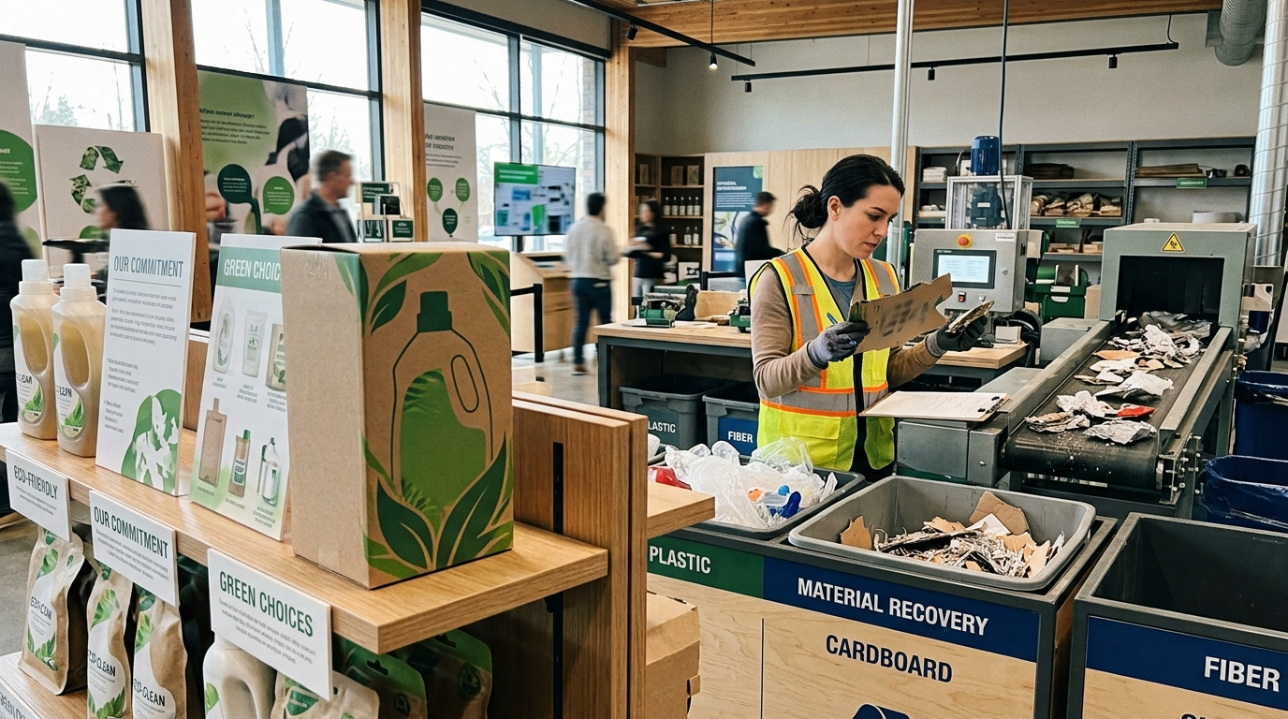
As more brands adopt circular language, a new risk is emerging: circular washing. This is greenwashing’s younger sibling. Companies claim circularity without the systemic changes to back it up.
iFixit and other repair advocates have flagged this trend, pointing out that some brands market products as “circular” based on theoretical recyclability rather than actual closed-loop systems. A product that could be recycled but never is because no infrastructure exists is not genuinely circular.
The regulatory environment is tightening. The EU’s Green Claims Directive and updated FTC Green Guides are both moving toward requiring substantiation for environmental and circularity claims. Brands that adopt circular marketing language without verifiable action face legal and reputational risk.
To protect against this, marketers need measurable, verifiable claims backed by transparent data. For more on navigating this, see this guide on how to avoid greenwashing.
The economics must also work, not just the story. Many leadership teams still treat circularity as a brand positioning exercise rather than a core business strategy. A take-back program without cost-effective sorting and reverse logistics usually becomes an expense line. A repair offer without spare-parts planning and service capacity creates customer friction. Circular economy marketing strategy fails when it runs ahead of operational reality.
Navigating Regulatory Enforcement: Green Claims & FTC Guides
Circular marketing carries significant legal and financial risks if claims lack verifiable operational backing. Global regulatory bodies have updated enforcement guidelines to eliminate "circular washing":
EU Empowering Consumers & Green Claims Directives: Anti-greenwashing regulations mandate that claims such as "100% recyclable" or "circular design" require third-party verification and proof of accessible local recycling infrastructure—not just theoretical end-of-life options.
FTC Green Guides Enforcement: Regulatory guidelines penalize brands using broad or unqualified terms like "eco-friendly" or "closed-loop" without substantiating the precise volume of recycled content actually recovered and processed.
Digital Product Passports (DPPs): Circular marketers must prepare to share verifiable product origin, repairability indices, and material breakdown data directly on consumer-facing touchpoints (such as scannable QR codes on packaging).
How to Get Started
For marketing teams ready to move from linear to circular, here is a practical starting point.
Audit current linear touchpoints. Map every point where your marketing assumes a single-use, single-purchase journey. Where does the customer relationship end today? Those endpoints are your circular opportunities.
Identify highest-value circular interventions. Not every product or category needs a full closed-loop system on day one. Start where the business case is strongest: high-value products with long potential lifespans, categories where resale demand already exists, or product lines with expensive raw materials worth recovering.
Align marketing with operations and supply chain. Circular marketing cannot operate in isolation. If you’re promoting a repair service, the repair infrastructure must exist. If you’re marketing a take-back program, reverse logistics must be in place. Cross-functional alignment is non-negotiable.
Measure with circularity-specific KPIs. Traditional marketing metrics still matter, but circular strategies need additional measures: program participation rates, resource recovery percentages, customer lifetime value across multiple product cycles, and repeat engagement with post-purchase services.
Start with language and framing. Before launching new programs, test how you talk about them. The difference between “secondhand” and “pre-loved,” between “leasing” and “membership,” can determine adoption rates.
For brands that need help bridging sustainability strategy to commercial outcomes, Grounded World’s discovery process is designed to diagnose gaps and build actionable plans.
The Future of Circular Economy Marketing
Circular economy marketing is not simply a sustainability communications strategy. It changes how marketers create demand, manage customer relationships, and measure growth across the entire product lifecycle.
The strongest strategies connect four elements: a commercially viable circular proposition, compelling customer demand, a frictionless participation experience, and measurable circular outcomes.
For most businesses, the practical starting point is not a complete transformation. It is identifying one product, customer journey, or post-purchase touchpoint where repair, resale, reuse, refurbishment, refill, rental, or take-back can create measurable value.
From there, marketers can test demand, remove barriers, measure results, and scale the circular model that works.
Frequently Asked Questions
What is a circular economy marketing strategy?
A circular economy marketing strategy is a marketing approach that promotes products and business models designed for reuse, repair, resale, and recycling. It shifts the marketing role from driving one-time purchases to supporting closed-loop systems where products stay in use as long as possible.
How does circular economy marketing differ from green marketing?
Green marketing promotes the environmental benefits of products within a traditional business model. Circular economy marketing restructures the business model itself around closed-loop principles, including post-purchase engagement like repair, resale, and take-back programs.
What is the intention-action gap in circular marketing?
The intention-action gap describes the disconnect between what consumers say they want (sustainable, circular options) and what they actually do. Research shows that convenience, not environmental concern or financial incentive, is the primary driver of circular behavior. Effective circular marketing addresses this gap through framing, ease of participation, and emotional appeal.
What are examples of circular economy marketing in practice?
Patagonia’s Worn Wear program (resale and repair), IKEA’s take-back and refurbishment program, and Back Market’s positioning of refurbished electronics as desirable all represent circular economy marketing strategies in action. Each extends the marketing relationship well beyond the initial sale.
What is circular washing?
Circular washing is when companies use circular economy language in their marketing without implementing genuine closed-loop systems. It is an emerging form of greenwashing, and regulators in the EU and US are moving toward stricter requirements for substantiating circularity claims.
How do you measure a circular economy marketing strategy?
Beyond traditional marketing metrics, circular strategies should track program participation rates, resource recovery percentages, customer lifetime value across multiple product cycles, repeat engagement with post-purchase services, and shifts in brand perception around sustainability.
Is circular economy marketing only for large companies?
No. While large brands like Patagonia and IKEA get the most attention, circular models like resale, repair services, and product-as-a-service can work at any scale. Startups and small businesses often have more flexibility to build circular models from the ground up rather than retrofitting linear ones.
What skills do marketers need for circular economy marketing?
Circular marketers need the same core skills as any marketer (consumer insight, brand building, campaign execution) plus an understanding of systems thinking, post-purchase customer journeys, and cross-functional collaboration with operations, supply chain, and sustainability teams. Familiarity with sustainability communications principles is also increasingly expected.