
 Gaia
GaiaTL;DR
A consumer behavior change strategy uses behavioral science to close the gap between what consumers say they want and what they actually do. It goes beyond awareness campaigns by targeting the psychological mechanisms (biases, friction, habits) that prevent people from acting on their intentions. Key frameworks include COM-B, Fogg’s B=MAP, EAST, and nudge theory. When done authentically, this approach drives both sustainability outcomes and commercial growth.
Most consumers say they care about sustainability. Most of them don’t follow through. That disconnect is not a moral failure. It’s a design problem, and solving it is exactly what a consumer behavior change strategy is built for.
Talk to a behavior change strategist about closing the gap between consumer intention and action.
Quick Definition: What Is a Consumer Behavior Change Strategy?
A consumer behavior change strategy is a behavioral science–driven marketing approach that focuses on changing what consumers actually do, not just what they think or say. It works by removing friction, leveraging psychological biases, and redesigning environments so desired actions become easier, more automatic, and more likely to happen.
Unlike traditional marketing that prioritizes awareness and persuasion, behavior change strategy prioritizes action, habit formation, and measurable behavioral outcomes such as purchase, reuse, recycling, or product switching.
Definition
A consumer behavior change strategy is a planned approach that applies behavioral science principles to influence how consumers act, not just what they think or feel. It targets the underlying psychological mechanisms that drive decision-making: habits, cognitive biases, social norms, friction points, and environmental cues.
Traditional marketing focuses on awareness and preference. It asks: “Do consumers know about us? Do they like us?” A consumer behavior change strategy asks a harder question: “Are consumers actually doing the thing we need them to do, and if not, why?”
In sustainability and purpose-driven marketing, this means designing interventions, products, messaging, and experiences that help consumers shift from less sustainable habits toward more sustainable ones, while also generating measurable business value.
The distinction matters. Plenty of brands can make people care. Very few can make people act.
How Consumer Behavior Change Actually Works
Consumer behavior change strategies work by intervening in three core drivers of human behavior: motivation, ability, and context. Instead of relying on persuasion alone, they reshape the decision environment.
At a practical level, behavior change happens through four mechanisms:
1. Reducing Friction
Making the desired action easier than the default option (e.g., one-click purchase, refill stations, default green settings).

2. Changing Context
Altering physical or digital environments so the desired behavior is the most obvious choice.
3. Leveraging Cognitive Biases
Using psychological tendencies such as loss aversion, social proof, and present bias to influence decisions.
4. Reinforcing Habits
Turning repeated actions into automatic behaviors through cues, routines, and rewards.
Why It Matters: The Intention-Action Gap
The single biggest reason consumer behavior change strategies exist is a phenomenon researchers call the intention-action gap.
The numbers tell the story plainly. According to findings cited in Harvard Business Review, 65% of consumers say they want to buy from purpose-driven brands that advocate sustainability, but only about 26% actually follow through. That’s a 39-percentage-point chasm between stated values and real behavior.
The gap isn’t shrinking on its own. Deloitte’s Sustainable Action Index found that the percentage of respondents who said they adopted more climate-friendly activities fell from 65% to 53% between September 2021 and March 2023. Meanwhile, PwC’s 2024 survey found 54% of consumers are willing to pay a premium for sustainable products, with the average consumer willing to spend 9.7% more for sustainably produced goods. The willingness is there. The behavior isn’t.
Why? Behavioral science points to several cognitive culprits:
Present bias: Future environmental benefits feel abstract compared to the immediate cost or inconvenience of changing behavior.
Status quo bias: People default to what they’ve always done, even when they know alternatives exist.
Choice overload: Too many “sustainable” options, with unclear differences, leads to decision paralysis.
Information gaps: 44% of global consumers say they want to make eco-friendly choices but feel uninformed about how their purchases actually affect the environment.
The challenge is not convincing consumers to care. It’s helping them act on the care they already feel. For a deeper look at why this gap persists, explore why sustainability intentions don’t translate to action.
Why Behavior Change Fails: The Real Barriers
Even when consumers are motivated, behavior often fails due to structural and psychological barriers:
Convenience gaps → sustainable option is harder to access
Price friction → sustainable choice feels more expensive upfront
Unclear decision paths → consumers don’t know what to do
Low salience → sustainability is not top-of-mind at purchase moment
Habit inertia → people default to existing routines
Most failed behavior change campaigns don’t fail because of messaging. They fail because the environment still makes the wrong behavior easier.
Consumer Behavior Change Strategy vs Traditional Marketing
While both approaches aim to influence consumer decisions, they differ fundamentally in focus and measurement.
Dimension | Traditional Marketing | Behavior Change Strategy |
|---|---|---|
Goal | Awareness & perception | Observable behavior |
Focus | Messaging & branding | Psychology & environment |
Success Metric | Clicks, impressions | Purchases, actions, habits |
Core Question | “Do they like us?” | “Are they doing it?” |
Tools | Ads, content, campaigns | Nudges, friction removal, defaults |
Traditional marketing stops at intent. Behavior change strategy closes the gap between intent and action.
Key Behavioral Science Frameworks
A consumer behavior change strategy isn’t guesswork. It draws on established behavioral science frameworks, each suited to different types of problems. Think of these as a toolkit, not a hierarchy.
COM-B Model (Capability, Opportunity, Motivation)
Developed by Susan Michie and colleagues, the COM-B model states that behavior occurs when three conditions are met simultaneously: capability (the person has the knowledge and skills), opportunity (the environment makes it possible), and motivation (the person wants to do it). According to the American Psychological Association, successful behavior change requires addressing all three components.
When to use it: When you need to diagnose why consumers aren’t taking a desired action. COM-B is excellent for auditing which of the three conditions is the bottleneck. Maybe consumers are motivated but lack the capability (they don’t know how to recycle your packaging). Maybe they have the capability and motivation but no opportunity (the sustainable option isn’t available where they shop).
Fogg Behavior Model (B=MAP)
BJ Fogg’s model simplifies behavior into a formula: Behavior = Motivation + Ability + Prompt, all converging at the same moment. The practical insight that makes this framework so useful for marketers is straightforward: it’s almost always easier and cheaper to increase ability (reduce friction) than to increase motivation.
As Fogg puts it: “Put hot triggers in the path of motivated people.”
When to use it: When you’ve identified a specific behavior you want to trigger and need to figure out the simplest intervention. If your audience is already somewhat motivated, focus on making the action easier and ensuring a prompt arrives at the right moment.
EAST Framework (Easy, Attractive, Social, Timely)
Developed by the UK’s Behavioural Insights Team, EAST provides four principles for designing interventions. Make the desired behavior easy (reduce steps, simplify choices). Make it attractive (use incentives, make it visually appealing). Make it social (show that others are doing it). Make it timely (prompt people when they’re most receptive).
When to use it: When you’re designing a specific campaign, touchpoint, or user experience. EAST works well as a checklist for evaluating whether your brand activation strategy is set up for actual behavior change.
Nudge Theory
Pioneered by Nobel laureate Richard Thaler and Cass Sunstein, nudge theory proposes that subtle changes to how choices are presented can significantly influence decisions without restricting freedom. Defaults, framing, and social proof are classic nudges.
A word of caution: nudges are best used as late-stage optimizations, not as the foundation of a strategy. Large-scale field research suggests that average nudge effects are often small and highly context-dependent.
When to use it: When you’re optimizing an existing behavior flow and want to test small, low-cost interventions. Not when you’re building a behavior change program from scratch.
Which Framework Should You Use?
Situation | Recommended Framework |
|---|---|
You don’t know why the behavior isn’t happening | COM-B (diagnose the bottleneck) |
The behavior is clear but consumers aren’t doing it | B=MAP (reduce friction, add prompts) |
You’re designing a campaign or touchpoint | EAST (design checklist) |
You’re optimizing a mature flow or decision point | Nudge (small-scale experiments) |
The behavior is new and needs habit formation | B=MAP + Habit loops (cue, routine, reward) |
For a hands-on walkthrough of how these frameworks translate into marketing plans, see this guide on behavior change marketing frameworks.
Three Types of Behavior Change
Not all behavior change is the same. Understanding which type you’re targeting shapes everything, from messaging to measurement.
Acquisition
Teaching consumers an entirely new behavior they haven’t done before. Example: getting consumers to use a refill station for household cleaning products instead of buying a new plastic bottle each time. L’OCCITANE did this through its participation in the Great British Beauty Clean Up, a cross-industry initiative by the Sustainable Beauty Coalition, promoting reuse and refill through a 360-degree communication plan spanning in-store, web, social media, press, and CRM channels.
Modification
Adjusting an existing behavior to make it more sustainable. Example: a coalition including P&G, Target, and Nestlé created the How2Recycle labeling system to clearly communicate recycling instructions, modifying how consumers handle packaging they were already throwing away.
Extinction
Eliminating an unwanted behavior entirely. Example: REI’s #OptOutside campaign, which closes stores on Black Friday and encourages people to spend the day outside rather than shopping. While REI loses in-store revenue each year, it gains loyalty from members and employees, and the campaign has become a cultural moment that reinforces the brand’s identity.
Each type demands a different level of strategic effort. Acquisition is the hardest (new habits require the most motivation and capability building). Modification is the most common opportunity for brands. Extinction works best when a brand has the authenticity to challenge existing norms.
Real-World Examples
Unilever: Five Levers for Sustainable Living
Unilever’s analysis revealed that consumer use of its products accounts for nearly 70% of the total sustainability footprint. This insight shifted the company’s strategy from just making products more sustainable to changing how consumers use them. Unilever developed five levers for sustainable living, using behavioral nudges like social proof, choice editing (opt-out vs. opt-in defaults), framing, and prompts at the point of relevance.
BSR’s Sustainable Lifestyles Frontier Group
AT&T, eBay, Johnson & Johnson, McDonald’s, and Walmart collaborated through BSR to explore how companies can trigger simple behavioral shifts that enable more sustainable lifestyles, grow demand for more sustainable products, and create business value.
One finding stands out as perhaps the most actionable insight for brand marketers: AT&T discovered that the most effective messaging focused on benefits like security and control over one’s home, rather than carbon footprint reduction. Sustainability was a value-add, not the sole value proposition. This is a critical distinction. Consumers respond better when sustainability enhances a benefit they already want rather than being the only reason to act.
Patagonia: Anti-Consumption as Brand Strategy
Patagonia’s famous “Don’t Buy This Jacket” campaign was credible because it aligned with the company’s long-standing philosophy of limiting growth. Research suggests the campaign was well-received precisely because consumers perceived it as authentic to the brand’s existing identity.
This underscores a pattern: consumer behavior change strategies work when they’re rooted in genuine brand purpose, not bolted on as a marketing tactic.
Explore how AI-assisted assessments can surface behavior change opportunities for your brand.
The Role of Authenticity (Avoiding Greenwashing)
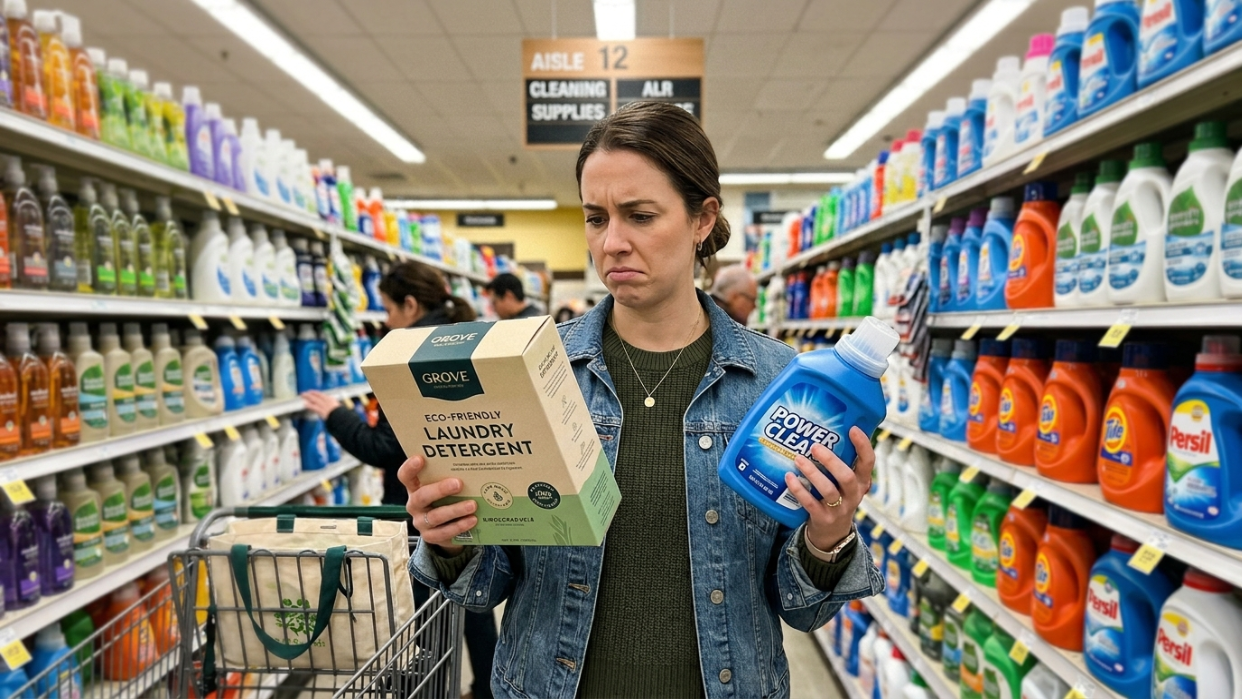
Greenwashing is not just an ethical problem. It’s the failure mode of consumer behavior change strategy done poorly, or faked entirely.
When consumers perceive greenwashing, research shows it triggers belief disconfirmation: expectations are violated, confusion rises, trust collapses, and brand loyalty weakens. The consequences go beyond passive disengagement. Studies indicate that perceived digital greenwashing can lead to active backlash, including boycott intentions, brand switching, and social media activism.
The key variable is perceived honesty. Consumers are becoming more sensitive to environmental claims, but the perceived openness and transparency of those claims determines whether trust is built or destroyed. A strong brand identity and consistent brand image enhance the credibility of behavior change messages. Everything, from product design to advertising to retail activation, needs to tell the same story.
Practitioners on LinkedIn and sustainability forums frequently note that the brands succeeding at behavior change aren’t the ones making the boldest claims. They’re the ones whose actions visibly match their words. For practical guidance on staying on the right side of this line, see how to avoid greenwashing.
How Consumer Behavior Change Strategy Connects to Business Outcomes
Some marketers treat behavior change as a “nice to have,” a feel-good addition to their sustainability report. That’s a mistake. The commercial case is concrete.
PwC’s 2024 data shows 73% of consumers now prefer sustainable brands, and 54% are willing to pay a premium for sustainable products. The average sustainability premium consumers will pay is 9.7%. That’s real revenue potential for brands that can convert intention into purchase.
The BSR research demonstrated that companies like McDonald’s and Walmart weren’t pursuing behavior change out of altruism alone. They were looking for behavioral shifts that simultaneously enable more sustainable lifestyles, grow demand for more sustainable products, and create business value. These three outcomes aren’t in tension. They reinforce each other.
Effective impact measurement is what ties behavior change interventions to commercial results. Without it, you’re guessing.
The commercial logic is simple. If you can identify the specific barriers preventing consumers from buying or using your product more sustainably, and you can design interventions that remove those barriers, you drive both sustainability outcomes and revenue growth. That’s not idealism. That’s strategy.
For more on understanding and resolving the disconnect between what consumers say and what they buy, explore this deep dive on why consumers aren’t buying.
How to Measure Consumer Behavior Change
Behavior change strategies must be measured using real-world actions, not proxy metrics like engagement.
Key performance indicators include:
Conversion rate (intent → action)
Repeat purchase rate
Product usage frequency
Adoption rate of new behavior
Drop-off points in behavior funnels
Sustainability-linked actions (refill, reuse, recycling)
The most important metric is the intention-action gap, which measures the difference between what consumers say they will do and what they actually do.
Related Terms
Consumer behavior change strategy overlaps with several adjacent concepts. Here’s how they differ:
Sustainability marketing: The broader discipline of marketing sustainable products and practices. Consumer behavior change strategy is a specific discipline within it, focused on shifting actual behavior rather than just promoting sustainable products.
Green marketing: Emphasizes environmental claims about products. Behavior change strategy is about how people act, not just what they buy.
Social marketing: Uses commercial marketing techniques to achieve social good. This is the closest relative, as behavior change is often its primary goal.
Nudge marketing: A specific tactic within behavior change, not the whole strategy. Nudges are one tool in a larger toolkit.
Purpose-driven marketing: Brand positioning around values and mission. Consumer behavior change strategy is the operational mechanism that turns purpose into measurable consumer action.
Start a conversation about building a consumer behavior change strategy that connects sustainability to commercial growth.
Frequently Asked Questions
What is a consumer behavior change strategy?
A consumer behavior change strategy is a planned approach that uses behavioral science principles to influence how consumers act. Unlike traditional marketing that focuses on awareness and preference, it targets the psychological mechanisms (habits, biases, friction, social norms) that determine whether someone actually follows through on their intentions.
Why do consumers say they care about sustainability but not follow through?
This is called the intention-action gap. Cognitive biases like present bias (future benefits feel abstract), status quo bias (people stick with familiar habits), and choice overload (too many options cause paralysis) all contribute. 65% of consumers say they want to buy from purpose-driven brands, but only 26% actually do.
What’s the difference between a nudge and a behavior change strategy?
A nudge is a single tactic: a subtle change to how a choice is presented (like making the sustainable option the default). A consumer behavior change strategy is the overarching plan that diagnoses barriers, selects the right framework, designs interventions across multiple touchpoints, and measures results. Nudges might be part of the strategy, but they’re rarely sufficient on their own.
Which behavioral science framework is best for marketers?
It depends on the problem. COM-B is best for diagnosing why a behavior isn’t happening. Fogg’s B=MAP is best for designing specific interventions. EAST works well as a campaign design checklist. Nudge theory is best for optimizing existing decision flows. Most effective strategies combine elements from multiple frameworks.
Can small brands use consumer behavior change strategies, or is this only for large corporations?
Any brand can apply these principles. Small brands often have advantages: more authentic relationships with customers, faster iteration cycles, and fewer legacy systems to work around. The frameworks are scale-neutral. What matters is understanding your specific audience’s barriers and designing targeted interventions.
How do you measure the success of a behavior change strategy?
Track actual behavior, not just attitudes or awareness. This includes purchase data, product usage patterns, refill or return rates, recycling behavior, and repeat purchase rates. The gap between stated intention and actual behavior is itself a key metric. Closing that gap, even partially, represents both sustainability progress and commercial gain.
What’s the biggest risk of getting behavior change strategy wrong?
Greenwashing, whether intentional or accidental. If your behavior change messaging isn’t backed by genuine operational commitment, consumers will perceive it as dishonest. Research shows this leads to active backlash: boycotts, brand switching, and negative social media campaigns. Authenticity isn’t optional.