
 Gaia
GaiaTL;DR
The best environmental campaigns go beyond raising awareness. They create a specific action, make it easy to join, and back the message with operational proof. This article breaks down 12 campaigns, from Patagonia’s “Don’t Buy This Jacket” to World Cleanup Day, using a consistent evaluation framework that examines credibility, behavior change, measurable impact, and greenwashing risk. Each entry includes what worked, what to watch out for, and what marketers can actually copy.
Quick Answer: What Are the Best Environmental Campaigns?
The best environmental campaigns combine a credible environmental claim with a specific action people can easily take. Standout examples include Patagonia’s “Don’t Buy This Jacket,” REI’s #OptOutside, WWF’s Earth Hour, Fridays for Future, the Palau Pledge, World Cleanup Day, and Adidas x Parley’s Run for the Oceans. The strongest campaigns go beyond awareness by creating participation, social proof, measurable outcomes, and a clear next behavior.
Environmental Campaigns Are Easy to Admire and Hard to Get Right
Every brand wants to be on the right side of the environment. Few are willing to do the work that makes an environmental campaign credible.
The gap between intention and action is where most campaigns fail. A company posts about Earth Day, runs a tree-planting promotion, and calls it sustainability marketing. Meanwhile, the European Commission reports that 53% of green claims examined in the EU were vague, misleading, or unfounded, and 40% were unsubstantiated. In the U.S., the FTC Green Guides require marketers to substantiate environmental claims with competent, reliable evidence.
Consumer interest is real, though. PwC’s 2024 Voice of the Consumer Survey, covering more than 20,000 consumers across 31 countries, found that people were willing to pay an average 9.7% sustainability premium even amid cost-of-living pressure. The demand exists. The question is whether your campaign can earn trust while driving action.
The best environmental campaigns are not the loudest. They are the ones that combine credible proof, a specific audience action, emotional salience, and a measurable path from attention to behavior change. That is the standard this list applies.
Explore Grounded World’s approach to closing the intention-action gap between sustainability messaging and real consumer behavior.
What Is an Environmental Campaign?
An environmental campaign is a coordinated effort to influence behavior, raise awareness, mobilize communities, change business practices, or influence policy around an environmental issue. Campaigns can address climate change, pollution, waste, biodiversity, conservation, energy, water, food systems, or overconsumption.
Environmental campaigns can be run by brands, nonprofits, governments, grassroots movements, scientists, or community organizations. The strongest campaigns connect a specific environmental problem to a specific audience action and provide credible evidence that the action matters.
Environmental Campaign vs. Green Marketing
Environmental campaigns and green marketing overlap, but they are not identical.
Environmental campaign | Green marketing |
|---|---|
Usually has a defined campaign or movement | Usually promotes a product, service, or brand |
Focuses on behavior, awareness, participation, or policy | Focuses primarily on consumer choice and brand positioning |
Can be run by nonprofits, governments, movements, or brands | Usually associated with businesses |
May not involve a product purchase | Often connected to a product or service |
Can focus on systemic environmental issues | Usually communicates environmental attributes or benefits |
At-a-Glance Comparison Table
Campaign | Organization | Best For | Main Behavior Lever | Strongest Proof Point | Honest Tradeoff |
|---|---|---|---|---|---|
Don’t Buy This Jacket | Patagonia | Anti-consumption brand activism | Values-based restraint + transparency | Sales rose ~33% ($158M) in 9 months | Only works with decades of credibility behind it |
#OptOutside | REI Co-op | Brand purpose as public ritual | Removing purchase opportunity + social participation | 1.4M supporters, 175 orgs joined in 2015 | Mixed community sentiment on labor and policy consistency |
Earth Hour | WWF | Simple global participation | One-hour symbolic action | 100+ countries, 1.4M+ hours committed in 2024 | Symbolic action needs a clear next step |
Fridays for Future | Youth climate movement | Youth-led mobilization | Collective protest + moral urgency | ~7.6M people across 185 countries in Sept 2019 | Protest must connect to policy and voting |
Rang-tan | Greenpeace + Iceland Foods | Emotional storytelling + earned media | Character-led story + controversy | 1M+ petition signatures, 10,000% rise in palm oil searches | Controversy can oversimplify complex issues |
Run for the Oceans | Adidas x Parley | Gamified brand participation | Fitness challenge tied to cleanup funding | 924K+ runners, 12.4M km in 2018 | Activity-to-impact math needs transparency |
Palau Pledge | Palau Legacy Project | Behavior design at point of entry | Public commitment at border | ~1.7B impressions, $6.2M earned media, zero media budget | Pledges need enforcement infrastructure |
Show Your Stripes | Ed Hawkins / University of Reading | Data visualization for climate conversation | Localized visual evidence + social sharing | 120 TV forecasters across 30 countries used the stripes | Simplification can trigger skepticism |
World Cleanup Day | Let’s Do It World | Mass volunteer mobilization | One-day civic action | 19.1M volunteers, 219K tons collected in 2023 | Must connect to waste prevention, not just removal |
The Ocean Cleanup | The Ocean Cleanup | Tech-enabled environmental storytelling | Progress dashboard + milestones | 11.5M kg removed in 2024 | Cleanup without prevention is incomplete |
Uncrap the World | Who Gives A Crap | Humor in sustainability | Comic relief + product switch + impact model | $14.4M+ donated to WASH partners | Repeat purchases depend on quality and proof |
Mini Impact Kitchen | Impossible Foods | Making small food swaps feel doable | Cultural trend piggybacking + metaphor | Tiny NYT ad dramatized smaller footprint | Plant-based claims attract nutritional scrutiny |
How We Chose the Best Environmental Campaigns
Most “best of” lists rank campaigns by fame or visual appeal. That is not enough. An environmental campaign can go viral and still change nothing.
We evaluated each campaign against a framework we call the C.A.M.P.A.I.G.N. test:
Credibility: Is the campaign backed by real action, data, or operational change?
Actionability: Can the audience do something specific and easy?
Measurability: Are there impact metrics beyond impressions?
Participation design: Does the campaign create a ritual, pledge, challenge, or community action?
Audience fit: Does the message match the audience’s values and barriers?
Issue relevance: Is the environmental issue materially connected to the organization?
Greenwashing risk: Are claims specific, qualified, and substantiated?
Next behavior: Does the campaign lead to a durable behavior, policy change, or product switch?
This framework helps distinguish campaigns that actually changed behavior from those that merely generated applause.
Types of Environmental Campaigns
Environmental campaigns can be organized by the behavior or outcome they are designed to influence.
Climate Change Campaigns
These campaigns focus on emissions, climate awareness, fossil fuels, energy use, adaptation, or political action. Fridays for Future and Show Your Stripes are examples of climate-focused approaches.
Conservation Campaigns
Conservation campaigns focus on protecting ecosystems, wildlife, biodiversity, forests, oceans, or natural resources.
Waste and Recycling Campaigns
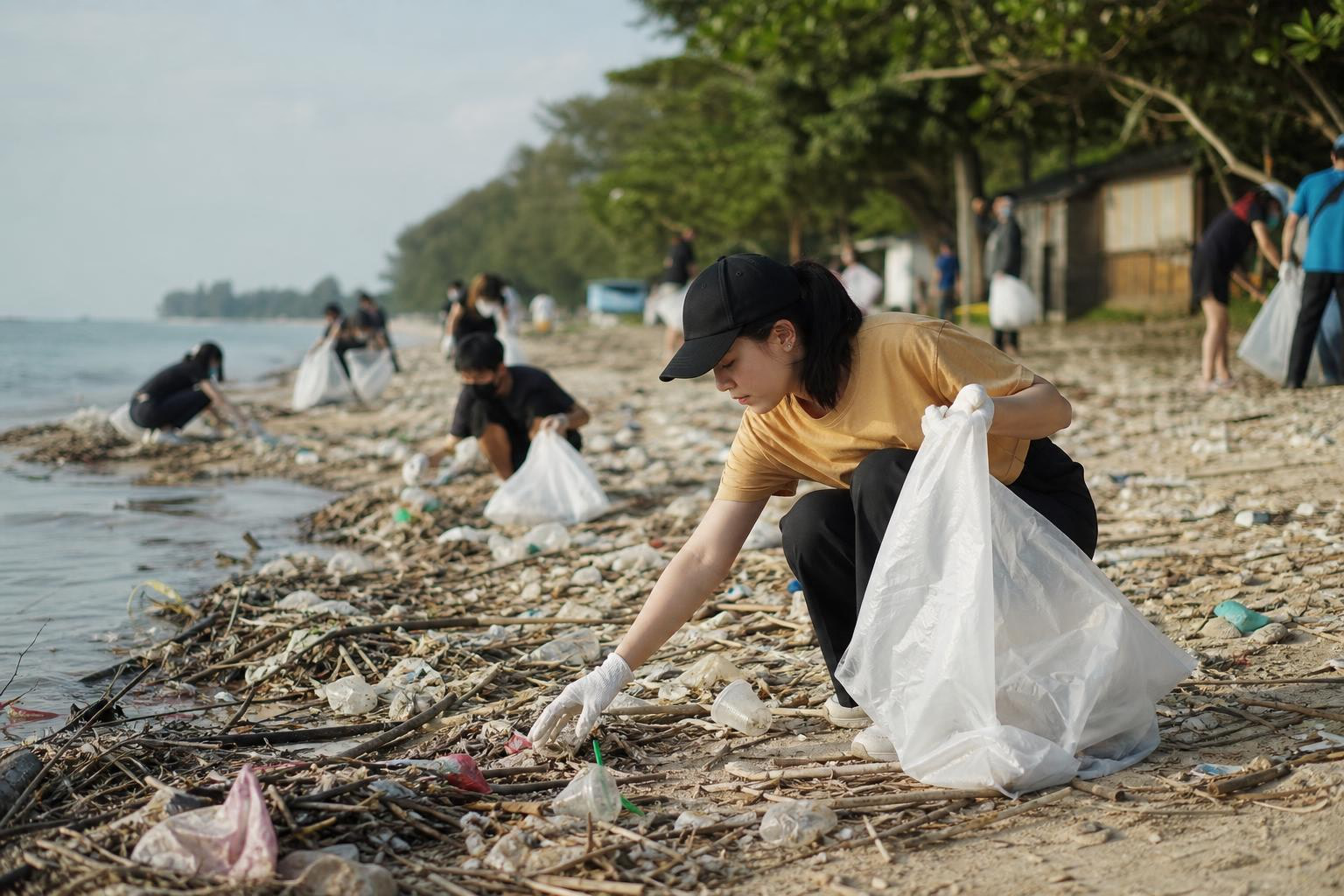
These campaigns encourage waste reduction, reuse, recycling, cleanup, or changes to consumption. World Cleanup Day is a prominent example.
Sustainable Consumption Campaigns
These campaigns encourage people to buy less, buy differently, repair products, reuse goods, or choose lower-impact alternatives. Patagonia's “Don't Buy This Jacket” is a strong example.
Sustainable Food Campaigns
Food campaigns encourage changes in diet, food waste, sourcing, agriculture, or purchasing. Impossible Foods' Mini Impact Kitchen illustrates how creative campaigns can make a food substitution feel accessible.
Environmental Tourism Campaigns
These campaigns influence visitor behavior, conservation funding, or tourism policy. The Palau Pledge demonstrates how an environmental message can be integrated directly into the visitor journey.
Environmental Activism Campaigns
Activism campaigns seek public participation, political pressure, policy change, or institutional action. Fridays for Future is a major example.
The 12 Best Environmental Campaigns
1. Patagonia, “Don’t Buy This Jacket”
Best for: Credible anti-consumption messaging from a brand with operational proof.
On Black Friday 2011, Patagonia ran a full-page New York Times ad telling people not to buy one of its best-selling jackets unless they truly needed it. The ad broke down the jacket’s environmental cost and asked readers to consider durability, repair, and reuse before buying anything new.
Why it worked:
Pattern interrupt: a retail brand telling people not to shop on the biggest shopping day of the year.
Transparency over perfection: the ad discussed the product’s footprint rather than claiming Patagonia was impact-free.
Credibility bank: Patagonia had pledged 1% of sales to environmental preservation since 1985.
The campaign reduced immediate pressure to buy, which paradoxically increased trust and loyalty.
Evidence of impact:
NYU Stern’s sustainability business case report found that sales increased almost one-third in the nine months following the campaign, generating $158M in new apparel sales. PBS framed the approach as a broader challenge to consumerism, not a one-off stunt.
Budget signal: Full-page New York Times ad buy. Exact total budget not public.
Community signal: Practitioners on Reddit regularly cite “Don’t Buy This Jacket” as a benchmark sustainability campaign, though some question whether anti-consumption messaging can ever fully align with sales goals.
Tradeoff: This is dangerous to copy without deep credibility. A fast-fashion brand saying “buy less” without changing its production model would be attacked, rightly so.
What to copy: Restraint can be commercially powerful when the brand has earned the right to say it.
2. REI, #OptOutside
Best for: Turning brand purpose into a participatory ritual.
In 2015, REI closed all 143 retail stores, its headquarters, and two distribution centers on Black Friday. It paid 12,000 employees to spend the day outside and invited the public to join using #OptOutside.
Why it worked:
Sacrifice signal: closing on a major revenue day made the message impossible to dismiss as marketing fluff.
Clear action: “Go outside instead of shopping” is simple and memorable.
Social proof: the hashtag turned individual choices into a visible movement.
Employee alignment: paid time off made the campaign internally credible before it went external.
Evidence of impact:
REI’s 2015 stewardship report says more than 1.4M people supported #OptOutside and 175 organizations joined the movement. The One Club reports the campaign earned 6.7B media impressions and 1.2B social impressions. REI later made Black Friday closure permanent, announcing the commitment in 2022.
Budget signal: Revenue sacrifice from closing on Black Friday, plus campaign creative, microsite, and partner activation. Exact opportunity cost not public.
Community signal: Reddit sentiment is genuinely mixed. Some users defend #OptOutside as one of the few things that still makes REI’s co-op identity feel distinct. Others criticize perceived labor issues, pre-Black Friday sales, and public-lands contradictions. This is important: the more moral the campaign, the more people audit the company behind it.
Tradeoff: A ritual can become fragile when the organization’s broader actions appear inconsistent. REI shows that purpose campaigns invite scrutiny as much as admiration.
What to copy: Change the company’s behavior first, then ask customers to join. Not the other way around.
For more on how brand activation campaigns can turn values into measurable action, see our full breakdown.
3. Earth Hour
Best for: A simple global ritual that lowers the barrier to participation.
Earth Hour began in Sydney in 2007 as a lights-off event and grew into a global WWF-led movement. The ask is almost absurdly simple: switch off your lights from 8:30 p.m. to 9:30 p.m. local time.
Why it worked:
Low friction: almost anyone can turn off lights for an hour.
Visible ritual: dark landmarks and homes create a shared symbol.
Repeatability: annual timing makes participation habitual.
Global-local design: the same action works across countries, cities, schools, and households.
Evidence of impact:
WWF’s 2024 annual report says people in more than 100 countries committed over 1.4M hours to the planet during Earth Hour 2024.
Budget signal: Distributed across WWF, partner organizations, city activations, and local events. No single public budget.
Community signal: Reddit threads on r/ZeroWaste reveal the core tension. Some users say Earth Hour raised their awareness and helped them take later steps like composting and native gardening. Others question whether one symbolic hour a year accomplishes anything meaningful.
Tradeoff: Symbolic campaigns need a “next action.” Without one, people may participate once and feel they have done their part.
What to copy: Earth Hour’s genius is not energy savings in a single hour. It is the simplicity of a shared, visible, repeatable commitment that opens the door to deeper engagement.
4. Fridays for Future / Global Climate Strike
Best for: Youth-led mobilization and moral clarity.
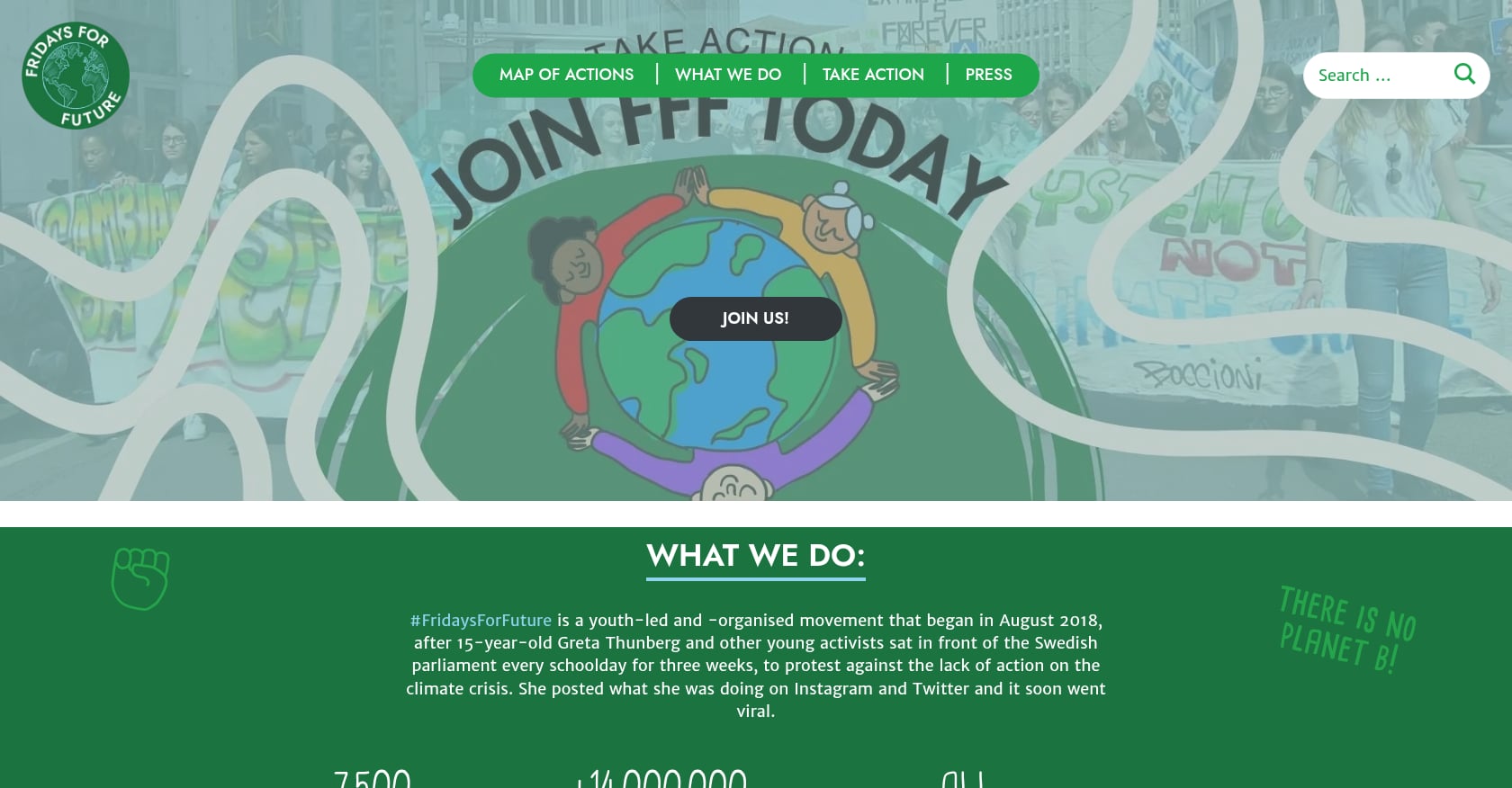
Fridays for Future grew from Greta Thunberg’s solo 2018 school strike outside the Swedish Parliament into a decentralized global youth climate movement.
Why it worked:
Moral inversion: children asked adults to protect their future.
Repeatable cadence: Friday strikes created a simple weekly rhythm.
Decentralized ownership: local groups organized without waiting for a central team.
Strong visual: young people leaving school created a powerful media story.
Evidence of impact:
The September 2019 Global Climate Strikes drew roughly 7.6 million people across 185 countries, according to 350.org and University of Helsinki protest research. Guinness World Records estimates approximately 7.22 million participants across 7,935 registered events.
Budget signal: No single campaign budget. This was decentralized organizing powered by volunteers, NGO support, and social platforms.
Community signal: Reddit discussions show both support and practical friction. Some users said they could not afford to strike. Others argued that demonstrations need to connect to voting, lobbying, and policy demands to create lasting change.
Tradeoff: Mass protest creates pressure and visibility, but it needs translation into policy, institutional commitments, and sustained organizing to produce outcomes.
What to copy: Environmental campaigns can be led by people with moral authority rather than brands with media budgets. The question is always: what happens after the march?
Building an environmental campaign is not just a creative exercise. The best examples on this list start with behavior: what people do now, what you want them to do next, and what proof they need to trust you. Talk to Grounded World about turning sustainability strategy into credible campaigns and commercial outcomes.
5. Greenpeace + Iceland Foods, Rang-tan
Best for: Emotional storytelling, earned media, and controversy-driven reach.
Iceland Foods repurposed a Greenpeace animated film about an orangutan displaced by palm oil deforestation for its 2018 Christmas campaign. Clearcast did not clear the ad for UK TV broadcast due to rules on political advertising tied to Greenpeace, creating a massive earned-media moment.
Why it worked:
Character-led storytelling: Rang-tan made palm oil deforestation emotionally legible.
Unexpected seasonal contrast: a Christmas ad about deforestation broke category norms.
Controversy amplification: the “not cleared for TV” story drove social sharing far beyond what a standard TV buy could have achieved.
Specific consumer issue: palm oil gave people something concrete to investigate and act on.
Evidence of impact:
Iceland says the petition to allow the ad on TV gained more than 1 million signatures and that Google searches for palm oil rose 10,000% in the five months to March 2019. The Drum reported that Tubular Labs data showed 15.2 million views in a week, and Kantar Millward Brown ranked it the most powerful UK Christmas ad of 2018.
Budget signal: Exact budget not public. Iceland reused Greenpeace creative and gained massive earned reach through the clearance controversy.
Community signal: The ad went viral on Reddit, generating 37,000+ upvotes on r/videos. But some users debated whether palm oil substitution could create unintended land-use issues, since palm oil is one of the most productive vegetable oils per hectare.
Tradeoff: Viral controversy can amplify an issue, but brands must be precise. “Getting banned” is not a replicable strategy. The campaign worked because the controversy amplified a specific supply-chain issue the brand had already acted on.
What to copy: Give a complex supply-chain issue a memorable emotional hook, but do not let simplification override accuracy. For more examples of this model, see our guide to cause marketing campaigns that connect brand and cause credibly.
6. Adidas x Parley, Run for the Oceans
Best for: Gamifying sustainable action and tying participation to direct funding.
Adidas and Parley for the Oceans launched Run for the Oceans in 2017 as a global movement using running to raise awareness of marine plastic pollution and fund Parley’s cleanup and education programs.
Why it worked:
Gamification: kilometers became measurable contribution units.
Brand fit: running gear, ocean plastic materials, and sport were naturally connected.
Collective progress: individual runs added up to a shared global target.
Transparent conversion: Adidas matched the first 1 million km with $1 per km.
Evidence of impact:
In 2018, 924,237 runners covered 12,402,854 km, and Adidas matched the first 1 million km with $1/km for Parley Ocean School initiatives. By 2019, the movement grew to 2.2 million participants. For 2022, Adidas committed to support Parley in cleaning up the equivalent weight of one plastic bottle for every 10 minutes of activity logged.
Budget signal: Adidas publicly committed up to $1M in 2018 for the first 1M km. Full global campaign budget not public.
Community signal: Reddit sentiment around Adidas x Parley is mixed. Some sneaker enthusiasts admire the designs and say the collaboration introduced them to ocean conservation. Others question how much recycled ocean plastic is actually in specific products and whether the environmental benefit is overstated.
Tradeoff: Gamified campaigns need clear accounting. If the activity-to-impact conversion feels fuzzy, the audience may see it as cause-washing.
What to copy: “Impact math” that is simple, capped, and auditable. One kilometer equals one dollar. Ten minutes equals one bottle. Make it concrete.
7. Palau Pledge
Best for: Changing tourist behavior through commitment design.
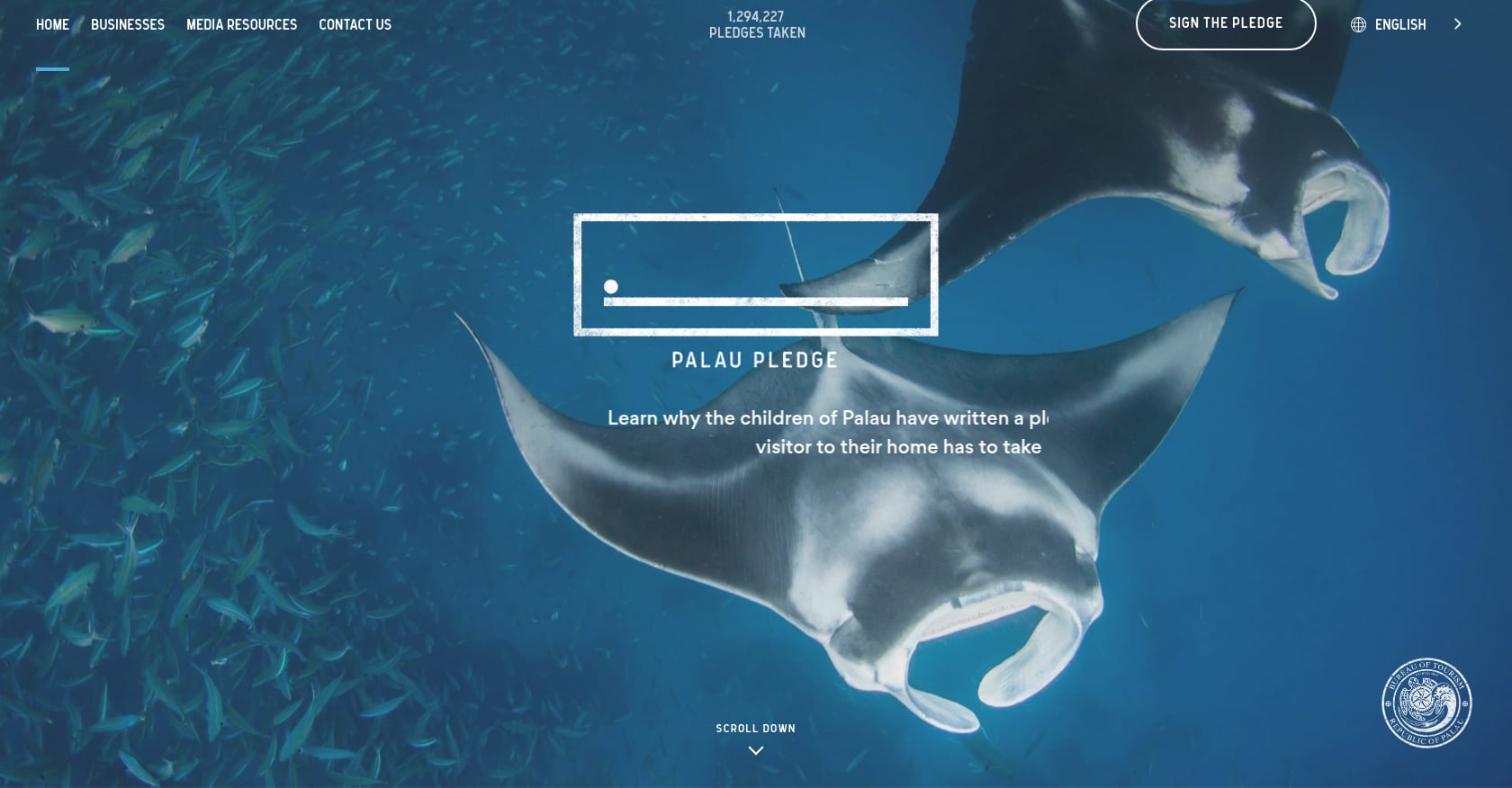
The Palau Pledge requires every visitor to sign a commitment stamped directly into their passport, promising to act responsibly toward Palau’s environment and culture. The government later passed the Responsible Tourism Education Act, embedding the pledge into immigration processes and introducing reef-toxic sunscreen bans, single-use plastic reductions, and tourism business accreditation.
Why it worked:
Public commitment: signing a passport pledge is psychologically stronger than seeing a poster.
Point of maximum attention: visitors encounter the message at border entry, before behavior happens.
Local moral voice: the pledge is framed around protecting Palau for children and future generations.
Policy integration: the campaign connects to tourism rules, not just communication.
Evidence of impact:
A Westminster Papers case study reports that the campaign generated roughly 1.7 billion media impressions and $6.2M in earned media without a media budget.
Budget signal: No media budget. Implementation required government cooperation, legal change, passport and in-flight materials, and tourism-sector training.
Community signal: Reddit travel communities describe the pledge as a memorable passport-stamp experience. Some users raise practical concerns about whether the stamp causes questions at later borders or whether enforcement feels uneven.
Tradeoff: A pledge without enforcement becomes theater. Palau’s real lesson is the combination of pledge, policy, education, and system design.
What to copy: Move from “awareness” to “pre-commitment at the point of behavior.” This is one of the strongest examples of behavior design in any environmental campaign.
8. Show Your Stripes
Best for: Turning climate data into a simple, shareable visual language.
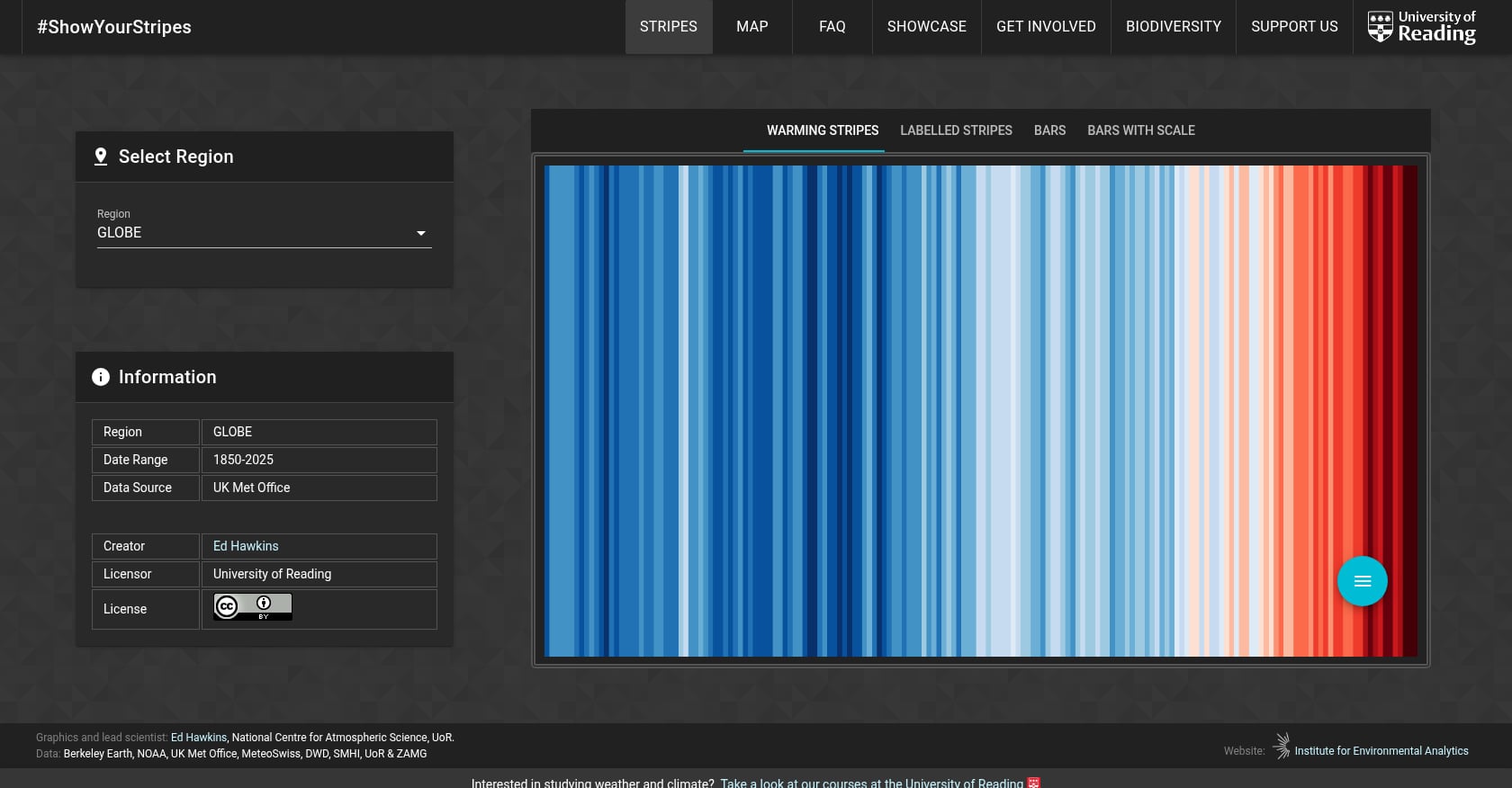
Climate scientist Ed Hawkins created warming-stripe graphics showing temperature change over time as colored bands. The Show Your Stripes website lets anyone download localized climate visuals and share them.
Why it worked:
Extreme simplicity: no chart literacy required at first glance.
Localization: people can see warming where they live.
Identity object: the stripes work on ties, scarves, murals, social profiles, and TV graphics.
Conversation starter: the visual invites “what is that?” questions.
Evidence of impact:
A University of Reading impact case study says related campaigns brought live broadcast coverage by up to 120 TV weather forecasters across 30 countries. A 2025 Bulletin of the American Meteorological Society article says Show Your Stripes Day exposes millions to climate information in a single day.
Budget signal: This is an open, freely downloadable visual asset, not a traditional paid campaign.
Community signal: Reddit users generally find the graphics compelling and easy to share. Some criticize the lack of numbers or scale, noting the graphic can feel more like advocacy than data visualization to skeptical audiences.
Tradeoff: Simple visuals travel further, but simplification can trigger skepticism among technical audiences. Pair the visual with a clear data source or explainer.
What to copy: Open assets can outperform paid assets when they become identity symbols people want to adopt.
9. World Cleanup Day
Best for: Mass volunteer mobilization and tangible local action.
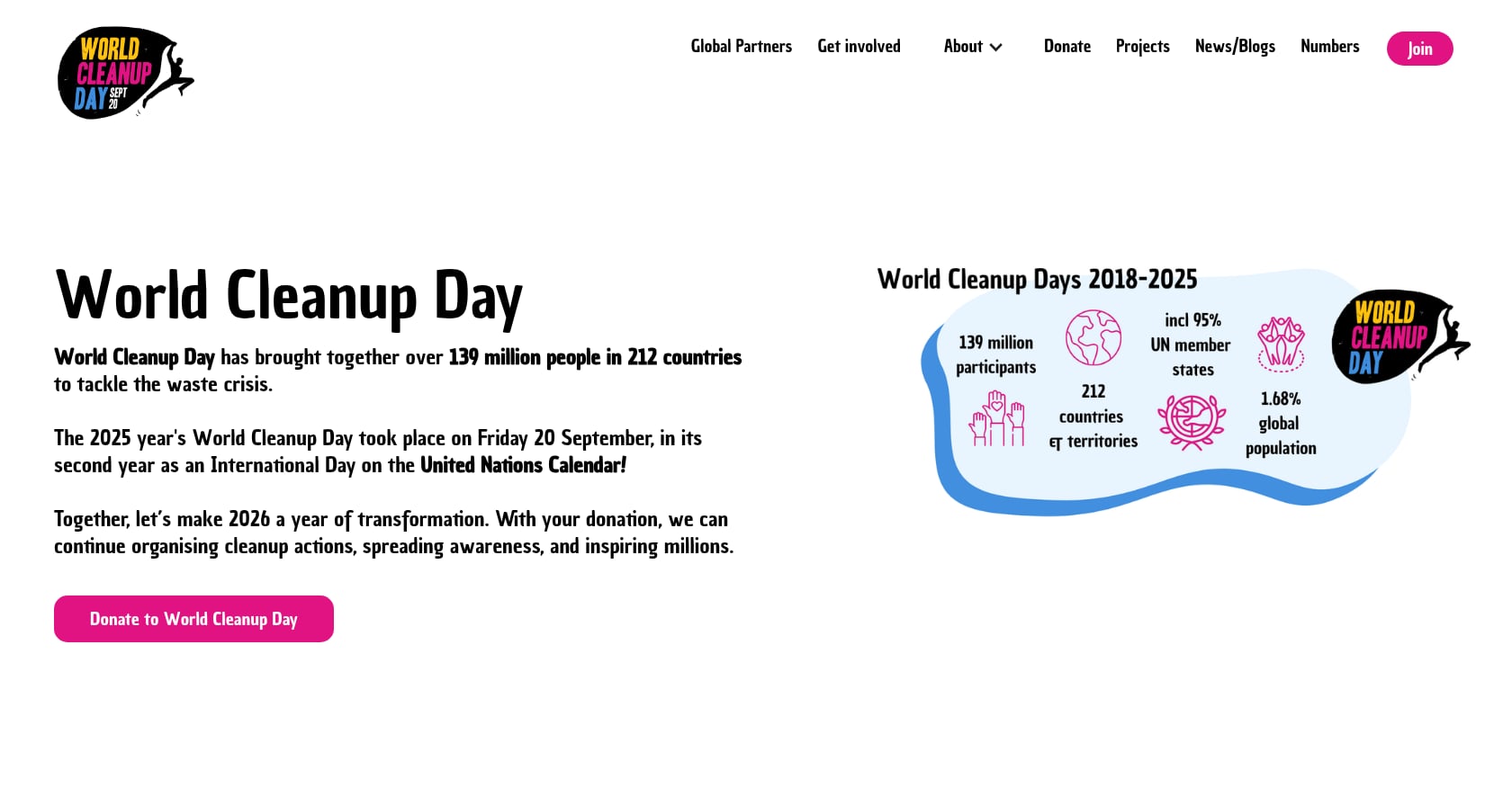
World Cleanup Day is a global civic action organized by Let’s Do It World. In December 2023, the UN General Assembly proclaimed September 20 as World Cleanup Day, making it an official UN International Day from 2024 onward.
Why it worked:
Physical participation: volunteers see the bags of waste they remove.
Local pride: people clean their own beaches, parks, rivers, and neighborhoods.
Low barrier to organizing: schools, workplaces, and community groups can all participate.
Global umbrella: local action feels part of a worldwide movement.
Evidence of impact:
World Cleanup Day 2023 engaged 19.1 million volunteers across 195 countries and territories, collecting 219,000 tons of waste according to the Let’s Do It World annual report.
Budget signal: Decentralized volunteer network. No single public campaign budget.
Community signal: Reddit volunteer discussions show that cleanups are accessible activities for corporate teams, families, and community groups. Participants value the visible results and social experience.
Tradeoff: Cleanup campaigns can be criticized if they only address visible waste without tackling waste creation, producer responsibility, or waste-management failures upstream.
What to copy: Design campaigns where people can see progress with their own eyes. Tangible local action creates emotional proof that abstract messaging cannot.
10. The Ocean Cleanup
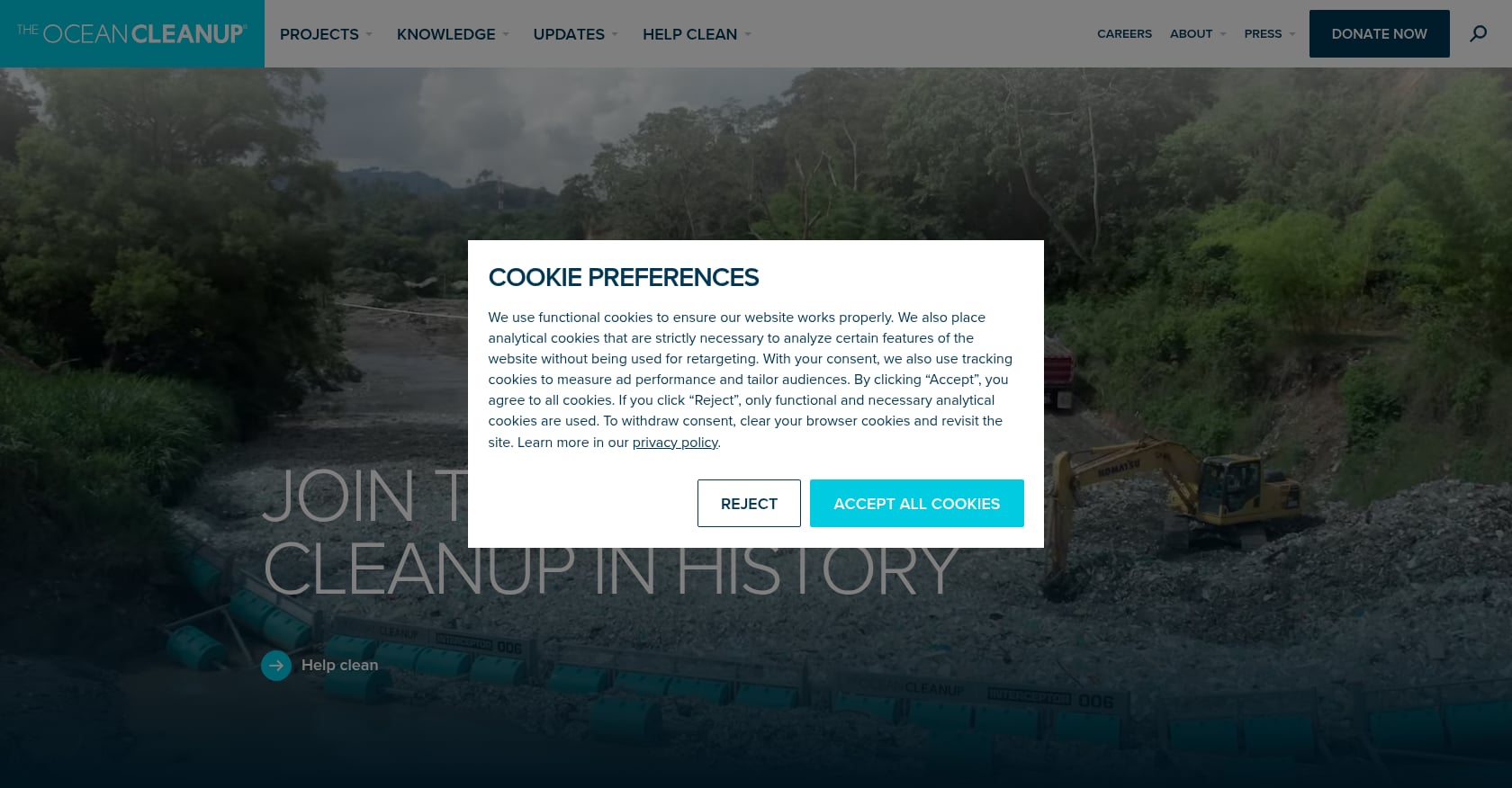
Best for: Technology-led environmental storytelling with measurable progress.
The Ocean Cleanup develops systems to remove plastic from oceans and intercept it in rivers. Its communications are built around engineering milestones, extraction metrics, and a bold vision of cleaning the Great Pacific Garbage Patch.
Why it worked:
Progress visibility: the campaign story is updated through milestones.
Founder narrative: Boyan Slat gives the project a clear protagonist.
Engineering drama: big machines in the ocean make the problem tangible and watchable.
Metric clarity: kilograms removed is easier to understand than abstract awareness.
Evidence of impact:
In 2024, The Ocean Cleanup removed 11.5 million kg of trash from oceans and rivers, more than all previous years combined, and reached 20 million kg removed by November 2024. The organization projects that cleaning the Great Pacific Garbage Patch is achievable at a cost of $7.5 billion.
Budget signal: The $7.5B projected cost is public. Individual campaign and communications budgets are not.
Community signal: Reddit discussions show excitement about the project, including direct AMA engagement with Boyan Slat. But skepticism centers on whether cleanup alone can solve plastic pollution if upstream production and waste systems remain unchanged.
Tradeoff: Technology campaigns risk becoming “solutionism” if they do not acknowledge prevention, policy, and producer responsibility.
What to copy: Measurable progress over time is the strongest form of campaign content. Show what changed, not just what you intend.
11. Who Gives A Crap, “Uncrap the World”
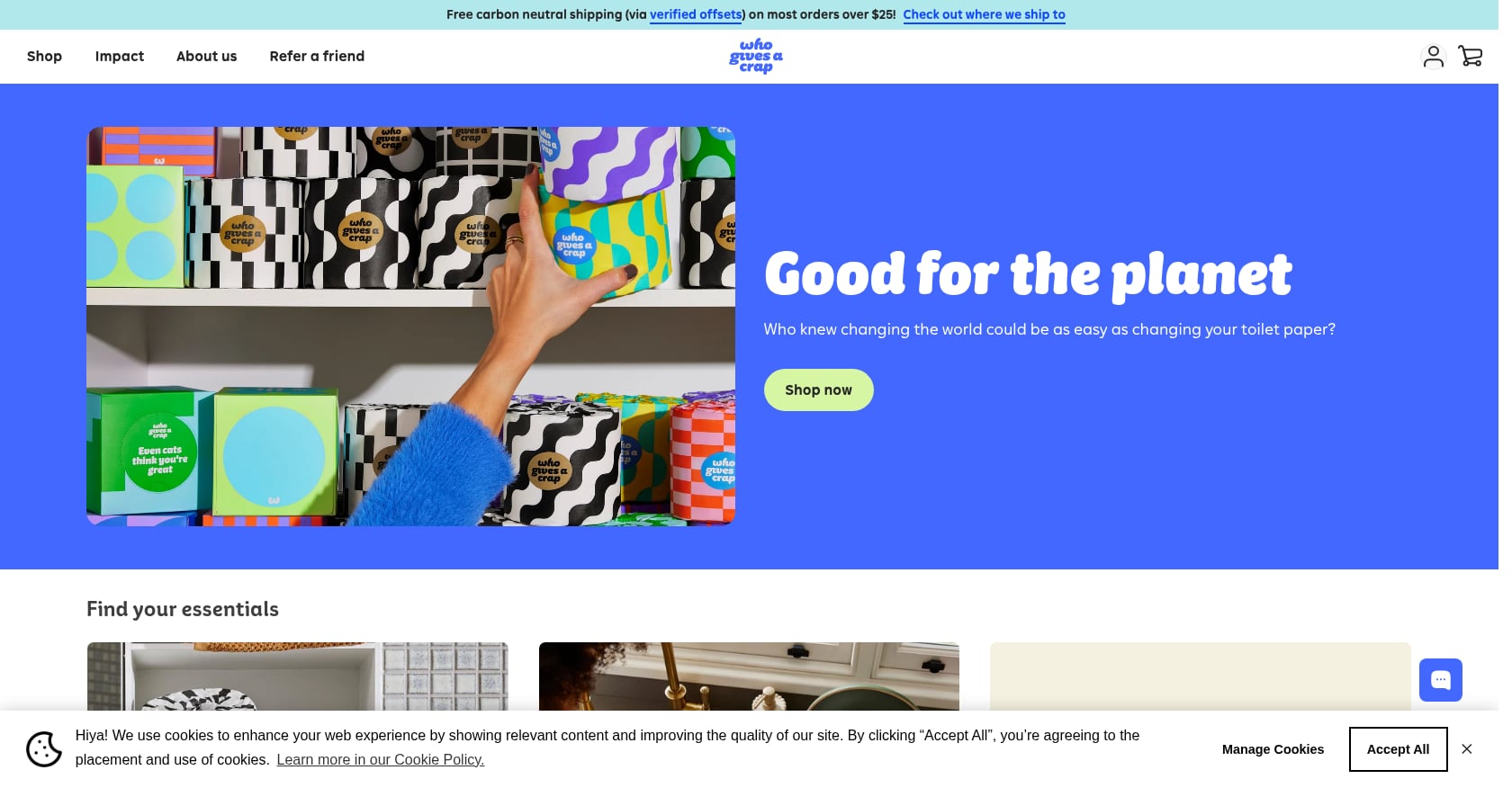
Best for: Using humor to make sustainable product switching less earnest and more memorable.
Who Gives A Crap built a toilet paper brand around recycled and bamboo products, cheeky copywriting, and a commitment to donate 50% of profits to water, sanitation, and hygiene partners.
Why it worked:
Humor as friction reducer: toilet jokes make an uncomfortable topic approachable.
Clear product substitution: switch toilet paper. No complex behavior change required.
Impact model: 50% profit donation gives the brand a simple, auditable reason to believe.
Distinctive voice: the tone cuts through a category that is usually bland and invisible.
Evidence of impact:
Who Gives A Crap reports it has raised $14.4M+ to date, and its 2023 impact data says partners helped 575,082 people access improved WASH services.
Budget signal: Campaign budget not public. The business model itself funds impact via profit donation.
Community signal: Reddit users on r/AskUK have debated whether Who Gives A Crap is genuinely ethical or greenwashing. They discuss product-quality changes over time, showing that purpose-led brands must maintain both proof and product performance to retain trust.
Tradeoff: Humor creates attention, but repeat purchases depend on quality, price, delivery experience, and continued proof that donations are real and growing.
What to copy: Make the sustainable switch feel funny, easy, and socially shareable. For more on social impact campaign models that tie commercial performance to mission outcomes, see our examples guide.
12. Impossible Foods, Mini Impact Kitchen

Best for: Making small sustainable food swaps feel doable and culturally relevant.
For Earth Day 2023, Impossible Foods and Deloitte Digital launched “Mini Impact Kitchen,” using the mini-food social trend to dramatize the idea that smaller individual choices add up. The campaign featured creators specializing in miniature food and a 1-inch by 1-inch New York Times ad, the smallest format the paper offered.
Why it worked:
Cultural piggybacking: the campaign used an existing social trend rather than forcing a new behavior.
Concrete metaphor: a tiny ad represented a smaller carbon footprint.
Behavior focus: the desired action was simple: swap a meat product for a plant-based option.
Earth Day timing: the campaign joined an existing moment of environmental attention.
Evidence of impact:
Marketing Dive reports that the tiny NYT ad and mini-food creator content dramatized the smaller carbon footprint of Impossible products compared with conventional animal meat production.
Budget signal: Known paid placement includes a New York Times 1x1 ad. Full campaign budget not public.
Community signal: No strong Reddit thread specific to Mini Impact Kitchen surfaced. This works best as a creative and practitioner example rather than a community-validated movement.
Tradeoff: Food sustainability claims attract scrutiny over nutrition, processing, and comparative lifecycle assessments. Comparative emissions claims need specific, accessible substantiation.
What to copy: Make the invisible environmental benefit visible through a memorable metaphor. The smallest ad in the New York Times said more about footprint reduction than a standard green claim ever could.
Which Environmental Campaigns Actually Changed Behavior?
Not every successful environmental campaign has the same type of evidence. Some demonstrate participation, some produce measurable environmental outputs, and others primarily generate awareness or commercial results.
The strongest behavior-change examples are those that put the desired action directly into the campaign experience.
Campaign | Desired behavior | Evidence type | Behavior-change strength |
|---|---|---|---|
Palau Pledge | Tourists commit to responsible behavior | Point-of-entry pledge + policy integration | High |
#OptOutside | Replace shopping with outdoor activity | Participation + REI operational commitment | High |
World Cleanup Day | Physically remove waste | Volunteer participation + waste collected | High for immediate action |
Run for the Oceans | Exercise while contributing to ocean initiatives | Activity logged + funding mechanism | Medium-high |
Earth Hour | Temporarily reduce electricity use | Participation | Medium |
Fridays for Future | Protest and political mobilization | Mass participation | Medium-high for mobilization |
Don’t Buy This Jacket | Consider buying less and repairing/reusing | Sales + brand behavior | Medium |
Rang-tan | Investigate/support action on palm oil | Petition + search behavior | Medium |
Show Your Stripes | Engage with climate information | Reach and adoption | Low-medium |
Mini Impact Kitchen | Consider plant-based food substitution | Creative exposure | Low direct evidence |
What the Best Environmental Campaigns Have in Common
After examining these twelve campaigns, seven traits separate the effective environmental campaigns from the forgettable ones.
They include a sacrifice signal. Patagonia gave up a conventional sales message. REI gave up Black Friday revenue. Palau gave up frictionless tourism entry. People notice when organizations risk something real. As practitioners on Reddit often point out, audiences reward brands that change their own behavior, not just their advertising.
They connect to the organization’s material impact. Patagonia talked about consumption because it sells apparel. Adidas talked about ocean plastic because it had product partnerships around recycled materials. A food brand talking food waste is stronger than a random tree-planting stunt.
They reduce friction. Earth Hour asks for one hour. Show Your Stripes offers a free download. Adidas lets people log activity in an app. The lower the barrier, the higher the participation. Understanding barriers to sustainable purchasing is the starting point for any campaign designed to change behavior.
They create social proof. Hashtags, pledges, public landmarks, global strikes, volunteer totals, and shared progress counters all signal that others are acting too.
They make the invisible visible. Rang-tan visualized deforestation. Show Your Stripes visualized warming. The Ocean Cleanup visualizes kilograms of plastic removed. Environmental problems are abstract until a campaign makes them concrete.
They give the audience a role, not just a message. The best campaigns ask people to sign, switch, run, pledge, strike, repair, volunteer, share, or choose differently. Passive viewing rarely changes behavior.
They are specific enough to defend. Terms like “eco-friendly,” “carbon neutral,” and “sustainable” need qualification and evidence under green-claims guidance from both the FTC and EU regulators. The campaigns that endure are the ones that can explain exactly what they mean. For a deeper look at what this means for marketers, read our guide on how to avoid greenwashing.
How to Tell Whether an Environmental Campaign Is Greenwashing
An environmental campaign can sound sustainable without demonstrating meaningful environmental action. Greenwashing risk increases when a campaign uses broad environmental language, highlights a minor initiative while ignoring a larger environmental impact, or presents an unqualified claim without accessible evidence.
Look for five signals:
Specific claims: Does the campaign explain exactly what environmental benefit it provides?
Evidence: Can the organization substantiate the claim with credible data?
Materiality: Is the environmental issue significant to the organization's actual footprint?
Tradeoffs: Does the campaign acknowledge limitations or unintended consequences?
Operational alignment: Is the organization changing its own practices rather than asking customers to solve the problem alone?
What to Avoid: Environmental Campaign Mistakes
Not all environmental campaigns are good environmental campaigns. The common failures:
Vague green claims. “Better for the planet” without specifics is both unconvincing and increasingly risky under regulatory scrutiny.
Awareness without action. If the campaign does not tell people what to do next, it is entertainment, not behavior change.
One-day activism with no next step. Earth Day posts and sustainability week activations that lack follow-through create cynicism rather than loyalty.
Claims disconnected from business model. A company with a massive waste footprint running a recycling campaign without addressing its own operations will be called out. Community discussions consistently show that audiences audit the company behind the campaign.
Hiding tradeoffs. Every solution has limits. Acknowledging them builds trust. Hiding them builds liability.
Over-indexing on impressions. Billions of impressions and zero behavior change means the campaign reached people without moving them.
For more on what distinguishes effective sustainability campaigns that drive results from those that stop at awareness, explore our detailed analysis.
How to Build a Credible Environmental Campaign
The best environmental campaigns are not accidents. They follow a pattern that can be learned and replicated, provided the organization is willing to do the foundational work.
Find the real behavior gap
Identify the audience’s current behavior, the desired behavior, the barriers between them, and the trust issues involved. Quantify the intention-action gap where possible. Study culture, category norms, and what competitors are already claiming. Start with people, not with a creative brief.
Choose a claim you can prove
Avoid vague “green” language. Make the claim specific, qualified, and connected to a material issue. Define the proof before the creative idea. If you cannot defend it to a regulator, do not put it in an ad.
Make the action easy and visible
Build the campaign around a specific action: repair, refill, switch, pledge, sign, volunteer, run, clean up, or advocate. Use rituals, social proof, challenges, public commitments, or community events. Design campaign assets people want to share or adopt. For frameworks on designing these interventions, see our behavior change framework for marketing.
Measure behavior and business outcomes
Track participation, conversion, retention, product adoption, petition signatures, policy outcomes, waste removed, or emissions avoided. Report what changed and what still needs work. Impressions are a starting point, not an endpoint.
Honorable Mentions
A few more environmental campaigns worth studying:
IKEA, “Fortune Favors the Frugal”: IKEA’s 2021 ad turned doom-heavy climate messaging into a hopeful story where everyday actions shrink a “garbage meteor.” Notable for mentioning only one IKEA product in the entire spot. Works best as an example of optimistic climate storytelling, though any furniture retailer’s sustainability campaign must be weighed against the material footprint of mass furniture consumption.
Climate Clock, NYC: A public installation in Union Square displaying time left to act on global warming. Strong as urgency design. The tradeoff: countdown framing can motivate action or trigger fatalism.
Surfers Against Sewage, #EndSewagePollution Election Road Trip: A 2024 UK campaign that generated 189 media placements and kept sewage pollution visible as a voter issue during the UK election. A useful model for tying environmental campaigns to civic pressure and election cycles.
Want your sustainability work to become a campaign people act on? Grounded World works with brands, retailers, startups, and nonprofits to diagnose the intention-action gap, build credible sustainability stories, and activate campaigns that connect purpose to commercial outcomes. Start a conversation.
FAQ
What is an environmental campaign?
An environmental campaign is a coordinated effort to raise awareness, change behavior, influence policy, or mobilize people around an environmental issue such as climate change, waste, biodiversity, pollution, water, food systems, energy, or overconsumption. It can take the form of a brand ad, a grassroots movement, a nonprofit initiative, a policy pledge, a volunteer mobilization, or a product-linked challenge.
What makes an environmental campaign successful?
A successful environmental campaign creates a specific action, reaches the right audience, is backed by credible proof, measures outcomes beyond impressions, and connects short-term participation to longer-term behavior or systems change. The best environmental campaigns also include a “sacrifice signal,” where the organization changes its own behavior first.
What are examples of famous environmental campaigns?
Famous examples include Patagonia’s “Don’t Buy This Jacket,” REI’s #OptOutside, WWF’s Earth Hour, Fridays for Future, Greenpeace and Iceland’s Rang-tan palm oil campaign, Adidas x Parley’s Run for the Oceans, the Palau Pledge, Show Your Stripes, and World Cleanup Day.
How do you avoid greenwashing in environmental campaigns?
Avoid vague claims like “eco-friendly” or “sustainable” without specifics. Qualify the scope of environmental benefits, substantiate claims with reliable evidence, disclose tradeoffs, and connect the campaign to material operational action. The FTC Green Guides and EU green-claims regulations both require marketers to back environmental claims with competent, reliable evidence and avoid implying benefits that cannot be defended.
Are environmental campaigns effective?
They can be, when they move people beyond awareness into action. REI’s #OptOutside generated 1.4 million supporters in its first year. World Cleanup Day 2023 engaged 19.1 million volunteers. Adidas x Parley’s 2018 Run for the Oceans engaged over 924,000 runners. But environmental campaigns that stop at impressions without changing behavior, purchases, policy, or operations are not truly effective, no matter how many people see them.
What is the difference between an environmental campaign and green marketing?
Green marketing broadly refers to promoting products, services, or practices based on their environmental benefits. An environmental campaign is more specific: a time-bound effort with a defined audience, action, and outcome. The best environmental campaigns combine green marketing principles with behavior-change design and measurable impact.
How much do environmental campaigns cost?
Costs vary enormously. Patagonia’s campaign required a full-page New York Times ad. The Palau Pledge had no media budget but required government cooperation and legal infrastructure. World Cleanup Day runs on a decentralized volunteer network. The right question is not “how much does it cost?” but “what behavior change does it produce relative to the investment?”
Can small organizations run effective environmental campaigns?
Yes. Fridays for Future started with one teenager and a sign. Show Your Stripes started with one climate scientist and a free graphic. Who Gives A Crap started as a small toilet paper brand. The common thread is a clear action, a specific issue, and credible proof. Scale follows clarity, not budget.