
 Gaia
GaiaTL;DR
A behavior change framework for marketing is a structured model that helps marketers understand why people act (or don’t act) and design interventions that move them from intention to action. The most widely used frameworks include COM-B, Fogg’s B=MAP, the Transtheoretical Model, MINDSPACE, and EAST. These tools matter because awareness alone doesn’t change behavior, and the gap between what consumers say they’ll do and what they actually do is the central challenge for any brand trying to drive real-world results.
Need help applying behavioral science to your marketing? Get a free assessment to identify where your audience is getting stuck.
What is a Behavior Change Framework for Marketing?
A behavior change framework for marketing is a behavioral science-based model that helps marketers understand why people do not act on their intentions and how to design interventions that increase the likelihood of action. It works by diagnosing barriers such as motivation, ability, and opportunity, then applying structured strategies to remove friction and influence decision-making. Common frameworks include COM-B, Fogg’s B=MAP, EAST, MINDSPACE, and the Transtheoretical Model.
What Is a Behavior Change Framework for Marketing?
A behavior change framework is a structured model drawn from behavioral science that explains why people behave the way they do and, more importantly, how to shift that behavior. In a marketing context, it gives brand teams a systematic way to diagnose what’s stopping a desired action (a purchase, a signup, a habit shift) and design interventions that address the actual barriers, not just the ones marketers assume exist.
Every marketing campaign is, at its core, an attempt to change behavior. Clicking a button, switching brands, choosing the sustainable option over the conventional one, signing up for a newsletter. The difference between a generic campaign and one built on a behavior change framework is the difference between hoping your message lands and engineering conditions where the desired behavior becomes more likely.
These frameworks originated in public health and behavioral economics, but their application to commercial and purpose-driven marketing has accelerated in recent years, particularly among brands working in sustainability, social impact, and purpose-led categories.
Why Marketers Need Behavior Change Frameworks
The Intention-Action Gap Is the Core Problem
Here’s the number that should keep every brand marketer up at night: 65% of consumers say they want to buy from purpose-driven, sustainable brands, but only about 26% actually follow through with their wallets. Data from Supergoods puts it even more starkly, finding that only 16% of consumers who express concern about sustainability actually purchase sustainable products.
This gap between stated intention and actual behavior, often called the intention-action gap or the say-do gap, is the single biggest challenge for brands trying to grow through purpose or sustainability positioning. If you want to understand this problem in depth, read more about why customers say they care but don’t buy.
Awareness Does Not Equal Action
Most marketers default to an information-first approach: if we just tell people why this matters, they’ll change. The evidence says otherwise. Research published in the Journal of Social Marketing (Petrescu, 2021) found that people often do not change their behavior even when they know they should and understand why they should.
A case from Vermont’s State Nutrition Action Program illustrates this perfectly. The program developed appealing materials encouraging fresh, healthy food choices. Awareness rose, but action didn’t, until food stamps were accepted at local farmers’ markets. The structural barrier (access and payment) mattered far more than the messaging.
The lesson: behavior change frameworks force marketers to look past the message and address the system around the behavior. That includes friction, cost, convenience, social norms, and timing.
From Information Dumping to Structural Intervention
The Center for Public Interest Communications at the University of Florida draws a sharp distinction: commercial marketing and behavior change marketing are fundamentally different. Confusing the two has led countless well-intentioned campaigns to fail. Commercial marketing often assumes desire already exists and focuses on capturing it. Behavior change marketing assumes the behavior isn’t happening yet and focuses on creating the conditions for it.
A behavior change framework for marketing gives you the diagnostic tools to figure out which conditions are missing and the intervention playbook to address them.
When to Use a Behavior Change Framework in Marketing
Behavior change frameworks are most effective when marketing goals involve shifting real-world actions rather than just awareness.
Use them when:
You need to increase conversions (signups, purchases, subscriptions)
Customers show high intent but low follow-through
You are promoting sustainable or ethical behavior
You are trying to change habits or routines
Traditional marketing campaigns are not improving performance
Avoid relying on them alone when:
The goal is purely brand awareness
The product is already category-dominant
There are no meaningful behavioral barriers
The Major Behavior Change Frameworks for Marketing
COM-B Model and the Behaviour Change Wheel
Creator: Susan Michie, Maartje van Stralen, and Robert West (2011)
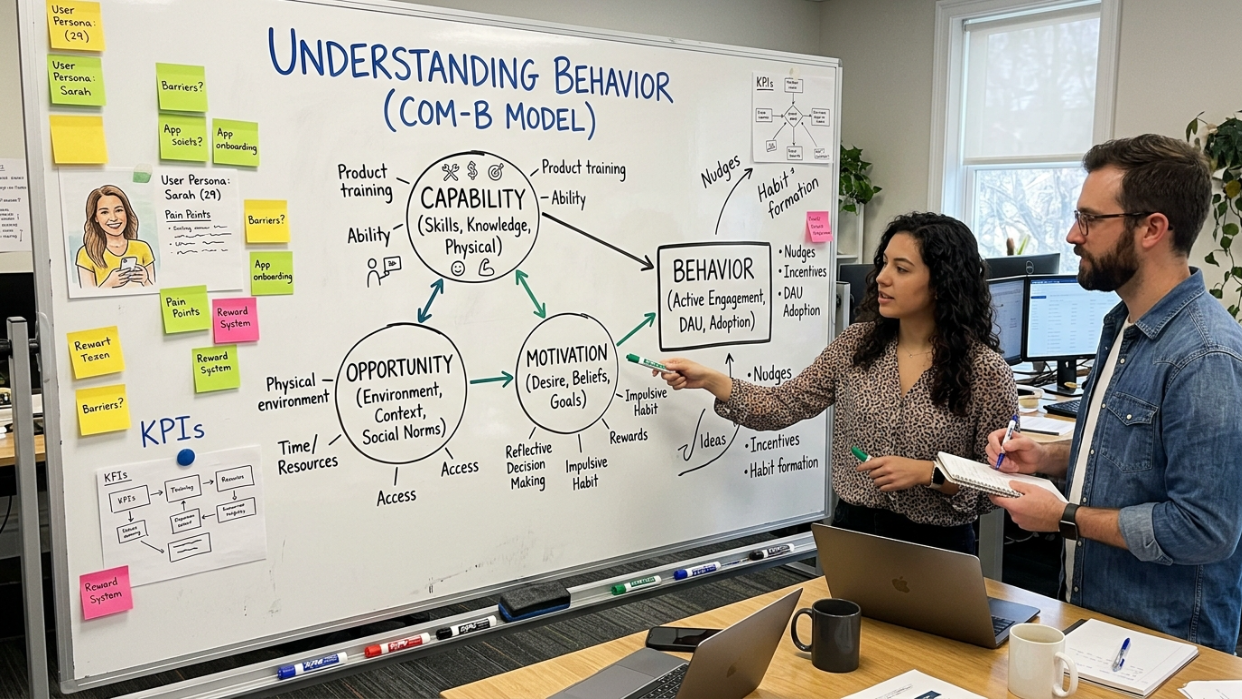
Core idea: Behavior (B) occurs when three conditions converge: Capability ©, Opportunity (O), and Motivation (M).
The COM-B model is the hub of the Behaviour Change Wheel (BCW), which synthesizes 19 prior behavior change frameworks into a single system. Around the COM-B core sit nine intervention functions (Education, Persuasion, Incentivisation, Coercion, Training, Restriction, Environmental Restructuring, Modeling, and Enablement) and seven policy categories for implementing them.
Why it matters for marketers: COM-B is the “know how, can do, want to” of behavior change. It forces you to diagnose which factor is actually blocking the behavior before you design a campaign. As the UK College of Policing puts it: just as a doctor wouldn’t prescribe treatment without a diagnosis, professionals seeking to address behavioral problems need to find out what underlies them before designing interventions.
Real-world result: A physical activity campaign in Portugal (“Follow the Whistle”) used COM-B to design its intervention and saw campaign recall jump from 1% to 24%.
Limitation: Academic in origin and can feel complex to operationalize without behavioral science training.
Behavioral Diagnosis Checklist (COM-B Applied)
Use this checklist before designing any campaign:
Factor | Key Question | Example Barrier |
|---|---|---|
Capability | Do people know how to perform the behavior? | Confusion about product use |
Opportunity | Is the behavior physically/socially possible? | No access, high cost |
Motivation | Do people want or feel compelled to act? | Low perceived value |
Fogg Behavior Model (B=MAP)
Creator: BJ Fogg, Stanford University
Core idea: Behavior (B) = Motivation (M) × Ability (A) × Prompt (P). All three must be present at the same moment for a behavior to occur.
Fogg’s model is elegant in its simplicity. If someone doesn’t act, one of three things is missing: they’re not motivated enough, it’s too hard, or there was no trigger at the right time. The model further distinguishes three prompt types: Sparks (which boost motivation), Facilitators (which reduce friction), and Signals (which serve as reminders).
Why it matters for marketers: This is the go-to framework for UX, digital marketing, and conversion optimization. Practitioners on Reddit frequently cite Fogg when discussing why users abandon checkout flows or ignore CTAs. One product designer noted that “the single biggest ROI move is almost always reducing friction, not increasing motivation.”
Limitation: Fogg is praised for clarity but falls short in explaining long-term, sustained behavior change. It’s better at triggering a single action than building a habit over months.
Transtheoretical Model (TTM) / Stages of Change
Creator: James Prochaska and Carlo DiClemente
Core idea: People move through five stages of readiness: Precontemplation (not even thinking about changing), Contemplation (thinking about it), Preparation (getting ready), Action (doing it), and Maintenance (sustaining it).
Why it matters for marketers: TTM is the best framework for audience segmentation by behavioral readiness. The critical insight, one that practitioners across YouTube walkthroughs and behavioral design forums emphasize repeatedly, is this: roughly 40% of a typical target population sits in the precontemplation stage at launch. They haven’t decided to change. They’re not even thinking about it. Designing a campaign that assumes people are ready to act means you’re talking past the majority of your audience.
This framework matters enormously for brand activation strategy, where understanding where your audience sits on the readiness spectrum determines whether you need awareness content, consideration content, or a direct call to action.
Limitation: The model implies a somewhat linear progression, when in reality people cycle back and forth between stages.
MINDSPACE Framework
Creator: UK Behavioural Insights Team (“Nudge Unit”), Dolan et al. (2012)
Core idea: Nine principles that influence behavior through subconscious cues and social context:
Messenger: who communicates matters
Incentives: we respond to rewards and losses
Norms: we follow what others do
Defaults: we stick with pre-set options
Salience: what’s novel or relevant grabs attention
Priming: subconscious cues shape our actions
Affect: emotions drive decisions
Commitments: public promises increase follow-through
Ego: we act to feel good about ourselves
Why it matters for marketers: MINDSPACE gives you a checklist of nine psychological principles to apply when designing campaigns, messaging, or choice environments. It’s particularly strong for ethical nudging in sustainability and social impact contexts, where the goal is to make the better choice feel natural rather than forced.
Limitation: Originally designed for government policy. Needs adaptation for brand and retail contexts.
EAST Framework
Creator: UK Behavioural Insights Team
Core idea: Make the desired behavior Easy, Attractive, Social, and Timely.
EAST is the simplest and most immediately actionable behavior change framework for marketing. It’s a design checklist: is your desired action easy to do? Is it presented attractively? Does social proof support it? Is the prompt delivered at the right moment?
One practitioner agency extends EAST with “Contextual” and “Relative” to create the CATERS mnemonic, though the core four principles cover most marketing applications. EAST translates directly to retail environments, e-commerce UX, and retail activation where reducing friction at the point of sale is everything.
Limitation: More descriptive than diagnostic. EAST tells you what good interventions look like, but it doesn’t help you figure out why the behavior isn’t happening in the first place.
CASE Framework
Creator: Nedra Weinreich
Core idea: Context, Appealing, Social, Easy. Designed specifically for social marketing campaigns.
CASE overlaps with EAST but adds explicit attention to context, the physical, cultural, and environmental factors surrounding the behavior. It’s useful for campaigns where the setting matters as much as the message, like community health initiatives or local sustainability programs.
Limitation: Less widely cited than COM-B or Fogg. Better suited to social marketing than commercial brand campaigns.
Cialdini’s Six Principles of Influence
Creator: Robert Cialdini
Core idea: Six principles that drive persuasion: Liking, Reciprocity, Authority, Commitment/Consistency, Social Proof, and Scarcity.
Cialdini’s principles aren’t a behavior change process model. They’re influence mechanisms. But they’re foundational to marketing practice and show up inside nearly every other framework on this list (social proof in MINDSPACE, commitment in EAST, etc.).
Why it matters for marketers: These principles work in any marketing context, from email subject lines to sustainability messaging. They’re particularly relevant when combined with a diagnostic framework like COM-B.
Limitation: Influence principles tell you how to make a message more persuasive. They don’t tell you whether persuasion is the right intervention or whether structural barriers need to be addressed first.
Behavioral Determinants Framework (BDF)
Creator: Marketing for Change (since 2005)
Core idea: Divides direct influences on behavior into 12 categories, overlaying foundational theories from social psychology and behavioral economics onto marketing challenges.
BDF is less well-known than COM-B or Fogg but useful for practitioners who want a more granular diagnostic tool. It’s particularly strong for campaigns targeting complex, multi-factor behaviors.
Framework Comparison Table
Framework | Core Elements | Best For | Key Limitation |
|---|---|---|---|
COM-B / BCW | Capability, Opportunity, Motivation → Behavior | Diagnosing why a behavior isn’t happening | Can be complex to operationalize |
Fogg B=MAP | Motivation, Ability, Prompt | UX, digital marketing, conversion optimization | Weak on long-term sustained change |
TTM (Stages of Change) | 5 stages: Precontemplation → Maintenance | Segmenting audiences by readiness | Implies linear progression |
MINDSPACE | 9 nudge principles | Campaign design, ethical nudging | Originally for policy, needs brand adaptation |
EAST | Easy, Attractive, Social, Timely | Simplifying interventions, retail/POS | Descriptive, not diagnostic |
CASE | Context, Appealing, Social, Easy | Social marketing campaign strategy | Less widely cited |
Cialdini’s 6 | Liking, Reciprocity, Authority, Commitment, Social Proof, Scarcity | Persuasion across any context | Not a behavior change process |
BDF | 12 behavioral influence categories | Granular behavioral diagnosis | Less mainstream adoption |
How to Choose the Right Behavior Change Framework
Start with Diagnosis, Not Execution
The most common mistake is jumping straight to campaign tactics. Before choosing an intervention framework, you need to understand why the behavior isn’t happening. COM-B is the strongest diagnostic tool here. Run your audience through the Capability, Opportunity, and Motivation lens first.
Do people lack the knowledge or skills to act? That’s a Capability problem. Is the behavior physically or socially inaccessible? That’s an Opportunity problem. Do they lack the desire, confidence, or habit formation to follow through? That’s Motivation.
This approach aligns with human-centered marketing, which starts with the audience’s reality rather than the brand’s assumptions.
Match Framework to Problem Type
Once you’ve diagnosed the barrier, pick the framework that addresses it:
Awareness or readiness gap? Use TTM to segment your audience by stage and tailor your messaging accordingly.
Friction or complexity problem? Use Fogg’s B=MAP to identify where ability is too low or prompts are missing.
Motivation or social norm problem? Use MINDSPACE to design nudges that shift subconscious cues.
Execution and design problem? Use EAST to pressure-test whether your intervention is easy, attractive, social, and timely.
Layer Frameworks for Maximum Effect
The most sophisticated practitioners don’t pick one framework. They layer them. The pattern that shows up repeatedly in behavioral design communities is:
COM-B for diagnosis (what’s blocking the behavior?)
TTM for segmentation (where is each audience segment on the readiness spectrum?)
EAST or MINDSPACE for execution (how do we design the intervention?)
This layered approach is absent from most published guides but reflects how behavior change actually works in practice. For a deeper look at turning these frameworks into a working strategy, explore behavior change marketing strategy.
Want to diagnose your brand’s specific behavioral barriers? Talk to our team about applying these frameworks to your marketing challenges.
How to Choose the Right Behavior Change Framework (Decision Guide)
Problem Type | Best Framework | Why |
|---|---|---|
Low awareness or readiness | Transtheoretical Model (TTM) | Identifies stage of change |
High friction or complexity | Fogg’s B=MAP | Identifies ability barriers |
Poor engagement or motivation | MINDSPACE | Targets subconscious drivers |
UX or conversion issues | EAST | Optimizes ease and timing |
Deep behavioral diagnosis | COM-B | Identifies root cause |
Behavior Change Frameworks in Sustainability Marketing

The Intention-Action Gap Is Sustainability’s Biggest Problem
Sustainability marketing sits at the epicenter of the intention-action gap. Consumers overwhelmingly say they care, but the effort required to buy sustainable products, whether that’s higher prices, less convenient availability, or confusing claims, outweighs the perceived benefits. This creates a stumbling block that no amount of awareness messaging can overcome alone.
The founder of Supergoods captured the shift that’s needed: instead of trying to educate people out of the gap, design your way around it. This means treating the intention-action gap as a design problem, not a communication problem. For brands struggling with this exact challenge, why sustainability intentions don’t translate to action provides a detailed breakdown.
What the BSR Research Proved
BSR’s Sustainable Lifestyles Frontier Group, which included AT&T, eBay, Johnson & Johnson, McDonald’s, and Walmart, partnered with Futerra and Stanford to test behavior change messaging in real market conditions. The findings were counterintuitive for many sustainability marketers:
AT&T discovered that the most effective messaging focused on benefits like security and control over one’s home, not carbon footprint reduction. The sustainability benefit worked as a value-add, not the primary selling point.
eBay and Johnson & Johnson found that when their communications helped consumers be more sustainable, those messages also improved consumers’ perception of the brands. In other words, behavior change and brand building reinforced each other.
The consistent finding across all participants: if you put any friction in the way, you create barriers to purchase. The behavior change framework for marketing that works in sustainability isn’t about better facts. It’s about removing obstacles and framing sustainable choices through benefits people already care about.
The Implication for Brands
Sustainability marketing that relies on guilt, fear, or information overload is not behavior change marketing. It’s awareness marketing dressed up as something more. The frameworks described in this article give brand teams the tools to move past awareness and into actual behavioral intervention, which is where impact measurement becomes essential to prove that campaigns are driving real change, not just impressions.
Common Mistakes When Applying Behavior Change Frameworks
Mistake 1: Confusing Awareness with Behavior Change
This is the most pervasive error. Education and awareness alone do not lead to behavior change. Peer-reviewed research consistently shows that knowing something is important does not translate to doing it. If your KPIs are awareness and recall but your goal is behavior change, you’re measuring the wrong thing.
Mistake 2: Using Commercial Marketing Tactics for Behavior Change Problems
Commercial marketing assumes demand exists and competes for it. Behavior change marketing assumes the desired behavior isn’t happening and creates conditions for it. The strategies, metrics, and timelines are fundamentally different. Running a standard brand campaign and calling it behavior change is a recipe for failure, and it risks greenwashing accusations if sustainability claims aren’t backed by measurable behavioral outcomes.
Mistake 3: Skipping the Behavioral Diagnosis
Jumping to a creative brief without first diagnosing the behavioral barrier is like prescribing medication without an examination. COM-B’s “behavioral diagnosis” step exists precisely because most behavior change failures trace back to misidentified root causes. Marketers often assume the problem is motivation when it’s actually capability or opportunity.
Mistake 4: Ignoring Structural Barriers
The Vermont nutrition program story bears repeating. The materials were excellent. The messaging was sound. But people couldn’t use food stamps at farmers’ markets. No amount of creative excellence overcomes a structural barrier like access, cost, or convenience.
Mistake 5: Treating Behavior Change as an Event
Many programs fail because they don’t account for the fact that behavior change is a journey, not a single conversion moment. The TTM model makes this explicit: people cycle through stages, sometimes regressing before progressing. A single campaign touchpoint is rarely enough. Building sustained behavior change requires ongoing engagement, reinforcement, and structural support over time.
Related Terms
Social marketing: Using marketing principles to influence behaviors that benefit individuals and communities, not just sell products.
Nudge theory: Designing choice environments so that the desired behavior becomes the path of least resistance, without restricting options.
Behavioral economics: The study of how psychological, social, and emotional factors affect economic decisions.
Intention-action gap (say-do gap, value-action gap): The measurable difference between what people say they’ll do and what they actually do. Learn more about closing the intention-action gap.
Choice architecture: The practice of designing how choices are presented to influence decisions.
Cause marketing: Brand partnerships with social or environmental causes to drive mutual benefit.
Ready to apply behavioral science to your brand’s biggest challenges? Grounded World specializes in diagnosing the intention-action gap and building marketing strategies that drive real behavior change. Start a conversation about what’s possible for your brand.
Frequently Asked Questions
What is a behavior change framework for marketing?
A behavior change framework for marketing is a structured model from behavioral science that helps marketers understand why people don’t act on their intentions and design campaigns or interventions that address the actual barriers. Rather than relying on persuasion alone, these frameworks diagnose whether the problem is motivation, ability, opportunity, timing, or some combination.
Which behavior change framework is best for marketing?
There is no single best framework. COM-B is the strongest for diagnosing why a behavior isn’t happening. Fogg’s B=MAP excels in digital and UX contexts. TTM is best for segmenting audiences by readiness. EAST and MINDSPACE are strongest for designing interventions. The most effective approach layers multiple frameworks: COM-B for diagnosis, TTM for segmentation, and EAST or MINDSPACE for execution.
How is behavior change marketing different from regular marketing?
Commercial marketing assumes people already want the product and focuses on capturing demand through awareness, positioning, and conversion. Behavior change marketing assumes the desired behavior isn’t happening and focuses on identifying and removing the barriers, whether those are psychological, structural, social, or environmental.
What is the intention-action gap and why does it matter?
The intention-action gap is the measurable difference between what consumers say they’ll do and what they actually do. In sustainability, 65% of consumers say they want to buy sustainable brands, but only 26% follow through. This gap is the central problem that behavior change frameworks for marketing are designed to solve.
Can behavior change frameworks work for commercial brands, not just public health?
Yes. BSR’s research with AT&T, eBay, Johnson & Johnson, McDonald’s, and Walmart demonstrated that behavior change frameworks produce measurable results in commercial settings. One of the largest insurers reportedly realized $30 million in annual revenue from a dedicated behavioral science practice. These frameworks apply anywhere you need to move people from intention to action.
How long does behavior change marketing take to work?
Behavior change is a process, not an event. The Transtheoretical Model shows that people cycle through stages of readiness over weeks, months, or even years. Campaigns should be designed for sustained engagement rather than single-touchpoint conversion. Quick wins are possible (especially with friction reduction), but lasting shifts require ongoing reinforcement.
What’s the biggest mistake marketers make with behavior change?
Assuming that giving people more information will change their behavior. Research consistently shows that awareness and knowledge do not reliably translate to action. The biggest gains come from removing structural and psychological barriers, not from better facts or more compelling arguments.
How do I get started with a behavior change framework for marketing?
Start with a behavioral diagnosis using COM-B. Map your target behavior against Capability (do people know how?), Opportunity (can they do it?), and Motivation (do they want to?). Then segment your audience using TTM to understand their readiness. Finally, design your intervention using EAST or MINDSPACE principles. If you need help with this process, Grounded World offers a complimentary 5C assessment to identify where your audience is getting stuck.