

 Gaia
GaiaTL;DR
Purpose driven storytelling is the practice of building brand narratives around a mission that goes beyond profit, connecting audiences emotionally to the positive change a brand exists to create. It differs from generic brand storytelling by anchoring every narrative choice in social or environmental values. When done with authenticity and backed by real action, it builds trust, drives purchase intent, and closes the gap between what consumers say they want and what they actually buy.
Every brand has a story. Most of those stories are forgettable. They talk about product features, founding dates, and vague commitments to “making the world a better place.” Purpose driven storytelling is something different. It starts with a genuine reason for existing beyond revenue, then uses narrative craft to make that reason felt.
The difference matters more than ever. According to Edelman’s 2024 Trust Barometer, 84% of global consumers say they must share values with a brand before they will buy from it, while 60% actively buy or boycott based on a brand's societal stance. Story is how trust gets built.
This article breaks down what purpose driven storytelling actually means, what separates it from greenwashing, and how to build stories that hold up under scrutiny.
Looking for expert help building your purpose driven narrative? Talk to our team.
What Is Purpose-Driven Storytelling?
Purpose-driven storytelling is a brand communication approach that uses stories to communicate an organization's social, ethical, or environmental mission. It connects that mission to real people, meaningful challenges, and verifiable actions, helping audiences understand not only what a brand stands for but also how it puts its values into practice.
Unlike traditional brand storytelling, which may focus on a company's history, products, or customer experience, purpose-driven storytelling centers on a mission beyond profit. Its credibility depends on the connection between what a brand says, what it does, and the impact it can demonstrate.
The key principle: A compelling purpose-driven story combines a meaningful mission, a human-centered narrative, and credible evidence of real-world action.
What Is Purpose Driven Storytelling?
Purpose driven storytelling is the practice of crafting brand narratives around a core mission, using story structure to build emotional connections between audiences and the positive impact a brand aims to create. It goes beyond product features and promotional messaging to communicate values, commitments, and real-world outcomes.
The key word is “purpose.” In this context, purpose means the reason a brand exists beyond making money. It encompasses core values, mission, and the specific change the organization wants to see in the world.
Three things separate purpose driven storytelling from standard brand storytelling:
The narrative anchor is a social or environmental commitment, not a product benefit or brand heritage moment.
The audience is invited into the story as a participant, not positioned as a passive consumer.
Claims require proof. A purpose narrative that can’t point to measurable outcomes isn’t storytelling. It’s marketing fiction.
Standard Storytelling vs. Purpose Driven Storytelling
Feature / Metric | Standard Brand Storytelling | Purpose Driven Storytelling |
Primary Focus | Product features, heritage, or user lifestyle | Social, ethical, or environmental mission |
Customer Role | Passive consumer or buyer | Active participant in a movement |
Narrative Hero | The brand, founder, or product | The community, beneficiaries, or customer |
Proof Required | Product specs, reviews, testimonials | Certified impact data, audits, public reports |
Primary Goal | Awareness, immediate sales, brand preference | Trust, shared values, systemic behavior change |
This distinction is practical, not theoretical. A heritage whiskey brand telling the story of its 200-year distilling tradition is doing brand storytelling. A chocolate company telling the story of how it’s fighting slavery in the cocoa supply chain, and showing you the audit data to prove it, is doing purpose driven storytelling.
How Does Purpose-Driven Storytelling Work?

Purpose-driven storytelling connects a brand's mission to an audience's values through a narrative grounded in real actions and measurable outcomes. Rather than simply announcing what a company believes, it shows why the mission matters, who is affected, and how the organization contributes to change.
The process typically follows six steps:
Define the purpose. Identify the specific social, ethical, or environmental issue the brand is committed to addressing.
Understand the audience. Research what the audience cares about, what it doubts, and what might prevent it from acting.
Find the human story. Identify real people, communities, or experiences that illustrate the issue without exploiting the people involved.
Connect the story to action. Explain what the brand is doing, how its products or operations support the mission, and what role the audience can play.
Substantiate the claims. Support statements with relevant data, documented initiatives, independent verification where appropriate, and transparent explanations of limitations.
Measure and improve. Evaluate whether the story increases understanding, credibility, engagement, or desired behavior, then refine the message based on the results.
For example, a clothing brand committed to reducing textile waste could tell the story of how garments are collected, repaired, and resold. Rather than relying on a broad claim such as "better for the planet," it could show the process, disclose how much clothing was diverted from disposal, explain how that figure was calculated, and identify what still needs improvement.
The result is a story that makes the brand's purpose tangible. The mission explains why the work matters, the narrative makes it relatable, and the evidence helps audiences assess whether the brand is following through.
Core Elements of Purpose Driven Storytelling
Analysis of how the most effective purpose driven campaigns are built reveals five recurring elements.
Element | Key question | What good execution looks like |
|---|---|---|
Authenticity | Does the story reflect what the organization actually does? | The narrative matches operational practices and acknowledges gaps. |
Clear purpose | Is the mission specific enough to guide decisions? | The organization identifies a defined issue and a credible role in addressing it. |
Human-centered narrative | Whose experience makes the issue understandable? | Real people are represented accurately, respectfully, and with appropriate consent. |
Conflict and resolution | What challenge is the story helping audiences understand? | The narrative explains the problem, the organization's contribution, and what remains unresolved. |
Evidence and impact | What can the organization substantiate? | Claims are supported by relevant records, transparent methods, and independent verification where appropriate. |
Authenticity
Audiences spot insincerity quickly. Practitioners on Reddit’s r/marketing and r/sustainability forums consistently flag “performative purpose” as the fastest way to destroy brand credibility. A survey from HubSpot found that 88% of buyers globally say brand trust is as important as price and quality. Authenticity isn’t a nice-to-have. It’s the structural foundation.
Authenticity means your purpose narrative reflects what the organization actually does, not an idealized version of what it aspires to be someday.
Clear Values and Mission
A compelling purpose driven story starts with a precise understanding of the brand’s values and mission. These should drive the narrative and inform every aspect of communication. Vague statements like “we care about the planet” don’t count. Specific commitments like “we donate 50% of profits to sanitation infrastructure” do.
Human-Centered Narratives
The best purpose stories focus on individuals and communities, not logos and executives. When Dove launched its “Real Beauty” campaign, the protagonists were real women, not the brand itself. This human-centered approach helps audiences connect with the cause rather than the company.
The principle here is straightforward: people remember people. They forget corporate messaging.
Conflict and Resolution
Every good story needs tension. Purpose driven storytelling is no different. It should highlight the challenges faced (the injustice, the environmental crisis, the systemic problem) and show how the brand’s actions contribute to a positive outcome. Without conflict, you have a press release, not a story.
Evidence and Measurable Impact
Promises alone aren’t enough. Brands must show tangible results, whether through impact reports, third-party certifications, or verified testimonials. Stories are 22 times more memorable than facts alone, but the facts still need to exist behind the story.
For a deeper look at how these elements combine into a sustainability storytelling strategy, that guide covers the full framework.
Purpose-Driven Storytelling vs. Greenwashing vs. Storywashing
These three approaches differ in how a brand's narrative relates to its actual practices and evidence.
Approach | What it means | Example | Key warning sign |
|---|---|---|---|
Purpose-driven storytelling | Communicating a genuine mission through human-centered stories and substantiated claims. | A clothing company documents its repair program, reports the number of garments repaired, and explains its limitations. | The story must continue to match the company's actions and results. |
Greenwashing | Creating a misleading impression about a product or organization's environmental performance. | A company uses broad environmental claims without evidence or presents a limited improvement as proof that an entire product is environmentally friendly. | Vague, exaggerated, unsubstantiated, or misleading environmental claims. |
Storywashing | Using compelling purpose-led narratives to create a favorable impression that is not adequately supported by the organization's practices or results. | A company highlights a small community initiative while omitting relevant evidence of harmful practices elsewhere in its operations. | The narrative emphasizes positive intentions while obscuring material contradictions or limitations. |
The distinction is between a story that communicates substantiated action and a story that creates an impression the evidence does not justify. Greenwashing generally concerns misleading environmental claims, while storywashing can involve broader social, ethical, and organizational narratives.
A credible purpose-driven story does not need to portray a perfect organization. It needs to accurately communicate what the organization is doing, what the evidence shows, and where meaningful work remains.
Purpose Driven Storytelling vs. Greenwashing and Storywashing
This is where most brands get into trouble. Understanding the boundary between genuine purpose storytelling and its counterfeits is not optional.
Greenwashing is making misleading environmental claims. A bottled water company marketing its product in green packaging with “100% eco-friendly” on the label, while the bottle is made from virgin plastic, is greenwashing. The claim is false or deliberately misleading.
Storywashing is subtler and arguably more dangerous. It means telling inspiring, values-driven stories that don’t match reality. The stories themselves might not contain outright lies, but they obscure a gap between brand messaging and actual operations. A fast-fashion company producing a beautiful documentary about sustainable cotton farming while its supply chain relies on exploitative labor is storywashing.
Brand strategist Stef Hamerlinck captured the tension well on his podcast: purpose-driven brand language often becomes “so floaty that it’s hard to see what you mean,” and many “purpose-driven” brands are, in his words, “BS.” That’s a real risk. The barrier to consumer trust isn’t cynicism about sustainability itself. Most people genuinely want to make better choices. The barrier is distrust generated by decades of greenwashing.
Three safeguards keep purpose storytelling credible:
Operational consistency. Stories must reflect the organization’s real values. Consistency between words and actions is the foundation of credibility.
Third-party verification. Back claims with certifications, independent audits, and published impact data, not just self-reported metrics.
Humanize the proof. The protagonists of your story shouldn’t only be executives. Feature employees, beneficiaries, communities, and partners who live that purpose every day.
For practical guidance on navigating these risks, this explainer on how to avoid greenwashing breaks down the most common traps.
The Intention-Action Gap: Where Storytelling Meets Behavior Change
Here’s the uncomfortable truth about purpose and sustainability. Harvard Business Review research showed that 65% of consumers said they wanted to buy purpose-driven sustainable brands, but only about 26% actually followed through. That 39-point gap between intention and action is not evidence that people don’t care. It’s evidence that caring isn’t enough to change behavior.
This is where purpose driven storytelling becomes more than a communications exercise. It becomes a behavior change tool.
Most sustainability messaging asks consumers to make sacrifices: pay more, accept less convenience, do research. That approach forces people to burn cognitive calories, and they opt out. Purpose driven storytelling works differently. It makes the sustainable choice feel desirable, normal, and easy. It wraps the right decision in a narrative that feels rewarding rather than dutiful.
Consider the data: purpose-driven ads achieve 38% higher unaided brand recall and 44% higher message association scores compared to product-feature-led executions. When people perceive a brand as purposeful, their likelihood of buying jumps 1.4 times. The story doesn’t just communicate values. It changes the decision-making context.
The intention-action gap is arguably the single most important concept for any brand trying to commercialize sustainability. Purpose driven storytelling is one of the primary mechanisms for closing it.
How to Measure the Effectiveness of Purpose-Driven Storytelling
Purpose-driven storytelling should be measured by more than views, likes, or positive comments. A campaign can attract attention without improving understanding, strengthening trust, or changing behavior.
The right metrics depend on the campaign's objective, the audience, and the action the organization wants to encourage.
Measurement goal | Useful metrics | What to look for |
|---|---|---|
Awareness | Reach, impressions, branded search volume, aided and unaided recall | Whether more people recognize the brand or remember its message. |
Understanding | Message comprehension, purpose association, survey responses | Whether audiences correctly understand the mission and the brand's role in it. |
Trust and credibility | Brand trust surveys, perceived authenticity, claim credibility | Whether audiences consider the story believable and supported by evidence. |
Engagement | Meaningful comments, shares, video completion, resource downloads | Whether audiences engage with the story beyond passive exposure. |
Consideration and behavior | Purchase consideration, sign-ups, donations, participation, conversion rate | Whether the campaign contributes to the action it was designed to encourage. |
Long-term impact | Repeat participation, customer retention, progress against impact targets | Whether behavioral and organizational outcomes persist over time. |
A practical measurement process
1. Define the intended outcome. Decide whether the campaign is intended to increase awareness, improve understanding, strengthen trust, encourage purchases, or support a measurable social or environmental outcome.
2. Establish a baseline. Measure the relevant metric before the campaign begins. Where possible, use comparable audiences, historical data, or a control group.
3. Track the right indicators. Combine audience research with behavioral and operational data. Engagement metrics can indicate interest, but they do not independently demonstrate trust or real-world impact.
4. Evaluate the contribution of the story. Use campaign experiments, comparison groups, or other appropriate methods to distinguish the effect of the storytelling from other factors, such as pricing, distribution, product changes, or media spending.
5. Report results transparently. Share what improved, what did not, and what the evidence can and cannot establish. Separate marketing outcomes from the actual social or environmental impact of the initiative.
The goal is not to prove that every story generates an immediate sale. It is to determine whether the narrative helps audiences understand the mission, assess the brand's credibility, and take the intended next step.
Grounded World specializes in diagnosing and closing this gap. See how we activate brand purpose.
How to Build a Purpose Driven Story: Frameworks That Work
You don’t need to invent your own structure from scratch. Several proven frameworks exist, and the best purpose driven stories tend to draw from more than one.
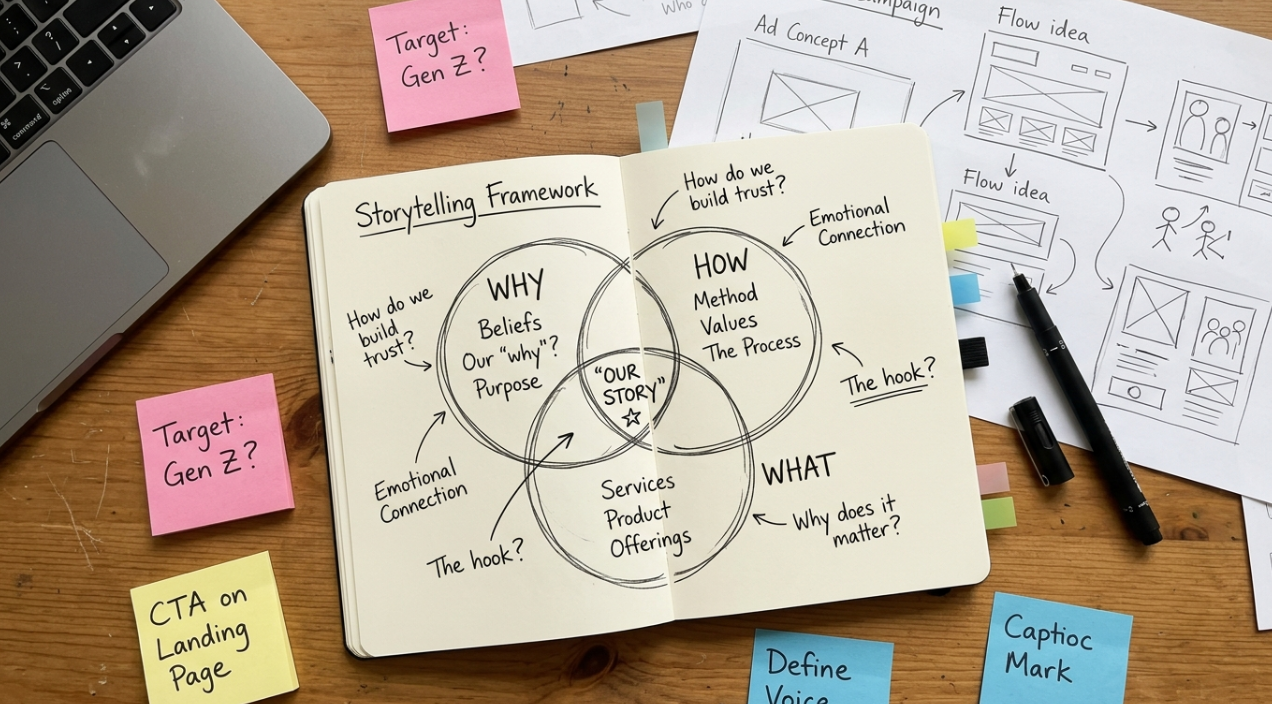
Simon Sinek’s Golden Circle
Start with Why, then move to How, then What. The Why is your purpose, the deeper reason the brand exists beyond making money. The How covers your unique methods or values. The What is your actual product or service. Most brands communicate in reverse order. Flipping it forces purpose to the front of every message.
Donald Miller’s StoryBrand Framework
StoryBrand positions the customer as the hero, not the brand. The seven-part structure: a Character (the customer) faces a Problem, meets a Guide (your brand) who provides a Plan, calls them to Action, leading to Success while avoiding Failure.
This framework matters especially for purpose driven storytelling because one of the most common mistakes is making the brand the hero of its own impact story. People want to participate in something larger than themselves. They don’t want to watch a brand congratulate itself.
Bernadette Jiwa’s Story-Driven Framework
This framework moves through five stages: Backstory (your journey to now), Values (your guiding beliefs), Purpose (your reason to exist), Vision (your aspiration for the future), and Strategy (the alignment of opportunities, plans, and behavior). It’s particularly useful for founders and nonprofits building their narrative for the first time.
Proven Narrative Frameworks at a Glance
Framework | Core Concept | Best Used For |
Simon Sinek’s Golden Circle | Start with Why (Purpose), then How, then What. | Defining overall brand identity and mission statements. |
Donald Miller’s StoryBrand | Position the customer as the hero and the brand as the guide. | Campaign copy, landing pages, and customer messaging. |
Bernadette Jiwa’s Story-Driven | 5-stage alignment: Backstory, Values, Purpose, Vision, Strategy. | Founders, early-stage startups, and non-profits building identity. |
Practical Application
These frameworks give you structure. Execution requires translating that structure into campaigns, retail experiences, content, and stakeholder communications. For a step-by-step approach to turning strategy into action, this guide to brand activation strategy covers the activation side.
Purpose-Driven Storytelling Template
Use this template to develop a purpose-driven story for a brand campaign, website, social media post, video, or sustainability report.
1. Our purpose
What specific issue are we committed to addressing, and why does it matter to our organization?
Template: We exist to help address [specific issue] because [reason this issue matters to the people or communities affected].
2. The human challenge
Who is affected by this issue, and what challenge, need, or barrier do they experience?
Template: For [audience or community], [specific challenge] affects [relevant aspect of daily life, access, opportunity, or well-being].
3. Our role
What are we doing to address the challenge, and how does that action connect to our purpose?
Template: We are working to address this challenge by [specific action], using [relevant resources, expertise, partnerships, or operational changes].
4. The evidence
What can we demonstrate today? Include the measurement period, relevant baseline, source, and limitations where applicable.
Template: Between [start date] and [end date], we [documented outcome]. This result is based on [data source or measurement method]. It demonstrates [supported conclusion], while [remaining limitation or challenge] still needs attention.
5. The audience's role
How can customers, employees, partners, or communities participate meaningfully?
Template: You can participate by [specific action]. This contributes to [clearly explained outcome], although the overall impact also depends on [relevant conditions or limitations].
6. The next milestone
What will the organization do next, and how will progress be reported?
Template: By [date], we aim to [specific target]. We will report progress through [public report, progress update, or measurement process].
Final credibility check
Before publishing, confirm that the story:
Reflects an actual organizational commitment.
Represents the people involved accurately and respectfully.
Distinguishes completed results from future targets.
Uses evidence that supports the specific claims being made.
Discloses important limitations rather than implying that one initiative solves an entire problem.
Real-World Examples of Purpose Driven Storytelling
Theory only gets you so far. Here’s how five brands turned purpose into narrative that actually worked.
Patagonia: “Don’t Buy This Jacket”
Patagonia’s 2011 Black Friday campaign confronted head-on the conflict between its profit goals and its environmental commitments. The ad ran in the New York Times, asking consumers not to buy something. The honesty was disarming. Sales surged by nearly 30% in 2012. The story worked because it demonstrated real tension between business and values, and it trusted the audience to engage with that complexity.
Dove: Real Beauty
Dove transformed from a functional soap brand into a movement for body positivity. The “Real Beauty” campaign featured real women instead of models and challenged beauty industry norms. The shift wasn’t cosmetic. It reshaped how the brand developed products, chose ambassadors, and communicated across every channel.
Tony’s Chocolonely
Tony’s Chocolonely exists to end slavery in the cocoa industry. That’s not a marketing tagline. It’s the business model. Their bold packaging, transparent supply chain reporting, and educational campaigns make customers feel like co-conspirators in the fight. The unequal bar segments are designed to represent inequality in the chocolate industry. Every design choice tells the story.
Who Gives A Crap
This brand proves that purpose driven storytelling doesn’t have to be serious. Who Gives A Crap makes sustainable toilet paper with witty, irreverent marketing and donates 50% of profits to sanitation charities. The humor makes the product shareable, the donation model makes it meaningful, and the combination makes it sticky.
Warby Parker
The origin story hooks you immediately: a grad student lost his glasses on a trip and couldn’t afford replacements. The founders discovered that one company controlled the eyewear industry and kept prices artificially high. Warby Parker’s narrative is about democratizing access to something essential while giving back through its buy-one-give-one program.
For more examples of what works and what doesn’t, this collection of purpose driven marketing examples covers a broader range.
Purpose Driven Storytelling in 2026: Navigating AI Overviews and Brand Skepticism
By 2026, generative AI tools allow any organization to generate "inspiring" brand messaging in seconds. As AI-generated content floods digital channels, consumer skepticism toward corporate mission statements is at an all-time high.
To stand out in modern search engine AI overviews and maintain audience trust, your storytelling strategy must integrate three key principles:
First-Party Proof Points (E-E-A-T): Search engines prioritize direct Experience, Expertise, Authoritativeness, and Trustworthiness. Generic claims will be ignored by search crawlers. Include primary raw data, original photos, employee interviews, and direct supply-chain audits.
Transparent Progress Tracking: Audiences no longer expect perfection; they demand transparency. Narratives that highlight ongoing challenges, unmet targets, and honest roadmaps perform significantly better than flawless corporate declarations.
Interactive Impact Experience: Static text is easily summarized and replaced by search engine summaries. Incorporate visual impact dashboards, interactive supply chain maps, or dynamic carbon offset calculators to engage users directly on your site.
Common Mistakes to Avoid
Purpose driven storytelling fails in predictable ways. Knowing the patterns helps you avoid them.
Vague purpose statements. “We believe in making the world a better place” means nothing. A purpose statement should be specific enough that someone could disagree with it. If no one could possibly object, it’s probably too generic to drive a real story.
Making the brand the hero. When the brand becomes the protagonist of its own impact story, audiences disengage. The StoryBrand principle applies doubly here: position the customer or community as the hero and the brand as the guide. Patagonia doesn’t position itself as the savior of the planet. It positions its customers as people who make intentional choices.
Emotion without purpose. For years, storytelling was synonymous with emotional appeal. Today, emotion without substance falls flat. Audiences are more critical and can tell when a story is designed to make them feel something without actually saying anything. 95% of purchasing decisions are subconscious and emotionally driven, but the emotion needs to be anchored to something real.
Purpose without proof. Storytelling disconnected from measurable impact invites accusations of purpose-washing. If you can’t point to an impact report, a certification, or a verifiable outcome, you’re asking for trust you haven’t earned. This connects directly to the sustainability claims challenge that many brands struggle with.
Burning cognitive calories. Donald Miller’s phrase captures a critical error: making the audience work too hard to understand what you stand for. If your purpose story requires a 10-minute explainer video before it makes sense, it won’t travel. Simplicity is not dumbing down. It’s a discipline.
The Commercial Case for Purpose Driven Storytelling
Some readers still need the business case. Here it is.
Brands that use storytelling effectively can see conversion rates increase by 30%. According to research from Brandesis, 68% of consumers say brand stories directly influence their purchasing decisions. And 36% of CMOs who have successfully communicated their brand through stories say brand purpose work is absolutely essential for identifying the core story.
This isn’t soft metrics. Research from Kantar shows that brands with a high perceived positive impact grow their brand value at double the rate of brands without it. Emotional connection can drive up to 8x more visits and sales. And 77% of CMOs who’ve built successful brand narratives use purpose-driven updates to keep their story relevant over time.
The commercial logic is simple: trust drives buying, story builds trust, and purpose gives the story something worth trusting.
Related Terms
Brand purpose: The reason a brand exists beyond profit. The foundational commitment that purpose driven storytelling communicates.
Sustainability storytelling: A subset of purpose driven storytelling focused specifically on environmental commitments and outcomes.
CSR storytelling: Narrative built around corporate social responsibility initiatives, often directed at stakeholders and investors as well as consumers.
Brand narrative: The overarching story a brand tells across all touchpoints. Purpose driven storytelling is a specific approach to constructing that narrative.
Purpose-led marketing: The broader strategic discipline of building marketing programs around brand purpose, of which storytelling is one component.
FAQ
How is purpose driven storytelling different from regular brand storytelling?
Regular brand storytelling can be built around anything: heritage, humor, product innovation, founder personality. Purpose driven storytelling specifically anchors the narrative in a social or environmental mission beyond profit. It requires the brand to have a genuine commitment to positive change and to back up that commitment with evidence.
Can small businesses use purpose driven storytelling effectively?
Yes, and in some ways more effectively than large corporations. Small businesses and startups often have clearer, more personal purpose stories because the founders are directly involved in the mission. The key is the same regardless of size: be specific about your purpose, tell stories about real people affected by your work, and show proof of impact.
How do you avoid purpose driven storytelling becoming greenwashing?
Three things: operational consistency (your actions match your words), third-party verification (certifications, independent audits, published data), and honesty about progress rather than perfection. Brands that acknowledge where they’re still falling short tend to earn more trust than those that claim to have it all figured out.
What frameworks work best for building a purpose driven story?
Simon Sinek’s Golden Circle (Why, How, What) is the simplest starting point. Donald Miller’s StoryBrand framework is excellent for making the customer the hero. Bernadette Jiwa’s Story-Driven framework works well for founders building their narrative from scratch. Most strong purpose stories draw from multiple frameworks rather than following one rigidly.
Does purpose driven storytelling actually increase sales?
The evidence says yes. Purpose-driven ads achieve 38% higher brand recall, brands using storytelling effectively see conversion rates jump by 30%, and consumers who perceive a brand as purposeful are 1.4 times more likely to buy. The mechanism is trust: storytelling builds emotional connection, and emotional connection drives purchasing behavior.
What’s the biggest mistake brands make with purpose driven storytelling?
Making the brand the hero instead of the customer or community. The most effective purpose stories position the audience as participants in a movement, with the brand serving as a guide. Brands that center themselves as saviors tend to come across as self-congratulatory, which undermines the trust they’re trying to build.
How does purpose driven storytelling relate to the intention-action gap?
The intention-action gap describes the disconnect between what consumers say they want (sustainable, ethical products) and what they actually buy. Purpose driven storytelling is one of the primary mechanisms for closing this gap because it makes the sustainable choice feel desirable and normal rather than requiring sacrifice. It shifts the decision context from duty to identity.
How often should a brand update its purpose driven story?
Purpose itself should be stable, but the stories you tell should evolve. Research shows that 77% of CMOs with successful brand narratives use purpose-driven updates to maintain relevance. As your impact grows, your stories should reflect new milestones, new communities reached, and new challenges confronted. Stale purpose stories signal a brand that stopped caring after the launch campaign.