 Gaia
TL;DR
Brand activation is a $86.66 billion market in 2026, and the best ideas go beyond generating buzz to actually change consumer behavior. This guide covers 21 brand activation ideas organized by objective, from purpose-driven experiential events to employee-led ambassador programs, with budget ranges, real examples, and measurement frameworks. The strongest activations close the gap between what consumers say they want and what they actually do.
Why Brand Activation Ideas Matter More Than Ever
Brand activation is a marketing strategy that creates memorable experiences, live or digital, designed to prompt direct interaction with a brand. Unlike traditional advertising that talks at people, activation invites them to participate. The difference matters: 91% of consumers say they’re more likely to purchase from a brand after participating in an activation experience.
The global brand activation market sits at $86.66 billion in 2026, on pace to reach over $137 billion by 2035 at a 5% to 7% CAGR. And 74% of Fortune 1000 marketers plan to increase their experiential spending this year, according to Event Marketer’s EventTrack 2025 study. The money is flowing in because activations work.
But here’s the problem most listicles won’t tell you: 65% of consumers say they want to buy from purpose-driven brands, yet only 26% actually follow through. Researchers call this the intention-action gap, and it’s the hidden killer of marketing ROI. The best brand activation ideas don’t just create awareness. They close that gap by making it easy, rewarding, or emotionally compelling for people to act on their stated values.
That’s the lens we’ll use throughout this guide. Every idea below is framed around a specific behavior it’s designed to trigger, not just a format to copy.
What Are the Best Brand Activation Ideas in 2026?
Brand activation ideas are interactive marketing campaigns that encourage consumers to engage directly with a brand, product, or cause. The best brand activation ideas include experiential pop-ups, interactive product demonstrations, social media challenges, product sampling, user-generated content campaigns, community events, and employee ambassador programs.
The right activation depends on your marketing objective:
Increase brand awareness: Guerrilla marketing, public installations, and social media challenges.
Generate product trials: Product sampling, interactive demonstrations, and pop-up shops.
Build brand loyalty: Community events, customer appreciation experiences, and loyalty activations.
Strengthen brand trust: Purpose-driven campaigns, sustainability showcases, and transparency activations.
Generate sales: Retail takeovers, limited-time offers, and interactive shopping experiences.
Increase social engagement: UGC campaigns, gamified experiences, and creator collaborations.
A successful brand activation goes beyond attracting attention. It creates a memorable interaction that encourages a measurable action, such as trying a product, sharing content, joining a community, or making a purchase.
Brand Activation vs. Experiential Marketing: What's the Difference?
Brand activation and experiential marketing are closely related, but they are not exactly the same. Brand activation is the broader marketing strategy designed to encourage consumers to interact with a brand and take a measurable action. Experiential marketing is one approach within brand activation that uses immersive, memorable experiences to build emotional connections.
Comparison | Brand Activation | Experiential Marketing | Brand Awareness |
|---|---|---|---|
Primary purpose | Encourage consumer action | Create memorable experiences | Increase brand recognition |
Main focus | Participation and conversion | Engagement and immersion | Visibility and recall |
Common formats | Sampling, promotions, challenges, events | Pop-ups, installations, immersive demos | Advertising, sponsorships, PR |
Success metrics | Leads, trials, conversions, sales | Dwell time, engagement, brand lift | Reach, impressions, recall |
Expected outcome | Measurable consumer behavior | Stronger emotional connections | Greater brand familiarity |
How These Marketing Approaches Work Together
A brand can use all three approaches within one campaign.
For example, a beverage company launching a new product could:
Run digital advertisements to increase brand awareness.
Organize an interactive pop-up where consumers can sample the beverage.
Encourage visitors to share their experience through a branded social media challenge.
Offer a discount code to convert participants into customers.
The advertising builds awareness, the pop-up creates an experience, and the activation encourages measurable consumer action.
At-a-Glance Comparison: Brand Activation Ideas by Category
Category | Best For | Budget Range | Key Metric | Difficulty |
|---|---|---|---|---|
Purpose-Driven & Sustainability | Brand trust + social impact | $15K–$150K | Brand lift + behavior change | Medium |
Experiential & Immersive | Product education + shareability | $25K–$200K | Dwell time + social shares | High |
Retail & In-Store | Point-of-sale conversion | $10K–$100K | Sales lift + sell-through | Medium |
Digital & Social | Reach + participation at scale | $2K–$60K | Participation rate + UGC volume | Low-Medium |
Community & Partnership | Trust equity + local relevance | $5K–$50K | NPS + community growth | Low-Medium |
Sampling & Guerrilla | Trial-to-purchase conversion | $10K–$50K | Conversion rate + earned media | Low |
Employee-Led | Internal buy-in + authenticity | $5K–$30K | Employee NPS + advocacy rate | Low |
Purpose-Driven & Sustainability Brand Activation Ideas
These activations connect your brand to something bigger than the product. They work because 82% of consumers say values alignment is a necessity before they’ll consider doing business with a brand. Purpose-driven brands that get activation right see results: 58% of purpose-driven brands experienced double-digit growth in 2026.
1. Cause-Connected Experiential Event
Best for: Brands wanting to demonstrate social commitment through lived experience, not just messaging.
Lush’s “Bloom a New Day” activation at SXSW 2025 partnered with nonprofit Change the Ref to advocate for gun safety awareness. It wasn’t a product launch disguised as activism. The brand used its marketing platform to contribute to social good, deepening connections with consumers who shared those values.
Budget: $50K–$150K depending on scale and nonprofit partnership structure
Key features: Nonprofit co-creation, press-worthy narrative, values-first design
Why it works: Participation over presentation. Attendees don’t just observe a cause, they engage with it alongside the brand
Tradeoffs: Requires genuine organizational commitment to the cause. Token partnerships get called out fast
For more campaigns that balance purpose with commercial results, real examples show how this approach translates to revenue.
2. Circular Economy Pop-Up
Best for: Brands with existing products that can be repaired, resold, or recycled.
Patagonia’s Worn Wear program is the gold standard. Customers bring in used gear for repair or trade-in, extending product life while reinforcing Patagonia’s identity as an environmentally responsible brand. The “Don’t Buy This Jacket” campaign, which sounds counterintuitive for a retailer, drove a 30% sales increase.
Budget: $15K–$75K for a single-location pop-up
Key features: Repair stations, trade-in incentives, storytelling about product lifecycle
Why it works: Closes the intention-action gap by making circular behavior the easiest option in the room
Tradeoffs: Requires products durable enough to warrant repair. Not suitable for single-use categories without adaptation
3. Transparency-as-Activation
Best for: Brands whose supply chain or production story is genuinely differentiated.
Allbirds prints the carbon footprint directly on its product labels and publishes detailed lifecycle analyses. This turns what most brands hide (environmental impact data) into a point of pride and engagement. When consumers can see and compare, they make more informed choices, and the transparent brand wins.
Budget: $10K–$40K for in-store or digital transparency displays
Key features: Carbon labels, interactive supply chain maps, QR-code-linked impact reports
Why it works: 86% of consumers find authenticity crucial when deciding which brands to support. Transparency is the most direct proof of authenticity
Tradeoffs: You need genuinely good numbers to share. If your supply chain can’t withstand scrutiny, this backfires
4. Behavior-Change Challenge
Best for: Brands that can gamify a real-world action tied to their mission.
Adidas partnered with Parley for the Oceans for “Run for the Oceans,” attracting over 14 million participants. Each kilometer logged triggered ocean plastic cleanup. It transformed individual exercise into collective environmental action.
Budget: $75K–$300K+ depending on digital infrastructure and scale
Key features: Gamified participation, impact tracking visible to users, social sharing mechanics
Why it works: Converts passive support into measurable action. The intention-action gap narrows when doing the right thing also feels fun
Tradeoffs: Requires significant tech investment for tracking and a credible impact partner
For deeper examples of behavior change campaigns that moved the needle, the patterns are consistent: make the desired action rewarding and visible.
5. Packaging-Free or Sustainable Materials Showcase
Best for: CPG and beauty brands ready to demonstrate material innovation.
Lush Cosmetics opened “naked” stores, entirely packaging-free, reducing waste while turning sustainability into spectacle. Customers touched, smelled, and experienced products without the barrier (literal and figurative) of plastic wrapping.
Budget: $15K–$60K for a pop-up version; permanent installations cost significantly more
Key features: Zero-waste design, sensory-rich product interaction, educational signage
Why it works: Makes sustainable consumption tangible and pleasurable rather than sacrificial
Tradeoffs: Inventory management is more complex. Not every product category works without packaging
6. Renewable Energy-Powered Event
Best for: Brands in outdoor, fitness, energy, or sustainability-adjacent categories.
Powering your activation with solar panels or kinetic energy (generated by attendee activity) turns the event infrastructure itself into a brand statement. Interactive sustainability that empowers participants is replacing static “we care about the planet” messaging.
Budget: $30K–$100K (solar/kinetic rental and installation adds $5K–$20K to a standard event budget)
Key features: Visible renewable energy sources, attendee participation in energy generation, real-time energy dashboards
Why it works: The medium is the message. Sustainability isn’t a talking point but the operating system of the entire experience
Tradeoffs: Weather-dependent for solar. Kinetic energy components need careful safety engineering
Experiential and Immersive Brand Activation Ideas
Experiential activations let people physically interact with your product or brand story. They tend to have the highest per-unit cost but also generate the strongest emotional connections and social sharing.
1. Immersive Product Demonstration
Best for: Products whose value is difficult to communicate through traditional advertising.
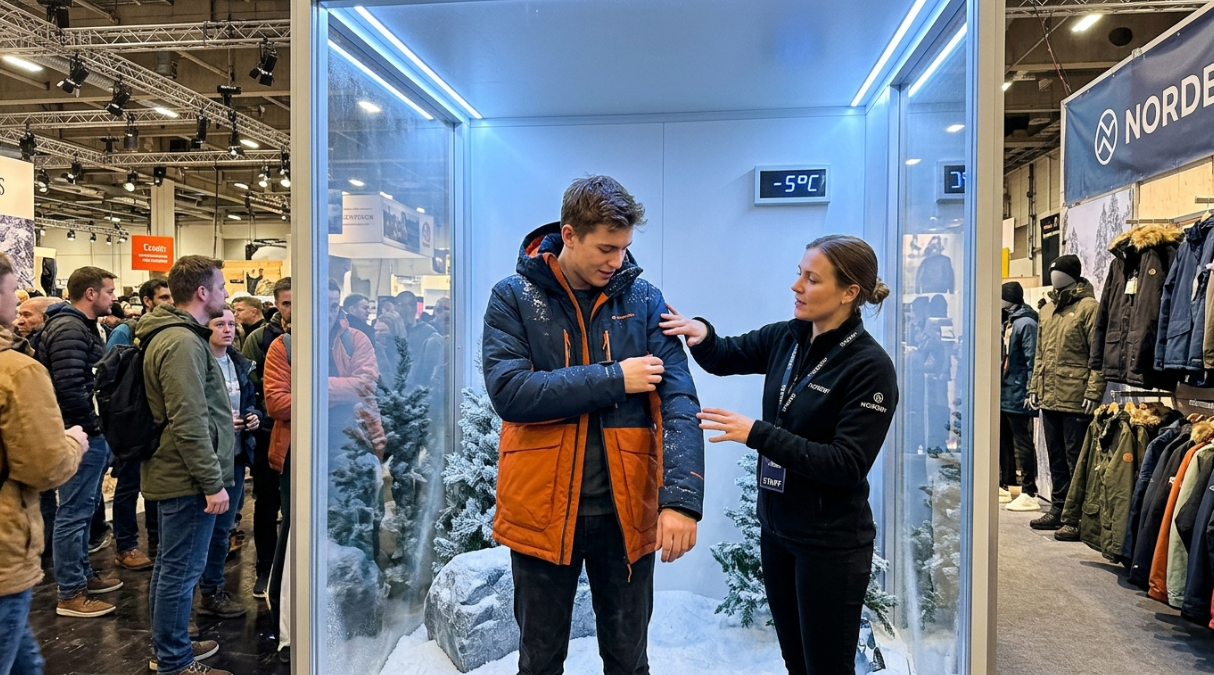
Think testing a winter coat inside a literal walk-in freezer, or trying waterproof headphones in a simulated rainstorm. The activation removes doubt by letting the product prove itself under conditions the customer cares about.
Budget: $50K–$200K+ depending on build complexity
Key features: Custom environment build, product trial under realistic conditions, staff trained for guided experience
Why it works: Direct experience converts skeptics. 91% of consumers report positive feelings toward a brand after a brand experience
Tradeoffs: Logistics-heavy. Requires significant floor space and often custom fabrication
2. AR/VR Brand Experience
Best for: Brands selling a vision, transformation, or complex product (real estate, travel, automotive, tech).
Interactive brand activations using AR and VR make the audience part of the story rather than spectators. A furniture brand that lets you see a couch in your actual living room through AR, or a travel company that drops you into a 360-degree beach walkthrough, creates product desire through simulated ownership.
Budget: $30K–$200K depending on custom development vs. off-the-shelf AR tools
Key features: Custom AR/VR content, shareable digital takeaways, guided vs. self-directed modes
Why it works: High dwell time, strong social sharing impulse, memorable differentiation from competitors
Tradeoffs: Tech glitches are public and embarrassing. Requires on-site tech support and backup experiences
3. Multi-Sensory Pop-Up Shop
Best for: Food, beverage, beauty, and lifestyle brands where sensory experience drives preference.
A temporary retail space designed around taste, touch, scent, and sound creates a brand world that standard retail can’t match. The pop-up format adds urgency (it won’t be here next week) to the sensory pull.
Budget: $25K–$150K for a single-city, multi-week installation
Key features: Curated sensory journey, limited-edition products, shareable design moments
Why it works: Engages memory systems that visual-only advertising misses. Multi-sensory encoding creates stronger, longer-lasting brand associations
Tradeoffs: Short lifespan means you need a strong pre-event awareness campaign. Post-event content capture is essential
4. Gamified Booth or Challenge
Best for: Trade shows, festivals, and high-foot-traffic environments where you’re competing for attention.
Creative brand activation ideas turn a booth into a game people queue to play. Leaderboards, prizes, and social sharing mechanics extend the activation’s life beyond the physical space.
Budget: $10K–$75K depending on technology and prize value
Key features: Digital leaderboards, instant prize fulfillment, social media integration for score sharing
Why it works: Games create voluntary attention. People choose to engage rather than being interrupted
Tradeoffs: Risk of attracting prize-seekers with no brand affinity. Game design must connect to brand message
Retail and In-Store Brand Activation Ideas
Retail activations engage consumers at the point of purchase, where the distance between interest and transaction is shortest. For examples of retail activations with proven ROI, the data consistently shows that in-store experiences outperform passive displays.
1. In-Store Brand Takeover
Best for: Brands launching new products or entering new retail channels.
A full takeover transforms a section of a retail partner’s store into your brand environment. It’s more than an endcap. Think custom fixtures, trained brand ambassadors, and exclusive in-store offers that can’t be found online.
Budget: $10K–$100K depending on retailer, store count, and customization
Key features: Custom fixtures, trained staff, exclusive offers, POS integration
Why it works: Captures undecided shoppers at the moment of decision. In-store activation engages consumers right at the point of sale
Tradeoffs: Requires retailer buy-in and coordination. Execution quality varies across locations
2. Retail Storytelling Activation
Best for: Heritage brands or products with a story that differentiates them from commoditized competitors.
Walker’s Shortbread created a vending machine that dispensed free samples, but only after customers answered questions about the brand’s history. Customers learned what set Walker’s apart while earning their reward, creating memorability that a standard sampling table never achieves.
Budget: $15K–$60K for a custom interactive display
Key features: Interactive quiz or story mechanic, product reward, data capture opportunity
Why it works: Combines education with reward. The knowledge sticks because the consumer had to work for the outcome
Tradeoffs: Slower throughput than simple sampling. Works best in locations where people aren’t rushing
3. Pop-Up Recycling or Buyback Station
Best for: Brands with loyalty programs or circular economy commitments.
IKEA’s Buyback program invites customers to return used furniture for store credit. The activation drives store traffic, reinforces sustainability credentials, and generates inventory for a secondary market. It works because the consumer gets something tangible (credit) for something intangible (doing the right thing).
Budget: $10K–$40K for a temporary station; lower if integrated into existing store operations
Key features: Instant credit or discount, visible impact counter, social sharing prompt
Why it works: Removes friction from sustainable behavior by attaching a financial incentive
Tradeoffs: Requires reverse logistics capability. Quality assessment of returned items needs clear standards
Digital and Social Brand Activation Ideas
Digital activations scale faster and cost less per engagement than physical events, though they typically generate weaker emotional connections. The best ones blur the line between digital and physical.
1. Social Media Challenge with Purpose
Best for: Brands with large existing social followings and a clear cause connection.
Nike’s #PlayInside challenge generated billions of impressions during lockdown by turning a constraint (staying home) into a branded movement. The key: the challenge served the audience’s real need while naturally embedding the brand.
Budget: $5K–$60K depending on influencer partnerships and paid amplification
Key features: Simple, repeatable action, branded hashtag, creator seeding, cause connection
Why it works: Low barrier to entry means massive participation potential. Social proof compounds as more people join
Tradeoffs: Viral mechanics are unpredictable. Many challenges fizzle. Requires genuine cultural relevance, not forced trendiness
2. UGC-Driven Campaign
Best for: Brands with passionate existing customers who already create content organically.
Turn customers into co-creators by giving them a framework and a reason to share. Whether it’s a design contest, a storytelling prompt, or a photo challenge, UGC campaigns generate authentic content at a fraction of the cost of studio production.
Budget: $2K–$30K for platform, prizes, and moderation
Key features: Clear creative brief, easy submission process, community voting, winner spotlight
Why it works: User-generated content carries more trust than brand-produced content. It also provides months of repurposable assets
Tradeoffs: Quality control is limited. You need enough engaged customers to hit critical mass
3. Digital-Physical Hybrid Activation
Best for: Brands operating at scale who want to extend physical experiences digitally (or vice versa).
Spotify Wrapped is the benchmark. The 2025 campaign attracted 200 million engaged users in just 65 hours with over 500 million shares. It works because the digital experience (your personal music data) feels physical and personal, prompting real-world conversations.
Budget: $10K–$100K+ depending on custom app development vs. existing platform integration
Key features: Personalized digital experience, shareable output, connection to real-world behavior data
Why it works: Personalization creates ownership. People share things that feel uniquely theirs
Tradeoffs: Requires robust data infrastructure. Privacy compliance adds complexity
Brand Activation Ideas for Small Businesses on a Budget
Small businesses don't need expensive installations or large experiential events to create effective brand activations. They can encourage meaningful customer participation through local partnerships, interactive demonstrations, referral challenges, and community-based experiences.
The most effective low-budget activations focus on one specific action rather than trying to create a large-scale brand spectacle.
1. Customer Appreciation Pop-Up
Organize a small event where existing customers can try new products, receive exclusive offers, and interact with your team.
Estimated budget: $500–$3,000
Best for: Local retailers, restaurants, and independent brands
Primary KPI: Repeat purchases and attendance
2. Local Business Collaboration
Partner with another non-competing business to create a shared experience. For example, a coffee shop could collaborate with a local bookstore to organize a reading event with complimentary drinks.
Estimated budget: $300–$2,000
Best for: Small businesses and local service providers
Primary KPI: Referral traffic and new customers
3. Customer Referral Challenge
Create a campaign that rewards customers for introducing friends to your brand. Use referral codes, social sharing, or in-store participation to track results.
Estimated budget: $500–$2,500
Best for: Subscription businesses, retail brands, and startups
Primary KPI: Referral conversions
4. Interactive Product Demonstration
Host a demonstration where customers can test, compare, or experience your product before purchasing.
Estimated budget: $500–$5,000
Best for: Beauty, technology, food, and lifestyle brands
Primary KPI: Product trials and conversion rate
5. Community Giveback Campaign
Organize a local volunteer activity, donation drive, or community improvement project connected to your brand's values.
Estimated budget: $500–$3,000
Best for: Purpose-driven businesses and local brands
Primary KPI: Participation and community engagement
6. Social Media Photo Challenge
Encourage customers to share photos or videos featuring your product. Create a branded hashtag and offer a small reward for selected entries.
Estimated budget: $100–$1,500
Best for: Consumer brands and businesses with active social audiences
Primary KPI: UGC submissions and engagement
How to Choose a Low-Budget Activation
Marketing objective | Recommended idea |
|---|---|
Attract new customers | Local business collaboration |
Encourage repeat purchases | Customer appreciation pop-up |
Generate product trials | Interactive demonstration |
Increase referrals | Customer referral challenge |
Build community trust | Community giveback campaign |
Increase social visibility | Photo challenge |
Community and Partnership Brand Activation Ideas
Community activations build trust through local presence and shared values. They’re slower to scale but generate deeper loyalty.
1. Nonprofit Partnership Activation
Best for: Brands seeking credibility with values-driven consumers through authentic cause alignment.
Ben & Jerry’s has built decades of advocacy into its brand through activist partnerships that go beyond writing a check. The ice cream is the vehicle. The values are the product. As practitioners on the NTIA panel have noted, brand activations need to feel authentic, and mismatched partnerships feel forced and ineffective.
Budget: $5K–$50K depending on partnership scope and event scale
Key features: Co-branded experience, nonprofit storytelling integration, impact metrics shared publicly
Why it works: Borrowed credibility from trusted nonprofits transfers to the brand, but only when the partnership is genuine
Tradeoffs: Requires long-term commitment. One-off partnerships read as opportunistic
2. Co-Created Community Event
Best for: Local or regional brands, and national brands trying to build grassroots presence.
Invite community members to help shape the experience, from choosing the cause to designing the activities. Co-creation shifts the power dynamic from “brand tells community” to “community and brand build together.”
Budget: $5K–$30K for a single-community event
Key features: Community advisory input, local partner involvement, attendee-driven programming
Why it works: People support what they help create. Co-created events generate stronger word-of-mouth because attendees have personal ownership
For strategic approaches to community engagement for brands, the research shows that co-creation consistently outperforms top-down event design.
Tradeoffs: Slower planning timeline. Requires genuine willingness to share creative control
B2B Brand Activation Ideas for 2026
B2B brand activation focuses on creating meaningful interactions between businesses, decision-makers, industry professionals, and potential customers. Unlike consumer activations, which often prioritize broad participation and product trials, B2B activations typically aim to build relationships, demonstrate expertise, and generate qualified leads.
Here are six B2B brand activation ideas worth considering.
1. Interactive Trade Show Demonstration

Instead of relying on a conventional exhibition booth, create a demonstration area where visitors can test your software, equipment, or business solution.
Best for: SaaS companies, manufacturers, and technology brands
Primary KPI: Qualified leads and product demonstrations
Activation example: A live product walkthrough where attendees solve a real business problem using your software.
2. Executive Roundtable Event
Invite a small group of decision-makers to discuss industry challenges, emerging trends, and practical solutions.
Best for: Consulting firms, financial services, and enterprise technology
Primary KPI: Qualified meetings and relationship development
Activation example: A private discussion involving 10–15 industry executives.
3. Industry Knowledge Workshop
Organize a hands-on workshop that teaches attendees how to solve a specific problem using your expertise or products.
Best for: Professional services, technology providers, and business education companies
Primary KPI: Attendance, engagement, and sales-qualified leads
Activation example: A cybersecurity company hosting a practical security assessment workshop.
4. Account-Based Marketing Experience
Create personalized experiences for selected high-value prospects rather than targeting a broad audience.
Best for: Enterprise SaaS and high-value B2B services
Primary KPI: Target-account engagement and pipeline generation
Activation example: A customized product demonstration based on a prospect's existing business challenges.
5. Customer Innovation Day
Invite existing customers and prospects to experience new products, discuss product development, and participate in demonstrations.
Best for: Established technology and manufacturing companies
Primary KPI: Customer retention, expansion opportunities, and product adoption
Activation example: An annual event showcasing new product features and customer success stories.
6. Partner-Led Networking Event
Collaborate with complementary businesses to host a networking experience for shared audiences.
Best for: Agencies, software providers, and professional service firms
Primary KPI: Partnership leads and qualified introductions
Activation example: A CRM provider and marketing agency hosting a joint event on customer acquisition.
B2B vs. B2C Brand Activation
Factor | B2B Activation | B2C Activation |
|---|---|---|
Target audience | Business decision-makers | Individual consumers |
Main objective | Generate qualified opportunities | Encourage consumer participation |
Typical format | Workshops, roundtables, demonstrations | Pop-ups, sampling, social challenges |
Sales cycle | Often longer | Often shorter |
Primary KPIs | Qualified leads, meetings, pipeline | Trials, conversions, engagement |
Relationship focus | Professional and organizational | Individual and community |
Sampling, Guerrilla, and Street Brand Activation Ideas
These activations are built for high-impact, high-frequency touchpoints in public spaces. They’re among the most affordable formats and can be deployed quickly.
1. Purpose-Driven Sampling
Best for: FMCG and CPG brands launching products with a sustainability or social impact angle.
Tie each sample to a micro-donation or visible impact metric. “Every sample you try, we plant a tree” is simple but effective, because it transforms a free product into a shared action. Practitioners report that well-executed sampling can deliver a 17% sample-to-purchase conversion rate.
Budget: $10K–$35K for a single-market activation
Key features: Sample distribution, impact counter display, data capture (email/SMS opt-in), trained brand ambassadors
Why it works: Samples reduce purchase risk. Adding a purpose layer adds emotional motivation on top of the rational trial
Tradeoffs: Sampling without strategic targeting wastes product. Location selection is critical
One practitioner warning worth noting: an athletic wear company promoting fitness and wellness gave away sugary donuts with disengaged sitting staff, instantly undercutting the brand’s message. Operational details can destroy an activation’s credibility.
2. Guerrilla Public Art Installation
Best for: Challenger brands and campaigns designed to generate earned media and social conversation.
Outdoor brand activation ideas use public art and out-of-home installations to reach people during their daily routines. A well-placed, visually striking installation that connects to your brand story can generate millions in earned media value for a fraction of a traditional media buy.
Budget: $10K–$75K depending on materials, permits, and location
Key features: Visually shareable design, subtle (not overt) brand integration, social media hashtag prompt
Why it works: Surprise and delight in unexpected contexts. People photograph and share things that break the pattern of their environment
Tradeoffs: Permit requirements vary wildly by city. Risk of vandalism or removal if not properly coordinated
Employee-Led Brand Activation Ideas
This is the blind spot. No major competitor ranking for brand activation ideas covers internal activations, yet employees can be the most powerful brand advocates. Internal activations, such as purpose workshops, ambassador programs, or sustainability challenges, bring brand values to life from the inside out.
1. Employee Brand Ambassador Program
Best for: Any brand whose employees interact with customers, communities, or social media audiences.
Equip employees with the tools, training, and autonomy to activate the brand through their own networks. This could mean sustainability challenge programs (reducing office waste, volunteering hours), social media advocacy kits, or employee-led community events.
Budget: $5K–$30K for program development, training, and incentive structure
Key features: Training curriculum, content toolkit, recognition program, impact tracking dashboard
Why it works: Employee advocacy reaches networks that paid media can’t access. It also builds internal alignment, which is essential because disengaged employees create disjointed brand experiences
Tradeoffs: Requires genuine internal culture alignment. Forced advocacy reads as inauthentic to both employees and their audiences
The 5-Step Brand Activation Framework
Moving from a creative concept to a high-ROI campaign requires a structured production methodology. Follow this five-step framework to ensure execution:
1. Audit Your Intention-Action Gap
Identify the specific friction point preventing your target audience from buying or advocating. If consumers love your product category but mistrust supply chain ethics, build a Transparency-as-Activation model. If they lack urgency, build a Limited-Time Pop-Up.
2. Design for Shareability & Dwell Time
An activation fails if people walk past it. Build architectural or digital hooks that force a pause. Aim for a minimum dwell time of 4 to 7 minutes per participant to maximize product education and emotional encoding.
3. Build a Multi-Channel Content Engine
Never treat an activation as a one-day event. Capture professional photo, short-form video, and creator content on-site to fuel your paid and organic channels for 6 to 8 weeks post-event.
4. Align Frontline Staff and Operations
Your brand ambassadors are your brand. Ensure staff undergo rigorous training on both product specs and the core brand narrative. Operational disconnects destroy credibility instantly.
5. Close the Loop with First-Party Data Capture
Every activation must build your CRM. Use frictionless opt-ins (QR-code-driven giveaways, digital leaderboards, or personalized takeaways) to capture email or SMS data for retargeting.
Brand Activation Planning Checklist: What to Prepare Before Launch
A successful brand activation requires more than an interesting creative concept. Marketing teams must coordinate objectives, audience research, campaign logistics, staffing, measurement, and post-event follow-up.
Use this checklist before launching your next activation.
1. Strategy and Objectives
Define the primary campaign objective.
Identify the target audience.
Determine the specific consumer behavior you want to encourage.
Establish measurable campaign targets.
Select the activation format that supports the objective.
2. Budget and Resources
Establish the total activation budget.
Allocate spending for venue, production, staffing, and technology.
Set aside contingency funds.
Confirm vendor and partner availability.
Establish approval responsibilities.
3. Creative and Experience Design
Develop the central campaign concept.
Align the activation with brand positioning.
Design the customer participation experience.
Prepare branded materials and signage.
Create social media and content-sharing opportunities.
4. Operations and Execution
Confirm venue permissions and permits.
Train employees and brand ambassadors.
Test equipment and technology.
Establish a participant registration process.
Prepare backup plans for operational problems.
5. Measurement and Follow-Up
Set up campaign tracking.
Prepare pre- and post-campaign surveys if needed.
Configure QR codes, landing pages, and tracking links.
Define how leads and customer data will be collected.
Schedule post-campaign reporting.
Evaluate results against the original objectives.
How to Choose the Right Brand Activation Idea
Picking the right activation starts with a clear objective, not a cool format. As one Substack practitioner from The Hook Studio put it: “If you want your next brand activation to stand out and actually move the needle, it’s time to pause the ‘cool ideas’ and start with strategy.”
Step 1: Define the behavior you want to change. Not “raise awareness” but “get 5,000 lapsed customers to try the reformulated product” or “shift brand perception among 25-34 year-olds on sustainability credentials.”
Step 2: Match the behavior to the format. Use the comparison table above. Trial-to-purchase? Sampling. Brand trust? Purpose-driven experiential. Internal alignment? Employee ambassador program.
Step 3: Run 2-3 types in parallel. The brands winning in 2026 aren’t betting on a single activation. A pop-up plus campus ambassadors plus a creator activation triangulates across three audience cohorts and produces a content engine that lasts a full quarter. Practitioners report this parallel approach outperforms single-event strategies consistently.
Step 4: Apply the intention-action gap test. For every idea on your shortlist, ask: what specific gap between consumer intention and consumer action does this close? If you can’t answer that clearly, the activation will generate buzz but not business results.
See how Grounded World’s brand activation team works.
Brand Activation Budget Guide
Budget is the first question every brand manager asks internally. Here are the ranges based on industry benchmarks:
Activation Type | Budget Range | Key Cost Drivers |
|---|---|---|
Simple single-market sampling | $10K–$35K | Product cost, staffing, location permits |
Digital/social campaign | $2K–$60K | Platform development, influencer fees, paid amplification |
Branded pop-up or single-location experiential | $25K–$75K | Build-out, rent, staffing, design |
Custom immersive product launch | $75K–$250K | Fabrication, technology, multi-week staffing |
Mid-size multi-format experiential | $150K–$300K | Multiple activations, larger creative team, broader reach |
Multi-city tour or full agency engagement | $1M+ | Logistics, transportation, market-specific customization |
Staffing typically absorbs 25% to 40% of the total budget, and trade show services add another 15% to 25% on top of booth costs. Digital activations offer the widest budget flexibility, while immersive builds have the most unpredictable cost overruns.
Average cost per engagement in experiential marketing runs $3 to $15. Cost per lead sits at $3 to $25. Cost per customer acquisition ranges from $15 to $75. These benchmarks help you model expected ROI before committing budget.
How to Avoid Greenwashing Your Brand Activation
This section exists because no other brand activation guide covers it, and it’s the fastest way to destroy everything an activation is supposed to build.
Exaggerating or misrepresenting what a brand activation will offer leads to disappointment, disillusionment, and irreparable reputation damage. Here’s how to keep activations authentic:
Align the activation with actual operations. If your activation promotes sustainability, your supply chain should reflect it. Consumers are sophisticated enough to fact-check, and competitors are motivated enough to call you out.
Avoid borrowed purpose. Slapping a cause onto an unrelated product activation doesn’t work. 39% of shoppers say they would permanently boycott a favorite brand over a values mismatch. The stakes are real.
Use third-party verification. B Corp certification, Science Based Targets, or independent impact audits give your activation claims credibility that self-reported data can’t. For a deeper framework on how to avoid greenwashing, the principles are straightforward: prove it, don’t just say it.
Test with skeptics, not fans. Before launch, pressure-test the activation messaging with consumers who are neutral or skeptical toward your brand. Fans will forgive inconsistencies. Everyone else won’t.
Document and share impact. If your activation claims to drive change (trees planted, plastic removed, meals donated), publish the numbers with third-party verification after the event.
How to Measure Brand Activation Success
Vanity metrics like “impressions” and “foot traffic” rarely survive a budget review meeting. The metrics that matter connect activation activity to business outcomes across three layers:
Layer 1: Brand Lift. Did the activation shift perception? Measure brand awareness, favorability, and purchase intent through pre/post surveys.
Layer 2: Behavior Change. Did consumers take the desired action? Track first-party data opt-in rates, social sharing rates (a production veteran with 15 years of experience reports organic share rates of 50% to 70% across activations), and downstream retail redemption.
Layer 3: Commercial Outcomes. Did it generate revenue? Track cost per engagement, cost per lead, and customer acquisition cost against the benchmarks above.
Absolut Home offers a concrete example: average revenue per guest increased 36% since 2018 while maintaining an 85% brand conversion score post-event. That’s what measurement-first activation design produces.
For a broader view of how to measure impact across sustainability and social campaigns, the same three-layer approach applies.
Frequently Asked Questions
What is a brand activation?
Brand activation is a marketing strategy that creates direct, memorable experiences (live, digital, or hybrid) designed to prompt consumer interaction with a brand. Unlike traditional advertising, it focuses on participation rather than passive viewing. The four core types are experiential marketing, in-store activations, events and trade shows, and sampling/free trials, though digital, purpose-driven, and employee-led activations have become equally important categories.
What are the best brand activation ideas for small budgets?
Digital and social activations ($2K to $60K), purpose-driven sampling ($10K to $35K), and employee ambassador programs ($5K to $30K) offer the strongest returns at lower budget levels. UGC campaigns and social media challenges can generate significant reach with minimal spend if you have an engaged existing audience. The key is choosing one format and executing it exceptionally rather than spreading a small budget across multiple activations.
How much does a brand activation cost?
Costs range from $2,000 for a simple digital campaign to over $1 million for a multi-city experiential tour. A focused single-location pop-up typically runs $25,000 to $75,000. A larger produced activation sits closer to $150,000 to $300,000. Staffing accounts for 25% to 40% of most budgets, so factor that in early.
How do you measure brand activation ROI?
Use the three-layer framework: brand lift (perception shifts via pre/post surveys), behavior change (opt-ins, shares, redemptions), and commercial outcomes (revenue, acquisition cost, customer lifetime value). The basic ROI formula is: (Revenue Generated minus Activation Cost) / Activation Cost x 100. Industry benchmarks show well-executed activations deliver 200% to 600% ROI.
What makes a purpose-driven activation different from a standard activation?
A purpose-driven activation connects the brand experience to a social or environmental cause that the brand genuinely supports through its operations, not just its marketing. The commercial case is strong: 62% of consumers say their purchase decisions are heavily influenced by a brand’s values, and purpose-driven brands that execute well see double-digit growth. The difference is authenticity backed by operational commitment.
How do you avoid greenwashing in a brand activation?
Align activation messaging with verifiable operational practices. Use third-party certifications (B Corp, Science Based Targets). Publish impact data after the activation with independent verification. Test messaging with skeptical audiences before launch. If you can’t prove the claim, don’t make it.
Should I run multiple brand activations at the same time?
Yes. The parallel activation strategy is the 2026 standard for brands with sufficient budget. Running a pop-up alongside campus ambassadors and a creator activation reaches different audience segments while creating a content engine that sustains momentum for months. Single-event activations spike and fade. Parallel activations compound.
What is the biggest brand activation mistake to avoid?
Starting with format instead of strategy. Many teams fall in love with an idea (VR experience, elaborate pop-up) before defining the specific behavior they want to change. As practitioners consistently note, simplicity executed well beats complexity every time. One clear idea that genuinely connects to your brand’s core identity will outperform a dozen disconnected spectacles.