

 Gaia
TL;DR
A social impact measurement framework is a structured system for evaluating how an organization’s activities create real change, focusing on outcomes rather than just activity counts. The major frameworks include Theory of Change, Logic Models, SROI, IRIS+, B Impact Assessment, and GRI Standards. Most experienced practitioners recommend starting with 3 to 5 core metrics and building complexity over time. For brands, getting this right is the difference between credible purpose claims and greenwashing accusations.
Quick Summary: What Is a Social Impact Measurement Framework?
A social impact measurement framework is a structured methodology used by organizations to plan, track, and evaluate the non-financial outcomes and long-term impacts of their activities.
The 3 Core Components:
Results Chain Logic: Differentiates between Inputs (resources), Outputs (activities completed), and Outcomes (actual social/environmental changes created).
Standardized Indicators: Measures qualitative and quantitative success using established metrics (e.g., IRIS+, GRI, SROI).
Stakeholder Alignment: Validates impact claims with real-world beneficiaries to prevent greenwashing and guide decision-making.
What Is a Social Impact Measurement Framework?
A social impact measurement framework is a structured method for tracking how an organization's activities lead to measurable social or environmental change. It connects resources and activities to outputs, outcomes, and long-term impact using defined indicators, data collection methods, and reporting processes. To get started, identify your intended outcomes, select 3–5 meaningful metrics, establish a baseline, and review results with the people affected by your work.
The key principle: Measure what changes because of your work, not just what your organization does.
Most organizations can begin with a Logic Model or Theory of Change, then use standardized metrics from resources such as IRIS+ or GRI Standards when their reporting needs require them.
Why Social Impact Measurement Matters
For nonprofits: survival
56% of surveyed nonprofits struggle to communicate their impact to funders. That statistic, from Social Impact Solutions, reveals a measurement crisis. When organizations can’t articulate what changed because of their work, funding dries up.
The pressure is intensifying. 89% of social impact leaders are now asked to prove how their impact is measured, and boards have learned to discount vanity metrics like dollars donated and volunteer hours logged. Frameworks provide the structure to answer these questions with evidence, not anecdotes.
For brands: trust, revenue, and greenwashing protection
The commercial case is just as urgent. A 2022 Harris Poll found that 82% of consumers want a brand’s values to align with their own, and three-quarters will drop a brand because of a conflict in values.
Purpose-driven companies show 30% higher levels of innovation, according to Deloitte research. But purpose without proof is a liability. Consumers are sophisticated enough to spot empty claims, and regulatory scrutiny around sustainability marketing is tightening globally. A social impact measurement framework gives brands the credible evidence they need to avoid greenwashing while making their purpose work commercially.
For everyone: better decision-making
Measurement isn’t just about external reporting. Well-designed frameworks help organizations learn what’s working, stop investing in what isn’t, and improve programs over time. The accountability and transparency that come with structured measurement build trust among stakeholders, from investors and donors to employees and customers.
Key Concepts: The Results Chain
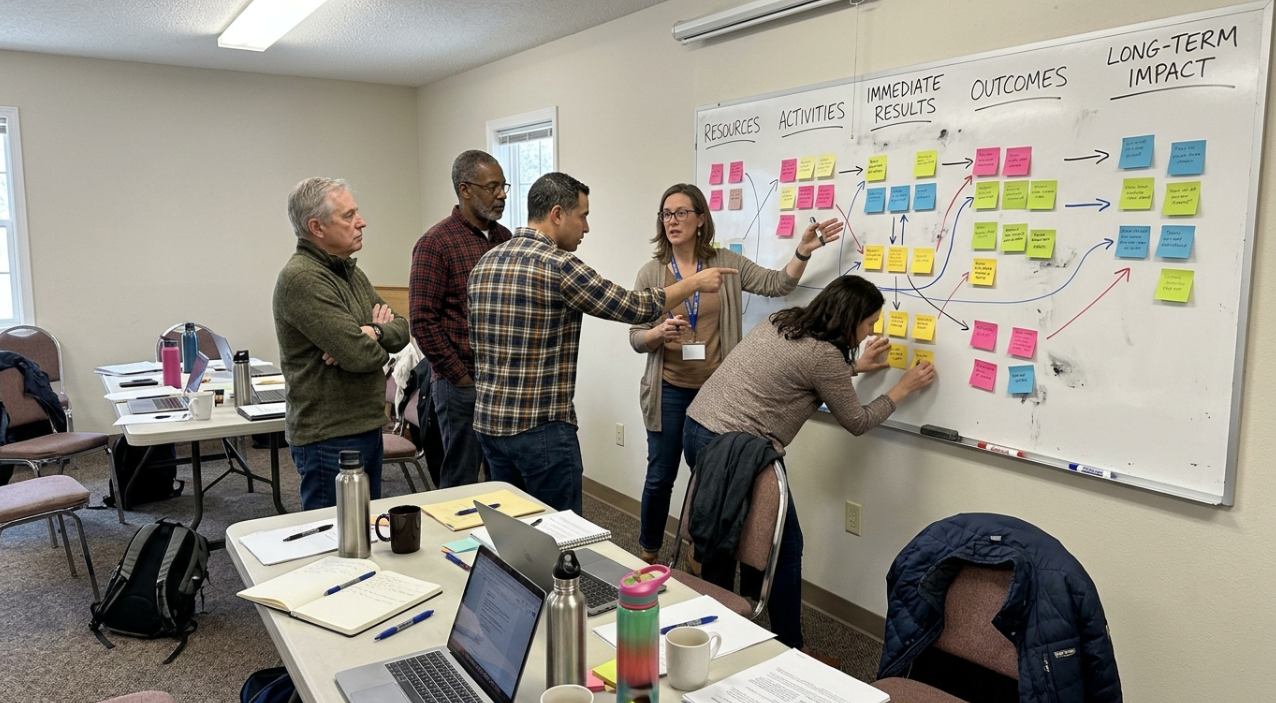
Before comparing frameworks, it helps to understand the language they share. Most social impact measurement frameworks organize thinking around a results chain:
Inputs are the resources you invest: money, staff time, materials, partnerships.
Activities are what you do with those inputs: run workshops, distribute products, launch campaigns.
Outputs are the direct, countable products of your activities: 500 people trained, 10,000 meals served, 3 retail activations launched.
Outcomes are the changes that happen as a result: participants gained new skills and found employment, food insecurity decreased in a target community, consumer purchase intent shifted.
Impact is the broader, longer-term difference your work contributes to, net of what would have happened anyway.
Inputs vs. Activities vs. Outputs vs. Outcomes vs. Impact
A social impact measurement framework separates the resources an organization invests from the activities it performs and the changes it helps create. Use the following table to classify your indicators correctly.
Results-chain stage | What it means | Community health program example | What to measure |
|---|---|---|---|
Inputs | Resources invested | Funding, staff, medical supplies | Budget, staff hours, resources allocated |
Activities | Work performed | Health education workshops | Workshops delivered, sessions completed |
Outputs | Immediate, countable deliverables | Community members attending workshops | Attendance, completion, people reached |
Outcomes | Changes in knowledge, behavior, access, or well-being | Participants improve their health knowledge or adopt healthier habits | Knowledge change, behavior change, access to care |
Impact | Broader, longer-term change to which the program contributes | Improved community health over time | Sustained health outcomes and evidence of the program's contribution |
Important: These are illustrative examples, not measured results. A program should only report an outcome or impact when appropriate evidence supports the claim. A change observed after an intervention does not, by itself, prove that the intervention caused the change.
The outputs vs. outcomes distinction
Outputs show what a program delivers. Outcomes show what changes for the people or communities it serves. Impact refers to the broader change the program contributes to, taking account of other influences and what might have happened without the intervention.
For example, a company may fund the planting of 100,000 trees. The number of trees planted is an output. Tree survival, habitat recovery, and measurable carbon storage are potential outcomes. Longer-term ecological improvements may contribute to wider environmental impact, but they require appropriate evidence and consideration of other factors.
A useful rule is: count outputs, measure outcomes, and substantiate claims about impact.
A practical heuristic from practitioners: “You count outputs, you measure outcomes, and you argue for impact.”
Example: A brand partners with a nonprofit to plant 100,000 trees (output). The outcome would be measurable carbon sequestration, restored biodiversity, or improved livelihoods for local communities. The impact is the long-term environmental and economic change that can be attributed to those specific trees, accounting for what would have happened without the program.
Funders and consumers increasingly want outcome evidence, not just activity counts. Any credible social impact measurement framework prioritizes this distinction.
Major Frameworks Compared
Seven frameworks dominate the field. A systematic literature review found that SROI is the most commonly cited measurement model, while Theory of Change was identified as a core concept across the social impact measurement literature. Here’s what each does and who it’s best for.
Theory of Change (ToC)
A Theory of Change maps the causal logic between your inputs, activities, outputs, outcomes, and long-term impact. It forces you to articulate not just what you do, but why you believe it will produce the change you intend.
Think of it as a hypothesis: “If we do X, then Y will happen, because of Z.” A well-built Theory of Change is the foundation for selecting meaningful metrics. It’s also widely required for grant proposals and strategic planning.
Best for: Internal alignment, grant applications, testing assumptions.
Effort level: Medium.
Logic Models
A Logic Model is a simplified visual map showing the relationship between resources, activities, outputs, and outcomes. It’s less ambitious than a Theory of Change (it typically doesn’t include the “because” reasoning), but it’s faster to build and easier to communicate.
Best for: Getting started, internal clarity, program design.
Effort level: Low.
Social Return on Investment (SROI)
Developed in the 1990s by the New Economics Foundation, SROI translates social and environmental outcomes into monetary value. It answers the question: “For every dollar invested, how much social value was created?”
Credibility depends on stakeholder engagement, strong evidence, appropriate financial proxies, and counterfactual adjustments. Practitioners warn that SROI should be treated as a range, not a single precise number. It’s powerful for value-for-money cases but resource-intensive to do well.
Best for: Demonstrating value-for-money, investor reporting.
Effort level: High.
IRIS+
Managed by the Global Impact Investing Network (GIIN), IRIS+ is a catalog of generally accepted performance metrics tied to the UN’s 17 Sustainable Development Goals. As of its latest update, IRIS+ includes 500+ standardized performance metrics, which signals both its comprehensiveness and the complexity challenge organizations face in selecting the right ones.
Best for: Impact investors, standardized reporting, SDG alignment.
Effort level: Medium (selecting metrics) to High (full implementation).
B Impact Assessment
The B Impact Assessment measures a company’s entire social and environmental performance, covering governance, workers, community, environment, and customers. It’s the foundation of B Corp certification. GIIN and B Lab have worked closely to harmonize their respective standards.
Best for: Companies seeking holistic assessment, B Corp certification path.
Effort level: Medium to High.
GRI Standards
The Global Reporting Initiative provides the most widely used sustainability reporting standards globally. GRI focuses on reporting what matters to stakeholders (materiality principle). It’s been criticized for not verifying the quality and accuracy of reported information, which is why many organizations pair GRI reporting with additional verification methods.
Best for: Large organizations, corporate sustainability reporting, stakeholder disclosure.
Effort level: High.
Five Dimensions of Impact (IMP)
Developed by the Impact Management Project, this framework helps organizations think systematically about impact across five dimensions: What (the outcome), Who (which stakeholders), How Much (scale, depth, duration), Contribution (what’s your additionality), and Risk (likelihood of impact occurring as expected).
Rather than prescribing specific metrics, the Five Dimensions provide a thinking structure that works across sectors and investment types.
Best for: Impact investors, portfolio-level assessment, strategic impact planning.
Effort level: Medium.
Social Impact Measurement Frameworks Compared
Different social impact measurement frameworks solve different problems. Some help organizations plan how change should happen, some standardize performance metrics, and others support company-wide assessment or sustainability reporting.
Framework | Primary purpose | Best suited for | Main consideration |
|---|---|---|---|
Logic Model | Map resources, activities, outputs, and outcomes | Nonprofits and teams starting measurement | Simple to develop, but does not establish that the program caused an outcome |
Theory of Change | Explain how and why activities are expected to create change | Program design, strategy, and grant proposals | Requires explicit assumptions and evidence to test them |
Social Return on Investment (SROI) | Estimate social value using monetary proxies | Value-for-money analysis and selected funding decisions | Data-intensive; results depend on assumptions and valuation choices |
IRIS+ | Select standardized impact performance metrics | Impact investors and organizations seeking comparable indicators | Metrics must be selected for the specific impact objective |
B Impact Assessment | Assess a company's social and environmental performance | Companies evaluating their overall business impact | Assessment is distinct from obtaining B Corp certification |
GRI Standards | Structure sustainability reporting and disclosures | Organizations reporting significant impacts on the economy, environment, and people | Reporting requires appropriate disclosures and supporting evidence |
Five Dimensions of Impact | Examine what changes, who experiences it, how much changes, contribution, and risk | Impact investors and impact-management teams | Provides an analytical framework rather than a complete metric set |
How to choose: Use a Logic Model for a straightforward program map, a Theory of Change to explain causal assumptions, IRIS+ for relevant standardized impact metrics, GRI Standards for sustainability disclosures, B Impact Assessment for company-wide assessment, and SROI when a defensible monetary valuation is needed. The Five Dimensions of Impact can complement these methods.
These approaches can be combined. They are not seven interchangeable alternatives, and choosing one does not automatically satisfy every reporting, certification, or assurance requirement.
How to Choose the Right Framework for Your Organization
Choose a social impact measurement framework based on the decision you need to make, the outcomes you want to measure, the evidence you can collect, and the reporting requirements you must meet.
Start with three questions:
What do you need to understand? Choose a Logic Model or Theory of Change when you need to map how activities are expected to create change.
What do you need to report? Consider IRIS+ for relevant standardized impact metrics, GRI Standards for sustainability disclosures, or the B Impact Assessment for company-wide assessment.
What evidence or valuation do stakeholders require? Consider SROI when a monetary estimate of social value is appropriate and you have the data and resources to support it.
Many organizations can begin with a simple Logic Model, develop a Theory of Change, and introduce standardized indicators as their measurement capacity grows.
Do not adopt multiple frameworks simply to appear comprehensive. Use each method only when it answers a distinct question or meets a real stakeholder requirement.
Engage Stakeholders Throughout the Process
People affected by a program should help define what success means, identify meaningful outcomes, and interpret the results. This helps prevent organizations from measuring what is convenient for them rather than what matters to the people they serve.
Use existing operational data where appropriate, build staff capacity, and combine quantitative and qualitative evidence when each adds value.
For brands developing a social impact marketing strategy, align measurement with the claims the organization plans to make. Marketing language should reflect the scope and strength of the available evidence.
Engage stakeholders throughout
A 2026 Q-method study confirmed what practitioners have long argued: stakeholder engagement is the most broadly valued principle in social impact measurement. The people affected by your programs should inform what you measure, how you measure it, and what counts as success.
Four key strategies from systematic research reviews: (1) engage stakeholders throughout the process, (2) mobilize existing operational data, (3) increase measurement capacity, and (4) use both qualitative and quantitative data.
For brands building a social impact marketing strategy, the framework you choose shapes the story you can tell. Measurement feeds directly into communications, so alignment between your measurement approach and your brand narrative matters from the start.
How to Build a Social Impact Measurement Framework in 7 Steps
Building a social impact measurement framework starts with a clearly defined change, not a long list of metrics. The goal is to select indicators that help your organization understand whether its activities are producing meaningful results.
Step 1: Define the social or environmental problem
Identify the problem your organization wants to address, who experiences it, and the context in which it occurs.
Avoid goals that are too broad to evaluate, such as “improve communities” or “support sustainability.” Define a specific problem, population, and intended change.
Example: Improve access to preventive health information for adults in underserved communities.
Step 2: Identify stakeholders and intended outcomes
Consult the people affected by the program, along with relevant staff, funders, partners, and other stakeholders.
Determine what meaningful change looks like from their perspectives. A program may meet its delivery targets without improving the outcome that matters most to its beneficiaries.
Example: Participants can identify preventive health practices and know where to access local health services.
Step 3: Map the results chain
Connect your resources and activities to expected outputs, outcomes, and longer-term impact.
Use a Logic Model for a straightforward results chain. Develop a Theory of Change when you need to explain why the activities are expected to produce the intended outcomes and which assumptions must hold.
Step 4: Select meaningful indicators
Choose a small set of indicators that directly relate to your priority outcomes. Three to five core indicators can be a useful starting point for a focused program, but the appropriate number depends on its complexity and reporting obligations.
Include indicators that capture both delivery and change. For example, attendance may show whether a program reached participants, while a pre- and post-program assessment may indicate whether their knowledge improved.
Step 5: Establish a baseline and target
A baseline describes the starting point against which progress will be assessed. A target describes the result the organization aims to achieve within a defined period.
Whenever possible, collect baseline data before the intervention begins. If that is not possible, document the limitations and choose an appropriate alternative.
Example: Establish participants' health knowledge at enrollment, then set a target for improvement by the end of the program.
Step 6: Collect and analyze data
Specify how each indicator will be measured, who will collect the data, how frequently it will be recorded, and how quality will be checked.
Use quantitative methods, such as surveys and administrative records, alongside qualitative methods, such as interviews and focus groups, when these provide a fuller understanding of the results.
Protect participant privacy, obtain appropriate consent, and minimize the collection of unnecessary personal information.
Step 7: Report findings and improve the program
Compare actual results with your baseline, target, and relevant comparison data. Explain what improved, what did not, what remains uncertain, and what the organization plans to change.
Share findings with affected stakeholders, not only funders or executives. Review the framework periodically to ensure that its indicators remain relevant and useful.
Final check: Every reported impact claim should have a clear definition, an appropriate evidence source, a stated measurement period, and an explanation of the limits of the evidence.
Social Impact Measurement Template and Example
A social impact measurement template connects each intended outcome to an indicator, baseline, target, data source, and reporting schedule. Use it to create a practical measurement plan before collecting data.

Social Impact Measurement Plan Template
Field | What to record |
|---|---|
Social or environmental problem | The issue the program aims to address |
Target stakeholders | The people, communities, or groups affected |
Intended outcome | The specific change the program seeks to achieve |
Indicator | The evidence used to assess that change |
Baseline | The starting measurement or documented starting condition |
Target | The desired result and deadline |
Data source | Survey, interview, administrative record, observation, or other evidence |
Collection frequency | When and how often the data will be collected |
Responsible person | The person or team accountable for data quality |
Reporting method | How findings will be analyzed, shared, and used |
Worked Example: A Community Health Education Program
The following example uses hypothetical targets to illustrate how a measurement plan works. It does not describe verified program results.
Measurement element | Illustrative example |
|---|---|
Problem | Limited access to reliable preventive health information |
Target stakeholders | Adults participating in community health workshops |
Intended outcome | Improved knowledge of preventive health practices |
Indicator | Percentage of participants meeting a predefined knowledge threshold |
Baseline | Knowledge assessment completed before the program |
Target | At least 75% of participants meet the threshold at the six-month assessment |
Data source | Baseline and follow-up assessments |
Collection frequency | At enrollment and six months after participation |
Responsible person | Program monitoring and evaluation lead |
Reporting method | Compare baseline and follow-up results, document participation and attrition, and explain limitations |
How to Evaluate the Results
At the end of the measurement period, report the number of participants assessed, the percentage meeting the outcome threshold, the change from baseline, and the number lost to follow-up.
If you want to claim that the program caused the improvement, you may need a stronger evaluation design, such as a suitable comparison group, depending on the claim and the context.
A completed measurement plan is not proof of impact. It is a structured way to collect the evidence needed to assess progress and make better decisions.
How to Measure and Report Social Impact Credibly
A social impact measurement framework is only as useful as the indicators, data, and evaluation methods behind it. Organizations should select indicators that reflect meaningful change, establish consistent measurement procedures, and communicate the limits of their findings.
Choose indicators that reflect meaningful change
A useful indicator should relate directly to an intended outcome and have a clear definition. It should also be practical to measure, relevant to stakeholders, and suitable for the decisions the organization needs to make.
For each indicator, document what counts, who is included, the measurement period, the data source, and any calculation method.
For example, “people reached” is a useful delivery indicator, but it does not establish whether participants learned something, changed their behavior, or experienced a lasting improvement.
Combine quantitative and qualitative evidence
Quantitative data can show how many people participated, how results changed, and whether a target was achieved. Qualitative evidence can help explain why a program worked, why it failed, or how different stakeholders experienced it.
Depending on the program, useful sources may include:
Surveys and assessments completed before and after an intervention.
Administrative or service-delivery records.
Interviews and focus groups with affected stakeholders.
Follow-up assessments that test whether changes persisted.
Independent evaluations or suitable comparison-group studies.
Use methods appropriate to the question being asked. More data does not automatically mean stronger evidence.
Separate contribution from attribution
Attribution asks whether a particular intervention caused an observed result. Contribution asks how the intervention helped produce a result alongside other influences.
For many complex social and environmental programs, several factors affect outcomes simultaneously. Organizations should not claim sole responsibility for a broad change unless the evidence supports that conclusion.
Disclose limitations and unintended effects
Credible reporting explains the measurement period, population covered, missing data, important assumptions, and limitations of the evaluation method.
It should also consider potential negative or unintended effects. A program may produce benefits for one group while creating costs or barriers for another.
Turn findings into decisions
Measurement should inform what happens next. Review results with relevant stakeholders, identify which activities appear effective, and determine what needs to change.
A useful impact report explains what the organization did, what changed, how the evidence was collected, what remains uncertain, and what the organization will do differently.
Common Mistakes
Reporting outputs as impact
This bears repeating because it’s everywhere. “We trained 5,000 people” is an output. “73% of trainees found employment within six months, compared to 31% in a control group” is outcome evidence. Organizations face real pressure to demonstrate success, which leads many to overclaim outcomes. Resist the temptation. Credible understatement builds more trust than inflated claims.
Vague goals that can’t be measured
When goals are broad (“empower youth,” “strengthen communities”), it’s nearly impossible to know what success looks like or how to capture it. Every goal in your framework should be specific enough that two reasonable people would agree on whether it was achieved.
Framework overload
Trying to implement every framework simultaneously is a recipe for paralysis. Harvard Business School research suggests that not everyone needs to measure impact, and sometimes organizations should focus on measuring outputs well before attempting full impact measurement. Pick one approach, do it well, and build from there.
Designing measurement for funders rather than learning
Practitioners on forums frequently note that organizations design data collection around funder requirements rather than genuine learning. This creates compliance artifacts that check boxes but don’t actually help the organization improve. The best frameworks serve both purposes: they satisfy external reporting needs while generating insights that make programs better.
Many nonprofit teams already wear multiple hats. Without someone dedicated to program evaluation, measurement tends to fall by the wayside. If internal capacity is limited, working with social impact agencies for nonprofits can fill the gap without requiring a full-time hire.
Social Impact Measurement Trends in 2026
Social impact measurement is increasingly shaped by the need for comparable data, credible evidence, and reporting systems that organizations can maintain with limited resources. For nonprofits, social enterprises, investors, and consumer brands, the challenge is to demonstrate meaningful outcomes without creating unnecessary administrative work.
Greater demand for comparable impact data
Funders, investors, and business stakeholders need consistent information to compare programs and understand performance. Standardized indicators can improve comparability, but organizations still need to define their target populations, measurement periods, and intended outcomes clearly.
Frameworks such as IRIS+ can support metric selection, while GRI Standards provide a structure for sustainability disclosures. Neither removes the need to explain the context behind the reported numbers.
More attention to stakeholder participation
Organizations are increasingly expected to consider how affected communities define success and how measurement findings are used.
Stakeholder engagement can help identify overlooked outcomes, reveal unintended consequences, and improve the relevance of program decisions. It should be incorporated into measurement design and interpretation rather than treated as a final consultation step.
Greater scrutiny of impact claims
Social and environmental claims need evidence that supports their wording, scope, and time frame. A program's activities or funding commitments should not be presented as proof of outcomes that have not yet been measured.
For brands, credible impact measurement can support more responsible sustainability and social impact communications. Claims should explain what was measured, which population or activity was covered, and what the evidence does and does not establish.
More use of technology and AI
Digital tools can help organizations organize data, identify patterns in feedback, and prepare draft reports. AI may assist with analyzing qualitative responses or mapping data to reporting categories, but its output should be checked against the original evidence.
Organizations should establish appropriate privacy protections, document methods, and retain human oversight. Automated analysis cannot replace stakeholder participation or independently establish that a program caused an observed outcome.
What organizations should do next
The practical priority is to build a measurement process that is useful, proportionate, and transparent. Begin with clearly defined outcomes, a small set of meaningful indicators, and a repeatable data collection process. Add standardized reporting, advanced evaluation, or automated analysis when those capabilities address a specific need.
Editorial note: Add dated, primary-source citations for any named 2026 initiative, research finding, launch, or regulatory development. Remove or qualify any claim that cannot be independently verified.
What’s Changing in 2026
The social impact measurement field is consolidating and maturing. In February 2026, Charity Navigator and YourCause from Blackbaud joined True Impact to launch the Impact Reporting Network, a shared infrastructure designed to reduce nonprofit reporting burden while improving data quality for donors and funders.
The Impact Align SDG Vision Document 2026-2030 presents a global framework for measuring, accrediting, and scaling sustainable development impact. It responds directly to the challenge that most organizations still lack standardized systems to measure and report their real impact.
Meanwhile, a 2026 Q-method study found broad agreement among social enterprises on the value of stakeholder engagement, but significant disagreement on how to handle resource constraints, long-term versus short-term impact priorities, and external reporting pressure. The “one-size-fits-all” approach was broadly rejected.
The direction is clear: more standardization in reporting infrastructure, more flexibility in how individual organizations implement frameworks, and growing expectations from funders, investors, and consumers that impact claims are backed by evidence.
Step-by-Step Matrix: Selecting the Right Framework for Your Organization
Use this decision matrix to align your organization’s primary objective with the optimal framework:
Primary Goal | Recommended Framework | Primary Benefit | Implementation Effort |
Grant Funding & Program Design | Theory of Change / Logic Model | Clarifies program logic for funders | Low to Medium |
Corporate Sustainability & ESG Disclosure | GRI Standards | Provides globally recognized stakeholder reporting | High |
Impact Investing Portfolio Management | IRIS+ & IMP (Five Dimensions) | Standardizes metrics across diverse asset classes | Medium to High |
Certification & Company-Wide Assessment | B Impact Assessment | Evaluates holistic business impact across 5 operational pillars | Medium to High |
Valuation for Investors & Pitching | SROI (Social Return on Investment) | Converts social outcomes into monetary terms | High |
Building Your Framework: Where to Start
If you’re a brand, retailer, or purpose-driven company trying to connect social impact measurement to commercial results, the path forward doesn’t require perfection on day one. It requires the right starting point, genuine stakeholder engagement, and a willingness to measure what actually matters rather than what’s easiest to count.
Talk to our team about building an impact measurement approach that connects purpose to profit.
Frequently Asked Questions
What is the simplest social impact measurement framework to start with?
A Logic Model is the lowest-effort starting point. It visually maps your resources, activities, outputs, and intended outcomes on a single page. Most practitioners recommend beginning here, then maturing into a Theory of Change as your measurement capacity grows.
What’s the difference between outputs, outcomes, and impact?
Outputs are what you do (people trained, meals served, products distributed). Outcomes are what changes as a result (new skills gained, food insecurity reduced, behavior shifted). Impact is the long-term, broader change your work contributes to, adjusted for what would have happened without your intervention. You count outputs, measure outcomes, and argue for impact.
How many metrics should a social impact measurement framework include?
Start with 3 to 5 core metrics tied directly to your most important outcomes. IRIS+ offers nearly 600 potential metrics, which illustrates why focus matters. Experienced practitioners consistently warn against measuring everything at once. Depth on a few meaningful metrics beats shallow coverage across dozens.
Can for-profit companies use social impact measurement frameworks?
Absolutely. Frameworks like the B Impact Assessment, GRI Standards, and IRIS+ are widely used by commercial companies. 76% of executives plan to increase CSR investment in 2025, making credible measurement more important than ever for demonstrating ROI, building consumer trust, and avoiding greenwashing claims.
How is SROI different from traditional ROI?
SROI (Social Return on Investment) translates social and environmental outcomes into monetary value, producing a ratio like “for every $1 invested, $4.50 in social value was created.” Unlike traditional ROI, it requires financial proxies for non-financial outcomes, stakeholder engagement, and counterfactual analysis. It should be expressed as a range, not a single number, and is best reserved for situations where a value-for-money case is specifically required.
What role do the UN Sustainable Development Goals play in impact measurement?
The SDGs provide a shared global framework of 17 goals and 169 targets. Frameworks like IRIS+ explicitly map their metrics to SDG targets, making it easier for organizations to align their measurement with internationally recognized priorities. The SDGs are useful for benchmarking and communication, though they’re a reference system rather than a measurement methodology on their own.
How often should organizations update their impact measurement framework?
Review your framework annually at minimum. Program strategies evolve, stakeholder needs shift, and new data may reveal that your original Theory of Change assumptions were wrong. The best frameworks treat measurement as a continuous learning cycle, not a one-time compliance exercise.
What’s the biggest mistake organizations make with social impact measurement?
Reporting outputs as if they were outcomes. Saying “we served 10,000 people” tells you about activity, not change. The second most common mistake is setting goals so vague that no measurement system could evaluate them. Specificity and honesty are the foundation of credible measurement.
How is AI changing social impact measurement in 2026?
AI tools are increasingly used to automate qualitative data analysis from beneficiary surveys, synthesize reporting across multiple standards, and match organization outputs to IRIS+ or SDG metrics. However, human verification and stakeholder engagement remain essential to validate data integrity and avoid false impact claims.