

 Gaia
GaiaTL;DR
The best Earth Day campaigns share a common thread: they’re backed by real operational change, not just clever creative. This analysis covers 10 standout campaigns from Patagonia, IKEA, Apple, and others, evaluated through a five-point framework covering authenticity, behavior change, commercial integration, longevity, and measurable impact. The piece also addresses the growing greenwashing risk and new EU regulations that will reshape sustainability marketing from September 2026 onward.
Quick Answer: What Are the Best Earth Day Campaigns?
The best Earth Day campaigns are those that turn environmental messaging into measurable action. Patagonia's “Don't Buy This Jacket” stands out for authenticity and commercial impact, IKEA's Buy Back program for circular behavior change, Mastercard's Priceless Planet Coalition for long-term partnership and measurement, Google's Your Plan, Your Planet for practical consumer utility, and The North Face's Earth Day petition for coalition-driven advocacy.
Why Earth Day Campaigns Matter More (and Face More Scrutiny) Than Ever
Over 70% of global consumers say they would change purchasing habits to reduce their environmental impact. But products marketed as sustainable capture only about 25.4% of US CPG market share. That gap between what people say and what they actually do is the defining challenge for any brand trying to make Earth Day more than a logo swap.
The tension is sharper in 2026 than in any previous year. Earth Day’s theme, “Our Power, Our Planet,” reflects a tone shift from feel-good participation toward organizing, policy defense, and direct confrontation with rollbacks on environmental protections. Meanwhile, 61% of global consumers still care about climate change, yet only 51% believe their individual choices drive real change. That pushes the expectation onto brands to lead, not just participate.
This isn’t just a list of pretty campaigns. It’s an analysis of what actually worked, what didn’t, and what patterns separate purpose-driven campaigns that drive results from the performative kind. Each campaign is evaluated through a consistent framework so you can extract practical lessons, not just inspiration.
If your brand is planning its own Earth Day activation and wants to close the gap between sustainability promises and commercial outcomes, start with a discovery call to diagnose where you actually stand.
How We Selected the Best Earth Day Campaigns
We evaluated each campaign using five criteria designed to distinguish meaningful sustainability marketing from short-lived Earth Day promotions:
Criterion | What We Looked For |
|---|---|
Authenticity | Evidence that the campaign was connected to real business practices, commitments, or environmental action |
Behavior change | Whether the campaign encouraged people to do something different, rather than simply consume a message |
Commercial integration | Whether sustainability was connected to the product, business model, customer experience, or brand strategy |
Longevity | Whether the idea continued beyond Earth Day or created a lasting program |
Measurable impact | Publicly available evidence such as sales, participation, signatures, products recirculated, partnerships, reach, or environmental outcomes |
At-a-Glance: 10 Best Earth Day Campaigns Compared
Campaign | Brand | Year | Type | Measurable Result | Best For |
|---|---|---|---|---|---|
Don’t Buy This Jacket | Patagonia | 2011 | Anti-consumption provocation | Sales up 30% to $543M | Brands with deep sustainability credibility |
Buy Back & Resell | IKEA | 2020+ | Circular business model | 19,000 pieces recirculated year one | Retailers embedding circular operations |
Mother Nature | Apple | 2023 | Entertainment-led transparency | 5M YouTube views by 2024 | Large brands simplifying complex data |
Explore Mode / Holiday Petition | The North Face | 2019 | Advocacy + coalition | ~200,000 petition signatures | Outdoor/lifestyle brands with nature ties |
Your Plan, Your Planet | 2018+ | Utility-first digital tool | FWA Site of the Month | Tech and digital-first companies | |
Priceless Planet Coalition | Mastercard | 2020+ | Long-term partnership | 17M trees funded, 150+ partners | Financial services and B2B brands |
Reusable Cup Campaign | Starbucks | Annual | Product behavior change | Addresses 73% ownership / 33% usage gap | CPG and food/beverage brands |
Good Life 2030 | Purpose Disruptors | 2023 | Industry self-critique | Adopted by UN at COP27 | Agencies and advocacy organizations |
Every Ducking Day | Lundberg Farms | Ongoing | Operational storytelling | N/A (awareness-focused) | Small brands with genuine eco-practices |
Earth Day Special Can | Budweiser | 2020 | Mass-market product tie-in | Brand-to-cause donation | Mass-market brands wanting a simple tie-in |
What Makes an Earth Day Campaign Actually Good?
Most “best Earth Day campaigns” lists describe what brands did. They rarely explain why it worked or whether it amounted to anything beyond a press hit. That’s a problem, because the gap between a great campaign and a greenwashing scandal is often just a few missing details.
Here are five criteria that separate the best from the rest.
Authenticity anchor. Is the campaign backed by verifiable operational change, or is it just a marketing layer on top of business as usual? The EU’s Empowering Consumers for the Green Transition Directive, taking effect September 27, 2026, will ban broad claims like “eco-friendly” or “sustainable” unless backed by recognized certification. Vague pledges are becoming a legal risk, not just a reputational one. For a deeper look at how to avoid greenwashing, the regulatory context is worth understanding now, before enforcement begins.
Behavior change potential. Does the campaign shift what people actually do, or just what they feel? Awareness is cheap. Changing habits is the hard part, and it’s where most Earth Day activations fall short.
Commercial integration. The best campaigns connect sustainability to business outcomes. Not in a cynical way, but in a way that proves to the C-suite that purpose generates revenue.
Longevity. A one-day stunt that disappears on April 23 isn’t a campaign. It’s a social media post. The strongest Earth Day campaigns are year-round commitments that peak on a specific date.
Measurable impact. Can the brand prove what happened? Numbers, not narratives.
As one sustainability consultant put it in a 2026 industry analysis: “The only way to beat greenwashing allegations today is raw, organized data.”
Now, the campaigns.
1. Patagonia, “Don’t Buy This Jacket”
Best for: Brands with deep, established sustainability credibility who can afford counter-intuitive messaging.
The play: During Black Friday 2011, Patagonia ran a full-page ad in The New York Times with the headline “Don’t Buy This Jacket.” The ad broke down the environmental cost of a single R2 fleece: 36 gallons of water, 20 pounds of CO₂ emissions, and two-thirds of the jacket’s weight in waste. It asked customers to buy less.
Why it works:
Authenticity anchor is ironclad. Patagonia had years of 1% for the Planet membership, organic cotton supply chains, and environmental activism behind it.
The message was genuinely counter-intuitive. Telling customers not to buy your product gets attention because it violates every advertising norm.
It framed consumption itself as the problem, which aligned with the brand’s founding ethos.
The numbers: Sales rose 30% following the campaign, reaching $543 million in 2012. The campaign demonstrated that authentic messaging aligned with genuine corporate values creates deeper customer loyalty and drives commercial success.
What to steal: Honesty about your product’s footprint builds more trust than glossy sustainability claims. But this approach only works if your supply chain can survive the scrutiny.
Honest caveat: Without Patagonia’s decades of credible action, this would have been dismissed as a stunt. Don’t copy the tactic without first building the foundation.
A Note About These Earth Day Campaign Examples
Not every example below is a traditional April 22 advertising campaign. Some are Earth Day activations, while others are broader sustainability programs that became especially useful as Earth Day marketing examples.
That distinction is intentional. The most effective environmental campaigns rarely depend on a single day. They use Earth Day to amplify a larger commitment involving product design, circularity, consumer behavior, environmental restoration, advocacy, or operational change.
This list therefore focuses on campaigns and sustainability activations that provide transferable lessons for Earth Day marketing, rather than limiting the selection to advertisements released on April 22.
2. IKEA, Buy Back & Resell
Best for: Retailers who can embed circular services into existing operations and want Earth Day to launch systemic business model changes.
The play: In 2020, IKEA launched “Buy Back” for Earth Day, allowing customers to sell gently used IKEA furniture back to the company for up to 50% of its original value. The furniture was then resold at a discount. The program rolled out across 20 countries.
Why it works:
This wasn’t a campaign bolted onto existing operations. It required genuine infrastructure: 160,000 co-workers worldwide were trained on circular economy practices and new business processes.
It directly addresses the waste problem at the product level, not through messaging.
The “BuyBack Friday” extension earned 3.7 billion+ impressions and 5,800+ total mentions, showing the concept had legs beyond a single activation.
The numbers: 19,000 pieces of furniture were recirculated in the first year. Within six days of a subsequent push, over 6,000 pieces were returned, roughly 60 tons of furniture potentially diverted from landfill.
What to steal: Use Earth Day as a launch date for permanent business model changes, not temporary promotions. If you’re looking at how brand activation campaigns can turn purpose into profit, IKEA’s approach is a blueprint.
Honest caveat: Requires serious operational commitment and capital investment. You can’t fake a circular economy program.
3. Apple, “Mother Nature”
Best for: Large brands that need to make complex sustainability data entertaining and accessible to a mass audience.
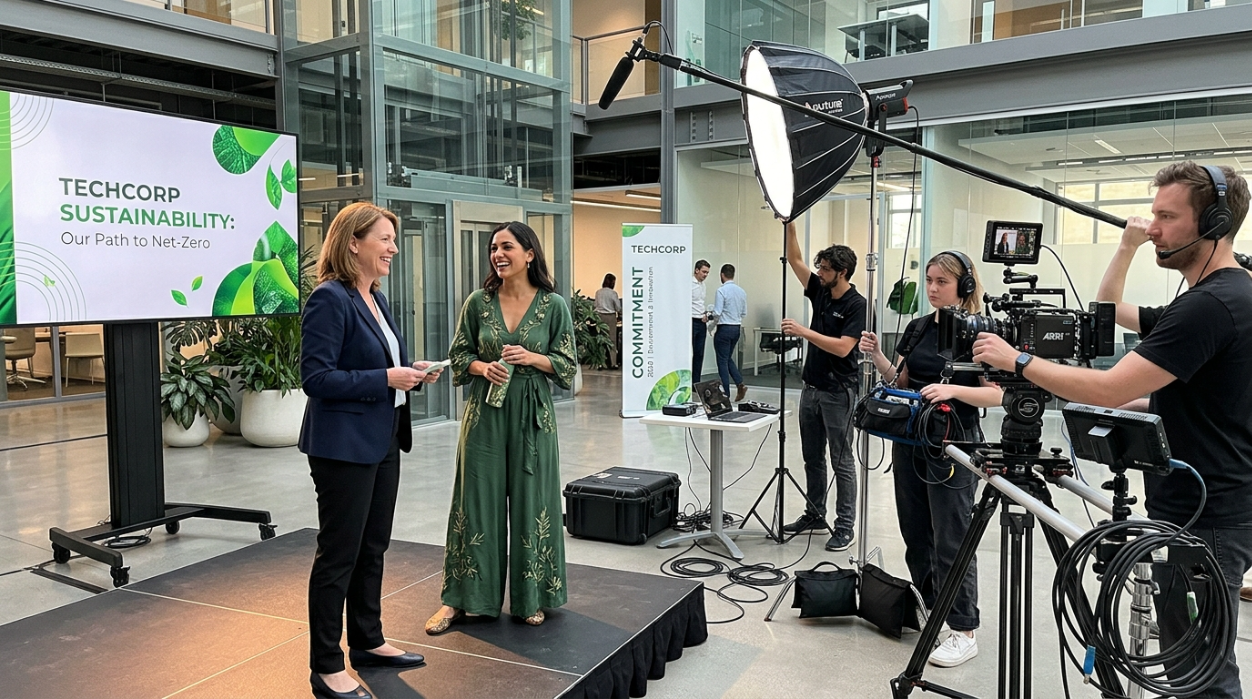
The play: Created by TBWA\Media Arts Lab, Apple’s 2023 campaign featured Octavia Spencer as “Mother Nature” visiting Apple Park to interrogate Tim Cook and his team about the company’s environmental commitments. The mockumentary format used humor, quirky characters, and polished production to walk viewers through intricate sustainability topics.
Why it works:
The format broke from the standard corporate sustainability video. No infographics, no earnest voiceover. Just a funny, high-production sketch with real data woven in.
It made Apple’s environmental progress feel like a narrative rather than a report.
The celebrity casting and Apple’s distribution muscle guaranteed reach.
The numbers: The video garnered 3.8 million YouTube viewers within a week of release and reached 5 million by 2024.
What to steal: Complex sustainability data doesn’t have to be boring. Invest in the creative format, not just the message. Entertainment value drives shareability.
Honest caveat: Apple openly acknowledged that its 2020 pledge to achieve carbon neutrality by 2030 is not sufficient. Even this well-received campaign drew criticism for vagueness on certain targets. Scale and production budgets like this are obviously out of reach for most brands.
4. The North Face, “Explore Mode” and the Earth Day Holiday Petition
Best for: Outdoor and lifestyle brands whose core product is connected to nature and who can build coalition partnerships around a shared cause.
The play: In 2019, The North Face launched a Change.org petition to make Earth Day a nationally designated holiday. For the first time in the brand’s history, it closed all 113 US and Canadian stores and its headquarters on April 22. The petition was co-sponsored by National Geographic, Clif, S’well, the Girl Scouts, and Headspace.
Why it works:
The store closure gave the campaign teeth. It wasn’t just words; it cost the company a day of revenue.
The coalition approach multiplied the reach without multiplying the budget. Each partner brought its own audience.
Framing Earth Day as a potential national holiday elevated the conversation beyond any single brand.
The numbers: The petition gathered nearly 200,000 signatures. The coalition of brands created cross-promotional visibility that a solo campaign couldn’t have achieved.
What to steal: Coalitions beat solo plays. Find partners whose audiences overlap with yours but whose products don’t compete. For more on this model, see examples of cause marketing campaigns that used partnership structures effectively.
Honest caveat: Critics noted that closing stores on one day while continuing business as usual the other 364 is more symbolic than substantive. The gesture needs to connect to year-round action.
5. Google, “Your Plan, Your Planet”
Best for: Tech brands and digital-first companies looking to create utility-driven sustainability content rather than awareness messaging.
The play: Google partnered with the California Academy of Sciences and the Ellen MacArthur Foundation to create “Your Plan, Your Planet,” an interactive online tool for eco-friendly living. It walks users through practical changes across four pillars: water, food, energy, and stuff (the fourth was added for Earth Day 2019 through the Ellen MacArthur Foundation partnership).
Why it works:
It created a utility, not just a message. Users could set actual sustainability pledges that synced with Google Calendar for follow-up reminders.
The tool addresses the intention-action gap directly by converting abstract concern into concrete, scheduled actions.
Partnership with credible scientific and circular economy organizations gave it authority that a solo Google effort wouldn’t have had.
The numbers: The site received the Favorite Website Award of the month in October 2018. Ongoing engagement data isn’t public, but the tool remains live years after launch, suggesting sustained utility.
What to steal: Build something people use after April 22, not just something they watch. Sustainability tools that integrate into daily routines outperform one-off content.
Honest caveat: Google’s own environmental footprint (data centers, energy consumption) creates an inherent tension. The tool works because it focuses on individual action rather than making claims about Google’s own impact.
6. Mastercard, Priceless Planet Coalition
Best for: Financial services and B2B brands looking to use ecosystem partnerships for measurable, long-term environmental impact.
The play: On Earth Day 2021, Mastercard repurposed its iconic “priceless” tagline for the Priceless Planet Coalition, pledging to restore 100 million trees. The coalition now includes over 150 corporate and financial partners, with restoration projects at 22 sites worldwide.
Why it works:
The “priceless” brand equity transfer is seamless. It connects a well-known tagline to something tangible.
The partnership ecosystem means Mastercard isn’t acting alone, which distributes both cost and credibility.
Rigorous measurement: all projects monitor 13 required and six optional metrics of success for five years after planting.
The numbers: As of spring 2024, 17 million trees representing more than 600 species have been funded across close to two dozen countries, with about 12 million trees planted and established.
What to steal: Long-term commitments with transparent measurement beat splashy one-off announcements. If you’re making a pledge, build the monitoring infrastructure on day one. This is a strong example of a sustainability campaign that drives results through partnership and accountability.
Honest caveat: Tree planting has faced criticism as a carbon offset mechanism when it’s disconnected from broader decarbonization. The five-year monitoring protocol helps address this, but the 100-million target remains ambitious relative to current progress.
7. Starbucks, Reusable Cup Earth Day Campaign
Best for: CPG and food/beverage brands wanting to tie product behavior directly to sustainability outcomes at point of purchase.
The play: Each year, Starbucks uses Earth Day to promote reusable cups and waste reduction through limited-time offers and region-specific activations. In Peru, for example, the first 40 customers per store who purchased select drinks received a free reusable cup.
Why it works:
It targets a specific, measurable behavior: using a reusable cup instead of a disposable one.
The data behind it is striking. Despite 73% of consumers owning a reusable cup, only a third say they use them regularly. Starbucks’ campaign directly addresses that gap.
The regional customization lets each market adapt the activation to local consumer habits.
What to steal: Design for behavior change at the moment of purchase, not just awareness. Giving people the tool (the cup) is only half the job. The campaign needs to create the habit.
Honest caveat: Starbucks’ core business model still depends on single-use consumption at massive scale. The reusable cup push, while genuine, represents a small fraction of total transactions. For more on how brands can design for behavior change, the gap between ownership and usage is the key challenge.
8. Purpose Disruptors, “Good Life 2030” and Reclaim the Commercial Break
Best for: Agencies, industry organizations, and advocacy groups willing to turn the mirror on their own sector.
The play: Purpose Disruptors, an advertising reform group, used Earth Day 2023 to highlight the advertising industry’s own contribution to overconsumption and climate change. Their approach flipped traditional advertising on its head, questioning the industry’s role in driving the very consumption patterns that fuel environmental damage.
Why it works:
The insight is backed by hard data: their Advertised Emissions report found that consumption driven by ads increases the carbon footprint of every UK individual by 32%.
Self-critique from inside the industry carries more weight than external finger-pointing.
The Advertised Emissions framework was adopted by the UN as best leadership practice at COP27.
The numbers: Their sell-out Advertising Earth Day Summit at the Tate Modern drew over 200 industry leaders. The framework has influenced industry conversations well beyond the event itself.
What to steal: The most powerful position a brand (or agency) can take is honest about its own complicity. If your industry is part of the problem, saying so publicly builds more credibility than pretending otherwise.
Honest caveat: This works for organizations whose audience is the industry itself. Consumer-facing brands need a different tone, one that acknowledges the tension without alienating the customer.
9. Lundberg Family Farms, “Every Ducking Day is Earth Day”
Best for: Smaller brands with genuine, visible ecological practices who want to prove you don’t need a massive budget to create a memorable Earth Day campaign.
The play: Lundberg’s “Ducking Good” campaign used the playful slogan “Every Ducking Day is Earth Day.” The duck reference isn’t just wordplay. The company floods its rice fields in winter to recreate the original Californian swampland habitat, providing feeding and resting grounds for local ducks and other wildlife.
Why it works:
The campaign is inseparable from the company’s actual operations. There’s no daylight between what Lundberg says and what it does.
The humor makes it shareable without feeling preachy.
It demonstrates that operational authenticity is a stronger foundation than production budgets.
What to steal: If your business has a genuine ecological story baked into its operations, lead with that. Consumers can spot the difference between a company that does something meaningful and one that hires an agency to say it does.
Honest caveat: This model depends on having a literal ecological practice to spotlight. Not every brand has rice fields and ducks. But every brand can audit its operations for genuine stories worth telling.
10. Budweiser, Earth Day Special Can
Best for: Mass-market brands looking for a simple, credible product tie-in that connects to a larger commitment.
The play: For Earth Day’s 50th anniversary in 2020, Budweiser released a special-edition can, donated a portion of beer sales to Earth Day Canada, and pledged that by 2025 all products would be manufactured using only renewable electricity.
Why it works:
The special can created a physical, collectible artifact that put the message in consumers’ hands.
The donation and renewable energy pledge gave the activation substance beyond aesthetics.
The campaign launched during the pandemic, when people were socializing differently, and Budweiser framed it as a shared moment of environmental awareness.
What to steal: A simple product tie-in can work if it’s connected to a verifiable, long-term commitment. The can alone would be empty. The renewable energy pledge gives it weight.
Honest caveat: Special-edition packaging is the most common (and most easily dismissed) form of Earth Day marketing. It only holds up when paired with meaningful action behind the label.
Which Type of Earth Day Campaign Is Best for Your Brand?
The right Earth Day campaign depends on what your business can credibly change or demonstrate. A retailer may be better suited to a circular-economy activation, while a software company can create a sustainability tool or educational experience.
Brand Situation | Best Campaign Approach | Example |
|---|---|---|
Strong sustainability operations | Authenticity-led storytelling | Patagonia |
Retail or physical products | Circularity or resale | IKEA |
Large consumer brand | Entertainment + transparency | Apple |
Outdoor or nature-focused brand | Advocacy + partnerships | The North Face |
Digital or technology company | Interactive utility | |
Financial services or B2B | Partnership + measurable impact | Mastercard |
Food and beverage | Point-of-purchase behavior change | Starbucks |
Advertising or marketing agency | Industry self-critique | Purpose Disruptors |
Small brand | Operational storytelling | Lundberg Family Farms |
Mass-market consumer brand | Product + cause activation | Budweiser |
Patterns That Separate Great Earth Day Campaigns from Greenwash
Looking across these ten campaigns, a few clear patterns emerge.
The best campaigns are year-round commitments that happen to peak on Earth Day. IKEA didn’t build a circular economy program for one day. Mastercard didn’t pledge 100 million trees for a press release. Google’s tool is still live. The campaigns that rank as the best Earth Day campaigns over time are the ones that treat April 22 as an amplification moment, not a starting gun.
Verifiable claims beat aspirational language. Mastercard monitors 13 required metrics for five years. Patagonia quantified the footprint of a single jacket. Apple used a mockumentary format to walk through actual progress. The brands that showed their work outperformed the ones that made promises.
Behavior change trumps awareness. Starbucks’ reusable cup campaign, Google’s pledge-setting tool, and IKEA’s furniture buyback all attempt to change what people do, not just what they think. With NYU Stern reporting that sustainable products grow at nearly three times the rate of the total market (10.9% vs. 4.0% compound annual growth), the commercial case for behavior-focused campaigns is strong.
The greenwash tells are obvious once you know them. One-day social media posts with no year-round connection. Vague pledges like “committed to sustainability” without specifics. Green packaging on products with no underlying supply chain change. The EU’s upcoming Green Transition Directive will make these tactics not just embarrassing but illegal for brands operating in Europe.
Coalitions outperform solo plays. The North Face’s petition succeeded because of its coalition partners. Mastercard’s tree-planting scales because of 150+ partners. Google’s tool gained authority through the California Academy of Sciences and the Ellen MacArthur Foundation. Building alliances distributes cost, credibility, and reach.
For a broader analysis of sustainability campaigns that drive results, these patterns hold true well beyond Earth Day.
7 Greenwashing Warning Signs in Earth Day Campaigns

An Earth Day campaign deserves closer scrutiny when:
The claim is vague. Words such as “green,” “eco-friendly,” or “sustainable” appear without explaining what specifically improved.
There is no supporting evidence. The campaign makes an environmental claim but provides no data, methodology, certification, or source.
The campaign is disconnected from operations. The marketing promotes sustainability while the underlying product, supply chain, or business model remains unchanged.
The environmental benefit is too small relative to the headline claim. A minor packaging change should not be presented as evidence that an entire company is sustainable.
The campaign exists for one day. The brand disappears from the issue immediately after Earth Day.
The campaign relies on imagery instead of evidence. Green colors, forests, leaves, animals, and recycling symbols do not prove environmental performance.
The brand cannot explain how impact was measured. A credible campaign should be able to identify what changed, how it was measured, and over what period.
How to Plan Your Own Earth Day Campaign
If these examples have you thinking about your own brand’s Earth Day activation, here’s where to start.
Diagnose before you create. The biggest mistake brands make is jumping to creative execution before understanding their actual sustainability position. What are your verifiable commitments? Where are the gaps? What can you credibly claim? An honest internal audit is worth more than a brilliant concept built on a shaky foundation.
Explore Grounded World’s strategic tools for a structured approach to assessing your brand’s sustainability landscape before building your campaign.
Design for behavior change, not just awareness. The intention-action gap is real: over 70% of consumers express willingness to change, but actual purchasing behavior lags far behind. Your campaign should make the sustainable choice easier, more visible, or more rewarding, not just more known.
Build coalitions, not solo plays. Find partners whose audiences complement yours. Share the investment. Share the credibility. A coalition campaign reaches further and faces less skepticism than a brand acting alone.
Measure and report outcomes. Decide what success looks like before launch, not after. Track it publicly. The brands that survive greenwashing scrutiny are the ones with data.
Make it last beyond April 22. If your campaign can’t sustain itself past Earth Day, it’s a social media post, not a strategy.
What Not to Do With an Earth Day Campaign
Avoid these common mistakes when planning an Earth Day campaign:
Don't make Earth Day the entire sustainability strategy
A temporary campaign cannot compensate for weak year-round environmental practices. Use April 22 as an amplification point for commitments that already exist or that the company is prepared to maintain.
Don't lead with a vague sustainability claim
“Go green,” “better for the planet,” and similar language provide little useful information without supporting evidence. Explain exactly what changed and why it matters.
Don't confuse visibility with impact
Views, impressions, likes, and shares measure attention. They do not necessarily measure environmental impact. Pair marketing metrics with a meaningful behavioral, operational, or environmental KPI.
Don't make the customer do all the work
Asking consumers to “make better choices” is weaker than designing a campaign that makes the better choice easier. Give customers a tool, incentive, service, product option, or specific action.
Don't stop on April 23
The strongest Earth Day campaigns create a bridge into the rest of the year. Decide what continues after Earth Day before the campaign launches.
Frequently Asked Questions
What makes the best Earth Day campaigns different from regular sustainability marketing?
The best Earth Day campaigns use April 22 as an amplification point for year-round commitments, not as a standalone event. They’re backed by verifiable operational changes, tied to measurable outcomes, and designed to change consumer behavior rather than just raise awareness. Regular sustainability marketing often operates in the background. Earth Day campaigns concentrate attention and create a moment of accountability.
How can small brands create effective Earth Day campaigns without big budgets?
Lundberg Family Farms proves that operational authenticity beats production budgets. Small brands should lead with genuine practices already embedded in their business, whether that’s supply chain choices, waste reduction processes, or community partnerships. A real story told simply outperforms a polished campaign built on thin claims.
How do you tell if an Earth Day campaign is greenwashing?
Look for three warning signs: the campaign makes vague claims without specific data, the brand has no visible year-round sustainability commitment, and the messaging is disconnected from the company’s actual business model. Starting in September 2026, the EU will legally ban unsubstantiated environmental claims, raising the stakes for brands that rely on vague language.
What is the intention-action gap in sustainability marketing?
The intention-action gap describes the disconnect between what consumers say they want (over 70% claim they’d change purchasing habits for the environment) and what they actually do (sustainable products capture roughly 25% of CPG market share). The best Earth Day campaigns address this gap by making sustainable choices more convenient, tangible, or rewarding at the moment of decision.
Which Earth Day campaign generated the best measurable results?
By commercial metrics, Patagonia’s “Don’t Buy This Jacket” is hard to beat: sales rose 30% to $543 million despite the anti-consumption message. For partnership scale, Mastercard’s Priceless Planet Coalition has funded 17 million trees across two dozen countries. For media reach, Apple’s “Mother Nature” hit 5 million YouTube views within a year.
Are Earth Day campaigns still relevant in 2026?
More relevant than ever, but the bar is higher. Earth Day 2026’s “Our Power, Our Planet” theme reflects a shift toward political organizing and policy defense. Consumers are more skeptical of corporate sustainability claims, and EU regulations are about to enforce accountability. Brands that show up with substance will stand out. Brands that show up with empty gestures will face backlash.
How should brands prepare for the EU Green Transition Directive’s impact on Earth Day campaigns?
Any brand marketing to EU consumers should audit its environmental claims now. The directive bans terms like “eco-friendly,” “green,” and “carbon neutral” unless backed by recognized third-party certification. Claims based solely on carbon offsetting are also prohibited. Start building the evidence base and certification infrastructure before the September 2026 enforcement date.
Where should a brand start if it wants to build a credible Earth Day campaign?
Start with a honest assessment of your sustainability position. Understand your actual environmental impact, identify what you can credibly claim, and build your campaign around verifiable commitments. Then design for behavior change, recruit partners, and set measurable goals. If you need expert guidance on bridging the gap between sustainability commitments and commercial outcomes, reach out to Grounded World for a conversation about where to begin.