 Phil White
According to the UN Global Compact - Kantar CMO Blueprint for Sustainable Growth, less than 6% of senior marketing and global sustainability professionals say they know how to align consumer needs and category growth drivers with their sustainability goals and commitments.
Sustainability initiatives often fail, flounder, or don't even get off the ground because they struggle to earn leadership support and internal buy-in. That's usually because they can’t clearly demonstrate how they drive commercial value by connecting to brand, business or go-to-market strategy.
If you're struggling to get buy-in and good intentions aren't translating into revenue growth, grounded has developed an AI-driven landscape assessment tool that can help you identify the biggest intention-action gaps, quantify the lost opportunity, and build the business case—to make sure your teams align and you can prove the return on investment.
What is an Intention-Action Gap?
“The intention-action gap describes the discrepancy between our intentions, or what we plan to achieve, and our actual actions, or what we ultimately do.” — The Decision Lab
This is the biggest problem with consumer research. People rarely say what they mean or do what they say. It's why our New Year’s resolutions die by February, despite the gym membership and Lycra leggings. In business, it’s why sustainability initiatives are discussed at length in meetings - always awaiting more data - but never get off the ground.
Intention-action-action gaps also show up in other ways. Sometimes good intentions can inadvertently cause actions or consequences that do more harm than good!
.webp)
The Trader Joe’s reusable tote is a perfect cultural parable. Trader Joe’s introduced the “Save a Tree” bag in the 1970s, designed as an alternative to disposable bags (TastingTable). Their hope was to encourage sustainable shopping habits. Then TikTok got involved.
The bags went viral. Limited edition drops sold out. Social media feeds filled with Millennial and Gen Z consumers showing off their collection of stylish shopping totes. The Trader Joe's tote bag was a classic example of an intention-action gap that ushered in unintended consequences.
The law of unintended consequences refers to the idea that actions or decisions can have unforeseen and unintended consequences, often in ways that are not immediately apparent. tutor2u.net
The exclusivity of the bag in the U.S. piqued the interest of consumers all over the world, especially in Japan (BBC). The carbon footprint of shipping a $3 canvas tote from California to Tokyo for resale generated an environmental impact that dramatically exceeded any benefit from replacing a disposable bag.
In fact, a 2018 study by the Danish Environmental Protection Agency found that an organic cotton tote must be reused up to 20,000 times to offset its production impact compared to a single-use bag (Beyond Plastics). When reusable bags are overproduced and underutilized, they can generate waste that's comparable to the single-use plastics they were intended to replace.
Good intent does not automatically create better outcomes. Without clarity around behavior, context, and impact, sustainability efforts can sometimes create the opposite of what companies set out to solve or achieve.
What are the Different Types of Intention-Action Gaps?
Not all gaps are the same. Before you can close one, you need to identify which kind you have and where the bottle neck is across you value chain.
- Consumer Decision Gaps: Sustainability messaging fails to influence purchasing behavior or conversion.
Consumers see the messaging but don’t connect with it. They aren’t convinced that the purchase is worth the cost, effort, or behavior change. Usually it's because a sustainability reason to believe isn't connected to a category growth driver (needstate)…so it never translates into a reason to buy. Its like a gift with purchase…if you've already decided that's what you're going to buy.
“Most consumers neglect the products’ environmental impact when making purchase decisions of fast-moving consumer goods.” – Science Direct
- Credibility Gaps: claims, reporting, or storytelling that lacks trust, proof, or differentiation.
A brand may well have sustainable intent, but when its claims are too broad, generic, unsubstantiated or even misleading consumers struggle to see what makes the product “worth it.” and may even boycott it.
For example, Shein was fined €40 million for misleading consumers about discounts and environmental impact in France. The case triggered a wave of critical press across Europe (Fashion Dive, Sourcing Journal, ABC News, Eco-Business) that fed into broader consumer distrust of Shein's sustainability messaging, and coincided with heightened public hostility toward the brand in France — including protests and calls to shun retailers hosting Shein — when it opened its first physical store in Paris that November.
“62% of consumers believe companies are engaging in greenwashing, up from just a third in 2023 and over half in 2024.” – edie
- Capability Gaps: Internal teams lack the alignment, tools, or cross-functional integration needed to execute effectively.
Teams recognize the need for sustainability initiatives and want to close the gap, but they often don’t have the budget, leadership support, or resources to move from intention to action (*Read more: *Why Teams Want to Act — But Don’t).
“While 93% of respondents consider sustainability important to commercial success, only half of leadership teams are “highly focused on sustainability.” Further, only half of those 50% are allocating the “necessary levels of capital.” – Impakter
- Retailer Alignment Gaps: Brands struggle to demonstrate the commercial value retailers need to see in order to prioritize support, preferential placement, feature, display or collaboration.
Brand Activation for Good is a one day workshop that maps retailer sustainability goals and commitments back to the commercial drivers of your brand and business
In the workshop, we identify and prioritize the biggest intention-action gaps along the path to purchase - to drive the right behavior change at the moments that matter.
“According to NIQ’s 2023 CPG Sustainability Report, 92% of shoppers say sustainability is important when choosing a brand today.” – NIQ
We Have a Sustainability Strategy. So Why Isn't it Working?
What brands can control is how clearly they understand where their own gap lives. Is it a messaging problem? A trust problem? An internal execution problem? A retail problem? Each requires a separate istrategy. Trying to fix the wrong gap is how initiatives fail.
Find Your Gap
To solve problems like this, grounded has built a diagnostic tool that gives companies the clarity they need to see exactly what needs to change and where to start.
.png)
Introducing our AI driven 5C Landscape Assessment Tool
In partnership with Kodeful, we have developed an enterprise-level 5C landscape assessment tool (company, culture, category, consumer and competitor) that can help you identify what your biggest intention-action gaps are, where they are located, and how they’re preventing you from commercializing sustainability and driving cross-functional team alignment.
The platform automatically scans all publicly available digital assets (website, social media etc.), along with your competitors, and compares that data against stated sustainability goals, commitments and reporting. An executive level dashboard and report is then automatically generated that:
- Articulates your brand or company’s belief, purpose and commercial pursuits (v.s. the competition).
- Unearths the cultural insights / themes / trends that are most relevant.
- Finds need states and growth drivers that map best to your business.
- Reveals the barriers and drivers across the consumer journey.
- Defines the commercial job to be done.
- Provides a clear rationale and recommendations for closing the biggest gap between stated sustainability goals and commitments and brand / commercial strategy.
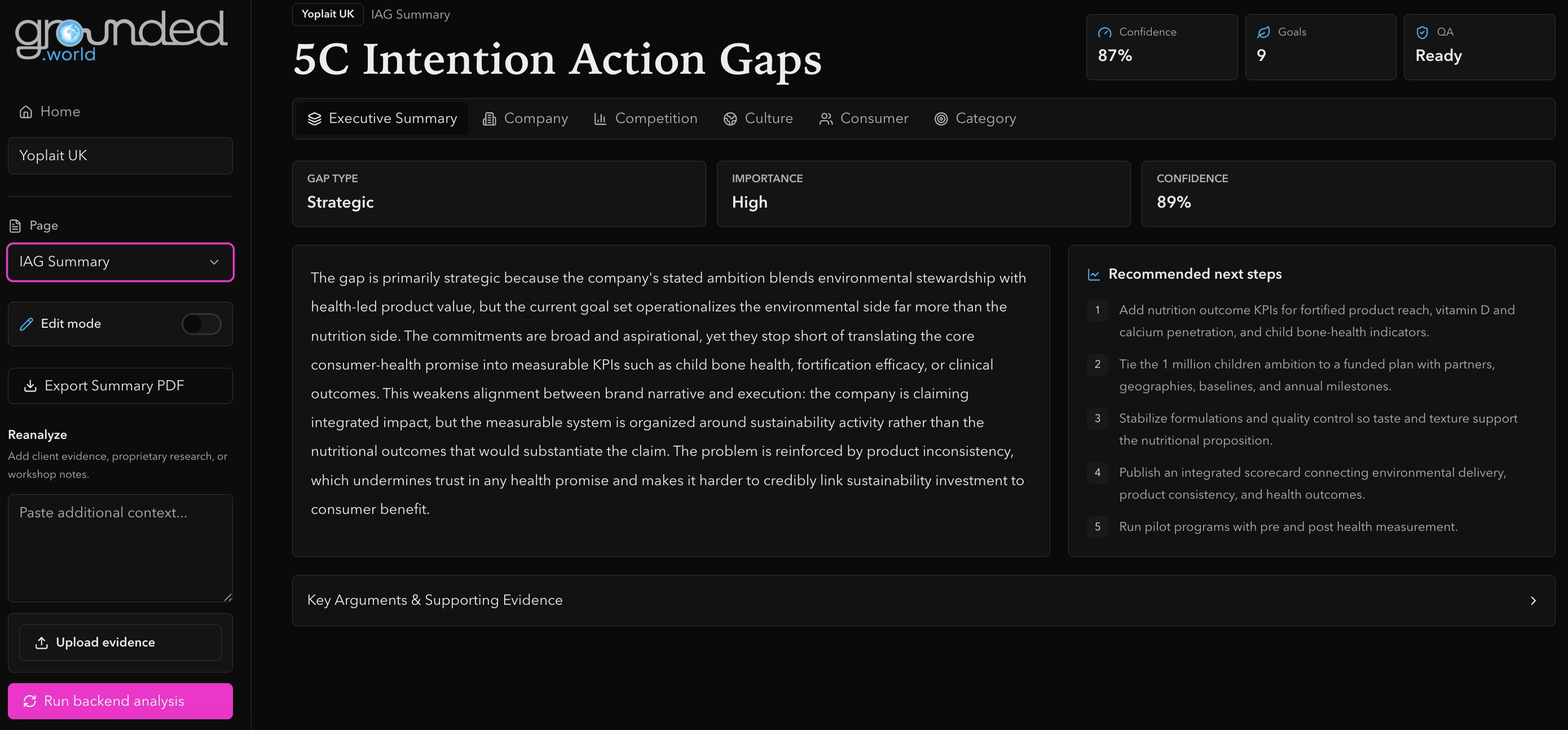
The platform is currently in the pilot phase. Phase 2 of development will be able to quantify the size of the gaps along with the lost commercial opportunity.
Phase 3 will allow subscribers to deploy their own customized AI agents—accessing unique knowledge graphs, deep data, and competitive intelligence to monitor their gaps and stay ahead of the curve.
Brands that win aren’t the ones with big commitments. They know exactly where their intention-action gaps are and have spent time articulating a clear job to be done to close them and commercialize sustainability.
Close your intention–action gap.
If you're struggling to get buy-in and good intentions aren't translating into revenue growth, we can help you identify the biggest gaps, quantify the lost opportunity and build the business case - to make sure your teams get aligned and you can prove out the return on investment.
Works Cited
Beyond Plastics. "Breaking Down the Danish Study on Environmental Impacts of Grocery Bags." Beyond Plastics, www.beyondplastics.org/news-stories/breaking-down-danish-study-on-environmental-impacts-grocery-bags.
BBC Culture. "Trader Joe's Tote Bags: Viral Style and Fashion Status Symbol in Japan." BBC Culture, 19 Mar. 2024, www.bbc.com/culture/article/20240319-trader-joes-tote-bags-viral-style-fashion-status-symbol-in-japan.
The Decision Lab. "Intention-Action Gap." The Decision Lab Reference Guide, https://thedecisionlab.com/reference-guide/psychology/intention-action-gap.
edie. "Greenwashing Concerns Rise Sharply as Brands Fail to Credibly Demonstrate Progress." Edie, 2025, www.edie.net/greenwashing-concerns-rise-sharply-as-brands-fail-to-credibly-demonstrate-progress.
Grounded World. "Why Teams Want to Act But Don't." Grounded World, https://grounded.world/gaia/explainers/why-teams-want-to-act-but-don-t.
Impakter. "Corporate Sustainability: How Big Is the Gap Between Intentions and Implementation?" Impakter, 9 Feb. 2024, ihttps://impakter.com/corporate-sustainability-how-big-is-the-gap-between-intentions-and-implementation/.
Kodeful. kodeful.com.
NIQ. "Conquering the Retail Shelf: New Omnichannel Strategies That Win." NIQ, 2024, nielseniq.com/global/en/insights/analysis/2024/conquering-the-retail-shelf-new-omnichannel-strategies-that-win.
ScienceDirect. "Environmental Sustainability Considerations in Consumer Decision Making." Journal of Retailing, 2024, www.sciencedirect.com/science/article/pii/S0167811624000648.
Tasting Table. "The Real Reason Trader Joe's Reusable Bags Are So Popular." Tasting Table, www.tastingtable.com/1256069/reusable-bags-popular-trader-joes.
UN Global Compact and Kantar. "CMO Blueprint for Sustainable Growth." UN Global Compact, unglobalcompact.org/cmo-blueprint-for-sustainable-growth.

.png&w=3840&q=75&dpl=dpl_FLFrN1LP2avA9S3UwbLG6RxcUGrt)