
 Hope Wehrli
 Most teams are not against sustainability transformation.
They understand why it matters. They know customers, investors, employees, and regulators are paying closer attention. They may even feel personally invested in helping the organization move forward.
And still, action slows.
A team agrees to explore a lower-impact supplier, but the current option is cheaper and easier to defend. A brand team wants to tell a stronger sustainability story, but legal needs more proof. A product team supports innovation, but the next quarterly target makes experimentation feel risky. A commercial team likes the purpose, but cannot see how it helps them hit their numbers.
This is the quiet problem inside many organizations: teams want to act, but the business has not given them enough reason, permission, or support to do so.
That is where sustainability transformation stalls. Not because people do not care, but because caring is not the same as being incentivized to act.
The Gap Between Support and Action
There is a difference between agreeing with sustainability and changing how work gets done.
Agreement is easy to see. It happens in workshops, leadership meetings, strategy decks, and employee surveys. Action is harder. It shows up in budgets, supplier decisions, product roadmaps, claims approvals, sales conversations, and performance metrics.
That difference matters because sustainability transformation depends on behavior change inside the business. It asks teams to make different decisions, often under the same commercial pressure they already face.
The Decision Lab explains that behavior is shaped by the way choices are presented and structured, not only by what people say they intend to do. In behavioral science, this is often described through choice architecture: the idea that the design of a decision environment can influence what people actually choose.¹ That matters inside organizations because teams may support sustainability in principle, but still default to the easier option when the system around them makes that choice faster, safer, or more familiar.
In other words, intention is not implementation.
Why Teams Default to the Old Way
Teams often return to business as usual because it is the path with the fewest consequences.
The current supplier has already been approved. The existing claim language has already passed review. The old process already fits the timeline. The familiar product spec already protects margin. The standard campaign brief already has a known approval route.
The sustainable alternative may be better in the long run, but it often asks for more work upfront. Someone has to gather evidence. Someone has to explain the cost. Someone has to manage a new risk. Someone has to defend the choice if results are not immediate.
That creates a practical barrier. Teams may want to act, but if the organization does not reward the action, protect the risk, or clarify ownership, the easier decision is to wait.
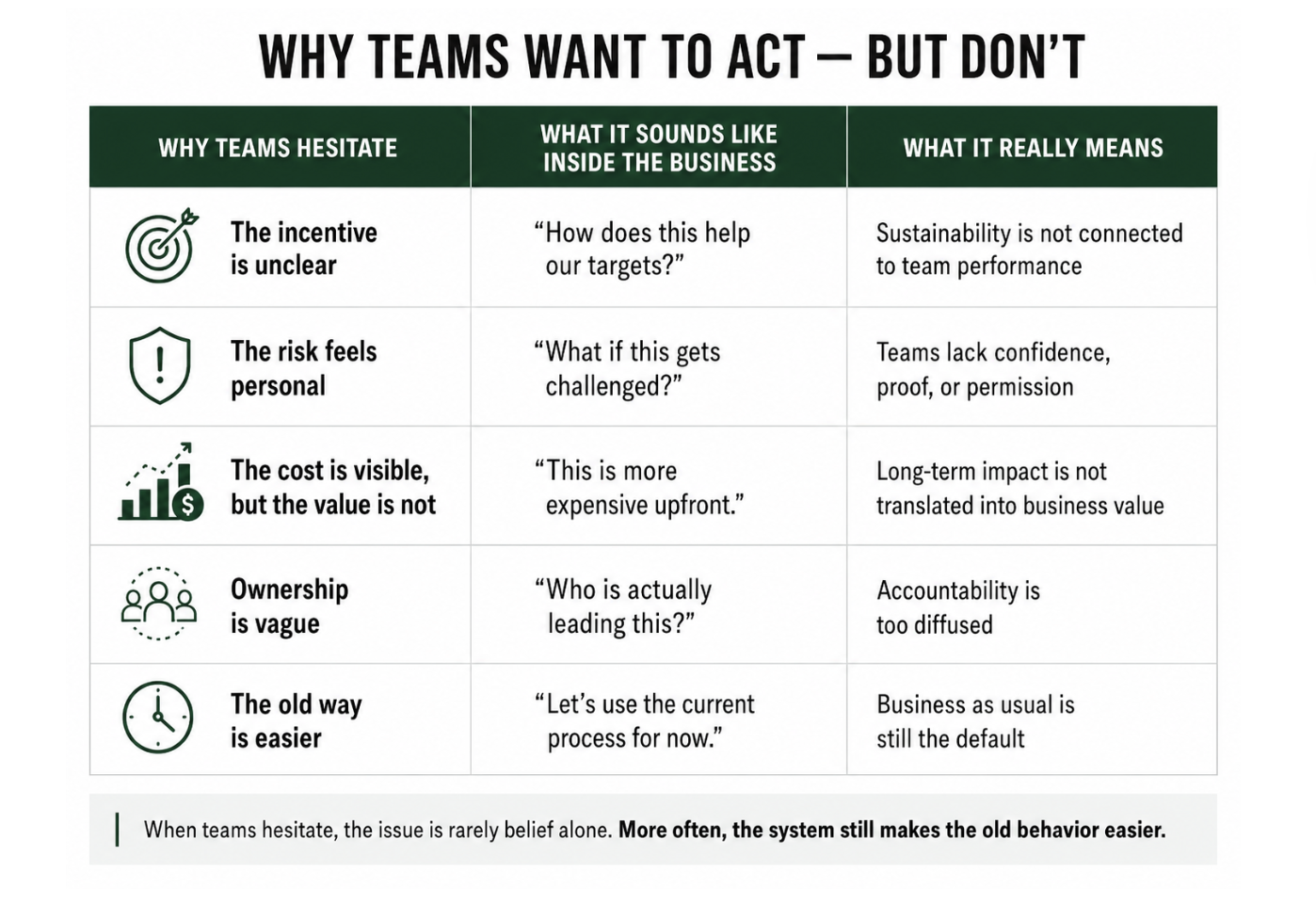
These barriers are not signs of laziness or resistance. They are signs that the organization has not designed sustainability transformation into the way people are measured, supported, and expected to decide.
Incentives Shape the Pace of Transformation
If a procurement team is measured mainly on cost savings, a lower-impact supplier with a higher upfront price will look like a problem. If a marketing team is measured on speed, sustainability proof points may feel like a delay. If legal is rewarded for minimizing risk, claims may become so cautious that they lose meaning. If sales teams are judged on short-term conversion, they may avoid propositions that require customer education.
People respond to the system around them.
That is why a lack of incentives to act can quietly block sustainability transformation. Teams may agree with the strategy, but when the strategy conflicts with their metrics, the metrics usually win.
UNDP’s issue brief on youth and responsible consumption describes an intent-action gap in sustainable consumption, noting that sustainability can matter during research and reflection, but fall from view at the point of purchase when other choice drivers take over.² The same logic applies inside companies. Sustainability may matter during strategy discussions, but disappear from the decision when cost, speed, risk, or quarterly performance becomes more immediate.
Without the right incentives, sustainability becomes something teams approve of in principle but avoid in practice.

The Cost of Unsupported Action
When teams are asked to act without the right incentives, sustainability becomes fragile.
A project may move forward only because one person pushes it. A claim may survive only if one team has the confidence to defend it. A supplier shift may depend on one leader’s willingness to absorb the risk. A campaign may launch only after months of extra coordination.
That kind of progress is possible, but it is not scalable.
Over time, unsupported action creates fatigue. Teams begin to see sustainability as extra work. Leadership wonders why implementation is slow. The sustainability team becomes responsible for pushing the whole organization forward, even though it does not control the systems where decisions are made.
This is how momentum fades. Not all at once, but through repeated moments where the sustainable option is harder to justify than the default.
What the LYCRA VintageFX Case Shows
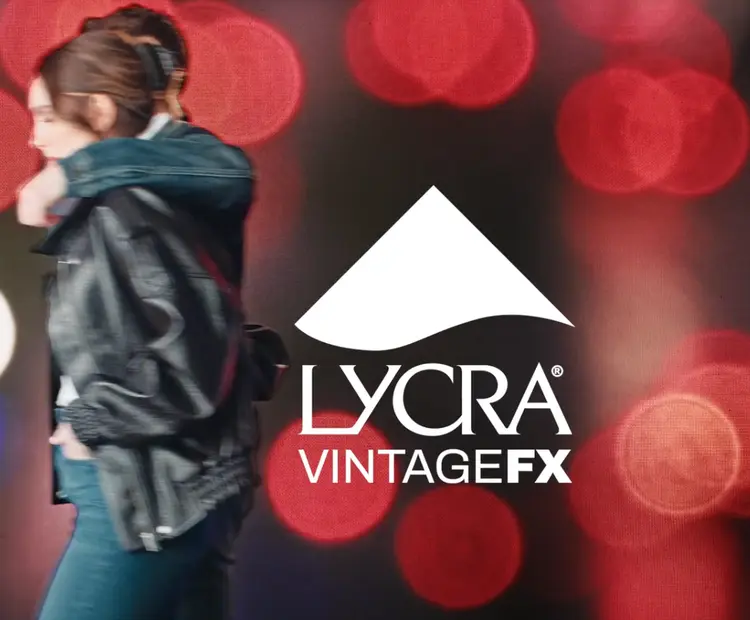
Grounded’s work with LYCRA’s VintageFX HiRes offers a useful example of how innovation can gain momentum when it is translated into a clear, compelling experience. The case study describes an evocative brand activation campaign for LYCRA’s VintageFX HiRes, showing how modern fabric innovation can honor vintage aesthetics while delivering contemporary comfort.³
Make a creative impact.
See what making a creative impact looks like with some award-winning case studies from the Grounded team.
That matters because sustainability transformation often struggles when innovation remains too abstract. A new material, improved product, or lower-impact feature does not automatically move people. It has to be connected to what teams and audiences can understand, communicate, and value.
The LYCRA example shows how a technical innovation can become more actionable when it is turned into a story and experience. Instead of expecting people to care about the feature alone, the activation connected heritage design, performance technology, and consumer relevance.³
LYCRA VintageFX HiRes Brand Activation Case Study
For organizations, the lesson is clear: teams are more likely to act when they can see the value of the transformation. They need more than a mandate. They need a reason that connects to the work they already do.
What Stronger Organizations Do Differently
Organizations that make sustainability transformation easier do not rely on goodwill alone. They redesign the conditions around action.
They connect sustainability to team KPIs. They clarify who owns decisions. They give people stronger proof points. They build claims guidance before campaigns reach legal review. They bring sustainability into procurement, product, and commercial planning early enough to shape decisions instead of correcting them later.
The World Economic Forum has written that sustainable choices are often harder when affordability, trust, and product confidence are weak. Its 2026 World Consumer Rights Day piece emphasizes that trust is crucial because consumers often return to familiar options when they lack confidence in sustainability claims.⁴ Internally, the same principle holds: teams need confidence in the proof, the process, and the business value before they will choose a new path.
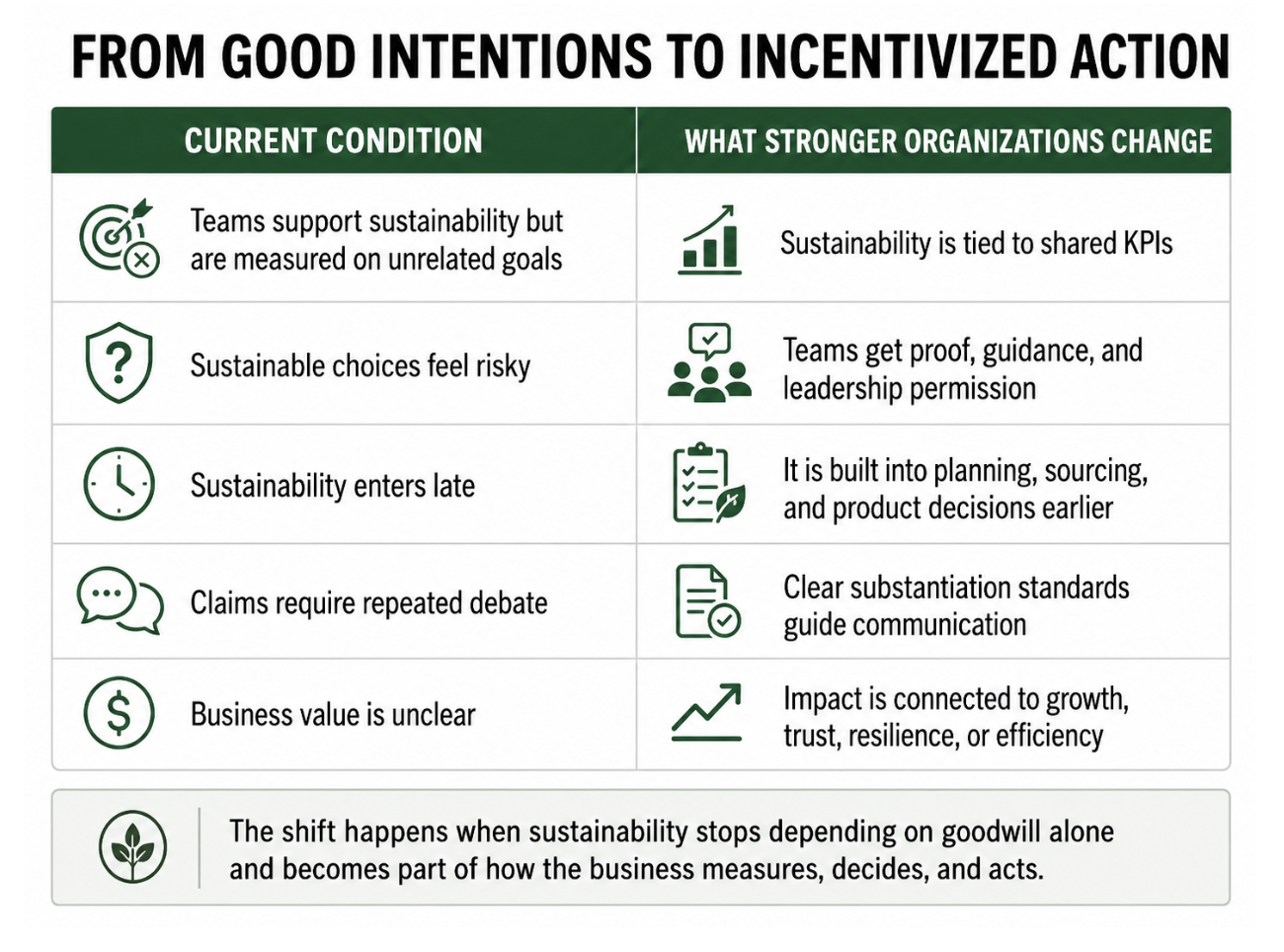
This is where sustainability transformation becomes more practical. The organization stops asking teams to act on belief alone and starts making action easier to defend.
How the Friction & Incentive Audit Helps
Grounded’s Friction & Incentive Audit is built for organizations asking:
“We want to move forward, so what is actually slowing us down?”
It identifies the operational barriers and misaligned incentives that keep teams from acting. Instead of assuming the problem is motivation, it looks at the conditions around decision-making.
The audit asks:
Which teams support sustainability but lack a clear reason to act?
Where do KPIs reward business as usual?
Which decisions feel too risky without stronger proof?
Where is ownership unclear?
Which approval processes create unnecessary drag?
What would make the sustainable choice easier, faster, or more valuable?
The point is not to blame teams for moving slowly. Most teams are responding logically to the system around them. The point is to understand what the system is rewarding and what it is quietly discouraging.
Once those barriers are visible, leaders can redesign the path to action.
Closing the Incentive Gap
If teams want to act but do not, the issue may not be belief.
It may be incentives.
What does the business reward first? What feels safest to defend? What creates extra work without clear value? Which teams are being asked to support sustainability while being measured against something else? Where does the organization say it wants transformation, but still make business as usual easier?
These questions matter because sustainability transformation cannot depend on intention alone. It needs structure, ownership, confidence, and incentives that make action feel possible.
Grounded’s Friction & Incentive Audit helps organizations identify what is slowing teams down, where incentives are misaligned, and how to redesign the conditions that turn support into action.
Because most teams do want to move forward.
They just need the business to make forward movement worth choosing.
Close your intention–action gap.
If your investments in sustainability and social impact aren't translating into sales, growth or internal buy-in, we can help you identify the gap.
Footnotes
- The Decision Lab, “Choice Architecture.”
- UNDP, “Achieving SDG 12: Bridging the Intent-Action Gap among Young Consumers.”
- Grounded World, “LYCRA VintageFX HiRes Brand Activation Case Study.”
- World Economic Forum, “Why Consumers Still Struggle to Buy Sustainable Products.”
Works Cited
The Decision Lab. “Choice Architecture.” The Decision Lab.
Grounded World. “LYCRA VintageFX HiRes Brand Activation Case Study.” Grounded World.
UNDP. “Achieving SDG 12: Bridging the Intent-Action Gap among Young Consumers.” United Nations Development Programme, 4 Oct. 2023.
World Economic Forum. “Why Consumers Still Struggle to Buy Sustainable Products.” World Economic Forum, 15 Mar. 2026.

.jpg&w=3840&q=75&dpl=dpl_2kvohjJNLDGbLCezBymAGSc1UxXC)
.jpg&w=3840&q=75&dpl=dpl_2kvohjJNLDGbLCezBymAGSc1UxXC)
