
 Hope Wehrli
 Most companies do not set out to delay sustainability transformation.
They set goals. They build strategies. They assign workstreams. They talk about innovation, impact, responsibility, and growth. For a while, the momentum feels real.
Then the strategy enters the business.
A team chooses the familiar supplier because switching feels too risky. A campaign avoids stronger sustainability language because the proof points are not fully aligned. A product idea gets softened to protect margin. A packaging update gets pushed into the next planning cycle. A cross-functional initiative becomes one more meeting where everyone agrees, but nothing quite moves.
This is how sustainability transformation loses energy. Not through obvious rejection, but through small returns to business as usual.
The problem is rarely that teams do not care. More often, the organization has not made sustainable action easier than the default. When the familiar path is faster, safer, and better rewarded, even committed teams drift back toward the old way of working.

Why teams default to business as usual
Business as usual is powerful because it is already built into the operating system.
It shows up in the suppliers a company already knows, the approval pathways teams already follow, the KPIs they already report against, and the risk thresholds they already understand. It is not always the best path, but it is usually the clearest one.
Sustainability transformation asks people to interrupt that pattern. It may require a new material, a different claim, a revised sourcing model, a longer-term investment case, or a customer behavior change. Those shifts can be valuable, but they also create extra effort. Someone has to gather the evidence. Someone has to defend the cost. Someone has to explain the risk. Someone has to own the decision if it does not work immediately.
That is where operational friction starts to matter.
Harvard Business Review describes a similar challenge in consumer behavior: people may say they want sustainable products, but positive attitudes do not automatically turn into action. **HBR notes that 65% of consumers in one survey said they wanted to buy purpose-driven brands that advocate sustainability, while only about 26% actually did so.¹ That gap is not only a consumer issue. Inside organizations, teams can believe in sustainability and still choose the easier, more familiar option when the system around them rewards speed, certainty, and short-term performance.
Where sustainability transformation gets stuck
When sustainability transformation slows down, it often looks like a coordination problem. In reality, it is usually a design problem.
The organization may not have made it clear who owns the next move. The business case may not connect sustainability to the metrics teams are judged against. Legal, marketing, procurement, operations, and finance may all be involved, but each team may be protecting a different version of success.
That is how good ideas become heavy.
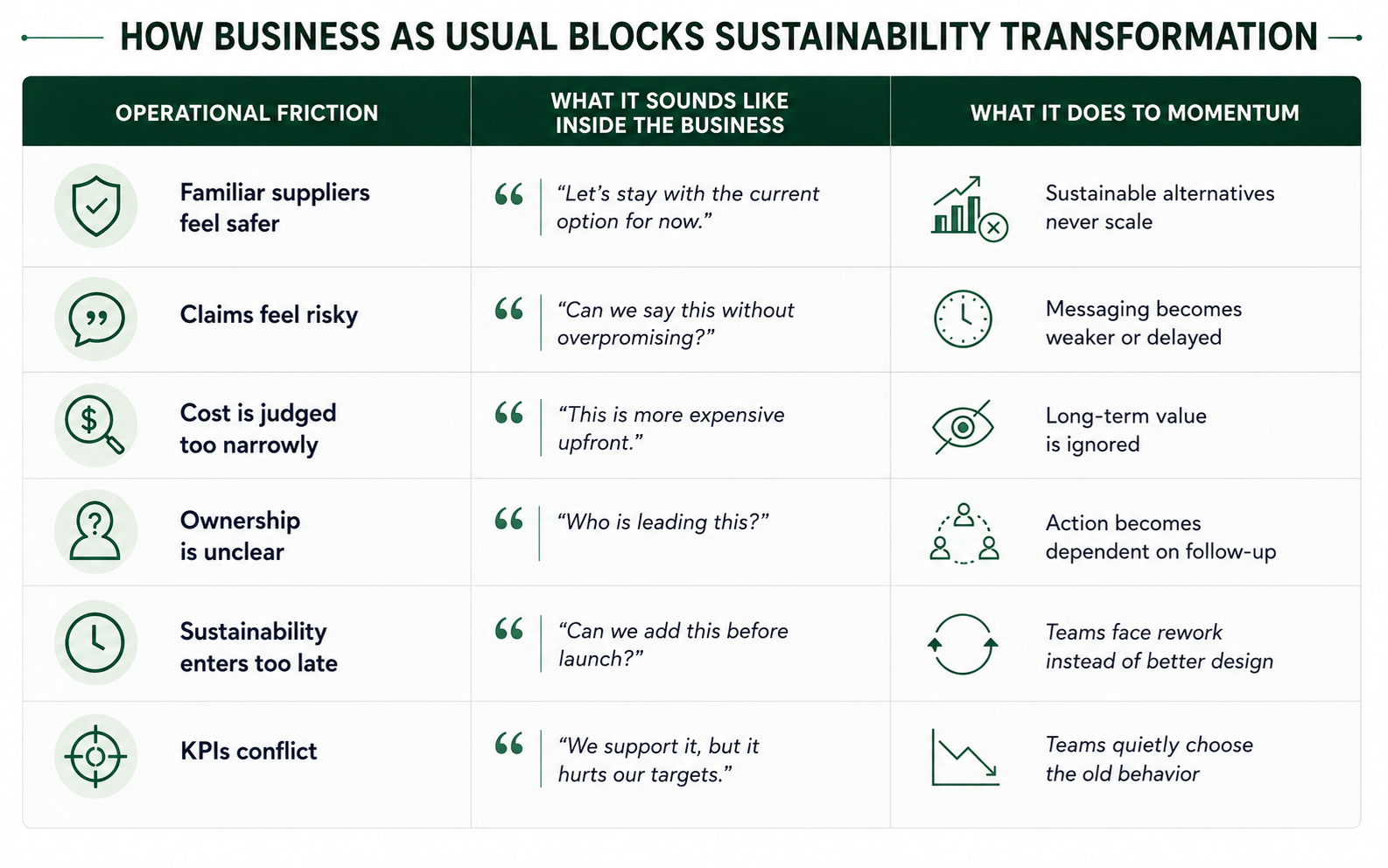
These barriers feel ordinary because they are part of normal business life. But when they repeat across projects, they become a pattern. Sustainability transformation stays visible in strategy documents while everyday decisions continue to favor the default.
The friction is not always resistance

One reason sustainability transformation is difficult to diagnose is that the blockers do not always look like opposition.
A legal team asking for more substantiation may be protecting the company from greenwashing risk. A finance team asking for clearer ROI may be trying to make the investment defensible. A procurement team staying with a familiar supplier may be protecting reliability. A brand team simplifying the message may be trying to avoid customer confusion.
These are reasonable behaviors. The issue is what happens when every team protects its own risk without a shared framework for progress.
That is when sustainability becomes something everyone supports but no one can move decisively.
Forbes contributor Solitaire Townsend argues that the value-action gap is not solved by simply telling people sustainability matters more. The work has to connect sustainable choices to functional, emotional, and social benefits people already care about.² That insight matters internally too. If sustainability is framed only as an obligation, teams will see it as added work. If it is connected to growth, customer relevance, innovation, and risk reduction, it becomes easier to justify inside the business.
What the LYCRA case study shows
Our work with** LYCRA’s Coolmax CloakFXT **shows what happens when sustainability and innovation are translated into a tangible consumer experience. The case study focuses on bringing Coolmax technology to life through an immersive brand activation campaign, with storytelling designed to demonstrate performance benefits such as moisture-wicking, stain resistance, and cooling performance.³** Lycra is making the innovation visible through the benefits consumers care about most.**
Make a creative impact.
See what making a creative impact looks like with some award-winning case studies from the Grounded team.
That matters because sustainability transformation often struggles when internal teams treat innovation as a technical achievement alone. A better material, technology, or product feature does not automatically create momentum. It has to be understood by the people selling it, approving it, communicating it, and experiencing it.
The example points to a broader lesson: transformation moves faster when teams can see the behavior they are trying to change. Instead of relying only on claims or internal language, the work becomes concrete. What does the product do? Why does it matter to the customer? How should the experience make the benefit obvious? What proof points help teams communicate it with confidence?
For sustainability transformation, that kind of clarity reduces internal hesitation. It gives teams something stronger than a goal to rally around. It gives them a reason to act.
The business cost of defaulting back
When teams default to business as usual, the cost is not only slower sustainability progress. It also weakens trust, innovation, and commercial advantage.
A delayed initiative can miss a market window. A cautious claim can make a meaningful improvement sound generic. A product with better impact credentials can fail because sales teams do not know how to explain it. A supplier change can die in procurement because the value case was never translated beyond cost.
Business Vision Magazine argues that sustainable marketing now requires more than isolated green messaging; it depends on product design, responsible supply chains, ethical promotion, stakeholder orientation, evidence, and cross-functional involvement.⁴ The article also notes that sustainable marketing involves multiple parts of the organization and requires senior leadership, KPI shifts, and a willingness to think beyond short-term profit.
That is why operational friction is so damaging. It does not just delay one initiative. It trains the organization to treat sustainability as a special project rather than a normal part of how value is created.
What stronger organizations do differently
Organizations that build sustainability transformation into the business do not depend on heroic effort. They make the desired behavior easier to repeat.
They clarify decision rights. They define what evidence is needed. They bring sustainability into planning earlier. They connect impact to the metrics teams already use. They give teams language that is commercially useful, not just ethically correct. They create internal confidence before launching external claims.
Most importantly, they stop treating business as usual as neutral.
Business as usual is a choice. It reflects what the organization has historically made easiest, fastest, and safest. If that default keeps pulling teams away from sustainability transformation, then the default has to be redesigned.
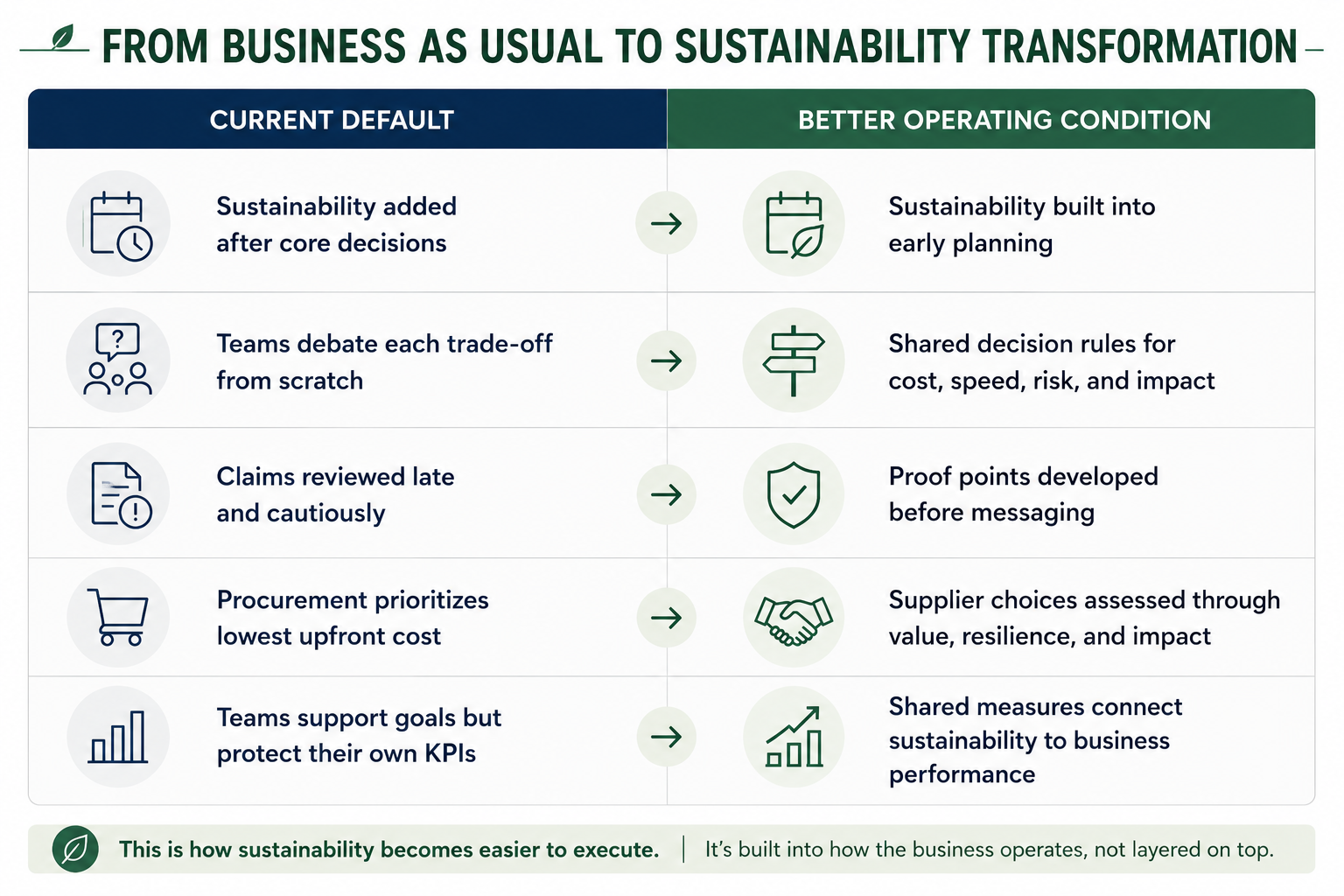
This is where sustainability transformation becomes practical. It stops being a parallel effort and becomes part of how work gets done.
How the Friction & Incentive Audit helps
Grounded’s Friction & Incentive Audit is designed for organizations asking, *“We want to move forward, so what is actually slowing us down?” *
It identifies the operational barriers and misaligned incentives that cause teams to default back to business as usual. Instead of assuming the problem is motivation, the audit looks at the conditions around action.
It asks:
- Where does the work slow down?
- Which teams have influence but no ownership?
- Which incentives reward the old behavior?
- Where does risk management become avoidance?
- What evidence would help teams move with confidence?
- Which decisions need clearer rules?

The value of the audit is that it makes invisible friction visible. Once leaders can see where sustainability transformation is being blocked, they can redesign the path. That may mean changing incentives, simplifying approval processes, clarifying ownership, strengthening proof points, or shifting sustainability earlier in product and campaign development.
The goal is not to force teams to care more. It is to make the desired action easier to choose.
Closing the gap between ambition and momentum
If sustainability transformation is losing momentum inside your organization, the strategy may not be the problem.
The problem may be the default.
What does the business make easiest? What does it reward fastest? What feels safest to defend? Which teams are asked to support sustainability while being measured against something else entirely? Where does the organization say it wants change, but quietly protect business as usual?
These questions are uncomfortable, but useful.
Most organizations already know why sustainability matters. What they need is a clearer understanding of what keeps pulling teams back into old patterns. Once those patterns are visible, they can be redesigned.
Grounded’s Friction & Incentive Audit helps organizations identify the operational friction killing their sustainability momentum, so transformation can move from ambition to action.
Close your intention–action gap.
If your investments in sustainability and social impact aren't translating into sales, growth or internal buy-in, we can help you identify the gap.
Footnotes
- Katherine White, David J. Hardisty, and Rishad Habib, “The Elusive Green Consumer,” Harvard Business Review.
- Solitaire Townsend, “Busting the Sustainability Value-Action Gap,” Forbes.
- Grounded World, “LYCRA Coolmax CloakFXT: Performance Innovation Meets Consumer Experience.”
- Business Vision Magazine, “Sustainable Marketing: Case Studies of Successful Green Campaigns.”
Works Cited
Business Vision Magazine. “Sustainable Marketing: Case Studies of Successful Green Campaigns.” Business Vision Magazine.
Grounded World. “LYCRA Coolmax CloakFXT: Performance Innovation Meets Consumer Experience.” Grounded World.
Townsend, Solitaire. “Busting the Sustainability Value-Action Gap.” Forbes, 26 July 2023.
White, Katherine, David J. Hardisty, and Rishad Habib. “The Elusive Green Consumer.” Harvard Business Review, July-August 2019.

.jpg&w=3840&q=75&dpl=dpl_2nFYNB6e7FMwSBw276o8y1dn2YZ2)
.jpg&w=3840&q=75&dpl=dpl_2nFYNB6e7FMwSBw276o8y1dn2YZ2)