
.png&w=3840&q=75)
 Hope Wehrli
 Every team has its own internal dynamics:
The go getters: pushing for more
The questioners: poking too many holes
The doubters: hesitant to change
These personalities can feel like obstacles, and too many heads looking in different directions makes identifying, implementing, and acting on sustainability feel impossible.
Add this to the fact that right now consumers and stakeholders expect brands to walk the talk, and the stakes for getting it right–or visibly failing to– have never been higher. According to TheRoundup.org, “84% of customers say that poor environmental practices will alienate them from a brand or company”
Sustainability matters. So how do strategies move forward and succeed?
Nike’s “Just Do It”…Stopped Doing It
*Case study sourced from PROPUBLICA *
.jpg)
The Pitch
In 2016, Nike framed its sustainability commitment as a “moonshot,” which would double its business and halve its environmental impact. This meant that the global company would be focusing on sustainability like never before—as a core growth initiative. The company invested in a “Sustainable Innovation team,” in hopes of decreasing consumption and incorporating materials that would have less environmental impact. The strategy worked: “cutting the carbon footprint of the Pegasus 41 midsole by at least 43%.”
This proves they were industry go-getters. Their vision for sustainable research and integration was ambitious. The public was cheering for them to keep moving forward, but how much would it cost to do that?
The Work
By spring 2023, Nike assembled a “Carbon Target Setting Working Group,” bringing together 30 employees who spent over a year meeting biweekly to map out how the company would actually hit its 2030 emissions targets.
Should they invest in renewable natural gas? Improve agricultural practices across its supply chain? Shift toward renewable fuels for shipping? Reduce the weight of paper inside shoe boxes? Reexamine packaging materials?
The group asked these questions and identified what’s worth changing. The result was a rigorous plan that would need approval from executives and Nike’s board to proceed, but operations suddenly slowed.
The Trust Fall .png)
Then everything paused. With sales flattening, Nike announced a plan to cut $2 billion in costs over three years. Companywide, that meant a 2% reduction, condensing the sustainability team by 30%.
About half of the “Carbon Target Setting Working Group” were laid off or moved to non-sustainability roles. And without the power of the team, a member said “the plan was now a stool missing one of its legs.”
This is where the doubters are proven right. They weren’t pessimists, they understood something the go-getters and questioners couldn’t: commitments compete with quarterly pressure, and when the two collide, sustainability rarely wins the fight. Nike's former chief sustainability officer later acknowledged this, saying a shift in business strategy “directly impacted the sustainability strategy, and frankly in a negative way.”
Nike built a sustainability team. The team created a strategy. But when it was time to act, the executives let it fall.
The Gap Reopens
Nike had the intention, but lacked the action to make it possible. This is what’s common across businesses today— they want to be sustainable, but numbers get in the way or the clarity isn’t there.
**That’s the intention-action gap. **
.png)
Get Grounded
As more companies invest in sustainability, closing the intention-action gap becomes critical—not just for brands, but for the impact their choices add up to. As The Harvard Business Review points out, when we start defaulting towards sustainable choices, we stick to them: in one German study, 94% of residents kept green electricity as their default rather than switching away.
Grounded’s 5C landscape assessment helps brands identify where sustainability strategy is losing momentum across company, culture, category, consumer, and competitor dynamics— so teams can close the gap before ambition turns into stalled execution.
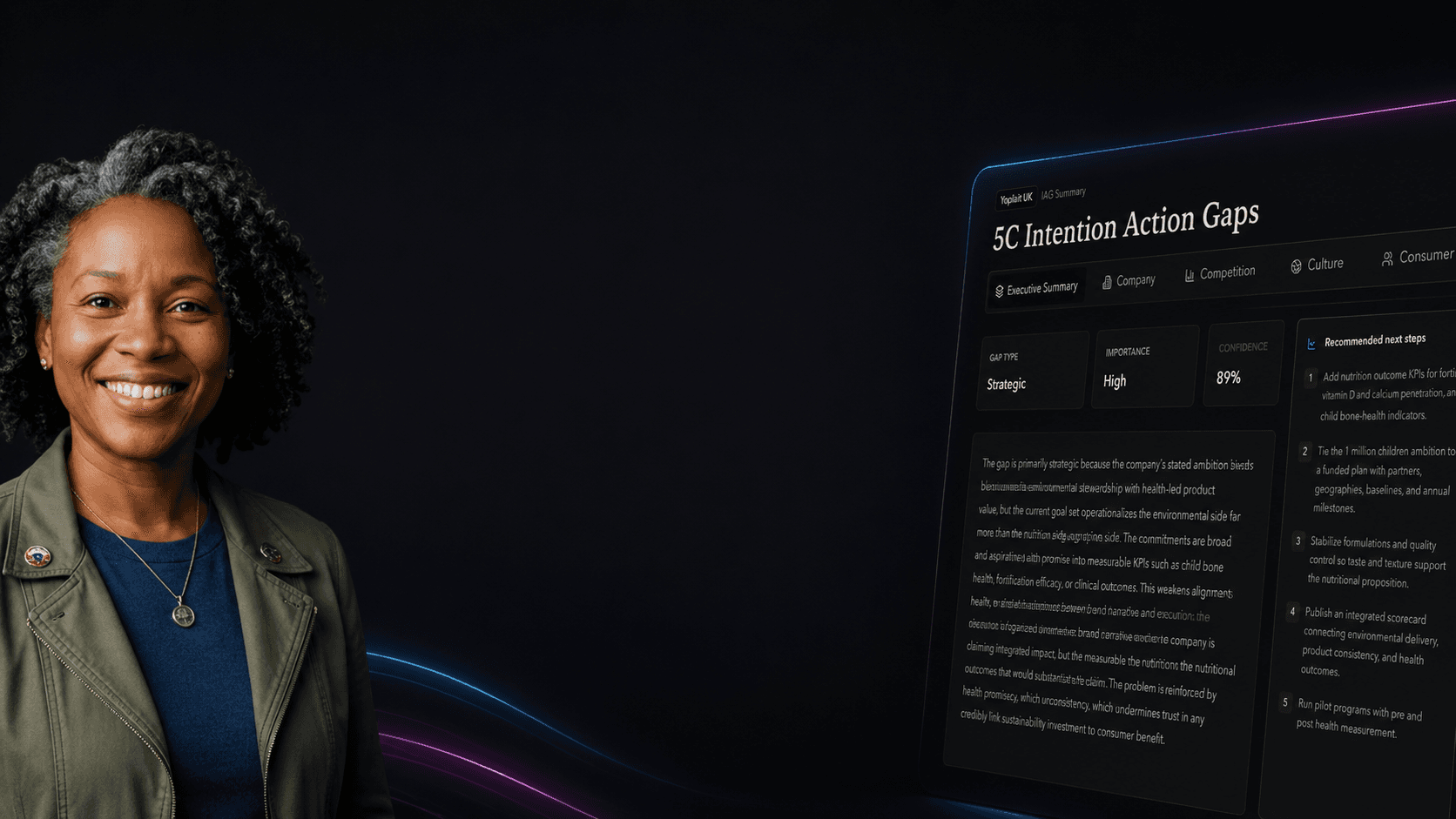
AI-Driven 5C Landscape Assessment
Identify intention-action gaps across Company, Culture, Category, Consumer, and Competitor– and turn insight into action.
Nike had the team, the targets, and the public commitment, but they lacked a structure that protected sustainability when other priorities took over. That's the difference between a strategy that survives a downturn and one that gets put on the back burner.
What’s at stake goes beyond reputation. Narrowing the gap matters not only for meeting corporate sustainability goals, but for the planet itself (HBR).
Close your intention–action gap.
If your investments in sustainability and social impact aren't translating into sales, growth or internal buy-in, we can help you identify the gap.
Works Cited
Ruiz, Arabella. "Greenwashing Statistics and Facts." The Roundup, 2023.

%2520.png&w=3840&q=75&dpl=dpl_9gmcg7kF2iURayF6Cu83WGH1D1nz)