
 Paloma Jacome
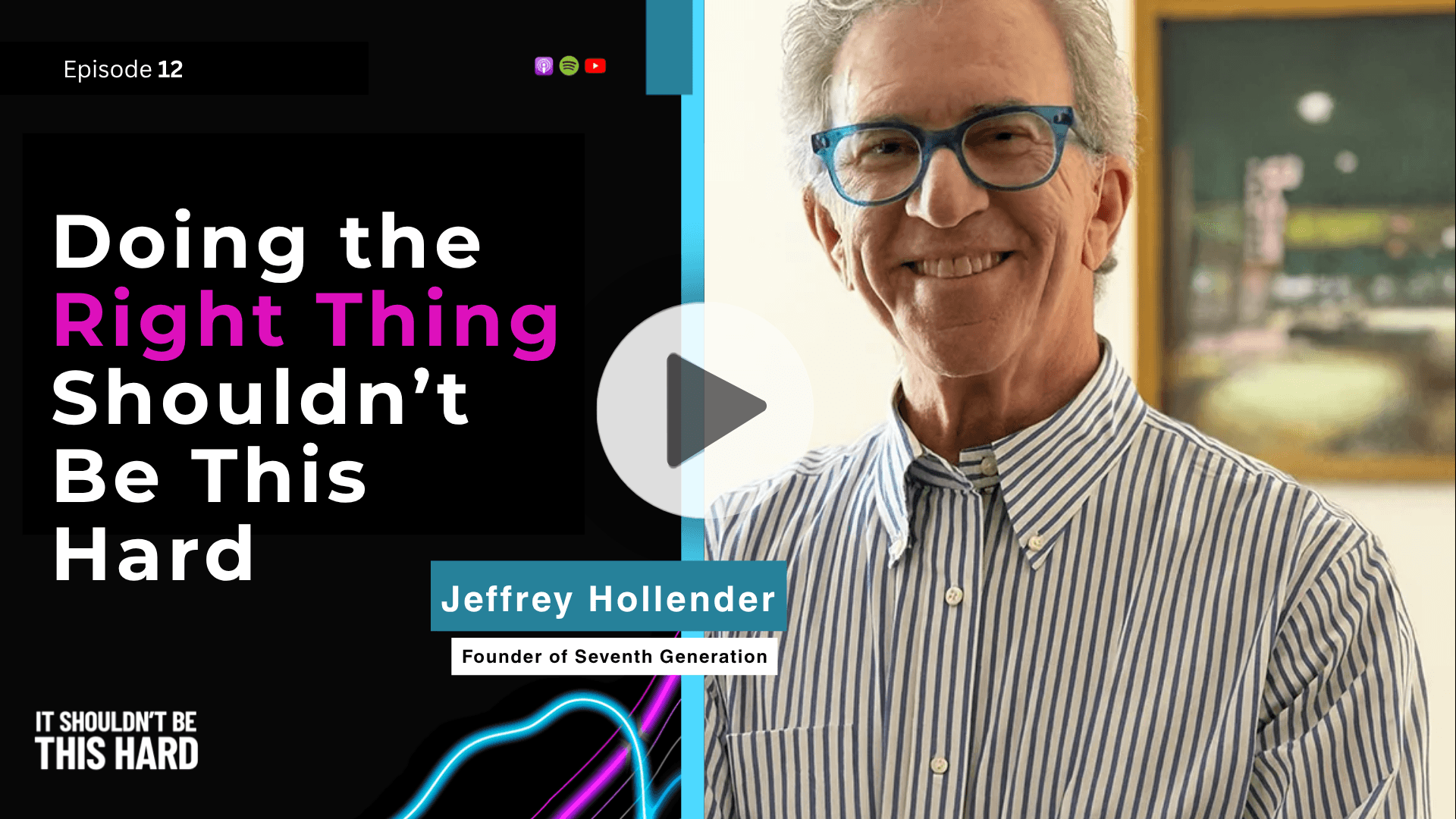
Jeffrey Hollender, Founder of Seventh Generation on Why Doing the Right Thing Shouldn't Be This Hard
A founder's candid conversation about what happens when the company you built around purpose begins to drift and why scaling values-aligned business inside systems designed to reward the opposite is structurally harder than most leaders realize.
When the Founder Gets Fired
Building a company around an important purpose is the easier part. Keeping that purpose intact as the company scales, pressures mount, and stakeholders multiply, that's where most mission-driven organizations fail.
Jeffrey Hollender's story is the uncomfortable version of this. He co-founded Seventh Generation with what seemingly is a straightforward thesis: business should be a force for environmental and social good. Over 15-20 years, he scaled the company from startup to recognizable brand. He influenced an entire industry. He proved the model could work.
Then the board fired him.
"Getting fired from a company you started is no fun. And it was a pretty horrific, painful experience that took many, many months, probably more than a few months, maybe two years to recover from," Hollender reflects on the painful transition.
This isn't only a story about a founder being ahead of his time. It's a story about what happens when governance structures, capital incentives, and stakeholder alignment all work against purpose-driven strategy and what that reveals about how enterprises maintain values-aligned business models.
The Capital Structure Problem: When Your Investors Aren't Aligned with Your Mission
The clearest lesson Hollender draws from his own experience is deceptively simple, but structurally deterministic: the capital you raise shapes the governance you get.
"I took a lot of capital that was traditional private equity venture and hedge fund money, that was a mistake. Because the equity I had was not really aligned with the mission I was trying to accomplish."
This is the hidden governance risk that very few founders discuss until it's too late. You can build a compelling mission. You can execute flawlessly. But if your shareholders are optimizing for different timelines, different risk profiles, or different definitions of success than your stated purpose, the cap table becomes the eventual controller of strategy.
For a company pursuing exponential growth, misaligned capital might not matter: growth masks all tensions. But the moment growth plateaus, the misaligned cap table takes control. Your values aren't what the board decides next. The shareholders' return expectations are.
Hollender was honest about his own role in this: "I was addicted to growth like you might be addicted to cocaine. I was hungry to grow more and more and more. That takes more capital. And that means I made some bad decisions in terms of who I took money from."
The parallel lesson: Growth addiction and misaligned capital are a dangerous combination. They create the conditions for governance failure years or decades down the line.
Being Ahead Without Bringing People Along: The Visionary's Trap
Beyond the capital structure problem, Hollender identifies something equally critical about his own leadership: he was operating far ahead of his board without bringing them along.
"I was way out ahead of my board. I had not brought them along on the journey that I was on, a journey that was deeply committed to things like employee ownership, radical transparency. And because of that, the board became nervous and probably scared of me."
This surfaces a recurring pattern in mission-driven organizations. The founder sees the roadmap clearly. The environmental case is obvious. The business logic seems inevitable. But the board, investors, and executive team are operating on different information, different assumptions about risk, and different timelines.
Co-host Heidi Schoeneck captures the core tension: "You try to be visionary and you look ahead, then you can see the roadmap as how to get there. And you don't understand why it's not always clear to everyone else or the values and the steps that you feel are important to make in making that vision possible."
Hollender's response gets at something deeper: "I think to get to where you want to go, it's not only about creating a plan of how to get there, but it often entails changing who you are and some level of personal growth and increased consciousness to be willing and eager to make those kind of changes. And that's not for everybody."
The strategic implication is uncomfortable: Scaling purpose requires the willingness to slow down on execution in order to align stakeholders. For growth-addicted founders and impatient leadership, this is a difficult trade-off. But it's the difference between a board that supports your strategy and a board that eventually overrides it.
The Hiring and Culture Solution (That Isn't Actually a Solution)
The conventional wisdom says the fix for mission drift is better hiring and stronger culture. Build teams around shared values. Bring in organizational development experts. Create roles dedicated to consciousness and values alignment.
Hollender doesn't dismiss this. He invested heavily in it: "It starts with who you hire and why they want to work for you. If there isn't great alignment there in terms of their motivation and values, you're going to have a tough time."
Seventh Generation worked with external culture consultants for three years. The company even created a dedicated role — a Director of Corporate Consciousness — whose sole job was to bridge the gap between stated organizational values and how people actually made decisions day-to-day.
But Hollender is direct about the limitation: "Yes, but it's a first step and it's not enough."
Why? Because you can optimize culture internally while operating within systems that structurally reward the opposite.
"We've created a context and an environment in which business operates that very often doesn't encourage us to do the right thing," Hollender explains.
Organizations can hire the right people, embed values deeply, and invest in consciousness work. But if the company operates in markets where competitors who externalize costs undercut you on price, if the investors on the cap table are optimizing for traditional returns, if the political environment makes sustainability communication risky…the culture becomes a friction point rather than a solution.
Good people leave when incentive structures override stated purpose. Talented teams burn out when execution excellence doesn't translate to strategic progress. Culture work becomes a retention tool rather than a transformation tool.
The System Problem: Why the Market Rewards the Wrong Things
This is the fundamental tension that sits at the heart of Hollender's analysis: the business system itself is structurally misaligned with purpose-driven business.
Large enterprises avoid taxes while depending on public infrastructure to survive. Competitors minimize labor costs through opacity. Environmental externalities reduce the cost of goods relative to responsible alternatives. Child labor remains profitable despite decades of knowing better.
"We live in a world today, in my opinion, where it's perfectly legal to do things that are unethical and immoral."
This isn't merely an ethics problem or a values problem. It's a competitive economics problem. A company that internalizes costs (paying fair wages, funding supply chain transparency, remediating environmental impact) competes against companies that don't. Without structural market change, the cost-conscious company loses.
For boards evaluating long-term enterprise value, this raises a critical question: How do you build sustainable competitive advantage when the market structure incentivizes the opposite?
The answer Hollender discovered is that you can't do it alone. You need ecosystem alignment and peer networks facing the same problems.
"There was a community of people trying to figure out the same thing at the same time. There were companies like Ben and Jerry's and Patagonia. We shared those challenges with each other and helped each other figure out where we were trying to get to. And without that community, I don't think we would have been successful."
The Endless Hurdle Race: Why Scaling Purpose Means Confronting Barriers Constantly
When asked when it became clear that scaling purpose-driven business would be fundamentally difficult, Hollender reframes the question: "It's more like a hurdle race because there wasn't one barrier. It was a question of which one comes next, not will there be one that we have to jump over today."
The barriers compound across multiple dimensions:
- Board governance concerns: When Hollender served on the Greenpeace board, the Seventh Generation board was uncomfortable. They thought activism was "unbecoming to a CEO." But customers loved it because the values were being lived.
- Capital constraints: Sustainable sourcing costs more than conventional alternatives. Growing fast enough to compete while maintaining operational integrity requires capital that comes with strings attached.
- Supply chain complexity: Real transparency across global supply chains is hard, expensive, and reveals uncomfortable truths about what "sustainable" actually costs.
- Growth pressure vs. values maintenance: The faster you grow, the harder it is to maintain cultural coherence and values alignment.
Hollender is clear: "There's endless hurdles. They start with who you take money from to start the business. But they don't ever go away."
This is the reality that most sustainability frameworks and corporate governance discussions avoid. Building values-aligned business isn't a problem you solve. It's a constraint you continuously navigate.
The Political Risk: When Sustainability Communication Becomes Dangerous
One of the more sobering dimensions Hollender addresses is the current political environment's effect on corporate sustainability strategy.
"We live in an environment where it has become increasingly dangerous to talk about doing the right thing. And we live in an environment where we have a government that puts people out of business for doing the right things."
This isn't activist rhetoric. It's an observation about market risk. Companies increasingly face reputational and regulatory backlash for taking explicit sustainability stances. The result is a paradox: More companies are executing sustainability initiatives than ever, but fewer are willing to discuss them publicly.
"I think companies in the United States, for the most part, are continuing the journey to do what they can do for the environment, even though they're not talking about it because it's dangerous to do so."
This creates a distinct governance challenge. Quiet execution without public commitment means:
- No board accountability for sustainability strategy
- No stakeholder alignment on what the company stands for
- No competitive differentiation (since nobody knows what you're doing)
- No ability to attract values-aligned talent
Companies execute initiatives that nobody knows about, while competitors who stay silent gain the same market benefits with less risk. The business case for transparency erodes when transparency becomes a liability.
For boards navigating the ESG landscape, this is the hidden cost of political polarization: the incentive structure now punishes public commitment to values-aligned business, even as consumers and employees increasingly expect it.
Doing the Right Thing vs. Doing the Right Things: The Integration Problem
Late in Hollender's analysis is a critical distinction that most organizations never fully resolve: the difference between doing the right thing (having the right values, making the right statements) versus doing the right things (executing integrated strategy that actually drives systemic change).
A company can be filled with well-intentioned executives committed to sustainability. The board can approve impressive purpose statements. The CEO can speak eloquently about stakeholder capitalism. But none of that automatically translates into integrated strategic execution.
Hollender articulates the core failure mode: "We can't just decide that we're going to save water and forget about CO2. We can't just decide that we're going to take great care of our staff and pay them very well, but make products that have toxic chemicals in them."
Many organizations approach sustainability as a collection of discrete initiatives rather than integrated strategy. They create a water efficiency program, a carbon reduction roadmap, a diversity initiative, a supply chain transparency effort, each operating independently, without sight lines to the others.
The problem isn't the initiatives themselves. It's the lack of integrated strategy. Without mapping interconnections across your entire value creation system, capital allocation becomes scattered, progress in one area negates progress in another, and the organization fragments.
Hollender describes his solution: teaching every person in the organization systems thinking—"which helps people see the unintended consequences of their actions and the interrelationship of all the things that they are working on."
"It is impossible to figure out what the most important thing you can do without understanding the entire system. Once you can see that system, you can say, okay, where is the greatest problem that we're creating by doing what we do?"
For enterprise leadership, the implication is significant: Strategic sustainability requires portfolio-level thinking, not initiative-level management. Which means it requires different governance structures, different KPIs, and different accountability models than most organizations currently have.
It requires understanding not just what matters, but which specific interventions will actually move the system most efficiently. This is radically different from treating all sustainability initiatives as equally important.
The Real Cost of Building Values-Aligned Business
If there's a thread running through Hollender's entire analysis, it's this: values-aligned business is structurally harder than traditional business and that difficulty is built into the systems, not the people.
You can hire the right people. You can invest in culture. You can articulate a clear mission. But you're still competing in markets that reward externalization. You're still managing cap tables with misaligned incentives. You're still operating in political environments where your values can become liabilities.
This doesn't mean it's impossible. It means it requires:
- Radical clarity on your capital structure: Know what your investors are optimizing for. Align capital with mission before growth becomes addictive.
- Board-level alignment on what success means: Not just rhetorically, structurally. Make sure your governance exists to enforce values, not override them when convenient.
- Acceptance of the slowness trade-off: Purpose-driven scaling often requires growing more slowly than your competitors. That's the cost.
- Commitment to integration, not fragmentation: Treat sustainability as a systems problem, not a collection of initiatives.
- Investment in ecosystem alignment: You can't solve structural problems alone. Find peers, build networks, create communities facing the same barriers.
- Willingness to communicate your values despite political risk: Silence might reduce short-term backlash. But it eliminates the ability to attract and retain values-aligned talent, and it surrenders competitive differentiation to those willing to take the risk.
- Honest acknowledgment that you'll face endless hurdles: Not one barrier to overcome and move past. Continuous tension between values and market forces. The question isn't whether you'll face constraints, it's whether you're committed to navigating them continuously.
Why the Board Problem Matters More Than Most Leaders Realize
Hollender's experience with his own board illustrates something that very few corporate governance conversations address directly: when the board's incentives diverge from the CEO's stated values, the board almost always wins. Not eventually. Immediately.
The founder can have built the company. The CEO can have driven culture and values. The organization can be executing brilliantly against the mission. But if the board perceives the CEO as too far ahead, too committed to values that threaten traditional returns, too unwilling to optimize for shareholder value above all else…the board will replace the CEO.
This is governance functioning as designed.
For any founder or CEO considering building a values-aligned enterprise at scale, this is the central strategic question: What governance structure ensures that values remain the controlling incentive, even under pressure?
It's not enough to be right about the strategy. It's not enough to be driving results. You need board-level agreement (built into the cap table, the charter, the governance) that your values aren't negotiable when things get hard.
The Lessons for Enterprise Leaders
For Chief Strategy Officers, Chief Sustainability Officers, and boards evaluating how to embed purpose into enterprise value creation, Hollender's experience reveals several non-negotiable principles:
1. Capital structure determines strategy. Misaligned investors in your cap table will eventually override your stated values, regardless of execution excellence or cultural strength. Choose capital partners carefully. Prioritize mission alignment over growth speed.
2. Vision without stakeholder alignment is a governance time-bomb. Being right about where the company should go isn't enough. You need board-level, investor-level, and leadership-level agreement on what success actually means.
3. Culture is necessary but not sufficient. You can have the strongest culture in the world. But if the company operates in markets that reward externalization, if the cap table is misaligned, if the political environment makes values risky, culture becomes a retention tool, not a transformation tool.
4. **The market doesn't reward values-aligned business automatically. **Competitors who externalize costs will often undercut you. This is structural, not a reflection of your execution quality. The solution is ecosystem alignment and peer networks, not individual excellence.
5. **Scaling purpose-driven business requires accepting slower growth. **If you try to scale as fast as traditional business while maintaining values alignment, you'll eventually face a choice. Growth addiction and values alignment rarely coexist.
6. Sustainability strategy must be integrated, not fragmented. Initiative-level management creates portfolio inefficiency. You need systems thinking that maps interconnections across value creation and hard choices about what actually matters most.
7. Political risk is now structural to sustainability work. Staying silent might reduce short-term backlash, but it eliminates competitive differentiation and your ability to attract values-aligned talent. The market is polarizing around transparency as a values signal.
8. Community and ecosystem alignment matter as much as internal alignment. You can't navigate structural constraints alone. Peer networks, industry coalitions, and shared problem-solving become operational necessities, not nice-to-haves.
The Uncomfortable Truth
What makes Hollender's story important isn't that he failed. It's that he succeeded in building exactly what he set out to build, and the system still eroded it.
This suggests something more fundamental: that embedding values into enterprise-scale business isn't primarily a problem of people, culture, or strategy execution. It's a problem of structure.
The governance structure. The capital structure. The market structure. The political structure.
Hollender could have been more patient with his board. He could have been slower with growth. He could have been less visionary and less committed. But given the structural misalignments he was navigating, the outcome was nearly inevitable.
The lesson for enterprise leadership isn't that you can avoid this outcome through better leadership. It's that you need to build different structures from the beginning if you want values-aligned business at scale.
And that requires being radically clear, from the start, about what you're actually optimizing for and willing to accept the trade-offs that mission-driven growth requires.
Because if you try to have it both ways — rapid growth, maximum shareholder returns, and uncompromised values — the structure will resolve that tension for you. Usually by eliminating the values part.
Key Principles for Values-Aligned Enterprise Strategy
- On Capital: Prioritize mission alignment over growth speed. Misaligned cap tables become the controlling incentive in moments of tension.
- On Governance: Build board structures that make values non-negotiable. Rhetorical commitment to purpose isn't enough if incentives point elsewhere.
- On Stakeholder Alignment: Spend time bringing people along. Visionary clarity without stakeholder buy-in is a governance vulnerability.
- On Integration: Treat sustainability as a systems problem. Initiative-level management fragments strategy and creates portfolio inefficiency.
- **On Ecosystem: **Build peer networks and industry coalitions. You can't navigate structural constraints alone.
- On Communication: Accept the political risk. Silence might reduce short-term backlash, but it eliminates competitive differentiation and attracts fewer values-aligned employees.
- On Growth: Accept that values-aligned scaling is slower. If you try to scale as fast as traditional business while maintaining values, you'll eventually choose growth over values.
- On Persistence: Understand that you're navigating endless hurdles, not solving a problem. The barriers don't disappear. They continuously change form.
The Question for Your Organization
Hollender's experience reveals a critical insight: the structural barriers to purpose-driven business aren't unsolvable. But they require a different kind of strategy work than most organizations currently do.
Most approaches to sustainability or purpose strategy operate at the surface level. You audit gaps. You implement initiatives. You report progress.
The question isn't whether you can build values-aligned business. Seventh Generation proved you can. The question is whether you're willing to address the structural misalignments that make it feel impossible.
That's where grounded comes in.
We work with enterprise leadership to map the full ecosystem of constraint. We don't start with initiatives. We start with diagnosis:
Where does your stated purpose diverge from your actual incentive structures?
Is your capital aligned with your mission, or embedded with misaligned expectations?
Are your governance structures protecting values, or overriding them under pressure?
How fragmented is your sustainability strategy, and what would integration actually require?
Where are you silencing communication that could differentiate you?
Then we help you rebuild.
If you're navigating the same tensions Hollender faced (if you're trying to embed purpose into enterprise strategy without it eroding under pressure) let's get you grounded.

.png&w=3840&q=75&dpl=dpl_2XYjtNbnM2QcFi3x6GEQU2Gvhmn3)

%2520.png&w=3840&q=75&dpl=dpl_2XYjtNbnM2QcFi3x6GEQU2Gvhmn3)