
 Gaia
GaiaTL;DR
Social impact agencies range from nonprofit-focused digital shops to enterprise strategy consultancies to hybrid firms that tie purpose directly to revenue. The right choice depends on whether you need awareness, behavior change, or commercial outcomes. This guide profiles nine top social impact agencies, compares them on B Corp scores and specializations, and gives you a decision framework to shortlist the best fit. Grounded World leads with the highest B Impact Score (116) among profiled peers and a focus on commercializing sustainability.
Quick Answer: What Are the Best Social Impact Agencies?
If you're looking for the best social impact agency, the right choice depends on your organization's goals rather than simply choosing the largest firm.
- Grounded World – Best for commercial brands connecting sustainability to revenue growth.
- Carol Cone ON PURPOSE – Best for enterprise purpose strategy and CSR architecture.
- Futerra – Best for global sustainability communications.
- BBMG – Best for brand strategy and social innovation.
- HelpGood – Best for nonprofit marketing and cause campaigns.
- Whole Whale – Best for nonprofit digital marketing and fundraising.
- Enso – Best for community-building and creative strategy.
- Matter Unlimited – Best for mission-driven communications.
- DrawHistory – Best for advocacy, public health, and complex social issues.
The strongest agencies combine measurable social outcomes with business impact through strategy, creative execution, behavior-change expertise, and transparent reporting.
Why Top Social Impact Agencies Matter More Than Ever
Purpose-driven marketing is no longer optional. A 2026 joint study by WARC and Ipsos found that purpose-driven creative achieves 38% higher unaided brand recall and 44% higher message association scores compared to product-feature-led campaigns. Separately, research from Nielsen and Wharton shows that purpose-driven campaigns generate 3.6 times the earned word-of-mouth of standard brand campaigns.
The commercial case is just as clear. About 70% of consumers across 25 countries say they buy from brands reflecting their own principles. Nearly 1 in 5 shoppers have changed habits to actively avoid certain retailers. Insurgent brands, despite holding only 2% of overall market share, captured 36% of incremental growth in 2025.
Here’s the catch: most purpose work doesn’t connect to revenue. It sits in a CSR report or a feel-good campaign and never touches the P&L. That disconnect is what Accenture flagged when it found that trust degradation around purpose can cost brands billions. The agencies on this list exist to solve that problem, but they solve it in very different ways.
The real question isn’t “who does social impact?” It’s “who connects social impact to business outcomes?” Most agencies do the first. Few do the second. The gap between consumer intentions and actual purchasing behavior, what’s known as the intention-action gap, is the single most important criterion most brands overlook when selecting an agency partner.
Book a free 5C landscape assessment to understand where your brand sits before evaluating agency partners.
What Does a Social Impact Agency Actually Do?
Many organizations confuse social impact agencies with branding firms, sustainability consultants, or nonprofit marketing agencies. While there is overlap, social impact agencies typically combine multiple disciplines.
Typical services include:
Brand purpose strategy
ESG communications
Sustainability marketing
CSR campaign development
Community engagement
Cause marketing
Stakeholder communications
Behavior change campaigns
Employee engagement
Brand activation
Impact measurement
Partnership development
Reporting and storytelling
Creative campaigns
Digital marketing
Some agencies specialize in nonprofit fundraising while others help commercial brands translate sustainability into measurable business growth.
Types of Social Impact Agencies
Agency Type | Best For | Typical Clients | Main KPI |
|---|---|---|---|
Purpose Strategy Consultancy | Long-term purpose development | Fortune 500 companies | Brand trust |
Sustainability Agency | ESG communications | Enterprise brands | Reputation |
Nonprofit Marketing Agency | Fundraising | NGOs | Donations |
Cause Marketing Agency | Awareness campaigns | Brands & nonprofits | Engagement |
Brand Activation Agency | Consumer behavior change | Retail brands | Sales lift |
Full-Service Social Impact Agency | Strategy + execution | Mixed organizations | Business + social outcomes |
How to Choose a Social Impact Agency
Before scanning the list below, get clear on four things:
Define Your Mandate
Are you a commercial brand trying to make sustainability a growth driver? A nonprofit scaling your reach? An enterprise building purpose architecture across business units? These require fundamentally different agency capabilities. A firm that excels at nonprofit digital fundraising will not help you build a retail activation campaign, and vice versa.
Clarify the Outcome
There’s a spectrum. On one end: awareness, narrative, stakeholder alignment. On the other: purchase intent, revenue growth, measurable behavior change. Most social impact agencies cluster on the awareness end. If you need commercial outcomes, ask specifically how the agency measures them.
Check Credentials
B Corp certification is the most rigorous third-party verification of social and environmental performance. But not all B Corp scores are equal. A score of 80 qualifies for certification; a score above 100 puts an agency in rare territory. Named clients, proprietary frameworks, and published case studies matter more than a logo wall. If you’re building a CSR strategy from scratch, look for agencies with clear methodological rigor.
Ask the Hard Question
Does this agency measure commercial impact, or just social impact? The best social impact agencies do both. If an agency can’t explain how their work will affect your bottom line, they’re a production shop with good intentions, not a strategic partner.
At-a-Glance Comparison: Top Social Impact Agencies
Agency | B Corp Score | Best For | Commercial Focus | Key Clients | Geographic Reach |
|---|---|---|---|---|---|
Grounded World | 116 | Brands commercializing sustainability | High (purpose to profit) | Grove Collaborative, UNMAS, Fresh Air Fund | Global |
Carol Cone ON PURPOSE | N/A (network model) | Enterprise purpose strategy | Medium (strategy-led) | Microsoft, P&G, Unilever | Global |
Futerra | 102.3 | Global sustainability communications | Medium (narrative-led) | Google, IKEA, WWF | Global (5 offices) |
BBMG | Certified since 2007 | Brand design + social innovation | Medium (brand identity-led) | The North Face, Target, Ford Foundation | US-based |
HelpGood | 105.6 | Nonprofit and cause marketing | Low (mission-led) | Ad Council, 80+ social impact clients | US-based |
Whole Whale | 93.7 | Nonprofit digital performance | Low (digital performance) | 200+ nonprofit organizations | US-based |
Enso | Not listed | Creative strategy + community building | Medium | Select purpose-driven leaders | US-based |
Matter Unlimited | Not listed | Mission-driven creative | Medium | Social impact organizations | US-based |
DrawHistory | Certified | Complex societal issues (advocacy, rights) | Low (design-led) | UN, Change.org Foundation, Google Australia | Australia / Global |
How We Evaluated These Social Impact Agencies
This ranking is based on publicly available research rather than paid placements. We considered multiple evaluation factors, including:
B Corp certification and B Impact Scores
Years in business
Named client portfolio
Public case studies
Industry awards
Proprietary methodologies
Geographic reach
Commercial versus nonprofit specialization
Thought leadership
Third-party credibility
No single factor determined the rankings. Instead, agencies were evaluated based on their overall ability to deliver measurable social and business outcomes.
The List: Top Social Impact Agencies in 2026
1. Grounded World
Best for: Brands and retailers that need sustainability and social impact work tied directly to revenue growth, retail activation, and consumer behavior change.
B Corp Score: 116 (highest among profiled agencies)
Key features:
Four-phase service model: Discover, Articulate, Activate, Accelerate, covering everything from research and strategy through campaign execution and impact measurement
Proprietary frameworks including BPP (published by the ANA), 5Rs, Brand Activation for Good, and the Flywheel of Impact
AI-driven 5C landscape assessment covering Company, Culture, Category, Competitor, and Consumer dimensions
Specialization in diagnosing and closing the intention-action gap, the disconnect between what consumers say they value and what they actually buy
Women-led, multi-award-winning, with certifications spanning B Corp, Ethical Agency Alliance, 1% for the Planet, and Science Based Targets
Named a Top 100 Global Social Impact Company
Named clients: Grove Collaborative, Tribes on the Edge, Wasu, Fresh Air Fund, Mary’s Center, UNMAS, Plan USA, Network of Executive Women.
Pricing: Custom-scoped projects. No big-retainer overhead. No public pricing tiers. Offers a complimentary 5C landscape assessment and discovery call.
What sets it apart: Most top social impact agencies specialize in either strategy or execution, and most work exclusively with nonprofits or exclusively with commercial brands. Grounded World bridges those divides. It positions itself as the agency that commercializes sustainability, turning purpose work into something that shows up in purchase intent, retail sell-through, and topline growth. The brand activation approach is designed to translate sustainability narratives into commercial selling stories that work at shelf level.
Practitioners in purpose-driven marketing circles note that Grounded World operates at the intersection of brand experience, commercial strategy, and social impact, a positioning that’s rare in a market where most agencies pick one lane.
Tradeoffs:
Not a generalist performance marketing shop. If you need paid media management or SEO services in isolation, this isn’t the right fit.
Consulting-led engagement model. Not self-serve or plug-and-play.
Custom scoping means you’ll need a discovery conversation before getting a proposal.
2. Carol Cone ON PURPOSE
Best for: Enterprise brands needing strategy-level purpose architecture from the person who essentially invented the category.
B Corp Score: Not applicable (network consultancy model)
Key features:
Founded by Carol Cone, who created the world’s first social impact agency (Cone Inc.) in 1983 and sold it to Omnicom in 1999
Operates the Purpose Collaborative, a 45+ firm global network covering strategy, research, communications, and stakeholder engagement
Core services: purpose strategy, CSR, cause marketing, stakeholder engagement
Awards include PRWeek’s Lifetime Achievement Award for Purpose and PRSA’s Trailblazer Award (2023)
Publishes the Purpose 360 podcast, a strong thought-leadership platform
Named clients: Aflac, Campbells, L’Oreal, Microsoft, P&G, Unilever, Whirlpool.
Pricing: Enterprise-oriented, custom/bespoke. Not publicly listed.
Tradeoffs:
Primarily strategy and consulting. Leans on the Purpose Collaborative network for execution, which means you may work with multiple firms.
Not a creative production house. Not specialized in sustainability marketing or retail activation.
Limited third-party review footprint. Strong on thought leadership, thinner on verifiable client testimonials.
3. Futerra
Best for: Global corporate brands needing sustainability strategy and creative communications at scale. The blue-chip sustainability firm.
B Corp Score: 102.3 (compared to a median of 50.9 for ordinary businesses)
Key features:
Operating since 2001 with the mission of “making sustainable development so desirable it becomes normal”
Offices in London, Stockholm, New York, San Francisco, and Mexico City
Services span brand purpose strategy, ESG and sustainability communications, campaign creation, and impact consulting
Created landmark initiatives including The Good Life Goals (supporting the UN SDGs) and Climate Optimism
Majority women-owned and women-led
Named clients: Google, IKEA, WWF, Danone, Garnier, and leading global NGOs.
Pricing: Enterprise-level custom engagements. Not publicly listed.
Tradeoffs:
Large-brand oriented. Typically not positioned for startups, smaller purpose-driven brands, or organizations with limited budgets.
No explicit commercial activation or retail focus. Strength is narrative and communications, not sell-through metrics.
Global scale is a benefit for multinationals but may mean less hands-on attention for mid-market clients.
4. BBMG
Best for: Brands seeking a combined brand strategy and design shop with deep nonprofit and social justice credentials.
B Corp Score: Certified since 2007 (one of the earliest B Corp agencies)
Key features:
Founded in 2003 in Brooklyn, NY
Integrates branding with sustainability expertise and innovation strategies
Five principles of brand innovation designed to embed social purpose into brand DNA
Works across both commercial and nonprofit sectors
Focuses on identifying growth opportunities and driving culture change
Named clients: Burton Snowboards, Estée Lauder, General Mills, Macy’s, The North Face, Target, ASPCA, Ford Foundation, Planned Parenthood.
Pricing: Not publicly listed. Custom project-based.
Tradeoffs:
No explicit retail activation or commercial selling-story capabilities. Strength is brand identity and strategy, not point-of-sale execution.
No public review footprint. Agency Spotter shows no reviews listed, making independent evaluation harder.
Brand identity-led approach may not suit organizations that already have strong branding and need campaign execution.
5. HelpGood
Best for: Nonprofits and government agencies seeking a full-service digital-first marketing partner for PSA campaigns and cause marketing.
B Corp Score: 105.6
Key features:
More than 80 clients in social impact since 2012
Issue areas spanning animal welfare, diversity, environment, education, human rights, mental health, and social justice
Emmy Award for Ad Council’s Love Has No Labels campaign
Additional awards: Campaign US’s Purpose Pioneer Award (2020), Shorty Impact Award, Webby Anthem Award for Best Global Campaign
Certified as B Corp, Disabled Owned Business Enterprise (DOBE), and LGBTBE, making it one of the most diversely certified agencies in the space
Named clients: Ad Council and 80+ social impact organizations across issue areas.
Pricing: Not publicly listed. RFP-based.
Tradeoffs:
Focused on nonprofits, government, and cause marketing. Not positioned for commercial brands seeking revenue growth from social impact work.
Digital-first orientation means less depth in physical retail activation, packaging, or in-store strategy.
If your primary goal is connecting purpose to commercial outcomes rather than awareness, this isn’t the right match.
6. Whole Whale
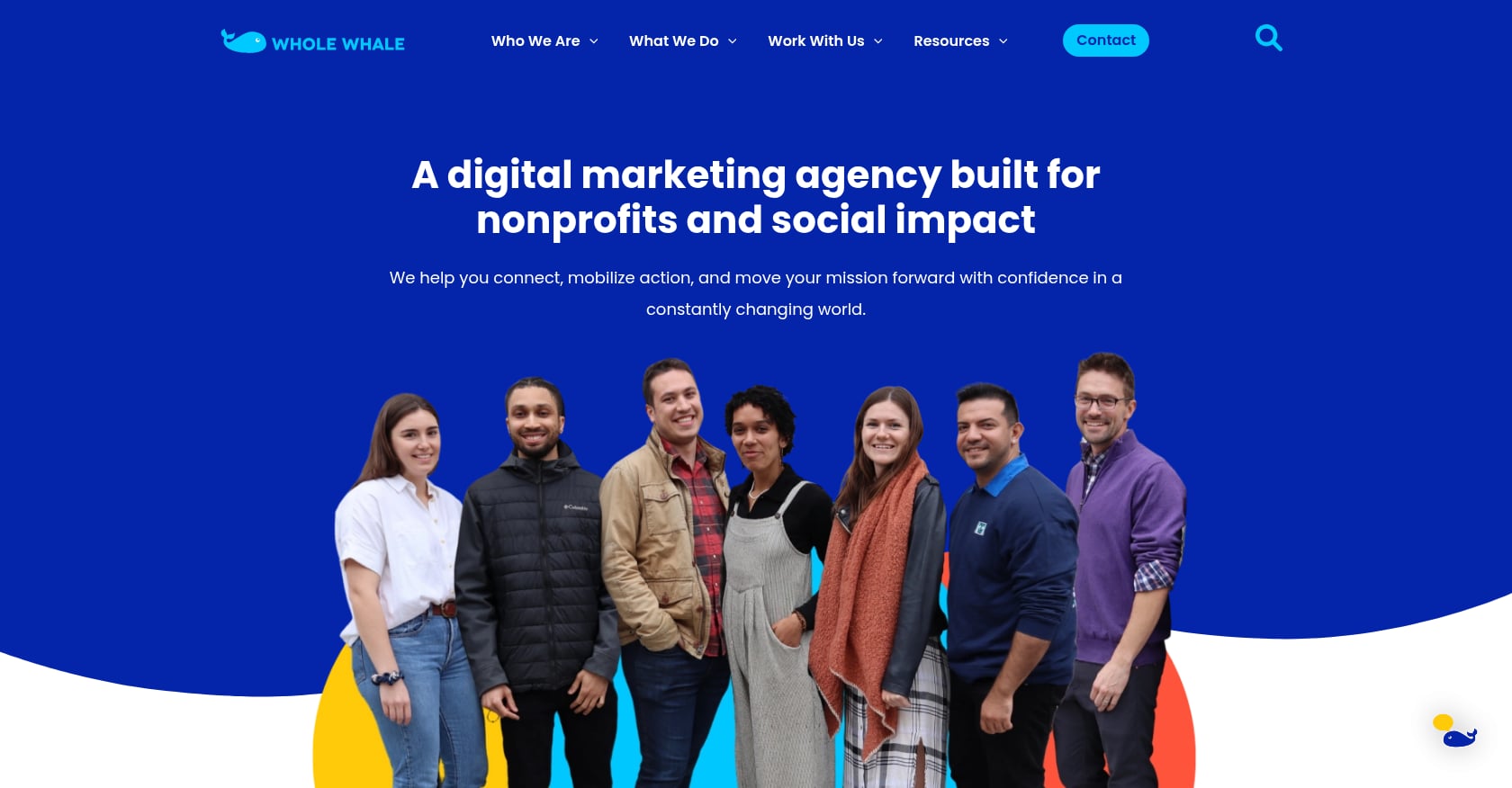
Best for: Nonprofits wanting data-driven digital marketing (SEO, analytics, Google Ad Grants, digital fundraising) with a capacity-building emphasis.
B Corp Score: 93.7
Key features:
Founded in 2010 in Brooklyn, NY. 15+ years of experience, 200+ organizations served.
Unique products like CauseWriter.AI for nonprofit content creation
Over 7,500 students enrolled in Whole Whale University, an online capacity-building platform
All contracts offer a 15-day escape clause, and services are billed after rendering, a notable trust signal in the agency world
Data, storytelling, and digital savvy are the core pillars
Pricing: Not publicly listed. The 15-day escape clause and post-delivery billing model lower the risk of engagement.
Tradeoffs:
Purely digital performance. No brand strategy, sustainability communications, commercial innovation, or retail activation.
Built specifically for nonprofits. Not suited for commercial brands, retailers, or hybrid social enterprises.
If you need strategic brand positioning or behavior change frameworks, Whole Whale’s toolset doesn’t extend there.
7. Enso
Best for: Leaders seeking creative strategy and community building for social impact at scale.
Key features:
Uses strategy, creativity, and community building to help leaders elevate their business while elevating the world
Positioned around “fearless creativity and collaborative action”
Focus on creating impact at scale, suggesting capability for larger campaigns and movements
Pricing: Not publicly listed.
Tradeoffs:
Less visible public client roster and review trail compared to peers on this list.
Harder to evaluate specific capabilities without direct engagement.
The broad positioning makes it difficult to assess depth in any single discipline.
8. Matter Unlimited
Best for: Mission-driven organizations needing communications and creative work specifically for social impact positioning.
Key features:
Self-described as “a strategic and creative agency exclusively focused on social impact”
Focuses on partnerships, storytelling, and digital media
Positioned around turning social responsibility into “profitable, sustainable, long-term competitive advantage”
Pricing: Not publicly listed.
Tradeoffs:
Smaller public footprint than other agencies on this list.
“Exclusively focused on social impact” positioning may limit breadth for brands that need integration across commercial and purpose functions.
Less publicly verifiable proof (no B Corp score listed, limited named client examples in public sources).
9. DrawHistory
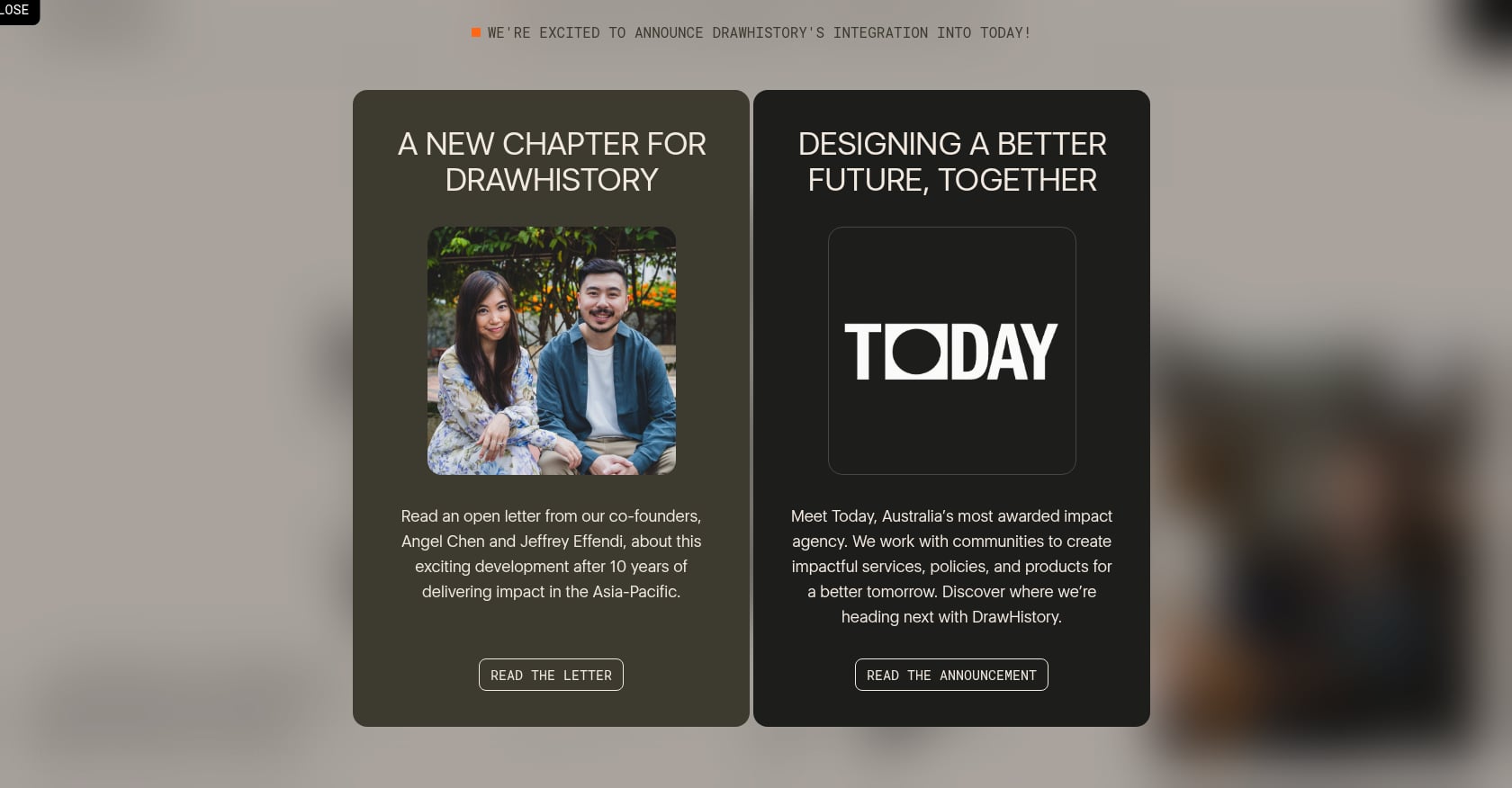
Best for: Social change organizations tackling complex societal issues like human rights, advocacy, and public health.
B Corp Score: Certified (specific score not publicly listed)
Key features:
Strategy and design consultancy with a “designing new futures” orientation
Worked with over 150 organizations on campaigns addressing violent extremism, disability advocacy, healthcare engagement, and more
Services span research, brand, campaigns, web, experience, and content
Named clients: UN, Change.org Foundation, Google Australia’s YouTube Creators for Change.
Pricing: Not publicly listed.
Tradeoffs:
Based in Australia with a global client list, which may create timezone and cultural friction for US or European teams.
Strength is in advocacy and societal issues rather than commercial brand building or retail activation.
Design-led approach may not suit organizations that need full-funnel marketing execution.
What Separates the Best Social Impact Agencies from the Rest
Listing agencies is easy. Knowing how to evaluate them is harder. After researching the field, a few clear separation points emerge.
B Corp Scores Are Not Created Equal
Certification requires a minimum score of 80 on B Lab’s assessment. But the range above that threshold matters. Among the agencies profiled here, Grounded World’s score of 116 sits well above Futerra (102.3), HelpGood (105.6), and Whole Whale (93.7). That score reflects governance, worker treatment, community impact, environment, and customer practices. It’s the closest thing to an objective, apples-to-apples comparison available.
No other ranking of top social impact agencies currently uses B Impact Scores as a comparison metric. It should be the first thing you check.
Proprietary Frameworks Signal Depth
Generic consulting advice is everywhere. The agencies worth paying for have developed their own intellectual property. Look for named frameworks, published methodologies, and tools specific to social impact work. A firm that’s codified its approach, whether in academic publications, industry association endorsements, or replicable processes, has thought harder about the problem than one offering bespoke strategy with no visible structure.
The Intention-Action Gap Is the Test
Most consumers say they care about sustainability. Most don’t change their purchasing behavior. This gap between stated intentions and actual actions is the central challenge of purpose-driven marketing. The best agencies don’t just create beautiful campaigns about doing good. They measure whether behavior actually changed. They understand the cognitive, structural, and economic barriers that prevent consumers from following through.
If an agency can’t explain how they diagnose and close this gap, they’re producing awareness, not outcomes. For brands trying to understand why consumers don’t buy sustainable products despite expressing interest, this distinction is everything.
Greenwashing Risk Is Real
As purpose-driven marketing has grown, so has skepticism. Practitioners on LinkedIn and Reddit consistently flag that poorly executed purpose campaigns can backfire, generating accusations of greenwashing that damage brands more than silence would. The right agency partner should have clear processes for avoiding greenwashing, including claim substantiation, third-party verification, and communications guardrails.
The Commercial-to-Mission Spectrum
This is the most important filter most lists ignore. The agencies on this list exist along a spectrum:
Mission-first: HelpGood, Whole Whale, DrawHistory. These agencies serve nonprofits, government, and advocacy organizations. They measure success in awareness, engagement, and fundraising.
Strategy-first: Carol Cone ON PURPOSE, Enso, Matter Unlimited. These agencies build purpose frameworks, stakeholder strategies, and narrative architecture. They operate upstream of execution.
Commercial-purpose hybrid: Grounded World, Futerra, BBMG. These agencies work with commercial brands and tie purpose work to business outcomes. Within this group, Grounded World is the most explicitly focused on commercial activation, retail sell-through, and revenue growth.
Knowing where you sit on this spectrum is the fastest way to cut your shortlist from nine agencies to three.
Common Mistakes When Hiring a Social Impact Agency
Organizations often choose agencies based on reputation alone rather than alignment with their objectives.
Common mistakes include:
Hiring a nonprofit specialist for commercial growth
Fundraising expertise doesn't necessarily translate into consumer marketing.
Focusing only on creative work
Beautiful campaigns mean little if they don't change behavior or improve business performance.
Ignoring measurement
Ask how success will be measured before signing a contract.
Confusing sustainability consulting with marketing
Some firms develop ESG strategy but don't execute campaigns.
Choosing based on awards alone
Awards recognize creative excellence, not necessarily measurable impact.
Conclusion: Choosing the Right Social Impact Agency Partner
The market for top social impact agencies is fragmented. Strategy consultancies, creative shops, digital performance firms, and hybrid agencies all claim the social impact label while doing very different work. The right partner depends on your mandate, your outcome goals, and whether you need purpose to drive commercial results or organizational mission.
If you’re a brand, retailer, or social enterprise looking to turn sustainability and social impact into measurable business outcomes, start with a clear assessment of where you stand today.
Request a complimentary 5C landscape assessment to diagnose your brand’s positioning across Company, Culture, Category, Competitor, and Consumer dimensions before selecting an agency partner.
Frequently Asked Questions
What is a social impact agency?
A social impact agency is a marketing, strategy, or consulting firm that helps organizations create measurable positive social or environmental outcomes. Some focus exclusively on nonprofits, while others help commercial brands integrate purpose into their marketing and business strategy. The best ones tie social impact work to both mission outcomes and business results.
How much do social impact agencies charge?
None of the top social impact agencies publish fixed pricing. Engagements are typically custom-scoped based on project complexity, duration, and deliverables. Expect enterprise-level pricing from firms like Futerra and Carol Cone ON PURPOSE. Boutique agencies like Grounded World and HelpGood may offer more flexible scoping without big-retainer overhead. Always request a discovery call to understand scope before comparing costs.
What is a B Corp score and why does it matter for agency selection?
A B Impact Score is an objective assessment by B Lab measuring a company’s performance across governance, workers, community, environment, and customers. Certification requires a minimum score of 80 (the median for ordinary businesses is 50.9). Higher scores indicate stronger verified commitments. Among the agencies profiled, scores range from 93.7 (Whole Whale) to 116 (Grounded World). It’s the closest thing to an independent quality benchmark for social impact agencies.
What is the intention-action gap in social impact marketing?
The intention-action gap describes the disconnect between what consumers say they value (sustainability, ethical sourcing, social responsibility) and what they actually purchase. Research consistently shows that stated purchase intent for sustainable products far exceeds actual buying behavior. Agencies that can diagnose and close this gap deliver significantly better commercial outcomes than those focused only on awareness campaigns.
Should I hire a social impact agency or a traditional marketing agency?
If your brand has a genuine sustainability or social purpose commitment and you want it reflected in your marketing, a specialist social impact agency will outperform a generalist shop. Traditional agencies may lack the frameworks, credentials, and subject-matter depth to navigate sustainability claims credibly. The risk of greenwashing accusations from poorly executed purpose campaigns makes specialist expertise worth the investment.
Can social impact agencies work with for-profit companies?
Yes, though not all of them do. Agencies like HelpGood and Whole Whale focus primarily on nonprofits and government organizations. Agencies like Grounded World, Futerra, and BBMG specifically work with commercial brands, helping them integrate purpose into brand strategy, retail activation, and commercial innovation. Check an agency’s client roster to confirm they have experience in your sector.
How do I evaluate whether a social impact agency delivers real results?
Ask three questions: What commercial metrics do you track beyond awareness? Can you share case studies showing business outcomes (not just campaign reach)? How do you measure actual behavior change versus stated intent? Agencies that can answer all three with specifics, named clients, and measurable outcomes are operating at a higher level than those offering only creative portfolios or strategy decks.