

 Gaia
GaiaTL;DR
Brand activation agencies plan and execute campaigns that bring brands directly into consumers’ lives through live events, sampling, digital experiences, and more. The market is growing from $10.4 billion to $19.2 billion by 2034, and the fastest-growing segment is purpose-driven activation, where sustainability and social impact meet commercial execution. Choosing the right agency comes down to execution capability, values alignment, budget transparency, and built-in measurement. This guide breaks down what these agencies do, the types that exist, and how to pick the right partner.
If you're choosing among the top brand activation agencies, prioritize execution capability over creative presentations. The best agencies have proven experience in your industry, transparent pricing, measurable ROI frameworks, and strong operational teams that can manage logistics, staffing, permits, and reporting. For brands focused on sustainability or social impact, agencies with behavioral science expertise and third-party certifications such as B Corp provide additional credibility.
The right agency depends on your goals:
Goal | Best Agency Type |
|---|---|
Product launch | Full-service activation agency |
Retail sales | Retail activation specialist |
Product sampling | Sampling agency |
Events & festivals | Experiential agency |
Sustainability campaigns | Purpose-driven activation agency |
Digital engagement | Digital-first activation agency |
Trade shows | B2B activation specialist |
What Is a Brand Activation Agency?
A brand activation agency helps companies execute online, in-person, or hybrid campaigns that introduce a brand and its values to consumers through direct interaction. These campaigns are designed to create and strengthen connections between brands and customers, not to push an immediate sale.
The critical word is “activation.” Unlike a traditional advertising agency that builds awareness through media placement, or a PR firm that shapes narrative through press coverage, a brand activation agency creates tangible moments where consumers experience the brand firsthand. Think product sampling at a festival, a pop-up shop in a transit hub, a digital challenge that earns real-world rewards, or a sustainability experience that changes how someone thinks about a product category.
What sets these agencies apart is operational scope. The right activation partner handles everything from concept through rollout: permits, staffing, vendor management, budgets, logistics, and measurement. This is not “strategy on a slide deck.” It is live execution with hundreds of moving parts.
The market reflects how seriously brands take this discipline. The global brand activation service market is forecast to grow from $10.4 billion in 2025 to $19.2 billion by 2034, at a CAGR of 7.2%. More than 68% of Fortune 500 companies reported increased budgets for experiential and activation-led marketing in 2025. These numbers are not speculative. Brands are shifting real dollars from passive media toward activation because it works.
For a deeper look at how activation strategy fits together, read more about brand activation strategy.
Activation vs. Experiential Marketing vs. Traditional Advertising
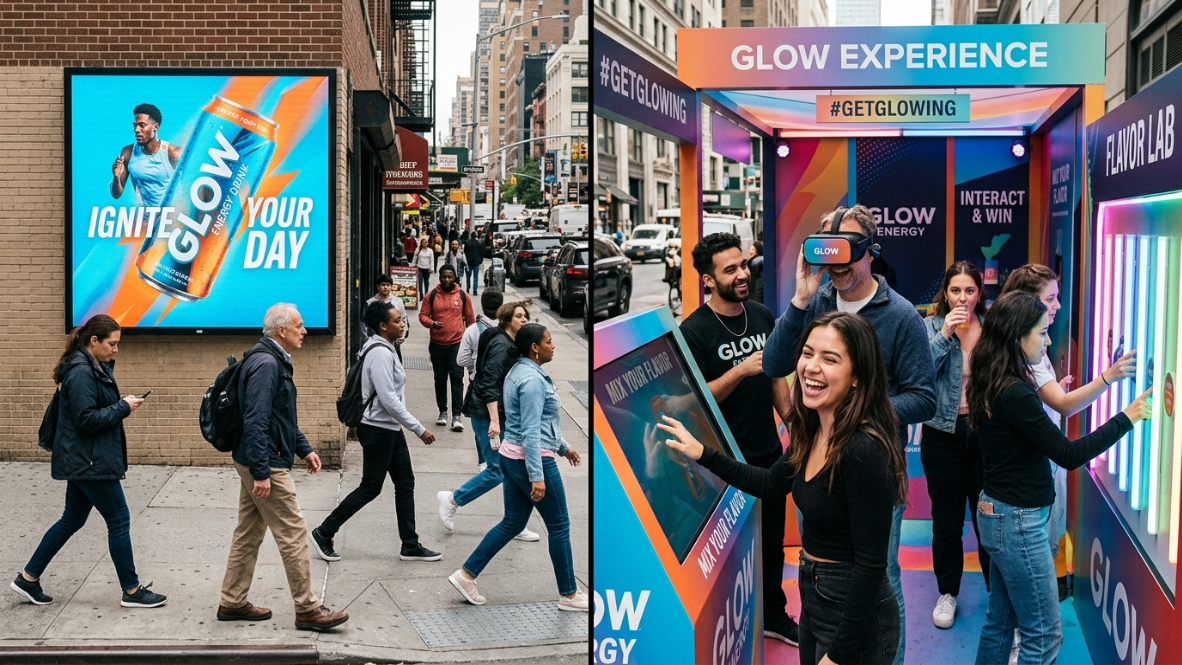
These terms get used interchangeably, and that causes real confusion during agency selection. Here is the distinction that matters:
Brand activation is a specific campaign designed to drive a defined action (product trial, app download, purchase, data capture) through direct consumer interaction.
Experiential marketing is the broader discipline of creating immersive brand experiences that build emotional connection and loyalty.
Traditional advertising pushes messages through media channels without requiring consumer participation.
Every brand activation is a form of experiential marketing, but not every experiential campaign qualifies as an activation. An immersive art installation that builds brand love is experiential. A sampling campaign inside that installation, where 60% of attendees scan a QR code and receive a product, is an activation. The difference is the defined, measurable action.
How the Brand Activation Process Works
Although every agency has its own methodology, most successful activation campaigns follow the same process.
Discovery
The agency identifies business goals, audience segments, budget, timeline, competitive landscape, and success metrics.
Strategy
Campaign concepts are developed alongside location planning, staffing requirements, technology selection, and measurement frameworks.
Creative Development
Designers produce event concepts, branded environments, digital experiences, promotional assets, and customer engagement activities.
Production
Permits, vendors, logistics, fabrication, staffing, inventory management, insurance, and compliance are coordinated.
Activation
The campaign launches through live experiences, retail programs, pop-ups, digital activations, or hybrid events.
Measurement
Performance is evaluated using KPIs such as engagement, lead capture, sales lift, earned media, and return on investment.
Types of Brand Activation
Brand activation is not one thing. It spans formats, channels, and objectives. Understanding the types helps you match your goals to the right agency specialization.
Experiential and Live Events
The most visible form of activation. Brands create immersive, physical experiences at festivals, conferences, public spaces, or dedicated venues. The goal is direct sensory engagement that no screen can replicate. Think branded installations, interactive exhibits, or multi-room experiences that guide consumers through a narrative.
Sampling Campaigns
Getting a product into someone’s hands remains one of the highest-conversion activation formats. Sampling campaigns show up at retail locations, events, transit hubs, gyms, and offices. The execution details (temperature control, staffing quality, compliance, waste management) matter enormously and separate professional agencies from amateurs.
Digital Activations
Online campaigns on social media, email, and branded platforms designed to drive specific consumer actions. Digital activations are growing faster than offline formats, at 8.9% versus 5.2% CAGR according to market data. AR filters, gamified challenges, virtual product try-ons, and interactive content all fall here.
In-Store and Retail Activations
Marketing activities within a retail environment designed to engage shoppers while they are already in buying mode. Endcap takeovers, demo stations, interactive displays, and shelf-adjacent experiences convert browsing into purchase. This format requires deep understanding of retailer requirements, planograms, and compliance. For brands focused on this channel, exploring brand activation at retail is worth the time.
Influencer-Led Activations
Pairing brand experiences with creator distribution. Rather than just paying for a post, the brand builds an experience that influencers participate in and share organically. The activation creates the content, and the influencer amplifies it. This hybrid format is gaining ground because it produces both engagement and earned media simultaneously.
Purpose-Driven and Sustainability Activations
The fastest-growing subcategory. Brands create activations that align with environmental or social missions, turning values into tangible consumer experiences. Patagonia’s “Worn Wear” tour, which repairs used clothing at festivals, is a textbook example. So is Lush’s packaging-free “naked stores.” These activations build brand loyalty and behavioral change at the same time.
Guerrilla Marketing
Unconventional, often low-cost tactics designed for maximum surprise and shareability in public spaces. Flash mobs, street art, unexpected installations, and ambient media all qualify. High risk, high reward. Brilliant when it lands, embarrassing when it doesn’t.
Categories of Brand Activation Agencies
Not all activation agencies are built the same way. The market is moderately fragmented, with no single player commanding more than 8-9% of global market share. This fragmentation means brand managers have real choices, but also real confusion. Here is how the agency types break down.
Full-Service Global Agencies
Companies like Jack Morton and George P. Johnson operate at enterprise scale. They handle multi-city, multi-country programs with large production teams and established vendor networks. Their strength is scale and consistency. Their limitation is cost (premium US engagements typically run $1M to $2M+), slower decision-making, and the risk that your project gets staffed by junior teams while the senior strategists move on to bigger accounts.
Specialist Boutique Agencies
These agencies go deep in one or two activation formats: sampling, pop-ups, festival activations, or trade shows. They are nimble, often cheaper, and bring genuine expertise in their niche. The tradeoff is narrow scope. A sampling specialist may not be the right partner for a multi-channel product launch.
Purpose-Driven and Sustainability-Focused Agencies
This category is gaining share for a clear reason: consumers demand authenticity, and brands need partners who understand how to deliver it without tipping into greenwashing. Purpose-driven agencies combine brand strategy with genuine sustainability expertise. They understand how to connect a brand’s social or environmental commitments to consumer experiences that change behavior, not just generate impressions.
What makes this category distinct is its focus on the intention-action gap, the well-documented disconnect between what consumers say they value and what they actually buy. Closing that gap requires more than creative execution. It requires behavioral insight, credible storytelling, and measurement that tracks real-world outcomes.
To explore agencies in this space, the guide on choosing brand activation agencies offers a more detailed breakdown.
Digital-First Activation Agencies
These agencies lead with technology: AR, VR, AI personalization, gamification, and data-driven targeting. They excel at scale and measurability. The limitation is that purely digital activations sometimes lack the emotional depth and physical memorability of live experiences.
Design and Production Studios
Studios that build what they design, from custom fabrication to immersive environments. No vendor markup because they own the production. The tradeoff is less strategic marketing depth. They execute brilliantly but may not develop the campaign strategy or measurement framework.
Which Type of Brand Activation Agency Is Right for You?
Not every agency is the right fit for every business.
If You Need... | Choose... |
|---|---|
Nationwide product launch | Global activation agency |
Local community engagement | Boutique agency |
Trade show marketing | Event specialist |
Retail promotions | Shopper marketing agency |
Sustainability initiatives | Purpose-driven agency |
AI, AR, VR experiences | Digital-first agency |
Product sampling | Sampling specialist |
What to Look for in a Brand Activation Agency

The selection process is where many brand managers get burned. Practitioners on marketing forums consistently warn about the gap between the pitch and the reality. One widely cited observation from MarketerHire puts it bluntly: “Plenty of smart marketers hire the wrong activation partner, and they don’t just waste budget, it costs them their launch window.”
Here are the criteria that actually matter.
Track Record in Your Vertical
Generic “brand activation experience” is not enough. An agency that excels at trade shows may struggle at festivals, nightlife activations, or street-level consumer engagement. Ask for case studies in your specific industry and activation environment. If they cannot show relevant work, move on.
Execution Capability Over Creative Pitch
The visual concept matters, but the field reality matters more. Practitioners across Reddit and LinkedIn marketing communities frequently point out that agencies over-invest in pitch decks and under-invest in operational planning. Press for details on staffing models, contingency plans, vendor relationships, and timeline buffers. A beautiful concept that falls apart on-site is worse than a simple concept executed flawlessly.
Budget Transparency
Brand activations almost always include variable costs: travel, site fees, permits, production, staffing, and insurance. Ask for a full breakdown with itemized estimates. Do not accept placeholder ranges or “TBD” notes. Fixed costs, estimated costs, and contingency buffers should all be clearly separated.
Values and Culture Alignment
For brands with sustainability or social impact commitments, this criterion moves from “nice to have” to “essential.” You need an agency that respects your brand’s identity, voice, and ethical standards. Third-party certifications like B Corp status offer verifiable proof that an agency’s values are not just marketing copy.
Start with a free landscape assessment to understand where your brand stands before engaging any agency.
Measurement Frameworks Built In From Day One
This is the most overlooked criterion and the one that causes the most regret. Nearly 39% of marketers say proving experiential ROI is their biggest challenge. The problem is usually not that the activation failed; it is that no one set up the measurement infrastructure before launch. Any agency worth hiring will build data capture, attribution, and reporting into the campaign architecture from the start, not bolt it on after the fact.
A Realistic View of Scope
What does the agency actually handle end-to-end, and where will you need additional vendors? Some agencies own the full chain from strategy through measurement. Others are strong on creative but outsource production, staffing, or analytics. Neither model is inherently better, but you need to know which one you are buying.
Questions to Ask Before Hiring a Brand Activation Agency
Before signing a contract, ask every prospective agency these questions.
Experience
Have you managed campaigns in our industry?
Can you provide recent case studies?
What measurable results did those campaigns achieve?
Operations
Do you manage staffing internally?
How do you handle permits?
What contingency plans exist for weather or delays?
Reporting
Which KPIs do you track?
How often do you provide reporting?
Can you measure offline sales impact?
Budget
What costs are fixed?
Which expenses are variable?
What percentage should be reserved for contingency?
Technology
Do you provide QR tracking?
CRM integration?
First-party data capture?
Attribution reporting?
Why Purpose-Driven Brand Activation Outperforms
The search results for “top brand activation agencies” are dominated by sustainability and purpose-driven agency lists. This is not a coincidence. It reflects where the market is heading.
The Consumer Shift
Consumers increasingly expect brands to stand for something beyond profit. But they also have finely tuned radar for inauthenticity. Greenwashing is no longer just a reputational risk; it is a commercial one. Brands must integrate sustainability seamlessly into their experiences, not paste it on as a veneer.
The strongest activations make purpose tangible. Patagonia does not just talk about sustainability; it repairs your jacket in front of you. Lush does not just claim to reduce waste; it removes the packaging entirely. These are not marketing stunts. They are operational commitments expressed through consumer-facing experiences.
The Intention-Action Gap
Here is the uncomfortable truth that most activation agencies ignore: consumers consistently say they want to buy sustainably, and then they don’t. This gap between intention and action is the central challenge for any brand with a sustainability or social impact mission. Standard experiential tactics (flashy booths, free samples, social media moments) do not close this gap. They generate awareness, not behavior change.
Purpose-driven activation agencies approach the problem differently. They design experiences that reduce friction, build trust, and make the sustainable choice feel like the obvious choice. This requires behavioral insight, not just creative talent.
Avoiding Greenwashing
The line between authentic purpose and purpose-washing is thin, and the consequences of getting it wrong are severe. Brands that work with agencies holding third-party certifications (B Corp, for example) have a built-in credibility layer. For a practical framework on this risk, the guide on avoiding greenwashing is worth reading.
Grounded, a B Corp-certified agency that specializes in commercializing sustainability, approaches this through proprietary frameworks like BPP and Brand Activation for Good. Their Discover-Articulate-Activate-Accelerate model is designed to connect sustainability commitments to measurable commercial outcomes, not just generate feel-good moments.
Talk to Grounded about activating your brand’s purpose.
Common Mistakes Brands Make When Hiring Activation Agencies
The most common reasons activation campaigns underperform include:
Choosing the lowest-cost proposal instead of the strongest execution team.
Focusing only on creative concepts while overlooking operational planning.
Not defining KPIs before launch.
Ignoring first-party data collection.
Underestimating staffing requirements.
Forgetting permit and venue restrictions.
Measuring vanity metrics instead of business outcomes.
Hiring agencies without relevant industry experience.
Failing to integrate activation with broader marketing campaigns.
How to Measure Brand Activation ROI
Measurement is the discipline that separates professional activation from expensive guesswork. The data exists to prove activation works, but only if you set up the right framework before the campaign launches.
The Four-Layer Measurement Framework
Layer 1: Engagement. How many people interacted with the activation, and how deeply? Dwell time, participation rate, and completion rate all matter here. Surface-level foot traffic counts are not enough.
Layer 2: Data capture. Well-designed activations convert 40 to 70% of attendees through a first-party data capture mechanic (email, QR scan, app download). If your capture rate is below 40%, the mechanic needs redesign.
Layer 3: Earned media. Activations generate content that spreads beyond the event itself. According to Forbes, earned media from experiential activations can deliver up to 10x the value of paid media equivalents. This multiplier effect is one of the strongest financial arguments for activation over traditional advertising.
Layer 4: Revenue and brand lift. The ultimate measure. A well-run activation typically shows a 3 to 8 percentage point lift in spontaneous awareness among the target audience. And EventTrack research found that 74% of consumers say engaging with branded experiences makes them more likely to buy the promoted product.
Brand Activation KPIs That Matter
KPI | Why It Matters |
|---|---|
Attendance | Overall campaign reach |
Engagement Rate | Measures interaction quality |
Dwell Time | Indicates experience quality |
Lead Capture Rate | Measures conversion efficiency |
QR Scan Rate | Digital engagement |
Sampling Conversion | Product trial effectiveness |
Sales Lift | Revenue impact |
Brand Recall | Awareness improvement |
Net Promoter Score | Customer advocacy |
Earned Media Value | PR effectiveness |
Cost Per Engagement | Campaign efficiency |
ROI | Overall business impact |
Pre-Flight vs. Post-Flight
The biggest measurement mistake is treating it as a post-campaign activity. Baseline brand awareness, purchase intent, and competitive consideration should all be measured before launch. Without a baseline, you cannot calculate lift, and without lift data, you cannot justify budget to the CFO.
Strong brand storytelling extends the life of activation content well beyond the event itself, compounding ROI through ongoing earned media and narrative longevity.
Why Soft Metrics Alone Won’t Work
Social media impressions, “buzz,” and qualitative feedback are valuable inputs, not outcomes. Decision-makers who control budgets need hard numbers: cost per acquisition, cost per data point captured, revenue attributed to activation-driven leads, and earned media value. Agencies that cannot provide this level of rigor are not ready for enterprise partnerships.
The Bottom Line on Choosing Among Top Brand Activation Agencies
The activation agency market is large, growing, and fragmented. That is both an opportunity and a risk. The opportunity is that brands have access to specialized partners across every format, budget, and vertical. The risk is that the wrong choice does not just waste money; it wastes time, and in many cases, your best launch window.
For brands with sustainability, social impact, or purpose-driven commitments, the stakes are higher. Authentic activation builds trust and closes the intention-action gap. Inauthentic activation erodes both.
The agencies that will matter most over the next decade are those that combine creative ambition with operational rigor, behavioral insight with measurement discipline, and brand purpose with commercial outcomes.
Explore how Grounded can help activate your brand’s purpose.
Typical Brand Activation Costs
Actual costs vary by country, complexity, and campaign duration.
Campaign Type | Typical Budget |
|---|---|
Retail Demo | $5,000–25,000 |
Product Sampling | $20,000–100,000 |
Pop-up Experience | $30,000–250,000 |
Festival Activation | $100,000–500,000 |
National Tour | $500,000–2M+ |
Enterprise Launch | $1M+ |
Pricing tables improve commercial search rankings.
Frequently Asked Questions
What does a brand activation agency do?
A brand activation agency plans and executes campaigns that bring a brand directly into consumers’ lives through live events, sampling, digital experiences, retail activations, and more. They handle everything from strategy and creative development to logistics, staffing, vendor management, and post-campaign measurement. The goal is to drive specific consumer actions (product trial, data capture, purchase) through direct interaction rather than passive media exposure.
How much does brand activation cost?
Costs vary widely by format and scale. In the United States, premium experiential marketing agencies typically charge between $1 million and $2 million or more for large-scale programs. Smaller activations like pop-ups or single-event trade show presences cost significantly less. Variable costs including travel, permits, production, staffing, and insurance make itemized budgets essential during the selection process.
What is the difference between brand activation and experiential marketing?
Brand activation is a specific campaign designed to drive a defined consumer action through direct interaction. Experiential marketing is the broader discipline of creating immersive brand experiences that build emotional connection. Every brand activation is experiential marketing, but not every experiential campaign qualifies as an activation. The distinguishing factor is whether the campaign is built around a measurable, specific consumer action.
How do you measure brand activation ROI?
Effective measurement uses a four-layer framework: engagement metrics (dwell time, participation rate), data capture rate (targeting 40-70% of attendees), earned media value (which can deliver up to 10x the value of paid media), and revenue or brand lift (typically 3-8 percentage points of awareness increase). Baselines must be established before the campaign launches to enable accurate lift calculation.
What is a purpose-driven brand activation agency?
A purpose-driven brand activation agency specializes in creating consumer experiences that connect a brand’s social or environmental commitments to tangible, memorable interactions. These agencies combine brand strategy with sustainability expertise and behavioral insight. They focus on closing the intention-action gap, helping consumers move from saying they care about sustainability to actually changing their purchasing behavior. Third-party certifications like B Corp status help verify an agency’s commitment to these values.
Why are sustainability-focused agencies ranking as top brand activation agencies?
Search results and market trends show that purpose-driven and sustainability-focused agencies are gaining prominence because consumer demand for authenticity is rising, greenwashing risks are increasing, and brands need partners who understand behavioral science alongside creative execution. The global shift toward ESG commitments and conscious consumerism means brands with genuine sustainability missions need specialized activation partners, not generalists.