

 Gaia
GaiaTL;DR
Behavior change marketing agencies specialize in moving people from intention to action using behavioral science frameworks like COM-B and the Fogg Behavior Model. The best agencies diagnose why a target behavior isn’t happening before proposing any creative work. This guide defines the field, maps four distinct agency types, explains the frameworks worth knowing, and gives you concrete evaluation criteria so you can build a shortlist that actually fits your needs.
Most marketing agencies sell awareness. They’ll get your brand seen, clicked, maybe even remembered. But if your actual problem is that people say they care about your product or cause and then don’t follow through, awareness isn’t the answer. You need an agency that understands why humans fail to act on their own stated intentions, and that can design interventions to close that gap.
That’s what behavior change marketing agencies do. And finding the right one is harder than it should be, because the category spans everything from public health campaigns against tobacco use to sustainability brands trying to get consumers to choose the refillable option at shelf.
This guide breaks down the field so you can evaluate agencies with clarity rather than guesswork.
Get a complimentary 5C landscape assessment to understand where your brand stands before you start agency conversations.
Direct Answer: What Is a Behavior Change Marketing Agency?
A behavior change marketing agency helps brands move people from intention to action by identifying psychological and environmental barriers to behavior and designing interventions that close the intention–action gap. Unlike traditional agencies that optimize for awareness or clicks, they optimize for measurable behavior change such as purchases, sign-ups, or habit adoption.
What Is a Behavior Change Marketing Agency?
A behavior change marketing agency borrows from psychology, sociology, and communications theory to develop strategies that convince target audiences to not just change their minds, but change their behavior. The distinction matters. Traditional marketing optimizes for attention, preference, and recall. Behavior change marketing optimizes for action.
The field is sometimes called “social marketing,” a term coined by Kotler and Zaltman in 1971. Don’t confuse it with social media marketing. Where commercial marketing sells goods and services for profit, social marketing sells a change in behavior for the benefit of individuals and society. Today, the best behavior change marketing agencies blend both orientations, applying social marketing principles to commercial contexts where the goal is both profitable and prosocial.
A practitioner who works at a behavior change marketing agency with roots in social marketing described pursuing an executive master’s degree in behavioral science at LSE, and finding the two disciplines far more complementary than competitive. That tracks with what experts increasingly argue: the question isn’t whether behavioral science or social marketing is “better.” They overlap more than either side will readily admit, and the strongest agencies integrate both.
For a deeper look at the strategic frameworks these agencies apply, see our guide on behavior change marketing strategy.
Comparison: Traditional Marketing vs Behavior Change Marketing
Dimension | Traditional Marketing | Behavior Change Marketing |
|---|---|---|
Primary goal | Awareness & attention | Action & behavior change |
Success metric | Impressions, reach | Behavioral outcomes |
Core focus | Messaging & creativity | Barriers & psychology |
Strategy starting point | Brand or campaign idea | Target behavior definition |
Frameworks used | Minimal or none | COM-B, Fogg, CBSM |
Optimization target | Engagement | Real-world action |
How Behavior Change Marketing Works (Step-by-Step Model)
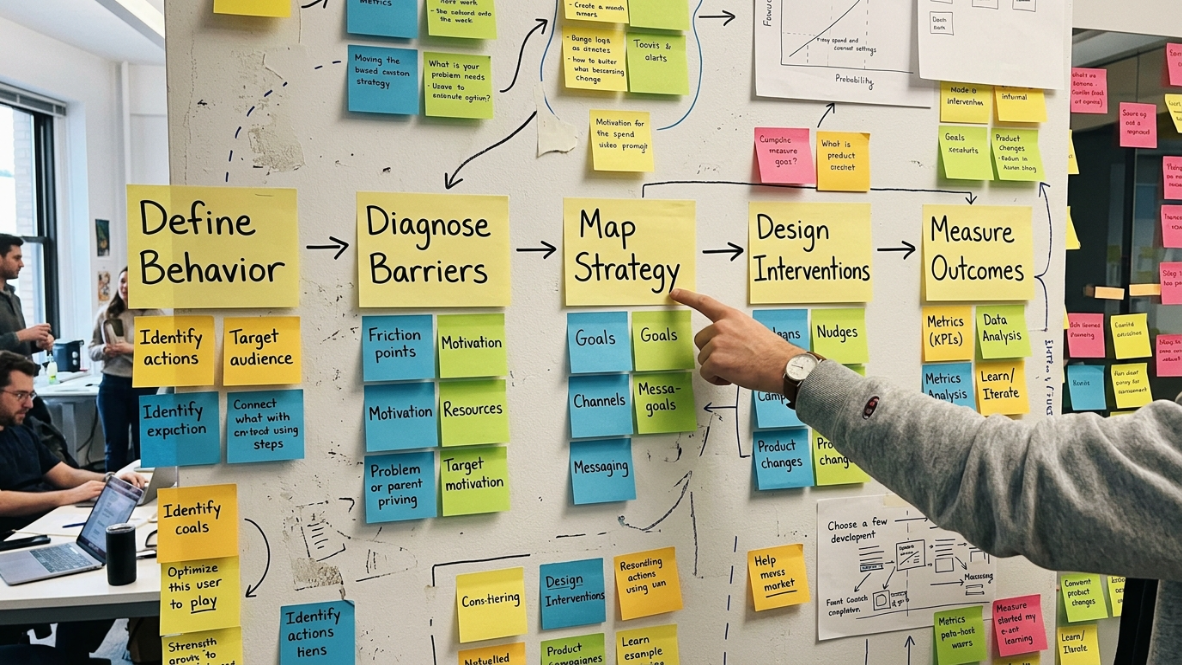
Step 1: Define the Target Behavior
Specify exactly what action must change (not awareness or sentiment).
Step 2: Diagnose Barriers
Identify psychological, social, and environmental blockers using frameworks like COM-B or Fogg.
Step 3: Map Intervention Strategy
Translate barriers into solutions (messaging, UX changes, incentives, environment design).
Step 4: Design Behavioral Interventions
Build campaigns, nudges, prompts, or system changes that make behavior easier.
Step 5: Measure Real Behavior Change
Track actual actions (sales, usage, adoption), not impressions or clicks.
Types of Behavior Change Marketing Agencies
Not all behavior change agencies serve the same clients or solve the same problems. The field breaks into four distinct categories, and understanding them will save you months of mismatched conversations.
Public Health Behavior Change Agencies
These are the original behavior change marketers. Agencies like Rescue Agency (a B Corp with 200+ employees focused exclusively on positive social change since 2001) and Marketing for Change (a research and creative agency designing health, environment, and advocacy campaigns) built the playbook for moving populations toward healthier choices. Ethos Marketing, a 100% employee-owned agency in Maine, applies behavior change marketing specifically to public health contexts, identifying and breaking down barriers to healthier behavior.
If your work is in tobacco cessation, nutrition, harm reduction, or disease prevention, this is your category.
Sustainability and Purpose-Driven Agencies
This is the fastest-growing segment, and the one with the widest gap between demand and supply. Agencies here help sustainability brands and purpose-driven companies translate good intentions into consumer action. Futerra, a B Corp that’s majority women-owned and one of the UK’s first certified B Corps, calls itself “a change agency” that joins creative magic with strategic logic to make sustainability happen. Their recent partnership with behavioral science firm BEworks signals where the category is headed: creative sustainability expertise fused with rigorous behavioral science.
Marketing for Change notes that most consumers are “conveniently green,” meaning they only take sustainable action when other needs (convenience, price, quality) are also met. Agencies in this category need to understand that dynamic deeply.
For brands exploring purpose-driven positioning, this is the agency type that connects identity to measurable behavior.
Behavioral Science Consultancies
These firms come from the academic side. The Decision Lab, one of the world’s leading behavioral science consultancies, applies research rigor to intervention design. The Behaviour Change Agency in South Africa combines behavioral and data science within communications and marketing. Affective Advisory in Switzerland applies academic behavioral science insights to customer, employee, and citizen engagement.
The strength here is methodological depth. The trade-off is that many behavioral science consultancies don’t execute campaigns. They diagnose and design, then hand off to creative partners.
MarTech and Data-Driven Platforms
Magnitude of Change represents this category: a Certified B Corporation providing advanced marketing technology to nonprofits, government agencies, and purpose-driven brands. They’ve managed hundreds of data-driven campaigns, using technology to enhance marketability, visibility, and reach. If your challenge is scale, measurement infrastructure, or data integration, this type of partner fills a different gap than a creative or strategy-first agency.
Core Frameworks the Best Behavior Change Marketing Agencies Use
Here’s a reliable litmus test: ask a prospective agency which behavior change frameworks they use and why. If they can’t name one, or if they name one and dismiss all others, that tells you something.
The COM-B Model
The COM-B model, developed by Susan Michie’s team at University College London, proposes three necessary components for any behavior to occur: Capability (does the person have the physical and psychological ability?), Opportunity (does the environment allow it?), and Motivation (does the person want to enough?). It’s especially useful for analyzing barriers because it captures both internal and external factors and connects them to specific intervention recommendations.
COM-B is a strong starting diagnostic. It won’t solve everything, but it prevents the common mistake of throwing motivation-heavy messaging at people whose real barrier is opportunity or capability.
The Fogg Behavior Model
B.J. Fogg’s model frames behavior as a function of Motivation × Ability × Prompt. All three must converge at the same moment. This framework is particularly useful for digital and UX contexts where you can control prompts precisely.
SHIFT and Community-Based Social Marketing
The SHIFT framework (Social influence, Habit formation, Individual self, Feelings and cognition, Tangibility) was developed specifically for sustainability behavior change. Community-Based Social Marketing (CBSM), created by Doug McKenzie-Mohr, takes a grassroots approach, identifying barriers and benefits at the community level before designing interventions.
Why Integration Beats Allegiance
The field has fragmented into 82+ competing behavior change theories. As Susan Michie’s team demonstrated with COM-B, the way forward is integration, not competition. Agencies that rigidly commit to a single framework are likely missing angles that other models would catch.
The APEASE criteria (Affordability, Practicability, Effectiveness, Acceptability, Side-effects, Equity) offer a complementary lens for evaluating whether a proposed intervention is actually implementable for your target population.
For a structured walkthrough of how these frameworks apply to marketing, that guide goes deeper.
The Intention-Action Gap: Why It’s the Central Question for Agency Selection
The intention-action gap is the difference between what consumers say they’ll do and what they actually do at the moment of purchase. It’s the core problem that separates behavior change marketing from everything else.
The gap widens when the “should” option requires more mental effort, has immediate barriers, or isn’t obviously superior in the moment of decision. This is why sustainability brands face it most acutely. Nearly 35% of consumers now say the past few years have taught them “less is more.” Americans are adapting to a new normal defined by emotional caution, intentional spending, and an unshakable focus on value. In this environment, good intentions lose to convenience and price unless an agency knows how to restructure the choice.
Any agency claiming to do behavior change work should be able to explain your specific intention-action gap, what’s causing it, and what they propose to do about it. If they skip straight to creative concepts without diagnosing the gap, they’re a traditional agency with behavioral language in their pitch deck.
Understanding why customers say they care but don’t buy is the starting point for any serious behavior change engagement.
The 5 Most Common Use Cases for Behavior Change Marketing
Behavior change marketing is most commonly used for:
Sustainability adoption (refill, recycling, green purchasing)
Health behavior change (smoking cessation, diet, exercise)
Financial behavior (saving, investing, reducing debt)
Product adoption (switching platforms or habits)
Public policy behavior (vaccination, compliance, safety)
How to Evaluate a Behavior Change Marketing Agency

There’s no industry-standard rating system for these agencies, so you need your own evaluation framework. Here are seven criteria that separate genuine behavior change specialists from agencies borrowing the vocabulary.
1. Do they start with a specific target behavior?
The best agencies refuse to begin work until they’ve defined exactly which behavior needs to change, in which population, in which context. Agencies that start with “raise awareness” are telling you they don’t actually do behavior change.
2. Do they diagnose barriers before proposing creative?
This is non-negotiable. Using COM-B, Fogg, or another diagnostic framework, the agency should identify what’s blocking the target behavior before designing any intervention.
3. Do they measure behavior change, not just impressions?
Campaign impressions, click-through rates, and even stated purchase intent are not behavior change metrics. The agency should track actual behavioral outcomes (purchases, sign-ups, repeat usage, disposal behavior, whatever the target action is).
4. Do they have relevant sector experience?
A public health behavior change agency may be excellent at reducing smoking rates but poorly suited for sustainability brand positioning. Match the agency’s track record to your challenge.
5. Do they hold third-party certifications?
B Corp status appears across several top agencies in this space (Magnitude of Change, Futerra, Rescue Agency, Grounded World). It signals values alignment, but it’s a necessary-not-sufficient criterion. Certifications matter less than measured outcomes.
6. Can they show behavioral outcomes from past work?
Ask for case studies with before-and-after behavioral data, not just creative awards. This is where the field gets thin. A former employee at a prominent behavior change agency noted on Glassdoor that “the idea of behavior change marketing is meaningful but the actual work is a bit sketchy, no real results.” That candid assessment should sharpen your due diligence.
7. Do they prevent the biggest failure mode?
As behavioral science experts have pointed out, the biggest failure in applied behavior change isn’t using the wrong framework. It’s spending months optimizing an intervention for a behavior that was never a good match for the target population. The best agencies invest heavily in upfront diagnosis to prevent exactly this.
Agencies working in sustainability contexts should also demonstrate awareness of greenwashing risks and how they help clients avoid them.
Schedule a discovery call to see how these criteria apply to your specific situation.
Behavior Change Marketing for Sustainability and Purpose-Driven Brands
Most behavior change marketing agencies come from public health. The sustainability and commercial behavior change space is newer, less established, and presents fundamentally different challenges. A tobacco cessation campaign and a sustainable packaging launch both require behavior change, but the barriers, motivations, and choice environments are nothing alike.
Sustainability brands face a specific version of the intention-action gap. Consumers report caring about environmental and social issues at high rates, but their purchasing behavior tells a different story. The gap persists because sustainable options often cost more, require more effort, or aren’t clearly superior on the attributes consumers weigh most heavily in the moment of decision.
This is where the “conveniently green” insight becomes critical. Consumers will choose the sustainable option when it also wins on convenience, quality, or price. They won’t sacrifice on those dimensions for sustainability alone. The best behavior change marketing agencies for sustainability brands understand this and design interventions accordingly, restructuring the choice environment so the sustainable option is also the easy, obvious, or appealing one.
For purpose-driven brands navigating these dynamics, understanding why consumers don’t buy sustainable products despite stated preferences is essential groundwork.
Brands that need to connect sustainability positioning to commercial growth strategy should look for agencies that explicitly bridge those two outcomes.
Common Mistakes When Hiring a Behavior Change Agency
Confusing awareness with behavior change. Awareness is a precondition for behavior change, not the thing itself. If an agency’s primary KPIs are reach, impressions, or brand awareness scores, they’re running a traditional campaign under a behavioral label.
Over-investing in motivation while ignoring opportunity and capability. This is the most common strategic error. Many campaigns pour resources into inspiring messaging (motivation) while the real barrier is that the target behavior is too difficult (capability) or the environment doesn’t support it (opportunity). COM-B exists specifically to prevent this mistake.
Choosing based on creative awards rather than measured outcomes. A Cannes Lion doesn’t mean anyone actually changed their behavior. Ask for behavioral data, not trophy photos.
Not defining the target behavior before the engagement starts. “Make people more sustainable” is not a behavior. “Increase refill station usage by 20% among existing customers in Q3” is. The agency should push you to get this specific.
Assuming one framework fits every problem. With 82+ competing theories in the field, framework rigidity is a red flag. The best agencies select and combine frameworks based on the specific challenge, not their own intellectual loyalty.
For a practical guide to removing barriers to sustainable purchasing, that resource walks through barrier diagnosis step by step.
Finding the Right Fit
The best behavior change marketing agencies share a few things in common: they start with diagnosis, they use proven frameworks, they measure behavioral outcomes, and they resist the temptation to skip straight to creative. Beyond that, the right agency depends on your sector, your specific behavior change challenge, and whether you need strategy, execution, or both.
For sustainability and purpose-driven brands specifically, the agency landscape is still maturing. The strongest partners combine behavioral science rigor with creative execution and a genuine understanding of how sustainability intersects with commercial reality.
Start with a complimentary 5C landscape assessment to clarify your behavior change challenge before engaging any agency.
Frequently Asked Questions
What is a behavior change marketing agency?
A behavior change marketing agency applies principles from psychology, behavioral science, and communications theory to move target audiences from intention to action. Unlike traditional marketing agencies that optimize for awareness or preference, these agencies diagnose behavioral barriers, design interventions, and measure whether actual behavior changed.
How is behavior change marketing different from social marketing?
Social marketing, a term created by Kotler and Zaltman in 1971, focuses on selling behavioral change for the benefit of individuals and society. Behavior change marketing is a broader term that encompasses both social marketing and commercial applications. In practice, the best agencies blend both approaches, and practitioners report the disciplines are more complementary than competitive.
What frameworks should a behavior change agency know?
At minimum, look for fluency in the COM-B model (Capability, Opportunity, Motivation, Behavior) and the Fogg Behavior Model (Motivation × Ability × Prompt). For sustainability contexts, the SHIFT framework and Community-Based Social Marketing (CBSM) are also relevant. Agencies should be able to select and combine frameworks based on your specific challenge rather than defaulting to a single model.
What is the intention-action gap and why does it matter for agency selection?
The intention-action gap is the difference between what consumers say they’ll do and what they actually do. It’s especially pronounced in sustainability, where consumers express strong pro-environmental attitudes but don’t follow through at the point of purchase. A good behavior change agency should be able to diagnose your specific gap and design interventions to close it.
How do I know if an agency actually delivers behavior change, not just awareness?
Ask for case studies with behavioral outcome data, not just campaign reach or creative awards. The agency should be able to show measurable changes in the specific target behavior (purchases, sign-ups, usage rates, disposal actions) rather than proxy metrics like impressions or stated intent.
Are B Corp-certified agencies better at behavior change marketing?
B Corp certification signals that an agency has met verified standards for social and environmental performance, accountability, and transparency. Several leading behavior change marketing agencies hold B Corp status. It’s a useful filter for values alignment, but it doesn’t guarantee behavioral science expertise or measured outcomes. Treat it as one criterion among several.
What’s the biggest mistake brands make when hiring a behavior change agency?
Failing to define the specific target behavior before the engagement starts. Vague goals like “make our customers more sustainable” lead to unfocused campaigns. The agency should push you to specify exactly which behavior you want to change, in which audience, in which context, before any creative work begins.
Can commercial brands use behavior change marketing, or is it only for nonprofits and public health?
Behavior change marketing applies to any context where you need people to act differently: choosing a sustainable product, adopting a new habit, switching from a competitor, or using a product correctly. While the field originated in public health, its techniques are increasingly applied by commercial brands, especially those with sustainability or purpose-driven positioning.