

 Gaia
GaiaTL;DR
Most sustainability brands don’t need another marketing agency. They need a behavior change agency that can close the gap between what consumers say they’ll do and what they actually buy. This guide profiles nine agencies with genuine behavioral science credentials, compares them across six dimensions, and gives you a framework for choosing the right partner. Grounded World leads the list for its focus on diagnosing and quantifying the intention-action gap, tying sustainability directly to commercial outcomes.
What Is a Behavior Change Agency for Sustainability Brands?
A behavior change agency for sustainability brands uses behavioral science (such as nudge theory, COM-B, and social marketing frameworks) to identify why consumers fail to act on sustainability intentions and then designs interventions that increase real-world sustainable purchasing, not just awareness or engagement.
Unlike traditional marketing agencies, they focus on closing the intention–action gap—the difference between what consumers say they will do and what they actually buy.
The $230 Billion Problem Nobody’s Solving Well
Consumers spent an estimated $230 billion on sustainably marketed products in 2025, representing nearly a quarter of consumer retail spending. Meanwhile, 72% of global consumers say they’re willing to pay more for sustainable products. Those numbers sound like a mandate for growth.
But here’s the contradiction that defines this market: what consumers say and what they do at the shelf are two different things. The intention-action gap, sometimes called the value-action gap, is somewhat legendary in the sustainability field. Roughly 44% of global consumers want to make eco-friendly choices but feel uninformed about how their purchases actually affect the environment. Focus groups love the sustainable concept. Sell-through rates tell a different story.
This gap is the reason a standard sustainability marketing agency often isn’t enough. Awareness campaigns, beautiful brand films, and clever social media posts can shift perception, but they rarely shift purchasing behavior on their own. The agencies in this guide are different. They apply behavioral science, not just creative storytelling, to the problem of getting people to actually change what they do.
If you’re a sustainability, marketing, or CSR professional looking for the best behavior change agencies for sustainability brands, this is the shortlist that matters.
Get a free 5C landscape assessment to diagnose where your brand’s intention-action gap sits before you start agency conversations.
The Intention–Action Gap in Sustainability Marketing
Why consumers don’t act on sustainability intentions
Barrier Type | What It Means | Example |
|---|---|---|
Cognitive overload | Too many choices or unclear information | “Eco-label confusion in grocery aisles” |
Price perception | Sustainable products feel more expensive | “Green detergent costs 20% more” |
Convenience gap | Sustainable option requires extra effort | “Reusable bottle not available at checkout” |
Habit inertia | People default to existing routines | “Buying the same brand every time” |
Trust gap | Skepticism about green claims | “Greenwashing concerns reduce trust” |
Key insight:
Most sustainability marketing fails not because consumers don’t care—but because the environment around the decision is not designed for behavior change.
What Makes a Behavior Change Agency Different From a Sustainability Marketing Agency?
The distinction is not academic. It determines whether your next campaign generates Instagram impressions or generates revenue.
A sustainability marketing agency creates communications about your sustainability story. A behavior change agency starts by understanding why people aren’t acting on what they already believe, then designs interventions to close that gap.
The difference shows up in methodology. Behavior change agencies draw on frameworks like COM-B (capability, opportunity, motivation), nudge theory (restructuring choice environments to make sustainable options the easy default), and community-based social marketing, or CBSM, which research shows is “the cornerstone of sustainable and healthy behavior change programs across the globe.” Traditional approaches of using ads, brochures, or websites to encourage behavior change, by contrast, simply don’t work well on their own.
Practitioners on sustainability forums are blunt about this. As one insight from Supergoods newsletter put it, the gap widens when the sustainable option “requires more mental effort, has immediate barriers, or isn’t obviously superior in the moment of decision.” A behavior change agency identifies those specific barriers (price perception, cognitive load, availability, social norms) and designs around them. A marketing agency designs around messaging.
This doesn’t mean creative work doesn’t matter. It means creative work without behavioral diagnosis is guesswork. If you want to understand the full spectrum of approaches, our guide to behavior change marketing frameworks breaks down the major models in detail.
How We Evaluated These Agencies
Every agency on this list was assessed against six criteria designed to separate genuine behavior change capability from sustainability marketing dressed up in behavioral language.
Behavioral science depth. Does the agency use named frameworks (nudge theory, COM-B, CBSM, implicit association testing), or is “behavior change” just a buzzword in their positioning?
Commercial outcomes focus. Do they connect their work to revenue, purchase conversion, and market share, or only to awareness and sentiment?
B Corp or comparable certification. This signals that the agency practices what it preaches, though certification alone isn’t sufficient.
Named sustainability client work. Can they point to real campaigns for real brands, not just hypothetical case studies?
Methodology transparency. Do they publish or explain their frameworks, or is the process a black box?
Greenwashing risk management. By 2026, misleading sustainability claims won’t just hurt brand reputation; they’ll trigger legal action and regulatory scrutiny. The right agency helps you avoid greenwashing rather than creating exposure to it.
How to Evaluate a Behavior Change Agency (2026 Criteria)
Key evaluation dimensions
Depth of behavioral science application
Ability to measure real-world behavior change
Integration of commercial outcomes (not just ESG impact)
Transparency of methodology
Experience with sustainability-specific challenges
Greenwashing risk mitigation processes
Red flag checklist
If an agency:
Talks about “behavior change” but cannot name frameworks
Only shows awareness or branding case studies
Has no measurement of actual behavior outcomes
Focuses entirely on storytelling
Then it is likely a marketing agency, not a behavior change agency
At-a-Glance Comparison Table
Agency | Core Specialty | Best For | B Corp? | Behavioral Science Depth | Geographic Strength | Key Differentiator |
|---|---|---|---|---|---|---|
Grounded World | Behavior change + commercial innovation | Closing the intention-action gap and tying sustainability to revenue | Yes | High (proprietary frameworks, AI-assisted gap analysis) | Global (English) | Quantifies the intention-action gap |
Futerra | Strategy + creative for behavior change at scale | Enterprise and government behavior change | Yes | High (Theory of Change, behavioral science integration) | Global (London, NYC, Stockholm, SF, Mexico City) | Named Climate Solutions Provider |
BBMG | Brand innovation + regenerative brand strategy | Mission-driven brand identity and design | Yes (Score: 122.0) | Medium (consumer research-led, less framework-explicit) | US-centric (Brooklyn) | Regenerative Brands methodology |
Marketing for Change | Research-driven behavior change campaigns | Government and public-sector environmental campaigns | No | High (behavioral science is core positioning) | US | “Conveniently green” consumer model |
Republic of Everyone | Sustainability + community behavior change | APAC-based brands and community engagement | No | Medium-High (research-backed, university partnerships) | Australia / APAC | Now part of South Pole’s climate services |
thinkPARALLAX | Sustainability strategy + ESG reporting | Integrated strategy, reporting, and comms | Yes (Score: 82.8) | Low-Medium (strategy/reporting focus) | US | 26-criteria sustainability benchmarking |
Radley Yeldar (RY) | Corporate reporting + stakeholder engagement | Large UK/European enterprises | No | Medium (internal behavior change, stakeholder engagement) | UK / Europe | 30+ year track record, 200-person team |
Nice and Serious | Purpose-driven creative (film, animation, design) | NGOs and ethical brands needing standout creative | Yes | Low (creative-first, not behavioral science-led) | UK (London) | Founded by former climate scientist; Moral Compass™ vetting |
Civilian | Social marketing + public-sector campaigns | Government agencies and nonprofits | No | Medium (social marketing methodology) | US | Cross-sector social issue campaign experience |
The 9 Best Behavior Change Agencies for Sustainability Brands
1. Grounded World
Best for: Diagnosing and closing the intention-action gap while tying sustainability to measurable commercial outcomes.
Grounded World is a B Corp-certified boutique marketing agency that focuses on commercializing sustainability through consumer behavior change, brand activation, and commercial innovation. What separates it from the broader field of sustainability agencies is a specific obsession with the gap between purchase intent and purchase behavior, not just in theory but as a quantifiable problem to solve.
Key features:
Proprietary four-phase model: Discover, Articulate, Activate, Accelerate
AI-assisted 5C landscape assessments covering Company, Culture, Category, Competitor, and Consumer
Named proprietary frameworks including BPP, 5Rs, Brand Activation for Good, and Flywheel of Impact
Intention-action gap research, analysis, and quantification built into the discovery process
Full-service capabilities spanning brand strategy, positioning, identity, packaging, retail activation, campaigns, and sustainability reporting
Credentials: B Corp certified, Ethical Agency Alliance member, 1% for the Planet, Science Based Targets, Top 100 Global Social Impact Company. Women-led and multi-award-winning.
Named clients: Grove Collaborative, UNMAS, Plan USA, Fresh Air Fund, Network of Executive Women.
Pricing: Custom-scoped projects. No public pricing tiers. The engagement model is consultative, not plug-and-play.
Tradeoffs:
Not a generalist performance marketing agency. If you need broad-spectrum digital marketing (PPC, programmatic, SEO), you’ll need a separate partner.
Strong specialization means it’s best suited for brands where sustainability is central to the value proposition, not a side initiative.
No self-serve packages or transparent pricing, which may slow down procurement for smaller organizations.
Why it’s the top pick for behavior change: Most agencies on this list do some version of sustainability marketing. Grounded World’s entire methodology starts with diagnosing why consumers aren’t converting on sustainability claims, then works backward to strategy, creative, and activation. The combination of behavioral diagnosis, commercial framing, and boutique agility is rare.
Book a discovery call to explore how Grounded World can diagnose your brand’s specific intention-action gap.
2. Futerra
Best for: Enterprise-scale behavior change strategy with global reach and institutional credibility.
Futerra has been operating since 2001, which makes it one of the longest-standing agencies in this space. It positions itself as “a change agency, think tank, and learning academy” that combines creative strategy with behavioral science to drive sustainability initiatives, climate action, and social justice.
Key features:
Theory of Change approach applied to sustainability storytelling and campaign development
First agency named as a “Climate Solutions Provider” by Exponential Roadmap Initiative
At least 90% of revenue from projects aligned with 1.5°C ambition
Teams in London, Stockholm, New York, San Francisco, and Mexico City
Deep thought leadership heritage, including co-creating the Good Life Goals framework with the UN
Credentials: One of the UK’s first B Corps. Majority owned and led by women. Founded by Solitaire Townsend, a widely recognized voice in sustainable business.
Named clients: Major corporations and UN agencies (specific names typically disclosed under NDA).
Pricing: Not publicly listed. Enterprise-level custom engagements implied by client roster.
Tradeoffs:
Enterprise focus may price out startups, small brands, and most nonprofits.
Heavy strategy and thought leadership orientation. Less suited for brands needing hands-on tactical execution like retail activation, packaging design, or trade show materials.
The global scale, while impressive, can mean less personal attention than boutique alternatives.
3. BBMG
Best for: Regenerative brand innovation for mission-driven organizations that need both strategy and standout design.
Founded in 2003, Brooklyn-based BBMG is a brand innovation studio that has pioneered the concept of “Regenerative Brands.” Their approach sits at the intersection of consumer research, brand strategy, and visual identity, with sustainability woven through every layer.
Key features:
Regenerative Brands methodology for building brands that go beyond “less bad” to actively restorative
Deep consumer research capabilities, including their ongoing Conscious Consumer Report
Design-forward brand identity and visual storytelling
B Impact Score of 122.0 (compared to a median of 50.9 for ordinary businesses)
Named clients: Burton Snowboards, Estée Lauder, General Mills, The North Face, Target, ASPCA, Ford Foundation, Marine Stewardship Council, OceanX.
Pricing: Custom project-based. No public rates.
Tradeoffs:
Stronger on brand strategy and design than on explicit behavioral science frameworks or quantified behavior change measurement.
Less suited for retail activation, campaign execution at scale, or community-based social marketing programs.
US-centric presence may limit appeal for brands needing deep European or APAC market knowledge.
4. Marketing for Change
Best for: Research-first behavior change campaigns for government agencies and organizations tackling environmental issues.
Marketing for Change is among the most explicitly behavioral science-oriented agencies on this list. Their core belief is that “all real change requires behavior change,” and they build campaigns starting from research, not creative concepts.
Key features:
Behavioral science is the stated foundation of all creative work
Acknowledges that most consumers are “conveniently green” and only take action when other needs are met, so campaigns give audiences something they’re already seeking beyond environmental protection
Deep public health behavior change experience (vaccine uptake, mental health, nutrition) that transfers directly to sustainability contexts
Pricing: Not publicly listed.
Tradeoffs:
Stronger in public-sector and cause marketing than commercial brand building. CPG brands seeking shelf-level conversion strategies may find the approach too oriented toward social marketing.
Less brand strategy and identity depth than agencies like BBMG or Grounded World.
Limited publicly visible sustainability-specific case studies compared to agencies that work exclusively in this space.
5. Republic of Everyone
Best for: APAC-based brands and organizations needing sustainability communications with a strong community engagement lens.
Republic of Everyone describes itself as Australia’s leading agency for sustainability, community, and behavior change communications. They work only on products and services that help increase health, reduce environmental impact, or bring people together.
Key features:
Research-backed approach to behavior change outcomes
Mix of sustainability, community, and communications strategists on staff
Close relationships with universities and consulting groups for evidence-based methodology
Joined South Pole in 2022, gaining access to the international leader in climate services and carbon project development
Named clients: Autodesk, QuadReal, Unilever.
Pricing: Not publicly listed.
Tradeoffs:
Integration into South Pole may shift the team’s focus toward climate consulting and carbon services rather than pure marketing and behavior change.
Strongest in the Australian market, with less presence in North America and Europe.
The independent boutique character that originally defined the agency may be diluted by corporate ownership.
6. thinkPARALLAX
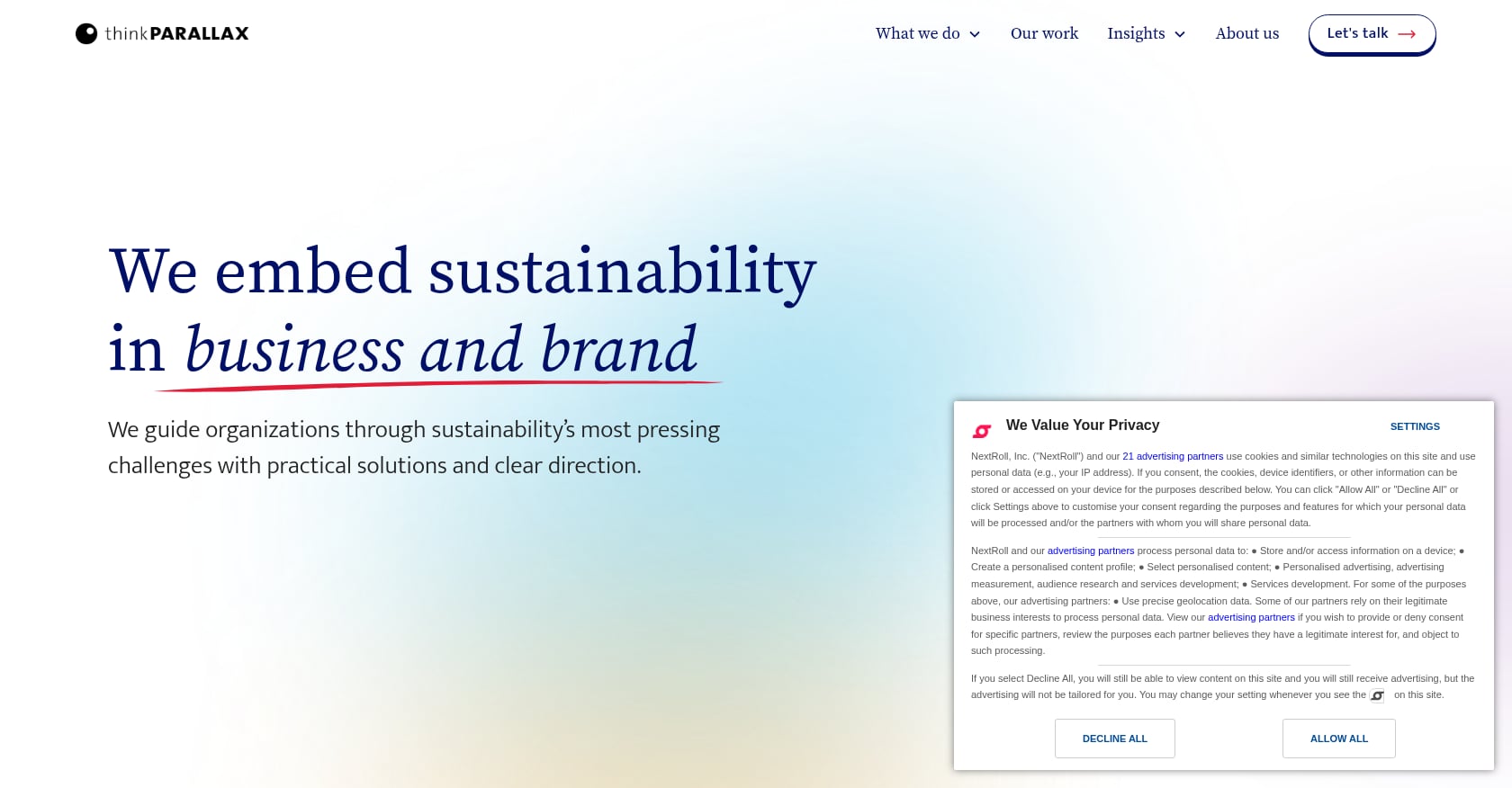
Best for: Mid-to-large companies that need sustainability strategy, ESG reporting, and communications under one roof.
With over 20 years of experience, thinkPARALLAX helps companies embed sustainability into strategy, brand, and storytelling. Their strength lies in combining deep expertise in regulatory reporting with creative execution.
Key features:
Certified B Corporation with a B Impact Score of 82.8
Proprietary benchmarking methodology analyzing 26 sustainability criteria to measure peer performance
Strong capabilities in CSRD, ESG reporting, and regulatory navigation
Full sustainability strategy through to communications and stakeholder engagement
Pricing: Not publicly listed.
Tradeoffs:
Heavier on reporting and strategy than on creative campaign execution or consumer-facing behavior change. If you need to change how people shop, not how they report, this may not be the right fit.
Less suited for retail activation, packaging design, or direct-to-consumer marketing.
Behavioral science is not a stated core competency.
7. Radley Yeldar (RY)
Best for: Large UK and European enterprises needing sustainability reporting combined with stakeholder engagement and internal behavior change programs.
Radley Yeldar is a 200-strong, London and Birmingham-based creative consultancy with over 30 years of experience. Their sustainability work spans reporting, employee engagement, brand positioning, and purpose strategy.
Key features:
World-leading sustainability reporting expertise combined with communications and engagement specialists
Created the “Fit for Purpose” brand purpose assessment index
Specialists in activating sustainability messages that “move people and shift markets”
Large team with broad capabilities across employee engagement and brand identity
Pricing: Not publicly listed. Likely premium given team size and enterprise focus.
Tradeoffs:
Large agency structure means less boutique agility and potentially slower response times.
Stronger in corporate reporting and internal engagement than consumer-facing behavior change campaigns.
UK-centric operations. Brands outside Europe may find limited local market understanding.
8. Nice and Serious
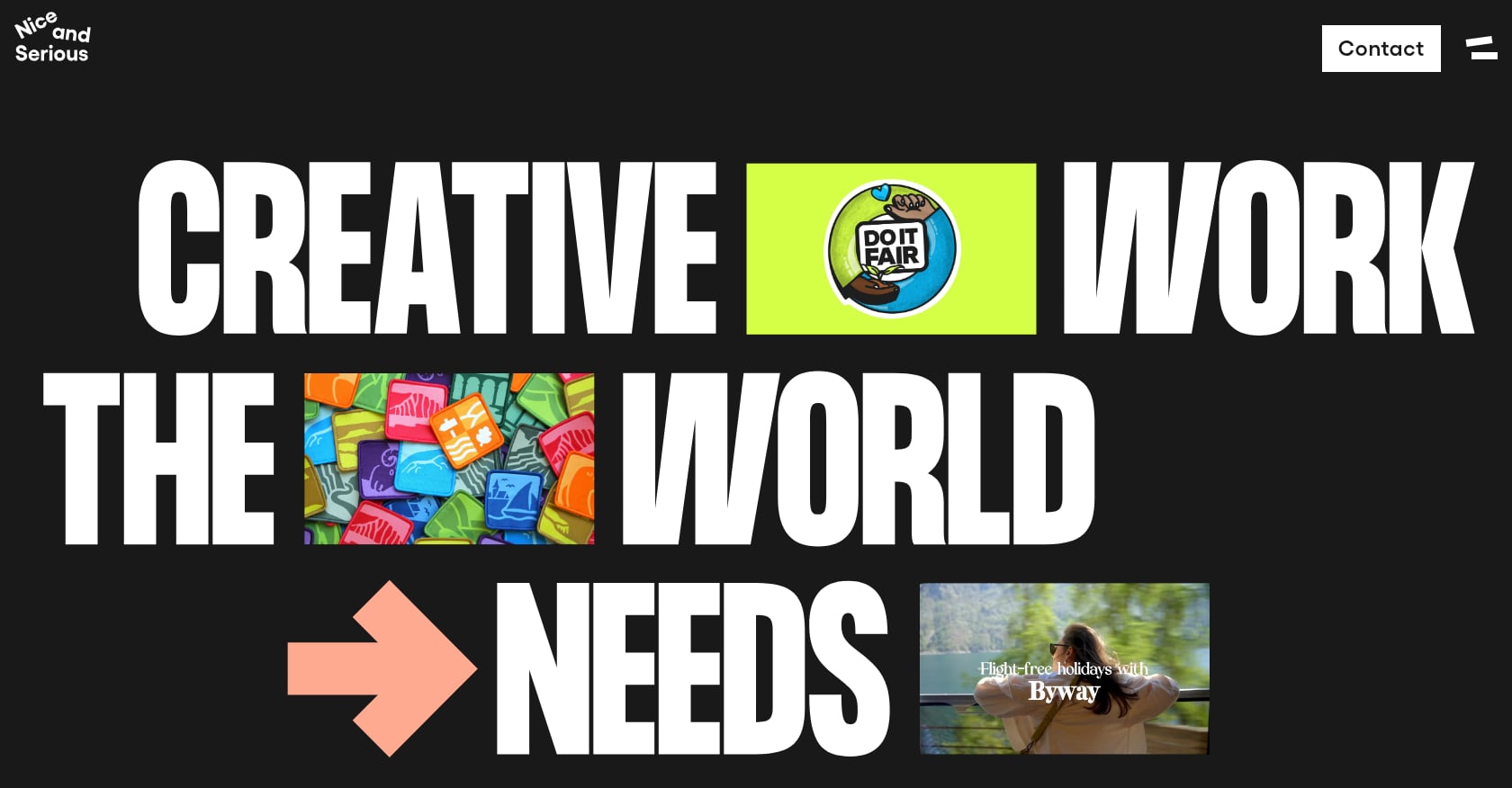
Best for: NGOs, ethical FMCG brands, and social enterprises that need high-quality creative content for sustainability campaigns.
Nice and Serious is a purpose-driven creative agency founded in London in 2008 by a former climate scientist. They’ve drawn a hard line: they only partner with brands, charities, and organizations on projects with positive impact.
Key features:
B Corp certified with a proprietary “Moral Compass™” used to vet every brief
Known for exceptional creative craft across film, animation, branding, and design
Driven by the belief that “serious issues deserve seriously good creative”
Strong in humor and storytelling as engagement levers
Named clients: WWF, Ben & Jerry’s, Innocent Drinks, IKEA Foundation.
Pricing: Not publicly listed.
Tradeoffs:
Primarily a creative execution studio. If you need deep behavioral science research, measurement frameworks, or commercial innovation strategy, you’ll need to pair them with a strategy partner.
Less suited for brands needing retail activation, packaging, or go-to-market strategy.
The creative-first approach means behavior change outcomes may be a byproduct rather than a designed-for result.
9. Civilian
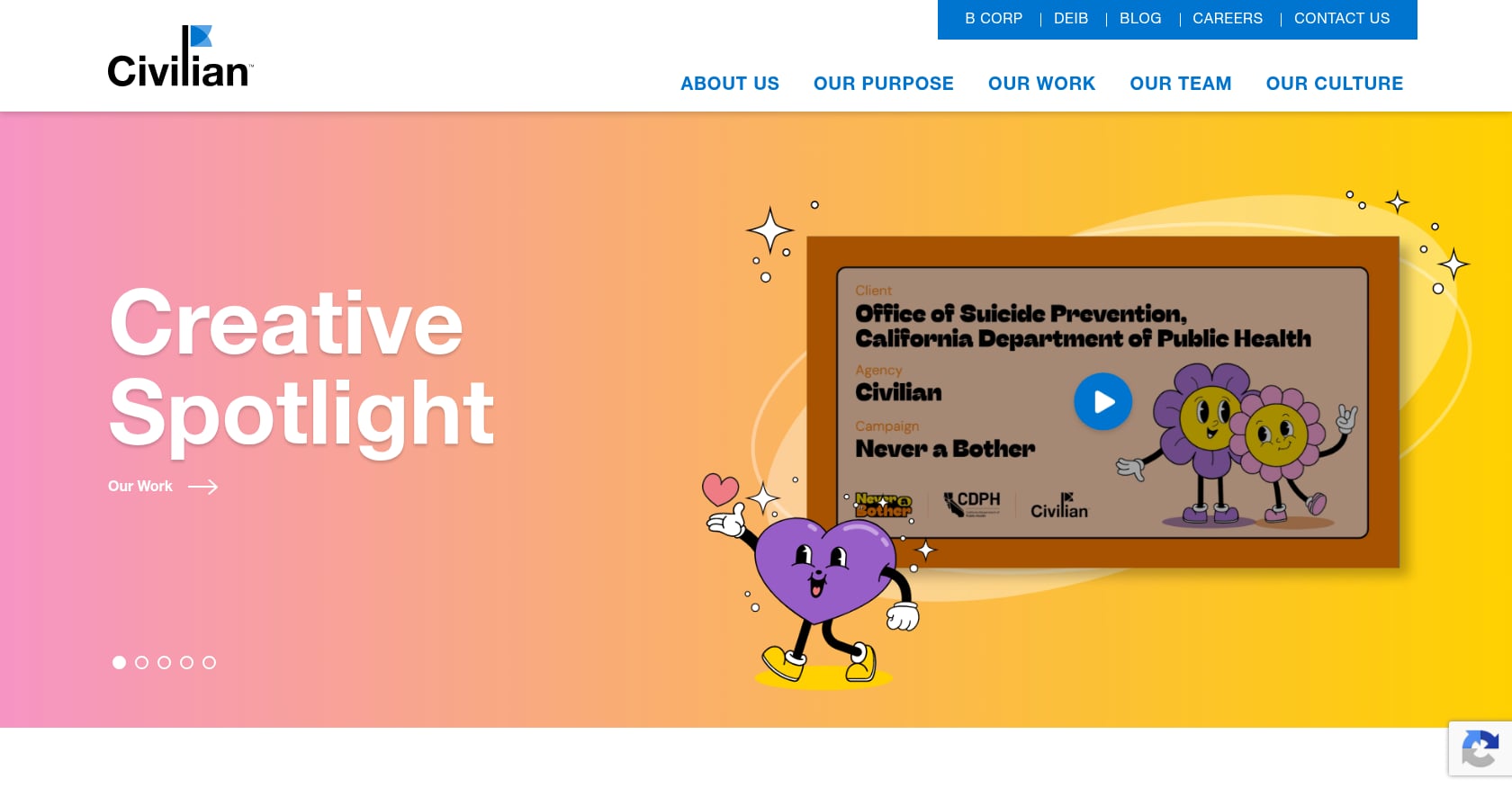
Best for: Government agencies and nonprofits running social marketing campaigns that drive measurable behavior change on sustainability issues.
Civilian is a full-service marketing communications agency dedicated to building stronger communities. They tackle complex social issues ranging from suicide prevention to recycling and conservation.
Key features:
Full-service capabilities: advertising, digital, media buying, social media
Sustainability track record includes work on the How2Recycle labeling system (a coalition with P&G, Target, and Nestlé) and campaigns with PaintCare to increase paint recycling rates
Experience across multiple social issue domains, bringing cross-pollinated behavioral insights
Pricing: Not publicly listed.
Tradeoffs:
Generalist social marketing agency, not exclusively sustainability-focused. The breadth is useful for some briefs but means less depth in sustainability-specific challenges.
May lack the greenwashing risk management capability and sustainability fluency that specialist agencies bring.
Limited publicly visible behavioral science framework usage compared to agencies like Marketing for Change or Grounded World.
How to Choose the Right Behavior Change Agency for Your Sustainability Brand
A comparison table gets you to a shortlist. The right agency partner emerges from deeper questions.
Questions to Ask in Your Discovery Call
“What behavioral science frameworks do you use, and how do they shape your process?” Any agency claiming behavior change expertise should be able to name specific models. COM-B, nudge theory, CBSM, or proprietary frameworks grounded in research. If they can’t answer this fluently, they’re a marketing agency with behavioral language in their pitch deck.
“How do you measure behavior change, not just awareness?” Impressions and reach are not behavior change metrics. You want to hear about purchase conversion, repeat purchase rates, waste diversion rates, or other behavioral indicators.
“Can you show me a case where the intention-action gap was quantified before and after your work?” This separates agencies that diagnose the problem from those that assume the problem and jump to creative.
“How do you handle greenwashing risk in your creative process?” The regulatory environment is tightening. By 2026, misleading sustainability claims will trigger legal action, not just Twitter backlash. The right agency has a vetting process, not just good intentions.
Red Flags That an Agency Is Faking Specialization
The word “behavior change” appears on the homepage but nowhere in the case studies. The team has marketing backgrounds but no one with behavioral science training. The proposal jumps straight to campaign concepts without a discovery or research phase. They can’t articulate the difference between why consumers say they care and why they aren’t buying.
When to Prioritize What
If your primary challenge is that consumers love your brand in surveys but don’t convert at shelf, you need behavioral diagnosis first. Grounded World and Marketing for Change are strongest here.
If you need a globally recognized name to lend credibility to a major corporate transformation, Futerra is the clearest choice.
If your brand identity itself needs reinvention around regenerative principles, BBMG brings the deepest design thinking.
If you need regulatory-ready sustainability reporting alongside your communications, thinkPARALLAX or Radley Yeldar cover both.
If your budget is primarily for standout creative content (film, animation, social), Nice and Serious delivers craft that few can match.
Reporting from Trellis and GreenBiz shows that about a third of 650+ sustainability professionals surveyed described themselves as “discouraged and stressed” or thinking about quitting, underscoring how urgently brands need external support to maintain momentum. Budgetary constraints have frozen hiring in most sustainability departments. The pressure to choose the right agency partner, and avoid expensive mistakes, has never been higher.
The Bigger Picture: Why Behavior Change Is the Growth Lever
Here’s the commercial case, stripped of idealism: sustainable products grew 2.7x faster than those that were not marketed as sustainable. They hold 17% overall market share but account for 32% of growth. The brands that figure out how to close the intention-action gap won’t just do good; they’ll capture disproportionate market share.
The barrier isn’t consumer apathy. It’s friction. The gap widens when the sustainable option requires more mental effort, has immediate barriers (price, availability, confusion), or isn’t obviously superior in the moment of decision. Neuro- and behavioral science research techniques can help brands identify the deeper, subconscious drivers and barriers to change among customers, as practitioners at The Drum and Unlimited Group have documented.
This is why doom-and-gloom messaging fails. Research consistently shows that brands should take a positive approach to sustainability messaging. Shaming narratives are counterproductive. The best behavior change agencies for sustainability brands know this and build their work around making sustainable choices feel easy, obvious, and rewarding.
Meanwhile, purpose-driven brands are reshaping business strategy across categories. The question isn’t whether your brand should invest in this space. It’s whether you’ll partner with an agency that can actually move the needle from intention to action.
Start with a complimentary 5C landscape assessment to understand where your brand’s behavior change opportunities are, before committing to any agency engagement.
Frequently Asked Questions
What is a behavior change agency, and how is it different from a sustainability marketing agency?
A behavior change agency applies behavioral science frameworks (like nudge theory, COM-B, or community-based social marketing) to understand why people don’t act on their stated intentions, then designs interventions that close that gap. A sustainability marketing agency focuses on communicating a brand’s sustainability story. The difference is between changing what people think and changing what people do. For a deeper explanation, see our guide on behavior change frameworks for marketing.
Why can’t a general marketing agency handle behavior change for a sustainability brand?
General agencies typically optimize for awareness, engagement, and reach. Behavior change requires understanding specific psychological barriers (cognitive load, status quo bias, perceived sacrifice) and designing around them. Without this diagnostic layer, campaigns may generate attention without shifting purchasing behavior. It’s the difference between knowing that consumers say they care and understanding why that doesn’t translate to sales.
How much does it cost to hire a behavior change agency for sustainability work?
None of the agencies on this list publish fixed pricing. Engagements are custom-scoped based on the brand’s size, challenge complexity, and scope of work. Enterprise engagements with agencies like Futerra or Radley Yeldar will cost significantly more than boutique projects. The most important cost consideration isn’t the fee itself but whether the agency can demonstrate ROI through measurable behavior change.
What is the intention-action gap in sustainable consumer behavior?
The intention-action gap is the difference between what consumers say they’ll do and what they actually do at the point of purchase. Despite 80% of worldwide consumers saying they’ll pay up to 5% more for sustainable products, actual purchasing behavior consistently falls short. This gap is the central problem that the best behavior change agencies for sustainability brands are designed to solve.
Is B Corp certification important when choosing a sustainability agency?
B Corp certification is a useful trust signal. It means the agency has been independently assessed on social and environmental performance, accountability, and transparency. But it’s not sufficient on its own. Several B Corp-certified agencies on this list are stronger in creative or reporting than in behavioral science. Certification tells you the agency walks the talk on sustainability. It doesn’t tell you whether they can close your intention-action gap.
What behavioral science frameworks should I look for in an agency?
The most relevant frameworks for sustainability behavior change include COM-B (which maps capability, opportunity, and motivation as preconditions for behavior), nudge theory (restructuring choice environments to make the sustainable option the default), CBSM (community-based social marketing that goes beyond information campaigns), and implicit association testing (uncovering subconscious attitudes that surveys miss). Ask any prospective agency which of these they use and how they’ve applied them to past work.
Can a behavior change agency help with greenwashing risk?
Yes, and this should be a core requirement. The regulatory environment around sustainability claims is tightening globally. A skilled behavior change agency will have processes for vetting claims, ensuring messaging accuracy, and helping brands communicate authentically. Some agencies, like Grounded World, build this into their discovery and strategy phases. Others treat it as an afterthought.
How long does it take to see results from a behavior change agency engagement?
Timelines vary significantly. A diagnostic phase (understanding the intention-action gap, mapping barriers) might take 6 to 12 weeks. Campaign development and activation add another 8 to 16 weeks. Measurable behavioral shifts, actual changes in purchasing or recycling or consumption patterns, often take 6 to 12 months to materialize and measure. Be skeptical of any agency promising overnight behavior change. The problems took years to develop, and solutions require sustained, evidence-based effort.