 Paloma Jacome
Food waste. Capital flows for a new regenerative economy. Ethical, sustainable snacking. Three founders on the reframes that changed how they scale and why they stopped waiting for the system to catch up.
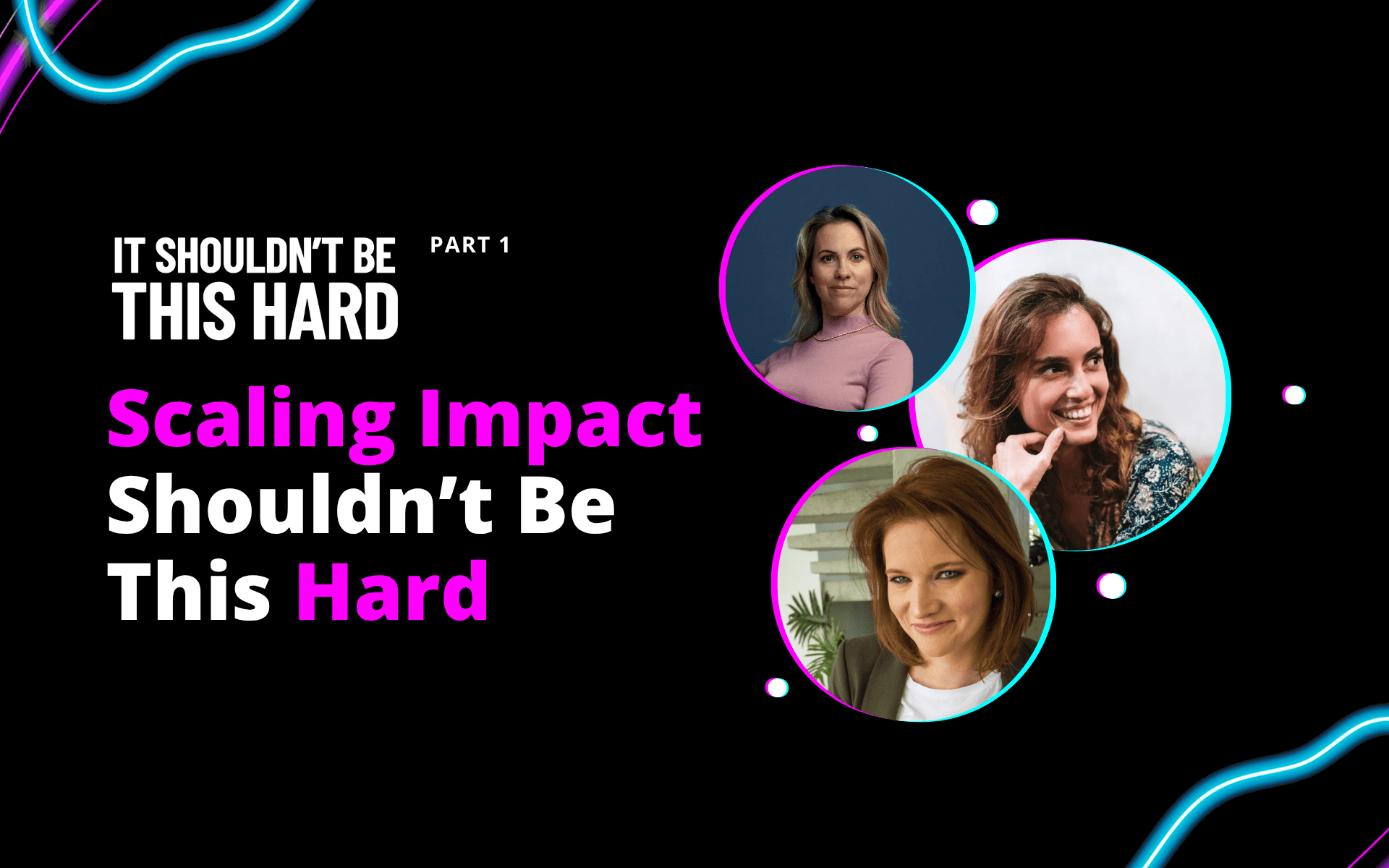
On our latest two-part episode of IT SHOULDN'T BE THIS HARD, three fierce women founders, all kicking ass across completely different industries, show us how it's done. ▶ Watch from the top (00:00)
- Tessa Clarke, Founder of Olio, the neighbor-to-neighbor app tackling food waste
- Alessa Berg, Founder of Top Tier Impact, a global network for impact investors and entrepreneurs
- Heather Terry, Founder of GoodSAM Foods, the snack brand that cut out the middlemen
None of them are waiting for the system to get fairer, cheaper, or more rational before they act. They're building what needs to exist themselves.
The TL;DR
- Guilt has a terrible conversion rate.
- Blame is the most expensive habit in business.
- Protest makes noise but profit makes precedent.
Contraband Carrots and Other Origin Stories
Before any of them had a pitch, a P&L, or a plan, all three had something messier: a feeling they couldn't explain away. For Tessa Clarke, it went back to a childhood where wasting food wasn't a mistake but a moral failure.
"I grew up on a farm in the middle of nowhere in the northeast of the UK... through that experience, I learned just how much hard work goes into producing the food that we all eat every single day... in my family, food waste was pretty much criminal."
▶ Tessa on growing up where food waste was "pretty much criminal" (01:30)
So one day when she was moving out, the removal men told her to toss her uneaten food, she did the only reasonable thing.
"The inner farmer's daughter in me was like no way I am not prepared to put perfectly good food in the bin when I know there's someone probably 100 meters from me who would love to have that food... I essentially resorted to cross-border vegetable smuggling... That was this light bulb moment for Olio, which is, why isn't there an app for this?"
That stubborn little act of rebellion is now Olio, and 150 million meals' worth of food has changed hands through it. Not bad for a box of contraband veg. ▶ The moment Olio was born (02:00)
Alessa Berg's spark for building Top Tier Impact came from learning to listen to herself. Instead of mapping out her career years in advance, she lets the next step reveal itself. ▶ Alessa on trusting her "internal coding" (02:44)
"I always kind of just kind of like follow the emergence of what's relevant for me. And I trust my navigational direction…let's call it, the coding in my system. And then I allow it to be emergent, right? As opposed to, in five years it has to be that, in ten years it has to be that, and so on– that never quite resonated with me."
That intuitive instinct created Top Tier Impact, a network now spanning more than 80 countries. ▶ Building Top Tier Impact's global ecosystem (03:15)
"We have a global ecosystem in impact investing: tech and innovation in all areas of our economy and our world, with a positive component that's measurable... anything ranging from regenerative agriculture to deep tech applied to areas like renewable energy and everything in between."
And Heather Terry started with a question most food brands would rather not ask: why do the people at the very start of the supply chain so often get paid last? ▶ Heather on backing farmers and cutting the middlemen (03:49)
"At the heart of the business model, it's to improve the economics of smallholder farmers and indigenous communities around the world. It is about -if we take care of that ecosystem of food providers, food stewards- that we can actually change a lot of what's happening in the world."
Her answer was to delete the middle entirely.
"There are actually no middlemen. Zero middlemen in Good Sam's entire supply network. We work with no intermediaries."
Steal this: The best origin stories aren't always about opportunity. They're about irritation. What in your industry makes you quietly furious? Start there.
The Intention-Action Gap: “Save the Planet” Doesn’t Sell
In almost every industry, there's a gap between what people say they value and what they actually do. Shoppers say they want sustainable products, then reach for the cheaper option. Employees say they want purpose-driven work, then stick with the job that feels safe. Leaders say sustainability is a priority, then let it slide to next quarter.
At grounded, we call it the intention-action gap, and we spend our days obsessing over it. Ask anyone if they care about the planet and you'll get an enthusiastic yes. Then watch what they choose at checkout.
That gap isn't hypocrisy. It's human. And Tessa Clarke learned just how wide it can be.
"We made the mistake of talking about Olio very much in environmental impact terms and what we have learned is that whilst people care about the environment, that does not motivate them to actually take action... We used to lead with the planetary benefit of using Olio... We've now flipped that hierarchy on its head. We now lead with the personal... We then follow with a real focus on the community... and to be honest, we barely talk about the planet at all anymore."
▶ Olio's pivot from "save the planet" to "what's in it for you" (04:30)
Olio didn't stop caring about the planet. It stopped asking people's values to do all the heavy lifting. Instead of trying to talk people across the gap, it built a bridge they'd actually want to walk over: something personal first, something communal second, and the planetary impact along for the ride.
That's the part most purpose-driven businesses miss. Closing the intention-action gap isn't about convincing people to care more. They already care. It's about removing whatever stands between that care and the action. And it's exactly the work we do with brands at grounded, helping bridge the gap between purpose and performance.
Steal this: Stop asking whether your audience cares. Assume they do. Then list every bit of friction between their good intentions and the moment they'd act, and start deleting. Need help closing the gap?
The Drama Triangle: Stop Playing the Victim in Your Own Business
When things go sideways, it's tempting to play the victim. The investor pulled out. The market shifted. The partner dropped the ball. And sure, sometimes that's true. But if every setback is someone else's fault, you've also handed them all the power to fix it.
Alessa Berg has a framework for catching exactly that. ▶ Alessa breaks down the drama triangle (05:06)
"I believe in taking full responsibility for our reality... I would often ask myself, well, if there's a certain situation I'm dealing with that is not ideal - how did I contribute, as opposed to being in the victim mode. And I think that our reality collectively... you use this framework within yourself of this, it's called a drama triangle of victim, hero, and perpetrator. You see it everywhere, all the time."
Her antidote is annoyingly simple. When something goes wrong, ask what part you played in it. Not to beat yourself up. To find the part you can actually improve.
Proof Over Protest: Why GoodSAM Is Scaling Slowly on Purpose
The food industry has long insisted that ethical supply chains don't pay. Heather Terry isn't interested in arguing the point. She's building the business that proves it wrong... ▶ Heather on "weaponizing cash" as protest (05:45)
"We believe in protest, and we believe in debate... But what we really believe can change things is when you can show that financial models work... It is a little bit like weaponizing cash and business against a system that has basically told all of us that they can't do it sustainably. They can't do it without corruption, they can't do it without hurting somebody."
Every profitable quarter at GoodSAM Foods is evidence. Fair pay for farmers, zero middlemen, and a business that still makes money. That's why GoodSAM Foods is taking it steady on purpose. ▶ Why slow, profitable scale beats fast (07:59)
"We're scaling the model. We're scaling nuts and coffee in particular. We are doing it slowly... I'd rather go really slow and really steady and continue to drive — for me, more than even scale — profitability is even better... If we're profitable and we scale slowly into big numbers profitably, that's what changes the entire system. That's what decimates the current system."
In a world where speed is the flex, Heather's flex is a business that pays farmers fairly and still turns a profit. Slow growth doesn't make headlines. It makes precedent. And precedent is much harder for a broken system to ignore.
When Your Product Disappears Too Fast
Olio had a problem most startups would trade their seed round for: demand so strong that listings vanish almost instantly. Great for engagement. Terrible for anyone who opens the app and finds nothing there.
The fix wasn't another clever feature. It was a business model pivot, turning businesses into paying clients instead of donors, backed by a small army of volunteers. ▶ Olio's 100,000 volunteers and the supply-side fix (06:31)
"Overall sort of biggest challenge has been on the supply side of the marketplace because once that food gets on the app it goes within minutes, sometimes seconds. One way we've tried to solve for that on the app is through partnering with businesses. We now have 100,000 food safety trained volunteers... a collection slot might be a Tuesday night at 8:30 p.m., they get to go to their local supermarket, they will pick up all of the unsold food from that store... and that takes on average one to two hours for that food to go from being considered a waste stream at the business location to instead being fully redistributed into multiple homes in the local community. And that's how Olio generates the majority of our revenues."
Steal this: Look at the side of your business that's always short. Is there someone who would pay you to solve it, rather than someone you're asking for favors?
Scaling Impact Shouldn’t Be This Hard
A farmer's daughter with a box of smuggled vegetables. An investor who refuses to plan past what's relevant right now. A snack founder getting their goods directly from the source. None of them had the perfect conditions. None of them waited for them either.
Part 2 of this conversation digs into the grit of actually scaling with purpose, and what it costs to keep going.
Audio Streaming Links for Part 1: