

 Hope Wehrli
 Leadership approved the sustainability strategy months ago. ESG goals are now embedded into investor presentations, annual reports, marketing campaigns, and company-wide messaging. Internally, teams understand that sustainability matters to long-term growth, customer trust, and competitive positioning. On paper, the organization appears aligned. Operationally, however, progress often feels slow, fragmented, and frustratingly difficult to scale.
Projects stall in approval cycles that seem endless. Teams revisit the same conversations repeatedly without reaching clear decisions. Product launches get delayed while stakeholders debate trade-offs between impact, cost, speed, and operational complexity. Momentum fades somewhere between strategic ambition and day-to-day execution. In many organizations, sustainability starts feeling less like innovation and more like bureaucracy.
This is the operational failure of cross functional sustainability. Companies often assume leadership buy-in automatically removes friction, but in reality, it frequently exposes how disconnected internal systems already were underneath the surface. Sustainability initiatives force organizations to confront competing incentives, unclear ownership structures, and decision-making systems that were never designed to support long-term environmental priorities alongside short-term commercial pressure.
Most organizations are not struggling because teams lack commitment. They are struggling because sustainability still operates as an additional layer placed on top of existing workflows instead of being embedded directly into how decisions are made. Every initiative therefore becomes heavier, slower, and more politically difficult to move through the organization.
At Grounded World, much of the work around stakeholder alignment and sustainability strategy focuses on identifying where operational friction prevents sustainability goals from translating into measurable action. Through workshops, stakeholder mapping, and behavior-change frameworks, the focus is not simply on helping organizations articulate purpose, but on understanding why execution slows down once initiatives reach cross-functional teams.
Make a creative impact.
See what making a creative impact looks like with some award-winning case studies from the Grounded team.
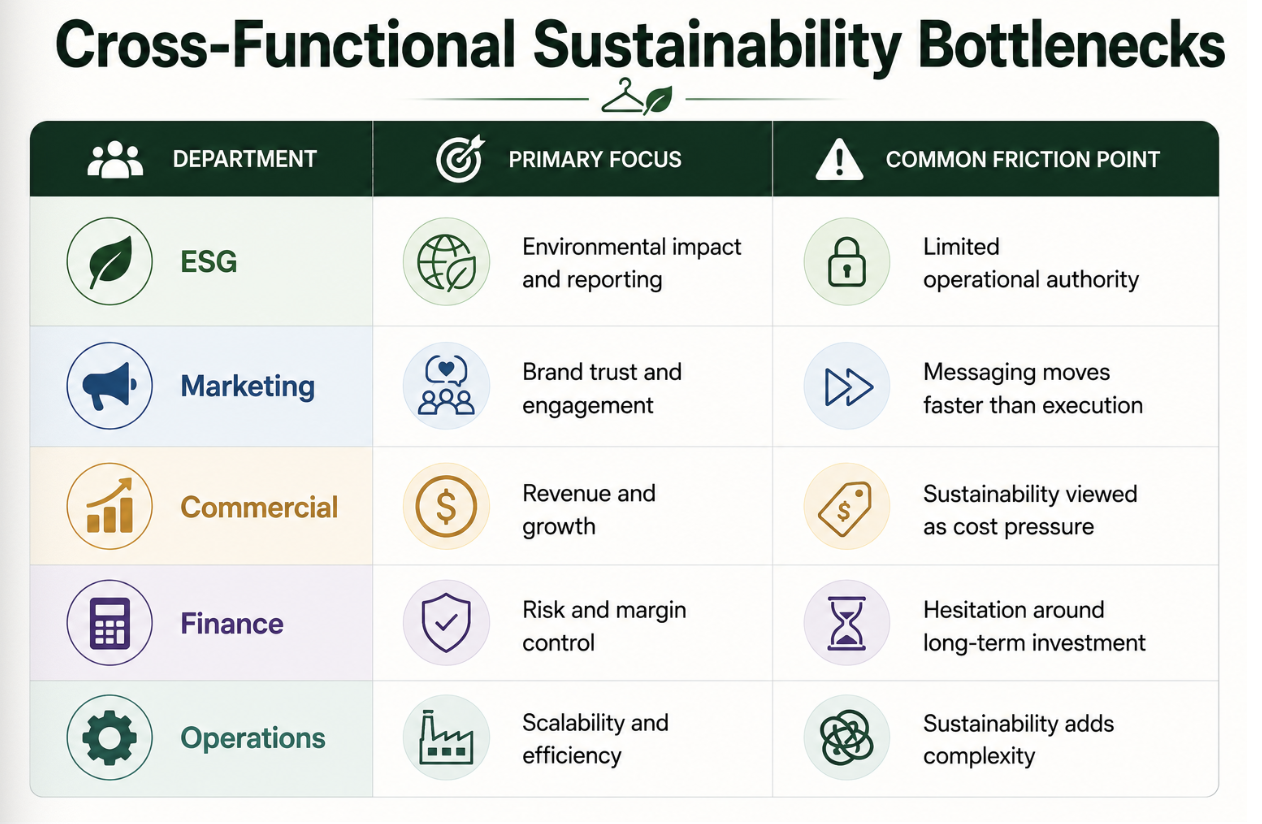
That distinction matters because sustainability initiatives tend to break down in predictable ways. ESG teams focus on measurable environmental impact, reporting metrics, and long-term compliance. Marketing teams focus on storytelling, engagement, and brand trust. Commercial teams prioritize profitability, scalability, and growth targets. Finance teams evaluate cost exposure and operational risk. Operations teams focus on efficiency and execution speed. Individually, these priorities all make sense. Together, however, they create an environment where nearly every sustainability decision requires repeated negotiation between competing definitions of success.
Research from Harvard Business Review explains that behavioral design plays a significant role in whether people follow through on sustainable choices. When decisions become too complex, inconvenient, or cognitively demanding, action slows down even when intentions remain positive.¹ Internally, organizations behave in much the same way. When sustainability decisions involve too many approvals, unclear ownership, or unresolved trade-offs, teams begin delaying action simply because the process itself becomes exhausting.
The Decision Lab similarly highlights how habit formation, competing priorities, and friction points widen the gap between intention and execution.² Inside organizations, this often appears through repeated debates around pricing flexibility, operational complexity, supplier constraints, or acceptable margin trade-offs. Teams spend months revisiting the same questions because no shared framework exists for resolving them efficiently.
Where cross functional sustainability breaks down
Cross-functional sustainability initiatives typically slow down in a few consistent areas:
- Too many stakeholders involved in approvals
- Sustainability treated as an additional review step
- Conflicting KPIs across departments
- Repeated debate around cost and margin trade-offs
- Unclear ownership over final decisions
- Sustainability disconnected from operational workflows
These bottlenecks become even more difficult during periods of economic uncertainty. Research from Sustainable Brands notes that affordability concerns consistently widen the intention–action gap, particularly when organizations or consumers perceive sustainability as increasing cost or operational difficulty.³ Similarly, the World Economic Forum has highlighted how trust, accessibility, and affordability continue shaping whether sustainability commitments translate into real behavioral change.⁴
Internally, organizations experience the same pressure. Sustainability initiatives become vulnerable when teams are forced to balance long-term environmental goals against short-term financial expectations. Without operational clarity, execution slows dramatically.
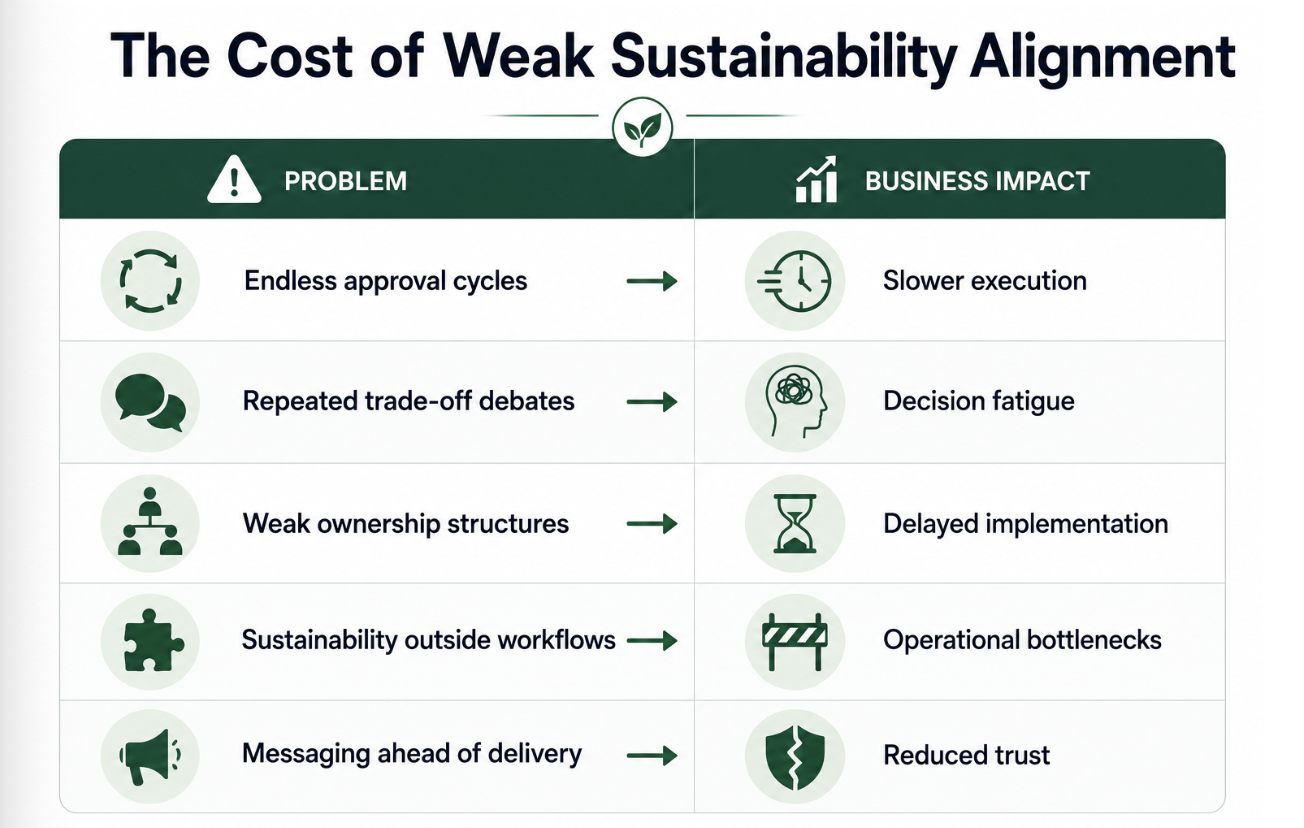
The consequences become measurable very quickly. Delayed execution weakens speed-to-market and reduces competitive advantage. Marketing campaigns begin outpacing operational reality, which creates credibility issues with consumers and stakeholders. Internal teams lose momentum because responsibilities remain unclear and approvals feel endless. Over time, sustainability becomes associated with friction instead of innovation.
Organizations successfully improving cross functional sustainability are usually not the ones adding more reporting layers or approval meetings. They are the ones redesigning how decisions happen operationally. This often includes embedding sustainability into core workflows, defining decision-making principles upfront, reducing unnecessary approvals, aligning KPIs across departments, and assigning clear ownership over implementation.
This is where sustainability shifts from aspiration into operational behavior.
**Leadership buy-in was never supposed to be the finish line. It was supposed to be the starting point. **The organizations making meaningful progress are the ones recognizing that sustainability execution is fundamentally a systems challenge. Until those systems change, sustainability strategies will continue moving far slower than the ambition surrounding them.
Close your intention–action gap.
If your investments in sustainability and social impact aren't translating into sales, growth or internal buy-in, we can help you identify the gap.
Footnotes
- Harvard Business Review. “Nudging Consumers to Purchase More Sustainably.”
- The Decision Lab. “Overcoming the Intention–Action Gap in Sustainable Consumption.”
- Sustainable Brands. “Economic Uncertainty and the Intention–Action Gap.”
- World Economic Forum. “Consumers’ Sustainability Choices.”
Works Cited
Harvard Business Review. “Nudging Consumers to Purchase More Sustainably.” https://hbr.org/2022/08/nudging-consumers-to-purchase-more-sustainably
Sustainable Brands. “Economic Uncertainty and the Intention–Action Gap.” https://sustainablebrands.com/read/deloitte-economic-uncertainty-inequity-intention-action-gap
The Decision Lab. “Overcoming the Intention–Action Gap in Sustainable Consumption.” https://thedecisionlab.com/big-problems/overcoming-the-intention-action-gap-in-sustainable-consumption
World Economic Forum. “Consumers’ Sustainability Choices.” https://www.weforum.org/stories/2026/03/consumers-sustainability-choices-world-consumer-rights-day/