
 Hope Wehrli
 Sustainability Has Become Emotionally Heavy Work
Most sustainability strategies do not collapse because leadership suddenly stops caring. In many organizations, the opposite is happening. Sustainability is now embedded into investor expectations, ESG reporting, annual reports, brand messaging, and long-term growth conversations. Executives publicly support climate commitments, internal teams understand the reputational importance of sustainability, and customers increasingly expect companies to demonstrate measurable environmental action.
Despite this widespread alignment, sustainability work inside organizations often feels frustratingly difficult to execute. Projects move slowly through layers of approvals, initiatives remain trapped in planning phases, and teams repeatedly revisit the same conversations without reaching clear operational decisions. Employees who were initially energized by sustainability work begin disengaging because execution feels endlessly complicated.
Over time, sustainability stops feeling like momentum and starts feeling like exhaustion.

This exhaustion is rarely discussed openly because organizations tend to interpret slow execution as a strategy issue or a communication issue. In reality, the problem is often psychological and structural. Sustainability initiatives force organizations to navigate competing incentives, unresolved trade-offs, and unclear ownership structures simultaneously. As complexity increases, decision-making slows down.
Research from The Decision Lab explains that people consistently struggle to translate intention into action when cognitive load becomes too high or decision pathways remain unclear.¹ Sustainability initiatives frequently create exactly these conditions. Teams may fully support environmental goals while simultaneously feeling uncertain about financial implications, operational feasibility, stakeholder expectations, or long-term risk exposure.
The result is not open resistance. The result is decision fatigue.
Why Sustainability Decisions Feel Harder Than Other Decisions

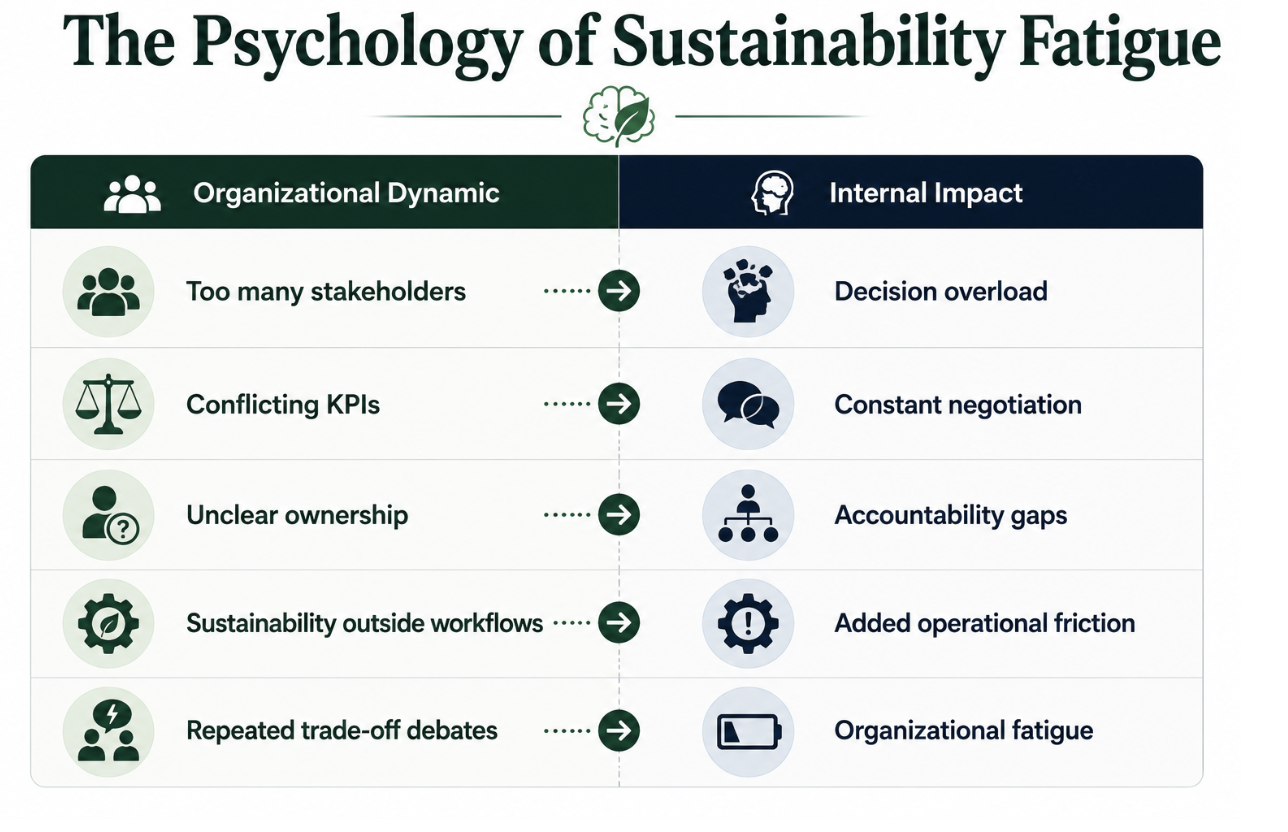
Inside organizations, sustainability decisions are rarely isolated to one department. A single initiative may move through ESG, finance, marketing, legal, procurement, operations, and commercial leadership before implementation even begins. Every department evaluates the initiative differently because every department operates under different incentives and measures success differently.
ESG teams focus on measurable impact, reporting rigor, and long-term environmental outcomes. Marketing teams focus on brand trust, messaging clarity, and consumer engagement. Commercial teams prioritize profitability, scalability, and competitive positioning. Finance teams evaluate operational risk, margin exposure, and investment pressure. Operations teams focus on execution speed, supply chain complexity, and efficiency.
Individually, each perspective makes sense. Collectively, however, they create organizational friction that compounds over time.
Sustainability therefore becomes layered onto existing systems as an additional decision-making process rather than embedded directly into operational workflows. Teams are asked to balance environmental impact against cost pressures, operational efficiency, consumer expectations, and growth targets all at once. Even highly motivated employees begin defaulting toward delay because every sustainability-related decision feels heavier, riskier, and more politically complex than a standard business decision.
Research from Forbes similarly notes that people frequently fail to act on sustainability values not because they disagree with them, but because systems fail to reinforce or simplify consistent behavior.² Organizations experience the same challenge internally. Without structures that reduce complexity and align incentives, sustainability work becomes emotionally and operationally draining.
What Sustainability Fatigue Actually Looks Like
Sustainability fatigue rarely appears as open opposition to environmental goals. More often, it appears through subtle organizational behaviors that collectively slow momentum and weaken execution quality.
Common signals of sustainability fatigue:
- Projects repeatedly delayed for additional stakeholder input
- Teams revisiting the same trade-offs every quarter
- Sustainability initiatives pushed into endless review cycles
- Employees disengaging from long approval processes
- Sustainability framed internally as operational complexity
- Initiatives scaled back before implementation begins
Economic Pressure Makes Sustainability Fatigue Worse
This dynamic becomes even more difficult during periods of financial pressure or market uncertainty. Research from Eco-Business highlights how sustainability intentions frequently weaken when affordability, convenience, or uncertainty increase.³ Consumers may continue supporting sustainability conceptually while prioritizing lower-cost or lower-friction options in practice.
Organizations behave similarly under pressure.
When margins tighten or operational pressure increases, sustainability initiatives often become more vulnerable to delays, hesitation, or scope reduction. Teams become increasingly risk-averse. Leaders hesitate to introduce additional operational complexity into already strained systems. Short-term efficiency begins outweighing long-term environmental priorities, even in organizations that remain publicly committed to sustainability goals.
At Grounded World, much of the work around stakeholder alignment and behavior-change strategy focuses on reducing these friction points before organizations attempt to scale sustainability initiatives. The challenge is not simply creating ambition around sustainability. The challenge is designing systems where sustainable action feels operationally achievable rather than endlessly complicated.
Make a creative impact.
See what making a creative impact looks like with some award-winning case studies from the Grounded team.
Why More Communication Usually Does Not Solve the Problem

Organizations often respond to slow sustainability execution by adding more communication, more workshops, more reporting structures, or more alignment meetings. While these interventions are usually well-intentioned, they frequently increase complexity instead of reducing it.
The organizations making meaningful progress are usually the ones simplifying how sustainability decisions happen operationally. They reduce unnecessary approval layers, clarify ownership structures, align KPIs across departments, and integrate sustainability directly into workflows instead of treating it like a parallel process.
This distinction matters because sustainability is no longer functioning as a side initiative. It increasingly shapes customer trust, investor confidence, regulatory scrutiny, supply chain resilience, and long-term business competitiveness. Organizations that cannot operationalize sustainability efficiently risk creating internal burnout around initiatives originally intended to create long-term value.
What Reduces Sustainability Fatigue

Organizations successfully reducing sustainability fatigue tend to prioritize operational clarity over additional complexity. They create systems where sustainability decisions move faster because ownership, incentives, and trade-offs are clearly defined upfront.
Organizations reducing sustainability fatigue often focus on:
- Clear ownership over sustainability initiatives
- Faster and simpler decision-making structures
- Defined trade-off frameworks between impact and cost
- Shared KPIs across ESG, finance, marketing, and operations
- Sustainability integrated directly into operational workflows
- Fewer approval layers between strategy and implementation
These changes appear operational on the surface, but **they are deeply behavioral. **They reduce cognitive load, simplify execution, and create clearer pathways between sustainability ambition and measurable action.
Ultimately, sustainability does not fail inside organizations because employees stop caring about environmental impact. It fails because too many systems make acting on those values unnecessarily difficult.
Close your intention–action gap.
If your investments in sustainability and social impact aren't translating into sales, growth or internal buy-in, we can help you identify the gap.
Footnotes
- The Decision Lab. “The Intention–Action Gap.”
- Forbes. “Busting the Sustainability Value-Action Gap.”
- Eco-Business. “Gen Z Singaporeans Talk Green but Baby Boomers Are More Likely to Act.”
Works Cited
Eco-Business. “Gen Z Singaporeans Talk Green but Baby Boomers Are More Likely to Act.” https://www.eco-business.com/news/gen-z-singaporeans-talk-green-but-baby-boomers-are-more-likely-to-act-study/
Forbes. “Busting the Sustainability Value-Action Gap.” https://www.forbes.com/sites/solitairetownsend/2023/07/26/busting-the-sustainability-value-action-gap/
The Decision Lab. “The Intention–Action Gap.”
https://thedecisionlab.com/reference-guide/psychology/intention-action-gap