

 Hope Wehrli
 The Problem Isn’t Disagreement. It’s Too Much Agreement.
At first glance, alignment looks like progress.
Leadership supports sustainability. ESG goals are approved. Marketing teams are aligned around messaging. Commercial teams recognize that consumers increasingly expect purpose-driven brands. Every stakeholder contributes input, participates in strategy sessions, and agrees sustainability matters to the future of the business.
And yet, nothing actually moves.
Projects stall in review cycles. Teams revisit the same conversations repeatedly. Product launches slow down as initiatives move through layer after layer of stakeholder approvals. Momentum disappears somewhere between strategy and execution. Internally, organizations often mistake alignment for progress when in reality alignment has quietly become a substitute for action.
This is the paradox at the center of sustainability stakeholder alignment.
Most sustainability initiatives do not fail because organizations disagree on the importance of sustainability. They fail because too many teams become involved in every decision without clear ownership structures or operational systems capable of moving initiatives forward efficiently.
At Grounded World, much of the work around stakeholder alignment and behavior-change strategy focuses on helping organizations identify where execution slows down operationally. The challenge is rarely convincing teams that sustainability matters. The challenge is understanding why organizations with widespread internal support still struggle to get initiatives over the finish line consistently.
Inside the Alignment Loop

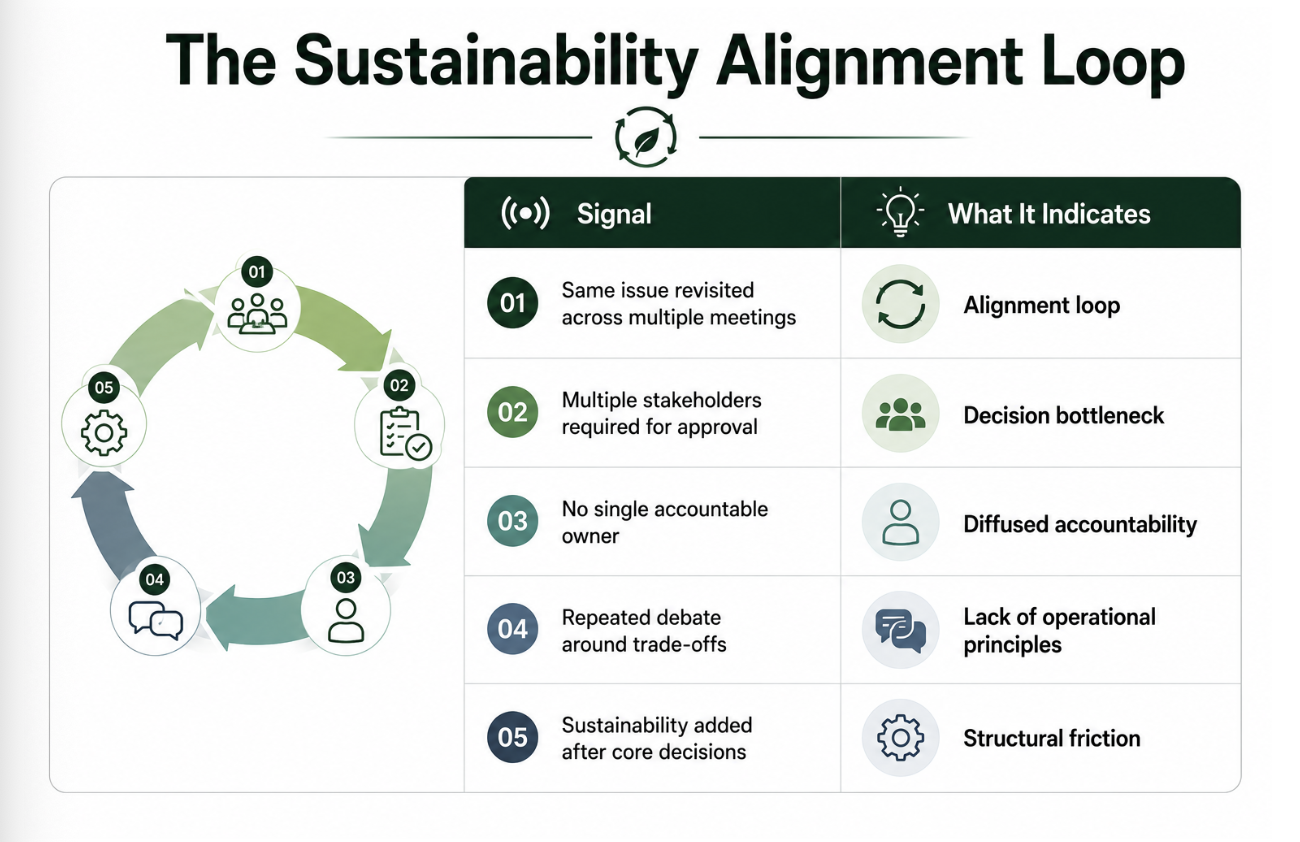
Many sustainability initiatives become trapped in what could be described as the alignment loop:
Discuss → align → refine → re-align → delay.
Every stage introduces additional perspectives, additional caution, and additional operational complexity. Teams continue refining initiatives long after strategic direction has already been established because organizations often default toward consensus-building instead of decision-making.
Over time, alignment stops functioning as one step in the process and becomes the process itself.
Research from The Decision Lab explains that people consistently struggle translating intention into action when decision-making pathways become overly complex or cognitively demanding.¹ Organizations behave similarly. Sustainability initiatives often require coordination across ESG, marketing, finance, legal, operations, procurement, and commercial leadership simultaneously. As more stakeholders become involved, decision-making slows significantly.
The result is not stronger execution. The result is organizational friction.
Why Some Brands Move Faster Than Others

Brands that operationalize sustainability effectively tend to reduce the amount of alignment required because sustainability is already embedded into how decisions are made from the beginning.
A company like Seventh Generation operates this way. Sustainability principles shape product development, sourcing, marketing, and commercial strategy upfront rather than functioning as additional review criteria layered onto existing systems later. Product design decisions already account for sustainability expectations before cross-functional negotiation begins. Marketing reflects operational realities that already exist rather than aspirational goals still under discussion.
As a result, fewer decisions require repeated alignment.
Contrast this with organizations where sustainability operates as a parallel process sitting outside core workflows. Every initiative requires negotiation across departments because sustainability has not yet been integrated into product development frameworks, pricing structures, sourcing systems, or go-to-market processes. Alignment therefore becomes a bottleneck instead of an accelerator.
Research from Unilever similarly highlights that brands with sustainability embedded into core business operations consistently outperform broader portfolios because sustainability shapes operational decisions directly rather than functioning as a separate initiative.²
Make a creative impact.
See what making a creative impact looks like with some award-winning case studies from the Grounded team.
The Structural Reason Alignment Slows Execution
Alignment increases the number of decision-makers involved in every initiative. More decision-makers create more perspectives to reconcile, more risks to evaluate, and more approvals to secure before action occurs.
At a certain point, additional alignment stops improving decisions and starts delaying them.
This effect becomes especially visible in sustainability work because trade-offs are constant. Teams are simultaneously balancing environmental impact, operational feasibility, pricing pressure, consumer expectations, supply chain complexity, and profitability targets. Without predefined principles guiding these trade-offs, organizations repeatedly renegotiate the same decisions.
Research from MIT Sloan Management Review notes that organizations frequently struggle operationalizing sustainability strategies when environmental priorities are not integrated directly into core business functions and decision-making systems.³ Sustainability therefore becomes an additional layer of validation rather than a built-in operational framework.
Where Sustainability Stakeholder Alignment Breaks Down
The breakdown points inside organizations are usually highly predictable.
Common alignment bottlenecks:
- Everyone contributes input, but no one owns execution
- Decisions are escalated upward unnecessarily
- Cost, impact, and speed trade-offs are renegotiated repeatedly
- Sustainability sits outside operational workflows
- Teams operate under conflicting KPIs
- Approval structures prioritize consensus over speed
The Commercial Cost of Endless Alignment
Weak sustainability stakeholder alignment creates consequences far beyond operational inefficiency. Time-to-market slows significantly as initiatives move through repeated review cycles. Opportunities shrink as momentum disappears internally. Execution becomes inconsistent across teams, departments, or geographic regions. Employees disengage from sustainability work that never appears to progress operationally.
Eventually, sustainability itself becomes associated with complexity rather than innovation.
This dynamic becomes especially difficult during periods of economic pressure. Research from Sustainable Brands notes that uncertainty increases hesitation around sustainability-related trade-offs because organizations become increasingly cautious around operational complexity and pricing pressure.⁴ Under these conditions, alignment loops become even slower and more risk-averse.
The Shift From Alignment to Decision Design
Organizations improving sustainability execution are usually not adding more meetings, workshops, or approval layers. Instead, they are redesigning how decisions happen operationally.
That shift often begins by defining:
- which decisions actually require cross-functional alignment
- which decisions can remain team-owned
- what sustainability principles guide trade-offs
- who ultimately owns execution authority
Alignment works best at the principle level rather than at every individual decision point.
Organizations moving faster on sustainability typically define acceptable cost thresholds, sustainability standards, and brand positioning boundaries upfront so teams are not renegotiating the same issues repeatedly during execution.
What Organizations Doing This Well Prioritize
Organizations successfully operationalizing sustainability stakeholder alignment often focus on:
- clear ownership structures
- fewer approval layers
- predefined trade-off frameworks
- sustainability integrated into operational systems
- shared KPIs across departments
- decision-making structures designed for speed
These changes appear operational on the surface, but they are fundamentally behavioral. They reduce cognitive overload, simplify execution pathways, and allow sustainability initiatives to move from discussion into measurable action more consistently.
Ultimately, the issue is not whether organizations support sustainability.
The issue is whether their systems are designed to execute it efficiently.
Close your intention–action gap.
If your investments in sustainability and social impact aren't translating into sales, growth or internal buy-in, we can help you identify the gap.
Footnotes
- The Decision Lab. “The Intention–Action Gap.”
- Unilever. “Sustainable Brands Growth.”
- MIT Sloan Management Review. “The Hard Truth About Business Model Innovation.”
- Sustainable Brands. “Economic Uncertainty and the Intention–Action Gap.”
Works Cited
MIT Sloan Management Review. “The Hard Truth About Business Model Innovation.” https://sloanreview.mit.edu/article/the-hard-truth-about-business-model-innovation/
Sustainable Brands. “Economic Uncertainty and the Intention–Action Gap.” https://sustainablebrands.com/read/deloitte-economic-uncertainty-inequity-intention-action-gap
The Decision Lab. “The Intention–Action Gap.” https://thedecisionlab.com/reference-guide/psychology/intention-action-gap
Unilever. “Sustainable Brands Growth.” https://www.unilever.com/news/news-search/2023/sustainable-brands-growth/