
 Gaia
GaiaTLDR
Commercializing sustainability means turning credible environmental or social impact into products, pricing, proof, and customer experiences that people actually choose. It goes well beyond sustainability marketing. The process requires identifying a real sustainability asset, translating it into customer value, building proof before promotion, removing purchase friction, and measuring both impact and business outcomes. Sustainability-marketed products can outperform conventional alternatives, but only when the core product still delivers on price, performance, and trust.
Quick Answer: How Do You Commercialize Sustainability?
Commercializing sustainability means turning credible environmental or social improvements into products, services, pricing strategies, customer experiences, and market propositions that generate measurable business value. The process typically involves identifying a defensible sustainability asset, connecting it to customer value, building proof, reducing adoption friction, setting the right price, activating across channels, and measuring both commercial and sustainability outcomes.
The 8 steps are:
Identify the sustainability asset.
Translate impact into customer value.
Decide whether sustainability leads or supports the proposition.
Build proof before promotion.
Remove commercial friction.
Price for value, not guilt.
Activate across the full funnel.
Measure both impact and ROI.
Sustainability Commercialization at a Glance
Step | Business question | Primary output | Main KPI |
|---|---|---|---|
1. Identify the asset | What can we credibly commercialize? | Sustainability asset inventory | Claim readiness |
2. Translate value | Why should customers care? | Customer value proposition | Value comprehension |
3. Position sustainability | Should sustainability lead or support? | Positioning strategy | Purchase intent |
4. Build proof | Can we substantiate the claim? | Evidence package | Claim confidence |
5. Remove friction | What prevents adoption? | Friction-reduction plan | Conversion rate |
6. Price for value | What is the customer willing to pay? | Pricing model | Margin / price premium |
7. Activate | Where and how will customers encounter it? | Go-to-market plan | Distribution / conversion |
8. Measure | Is sustainability creating business value? | Commercial + impact scorecard | ROI + impact |
Most companies have sustainability work underway. Fewer have figured out how to make that work drive demand, revenue, and growth. That gap between doing sustainability and selling through sustainability is exactly what commercialization addresses.
Commercializing sustainability is the process of turning a company’s verified environmental or social progress into products, services, campaigns, partnerships, and customer experiences that create both positive impact and commercial value. It is not a campaign. It is a business system.
The distinction matters because the data tells two stories at once. On one hand, sustainability-marketed branded products held 25.4% of CPG market share and delivered 44.9% of category growth from 2013 to 2025, according to NYU Stern’s Sustainable Market Share Index. On the other, Deloitte and the Ad Council found that when consumers buy food, they still prioritize taste, value, and quality above sustainability.
The challenge is not whether sustainability can sell. It can. The challenge is making it sell consistently, honestly, and at scale.
Book a discovery call to find where your sustainability work can create commercial value.
What Does It Mean to Commercialize Sustainability?
To commercialize sustainability means to move it from an internal commitment, CSR report, or operational improvement into a market-facing value system that customers, retailers, investors, and partners can understand and act on.
That includes five types of work:
Product commercialization. Launching or scaling lower-impact products, circular offerings, sustainable packaging, refill systems, resale models, or low-carbon alternatives.
Brand commercialization. Turning verified sustainability actions into credible positioning, claims, narratives, and customer experiences.
Retail and channel commercialization. Making sustainable choices visible, available, easy to sell, and compelling at shelf, in ecommerce, and through trade channels.
Business model commercialization. Creating revenue through reuse, resale, subscription, product-as-a-service, take-back, repair, or refill models.
Market-shaping commercialization. Building partnerships, supplier systems, category standards, and infrastructure that allow sustainable products to scale.
The World Economic Forum and BCG frame this as a “green go-to-market” model built around five linked actions: design the target green portfolio, define the green value proposition, engage promising customers, create a pricing strategy, and shape the market environment through partnerships with suppliers, customers, and regulators.
The key distinction: sustainability communications is one component. Sustainability commercialization is the whole system.
Commercializing Sustainability vs. Sustainability Marketing
These two phrases get used interchangeably. They should not be.
Sustainability marketing | Commercializing sustainability | |
|---|---|---|
Focus | Communicates sustainability | Turns sustainability into market value |
Scope | Often campaign-led | Cross-functional, business-wide |
Core concern | Message and brand perception | Product, proof, price, channel, adoption |
Timeframe | Can be short-term | Requires measurement and iteration |
Risk | Can become greenwashing if unsupported | Starts with credible action and substantiation |
Sustainability marketing is a piece of the puzzle. Commercialization is the puzzle. When a brand leads with messaging before building the product, proof, pricing, and channel strategy to back it up, the result is often distrust or, worse, regulatory trouble.
The FTC Green Guides are direct on this point: broad claims like “eco-friendly” are risky unless clearly qualified and substantiated. Practitioners on LinkedIn reinforce this. Sam Cande, a sustainability communications professional, frames the difference simply: greenwashing equals claims, green marketing equals proof through data, certification, and traceability.
For examples of what effective sustainability marketing looks like when backed by real substance, see sustainability marketing examples that drive measurable results.
Why Sustainability Does Not Commercialize Itself
Here is the uncomfortable truth: most consumers say they care about sustainability but do not follow through at the register. This is called the intention-action gap, and it is the central problem that commercializing sustainability must solve.
Bain’s retail analysis quantifies the problem. Nine out of ten retailers made less sustainability progress than expected. In the U.S., non-price barriers such as inadequate product information, lack of variety, poor quality, and low availability account for about three-quarters of the gap between what shoppers say and what they do.
The barriers are practical, not ideological:
Price. “I care, but it costs too much.”
Performance. “Will it work as well?”
Trust. “Is this greenwashing?”
Convenience. “This is too hard to find, use, or return.”
Habit. “I already buy something else.”
Confusion. “I don’t understand the claim.”
Practitioners on Reddit are blunt about this. In r/marketing discussions, users report that many people interpret “sustainable” as “double the price and half the effectiveness.” In r/SustainableFashion, users cite barriers like boring styles, limited sizing, lack of secondhand availability in all sizes, and the risk of buying online without trying something on.
These are not awareness problems. They are adoption problems. And closing them requires more than better advertising.
The Adoption Equation
Think of sustainable adoption as a multiplication problem, not an addition problem:
Adoption = Core benefit × Proof × Price fit × Availability × Ease × Social confidence
If any factor is near zero, adoption stalls, no matter how strong the others are.
Factor | What it means | Common failure |
|---|---|---|
Core benefit | Product still tastes good, works well, looks good, or solves the job | Brand leads with impact but ignores performance |
Proof | Claims are specific, substantiated, easy to verify | “Eco-friendly” with no evidence |
Price fit | Premium feels justified or offset by value | Premium appears arbitrary |
Availability | Customers can actually find and buy it | Sustainable SKU is buried or out of stock |
Ease | Use, refill, recycle, repair, return, or resell is simple | Customer must do extra work |
Social confidence | Buyer feels smart, normal, or aligned with their values | Sustainable choice feels fringe or preachy |
For a deeper look at this dynamic, read about the intention-action gap and how brands can close it.
The Business Case for Commercializing Sustainability
The data supports a clear, if conditional, conclusion: sustainability can drive growth when the commercial system is built correctly.
NYU Stern’s Center for Sustainable Business reports that sustainability-marketed products achieved a 10.9% five-year compound annual growth rate, compared to 2.2% for conventionally marketed products, with an average 26.6% price premium.
McKinsey and NielsenIQ analyzed five years of U.S. sales data across 600,000 SKUs, 44,000 brands, and 32 categories representing $400 billion in annual retail revenues. Products with ESG-related claims averaged 28% cumulative growth versus 20% for products without those claims. Products with multiple ESG claims grew even faster, with four claims showing a 2.5x increase in sales growth compared to products making a single claim.
These numbers are real but require careful interpretation. They do not mean every sustainable product will win. They show that sustainability correlates with growth when the claim is credible, relevant, visible, and connected to a product people already want. Sustainability remains a commercial amplifier, not a substitute for product-market fit.
Are You Ready to Commercialize Sustainability?

Not every sustainability initiative is ready to become a market proposition. Before investing in packaging, campaigns, sales enablement, or retail activation, assess whether the underlying initiative is commercially ready.
You are more likely to be ready when you can answer “yes” to these questions:
Is the sustainability benefit specific rather than vague?
Can the claim be substantiated with reliable evidence?
Does the product or service still deliver strong core performance?
Is the sustainability benefit relevant to the target customer?
Can the benefit be explained in one or two sentences?
Can customers easily access or purchase the offering?
Is the price competitive or is the premium justified?
Can sales and customer-facing teams explain the proposition?
Can the company measure both impact and commercial performance?
Has legal or compliance reviewed material environmental claims?
Sustainability Commercialization Readiness Score
Score | Readiness | Recommended action |
|---|---|---|
0–3 | Low | Strengthen the underlying sustainability initiative |
4–6 | Developing | Validate customer value and proof |
7–8 | Commercially promising | Test positioning, pricing, and channels |
9–10 | Launch-ready | Build the go-to-market and measurement system |
How to Commercialize Sustainability in 8 Steps
This framework turns sustainability from an internal capability into a market-facing system.
1. Identify the Sustainability Asset
Start with what the company can credibly claim or build. That might be lower-carbon materials, recycled content, recyclable or refillable packaging, regenerative sourcing, fair labor practices, a circular business model, reduced waste, or verified certifications.
The emphasis belongs on “credibly.” Practitioners on Reddit consistently push back against sustainability “vibes.” A commenter working in corporate sustainability with consumer goods described vague green language as an ongoing battle with marketing teams, arguing that specific claims like “100% recycled” carry far more weight because they show something tangible.
Do not start with a campaign. Start with an action, asset, or capability that can survive scrutiny.
Explore Gaia to identify where your sustainability work can create the most commercial value.
2. Translate Impact Into Customer Value
Sustainability should connect to what customers already care about:
Health: fewer harmful ingredients, safer materials
Performance: lasts longer, works better, wastes less
Savings: lower energy use, fewer replacements
Convenience: refill, repair, reuse, subscription
Identity: values-aligned, future-facing
Community: supports local farmers, workers, access
NYU Stern and Edelman found that environmental sustainability claims expanded brand reach by 24 to 33 percentage points above category claims alone, but only when tied to the product’s core value proposition and personal benefits.
The takeaway is direct: do not say only “better for the planet.” Say why it is better for the customer, their family, their budget, or their health, and prove it.
3. Decide Whether Sustainability Leads or Supports
Not every sustainable product should lead with sustainability. The right role depends on the market:
Market condition | Role of sustainability |
|---|---|
Deep-green niche audience | Lead benefit |
Mainstream CPG or retail | Supporting amplifier |
Regulated or B2B procurement | Proof and risk-reduction driver |
Premium lifestyle brand | Identity and quality signal |
Commodity category | Differentiator only if proof is simple and price/performance holds |
New behavior model (refill, reuse) | Adoption barrier to solve, not just a claim to promote |
HBR’s 2024 analysis of marketing sustainable products argues that companies often overemphasize social or environmental benefits while customers are first trying to get a job done. The sustainable option still needs to perform at or above the conventional alternative.
Commercializing sustainability usually means making sustainability relevant to the core reason people buy, not asking people to buy for sustainability alone.
4. Build Proof Before Promotion
This is where commercialization separates from greenwashing.
Proof assets include lifecycle assessments, product carbon footprints, supply-chain documentation, certifications, recycled-content percentages, ingredient and material transparency, third-party verification, before-and-after metrics, and impact reports.
A LinkedIn practitioner, Jennifer Spire, argues that many brands overdo Earth Month campaigns and then go quiet, while stronger sustainability content includes measurable numbers, long-term habits, and procurement choices. Another practitioner on Reddit’s r/AskMarketing wrote that effective sustainability marketing looks like old-school brand building: take a position, back it operationally over time, and let the audience verify it.
A sustainability campaign cannot carry a business model that contradicts it. For a deeper look at how to substantiate claims and avoid greenwashing, see the dedicated guide.
Use a Specificity Ladder for Sustainability Claims
Weak sustainability claims are broad and difficult to verify. Strong claims identify the specific attribute, scope, comparison, and evidence behind the statement.
Claim type | Example | Strength |
|---|---|---|
Broad | “Eco-friendly product” | Weak |
Attribute | “Made with 50% recycled plastic” | Stronger |
Comparative | “Uses 30% less virgin plastic than our previous package” | Stronger |
Verified | “Made with 50% recycled content, verified by [certifier]” | Strong |
Outcome-based | “Reduced packaging material by 30% per unit versus 2025 packaging” | Strong when properly substantiated |
5. Remove Commercial Friction
This is where many sustainability initiatives die. The product may be credible, but adoption is too hard.
Common friction points:
The premium is too high or unexplained
The product is unavailable where buyers already shop
The packaging claim is confusing
The refill system is inconvenient
Recycling requires too much effort
The sales team cannot explain the benefit
Retailers do not know how to merchandise it
The ecommerce page lacks proof
A practical checklist: put sustainable options where people already buy, make the lower-impact option easy to compare, use simple labels and proof links, train sales and retail teams, offer trial or sampling if quality is questioned, and use incentives for behavior shifts like refill or return.
For more on identifying and solving these obstacles, read the guide on barriers to sustainable purchasing.
6. Price for Value, Not Guilt
A green premium can work, but only when the buyer understands the value. The goal is not “charge more because it’s sustainable.” The goal is to make the value equation legible: better quality, lower lifetime cost, fewer replacements, health benefit, verified sourcing, or stronger performance.
NYU Stern’s data shows sustainability-marketed branded CPG products can carry an average price premium. But Deloitte’s consumer research warns that price remains a primary hurdle and that excessive discounting can also create skepticism, since many consumers do not associate very low prices with sustainability.
Pricing strategies worth considering: value-based pricing tied to performance or health benefits, tiered pricing with accessible entry points, subscription or refill models that reduce per-use cost, and co-investment models where brands and retailers share the cost of transition.
7. Activate Across the Full Funnel
Sustainability commercialization requires activation beyond a claim on packaging. That means brand positioning, retail merchandising, ecommerce content, sales enablement, shopper marketing, influencer proof, PR and thought leadership, events and sampling, impact pages, customer service scripts, B2B buyer decks, and behavior-change campaigns.
NYU Stern and Edelman found that simple, jargon-free sustainability messages tied to the consumer, family, and world around them are more effective than technical explanations.
For brands selling through physical retail, brand activation at retail is a critical piece of this step.
8. Measure Both Impact and ROI

Commercializing sustainability requires two scorecards.
Commercial metrics: awareness, claim comprehension, trust, purchase intent, conversion, repeat rate, retail velocity, distribution growth, price premium, market share, campaign ROI, and customer lifetime value.
Impact metrics: emissions reduced, water saved, waste diverted, recycled content, refill and reuse rates, repair and resale participation, supplier compliance, and community outcomes.
McKinsey and NielsenIQ found a positive association between ESG claim presence across a brand portfolio and higher repeat rates, with brands generating more than half of sales from ESG-claim products achieving 32 to 34% repeat rates versus under 30% for brands with less coverage. The study notes this is an association, not proof of causation.
The strongest sustainability commercialization connects both sides: proving that real impact creates real business value.
How Sustainability Commercialization Differs in B2B and B2C
Sustainability can influence purchasing decisions differently depending on who controls the buying decision.
Factor | B2C | B2B |
|---|---|---|
Primary buyer | Consumer | Procurement / buying committee |
Main value drivers | Price, quality, convenience, identity | Cost, risk, compliance, performance, customer requirements |
Proof | Packaging, certification, product page | LCA, supplier data, certifications, reporting |
Sales cycle | Shorter | Longer |
Sustainability role | Differentiator or amplifier | Risk reduction, procurement requirement, strategic value |
Key KPI | Conversion and repeat purchase | Win rate, retention, contract value |
Important channel | Retail / ecommerce | Sales / procurement / partnerships |
In B2B markets, sustainability commercialization often works best when environmental performance is translated into procurement language: cost reduction, regulatory readiness, supply-chain resilience, customer requirements, risk reduction, and measurable impact.
Examples of Sustainability Commercialization
Sustainable Packaging
A brand commercializes sustainable packaging when it does more than switch materials. It must explain the benefit, prove recyclability or recycled content, make disposal instructions clear, maintain product protection, and avoid confusing claims. McKinsey’s global packaging research across 11 countries found that consumer views on what counts as “sustainable packaging” vary by market, meaning the commercial answer must be category-specific and locally relevant.
Refill or Reuse
A refill model is commercialized only when the customer can find it, understand it, use it easily, and see enough value to change behavior. The barrier is not awareness. It is habit, convenience, and infrastructure.
Retail Activation
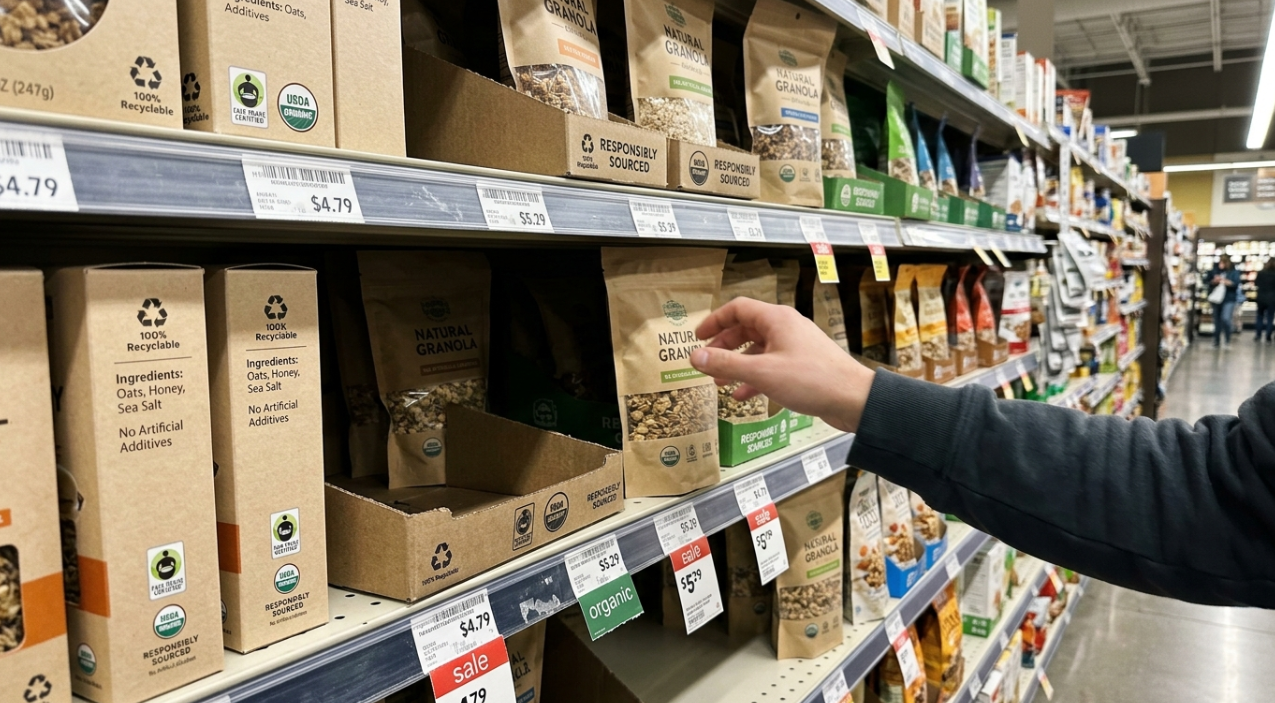
A retailer commercializes sustainability by making better choices visible and easy at shelf: through labeling, assortment, incentives, staff training, and category strategy. Bain recommends hypervisible ESG ranges, clear labeling, direct incentives, and frontline commercial ownership rather than relegating sustainability to a specialist team.
Circular Fashion
A fashion brand commercializes sustainability through durability, repair, resale, rental, or buy-back, not just sustainable materials. Reddit discussions in r/SustainableFashion reveal a useful tension: the most sustainability-conscious consumers may actually buy less new clothing, preferring to repair, reuse, or shop secondhand. That means sustainability commercialization in fashion sometimes requires shifting from volume-based revenue to models built around durability, service, and lifetime value.
Common Mistakes That Kill Commercialization
Leading with “sustainable” before performance. The product still has to work.
Using vague claims like “eco-friendly.” The FTC warns against these. Consumers distrust them. In Reddit discussions, vague sustainability language is treated as a red flag.
Treating sustainability as an Earth Day campaign. Seasonal bursts of green messaging without year-round proof undermine credibility.
Ignoring price and convenience. People who care about sustainability still compare prices and choose the easier option.
Hiding proof in a PDF. If the evidence is buried in a 40-page sustainability report that nobody reads, it is not doing commercial work.
Making customers do too much work. Confusing recycling instructions, inconvenient refill systems, and unclear labels all create friction.
Forgetting retail and sales enablement. If the sales team and retail partners cannot explain the benefit, it will not reach the customer.
Measuring only impressions, not adoption. Awareness without conversion is not commercialization.
Treating sustainability as a marketing responsibility only. It belongs across product, sales, operations, procurement, and finance.
Overclaiming before legal review. One misleading claim can destroy years of credible work.
Who Should Own Sustainability Commercialization?
Sustainability commercialization is cross-functional. No single team can do it alone.
Function | Role |
|---|---|
Sustainability / CSR | Impact strategy, metrics, proof |
Marketing | Positioning, claims, storytelling, demand |
Product / R&D | Product design and performance |
Sales | Buyer story, objections, sell-in |
Retail / Shopper | Shelf visibility, activation, availability |
Legal / Compliance | Claims substantiation and risk |
Finance | Pricing, margin, ROI, investment case |
Procurement / Supply chain | Sourcing, traceability, supplier improvement |
Customer experience | Usage, refill, returns, repair, education |
Leadership | Trade-offs, incentives, accountability |
Bain argues that sustainability must shift from specialist ESG teams into frontline commercial and operational teams. Brand strategist Giuseppe Cavallo made a similar point on LinkedIn: sustainability is not a brand strategy in isolation. It has to be embedded in decisions, culture, leadership, and business model.
Grounded World helps brands connect sustainability and social impact work to commercial outcomes through cross-functional alignment.
Key Terms to Know
Sustainability commercialization. The process of converting credible sustainability work into products, services, offers, campaigns, and customer experiences that generate adoption, revenue, brand value, or other business outcomes.
Green go-to-market. A go-to-market strategy for sustainable, lower-impact, or circular products. Covers portfolio design, value proposition, customer engagement, pricing, and market-shaping partnerships.
Intention-action gap. The gap between what consumers say they value and what they actually do. In sustainability, this gap is driven by price, convenience, quality, availability, habit, trust, and unclear information.
Green premium. A price premium paid for a product or service with credible sustainability benefits. It works best when buyers see personal value, performance, or lifetime-cost benefits, not just environmental virtue.
Greenwashing. Misleading or unsubstantiated sustainability marketing. Broad claims like “green” or “eco-friendly” are risky unless clearly qualified and supported by evidence.
Greenhushing. Under-communicating legitimate sustainability progress because of fear of backlash, scrutiny, or legal risk. The answer is not silence. The answer is better-substantiated claims.
Proof point. A specific, verifiable piece of evidence that supports a sustainability claim: a third-party certification, product carbon footprint, recycled-content percentage, supplier audit, or impact metric.
Scope 3 emissions. Indirect emissions across a company’s value chain. In retail, Scope 3 can represent about 95% of greenhouse gas emissions, which means commercializing sustainability often requires supplier and value-chain collaboration.
Circular business model. A business model designed to keep products, materials, or value in use longer through reuse, resale, repair, refill, remanufacturing, rental, or take-back.
Behavior-change marketing. Marketing designed to help people adopt new actions, such as using a refill system, buying secondhand, returning packaging, or choosing a lower-carbon option. For a framework on this topic, see the behavior change framework for marketing guide.
A 90-Day Sustainability Commercialization Plan
Days 1–30: Diagnose
Audit sustainability assets.
Identify customer needs.
Review existing claims.
Identify evidence gaps.
Analyze competitors.
Map customer friction.
Establish baseline commercial and impact metrics.
Days 31–60: Build
Create the sustainability value proposition.
Develop claims and proof assets.
Test positioning.
Develop pricing options.
Build sales enablement.
Design retail/ecommerce activation.
Establish compliance review.
Days 61–90: Test
Launch a controlled pilot.
Test messaging.
Test pricing.
Measure conversion.
Track customer objections.
Measure impact.
Compare results against the baseline.
Decide whether to scale, revise, or stop.
FAQ
What does it mean to commercialize sustainability?
It means turning credible environmental or social impact into customer value, market demand, and measurable business outcomes. This goes beyond marketing messages. It includes product strategy, pricing, proof, retail activation, behavior change, and measurement.
Is commercializing sustainability the same as sustainability marketing?
No. Sustainability marketing is one component, focused on communicating sustainability. Commercialization is the broader business system that connects sustainability to product, proof, price, channel, adoption, and ROI.
How do companies make sustainability profitable?
By tying sustainability to what customers already care about (health, performance, savings, convenience, identity), substantiating claims with proof, removing purchase barriers, pricing for value rather than guilt, and measuring both impact and commercial outcomes.
How can brands avoid greenwashing when commercializing sustainability?
Build proof before promotion. Use specific, substantiated claims rather than broad terms like “green” or “eco-friendly.” Back claims with certifications, data, third-party verification, or supply-chain evidence. Review claims against the FTC Green Guides and, for EU markets, the Green Claims Directive.
Why do consumers say they care about sustainability but not buy sustainable products?
Because real purchasing decisions are shaped by price, performance, habit, convenience, availability, trust, and confusion. This is the intention-action gap. Closing it requires making the sustainable option easier, more available, more trusted, and clearly valuable, not just morally appealing.
Should sustainability be the main message in marketing?
It depends on the audience and category. For deep-green niche markets, yes. For mainstream CPG and retail, sustainability usually works best as a supporting amplifier of the core benefit (taste, performance, health, savings). Leading with sustainability alone often fails when price and performance are competitive factors.
What teams need to be involved in sustainability commercialization?
Sustainability, marketing, product, sales, retail, legal, finance, procurement, customer experience, and leadership all play roles. Commercialization fails when it is treated as a marketing-only or sustainability-team-only responsibility.
What metrics show sustainability is driving business value?
On the commercial side: purchase intent, conversion, repeat rate, retail velocity, distribution gains, price premium, share growth, and campaign ROI. On the impact side: emissions reduced, waste diverted, recycled content, refill rates, supplier compliance, and community outcomes. The strongest programs track both.
Sustainability becomes commercially useful only when it answers a buyer’s real questions. Does this product work? Is it worth the price? Can I trust the claim? Is it easy to buy, use, and recommend? Does choosing it make me feel smarter, healthier, or more responsible?
The discipline of commercializing sustainability is the work of making those answers clear, credible, and simple enough that people act on them. It is a flywheel, not a launch moment. The more a brand proves value, removes friction, and measures outcomes, the easier it becomes to scale both impact and growth.
Request a discovery call with Grounded World to diagnose the gap between your sustainability promise and customer action.