

 Gaia
GaiaTL;DR
Commercializing sustainability means turning genuine environmental and social commitments into measurable business outcomes like revenue growth, margin improvement, and brand equity. It is not greenwashing. It is the opposite: making real sustainability work so commercially compelling that it scales. The core challenge is closing the gap between what consumers say they want and what they actually buy. Companies that get this right see firm value increases of up to 36% and profitability gains of up to 21%.
Quick Answer: How Do You Commercialize Sustainability?
Commercializing sustainability means turning measurable environmental and social performance into commercial value. Companies do this by identifying customer needs, developing sustainable products or services, creating credible value propositions, optimizing pricing, strengthening procurement and sales arguments, and measuring outcomes such as revenue, margin, retention, customer acquisition, cost savings, and brand value.
The key is not simply charging more for sustainable products. The goal is to make sustainability contribute to measurable business performance.
The core process is:
Identify sustainability issues that matter to customers and the business.
Quantify the economic value created by addressing them.
Build products, services, or processes around that value.
Develop credible and substantiated sustainability claims.
Use pricing, sales, marketing, and partnerships to capture the value.
Measure financial and sustainability outcomes together.
What “Commercializing Sustainability” Actually Means
Commercializing sustainability is the practice of converting a company’s environmental and social performance into business growth, treating sustainability as a revenue driver and competitive advantage rather than a cost center, compliance checkbox, or purely ethical obligation.
This is different from simply selling green products. It is broader and more strategic. Commercializing sustainability spans B2B and B2C markets, services and physical goods, brand positioning, pricing architecture, retail activation, go-to-market strategy, packaging, procurement, and organizational alignment. It touches every function that affects how value is created, communicated, and captured.
Jonathan Knowles, writing in the Journal of Sustainable Marketing, makes the case that the key to more sustainable business lies in its commercial possibilities. Rather than making a moral argument, he argues, it is better to make a commercial case for sustainability. This reframe matters. If sustainability cannot pay for itself, it stays small. If it can, it scales.
Explore a complimentary 5C assessment to understand where your sustainability work has untapped commercial potential.
How It Differs from Related Terms
People often confuse commercializing sustainability with adjacent concepts. Here is how they differ:
Sustainability marketing focuses on communication, the messaging and campaigns that tell a sustainability story. Commercializing sustainability is upstream of that; it includes the business model, pricing, and product decisions that create something worth marketing.
ESG compliance is about meeting regulatory and reporting requirements. Commercialization goes further, turning compliance into competitive positioning.
CSR (Corporate Social Responsibility) typically treats social and environmental work as separate from core business strategy. Commercialization integrates it into the core value proposition.
Green marketing is a subset, usually focused on product-level environmental claims. Commercializing sustainability encompasses the full commercial system.
The common thread: commercializing sustainability is about making sustainability a growth engine, not just a good deed.
Why Commercializing Sustainability Matters Now
Three forces are converging to make this an urgent strategic priority: consumer demand, B2B procurement shifts, and hard financial evidence.
Consumers Are Willing to Pay, but the Picture Is Complicated
According to Simon-Kucher’s 2024 Global Sustainability Study (covering 6,120 consumers across six countries), 54% of consumers are now willing to pay a premium for sustainable products, up from 35% in prior waves.
PwC’s 2024 Voice of the Consumer Survey, spanning 20,000+ consumers across 31 countries, found consumers willing to spend an average of 9.7% more on sustainably produced goods, even amid cost-of-living pressures.
But here is the tension. A BCG study found that while 45% of European consumers consider sustainability when shopping (up five percentage points year-over-year), only 17% would actually pay a premium. BCG’s interpretation is telling: this may indicate consumers increasingly view sustainability as a core product feature rather than an add-on worth paying extra for. In other words, sustainability is becoming table stakes, not a luxury. That reframes the entire commercialization challenge. The risk is not that consumers won’t pay more; it is that they will stop buying from companies that lack sustainability credentials altogether.
B2B Procurement Is Shifting
This is not just a consumer story. A 2025 Edelman Trust Barometer study found that 64% of B2B procurement decision-makers consider a supplier’s sustainability reporting quality when evaluating proposals. Sustainability is becoming a selection criterion, not just a brand differentiator.
For B2B companies, commercializing sustainability means embedding it into sales narratives, RFP responses, and commercial innovation strategies in ways that directly influence win rates.
The ROI Evidence Is Clear
The Project ROI 2025 study, synthesizing over 600 academic studies and reports, found that companies properly implementing sustainability see:
Firm value increases of up to 36%
Profitability gains of up to 21%
Sales increases of up to 20%
Meanwhile, sustainable funds drew USD 31 billion in net inflows globally in 2024, according to the IEEFA, despite significant market headwinds. Capital is flowing toward sustainability, and the businesses that can articulate their sustainability story in commercial terms are capturing a disproportionate share.
What Is Changing in Sustainability Commercialization in 2026?
The commercial sustainability environment is becoming more demanding. Companies are facing a combination of stronger scrutiny, affordability pressure, changing consumer priorities, and greater expectations for evidence.
Recent consumer research illustrates the challenge. BCG's 2026 European consumer research found that sustainability consideration declined by an average of three percentage points across categories compared with the previous year, while willingness to pay a sustainability premium remained at 17%.
This does not mean sustainability has stopped mattering. It means companies increasingly need to connect sustainability with value.
Three implications stand out:
Sustainability must compete with price and performance
Consumers may care about sustainability but still prioritize affordability. A sustainable product that is significantly more expensive or less convenient may struggle to convert interest into purchases.
Sustainability claims need stronger evidence
Consumers are increasingly researching sustainability claims before buying. Simon-Kucher's 2024 research found that 70% of consumers conduct their own research into sustainability claims, rising to around 80% among consumers who believe brands are greenwashing.
Sustainability needs a measurable commercial case
The strongest strategies connect sustainability to revenue, margins, customer retention, operational efficiency, resilience, or market access rather than treating sustainability as a standalone communications program.
The 6 Commercial Levers That Turn Sustainability Into ROI
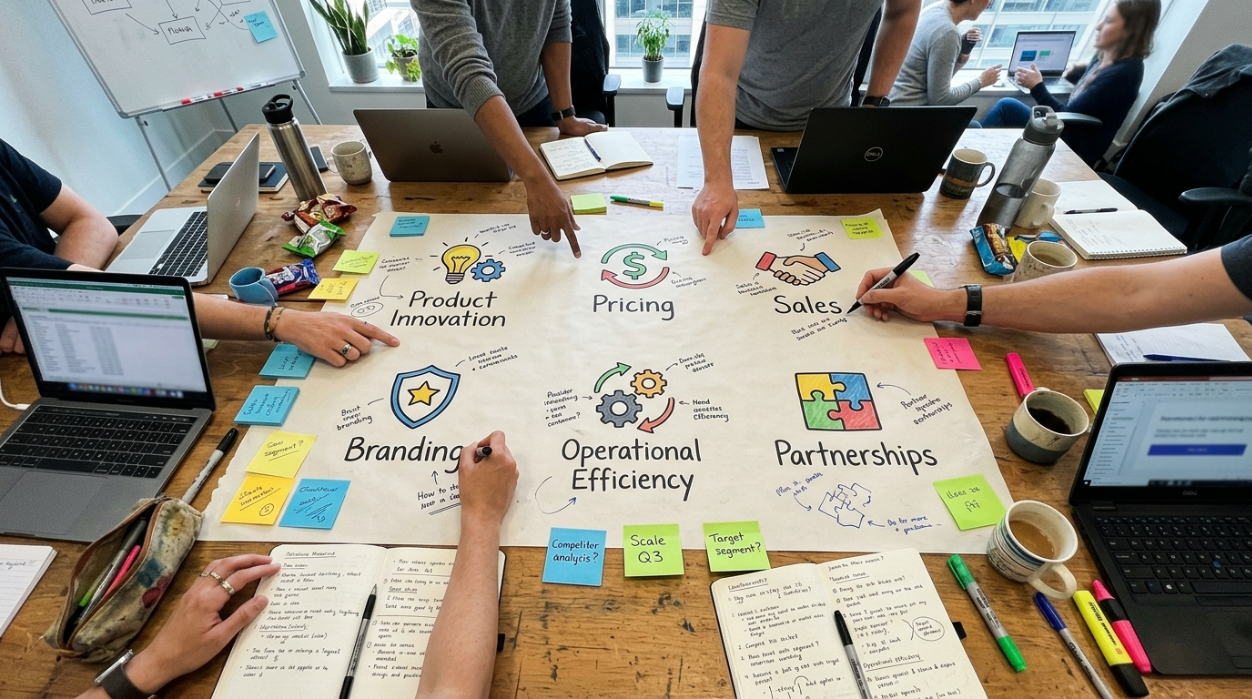
Sustainability does not automatically create financial returns. Companies need a mechanism for capturing the value they create. In practice, six commercial levers are especially important.
1. Product and Service Innovation
The first lever is creating products or services where sustainability is part of the customer value proposition.
Examples include lower-carbon materials, energy-efficient equipment, circular products, repair services, recycled-content products, sustainable packaging, and products designed to reduce waste.
The important question is not simply whether a product is more sustainable. It is whether the sustainability improvement solves a customer problem or creates an advantage the customer values.
2. Pricing and Value Capture
Sustainability can influence pricing, but companies should not assume every sustainable feature deserves a premium.
Pricing should reflect the value created for the customer.
That value may include:
lower operating costs
lower energy consumption
lower regulatory risk
improved durability
better resource efficiency
supply-chain resilience
stronger brand positioning
customer demand
easier compliance
In some markets, sustainability supports a premium. In others, it is becoming a baseline requirement that helps protect market share rather than increase price.
3. Sales and Procurement
Sustainability can become a commercial asset during B2B sales, RFPs, procurement evaluations, and supplier selection.
Companies should translate sustainability performance into customer-facing evidence:
emissions data
lifecycle information
certifications
supplier standards
recycled content
energy efficiency
traceability
social impact metrics
risk reduction
The goal is to make sustainability usable by the sales team rather than leaving it inside a sustainability report.
4. Brand and Customer Acquisition
Sustainability can also strengthen differentiation, trust, and customer acquisition when the claim is relevant and credible.
However, sustainability should not become a generic brand message. The strongest positioning connects a specific sustainability benefit to a specific customer need.
For example, instead of saying "We are committed to sustainability," a company could communicate a measurable product attribute, verified reduction, recycled-content percentage, durability improvement, or supply-chain change.
5. Cost and Operational Efficiency
Commercialization does not always mean generating more revenue.
Sustainability initiatives can create ROI through lower operating costs.
Potential sources include:
energy efficiency
reduced material use
waste reduction
logistics optimization
water efficiency
improved equipment utilization
lower packaging costs
reduced supply-chain disruption
improved resource productivity
These benefits can sometimes produce a faster financial return than sustainability-driven revenue growth.
6. Partnerships and New Business Models
Companies can also commercialize sustainability through partnerships, platforms, subscriptions, circular models, product-as-a-service offerings, take-back programs, and value-chain collaborations.
The strongest partnerships distribute investment and risk while creating measurable value for multiple participants.
The practical lesson: sustainability creates ROI when the business has a mechanism for capturing the value it creates. That mechanism may be price, revenue, cost savings, retention, market access, risk reduction, or a combination of several levers.
Sustainability ROI Framework
Business objective | Sustainability action | Commercial mechanism | Primary KPI |
|---|---|---|---|
Increase revenue | Launch lower-impact product | New demand and market expansion | Incremental revenue |
Protect margin | Reduce material or energy use | Lower unit costs | Gross margin |
Increase retention | Improve product sustainability and transparency | Customer trust and loyalty | Retention rate |
Win B2B contracts | Improve sustainability credentials | Procurement differentiation | Win rate |
Reduce costs | Reduce waste and resource consumption | Operational efficiency | Cost savings |
Reduce risk | Improve supplier and environmental performance | Lower disruption or compliance risk | Avoided cost |
Strengthen brand | Communicate verified performance | Differentiation and consideration | Brand preference |
Create new revenue | Develop circular or service models | New business model | Recurring revenue |
The Intention-Action Gap: The Core Challenge of Commercializing Sustainability
If the data is so compelling, why does commercializing sustainability remain so difficult? Because of the intention-action gap.
The intention-action gap describes the disconnect between what people say they will do and what they actually do. A meta-analysis on the determinants of pro-environmental behavior found that intentions accounted for only 27% of variance in actual behavior. People mean well. They just do not follow through consistently.
This gap is the central obstacle to commercializing sustainability. Consumers say they want more sustainable products, yet they do not consistently buy them because the effort required (finding them, verifying claims, absorbing higher prices) outweighs the perceived benefits. The gap is not a moral failing on the part of consumers. It is a design failure on the part of businesses.
Solitaire Townsend of Futerra makes this point forcefully: the shift from thinking about “gaps” (implying something missing in consumer morality) to “barriers” (which are not the consumer’s fault) is empowering for business. The problem is not consumer apathy. The problem is that companies have not made sustainability easy, affordable, and desirable enough to choose.
There is also a perception gap on the business side. While 66% of consumers claim willingness to pay more for sustainability, a striking 66% of retail executives believe consumers are not willing to pay more. This misalignment itself is a commercialization failure, one that leads to underinvestment in sustainability-forward product development and marketing.
Understanding where and why the intention-action gap exists for your specific brand and category is the first step toward closing it. For a deeper exploration, see this guide on removing barriers to sustainable purchasing.
Commercializing Sustainability vs. Greenwashing
This is the question everyone asks, and it deserves a direct answer. The line between commercializing sustainability and greenwashing is not thin. It is actually quite clear, even though some companies blur it.
Commercializing sustainability starts with real, verifiable environmental or social performance and then communicates and monetizes that performance through brand positioning, pricing, packaging, and go-to-market strategy. The sustainability is genuine. The commercial layer amplifies it.
Greenwashing starts with a commercial objective and retrofits sustainability claims (often unsubstantiated or exaggerated) to serve it. The sustainability is cosmetic. The commercial layer fabricates it.
The integration of genuine ecological and social performance is what builds consumer trust. Unsubstantiated claims expose companies to reputational damage and legal risk.
And consumers are paying attention. Research shows that 70% of consumers conduct their own research on sustainability claims before purchasing. That number jumps to around 80% when consumers suspect greenwashing. Only 20% of consumers believe brands are accurately communicating their sustainability initiatives in advertising.
Why Marketing Alone Cannot Own This
A key insight from AACSB research: the risk of greenwashing is greater at companies where sustainability efforts are anchored in the marketing department instead of the leadership team, where such efforts belong. Commercializing sustainability is not a marketing-only function. It requires cross-functional alignment across product development, supply chain, finance, operations, and executive leadership. When marketing is asked to tell a sustainability story that the rest of the organization has not built, greenwashing becomes almost inevitable.
For practical guidance on staying on the right side of this line, see this guide on how to avoid greenwashing.
The Greenhushing Problem: The Other Failure Mode
If greenwashing is saying too much, greenhushing is saying too little. And it is becoming just as common, if not more so.
A 2025 EcoVadis study found that 87% of US companies have quietly increased sustainability spending despite regulatory uncertainty. But they are not talking about it. Specifically, 48% of surveyed companies kept sustainability investment unchanged, while 31% said they are investing more while promoting it less.
The reasons are understandable. Companies are, as Bloomberg Law puts it, “caught in an ESG paradox, sued for saying too much, sued for saying too little, and sometimes both at once.” The regulatory and legal environment around sustainability claims has tightened significantly, and many brands have responded by going silent.
But greenhushing is its own kind of commercial failure. If you are investing in sustainability and not communicating it, you are leaving brand equity, customer loyalty, premium pricing potential, and competitive differentiation on the table. You are also failing to set norms. When leading companies go quiet about their sustainability work, it reduces pressure on laggards and slows systemic progress.
Proper commercialization of sustainability is the antidote to both greenwashing and greenhushing. It sits in the middle: honest, substantiated, strategically communicated. It turns real sustainability work into credible commercial narratives without overstating or staying silent.
What Effective Commercialization Looks Like in Practice
Tiered Product Architecture: Hydro Aluminium
Hydro Aluminium introduced product families like Reduxa (low-carbon aluminum) and Circal (high-recycled content) to give customers tangible sustainability choices. These offerings are certified, clearly branded, and priced in tiers, allowing customers to self-select based on their willingness to pay. This is commercializing sustainability at the product-portfolio level: making sustainability a concrete, differentiated feature that commands value.
Value-Chain Partnerships: Yara and PepsiCo
Yara, in partnership with PepsiCo, has begun decarbonizing agricultural inputs across selected value chains. The model works because it aligns upstream and downstream players through long-term commitments. Neither company could achieve this alone. The partnership structure spreads risk and cost while creating shared commercial value, a pattern increasingly common in B2B sustainability.
Consumer Switching Signals: Bio-Based Products
Simon-Kucher research for CropEnergies found the market had an average 16% short-term and 57% long-term openness to switching to bio-based products. That long-term number signals a massive commercial opportunity for companies that invest now in building awareness, distribution, and trust.
The Building Blocks
Across these examples, effective commercialization of sustainability shares common elements:
Consumer segmentation that identifies who will pay, who needs nudging, and who is not yet reachable
Pricing strategy that captures willingness to pay without alienating price-sensitive segments
Claims substantiation that can withstand regulatory scrutiny and consumer research
Brand positioning that integrates sustainability into the core value proposition
Retail and brand activation that makes the sustainable choice the easy choice at the point of purchase
Behavior change marketing that closes the intention-action gap through design, not guilt
These are not separate workstreams. They need to function as a system.
Get in touch with Grounded World to explore how to turn your sustainability investments into commercial results.
How to Start Commercializing Sustainability

For organizations that want to move from sustainability-as-cost-center to sustainability-as-growth-engine, the path typically follows a sequence:
1. Diagnose. Understand where your sustainability performance actually stands, where the intention-action gaps exist in your category, and what consumers and customers genuinely value. This means research, not assumptions.
2. Articulate. Develop a brand and sustainability narrative that connects your real performance to commercial positioning. This is where brand purpose strategy meets go-to-market planning.
3. Activate. Bring the strategy to life through campaigns, retail activation, packaging, and consumer touchpoints. See examples of sustainability campaigns that drive results for inspiration.
4. Accelerate. Measure impact, build partnerships, report transparently, and iterate. Sustainability commercialization is not a one-time launch. It is an ongoing system.
This is not theoretical. It is the work of making sustainability pay for itself so it can keep growing.
Frequently Asked Questions
What does “commercializing sustainability” mean?
Commercializing sustainability means converting a company’s genuine environmental and social commitments into measurable business outcomes, including revenue growth, margin improvement, customer acquisition, and brand equity. It treats sustainability as a growth driver rather than a cost center or compliance obligation.
Is commercializing sustainability the same as greenwashing?
No. Commercializing sustainability requires real, verifiable environmental or social performance as its foundation. Greenwashing involves making unsubstantiated or exaggerated claims. The former amplifies genuine impact through smart business strategy; the latter fabricates impact for commercial gain.
What is the intention-action gap in sustainability?
The intention-action gap is the disconnect between what consumers say they want (sustainable products) and what they actually buy. Research shows intentions account for only about 27% of actual behavior. Closing this gap through better product design, pricing, accessibility, and communication is the central challenge of commercializing sustainability. Learn more about the intention-action gap and how to close it.
What is greenhushing, and why does it matter?
Greenhushing is when companies invest in sustainability but stay quiet about it, often to avoid regulatory scrutiny or accusations of greenwashing. A 2025 EcoVadis study found 31% of US companies are investing more in sustainability while promoting it less. This silence leaves commercial value on the table and slows industry-wide progress.
Are consumers actually willing to pay more for sustainable products?
The data is mixed. Simon-Kucher found 54% of consumers globally are willing to pay a premium. PwC found an average willingness to pay 9.7% more. But BCG found only 17% of European consumers would actually pay extra, suggesting many now view sustainability as a baseline expectation. The takeaway: sustainability is shifting from premium feature to table stakes.
What is the business ROI of sustainability?
The Project ROI 2025 study, drawing on 600+ academic studies, found companies with strong sustainability implementation see firm value boosts of up to 36%, profitability gains of up to 21%, and sales increases of up to 20%.
How do B2B companies commercialize sustainability?
In B2B, sustainability commercialization shows up in procurement criteria, RFP responses, value-chain partnerships, and product tiering. Edelman’s 2025 research found 64% of B2B procurement decision-makers evaluate suppliers’ sustainability reporting quality. Companies like Hydro and Yara have built entire product lines and partnerships around making sustainability a commercial differentiator.
Can small companies commercialize sustainability, or is this only for large corporations?
Companies of any size can commercialize sustainability. The principles are the same: start with genuine performance, understand your audience’s barriers and motivations, and build sustainability into your value proposition rather than bolting it on as an afterthought. Startups and smaller brands often have an advantage because sustainability can be baked into their business model from day one, rather than retrofitted.
Talk to Grounded World about turning your sustainability work into commercial growth.