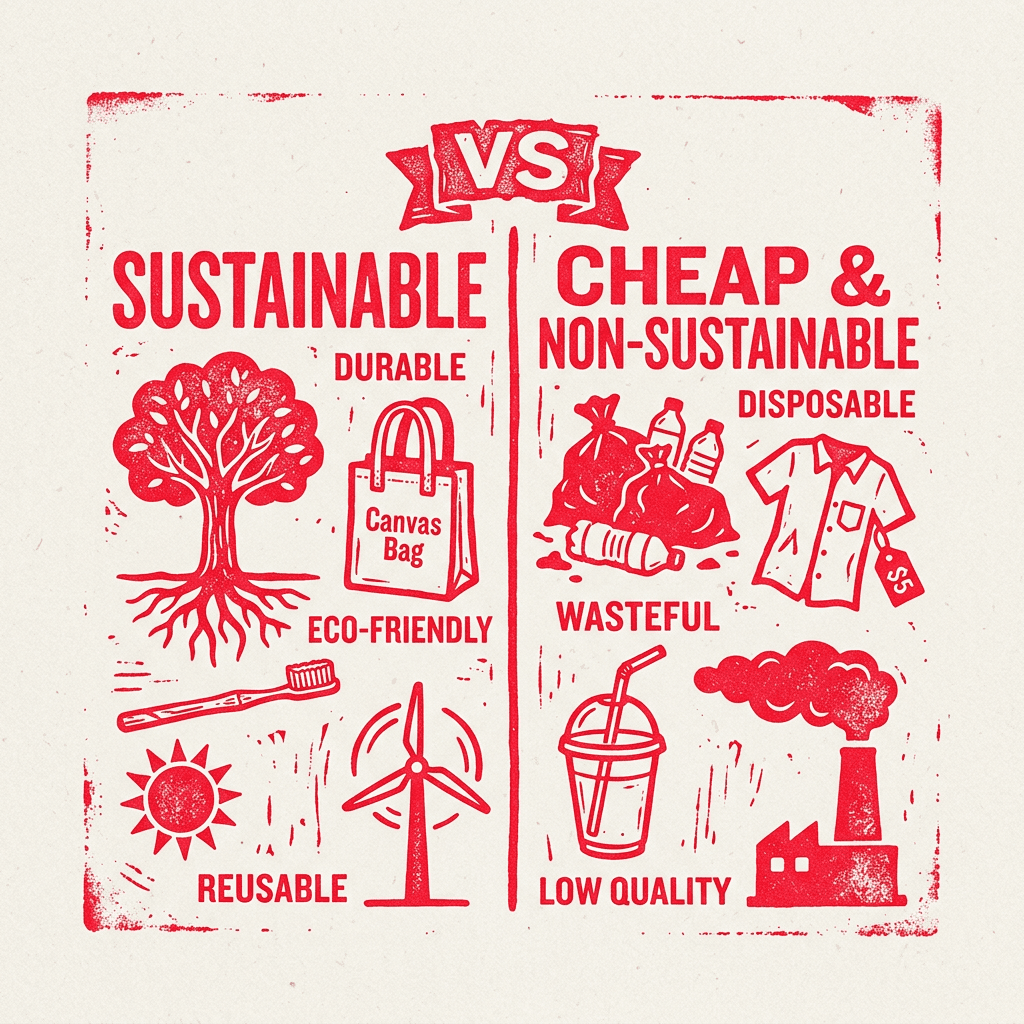

Grounded World
Your Sustainability Campaign Worked. So Why Didn’t Sales Move?

Your Sustainability Campaign Worked. So Why Didn’t Sales Move?

Hope Wehrli Hope Wehrli 7 min read

That gap between what consumers say and what they do is one of the clearest examples of sustainable consumer behaviour.

Your campaign performed well.

Customers clicked. They watched the video. They engaged with the messaging. They agreed with your sustainability positioning. They said they cared about climate change, sustainable products, and environmental impact.

But sales did not move.

That is one of the biggest frustrations facing businesses investing in sustainability marketing today.

Consumers care. They say they want sustainable products, sustainable packaging, and sustainable solutions. They want businesses to reduce carbon emissions, lower waste, and improve environmental outcomes.

But when they get to the shelf, the ecommerce page, or the checkout process, they often choose something cheaper, faster, or more familiar.

That gap between what consumers say and what they do is one of the clearest examples of sustainable consumer behaviour.

The problem is usually not awareness.

The problem is friction.

Customers Care About Sustainability. But That Does Not Guarantee Action.

Consumers care about sustainability issues.

Research consistently shows growing consumer demand for sustainable options, sustainable packaging, and more responsible business practices. Over 60% of consumers say they are willing to pay more for sustainable products. At the same time, affordability remains the number one barrier to sustainable consumption, with 61% of consumers citing cost as the main reason they do not follow through.¹

That is why sustainable consumer behaviour is often inconsistent.

Consumers may support sustainability goals in theory but behave differently in practice.

They may want eco-friendly products but still buy conventional alternatives if they are cheaper, easier to find, or more familiar.

They may care about carbon emissions, food waste, climate change, and environmental issues, but still prioritize convenience.

That does not make consumers irrational.

It means consumer behaviour is shaped by friction, habits, emotions, affordability, and trust.

Sustainable Consumer Behaviour Is More Complex Than Most Brands Realize

Sustainable consumer behaviour is the study of how environmental awareness, sustainability concerns, and personal values influence purchasing behavior.

But consumer psychology is rarely straightforward.

Consumers are balancing dozens of variables every time they buy something. They are considering price, quality, convenience, trust, health, brand reputation, personal care, energy use, packaging, and lifestyle fit.

That is why businesses often misread consumer decisions.

A customer may engage with a sustainability campaign and still not buy because:

  • The sustainable option costs more
  • The product is harder to find
  • The labeling is confusing
  • The environmental impact is unclear
  • The sustainable packaging does not look premium
  • The company has not built enough trust
  • The product does not fit their lifestyle
  • The process takes more time

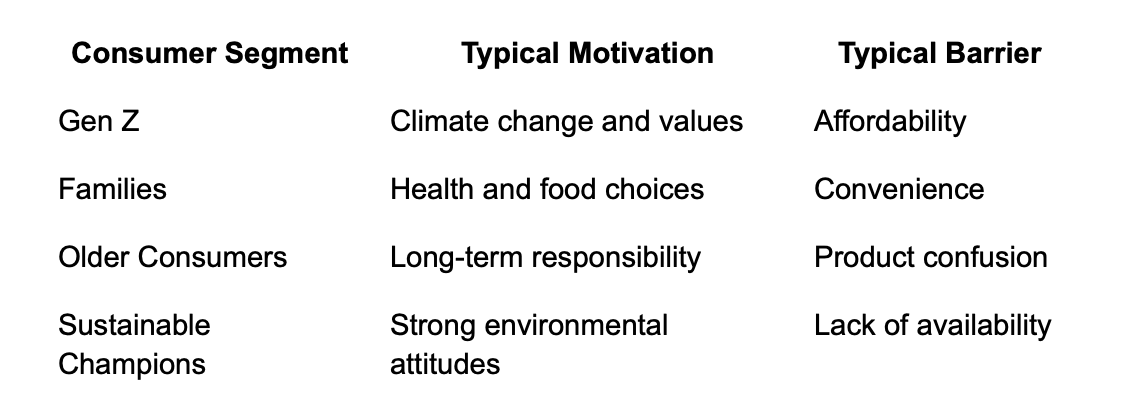
Research from Harvard Business Review found that the so-called “green consumer” is often misunderstood because there is no single sustainable consumer profile. Different consumers have different attitudes, motivations, and barriers.²

That matters because businesses often assume all consumers behave the same way.

They do not.

Affordability Is Still the Biggest Barrier

For many consumers, affordability is the biggest issue.

Consumers may care deeply about climate change, environmental issues, and sustainable practices, but they are also navigating inflation, higher food costs, and economic uncertainty.

Research from the World Economic Forum found that affordability is one of the biggest reasons consumers fail to act on sustainability intentions.³

That is especially important for sustainable products in food, personal care, household goods, and everyday services.

Consumers are often willing to pay a small premium, but there is a limit.

Over half of U.S. consumers say they are concerned about the environmental impact of packaging and are willing to pay more for sustainable options. At the same time, 82% of consumers across age groups are willing to pay more for products in sustainable packaging, with 90% of Gen Z consumers saying the same.¹

But willingness does not always translate into purchasing behavior.

The difference between intention and action is often driven by price sensitivity.

The Shelf Is Where Sustainability Wins or Loses

Most sustainable consumer behaviour decisions happen in seconds.

That means in-store decision making matters.

Consumers do not stop and read every label. They do not compare every carbon footprint claim. They do not analyze the full environmental impact of every product.

They make quick decisions based on shortcuts.

That is why sustainable solutions need to be easier to identify, easier to understand, and easier to trust.

Research from Ipsos found that many consumers would buy more sustainable products if they were better labeled, easier to compare, and easier to find. Around 35% to 36% of consumers said they would purchase sustainable products if labeling and availability improved.⁴

That is where businesses lose momentum.

Marketing teams focus on awareness, but they do not always focus on the actual customer experience.

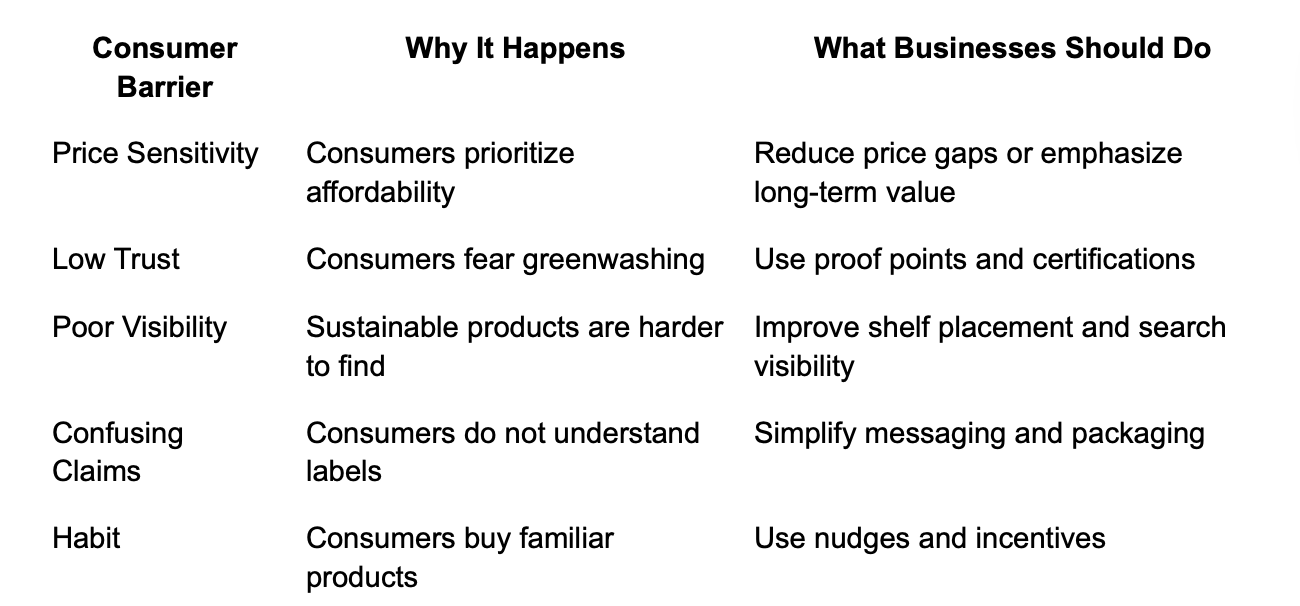
If the shelf placement is poor, the packaging is confusing, or the sustainable option looks less appealing, consumers default back to familiar behavior.
Habit Often Beats Good Intentions

Consumers are creatures of habit.

That is why consumer behaviour is so difficult to change.

Many sustainable behaviours require more effort than conventional ones. Consumers may need to pay more, spend more time researching, or change their normal routines.

That creates barriers.

Behavior change rarely happens because of one campaign.

It usually happens when sustainable solutions become simpler, more convenient, and more visible.

Research from Harvard Business Review emphasizes the importance of nudging, choice architecture, and behavioral design in shaping sustainable choices.²

That means companies need more emphasis on the details surrounding the purchase process.

They need to focus on:

  • Clearer labeling
  • Better sustainable packaging
  • Easier product comparisons
  • Lower friction during information search
  • More visible environmental claims
  • Better shelf placement
  • More convenient services
  • Stronger trust signals

Those changes may seem small, but they can make a high degree of difference.

Why Leadership Buy-In Is Not Enough

One of the most common questions from business leaders is:
“We have leadership buy-in, so why can’t we get anything over the line?”

The answer is that leadership support does not automatically change consumer behaviour.

Sustainability requires more than strategy.

It requires businesses to understand the real barriers affecting consumers.

That means mapping:
Helping businesses understand what is stopping consumers from acting, and turning abstract consumer psychology into actionable insights.

Sustainability Marketing Needs To Focus on Real Life

Too many sustainability campaigns focus only on attitudes.

They assume awareness automatically leads to action.

But real life is more complicated.

Consumers are balancing work, family, food costs, personal care needs, energy consumption, waste reduction, and everyday lifestyle pressures.

They may care about single use plastics, energy conservation, and reducing carbon emissions, but they also want convenience.

That is why sustainable consumer behaviour depends on how well sustainable products fit into daily life.

The majority of consumers report recycling household waste and reducing food waste as part of their sustainable behaviours. Seventy-three percent say they recycled household waste in the past year, while 68% reduced food waste.¹

That shows consumers are willing to act.

But they are more likely to act when sustainable choices feel realistic, affordable, and easy.
Businesses That Understand Sustainable Consumer Behaviour Will Win

The businesses seeing the strongest growth are the ones investing in research, data, and understanding.

They understand that sustainable consumer behaviour is not just about environmental awareness.

It is about consumer psychology, purchasing behavior, attitudes, habits, and lifestyle fit.

They use research, survey findings, business research, and data to design better sustainable solutions.

They create sustainable products that fit consumer needs.

They improve sustainable packaging.

They build trust.

They make sustainable options easier to understand.

They reduce barriers.

That is what helps businesses turn sustainability interest into actual sales.

Companies that understand sustainable consumer behaviour can create stronger marketing, better innovation, more relevant services, and more effective brand positioning.

They can also create real value for** consumers, governments, businesses, and the environment.**

Close your intention–action gap.

If your investments in sustainability and social impact aren't translating into sales, growth or internal buy-in, we can help you identify the gap.

Footnotes

  1. Harvard Business Review, “The Elusive Green Consumer,” https://hbr.org/2019/07/the-elusive-green-consumer
  2. Ipsos, “How to Beat the Say-Do Gap for Sustainable Products and Unlock Growth,” https://www.ipsos.com/en-us/how-beat-say-do-gap-sustainable-products-and-unlock-growth

About the Author

Hope Wehrli

Hope Wehrli

Copy Writing and Content Management Intern

Hope is a copywriter and content management intern at Grounded World, graduating from Rhodes College with a degree in Business and minors in Politics & Law and English/Creative Writing. Her work focuses on sustainable business, brand purpose, SEO, and purpose-led storytelling.

LinkedInView Profile

Related Articles

The Real Reason Sustainability Messaging Isn’t Converting Customers
Activating Brand Purpose and Sustainability

The Real Reason Sustainability Messaging Isn’t Converting Customers

May 11, 2026

Read Article
Why Awareness Doesn’t Translate Into Sustainable Purchasing Behaviour  Your sustainability campaign generated attention. Consumers clicked on the ads. They watched the videos. They shared the posts. They engaged with the message. But when it came time to buy, they chose something else. That is the problem many businesses face today. Green marketing campaigns may drive awareness, but awareness alone does not guarantee sales. A company can have strong sustainability messaging, leadership buy-in, and even positive media coverage, but still struggle to influence purchasing decisions. That is why sustainability marketing effectiveness has become such a critical issue. Brands often assume that if consumers say they care about sustainability, climate change, and environmental responsibility, they will naturally choose the more sustainable option. In reality, consumer behavior is much more complicated. Consumers Care About Sustainability. But They Still Choose Familiar Options. Modern consumers are more aware of environmental issues than ever before. More consumers are looking for eco friendly products, environmentally friendly products, and brands with clear sustainability goals. Many consumers say they care about environmental benefits, carbon footprint reduction, renewable energy, and sustainable practices. But there is a difference between attitudes and actions. Research shows that 66% of consumers are willing to pay more for sustainable brands. At the same time, there is still a large gap between what consumers say and what they actually buy. That gap often comes down to consumer behavior. Consumers are influenced by price, convenience, habit, trust, brand perception, and product packaging. They may support sustainability principles in theory but still default to familiar brands and traditional marketing cues when making purchasing decisions. This is why green marketing alone is not enough. Green Marketing Campaigns Often Stop at Awareness  Many marketing campaigns are designed to build awareness. They focus on storytelling, environmental claims, social responsibility, and environmental values. That is important. But if green marketing campaigns stop at awareness, they rarely influence behavior. Consumers need more than inspiration. They need clarity. They need trust. They need sustainable products that are easy to understand, easy to find, and easy to buy. Research from Harvard Business Review found that sustainable purchasing behavior is heavily influenced by behavioral design, nudging, and the way choices are presented.¹ That means marketing strategies should not only focus on promoting sustainability. They should also focus on reducing friction. Why Consumers Ignore Sustainability Messaging There are several reasons why consumers may engage with sustainability marketing but fail to act. The most common barriers include: Price sensitivity Habit and familiarity Low trust in environmental claims Confusing product packaging Poor visibility of sustainable products Fear of misleading claims Lack of understanding around environmental benefits Many consumers care about climate change and environmental impact, but they are still balancing affordability, convenience, personal priorities, and lifestyle fit. That is especially true for small businesses trying to compete with larger companies. Smaller brands may have strong sustainability initiatives and eco-friendly practices, but they often lack the resources to make their marketing campaigns as visible or persuasive. Consumer Barrier Why It Happens What Businesses Should Do Price Sensitivity Consumers prioritize affordability Reduce price gaps or emphasize long-term value Low Trust Consumers fear greenwashing Use proof points and certifications Poor Visibility Sustainable products are harder to find Improve shelf placement and search visibility Confusing Claims Consumers do not understand labels Simplify messaging and packaging Habit Consumers buy familiar products Use nudges and incentives  This is where sustainable marketing strategies become more important. The most successful campaigns are the ones that understand consumer psychology. Consumer Behavior Is Driven by More Than Values Consumers do not make purchasing decisions based only on environmental values. They also think about cost, convenience, quality, and how well a product fits into their lifestyle. That is why green marketing messages need to go beyond environmental claims. Brands need to show how their sustainable products support personal needs, save money, improve convenience, or create a positive impact. A consumer may care about carbon emissions, environmental concerns, and sustainable choices, but still ignore the product if it feels more expensive or harder to use. Research from the World Economic Forum found that affordability and trust remain two of the biggest reasons consumers fail to act on sustainability messaging.² That is why sustainability marketing should focus on both emotional and practical value. Trust Is the Difference Between Interest and Action Trust is one of the most important drivers of sustainability marketing effectiveness. Consumers are increasingly skeptical of green marketing messages. They have seen misleading claims, vague environmental claims, and empty promises from brands. That is why avoiding greenwashing is essential. Brands that provide concrete evidence of their sustainability efforts are more likely to build customer loyalty, stronger brand perception, and a better brand image. Consumers want proof. They want to know where products come from, how the supply chain works, whether carbon emissions have been reduced, and whether the company is making a genuine commitment to environmental responsibility. Authenticity is especially important in digital marketing, where consumers can quickly compare brands, search for reviews, and examine a company’s digital footprint.  Measuring Sustainability Marketing Effectiveness Requires More Than Engagement Metrics Many businesses still evaluate green marketing campaigns based only on impressions, clicks, website traffic, or social media engagement. Those metrics matter, but they do not tell the full story. Measuring sustainability marketing effectiveness requires businesses to look at: Changes in purchasing decisions Customer loyalty and brand loyalty Brand positioning and brand values Environmental outcomes and carbon footprint reduction Customer retention Brand image and brand perception Website behavior and meaningful engagement Supply chain improvements Business growth and financial performance Companies should establish a baseline and measure progress over time. They should track how sustainability initiatives influence consumer behavior, purchasing decisions, and customer loyalty. They should also align measurement with broader sustainability goals and ESG reporting. Research shows that brands integrating sustainability initiatives into their core identity see significantly stronger engagement than brands running disconnected green marketing campaigns.  Sustainability Marketing Needs To Be More Practical Sustainable marketing focuses on helping consumers make better choices. But sustainable marketing also needs to feel practical. Consumers are more likely to respond when green marketing campaigns highlight convenience, quality, cost savings, and personal relevance. That is especially important for businesses in food, personal care, services, and household products. Consumers want sustainable practices that fit naturally into daily life. They want eco friendly practices that feel easy rather than difficult. That means businesses need to focus on: Simpler marketing communications More transparent environmental claims Better product packaging More visible sustainability claims Stronger brand positioning More effective digital marketing Integrating sustainability into the overall marketing plan Connecting sustainability efforts to business practices and consumer expectations Sustainable marketing focuses on long-term trust, not just short-term clicks. That is the difference between campaigns that create awareness and campaigns that create real business growth. Businesses That Connect Sustainability To Brand Value Will Win The brands seeing the most success are the ones that make sustainability feel relevant. They connect sustainability to personal value, social responsibility, and everyday convenience. They show how sustainable practices support health, reduce waste, lower environmental impact, and create positive impact. They make sustainable choices feel easier. That is how companies create stronger customer loyalty, brand loyalty, and competitive advantage. It is also how businesses turn green marketing campaigns into successful campaigns. Recommended Next Reads From Grounded World https://grounded.world/resources/articles/purpose-driven-brands-why-consumer-demand-for-values-is-reshaping-business-strategy  https://grounded.world/resources/articles/brand-vision  https://grounded.world/resources/articles/closing-the-intention-action-gap-why-good-intentions-arent-always-enough-during-earth-month  Footnotes Harvard Business Review, “Nudging Consumers to Purchase More Sustainably,” https://hbr.org/2022/08/nudging-consumers-to-purchase-more-sustainably World Economic Forum, “Consumers’ Sustainability Choices,” https://www.weforum.org/stories/2026/03/consumers-sustainability-choices-world-consumer-rights-day/ White Rose University Consortium, “Psychological Drivers of Sustainable Consumer Behavior,” https://eprints.whiterose.ac.uk/id/eprint/205131/1/fpsyg-13-923464.pdf
Activating Brand Purpose and Sustainability

Why Awareness Doesn’t Translate Into Sustainable Purchasing Behaviour Your sustainability campaign generated attention. Consumers clicked on the ads. They watched the videos. They shared the posts. They engaged with the message. But when it came time to buy, they chose something else. That is the problem many businesses face today. Green marketing campaigns may drive awareness, but awareness alone does not guarantee sales. A company can have strong sustainability messaging, leadership buy-in, and even positive media coverage, but still struggle to influence purchasing decisions. That is why sustainability marketing effectiveness has become such a critical issue. Brands often assume that if consumers say they care about sustainability, climate change, and environmental responsibility, they will naturally choose the more sustainable option. In reality, consumer behavior is much more complicated. Consumers Care About Sustainability. But They Still Choose Familiar Options. Modern consumers are more aware of environmental issues than ever before. More consumers are looking for eco friendly products, environmentally friendly products, and brands with clear sustainability goals. Many consumers say they care about environmental benefits, carbon footprint reduction, renewable energy, and sustainable practices. But there is a difference between attitudes and actions. Research shows that 66% of consumers are willing to pay more for sustainable brands. At the same time, there is still a large gap between what consumers say and what they actually buy. That gap often comes down to consumer behavior. Consumers are influenced by price, convenience, habit, trust, brand perception, and product packaging. They may support sustainability principles in theory but still default to familiar brands and traditional marketing cues when making purchasing decisions. This is why green marketing alone is not enough. Green Marketing Campaigns Often Stop at Awareness Many marketing campaigns are designed to build awareness. They focus on storytelling, environmental claims, social responsibility, and environmental values. That is important. But if green marketing campaigns stop at awareness, they rarely influence behavior. Consumers need more than inspiration. They need clarity. They need trust. They need sustainable products that are easy to understand, easy to find, and easy to buy. Research from Harvard Business Review found that sustainable purchasing behavior is heavily influenced by behavioral design, nudging, and the way choices are presented.¹ That means marketing strategies should not only focus on promoting sustainability. They should also focus on reducing friction. Why Consumers Ignore Sustainability Messaging There are several reasons why consumers may engage with sustainability marketing but fail to act. The most common barriers include: Price sensitivity Habit and familiarity Low trust in environmental claims Confusing product packaging Poor visibility of sustainable products Fear of misleading claims Lack of understanding around environmental benefits Many consumers care about climate change and environmental impact, but they are still balancing affordability, convenience, personal priorities, and lifestyle fit. That is especially true for small businesses trying to compete with larger companies. Smaller brands may have strong sustainability initiatives and eco-friendly practices, but they often lack the resources to make their marketing campaigns as visible or persuasive. Consumer Barrier Why It Happens What Businesses Should Do Price Sensitivity Consumers prioritize affordability Reduce price gaps or emphasize long-term value Low Trust Consumers fear greenwashing Use proof points and certifications Poor Visibility Sustainable products are harder to find Improve shelf placement and search visibility Confusing Claims Consumers do not understand labels Simplify messaging and packaging Habit Consumers buy familiar products Use nudges and incentives This is where sustainable marketing strategies become more important. The most successful campaigns are the ones that understand consumer psychology. Consumer Behavior Is Driven by More Than Values Consumers do not make purchasing decisions based only on environmental values. They also think about cost, convenience, quality, and how well a product fits into their lifestyle. That is why green marketing messages need to go beyond environmental claims. Brands need to show how their sustainable products support personal needs, save money, improve convenience, or create a positive impact. A consumer may care about carbon emissions, environmental concerns, and sustainable choices, but still ignore the product if it feels more expensive or harder to use. Research from the World Economic Forum found that affordability and trust remain two of the biggest reasons consumers fail to act on sustainability messaging.² That is why sustainability marketing should focus on both emotional and practical value. Trust Is the Difference Between Interest and Action Trust is one of the most important drivers of sustainability marketing effectiveness. Consumers are increasingly skeptical of green marketing messages. They have seen misleading claims, vague environmental claims, and empty promises from brands. That is why avoiding greenwashing is essential. Brands that provide concrete evidence of their sustainability efforts are more likely to build customer loyalty, stronger brand perception, and a better brand image. Consumers want proof. They want to know where products come from, how the supply chain works, whether carbon emissions have been reduced, and whether the company is making a genuine commitment to environmental responsibility. Authenticity is especially important in digital marketing, where consumers can quickly compare brands, search for reviews, and examine a company’s digital footprint. Measuring Sustainability Marketing Effectiveness Requires More Than Engagement Metrics Many businesses still evaluate green marketing campaigns based only on impressions, clicks, website traffic, or social media engagement. Those metrics matter, but they do not tell the full story. Measuring sustainability marketing effectiveness requires businesses to look at: Changes in purchasing decisions Customer loyalty and brand loyalty Brand positioning and brand values Environmental outcomes and carbon footprint reduction Customer retention Brand image and brand perception Website behavior and meaningful engagement Supply chain improvements Business growth and financial performance Companies should establish a baseline and measure progress over time. They should track how sustainability initiatives influence consumer behavior, purchasing decisions, and customer loyalty. They should also align measurement with broader sustainability goals and ESG reporting. Research shows that brands integrating sustainability initiatives into their core identity see significantly stronger engagement than brands running disconnected green marketing campaigns. Sustainability Marketing Needs To Be More Practical Sustainable marketing focuses on helping consumers make better choices. But sustainable marketing also needs to feel practical. Consumers are more likely to respond when green marketing campaigns highlight convenience, quality, cost savings, and personal relevance. That is especially important for businesses in food, personal care, services, and household products. Consumers want sustainable practices that fit naturally into daily life. They want eco friendly practices that feel easy rather than difficult. That means businesses need to focus on: Simpler marketing communications More transparent environmental claims Better product packaging More visible sustainability claims Stronger brand positioning More effective digital marketing Integrating sustainability into the overall marketing plan Connecting sustainability efforts to business practices and consumer expectations Sustainable marketing focuses on long-term trust, not just short-term clicks. That is the difference between campaigns that create awareness and campaigns that create real business growth. Businesses That Connect Sustainability To Brand Value Will Win The brands seeing the most success are the ones that make sustainability feel relevant. They connect sustainability to personal value, social responsibility, and everyday convenience. They show how sustainable practices support health, reduce waste, lower environmental impact, and create positive impact. They make sustainable choices feel easier. That is how companies create stronger customer loyalty, brand loyalty, and competitive advantage. It is also how businesses turn green marketing campaigns into successful campaigns. Recommended Next Reads From Grounded World https://grounded.world/resources/articles/purpose-driven-brands-why-consumer-demand-for-values-is-reshaping-business-strategy https://grounded.world/resources/articles/brand-vision https://grounded.world/resources/articles/closing-the-intention-action-gap-why-good-intentions-arent-always-enough-during-earth-month Footnotes Harvard Business Review, “Nudging Consumers to Purchase More Sustainably,” https://hbr.org/2022/08/nudging-consumers-to-purchase-more-sustainably World Economic Forum, “Consumers’ Sustainability Choices,” https://www.weforum.org/stories/2026/03/consumers-sustainability-choices-world-consumer-rights-day/ White Rose University Consortium, “Psychological Drivers of Sustainable Consumer Behavior,” https://eprints.whiterose.ac.uk/id/eprint/205131/1/fpsyg-13-923464.pdf

May 11, 2026

Read Article
Customers Say They Care — So Why Aren’t They Buying?
Activating Brand Purpose and Sustainability

Customers Say They Care — So Why Aren’t They Buying?

May 11, 2026

Read Article