
 Hope Wehrli
 Most sustainability campaigns do not fail because the message is weak.
They fail because the customer journey is doing the opposite of what the campaign promises.
A company launches a sustainability campaign. Engagement looks strong. Customers click, like, comment, and share. Leadership sees interest, strong sentiment, and positive feedback. Business leaders assume sales growth will follow.
Then it does not.
That GAP between engagement and purchase behavior is one of the biggest challenges in sustainability today. Customers say they care about climate change, environmental sustainability, carbon reduction, and sustainable practices. Many customers say they support sustainability goals and want companies to make a positive impact.
But when they actually make a purchase, they often choose the cheaper, easier, or more familiar option.
This is not because customers are lying.
It is because sustainability transformation requires more than awareness. It requires companies to reduce friction, simplify decisions, and make sustainable choices easier.
For many organizations, the real issue is not campaign performance. The issue is sustainability conversion.
Research from McKinsey and NielsenIQ found that products with environmental, social, and governance claims often outperformed competitors and drove stronger growth.¹ However, not every sustainability strategy leads to sales.
Many organizations invest heavily in sustainability efforts, corporate social responsibility, and environmental messaging. They build a sustainability roadmap, create ESG targets, and commit resources to sustainable business development.
But leadership teams still ask the same question: if customers care so much, why are they not buying?
Customers Care About Sustainability — But Habits Still Win
Customers are not making decisions in ideal conditions.
They are making decisions quickly.

They are busy, distracted, price-sensitive, and overwhelmed. They are often comparing dozens of products at once. They are balancing convenience, quality, trust, price, and speed.
That means even customers who support sustainability goals may not follow through.
A customer may believe in environmental sustainability but still hesitate if:
- The sustainable option costs more
- The carbon footprint information is confusing
- The sustainability claims feel vague
- The product is harder to find
- The buying process takes longer
- The supply chain information is unclear
- The environmental impact is difficult to understand
- The customer does not trust the company
This is where many sustainability efforts break down.
Organizations often assume that if customers care, they will act. But behavior does not work that way.
Research from Deloitte found that economic pressure, affordability concerns, and inequity make it harder for customers to follow through on sustainability intentions.² That means environmental sustainability often competes with convenience, price, and habit.
The companies that win are not necessarily the companies with the biggest sustainability budget.
They are the companies that understand customer behavior.
Why Strong Campaign Engagement Does Not Lead to Sales
High engagement can be misleading.
People often engage with sustainability content because it aligns with who they want to be. They may support climate change action, sustainable business practices, and carbon reduction efforts. They may agree with the message emotionally.
But that does not always lead to a purchase.
When customers reach the point of decision, habit often takes over.
Most people buy what they know. They trust familiar companies, established business models, and recognizable brands. That is why sustainability transformation often stalls.
Organizations may have leadership buy-in, clear sustainability goals, and strong internal commitment, but if the purchase process is too difficult, customers revert to familiar habits.
Research from Drapers found that while most shoppers say sustainability influences their decisions, concerns around cost, trust, and quality still prevent action.³
This is why sustainability strategy cannot stop at marketing.
A strong sustainability strategy has to shape the entire customer experience.
The Real Problem Is Friction

Most organizations do not fail because they lack a sustainability strategy.
They fail because they do not understand the barriers standing between customer intention and customer action.
Those barriers usually include friction, bias, habit, and decision complexity.
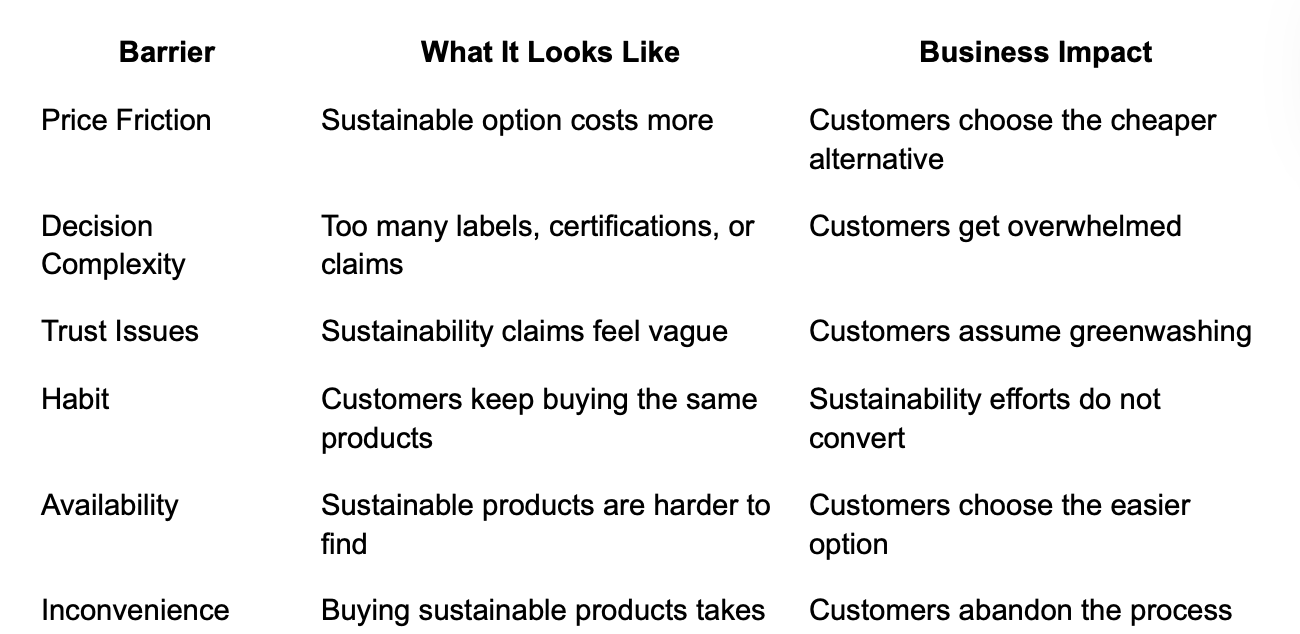
These barriers hurt business value.
They also hurt brand reputation, long term value creation, and competitive advantage.
Many organizations invest resources into sustainability transformation but fail to monitor progress across the customer journey.
That is why strong campaign metrics do not always lead to stronger sales.
A campaign can perform well at the awareness stage while still failing later in the process.
Simplicity Matters More Than More Information
Many companies assume that more information builds trust.
They overload customers with carbon emissions data, sustainability claims, ESG measurement frameworks, supply chain details, and technical language.
Often, that creates more confusion.
Customers do not want to decode a complicated sustainability strategy.
They want simple answers:
- Is this product worth the price?
- Is it good quality?
- Can I trust it?
- Is it better for the environment?
- Is it easy to buy?
McKinsey found that simpler sustainability messaging often performs better than technical or vague language.¹
This is especially important for companies trying to reduce carbon emissions, greenhouse gas emissions, and carbon dioxide across their value chains.
Customers want proof, but they want it quickly.
That is why sustainability leaders focus on making sustainable choices more visible, easier to compare, and easier to purchase.
The Companies Seeing Results Design for Behavior

The companies making real progress are designing for behavior, not just awareness.
They understand that sustainability transformation is not only about communications.
It is about integrating sustainability into the entire business strategy.
That means:
- Making sustainable products easier to find
- Reducing complexity at the point of purchase
- Using digital tools to simplify the process
- Making carbon footprint information easier to understand
- Improving supply chain transparency
- Supporting employee well being so employees can explain sustainability efforts more clearly
- Aligning sustainability goals with business value
- Creating new business models that support long term goals
The organizations that do this well create a competitive advantage.
They understand that sustainability transformation is a business process.
They focus on innovation, technology, and operations that make sustainability easier for customers.
They also understand that sustainable business growth depends on more than messaging.
It depends on making sustainable behavior the easier behavior.
Why Leadership Buy-In Is Not Enough
Many business leaders assume that leadership support should automatically create momentum.
But leadership buy-in alone does not remove friction.
Organizations can have strong sustainability goals, major investments, executive commitment, and a clear sustainability roadmap, but still struggle to accelerate progress.
That is because sustainability transformation affects every part of the business.
It affects supply chain decisions, operations, technology, governance, value chains, industrial processes, and customer experience.
It requires organizations to rethink business models, resource allocation, and decision making.
It also requires companies to monitor progress over time.
Without a clear process, sustainability efforts become disconnected.
Marketing teams may focus on awareness.
Operations teams may focus on energy efficiency.
Leadership teams may focus on ESG targets and regulatory compliance.
But if nobody owns the customer experience, sustainability transformation stalls.
Sustainability Requires More Than Good Intentions
The companies creating greater sustainability are the ones treating sustainability as a critical business issue.
They understand that climate change, greenhouse gas emissions, carbon emissions, and environmental footprint reduction are not only environmental issues.
They are business issues.
Governments are increasing pressure on organizations to reduce greenhouse gas emissions, improve governance, and strengthen regulatory compliance.
At the same time, customers are expecting companies to make a visible commitment to environmental sustainability.
That creates a major opportunity for sustainable business growth.
Organizations that invest in sustainability transformation can create cost savings, reduce negative impact, strengthen brand reputation, and unlock new business models.
They can also create a positive impact across supply chain networks, value chains, industrial processes, and environmental performance.
The future belongs to companies that integrate sustainability into business strategy rather than treating it like a side initiative.
Conclusion
Customers do care.
But caring is not enough.
The organizations that succeed are the ones that reduce friction, simplify decisions, and make sustainability easier.
They focus on integrating sustainability into technology, operations, business models, and customer experience.
They use innovation, emissions data, and digital transformation to create solutions that support sustainable business growth.
They understand that sustainability transformation is not just about messaging.
It is about removing the barriers that stop customers from acting.
That is the real path forward.
Close your intention–action gap.
If your investments in sustainability and social impact aren't translating into sales, growth or internal buy-in, we can help you identify the gap.
Footnotes
- McKinsey & Company and NielsenIQ, “Consumers Care About Sustainability—and Back It Up with Their Wallets,” February 2023, https://www.mckinsey.com/industries/consumer-packaged-goods/our-insights/consumers-care-about-sustainability-and-back-it-up-with-their-wallets
- Deloitte, “Economic Uncertainty Puts Pressure on Sustainable Consumer Behaviors,” July 2023, https://sustainablebrands.com/read/deloitte-economic-uncertainty-inequity-intention-action-gap
- Drapers, “The Evolution of the Conscious Consumer,” 2026, https://www.drapersonline.com/insight/the-industry-view/drapers-shopper-survey-the-evolution-of-the-conscious-consumer

.jpg&w=3840&q=75&dpl=dpl_9gmcg7kF2iURayF6Cu83WGH1D1nz)
.jpg&w=3840&q=75&dpl=dpl_9gmcg7kF2iURayF6Cu83WGH1D1nz)