
Grounded World
The Real Reason Sustainability Messaging Isn’t Converting Customers

The Real Reason Sustainability Messaging Isn’t Converting Customers

Hope Wehrli Hope Wehrli 7 min read

Sustainability conversion is often blocked by a combination of habit, decision complexity, low trust, and perceived inconvenience.

Your campaign is generating awareness.

Customers are engaging with the content. They are clicking on ads, opening emails, watching videos, and responding positively to your sustainability messaging.

Yet when it is time to make a purchase, they hesitate.

That disconnect is where many organizations stall.

They have leadership buy-in. They have a sustainability strategy. They have visible sustainability efforts, defined sustainability goals, and a clear public commitment.

But despite all of that, conversion remains weak.

The issue is rarely awareness.

The issue is friction.

Sustainability conversion is often blocked by a combination of habit, decision complexity, low trust, and perceived inconvenience. Customers may admire a company’s sustainability commitments, but if the purchase feels confusing, expensive, or difficult, they default to what is familiar.

Sustainability conversion is rarely blocked by a lack of consumer interest. More often, it is blocked by decision complexity, low trust, price sensitivity, habit, and confusing messaging.

Businesses may believe they have done enough by talking about environmental sustainability, carbon emissions, sustainable practices, and corporate social responsibility.

But if the buying process feels unclear, expensive, or inconvenient, customers default back to familiar behavior.

Customers Say They Care About Sustainability

Most customers care about sustainability.

Research consistently shows that customers want sustainable products, cleaner supply chains, lower carbon footprints, and stronger environmental commitments from the companies they support.

Many business leaders assume that means sustainability messaging should naturally convert.

It does not.

There is a significant gap between what people say and what they do.

Consumers may value environmental sustainability, climate change action, carbon reduction, and sustainable business practices, but they still make decisions based on affordability, convenience, trust, and familiarity.

That is why sustainability transformation requires more than marketing.

It requires organizations to rethink the entire customer experience.

Awareness Does Not Remove Friction

Many organizations invest heavily in sustainability campaigns but fail to address the real reasons customers hesitate.

They focus on storytelling instead of simplifying the decision-making process.

They talk about environmental impact, carbon emissions, greenhouse gas emissions, and ESG targets, but they do not explain why their offer is easier, better, or more valuable.

That creates friction.

Customers do not want to work hard to understand a product’s environmental footprint.

They do not want to decode complex sustainability claims or compare emissions data across multiple companies.

They want simple answers.

They want to know:

  • Is this worth the price?
  • Is it easy to use?
  • Can I trust the claims?
  • Does it fit my lifestyle?
  • Will it create a positive impact without making life harder?

Research from the World Economic Forum found that affordability and trust are still two of the largest barriers preventing sustainable purchasing decisions. Customers may support sustainability goals in theory, but when faced with higher prices or unclear claims, they often choose the easier option.
Why Sustainability Messaging Breaks Down

The most common reason sustainability messaging fails is because it is built around the company rather than the customer.

Many companies emphasize carbon reduction, greenhouse gas emissions, renewable energy investments, regulatory compliance, and supply chain improvements.

Those subjects are important. But they are not always persuasive.

Customers are usually more interested in practical outcomes.

They want to know whether a product will save them money, improve convenience, support healthier choices, or align with their personal values.

They want to understand how sustainability creates direct business value for them.

This is where many organizations lose momentum.

They communicate sustainability as a responsibility instead of a benefit.

They frame it as sacrifice rather than innovation.

The organizations seeing the strongest results do the opposite. They connect sustainability transformation to product quality, convenience, long term value creation, and everyday relevance.

That shift matters.

Customers are more likely to act when sustainability feels useful, achievable, and personally meaningful.

Sustainability Conversion Depends on Trust

Trust is one of the most critical drivers of conversion.

Customers are increasingly skeptical of sustainability messaging.

They have seen companies exaggerate their environmental commitments, overstate carbon reduction, or make vague claims about sustainable practices.

That skepticism creates a negative impact on brand reputation.

Organizations that want stronger sustainability conversion need more transparency.

They need to explain their supply chain, disclose emissions data, show progress against sustainability goals, and provide evidence of carbon footprint reduction.

They also need stronger governance and reporting processes.

Companies that monitor progress, publish ESG measurement data, and show clear business value are more likely to build trust.

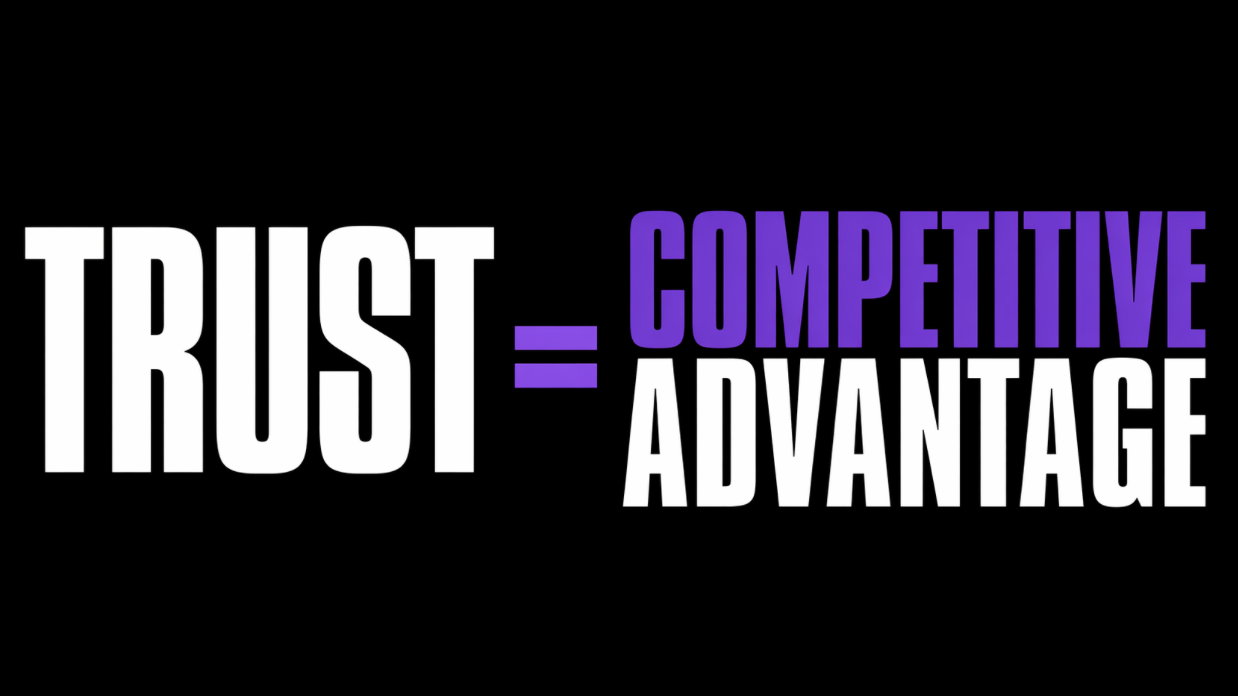
That trust becomes a competitive advantage.

Research shows that companies with strong ESG performance often outperform competitors financially and create greater sustainability value over time.
Sustainable Business Models Convert Better

Sustainability transformation works best when it is integrated into the core business strategy.

That means organizations need to move beyond one-off campaigns and build sustainability into products, services, operations, and value chains.

The strongest sustainable business models are built around:

  • Circular design
  • Lower carbon footprints
  • Renewable energy
  • Smarter supply chain management
  • Reduced greenhouse gas emissions
  • Energy efficiency improvements
  • Sustainable practices across operations
  • Better use of digital tools and technology

Companies that integrate sustainability into business models often unlock new business value, stronger growth, and more resilient operations.

They are also better positioned to respond to regulatory compliance pressures, climate change risks, and shifting customer expectations.

That is why sustainability transformation is not just an environmental initiative.

It is a business strategy.

It is a major opportunity for innovation, growth, and competitive advantage.

Sustainability Transformation Requires Better Measurement

Many business leaders struggle to get sustainability initiatives over the line because they cannot prove the value.

They may have an outline including ESG targets, and carbon reduction plans, but they lack the process and technology needed to measure results.

That creates challenges.

Without data, it is difficult to monitor progress, allocate resources, justify investments, or demonstrate long term goals.

Organizations need better systems for tracking:

  • Carbon emissions
  • Greenhouse gas emissions
  • Energy use
  • Supply chain performance
  • Environmental footprint
  • Customer conversion
  • Brand reputation
  • Employee engagement
  • Financial performance

Digital transformation plays a major role here.

Technology, AI, and digital tools can help organizations monitor emissions, automate reporting, and identify the highest-impact solutions.

That is especially important for large scale initiatives involving complex value chains and industrial processes.

The Companies That Win Make Sustainability Easier

The organizations making the most progress are not necessarily the ones with the biggest sustainability budgets.

They are the ones making sustainable choices feel easier.

They simplify the process.

They remove unnecessary friction.

They make sustainability easier to understand, easier to compare, and easier to act on.

They align sustainability goals with customer expectations, employee well being, and broader business strategy.

They use technology, innovation, and stronger governance to accelerate progress.

They build sustainable business models that create positive impact while also strengthening growth, resilience, and competitive advantage.

Most importantly, they understand that sustainability transformation is not about a single campaign.

It is about redesigning the customer experience from beginning to end.

That includes products, services, operations, supply chains, value chains, digital tools, and brand positioning.

Behavioural Barrier Mapper: The Missing Piece

This is where the Behavioural Barrier Mapper becomes valuable.

The tool helps organizations identify where customers are getting stuck.

It maps the friction points blocking conversion, including:

  • Trust barriers
  • Price sensitivity
  • Habit and familiarity
  • Poor visibility
  • Confusing claims
  • Decision fatigue
  • Lack of business value communication

That insight gives business leaders a clearer path forward.

Instead of assuming customers are not interested, organizations can identify what is actually preventing action.

That is often the missing link between awareness and conversion.
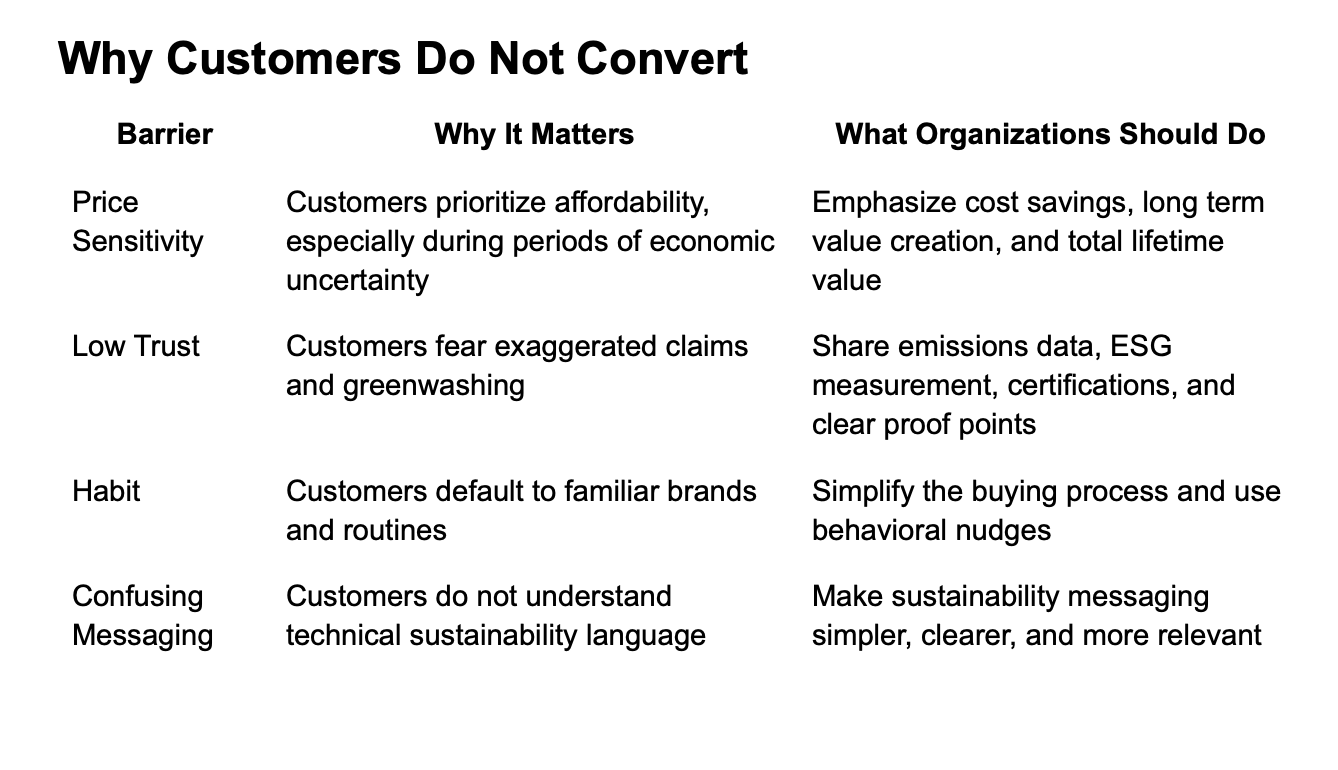
This table is often where organizations begin to see the real source of low conversion. Customers may care about sustainability, but they still need clear reasons to change their behavior.
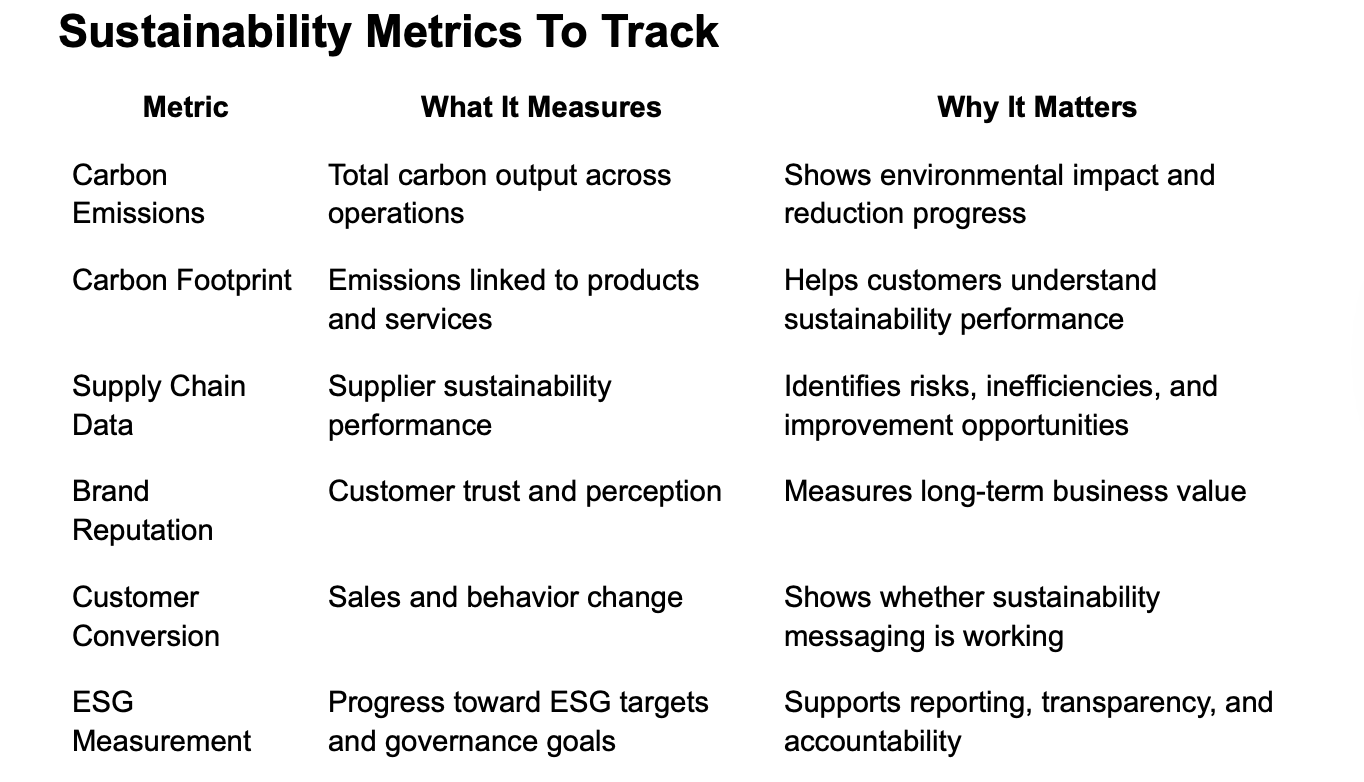
Organizations that monitor these metrics are better positioned to prove the business value of sustainability efforts, justify investments, and accelerate progress over time.

Close your intention–action gap.

If your investments in sustainability and social impact aren't translating into sales, growth or internal buy-in, we can help you identify the gap.

Footnotes

  1. White Rose University Consortium, “Psychological Drivers of Sustainable Consumer Behavior,” https://eprints.whiterose.ac.uk/id/eprint/205131/1/fpsyg-13-923464.pdf
  2. Business Vision Magazine, “Sustainable Marketing Case Studies of Successful Green Campaigns,” https://thebusinessvisionmagazine.com/sustainable-marketing-case-studies-of-successful-green-campaigns/

About the Author

Hope Wehrli

Hope Wehrli

Copy Writing and Content Management Intern

Hope is a copywriter and content management intern at Grounded World, graduating from Rhodes College with a degree in Business and minors in Politics & Law and English/Creative Writing. Her work focuses on sustainable business, brand purpose, SEO, and purpose-led storytelling.

LinkedInView Profile

Related Articles

Why Awareness Doesn’t Translate Into Sustainable Purchasing Behaviour  Your sustainability campaign generated attention. Consumers clicked on the ads. They watched the videos. They shared the posts. They engaged with the message. But when it came time to buy, they chose something else. That is the problem many businesses face today. Green marketing campaigns may drive awareness, but awareness alone does not guarantee sales. A company can have strong sustainability messaging, leadership buy-in, and even positive media coverage, but still struggle to influence purchasing decisions. That is why sustainability marketing effectiveness has become such a critical issue. Brands often assume that if consumers say they care about sustainability, climate change, and environmental responsibility, they will naturally choose the more sustainable option. In reality, consumer behavior is much more complicated. Consumers Care About Sustainability. But They Still Choose Familiar Options. Modern consumers are more aware of environmental issues than ever before. More consumers are looking for eco friendly products, environmentally friendly products, and brands with clear sustainability goals. Many consumers say they care about environmental benefits, carbon footprint reduction, renewable energy, and sustainable practices. But there is a difference between attitudes and actions. Research shows that 66% of consumers are willing to pay more for sustainable brands. At the same time, there is still a large gap between what consumers say and what they actually buy. That gap often comes down to consumer behavior. Consumers are influenced by price, convenience, habit, trust, brand perception, and product packaging. They may support sustainability principles in theory but still default to familiar brands and traditional marketing cues when making purchasing decisions. This is why green marketing alone is not enough. Green Marketing Campaigns Often Stop at Awareness  Many marketing campaigns are designed to build awareness. They focus on storytelling, environmental claims, social responsibility, and environmental values. That is important. But if green marketing campaigns stop at awareness, they rarely influence behavior. Consumers need more than inspiration. They need clarity. They need trust. They need sustainable products that are easy to understand, easy to find, and easy to buy. Research from Harvard Business Review found that sustainable purchasing behavior is heavily influenced by behavioral design, nudging, and the way choices are presented.¹ That means marketing strategies should not only focus on promoting sustainability. They should also focus on reducing friction. Why Consumers Ignore Sustainability Messaging There are several reasons why consumers may engage with sustainability marketing but fail to act. The most common barriers include: Price sensitivity Habit and familiarity Low trust in environmental claims Confusing product packaging Poor visibility of sustainable products Fear of misleading claims Lack of understanding around environmental benefits Many consumers care about climate change and environmental impact, but they are still balancing affordability, convenience, personal priorities, and lifestyle fit. That is especially true for small businesses trying to compete with larger companies. Smaller brands may have strong sustainability initiatives and eco-friendly practices, but they often lack the resources to make their marketing campaigns as visible or persuasive. Consumer Barrier Why It Happens What Businesses Should Do Price Sensitivity Consumers prioritize affordability Reduce price gaps or emphasize long-term value Low Trust Consumers fear greenwashing Use proof points and certifications Poor Visibility Sustainable products are harder to find Improve shelf placement and search visibility Confusing Claims Consumers do not understand labels Simplify messaging and packaging Habit Consumers buy familiar products Use nudges and incentives  This is where sustainable marketing strategies become more important. The most successful campaigns are the ones that understand consumer psychology. Consumer Behavior Is Driven by More Than Values Consumers do not make purchasing decisions based only on environmental values. They also think about cost, convenience, quality, and how well a product fits into their lifestyle. That is why green marketing messages need to go beyond environmental claims. Brands need to show how their sustainable products support personal needs, save money, improve convenience, or create a positive impact. A consumer may care about carbon emissions, environmental concerns, and sustainable choices, but still ignore the product if it feels more expensive or harder to use. Research from the World Economic Forum found that affordability and trust remain two of the biggest reasons consumers fail to act on sustainability messaging.² That is why sustainability marketing should focus on both emotional and practical value. Trust Is the Difference Between Interest and Action Trust is one of the most important drivers of sustainability marketing effectiveness. Consumers are increasingly skeptical of green marketing messages. They have seen misleading claims, vague environmental claims, and empty promises from brands. That is why avoiding greenwashing is essential. Brands that provide concrete evidence of their sustainability efforts are more likely to build customer loyalty, stronger brand perception, and a better brand image. Consumers want proof. They want to know where products come from, how the supply chain works, whether carbon emissions have been reduced, and whether the company is making a genuine commitment to environmental responsibility. Authenticity is especially important in digital marketing, where consumers can quickly compare brands, search for reviews, and examine a company’s digital footprint.  Measuring Sustainability Marketing Effectiveness Requires More Than Engagement Metrics Many businesses still evaluate green marketing campaigns based only on impressions, clicks, website traffic, or social media engagement. Those metrics matter, but they do not tell the full story. Measuring sustainability marketing effectiveness requires businesses to look at: Changes in purchasing decisions Customer loyalty and brand loyalty Brand positioning and brand values Environmental outcomes and carbon footprint reduction Customer retention Brand image and brand perception Website behavior and meaningful engagement Supply chain improvements Business growth and financial performance Companies should establish a baseline and measure progress over time. They should track how sustainability initiatives influence consumer behavior, purchasing decisions, and customer loyalty. They should also align measurement with broader sustainability goals and ESG reporting. Research shows that brands integrating sustainability initiatives into their core identity see significantly stronger engagement than brands running disconnected green marketing campaigns.  Sustainability Marketing Needs To Be More Practical Sustainable marketing focuses on helping consumers make better choices. But sustainable marketing also needs to feel practical. Consumers are more likely to respond when green marketing campaigns highlight convenience, quality, cost savings, and personal relevance. That is especially important for businesses in food, personal care, services, and household products. Consumers want sustainable practices that fit naturally into daily life. They want eco friendly practices that feel easy rather than difficult. That means businesses need to focus on: Simpler marketing communications More transparent environmental claims Better product packaging More visible sustainability claims Stronger brand positioning More effective digital marketing Integrating sustainability into the overall marketing plan Connecting sustainability efforts to business practices and consumer expectations Sustainable marketing focuses on long-term trust, not just short-term clicks. That is the difference between campaigns that create awareness and campaigns that create real business growth. Businesses That Connect Sustainability To Brand Value Will Win The brands seeing the most success are the ones that make sustainability feel relevant. They connect sustainability to personal value, social responsibility, and everyday convenience. They show how sustainable practices support health, reduce waste, lower environmental impact, and create positive impact. They make sustainable choices feel easier. That is how companies create stronger customer loyalty, brand loyalty, and competitive advantage. It is also how businesses turn green marketing campaigns into successful campaigns. Recommended Next Reads From Grounded World https://grounded.world/resources/articles/purpose-driven-brands-why-consumer-demand-for-values-is-reshaping-business-strategy  https://grounded.world/resources/articles/brand-vision  https://grounded.world/resources/articles/closing-the-intention-action-gap-why-good-intentions-arent-always-enough-during-earth-month  Footnotes Harvard Business Review, “Nudging Consumers to Purchase More Sustainably,” https://hbr.org/2022/08/nudging-consumers-to-purchase-more-sustainably World Economic Forum, “Consumers’ Sustainability Choices,” https://www.weforum.org/stories/2026/03/consumers-sustainability-choices-world-consumer-rights-day/ White Rose University Consortium, “Psychological Drivers of Sustainable Consumer Behavior,” https://eprints.whiterose.ac.uk/id/eprint/205131/1/fpsyg-13-923464.pdf
Activating Brand Purpose and Sustainability

Why Awareness Doesn’t Translate Into Sustainable Purchasing Behaviour Your sustainability campaign generated attention. Consumers clicked on the ads. They watched the videos. They shared the posts. They engaged with the message. But when it came time to buy, they chose something else. That is the problem many businesses face today. Green marketing campaigns may drive awareness, but awareness alone does not guarantee sales. A company can have strong sustainability messaging, leadership buy-in, and even positive media coverage, but still struggle to influence purchasing decisions. That is why sustainability marketing effectiveness has become such a critical issue. Brands often assume that if consumers say they care about sustainability, climate change, and environmental responsibility, they will naturally choose the more sustainable option. In reality, consumer behavior is much more complicated. Consumers Care About Sustainability. But They Still Choose Familiar Options. Modern consumers are more aware of environmental issues than ever before. More consumers are looking for eco friendly products, environmentally friendly products, and brands with clear sustainability goals. Many consumers say they care about environmental benefits, carbon footprint reduction, renewable energy, and sustainable practices. But there is a difference between attitudes and actions. Research shows that 66% of consumers are willing to pay more for sustainable brands. At the same time, there is still a large gap between what consumers say and what they actually buy. That gap often comes down to consumer behavior. Consumers are influenced by price, convenience, habit, trust, brand perception, and product packaging. They may support sustainability principles in theory but still default to familiar brands and traditional marketing cues when making purchasing decisions. This is why green marketing alone is not enough. Green Marketing Campaigns Often Stop at Awareness Many marketing campaigns are designed to build awareness. They focus on storytelling, environmental claims, social responsibility, and environmental values. That is important. But if green marketing campaigns stop at awareness, they rarely influence behavior. Consumers need more than inspiration. They need clarity. They need trust. They need sustainable products that are easy to understand, easy to find, and easy to buy. Research from Harvard Business Review found that sustainable purchasing behavior is heavily influenced by behavioral design, nudging, and the way choices are presented.¹ That means marketing strategies should not only focus on promoting sustainability. They should also focus on reducing friction. Why Consumers Ignore Sustainability Messaging There are several reasons why consumers may engage with sustainability marketing but fail to act. The most common barriers include: Price sensitivity Habit and familiarity Low trust in environmental claims Confusing product packaging Poor visibility of sustainable products Fear of misleading claims Lack of understanding around environmental benefits Many consumers care about climate change and environmental impact, but they are still balancing affordability, convenience, personal priorities, and lifestyle fit. That is especially true for small businesses trying to compete with larger companies. Smaller brands may have strong sustainability initiatives and eco-friendly practices, but they often lack the resources to make their marketing campaigns as visible or persuasive. Consumer Barrier Why It Happens What Businesses Should Do Price Sensitivity Consumers prioritize affordability Reduce price gaps or emphasize long-term value Low Trust Consumers fear greenwashing Use proof points and certifications Poor Visibility Sustainable products are harder to find Improve shelf placement and search visibility Confusing Claims Consumers do not understand labels Simplify messaging and packaging Habit Consumers buy familiar products Use nudges and incentives This is where sustainable marketing strategies become more important. The most successful campaigns are the ones that understand consumer psychology. Consumer Behavior Is Driven by More Than Values Consumers do not make purchasing decisions based only on environmental values. They also think about cost, convenience, quality, and how well a product fits into their lifestyle. That is why green marketing messages need to go beyond environmental claims. Brands need to show how their sustainable products support personal needs, save money, improve convenience, or create a positive impact. A consumer may care about carbon emissions, environmental concerns, and sustainable choices, but still ignore the product if it feels more expensive or harder to use. Research from the World Economic Forum found that affordability and trust remain two of the biggest reasons consumers fail to act on sustainability messaging.² That is why sustainability marketing should focus on both emotional and practical value. Trust Is the Difference Between Interest and Action Trust is one of the most important drivers of sustainability marketing effectiveness. Consumers are increasingly skeptical of green marketing messages. They have seen misleading claims, vague environmental claims, and empty promises from brands. That is why avoiding greenwashing is essential. Brands that provide concrete evidence of their sustainability efforts are more likely to build customer loyalty, stronger brand perception, and a better brand image. Consumers want proof. They want to know where products come from, how the supply chain works, whether carbon emissions have been reduced, and whether the company is making a genuine commitment to environmental responsibility. Authenticity is especially important in digital marketing, where consumers can quickly compare brands, search for reviews, and examine a company’s digital footprint. Measuring Sustainability Marketing Effectiveness Requires More Than Engagement Metrics Many businesses still evaluate green marketing campaigns based only on impressions, clicks, website traffic, or social media engagement. Those metrics matter, but they do not tell the full story. Measuring sustainability marketing effectiveness requires businesses to look at: Changes in purchasing decisions Customer loyalty and brand loyalty Brand positioning and brand values Environmental outcomes and carbon footprint reduction Customer retention Brand image and brand perception Website behavior and meaningful engagement Supply chain improvements Business growth and financial performance Companies should establish a baseline and measure progress over time. They should track how sustainability initiatives influence consumer behavior, purchasing decisions, and customer loyalty. They should also align measurement with broader sustainability goals and ESG reporting. Research shows that brands integrating sustainability initiatives into their core identity see significantly stronger engagement than brands running disconnected green marketing campaigns. Sustainability Marketing Needs To Be More Practical Sustainable marketing focuses on helping consumers make better choices. But sustainable marketing also needs to feel practical. Consumers are more likely to respond when green marketing campaigns highlight convenience, quality, cost savings, and personal relevance. That is especially important for businesses in food, personal care, services, and household products. Consumers want sustainable practices that fit naturally into daily life. They want eco friendly practices that feel easy rather than difficult. That means businesses need to focus on: Simpler marketing communications More transparent environmental claims Better product packaging More visible sustainability claims Stronger brand positioning More effective digital marketing Integrating sustainability into the overall marketing plan Connecting sustainability efforts to business practices and consumer expectations Sustainable marketing focuses on long-term trust, not just short-term clicks. That is the difference between campaigns that create awareness and campaigns that create real business growth. Businesses That Connect Sustainability To Brand Value Will Win The brands seeing the most success are the ones that make sustainability feel relevant. They connect sustainability to personal value, social responsibility, and everyday convenience. They show how sustainable practices support health, reduce waste, lower environmental impact, and create positive impact. They make sustainable choices feel easier. That is how companies create stronger customer loyalty, brand loyalty, and competitive advantage. It is also how businesses turn green marketing campaigns into successful campaigns. Recommended Next Reads From Grounded World https://grounded.world/resources/articles/purpose-driven-brands-why-consumer-demand-for-values-is-reshaping-business-strategy https://grounded.world/resources/articles/brand-vision https://grounded.world/resources/articles/closing-the-intention-action-gap-why-good-intentions-arent-always-enough-during-earth-month Footnotes Harvard Business Review, “Nudging Consumers to Purchase More Sustainably,” https://hbr.org/2022/08/nudging-consumers-to-purchase-more-sustainably World Economic Forum, “Consumers’ Sustainability Choices,” https://www.weforum.org/stories/2026/03/consumers-sustainability-choices-world-consumer-rights-day/ White Rose University Consortium, “Psychological Drivers of Sustainable Consumer Behavior,” https://eprints.whiterose.ac.uk/id/eprint/205131/1/fpsyg-13-923464.pdf

May 11, 2026

Read Article
Your Sustainability Campaign Worked. So Why Didn’t Sales Move?
Activating Brand Purpose and Sustainability

Your Sustainability Campaign Worked. So Why Didn’t Sales Move?

May 11, 2026

Read Article
Customers Say They Care — So Why Aren’t They Buying?
Activating Brand Purpose and Sustainability

Customers Say They Care — So Why Aren’t They Buying?

May 11, 2026

Read Article