 Paloma Jacome
When I was asked, “hey Paloma, want to go to India?” I knew it would be a life-changing experience. The plastic waste crisis crosses my mind daily and greatly influences my consumption behavior, so I was certain about accepting rePurpose Global’s invitation to join their annual Plastic Reality Project in India. The Plastic Reality Project is a unique opportunity for business and sustainability leaders to see the plastic waste crisis and innovative solutions for a circular economy - up close and personal. In addition to Grounded, other attending organizations of The Plastic Reality Project 2024 in India included Thrive Market, Innersense Organic Beauty, Olyra Foods, Yumove Lintbells, Vahdam India, Great Eastern Sun- Miso Master, Andersen Corporation, Goodwin Legal, and GIZ.
rePurpose Global is a circularity action platform with the world’s largest network of plastic recovery projects targeting the global epicenters of plastic pollution– ocean leakage hotspots and accelerating the transition to a circular economy. What started as a 3 person research and thesis project featuring Mumbai’s waste sector is today a coalition of over 500 purposeful brands scaling 14 impact projects around the world. As a brand, you do not have control over where the plastic in your packaging ends up…which is part of how rePurpose was born– to help brands be part of the solution against plastic pollution.
To date, rePurpose Global has:
- recovered over 60 million pounds of additional plastic waste from nature
- provided over 1 million people access to waste management
- positively impacted over 10 thousand waste workers and community members
- empowered over 30 regions with waste prevention infrastructure
Grazing cattle in front of formal waste site in Dehradun, India.
Let’s Talk Trash
Whether we like it or not we are losing the war against waste… badly. Even IF all current commitments are met, plastic pollution still grows 147% by 2040. That’s including even the most ambitious of commitments that will not be easily attained in time. The social impact of the plastic waste crisis is equally as devastating– because of mismanaged waste ~0.5 to 1 million people in the developing world die annually.
Impact of Plastic Waste
Environment:
- 40% surface of oceans have plastic debris
- 11 million tons plastic waste leaks to ocean every year
Communities:
- Communities are in danger due to reduction of fishes in the ocean
- Rivers are choking, leading to health challenges for the society living around it
People:
- Over 4 million informal waste workers in India
- Challenging working conditions- hazardous materials, lack of PPE
- Informal sector provides an immense opportunity for a JUST Transition to Circular Economy
Plastic pollution in Indian Himalayan Region.
Why is plastic a global problem?
Plastic is a valuable resource, but we’re wasting it. Plastic is actually an incredible material full of potential– it’s adaptable, durable, flexible, and most importantly, cheap! But the problem is the majority of plastic at retail is considered “Low Value Plastic” (LVP) that is not easily recyclable.
And it comes down to waste management systems. Most high-income countries achieve collection rates surpassing 95%.The lack of well-established waste management infrastructure poses a significant hurdle in low and middle-income countries, resulting in low rates of waste collection. Notably, low-income countries allocate three times less funding to waste management systems compared to high-income countries.
But, where does this collected waste go? It has to go somewhere. And more often than not, waste from high-income countries like Germany, Japan and the U.S. is exported to low-income countries like India for a fee. Every year, the Global North exports millions of metric tonnes of its plastic waste to the Global South. With plastic production predicted to grow globally, so will its plastic waste trade.
Understanding the Waste Problem in India
The Waste Crisis in India
- Most populous country in the world & 5th largest economy in the world
- Waste management ranks below other priorities like water and sanitation
- 9.4 Million tonnes of plastic waste is generated per year
- 3.8 Million tonnes plastic waste is left uncollected or littered
- Lower rates of Source Segregation
- High rates of illegal open dumping
- Lack of Proper Infrastructure for Ethical Disposal
- Most waste disposed in open dumpsite/landfill
- Nearly 4 million informal waste pickers in India
Dehradun, Uttrakhand: Foothills of Himalayas
The beginning of our journey for The Plastic Reality Project would start in Dehradun, near the foothills of the Himalayas. The Uttarakhand Himalayas include a 320 km stretch of the mountains between the Kali River forming the Indo-Nepal border in the east.
Home of Rivers and Tributaries
There are over 30 rivers that flow through Uttrakhand. Though far from the sea, many tributaries merge with major rivers like Ganga that directly confluence with the ocean.
Biodiversity Hotspot
Uttarakhand, is a biological hotspot which supports several wildlife sanctuaries, national parks and wildlife reserves, protecting endangered flora & fauna of the region. In fact, remote and mountainous areas around Dehradun are home to the Rajaji Tiger Sanctuary.
Famous Tourist Hotspot
Uttarakhand, known as the “Land of the Gods” is frequented by devotees all around the world who flock here for pilgrimages to religious temples and sacred rivers of the region.
Heavy Monsoon Season
Heavy monsoons carry everything with it. Waste that does not end up in a proper end destination gets carried away during heavy showers and ends up in nature.
Plastic pollution from nearby informal waste site choking local riverway in Dehradun, India.
Given the Himalayas are remote and rural in nature, a proper waste management system is lacking, consequently making the tourist destination highly prone to plastic pollution. The mountainous geography makes household collection and transportation expensive and challenging. For example, more than 80% of low value plastics generated in Dehradun end up being mismanaged.
And the lack of formal infrastructure has resulted in an informal economy that perpetuates human rights violations. Marginalized informal waste workers collect waste for very low pay in very life-threatening conditions. This reality applies around the Global South and only further proves the urgency for a circular economy.
Waste Site Visits
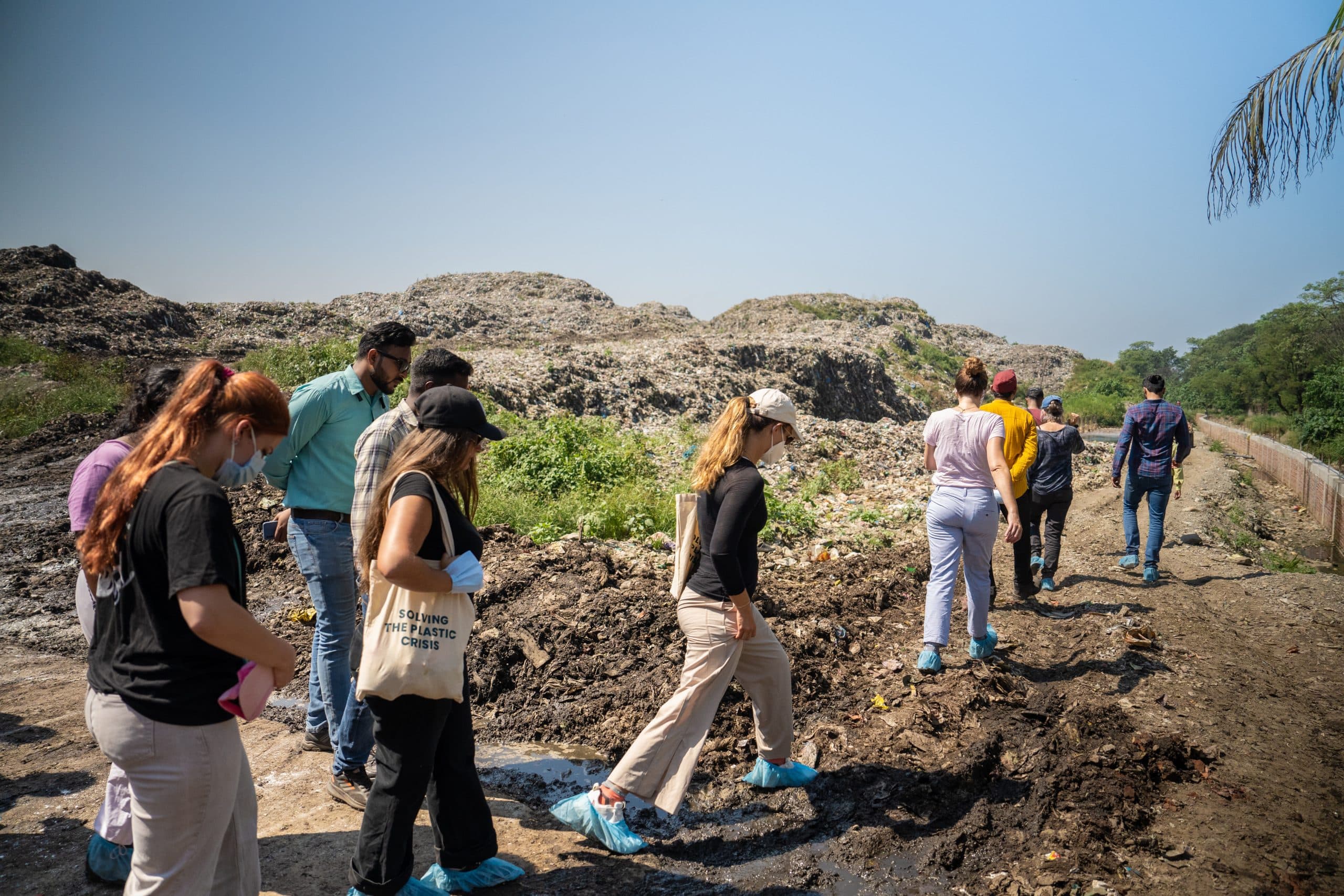
Day 1 of the Plastic Reality Project took place in Dehradun, where we visited two waste sites, the first being a formal one and the second informal.
Mountain of trash at formal waste site in Dehradun, India.
The formal waste site we visited was the first time I've ever been to a landfill or waste facility of any sort. The first thing peeking out of the bus window I could see was an incredible mountain of trash with two teenage boys, running on the top of it. I had never seen so much waste in one place. Getting off the bus, the stench was pungent. For myself, the smell was familiar, having spent some of my childhood on a farm, the smell was of fertilizer, and manure.
But I understood the real reason for the smell, and this was because of the waste and all of the organic matter being trapped amongst the plastic. Walking alongside waste mountain, there was sludge everywhere. And I was visibly shocked to learn that there were literal puddles of sludge water bubbling up beside us because of methane.
Paloma of Grounded learning about methane emissions from Kamal of rePurpose Global
The second waste site we visited was an informal transfer station, in which waste from the local community is brought in by trash collectors and later distributed. The trash comes in by the truck load at this transfer station and must be offloaded by crane. This is then collected by informal waste pickers who are scavenging these mountains of trash, often barefooted with no PPE, no proper safety where they’re at risk of being buried alive with trash.
There are no formal regulations protecting these informal waste pickers. Often young adults and minors pick through the trash piles in search of high value plastic such as PET bottles. Informal waste workers seek recyclable plastic that they can actually sell for money, contributing to India’s PET recycling rate of 95%, yet leaving behind tons and tons of low value plastic. Low value plastic, includes soft plastic, multi layer plastics, such as snack bags, food packaging or any plastic really that isn't recyclable by traditional recycling processes. Not to mention the high levels of contamination that reduces recycling rates and turns plastic as a valuable material quickly into disposable waste.
Informal waste pickers dodging crane loads of trash being dumped at informal waste site in Dehradun, India.
The faces of the informal waste workers at this site were drastically different from those of the formalized waste workers we would later meet. Even though we were outdoors in the open air, the whole environment felt toxic. We were only allowed a few minutes at this informal waste site, but even that was enough time for the toxic stench to seep into every fiber of your clothing, your hair and leave soot on your skin. I can only imagine what working full days in the piping sun and choking humidity, amongst medical waste, sanitary waste, and much more hazardous materials does to a young person’s lifetime. In fact, most of these young men working in these informal waste sites do not live full lifespans, and it's very obvious why.
Cleanup with Waste Warriors in the Himalayas
Day 2 of the Plastic Reality Project started on a much more positive and enlightening note. We started the day at a sacred temple in the foothills of the Himalayas, near a river which we would be helping protect later on that day.
Rural river community in Himalayan foothills.
The spiritual significance of this precious place draws tourists from around the world. With tourism comes single-use plastic consumption– and in a terrain like this where waste management infrastructure is nonexistent, the only option for waste disposal is nature.
Often, local residents simply dump their waste openly in the forest or in the rivers. Another popular method is burning waste in open air, including plastic, which releases very harsh chemical toxins into the atmosphere. But many rural residents are unaware of these consequences and see no alternatives as waste collection services are not offered. That's why Waste Warriors Society was created to specifically address the urgent waste management crisis in the Indian Himalayan region.
Based in Dehradun, rePurpose Global's impact partner, Waste Warriors, are providing proper access to rural waste management where waste is ethically processed and reaches an appropriate end destination.
Our initial introduction to Waste Warriors was through their Paryavaran Sakhi Model which employs and empowers local women (*Sahkis) *from diverse backgrounds, by equipping them with entrepreneurial roles for effective waste management in their communities.
Group photo of PRP group, Waste Warriors and rePurpose team after Himalayan cleanup. Paloma of Grounded waste picking with Sahkis from Waste Warriors.
It was beyond inspiring to see a women-led and operated team pioneering waste management infrastructure in their villages. All while expanding the mission and recruiting other women along the way for not only an equitable employment opportunity, but to change the culture around waste in their communities.
Under the leadership of each Sahki Waste Warrior, we broke off into small teams for the trash cleanup around the river. There was no shortage of plastic to pick. Every layer that we would pick would reveal further and furthermore waste buried. underneath that was further contaminated and certainly not recyclable anymore. We later learned that waste cleanups don't actually help to resolve the problem in the greater scheme, but are more a tool for awareness.
rePurpose X Waste Warriors: Project Pavitra Parvat
Having experienced the emotional anguish of the problem, we were desperately looking forward to meeting more superheroes behind the solution at Project Pavitra Parvat!
Group photo of PRP group and Waste Warriors team at Project Pavitra Parvat in Dehradun, India.
Through Project Pavitra Parvat, Waste Warriors is recycling “hard-to-recycle” plastics such as LDPE (Low-Density Polyethylene) for products in single-use containers and MLP (Multi-Layered Plastic) for packaged food products.
Since 2021, Project Pavitra Parvat’s impact to date includes:
- 211+ tonnes low value plastics ethically processed
- In 2023, 100% proportion of Low Value Plastic channelised to recycling end destination
- 25+ workers engaged in the project activities
- 3200+ urban households have access to plastic waste management services.
Project Pavitra Pavart was the first Materials Recovery Facility in partnership with rePurpose that we visited. After witnessing vast amounts of waste being mismanaged, it was mesmerizing to watch Waste Warriors do their magic. The most collected, baled material at the facility is low value plastic, but it was also interesting to see how they sorted other materials, such as e-waste, metals, and paper.
PRP group visiting Project Pavitra Pavart Materials Recovery Facility in Dehradun, India.
Since this facility is smaller, there is a core team of waste workers on the ground- literally. These waste workers are materials experts, some being so good at sorting and separating that they can tell a material by the sound that it makes when it hits the ground.
Waste worker sorting and separating at Project Pavitra Pavart.
After watching how they baled plastic with their baling machinery and how they sorted through waste by hand, we participated in a friendly competition of sorting on the conveyor belt. Each of us were paired up with a waste worker who then guided us on how to sort through all these various materials efficiently. Naturally, we were terrible at it, and a lot of things were left contaminated, so we apologized to the Waste Warriors who would later have to sort through our mess.
PRP group separating materials on a conveyor belt with Waste Warriors at Project Pavitra Pavart. Paloma of Grounded connecting with a woman Waste Warrior at Project Pavitra Pavart.
But what really connected us with these Waste Warriors is when we had the opportunity to sit down and ask them questions about them. It broke my heart to hear about the societal stigma against waste workers, whether formal or informal, that historically they would be considered “untouchable”. However, impact projects like these flip the script by putting the dignity back into this essential work, while providing salaried employment opportunities that are rarely available to many working-class Indians, let alone waste workers. Almost every waste worker we had the opportunity to ask translated questions, mentioned that Waste Warriors was their family, and every day they looked forward to work. Regardless of language, the love shared amongst these Waste Warriors was shared with us that day, and it couldn't have been a better peak of hope into what a true, just transition to a circular economy could look like.
Brick made from repurposed low value plastics at Project Pavitra Parvat.
Aligned with the rePurpose name, products such as bricks, bookcases and tables are being produced with repurposed low value plastic recycled at Project Pavitra Parvat.
After witnessing informal waste workers climb mountains of trash with no shoes, shirts nor masks on, visiting this first Materials Recovery Facility, demonstrated a drastic contrast to the normalized world of waste we’ve grown accustomed to. Sorting and separating trash myself on the conveyor belt, I was confronted with the reality that these waste workers go through tons and tons of the world's trash for hours and hours every week, every year. And there won’t be any shortage of supply anytime soon.
Kozhikode, Kerala: Shoreline of the Arabian Sea
Kerala is often called “God’s Own Country” because it’s one of the richest biodiversity hotspots in India blessed with abundant nature’s bounty, year-round foliage, diverse wilderness, crystal clear beaches, and the magnificent landscapes of the Western Ghats.
In Kerala, rural areas lack infrastructure, despite generating the majority of waste leading to ocean-bound plastic waste. Coastal litter in Kerala is 3 times the global average. 95% of low-value, soft, flexible plastics in Kerala are mismanaged: burning and dumping are the default. Only 21% of women in the state are employed, and have the highest gender pay gap in India.
Waste Collection with Green Worms
We had one powerful day in Kerala that started off with us going off in small groups on a waste collection route led by Haritha Karma Sena, women waste collectors organized through a local partnership with Green Worms. Green Worms is another impact partner of rePurpose scaling across Kerala. We joined alongside a few women waste collectors leading these regular waste pickup collections from household to household in remote jungle villages. On the side of the scenic route we noticed there were trash bags, which we realized were part of the collection service that we were shadowing.
Woman waste collector walking one of her regular routes in Kerala, India. Waste collectors scanning QR codes outside household for real-time data collection.
Doorstep to doorstep, the waste collectors would personally pickup each household’s waste for the month and record the data. By scanning a QR code, they're able to track all of this waste management system, but they also keep a written record. Before doing this work, neither of the two ladies who led us on their route knew how to use a smartphone nor owned one.
It was shocking to see how little waste each of these multi-generational households had produced per month. For example, one household seems the equivalent of what my two-person household would throw out every couple of days. This was one of the most eye-opening moments for me from the Plastic Reality Project– the undeniable fact that the Global North produces waste at a much higher rate than the Global South.
Paloma of Grounded, Kerry of Yumove - Lintbells, Vrishi of rePurpose, and the waste collectors of Green Worms picking up a month's worth of waste from a household in rural Kerala, India.
The cost of Green Worms’ waste collection service is affordable and thus improves access to these rural residents. Households pay less than $1 US dollar per month for this waste collection service. This is the type of innovative waste management model that rePurpose Global is urgently scaling across the Global South, where formalized waste management systems are most lacking.
It was apparent that the reason this system worked so well was because it was personable in nature. One is much more committed to separating at the source when one has a personal relationship with their waste collectors. By having these women waste collectors, Haritha Karma Sena, go door to door and collect personally, a strong bond is formed between households and their waste management system. It was incredible to witness, and in fact, I felt envious. I wished that I had that sort of relationship with my local waste collectors. I feel that if we had more community building around waste management as Western consumers, we would change our behavior and be dedicated to ensuring our waste is properly sorted and separated at the source. Thus, enabling circular solutions to be implemented at scale.
rePurpose X Green Worms: Project Hara Kal
A flagship for female empowerment in Kerala, Hara Kal was the most impressive project by rePurpose we visited.
Group photo at Project Hara Kal with Green Worms waste workers, PRP group and rePurpose.
Project Hara Kal by rePurpose Global and Green Worms is a women led operation specializing in recycling and co-processing of hard to recycle plastics and textiles. With a workforce of 98.5% women, Project Hara Kal is one of rePurpose Global’s most advanced impact projects.
Since 2020, Project Hara Kal’s impact to date includes:
- 15+ million KG of low value plastics ethically processed
- 53 local bodies engaged through the project
- 1,300+ formal workers engaged in the project activities
- 176k+ Households given access to improved plastic waste collection services
- 30% above minimum wage for employed workers on the project
Initial impressions of Project Hara Kal were oohs and awes at spaciousness and sophisticated machinery. Compared to Project Pavitra Parvat which had a single conveyor belt at their Materials Recovery Facility, Project Hara Kal had several conveyor belts and mechanisms in place for sophisticated sorting and separating of materials– efficiently processing tons of waste at speed.
Waste workers sorting materials at Project Hara Kal Materials Recovery Facility in Kerala, India.
Project Hara Kal has had great success at recycling low value plastics that are traditionally hard to recycle.
Plastic pellets recycled from LDPE, low value plastic at Project Hara Kal in Kerala, India.
For example, the founder of Green Worms, Jabir Karat, showed us samples of their recycled pellets that were derived from low value plastics such as LDPR and MLP.
As a textile upcycler myself, I was most interested in how Green Worms addressed textile waste and recycles fibers. What I discovered was fascinating— that downcycling textiles in India is quite rebellious. Since textiles are not yet widely accepted for downcycling, the secret sauce is shredding contaminated textiles, mixing them with the typical low value plastic bales that are sent for downcycling into cement. Plastic is notorious for being a problematic material, but textiles have become even more problematic, particularly for a circular economy.
PRP group playing tug of war with waste workers at Project Hara Kal.
It wasn't all work at Project Hara Kal– we had the chance to play games and dance with the waste workers! First, a friendly game of tug of war and second, music chairs, we bonded over laughs and smiles, breaking down the language barrier.
Waste workers playing music chairs with PRP group at Project Hara Kal.
Our visit to Project Hara Kal, was the ultimate exposure to a circular economy. Although we often discuss circular economy concepts in our work, we’re not on the ground like these women are. I’m grateful I had the translation opportunity to tell them that they’re my heroes.
Paloma of Grounded taking a selfie with waste workers she bonded with at Project Hara Kal.
Closing the Intention-Action Gap
There’s a myriad of takeaways I brought home with me from The Plastic Reality Project. On a consumer level, we must take back our power in controlling how much plastic waste we produce. These are choices we make on a daily basis.
Close your intention–action gap.
If your investments in sustainability and social impact aren't translating into sales, growth or internal buy-in, we can help you identify the gap.
What Can We Do To Take Action on Plastic Waste?
- Refuse single-use plastic products and packaging
- Reduce your consumption of products that are packaged in “hard-to-recycle”, low value plastic, such as soft, flexible and multi-layered plastic
- Prioritize your consumption instead towards “easy-to-recycle” plastics such as PET
- Always rinse your recyclables so they are not contaminated and deemed non-recyclable
- Check for recycling labels on even takeout foodware and prevent contamination of these recyclables by not tying up your trash in a single plastic bag
- Bring your own reusables on-the-go
- Buy in bulk packaging or from refilleries
- Choose brands that actively address their plastic footprint through plastic recovery projects like rePurpose Global’s
To achieve a circular economy, collaboration amongst global stakeholders is required. rePurpose Global is the world’s leading circularity action platform facilitating profound partnerships and scaling impact. Beyond rePurpose’s vast network of impact projects, rePurpose Global has established The Innovation Alliance for a Global Plastics Treaty (IAGPT). Consisting of over 100 member organizations globally, IAGPT is committed to advancing the role of innovation, technology, and entrepreneurship in the UN Global Plastics Treaty with the aim of accelerating systems change across the entire plastic pollution lifecycle from source to sea.
At grounded, we’re proud to collaborate with rePurpose Global on scaling their mission to solve the plastic waste crisis and are thankful to have been part of the Plastic Reality Project!
Make a creative impact.
See what making a creative impact looks like with some award-winning case studies from the Grounded team.