 Paloma Jacome
Key Takeaways:
- People resist change — even when change is obviously needed. Human behavior defaults to the status quo. Environmental progress isn’t blocked by technology or ideas as much as by our deep psychological tendency to avoid discomfort and stick with what we know.
- Earth Day works because it lowers the armor. For one day each year, people feel more open, more hopeful, and more willing to act. It creates a rare window for behavioral momentum — one that global movements must learn to extend beyond April 22nd.
- The environment is simply “what surrounds you.” Kathleen reframes environmentalism as the practice of protecting your immediate world. When people see the environment as local, tangible, and personal, they’re far more likely to participate in solutions.
- Fear doesn’t motivate — possibility does. Doom messaging shuts people down. Earth Day’s real power comes from optimism, storytelling, and empowerment, not anxiety.
- Climate solutions are unstoppable — despite political noise. Renewable energy isn’t a trend; it’s a historic turning point. Systems are shifting, investments are accelerating, and resistance is only a temporary slowdown.
- Nature is the ultimate reset button. If people simply reconnected with nature — even briefly — their anxiety drops and their sense of stewardship increases. Earth Day is as much an emotional intervention as an environmental one.
In this episode of It Shouldn’t Be This Hard, we dig deep into the world's most renowned environmental day of awareness - Earth Day. Not just the event, but the psychology, strategy, and movement-building required to activate a billion people across 192 countries.
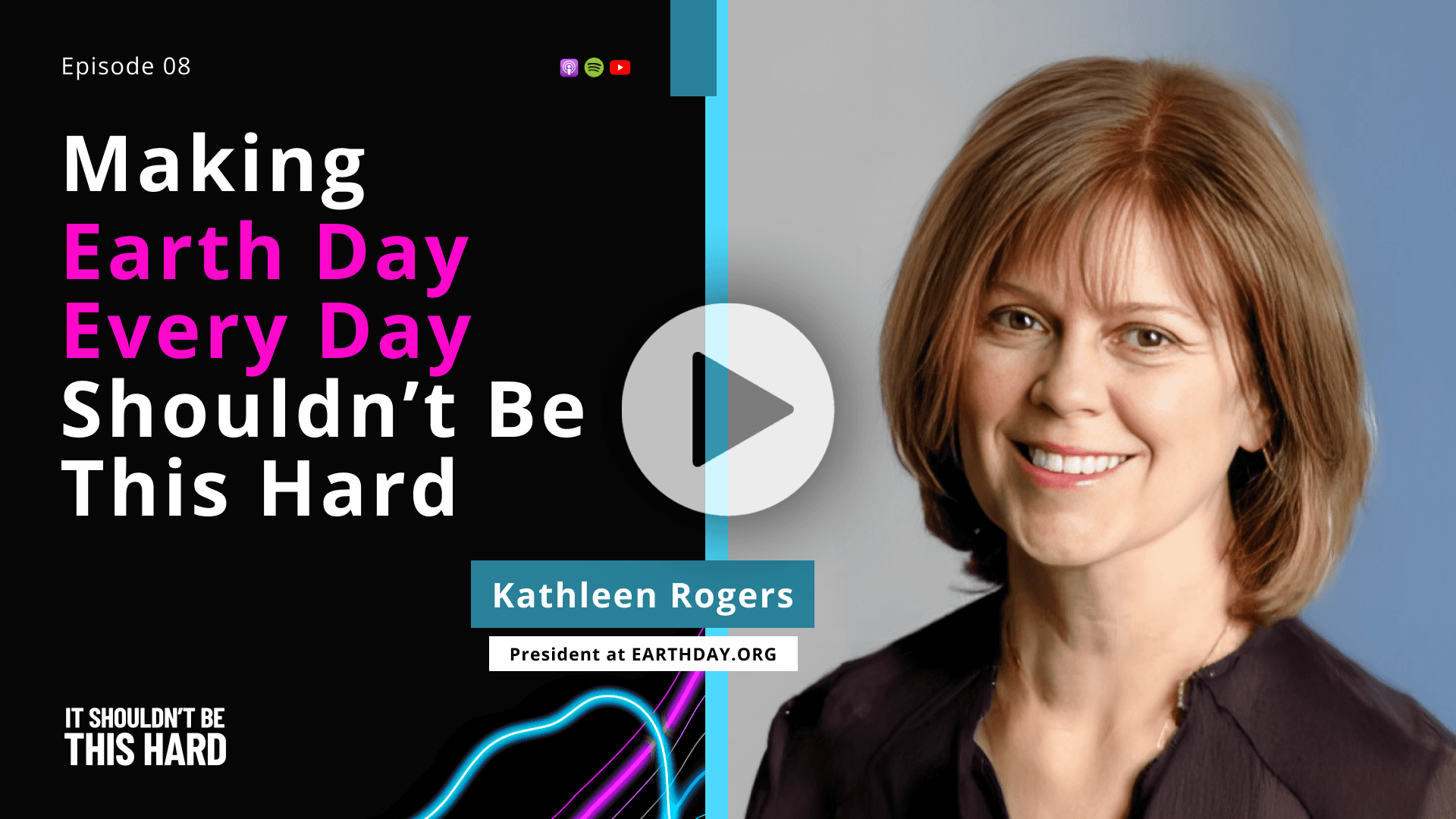
Kathleen Rogers, President of EARTHDAY.ORG, shares a candid look at what it takes to mobilize the world around environmental action and why the hardest part has nothing to do with science. It has to do with human behavior.
This is an episode about momentum, communication, and how to get people to care in a world that feels increasingly overwhelmed.
WATCH the full episode HERE.
The Paradox: Environmental Awareness Is Up… But Action Still Stalls
One of the most striking insights from the conversation is what Kathleen calls the paradox of modern environmentalism:
People know more about environmental issues than ever before. Yet the problems are getting bigger. And people feel increasingly powerless.
Part of this is psychological. Humans love predictability. We cling to “normal,” even when normal isn’t working. “People love the status quo,” Kathleen says and that resistance is one of the greatest barriers Earth Day tries to overcome.
Earth Day, at its core, is a massive behavioral nudge.
For one week each year, people feel invited (not shamed) into participating. Whether that’s a cleanup, a protest, a corporate announcement, or a creative project, Earth Day creates a global permission slip to act.
Why Earth Day Works: It Makes Climate Local, Personal, and Creative
When Kathleen first took the job, she went back to the literal definition of environment: “what surrounds you.”
And that simple insight has guided the organization ever since.
Earth Day succeeds because it collapses the distance between climate issues and personal experience. People aren’t asked to solve “climate change,” they’re asked to protect what’s around them — their block, their park, their community.
This makes the movement accessible to:
- artists
- volunteers
- students
- corporations
- cities
- creators
- policymakers
- anyone with a neighborhood to care about
The tent is intentionally big. Because the mission — diversify, educate, activate — only works if every kind of person sees themselves inside the movement.
The Real Challenge: What Happens After April 22nd?
Kathleen describes Earth Day as a “hot air balloon basket that keeps getting bigger” — but also as a moment that risks deflating once the day passes. Mobilizing a billion people is the easy part. Keeping them activated beyond April 22nd is the hard part.
This is where the episode goes deep into behavioral science:
- fear messaging shuts people down
- repetition is essential
- empowerment beats guilt
- storytelling creates identification
- momentum must be cultivated, not assumed
Earth Day is proof that people care. The challenge is sustaining that care when the news cycle moves on.
Renewable Energy: The Most Inevitable Transformation in History
One of the most powerful segments of the episode focuses on next year’s Earth Day, centered on renewable energy. Kathleen calls the transition to clean energy “unstoppable”... a once-in-history opportunity to redesign the world.
Despite political headwinds, she sees this moment as a temporary blip, not a barrier.
The train has left the station. The market has moved. And even legacy industries know it.
She frames climate not as an apocalypse but as a catalyst, a global reinvention moment that will define the next century.
The Human Side of the Movement: Hope, Anxiety & Spirituality
Earth Day isn’t just about carbon or pollution. It’s about connection.
Kathleen emphasizes something often missing from climate conversations: Nature is a mental health intervention.
Just stepping into nature lowers anxiety. And anxiety is one of the biggest barriers to climate action.
Her closing message is that nature is miraculous, soothing, and universally meaningful. If more people had access to it, the climate movement would be very different... and much stronger.
Author:
Paloma Jacome
linkedin Paloma Jacome is content lead and Junior Strategist at Grounded. With over 8 years of experience at the intersection of business and sustainability, she has launched and led multiple ventures —including ECOAVSOLUTIONS, local sustainable audiovisual production company in Southern California— before bringing her entrepreneurial perspective to client work at Grounded. She holds a Bachelor’s in Entrepreneurship and a Master of Science in Entrepreneurship and Sustainable Innovation from Loyola Marymount University.
Paloma is also an active ambassador and city coordinator for the Los Angeles chapter of Top Tier Impact, organizing events that connect impact founders, investors, and sustainability professionals to collaborate on solving the most pressing challenges of our time.
As part of Grounded’s partnership with rePurpose Global, Paloma represented the agency in the Plastic Reality Project in India, an immersive program designed to experience the scale of plastic pollution firsthand and explore circular solutions addressing the crisis at its source. She is also recently certified in sustainability legislation and regulations for the fashion industry by the Sustainable Fashion School, strengthening her expertise in policy-driven transformation.
Paloma was a core co-author of Grounded’s debut white paper Policy to Profit: How New Rules Can Create Commercial Wins for Fashion—featured in Forbes—and continues to explore how circularity and regulation unlock commercial and societal value.
LinkedIn | paloma@grounded.world