 Paloma Jacome
Key Takeaways:
The coffee industry is built on broken economics. Most farmers are paid less than the cost of production, forcing families off their land and trapping growers in generational poverty — a crisis hidden behind the price of a cheap cup.
OBIIS is rewriting the rules with Farm Direct. Bob & Michelle’s model removes brokers and “coyotes,” pushes value back to farmers, and proves that ethical sourcing isn’t charity — it’s smart, scalable business.
Capitalism needs a conscience to survive. As Bob says, you can be a sociopathic capitalist or an empathetic one — both make money, but only one leaves something worth keeping. Empathy is the engine of long-term profitability.
Flourishing farms create flourishing communities. When farmers earn a fair share, soil regenerates, kids stay in school, and entire communities grow stronger — creating a ripple effect that improves every cup, every customer, and every company involved.
Fairness shouldn’t be radical...but it still is. OBIIS is proving what’s possible when business prioritizes dignity and transparency. The future of coffee (and business) is one where prosperity is shared, not extracted.
How can something as simple (and universal) as a cup of coffee come from a system this broken?
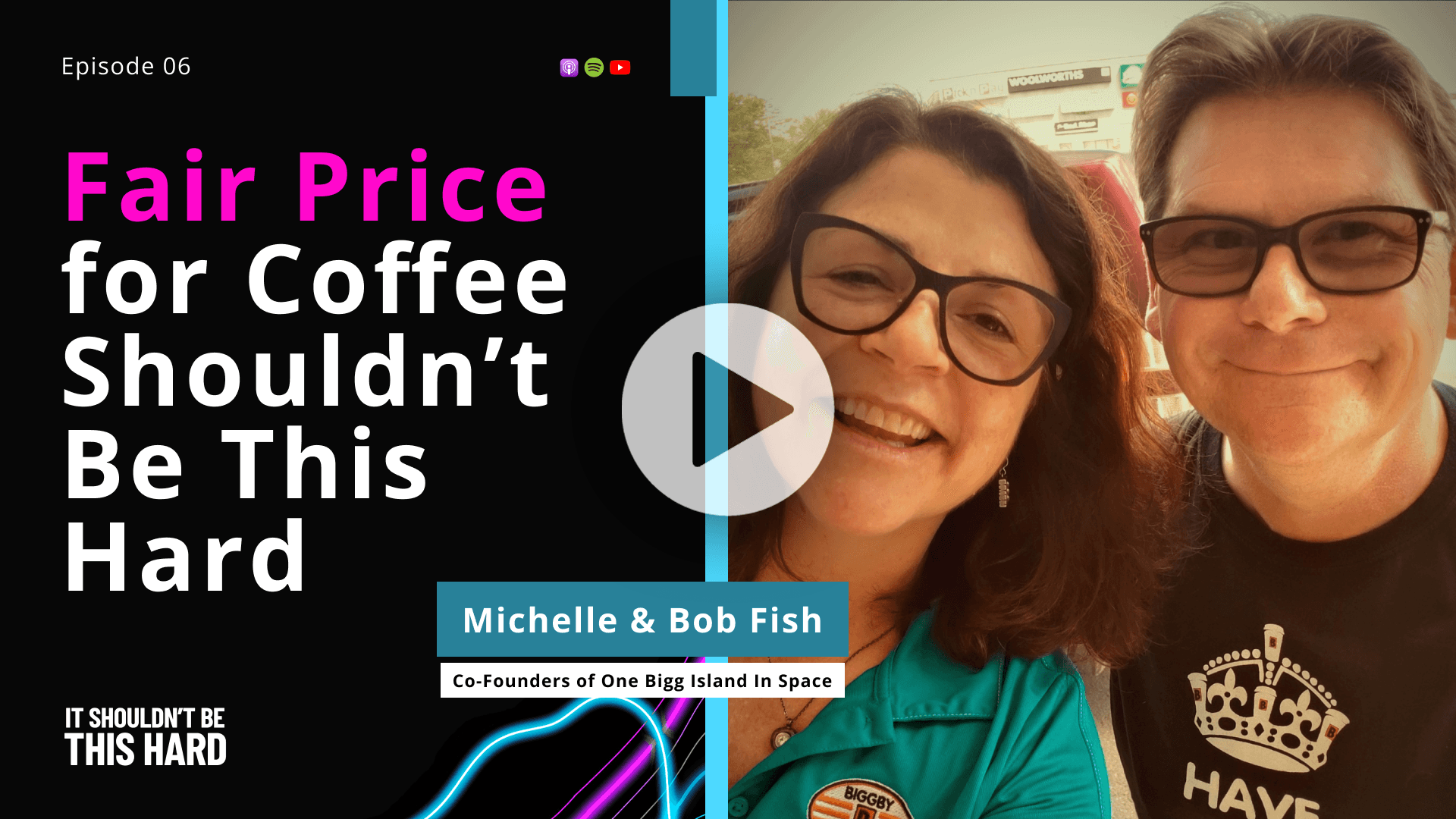
In this episode of It Shouldn’t Be This Hard, we sat down with Bob Fish and Michelle Fish , co-founders of One Bigg Island in Space (OBIIS) to talk about the bitter truth behind your morning brew.
OBIIS is building a Farm Direct model from the ground up — one that goes beyond Fair Trade and USDA Organic, regenerates farmland, empowers growers, and cuts out the “coyotes” and middlemen who’ve been profiting off inequity for decades.
It’s business reimagined — where empathy is an economic strategy, and profit becomes prosperity.
WATCH the full episode (with exclusive footage from OBIIS HERE. Or listen on your preferred streaming service** HERE. **
The True Cost of a Cheap Cup
The Fishes didn’t set out to start a movement... just to understand the business they’d built. After 20 years in coffee, they realized they’d never stepped foot on a farm.
What they found there was sobering.
“Eighty percent of coffee farmers have been paid less than the cost of production,” Michelle explains. “That’s not just unsustainable. It’s immoral.”
Families forced to abandon their land. Crops ravaged by droughts and disease. Generations of growers trapped in systems that value beans more than people.
So Bob and Michelle did what leaders do when faced with a broken system: they started rebuilding it.
Beyond Fair Trade. Toward Fair Future.
With One Bigg Island in Space, they’re redefining what “fair” really means.
Their Farm Direct model doesn’t stop at paying a little more for beans. It tears down the outdated chain of brokers, traders, and so-called “coyotes”, pushing value back to the source: the farmers themselves.
“We’re not philanthropists,” Bob says. “We’re capitalists with a conscience. It’s not charity...it’s smart business.”
By 2028, Biggby Coffee aims to be 100% Farm Direct, proving that ethical sourcing can scale to millions of pounds of coffee and billions of cups.
Capitalism Needs a Conscience
Bob doesn’t mince words.
“You can be a sociopathic capitalist or an empathetic one,” he says. “Both make money. But only one leaves something behind worth keeping.”
It’s a truth we don’t say out loud enough: capitalism doesn’t have to be cruel to be profitable. But it does have to evolve.
Empathy is the hidden engine of longevity, loyalty, and trust. The thing that keeps your business from eating itself alive.
The OBIIS model is empathetic in that it’s about feedback loops. When farmers thrive, their soil regenerates. Their children stay in school. Their communities grow stronger. And that strength flows upstream into every cup, every customer, every balance sheet.
It’s circular economics with a soul.It’s the capitalism of the future: profitable because it cares.
One Planet. One Cup. One BIGG Island in Space.
The name says it all. Born from that first image of Earth taken from Apollo 8.
“From space, you don’t see borders or brands,” Michelle says. “You just see one fragile ecosystem. One big island. All of us on it together.”
OBIIS tells the human story behind every cup of coffee (not through guilt) but through connection. Every farm they partner with becomes part of a new narrative: one where coffee isn’t just consumed... it’s cherished.
“Sustainability can’t just be data and labels,” Michelle adds. “People don’t fall in love with certifications. They fall in love with stories.”
Why Fair Shouldn’t Be Radical
This episode is a reminder that fairness shouldn’t feel revolutionary. But it does… because the system wasn’t built to be fair.
Bob and Michelle are proving you can change that. You can build a model that feeds everyone it touches (not just shareholders).
If the future of business is about shared value, this is what it looks like: transparent, human, and rooted in dignity.
Because the real question isn’t whether coffee can be fair. It’s why it’s taken us this long to make it so.
WATCH the full conversation with Bob and Michelle Fish HERE. And don’t forget to subscribe! More grounded conversations are brewing...
Author:
Paloma Jacome
linkedin Paloma Jacome is content lead and Junior Strategist at Grounded. With over 8 years of experience at the intersection of business and sustainability, she has launched and led multiple ventures —including ECOAVSOLUTIONS, local sustainable audiovisual production company in Southern California— before bringing her entrepreneurial perspective to client work at Grounded. She holds a Bachelor’s in Entrepreneurship and a Master of Science in Entrepreneurship and Sustainable Innovation from Loyola Marymount University.
Paloma is also an active ambassador and city coordinator for the Los Angeles chapter of Top Tier Impact, organizing events that connect impact founders, investors, and sustainability professionals to collaborate on solving the most pressing challenges of our time.
As part of Grounded’s partnership with rePurpose Global, Paloma represented the agency in the Plastic Reality Project in India, an immersive program designed to experience the scale of plastic pollution firsthand and explore circular solutions addressing the crisis at its source. She is also recently certified in sustainability legislation and regulations for the fashion industry by the Sustainable Fashion School, strengthening her expertise in policy-driven transformation.
Paloma was a core co-author of Grounded’s debut white paper Policy to Profit: How New Rules Can Create Commercial Wins for Fashion—featured in Forbes—and continues to explore how circularity and regulation unlock commercial and societal value.
LinkedIn | paloma@grounded.world