 Phil White
Since 1970, Earth Day campaigns have led the collective fight for the health and wellbeing of our planet. The very first earth day campaign led to the creation of the Environmental Protection Agency and the Clean Water and Endangered Species Acts here in the US and since then, Earth day campaigns have inspired decades of documentaries, books and activists including the indomitable Greta Thumberg.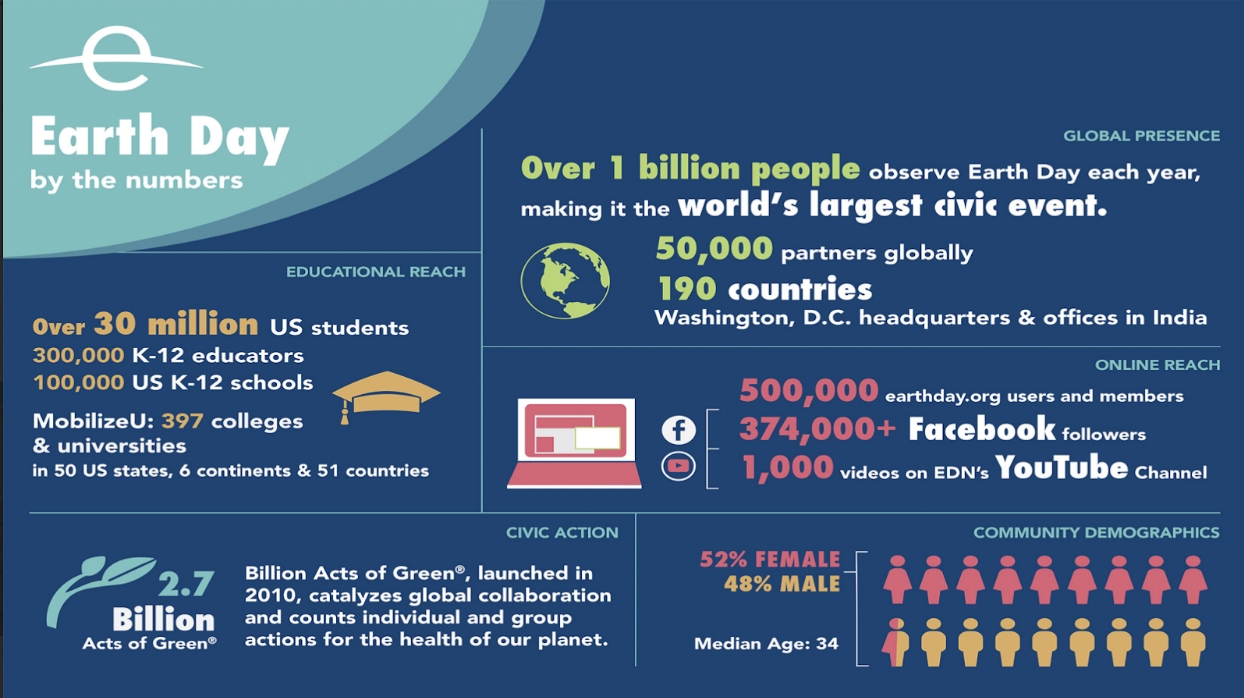
In 1990, Earth Day went global and mobilized 141 countries to participate in protecting the environment and since then over one billion people participate in Earth Day campaigns each year. This year, On April 22, 2023, corporations, individuals and government representatives joined together in a global breakthrough moment of progress and commitment calling them all to ‘invest in our planet.’
However, despite governments enacting many significant green policy initiatives in 2022, nearly every country in the world is still nowhere near meeting Greenhouse gas (GHG) neutrality by 2050 and an Earth Day campaign report from the market research firm Ipsos found that while the general public shows increasing levels of awareness with regard to the climate crisis, this has not translated into actions.
When asked what changes they were likely to make in order to combat climate change in 2023,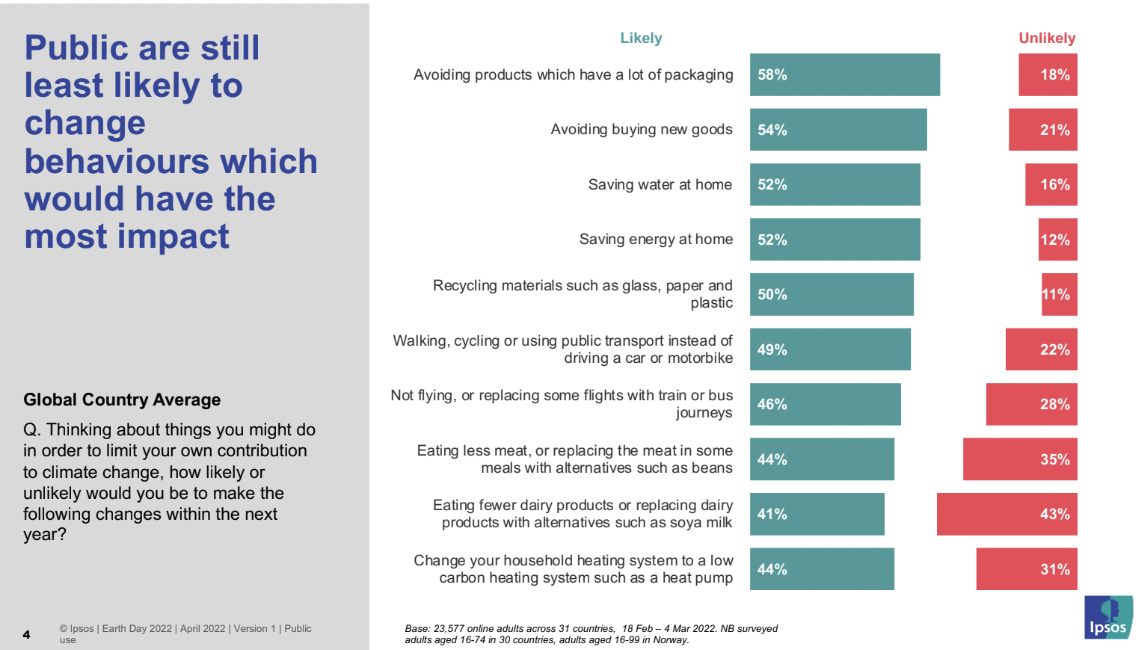 avoiding excess packaging still headed the bill. Meanwhile, respondents showed the least intention to change their behavior around actions that would actually have the biggest positive impact on fighting climate change, such as eating less meat and dairy, avoiding flights or changing their heating system at home. According to Greenbiz, Americans seem increasingly concerned about environmental issues, notably the climate crisis, but are as confused as ever about what to do about it and whether to believe companies’ green messaging.
Are Earth Day Campaigns Closing the Gap?
The recent socio-cultural trend tracker from Sustainable Brands, released to community members a few weeks before Earth day this year, finds that inflation and recession continue to make it difficult for consumers to make sustainable choices. Younger generations are also feeling the pinch and are less inclined to buy sustainably than previous years (with 2/3 agreeing that the economic landscape is making it difficult - rising to 77% for Gen Z and 75% for millennials) and that intention is waning along with action.
Although 96% percent of people reported that they try to live in ways that protect the planet, its people, and its resources, at least some or all of the time, the report suggests that brands may need to draw a stronger connection between the lesser-adopted sustainable behaviors to help move the needle - especially where behaviors aren’t yet normalized, routine or mainstream.
Simply put, we’re doing things but not necessarily the right things to keep us on track and global warming below 1.5C. Public understanding of what to do to reduce carbon emissions is low. For example: Less packaging and buying fewer items are incorrectly seen as priorities, whereas flying less or changing to a vegan diet are not seen by most as having a major impact. Making energy-efficient home swaps, choosing seasonal produce, buying and wasting less, composting your food scraps, going meatless on Mondays, or even going a year without using plastic can all make a big difference.
The beginning of 2023 saw a 47% drop in sustainability-related marketing messages, according to AI-supported data platform CreativeX, following steady growth between 2020 and 2022. Just 4% of ads over the last three years include sustainability messages, a new report showed.
So, we decided to take a look at a few big brands and their Earth Day campaigns from the past few years (as well as those that broke just last week) to see if any of this is filtering through and influencing behavior change.
A Round Up of Some Notable Earth Day Campaigns
Apple: The technology giant has committed to using renewable energy in all of its operations, including its manufacturing and data centers, and is investing heavily in developing new clean-energy technologies. By 2030, Apple plans to be carbon-neutral across its entire supply chain and product lifecycle. See more about Apple’s plan and promise to make every product carbon neutral by 2030:
Unilever: The consumer-goods company has set a bold goal to achieve net-zero emissions from its products and operations by 2039, and is pursuing a range of initiatives to reduce its footprint, such as green energy sourcing, plastic recycling, and regenerative agriculture. Their purpose - to make sustainable living common place - still drives their business forward, despite the rumblings of shareholders and naysayers following the retirement of Alan Jope.
Patagonia: The outdoor clothing brand is a pioneer in sustainable fashion, using organic and recycled materials in its products, reducing water and energy use in its factories and partnering with grassroots groups to advocate for environmental protection. Their founder famously donated the company to help fight climate change in September 2022. This year they launched a new version of the Footprint Chronicles, the place where the company shares information on how and where their products are manufactured, what the environmental costs are, and how they think the process can be improved.
The Non Fungible Earth Day Campaign
Last year, YouTube launched the NFP or non fungible planet earth day campaign riding on the waves created by the NFTs (non fungible token) world that year to highlight a simple yet powerful message: our planet, Earth, is our most unique and valuable gem.
This year, staying on a metaversal theme, Vanish, the Reckitt garment care brand, committed to encouraging consumers to re-wear their clothes. They raised awareness of clothing waste, recently partnering with some of Europe’s biggest gamers and streamers to expand its #ReWear message into the world of gaming.
#ReSkinChallenge was created to highlight the growing problem of virtual ‘fast fashion’ and real-world clothing waste. Skins (or clothing that allows players to personalize their character), just like in real life, are at the mercy of the latest trends, typically becoming obsolete within a few weeks. Along with a financial cost to the player, these purchases have an environmental cost. Each discarded skin, rather than ending up in landfill like their physical counterpart, is stored in a highly energy intensive data center.
High-profile gamers uncharacteristically reverted to a basic, default skin for a whole week as part of the #ReSkinChallenge. They also wore the same physical outfit on their streams for the duration of the challenge. At the end of the week-long challenge, the streamers revealed the challenge to their communities and encouraged them to play wearing their very first, or default, skin – with Vanish donating £20 (around 25 USD) to Oxfam for each stream shared.
Earth Day Campaigns 2023
Lundberg organic rice launched a new campaign that highlights its regenerative agriculture practices—with a special focus on its partnership with California Waterfowl to protect baby ducks discovered in its rice fields.The campaign kicked off with a full-page ad in The New York Times, announcing that “Every Ducking Day Is Earth Day.”
Rothy’s, a footwear brand that turns post-consumer plastic into shoes, launched a campaign this week to increase the deposit on those bottles., Rothy’s also kicked off the campaign with a full-page ad in The New York Times, asking readers to “Stop Recycling Like It’s 1982.”
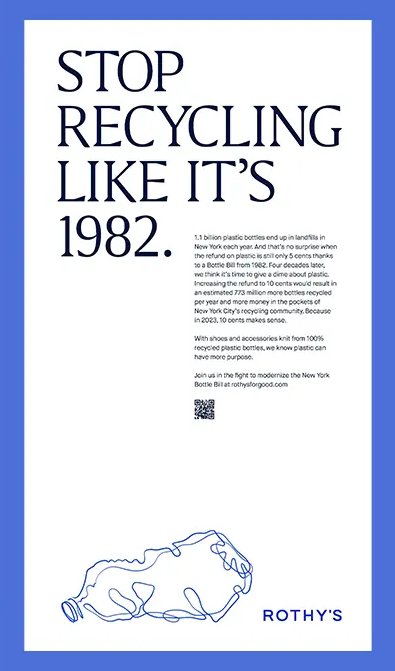 “When we realized that so few people had heard of this legislation, we saw an opportunity to elevate the issue by rallying our community and platforms to mobilize,” Jamie Gersch, CMO of Rothy’s, told Adweek. “We hope that this initiative will inspire others to join us in taking bold action toward a healthier, happier planet and demonstrate that there is power in the collective. Small changes, as small as a nickel, can make a big difference.”
An Activational Earth Day Campaign That Shifts Intention to Action
Perhaps one of the most effective earth day activation campaigns came from the island of Palau in Thailand. Tourism is so vital to this island, and yet has had a negative impact on its pristine ecosystem. The Thai tourism board ran an earth day campaign called the The Palau Legacy Project. An interactive app was created that gamified sustainability, allowing tourists to earn points by participating in sustainable activities on the island, and then they could use those points to enjoy unique experiences they simply would not have been able to access otherwise.
Earth Day Campaigns: Final Thoughts
“In 2023 we must come together again in partnership for the planet. Businesses, governments, and civil society are equally responsible for taking action against the climate crisis and lighting the spark to accelerate change towards a green, prosperous, and equitable future. We must join together in our fight for the green revolution, and for the health of future generations. The time is now to Invest In Our Planet,” said Kathleen Rogers, President of EARTHDAY.ORG.
This year there were thousands of events taking place around the world for Earth Day. Earth Day campaign organizers put together a number of ideas for celebrating Earth Day with this action toolkit along with leadership galas, community plastic clean up events, responsible fashion initiatives, conservation projects, tree planting and climate education. But standalone Earth Day campaigns from brands that focused on the specific behaviors required to shift the needle and stave off global warming were few and far between. As a marketing industry, closing the intention gap is our only option, and we would argue, our primary responsibility. Earth day has come and gone in 2023 and the Earth day campaigns, that we could find at least, seem to have fallen short of the behavior changes we need to stay on track. `