 Paloma Jacome
I just came back from Europe and my mind is still buzzing. Not from the espresso (though plenty of that), but from witnessing how a handful of Swiss brands are living circularity… not talking about it, not marketing it, but engineering it into the DNA of their business. I spent a week on the ground in Switzerland visiting some of the most forward-thinking circular brands in Europe. I met founders, walked through workshops, saw prototypes, fabrics, and machines being repaired by hand.
In Switzerland, design, craftsmanship, and circularity aren’t separate conversations. They’re part of the same ecosystem: a mindset built around precision, longevity, and respect for materials. And for anyone working in brand strategy or keen to contribute to the circular economy, there’s so much to learn from that.
QWSTION — Circularity You Can Carry
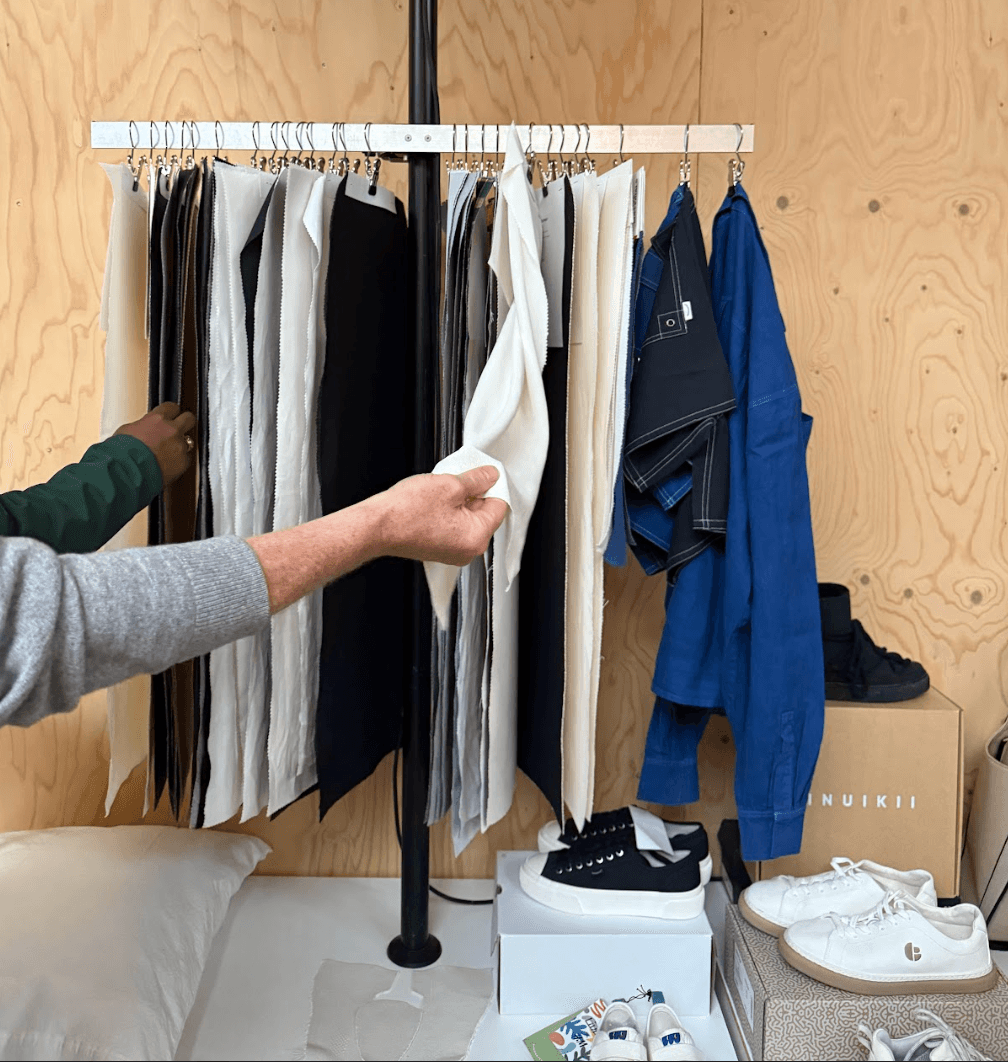
When I visited QWSTION in Zurich, founder Christian Paul Kaegi welcomed us with samples of fabric that looked nothing like nylon or polyester. It was Bananatex®, a material made from banana fibers grown in permaculture systems in the Philippines

He showed us how every part of their bags is designed to return to the system: metal parts can be removed by hand and recycled, the fibers biodegrade in soil or seawater, and worn bags can be either repaired in shop or upcycled into new products.

Their approach to circularity persists past the product’s purchase:
- A take-back program that gives 10% toward a new piece
- A subscription model for repaired “Second Cycle” bags
- A commitment to producing where the footprint is lowest (even if that means using global supply chains more intelligently)
QWSTION’S founder, Christian, said something that stuck with me:
“We’ve gotten used to low quality and low cost. But circular materials are high-cost because they’re real cost.”

ID Genève — The Future of Luxury Is Circular
A few days later, I visited ID Genève Watches, the first B Corp-certified Swiss company revolutionizing the legacy of Swiss watchmaking. On one table: straps made from orange peels and grape residues. On another: polished watch components forged from recycled steel melted in a solar furnace

Every piece tells a story about transparency and traceability… not as buzzwords, but as proof of concept. Their Circular S collection uses solar energy to remelt metal; their packaging is made from Notpla’s compressed seaweed that can literally wash away in the sea and mycelium that decomposes in your garden

And once ID put it out into the ether that they would love Leonardo DiCaprio to be their next investor — you guessed it! Surely he was. And now reps the circular brand on the regular!
They even launched a limited UN SDG watch collection, where buyers have to apply and prove their commitment to a particular SDG to purchase one.

That’s brand activation as alignment. “You don’t just wear a watch; you wear your values on your wrist.”
Zuriga — Swiss-Made Longevity
Back in Zurich, ZURIGA AG felt like stepping into a different kind of circular story. Their espresso machines are small, minimalist, and built to last 20 years. Every part is bolted, not glued. You can disassemble it, repair it, and upgrade it, and of course they’ll do it for you.

Zuriga’s product team told me their goal isn’t to scale fast, but to scale right. Each machine is made to order (all in the same warehouse combined office and repair shop space) with a wait time of typically 7 months and designed to be easily repaired with completely modular hardware that would drive any other espresso machinist mad.

It’s the opposite of disposability culture; it’s investment culture. Zuriga’s design proves that “slow” can be sleek and sexy.
What Does Circular Brand Activation Actually Look Like?
After a week of train rides, factory floors, and espresso refills, I came home convinced that brand activation in a circular world looks nothing like marketing.
It looks like this:
- Activation is built, not broadcast. These brands don’t run sustainability campaigns; they redesign the system itself.
- Purpose is visible. From banana fibre to solar steel, every choice leaves a trace — and that’s the point.
- Culture drives circularity. Switzerland’s precision isn’t just technical; it’s cultural. Circularity works here because it’s a shared value system.
From Zurich to Geneva, the Loop Is Alive
Switzerland showed me that true circular brand activation doesn’t feel aspirational, it feels operational. And that when brands design for forever, they activate trust, culture, and possibility.
Continue the Loop: Activating Brand Purpose & Sustainability
What QWSTION, ID Genève, and Zuriga are doing in Switzerland mirrors what we help brands do globally: activate purpose and sustainability at the moments that matter - for colleagues, customers, and consumers.
Because when circularity becomes activation (not aspiration) brands don’t just adapt to the future. They build it.
🔗 Explore how we do it:
Drive behavior change at retail.
Find out how to develop a big creative idea and commercial selling story that can drive behavior change at retail in just one day.
Author:
Paloma Jacome
Paloma Jacome is content lead and Junior Strategist at Grounded. With over 8 years of experience at the intersection of business and sustainability, she has launched and led multiple ventures —including ECOAVSOLUTIONS, local sustainable audiovisual production company in Southern California— before bringing her entrepreneurial perspective to client work at Grounded. She holds a Bachelor’s in Entrepreneurship and a Master of Science in Entrepreneurship and Sustainable Innovation from Loyola Marymount University.
Paloma is also an active ambassador and city coordinator for the Los Angeles chapter of Top Tier Impact, organizing events that connect impact founders, investors, and sustainability professionals to collaborate on solving the most pressing challenges of our time.
As part of Grounded’s partnership with rePurpose Global, Paloma represented the agency in the Plastic Reality Project in India, an immersive program designed to experience the scale of plastic pollution firsthand and explore circular solutions addressing the crisis at its source. She is also recently certified in sustainability legislation and regulations for the fashion industry by the Sustainable Fashion School, strengthening her expertise in policy-driven transformation.
Paloma was a core co-author of Grounded’s debut white paper Policy to Profit: How New Rules Can Create Commercial Wins for Fashion—featured in Forbes—and continues to explore how circularity and regulation unlock commercial and societal value.
LinkedIn | paloma@grounded.world