 Phil White
The Purpose of Brand Positioning vs. Positioning Brand Purpose
‘Marketers are afflicted by a lack of self-confidence and pride, and one of the main symptoms to have arisen from this is the idea brands should have a higher societal purpose beyond profit’, warns Professor Byron Sharp, ( Professor of Marketing Science and Director of the Ehrenberg-Bass Institute – the world's largest center for research into marketing. He coined the phrases ‘mental and physical availability’ as the primary means to grow brands). The widespread adoption of social purpose, he argues, could lead to brands becoming too similar and consequently being picked off by private labels.
Peter Field, an IPA Effectiveness expert and consultant, provides a slightly less alarmist and arguably better informed point of view by saying, “There is an awful lot of vitriolic criticism heaped on brand purpose, and some of it is naïve and not entirely justified. Admittedly, some criticism is justified (he concedes), but an awful lot of brand purpose advertising doesn’t have much, if any, consumer effectiveness to talk about.”
We’ll attempt to diagnose this point a little later.
Brand Purpose Statements
Peter Field defines ‘brand purpose’ or a brand purpose statement as “a commitment articulated by a commercial brand or its parent company to goals other than improved profits or products, involving contribution towards one or more positive social impact”. The great thing about brand purpose, he goes on to say, is that when it’s done well it introduces new dimensions to a category so a brand can differentiate itself in ways it couldn’t before.
We couldn't agree more and to that point, we’d like to share some of our favorite brand purpose statements that have done exactly that for their respective categories and brand owners. Do you know who they belong to? (All shall be revealed at the end!)
“We create tools for the mind that advance humankind.”
“Inspiring the builders of tomorrow.”
“To accelerate the world’s transition to sustainable energy.” =
“To create a world where anyone can belong anywhere.”
“Organize the world’s information to make it universally accessible and useful.”
“To inspire and nurture the human spirit, one person, one cup and one neighborhood at a time.”
Brand Purpose = Brand Power
Anyway, back to Peter. Here’s the evidence he presents:-
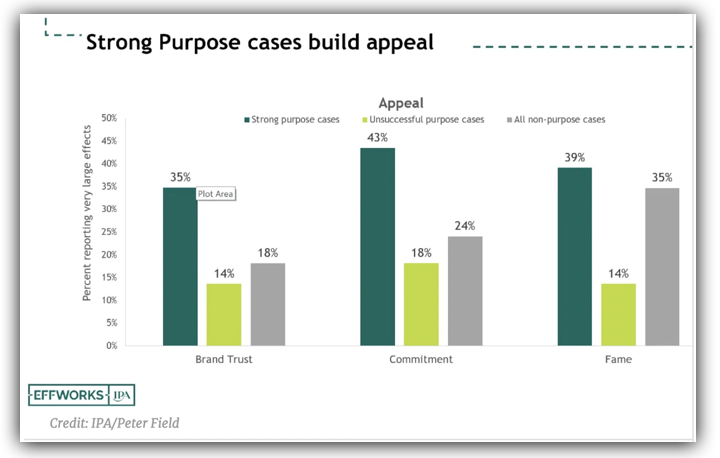
Studying the IPA Effectiveness Awards Databank, Peter compared and contrasted 47 brand purpose cases with 333 non-purpose cases over the same period.
Some 57% of brand purpose cases were deemed to have performed strongly and achieved very large customer acquisition effects, while only 30% of non-purpose cases managed the same. Similarly, 41% of strong purpose cases drove very large market share growth, compared to 26% for non-purpose cases and 0% among weak purpose cases. (Even though the intent is good, there’s still no excuse for poor ideas and execution!)
A strong purpose underpinned by a well articulated brand purpose statement can cause ‘very large brand effects’ with metrics associated with brand appeal, trust, commitment and fame performing particularly well in cases of well-executed brand purpose / brand purpose statements. More than a third (35%) of cases built brand trust, while 43% built commitment and 39% built fame (see chart above).
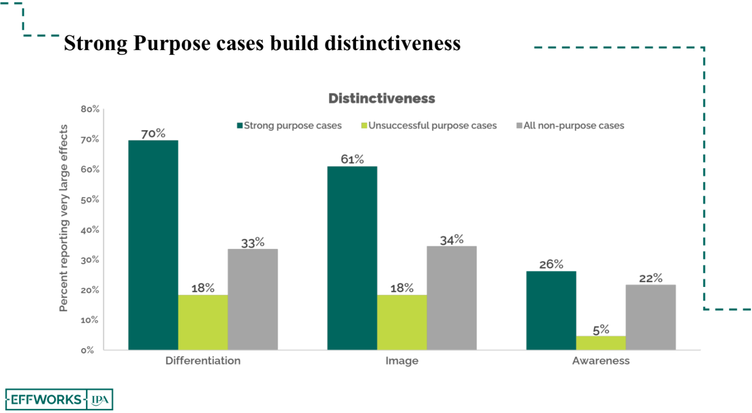
It’s a similar story across metrics associated with distinctiveness. Some 70% of strong purpose cases built differentiation, as 61% built image and 26% built awareness.
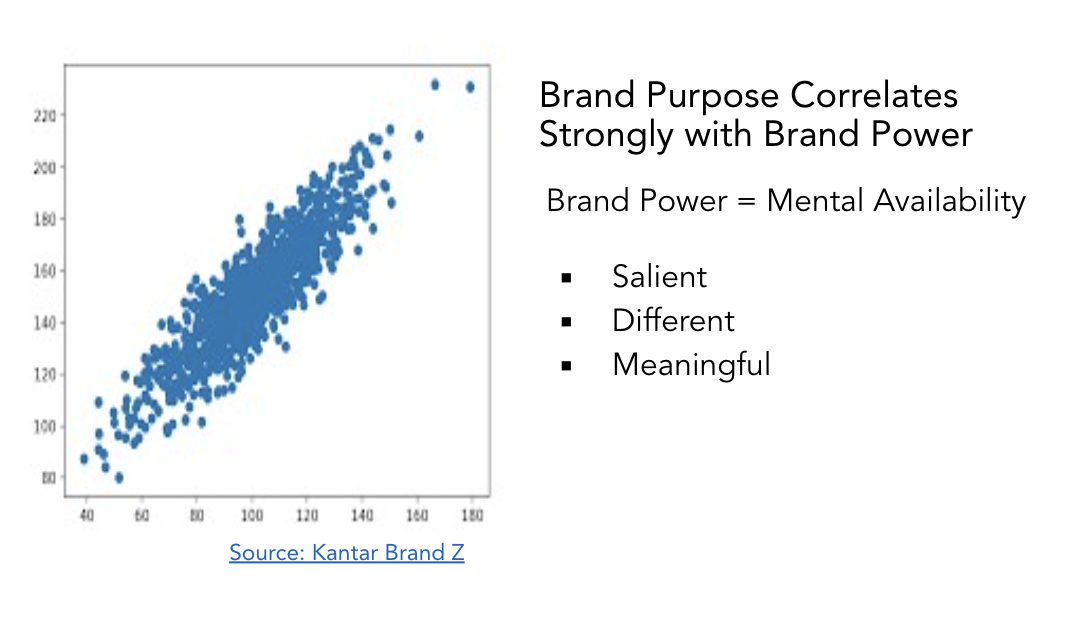
This is also consistent with research from Brand Z which finds that brand purpose (driven out of well-articulated brand purpose statements) correlates strongly with brand power (defined as mental availability - to use a ‘Byronism’). Brands with a clear and commercially compelling brand purpose cluster around stronger brand performance metrics such as salience, difference, and meaning. And brands with high brand power tend to X5 their competition in terms of market share. Ask anyone at Unilever.
Brand Purpose Drives Behavior Change
As a third and final point of reference, Porter Novelli’s 2021 study on Purpose Perception finds that not only are consumers more likely to remember and prefer a brand with a strong purpose, they are also more likely to be activated and triggered to action by it. So, a good brand purpose statement should also be activational and behavior-changing.
“Purpose brand attributes motivate reputational brand benefits among consumers in a way functional attributes cannot. A strong consumer-brand relationship goes further than traditional brand benefits, such as quality, function and cost by incorporating beliefs, traditions, practices and rituals that strengthen affinity and make the brand a meaningful part of consumers’ lives. This affinity drives the behaviors that companies seek”.
Porter Novelli finish the report by saying:-
“Purpose is more than a marketing tactic; it’s much more than a term thrown around at conferences. It is something that is so deeply embedded into our experience with a brand that it becomes a feeling. We can’t see it, and sometimes we can’t even articulate it, but we know it’s there. Purpose is complex and deep, and it’s emotional over rational. And within this complexity is the notion that consumers overwhelmingly gravitate toward it. In a world with so much clutter, myriad messages and touchpoints, Purpose is breaking through. In the fight to win not only consumers’ hard-earned dollars, but also loyalty and trust, Purpose is the clear leader.”
So let’s dig in and unpack all this good stuff a bit then shall we?
Brand Purpose Should Not Be Confused with Brand Positioning
This is a fallacy that underpins Professor Byron Sharpe’s logic and the distinction we’d like to draw between the two.
Brand positioning is relative. Its purpose is to create a promise or proposition that adds value and ultimately creates meaning for your product or service in a way that differentiates you from the competition. Its purpose is purely commercial. And positioning is a function of branding and marketing (or at least it should be?).
Brand purpose and a good brand purpose statement on the other hand are absolute. It's the brand's reason for being (i.e beyond its unique function or commercial offer.) Brand purpose should embody the impact or ambition that’s bigger than the brand itself, or the meaning it currently conjures up in consumers minds (and arguably, it should help reframe it). A motive that’s beyond simply making money (i.e. the central premise behind brand positioning) that can benefit humankind in some way.
Brand Purpose Isn't Just for Marketers and Their Agencies to Figure Out
Just because the words ‘brand’ and ‘purpose’ appear together does not confer ownership to marketing or make purpose servile to the overlords of brand positioning (whomever they may be). In fact quite the opposite should be the case. Brand purpose and a good brand purpose statement is much more organic, intersectional and holistic than that. The CEO should define it, the company should live it. The consumer should experience it and the world should be better because of it.
The ExO (Exponential Organization) community refers to Brand Purpose as an MTP or (Massive Transformative Purpose). If articulated well and embedded into the DNA of the brand or organization, the MTP is capable of scaling impact, reducing costs and giving you a competitive advantage. It is the ultimate brand purpose statement.
“Massive Transformative Purpose (MTP) describes a better future for the world (or at least your industry or community). It doesn’t specify how. It’s not about you, your customers, your organization, your products or services. No ‘you’, ‘we’ or ‘us’. You are not in the picture. It is not a marketing slogan. Consider it your north star, but one that doesn’t restrict your organization from changing direction. It might excite and scare you, and catch in your throat, it matters that much to you. You might never fully achieve it, yet it is still worth striving for. Generally speaking, a great MTP attracts the customers, community, partners and resources you need to make a dent in the universe…”
Brand Purpose Is About Your ‘WHY’. Brand Positioning is about your ‘WHAT’
So to get all Simon Sinek for a minute, Purpose is about your WHY. Positioning is about your WHAT. Marketing is your HOW.
Now, of course they should be confluent, but they are distinct. It’s actually the job of any good brand activation strategist and practitioner to be able to connect the why of purpose to the way of profit and work with a fully integrated key stakeholder team to articulate a compelling brand purpose statement framework that connects ‘WHY’ you exist to the ‘WHAT’’ you stand for in the mind of the consumer with the** ‘HOW’** your are going to deploy tactics and resources to create a meaningful and differentiating experience.
It’s that simple - in theory.
This is Why Greenwashing Exists
So the actual issue is not about brand purpose or positioning. It's about the connection (and often lack thereof) between the two. The Say-Do gap. The intention-action gap. The competence-cause gap. **** And so, the reason why greenwashing exists and purpose becomes conflated with marketing
To shift to Mr Fieldings findings, the reason that strong purpose campaigns and case work is that the why of purpose is rigorously and authentically connected to the way of profit, and by that i mean, the products or services that the company sells and the go to market strategy and value chain that the company uses to source, make, deploy and sell them. All of this hard work has to be done first before you can articulate, activate or even start to story-tell around brand purpose. And yet when a brand purpose statement - articulated by a marketing team or agency - ends up getting executed without this rigor then, well, you know the rest. And by the way, your brand purpose statement should never appear in external marketing communications. That's just lazy and unimaginative, frankly.
We Have A Framework For That.
So, where does this leave us? Well, we would be doing ourselves a disservice as brand purpose statement articulators if we didn't have an app for that right. Well, thankfully, we do.
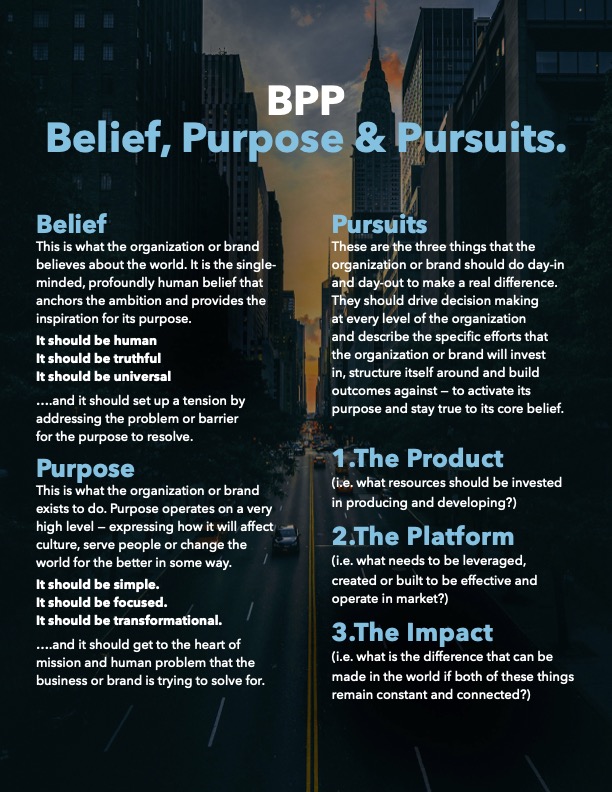
We call it the BPP and it stands for Belief, Purpose and Pursuits. It will help you articulate your brand purpose statement and if you adopt it as a personal development tool, it will also change your life.
Introducing the BPP
The BPP framework (Belief, Purpose & Pursuits) unites the ‘why’ of purpose with the ‘way’ of profit. From the top down and bottom up, it synchronizes people, product, process and performance behind purpose, providing the basis for innovation and the narrative for internal and external engagement. Its goal is to give brands and organizations the focus, inspiration, and flexibility to think, behave, and govern more responsibly — more like a social enterprise in fact. And that's why as a certified B Corp, the very first thing you do is start with your brand purpose as the foundation of good governance.
Here’s How it Works (click to expand):
Here’s an example:
Ocean Cycle:
OceanCycle is a startup, B-corp certified social enterprise.
BELIEF:
We will only put an end to ocean plastic by 2030 if we stop the flow of new plastic entering the ocean along with the marketing spin and misinformation around what can actually be retrieved and recycled.
PURPOSE:
Clean Up Ocean Plastic for Good.
PURSUITS:
- ***CONSULTATION: ***We create marketplace demand for ocean bound plastic and work with clients to help them build the recycling infrastructures, ecosystems and supply chains necessary for driving scale and circularity.
- ***CERTIFICATION: ***We certify ocean bound plastic material from collection through to manufacture — setting the standard, guaranteeing its authenticity and traceability across the entire chain of custody.
- ***COMMUNITY: ***We help our clients realize the commercial value of ocean bound plastic through direct engagement with the communities where plastic is collected — resulting in jobs and income that improve livelihoods and lift families out of poverty.
iDesign
Here’s Another Example for iDesign:
BELIEF
An organized home and a world without waste, is a much less anxious and happier place.
PURPOSE:
Inspire people to live simply and sustainably 
PURSUITS:
- ** CIRCULARITY** We design smart, stylish, aspirational products — made from sustainable, ethically sourced materials that can be reused and recycled
- ** SIMPLICITY** We strip out complexity and elevate beauty to put a sense of order and accomplishment back into people’s lives
- EMPATHY We empower our people, vendors, and partners to be authentic, treat each other with respect and give back to the community
And HERE is how we captured this blueprint into an internal manifesto and evergreen activation platform for the company. iDesign is now the category captain globally for sustainable living and housewares on Amazon.
Plan International
And finally, a recent non profit example for Plan International to demonstrate that the framework can be pulled down a level to work as an activation strategy blueprint too. HERE is an example of how it was expressed as tactical activation.
BELIEF
We believe that when girls develop meaningful relationships with each other, they’ll work together to be the change they want to see in the world — breaking free from the unattainable standards and stereotypes that hold them back.
PURPOSE:
Unleash the power of “we”. The unstoppable force that can be achieved when girls engage and support each other.
PURSUITS:****
- CONNECTION Create safe spaces, places and moments where girls can be themselves, tell stories, be mentors and bring other girls into the circle — strengthening the collective through empathy, inclusivity and support.
- ACTIVATION Learn from girls about the key issues they face and provide the resources they need… so they can support each other and challenge the systems and structures that continue to hold them back.
- PARTNERSHIPS Partner with brands, retailers, platforms and influencers who can become allies and enablers supporting girls to build confidence, access, tools, tactics and resources so we can make a positive impact together
Now Back to the Brand Purpose Statements:
*“We create tools for the mind that advance humankind.”  *
*
“Inspiring the builders of tomorrow.” 
“To accelerate the world’s transition to sustainable energy.” 
"To create a world where anyone can belong anywhere" 
"Organize the world’s information to make it universally accessible and useful" 
*"To inspire and nurture the human spirit, one person, one cup and *one neighborhood at a time." 
Useful links
Download your BPP Guide HERE
Learn more about OceanCycle HERE
Learn more about iDesign HERE
Learn more about how Plan International is fighting gender inequality HERE
Become a B-corp HERE
AND FINALLY, GET GROUNDED HERE