
 Gaia
GaiaTL;DR
The best sustainability communications agency for your brand depends on whether your core problem is credibility, consumer activation, ESG reporting, or media visibility. This guide compares eight agencies across those use cases, with honest notes on pricing, proof signals, and tradeoffs. Grounded World tops the list for brands that need sustainability communications tied to behavior change and commercial outcomes, not just reputation management. If your sustainability story is real but not driving action, start there.
Best Sustainability Communications Agency (Quick Answer)
If you’re looking for the best sustainability communications agency, the right choice depends on your business objective rather than the biggest agency name.
- Grounded World is best for brands that need sustainability communications tied directly to commercial growth, consumer behavior change, and retail activation.
- Futerra is ideal for global sustainability strategy and enterprise storytelling.
- Greenhouse Communications specializes in environmental PR, advocacy, and media relations.
- thinkPARALLAX focuses on ESG reporting and stakeholder communications.
- 3BL is best for distributing sustainability reports and ESG content.
- ERM Marketing & Communications serves enterprise organizations needing communications backed by technical sustainability consulting.
- Anthesis Brand & Communications combines green claims guidance with stakeholder engagement.
- BBMG specializes in regenerative branding and purpose led positioning.
The best agency is the one that solves your biggest communication challenge, whether that’s credibility, reporting, reputation, retail activation, or changing customer behavior.
At a Glance: What is the best sustainability communications agency?
The best sustainability communications agency for 2026 depends on your primary business objective:
- Best for Commercial Growth & Retail: Grounded World (Focuses on closing the “intention action gap” for CPG and retail).
- Best for Global Strategy: Futerra (Ideal for enterprise level, culture shifting narratives).
- Best for PR & Advocacy: Greenhouse Communications (Specialists in climate policy and environmental media).
- Best for Content Distribution: 3BL (A dedicated platform for ESG news and report amplification).
- Best for ESG Reporting: thinkPARALLAX (Focuses on integrated sustainability and corporate reporting).
Why This Search Matters Right Now
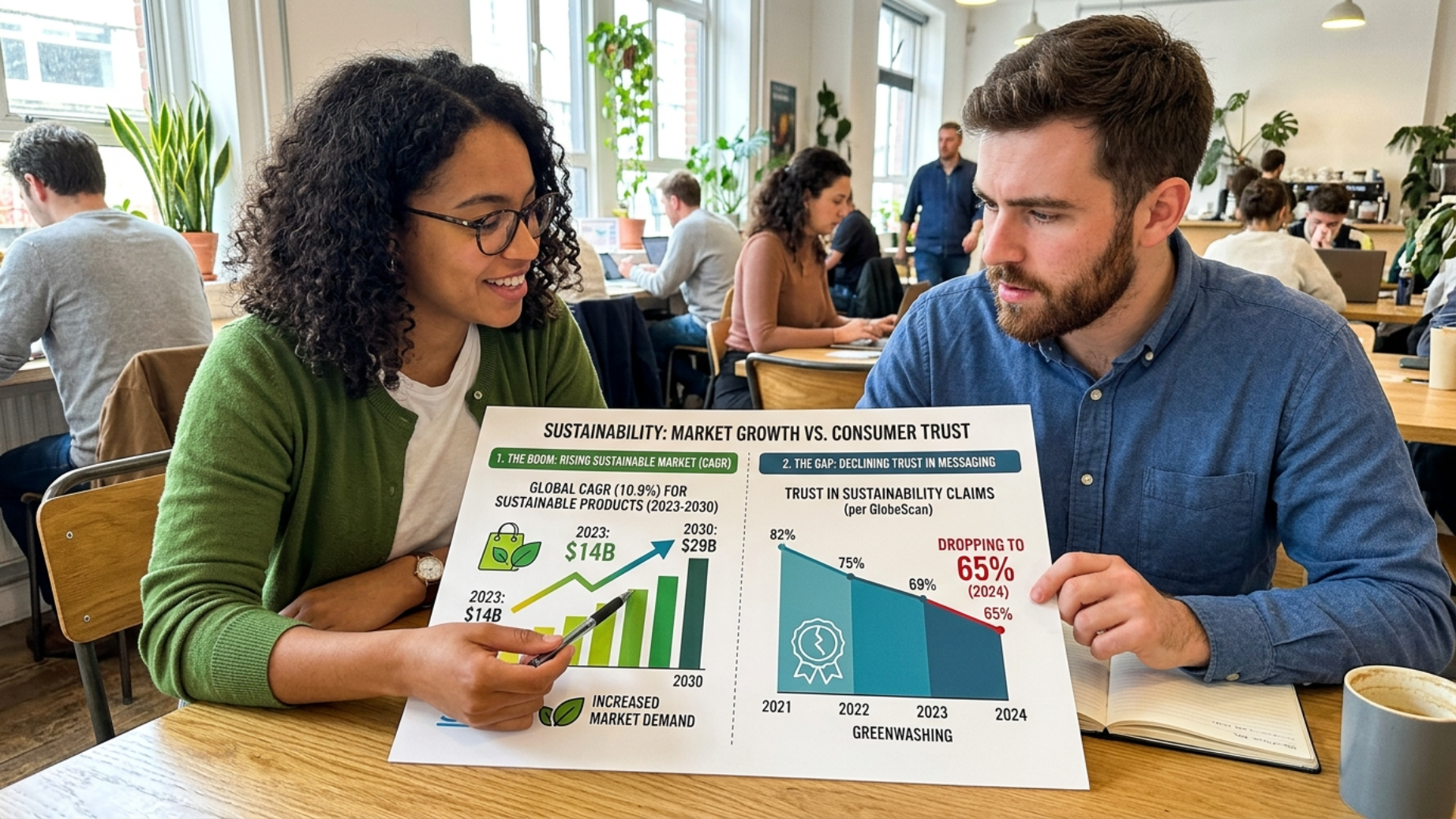
Sustainability marketed products now hold 25.4% of CPG market share and delivered 44.9% of total CPG market growth from 2013 to 2025, according to NYU Stern’s Center for Sustainable Business. These are not niche products. They grew at a 10.9% five year CAGR versus 4.0% for the total market.
And yet, fewer consumers are seeing sustainability messaging from brands. GlobeScan’s 2025 research across 30,000+ consumers in 31 markets found that only 36% reported seeing at least “some” sustainability messaging, down from 49% in 2023. Among those who did see it, trust dropped to 65%, from 79% just three years earlier.
The commercial demand is there. The communication is failing.
Brands are caught between two traps. Greenwashing (saying too much without evidence) gets you hauled in front of regulators and dragged across social media. Greenhushing (saying nothing out of fear) means consumers assume you’re doing nothing, competitors fill the narrative void, and your sustainability investments generate zero commercial return. For a deeper look at how these dynamics play out, see this guide on greenwashing vs greenhushing.
The safest sustainability communication strategy is not silence. It is specificity.
That is exactly what a good sustainability communications agency should deliver: claims grounded in evidence, translated into language people care about, and connected to actions that drive business results.
This guide compares the best agencies for the job, explains how to evaluate them, and gives you the questions to ask before signing anything.
| Metric | 2025/2026 Data Point | Source |
|---|---|---|
| Market Share | 25.4% of CPG market share held by sustainability marketed products. | NYU Stern CSB (2025) |
| Growth Rate | 10.9% 5 year CAGR (4.9x faster than conventional products). | NYU Stern CSB (2025) |
| Consumer Trust | Only 36% of consumers see sustainability messaging (down from 49% in 2023). | GlobeScan (2025) |
| Trust Index | Consumer trust in sustainability claims dropped to 65% (from 79% in 2022). | GlobeScan (2025) |
| Price Premium | Sustainable products command a 26.6% average price premium. | NYU Stern CSB (2024/25) |
The Anti Greenhushing Framework: Why Silence is the New Risk
In 2026, “Greenhushing” (staying silent about sustainability goals to avoid scrutiny) has become a commercial liability. While it feels like a “safe” hedge against litigation, it creates a Sustainability Information Gap.
- The Visibility Risk: If you don’t claim your space, competitors with less substance but louder voices will.
- The Trust Gap: 2025 GlobeScan data shows that consumers interpret silence not as humility, but as a lack of progress.
- The Solution: Move from generalized claims to granular proof. The best agencies today focus on “The Middle Path”: communicating incremental progress backed by raw data, which satisfies regulators while maintaining consumer momentum. A well built sustainability claims strategy makes this possible without overclaiming.
What Is a Sustainability Communications Agency?
A sustainability communications agency helps organizations turn environmental, social, and impact work into credible messages for customers, employees, investors, retailers, media, regulators, and other stakeholders. The scope typically includes sustainability storytelling, ESG and corporate narratives, green claims review, PR and earned media, impact report communications, stakeholder engagement, internal communications, brand purpose and positioning, campaigns, activations, and behavior change programs.
It is worth clarifying what a sustainability communications agency is not:
| Type | Main Job |
|---|---|
| Sustainability communications agency | Build credible sustainability narratives and stakeholder messages |
| Sustainability PR agency | Earn media, manage reputation, handle public visibility |
| Sustainability marketing agency | Drive demand, conversion, and customer action |
| ESG consultancy | Develop technical strategy, reporting, compliance, and data |
| Brand activation agency | Turn strategy into campaigns, retail experiences, and behavior change |
Many agencies blend these categories. The important thing is knowing which problem you’re actually trying to solve. If you need a sustainability marketing agency focused on demand generation, that is a different brief than needing someone to help you write a defensible ESG narrative. If you need both, you need a partner that bridges the gap.
Agency vs In House Team: When Each Makes Sense
One of the first decisions brands face is whether to build sustainability communications capability internally or hire an agency. The answer is rarely all or nothing.
When an in house team works well:
- You already have a sustainability lead and a marketing team who speak each other’s language
- Your communications needs are mostly internal (employee engagement, leadership updates, board reporting)
- You have a consistent, ongoing volume of content that justifies dedicated headcount
- Your regulatory environment is stable and you’ve already established compliant claims
When an agency adds more value:
- You need specialized expertise in green claims substantiation, behavior change, or retail activation that your team lacks
- You’re launching into new markets, channels, or stakeholder groups where you have no track record
- You need a credible external perspective to challenge internal assumptions (a good agency will tell you when a claim isn’t ready)
- Your sustainability investments are real but your internal team cannot translate them into commercial outcomes
- You need surge capacity for campaigns, product launches, or reporting cycles without adding permanent headcount
Practitioners on LinkedIn frequently note that the strongest model is a hybrid: an internal sustainability lead who understands the business paired with an agency that brings creative execution, regulatory literacy, and consumer insight. The agency acts as a force multiplier, not a replacement. This is especially true for mid market brands that can’t justify a full internal sustainability communications department but need more than a freelance copywriter who’s read one ESG report.
Not sure whether your sustainability story is clear, credible, and commercially useful? Start with Grounded’s free 5C assessment to identify the biggest gaps before you decide on build vs buy.
When Should You Hire a Sustainability Communications Agency?
Many organizations wait until they have completed an ESG report before seeking communications support. In reality, agencies often create more value when they’re involved earlier.
You should consider hiring a sustainability communications agency if:
- your sustainability initiatives are not improving customer perception
- your ESG reports receive little engagement
- your legal team is concerned about greenwashing risk
- your sustainability claims are difficult for customers to understand
- your company struggles to connect sustainability with sales
- internal teams communicate inconsistent sustainability messages
- investors or retailers ask for clearer sustainability evidence
If several of these apply, communications (not sustainability performance) may be your biggest bottleneck.
How to Choose the Right Sustainability Communications Agency

Before comparing names, get clear on criteria. Here are seven that matter more than agency awards or follower counts.
1. Substance before story. Can the agency test your claims against evidence? Will they tell you when a claim is not ready? A good partner will push back, not just produce.
2. Greenwashing literacy. Do they understand the FTC Green Guides, the UK CMA Green Claims Code, and emerging EU regulations? The FTC specifically warns against broad, unqualified environmental benefit claims like “green” or “eco friendly.” Your agency should know this cold.
2026 Regulatory Compliance Requirements
Your agency must be fluent in these three frameworks to protect your brand from litigation:
- EU Green Claims Directive (2026): Requires third party verification for all voluntary environmental claims and bans “carbon neutral” claims based solely on offsetting.
- FTC Green Guides (US Updated): Strict prohibitions on unqualified claims like “eco friendly” or “sustainable” without specific, accessible evidence.
- UK CMA Green Claims Code: Requires full life cycle transparency; omitting “unpleasant” environmental data is now legally considered misleading.
3. Audience insight. Can they translate sustainability into consumer relevance? Research from NYU Stern and Edelman found that sustainability claims performed strongly across all nine brands studied, particularly when tied to personal or community benefits like health, savings, children, or local farmers. The best agencies connect sustainability to what people already care about.
4. Commercial fluency. Can they connect communications to purchase intent, retail conversion, adoption, or stakeholder action?
5. Cross functional alignment. Can they work with sustainability, legal, product, brand, sales, retail, and leadership teams without creating silos?
6. Proof signals. Look for B Corp certification, third party certifications, verifiable case studies, and client references. Be cautious with self awarded superlatives.
7. Measurement. Do they define outcomes beyond impressions? Impressions are not behavior change.
Due Diligence to Verify an Agency’s Own Sustainability
Before signing with any sustainability communications agency, verify that they practice what they preach. An agency that helps you communicate sustainability credibility should be able to demonstrate its own.
Here’s a practical checklist:
- B Corp certification: Check the B Lab directory directly. Scores above 80 are certified; scores above 100 indicate stronger performance. Compare the score to the agency’s claims.
- 1% for the Planet or similar commitments: Verify membership on the organization’s public directory, not just the agency’s website.
- Science Based Targets: Check whether the agency has committed to (or validated) science based targets through the SBTi website.
- Published impact data: Ask whether the agency publishes its own carbon footprint, diversity data, or supply chain practices. If they advise you to be transparent but won’t share their own numbers, that’s a red flag.
- Client references on sustainability work: Ask for references specifically from sustainability or CSR leads, not just marketing directors. The people closest to the substance will give you the most honest assessment.
- Team expertise: Ask who on the team has formal sustainability training or experience. Creative talent matters, but so does someone who understands materiality assessments, lifecycle analysis, or regulatory frameworks.
Practitioners on Reddit consistently say they look for hard evidence, supply chain transparency, and specific metrics when evaluating sustainability claims. Apply the same standard to the agency you’re hiring.
At a Glance Comparison Table
| Agency | Best For | Credibility Score (B Corp / Yrs) | Proof Signal | Main Tradeoff |
|---|---|---|---|---|
| Grounded World | Commercial Growth & Retail | 116.0 / 10+ yrs | 1% for the Planet | Custom scoped |
| Greenhouse Comms | Environmental PR & Policy | 121.8 / 20+ yrs | Specialist PR | UK Headquartered |
| Futerra | Global Narratives | 102.3 / 20+ yrs | Global Presence | High Enterprise Cost |
| BBMG | Regenerative Branding | 92.4* / 20+ yrs | Purpose Led | Less Tactical Retail |
| thinkPARALLAX | ESG Reporting | Pending* / 20+ yrs | Reporting Depth | Limited PR Reach |
A note on pricing: Most sustainability communications agencies do not publish standard pricing. Work is typically custom scoped across research, strategy, campaigns, and activation. According to Clutch’s pricing data, the common hourly rate for advertising agency services is $100 to $149/hour, and most reviewed projects fall between $10,000 and $49,999. Sustainability communications work can vary widely by scope, so treat these as rough market benchmarks rather than direct quotes.
Which Sustainability Communications Agency Is Right for You?
| If You Need… | Choose |
|---|---|
| Retail activation | Grounded World |
| ESG reporting | thinkPARALLAX |
| Enterprise strategy | Futerra |
| PR campaigns | Greenhouse Communications |
| Report distribution | 3BL |
| Global consultancy | ERM |
| Green claims guidance | Anthesis |
| Brand purpose | BBMG |
Sustainability Communications Agency vs Other Sustainability Partners
| Need | Best Partner |
|---|---|
| ESG Reporting | ESG Consultancy |
| Sustainability Storytelling | Sustainability Communications Agency |
| Media Coverage | Sustainability PR Agency |
| Product Marketing | Sustainability Marketing Agency |
| Behavior Change | Brand Activation Agency |
| Carbon Accounting | Sustainability Consultancy |
| CSR Reports | ESG Reporting Agency |
| Internal Communications | Sustainability Communications Agency |
| Investor Messaging | Sustainability Communications Agency |
| Retail Activation | Sustainability Marketing Agency |
The Best Sustainability Communications Agencies
1. Grounded World
Best for: Purpose driven brands, retailers, startups, nonprofits, and social enterprises that need sustainability communications to drive behavior change, internal alignment, retail activation, and measurable commercial outcomes.
Grounded World is a B Corp certified boutique marketing agency focused on commercializing sustainability and turning purpose into profit. Where most sustainability communications agencies stop at storytelling, Grounded starts with diagnosing why sustainability investments are not translating into consumer action, and then builds the strategy, creative, and activation to close that gap.
Key strengths:
- Intention action gap research, analysis, and quantification
- AI assisted 5C landscape assessments (Company, Culture, Category, Competitor, Consumer)
- Brand strategy, positioning, architecture, and archetyping
- Consumer behavior change and demand generation
- Retail activation: customer journeys, category strategy, sell in stories, POSM, tactical toolkits
- Sustainability and social impact measurement and reporting
- Corporate narratives, brand purpose, and social purpose strategy
- Agile innovation, co creation, design sprints, claims and concept testing
- Content, video, advertising, campaigns, events, stakeholder engagement
Named client outcome: For Grove Collaborative, Grounded World worked on brand strategy, positioning, and retail activation to help the sustainable home essentials brand translate its environmental commitments into a consumer story that performed at shelf. The work spanned consumer insight, brand architecture, and go to market strategy across retail channels. Case studies including Tribes on the Edge, UNMAS, Network of Executive Women, and others are publicly referenced on the agency’s site, with outcomes tied to stakeholder engagement, behavior change, and campaign activation rather than vanity metrics alone.
Service model: Four phases (Discover, Articulate, Activate, Accelerate) that move from gap assessment through strategy, activation, and growth systems.
Pricing: No public pricing tiers. Offers a complimentary AI driven 5C landscape assessment and discovery call. Custom scoped agency work.
Proof signals: B Corp certification with a 2026 verified B Impact Score of 116. Member of the Ethical Agency Alliance and 1% for the Planet. Committed to Science Based Targets. Named a Top 100 Global Social Impact Company.
Tradeoffs:
- Custom agency engagement, not a plug and play platform
- No transparent pricing or self serve packages
- Best fit for teams needing strategic, creative, and commercial sustainability work, not basic press release distribution
Choose them if your sustainability work is real but not yet driving adoption, retail traction, internal alignment, or revenue. Start with Grounded’s discovery call and 5C assessment.
Consider another option if you only need a distribution platform for an ESG report you have already written, or if you need deep technical carbon accounting without a communications layer.
2. Futerra
Best for: Large brands, NGOs, foundations, and companies that need high profile sustainability strategy, storytelling, training, and culture shifting creative at a global scale.
Futerra describes itself as a change agency combining creative and strategy to make sustainable development desirable. According to its B Lab profile, the agency has been B Corp certified since September 2015, has a B Impact Score of 102.3, and operates across Mexico, Sweden, the UK, and the US.
Key strengths:
- Sustainability strategy and creative campaigns
- Global positioning and culture change work
- Training and academy style sustainability support
- Thought leadership development
Pricing: Public pricing not found. Likely custom scoped consulting and agency engagements.
Proof signals: B Corp certification. Visible thought leadership and industry presence.
User sentiment: Glassdoor shows a 2.8/5 rating from 11 employee reviews, with positive comments about purpose driven work and talented teams, but critical notes about management and transparency. This is employee sentiment, not client sentiment, but it is worth noting that external reputation and internal experience do not always align.
Tradeoffs:
- Likely better suited to larger budgets and global briefs
- May be more strategic and creative than retail activation focused
- Mixed public employee sentiment on Glassdoor
- Public pricing absent
Choose them if you need a globally recognized sustainability communications agency to build a culture shifting narrative.
Consider another option if you are a smaller brand needing hands on retail activation and commercial measurement without enterprise overhead.
3. thinkPARALLAX
Best for: Companies that need sustainability strategy, ESG reporting, and communications under one roof.
thinkPARALLAX positions itself as a full service ESG strategy and communication agency. Clutch lists the company as founded in 2003, with 10 to 49 employees based in Encinitas, California. Its work spans sustainability reporting, ESG strategy, and stakeholder communications.
Key strengths:
- ESG strategy and sustainability reporting
- Sustainability communications and stakeholder narrative development
- Long track record (founded 2003)
Pricing: Undisclosed on Clutch. Public pricing not found.
Proof signals: Clutch profile exists but is not yet reviewed. This is important to note. Ask for case studies and client references directly.
Tradeoffs:
- Limited public review footprint
- Pricing not transparent
- May be less focused on consumer retail activation or behavior change
Choose them if your primary need is ESG reporting with a strong communications layer.
Consider another option if your problem is consumer adoption, retail conversion, or brand activation strategy rather than reporting.
4. 3BL
Best for: Organizations that already have sustainability stories and need high volume distribution and visibility.
Note on Model: Unlike others on this list, 3BL is a SaaS based distribution platform, not a full service creative agency. They specialize in the amplification of your existing ESG content across a massive network of journalists, investors, and stakeholders. Use them as a “force multiplier” for your content once your strategy is set.
Key strengths:
- ESG and sustainability content distribution
- Brand Studio for content production
- PR and content amplification
- Useful for sustainability reports, announcements, thought leadership, and CSR news
Pricing: Listed as N/A or unavailable on both G2 and TrustRadius.
Proof signals: TrustRadius shows a 9.1/10 score from 7 ratings. G2 shows 4.5/5 from 1 review. The G2 reviewer, a verified user in nonprofit management, praised 3BL for helping an organization without a dedicated marketing team improve its online presence, while noting that onboarding new users can be challenging.
Tradeoffs:
- More a distribution and amplification platform than a full sustainability communications agency
- Will not build your narrative, brand strategy, or behavior change campaign
- Limited number of public reviews
- Pricing not public
Choose them if your sustainability narrative is already built and you need to get it in front of stakeholders at scale.
Consider another option if you need strategic help defining what to say, not just where to say it.
5. Greenhouse Communications
Best for: Climate, environmental, policy, renewable energy, nonprofit, and mission led organizations that need PR and advocacy led communications campaigns.
Greenhouse Communications is a specialist environmental communications agency based in Bristol, UK. According to its B Lab profile, the agency has been B Corp certified since February 2017, one of the highest scores in the sector at 121.8, reflecting 20+ years of environmental advocacy.
Key strengths:
- Environmental PR and media relations
- Advocacy and policy communications
- Public awareness and behavior change campaigns
- Integrated communications campaigns
- Event support
Pricing: Undisclosed on Clutch. Public pricing not found.
Proof signals: Strong B Corp score (121.8). Long operational track record. Clutch profile is not yet reviewed.
Tradeoffs:
- PR and campaign visibility focus may not cover full brand strategy, packaging, retail sell in, or commercial innovation
- Public pricing and client reviews are limited
- UK headquartered, which may matter for brands needing U.S. or global presence
Choose them if you need environmental PR and advocacy communications with serious mission credibility.
Consider another option if your challenge is consumer brand activation, retail conversion, or sustainability campaigns that need to drive commercial results alongside awareness.
6. BBMG
Best for: Brands and organizations that need deeper brand positioning, purpose strategy, and regenerative identity work.
BBMG frames regenerative branding as an evolution beyond “doing less harm” toward net positive impact. Its thought leadership argues that regenerative branding should redesign systems and stories, not only communicate sustainability actions.
Key strengths:
- Brand strategy and purpose led positioning
- Regenerative branding frameworks
- Nonprofit and mission driven organization branding
- Cultural narrative development
Pricing: Public pricing not found.
Proof signals: Glassdoor shows 4.5/5 from 10 reviews, with employees praising work with companies doing good things and noting a small team environment. This is employee rather than client sentiment, but it is a positive public signal.
Tradeoffs:
- More brand consultancy than PR, distribution, or retail activation
- Pricing not public
- Public client review footprint is limited
- May not be the best fit for tactical retail activation or ESG reporting
Choose them if your brand identity and purpose positioning need foundational work before you can communicate sustainability credibly.
Consider another option if you need end to end activation, retail strategy, or ESG reporting communications.
7. ERM Marketing & Communications
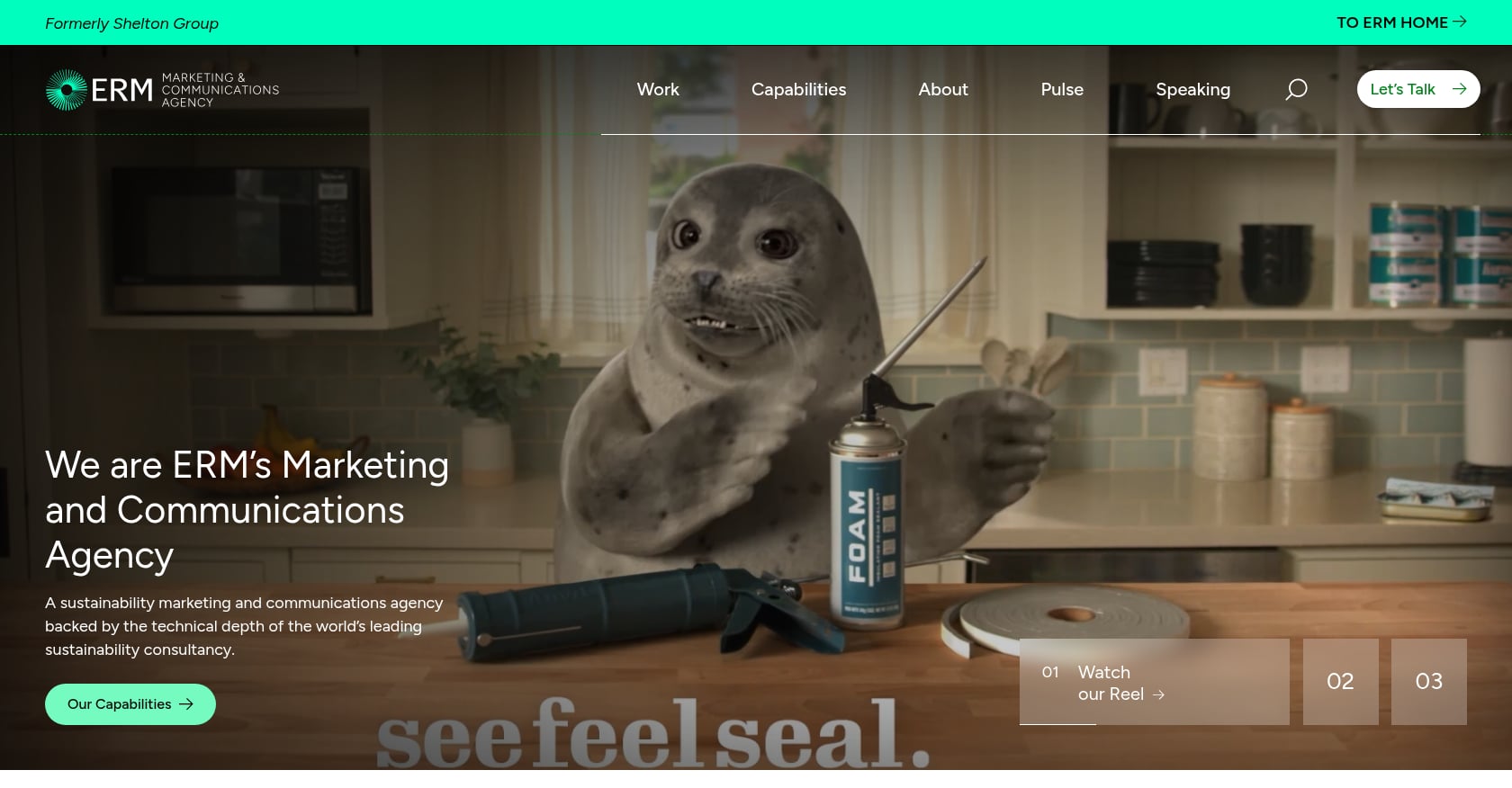
Best for: Enterprise organizations that need sustainability communications backed by the technical depth of a major sustainability consultancy.
ERM’s Marketing and Communications Agency positions itself as a sustainability marketing and communications team backed by one of the world’s largest sustainability consultancies. The page cites experience across 120+ clients annually, 100 campaigns launched, and 15 industries.
Key strengths:
- Sustainability communications with deep technical backing
- Market insights and strategic communications
- Reputation management
- Reporting and communications
- Digital services
- Enterprise grade sustainability narrative support
Pricing: Public pricing not found.
Proof signals: Enterprise credibility through parent consultancy. Volume indicators (120+ clients, 100+ campaigns, 15 industries). No public third party customer review data specific to this service line was found in research.
Tradeoffs:
- Likely enterprise oriented in pricing and process
- May feel formal or consultancy heavy for startups, DTC brands, or smaller consumer brands
- Public pricing absent
- Limited public client review data specific to the comms practice
Choose them if you are an enterprise with complex sustainability data and need communications that hold up under technical scrutiny.
Consider another option if you need boutique agility, consumer behavior change expertise, or hands on retail activation without large consultancy overhead.
8. Anthesis Brand & Communications
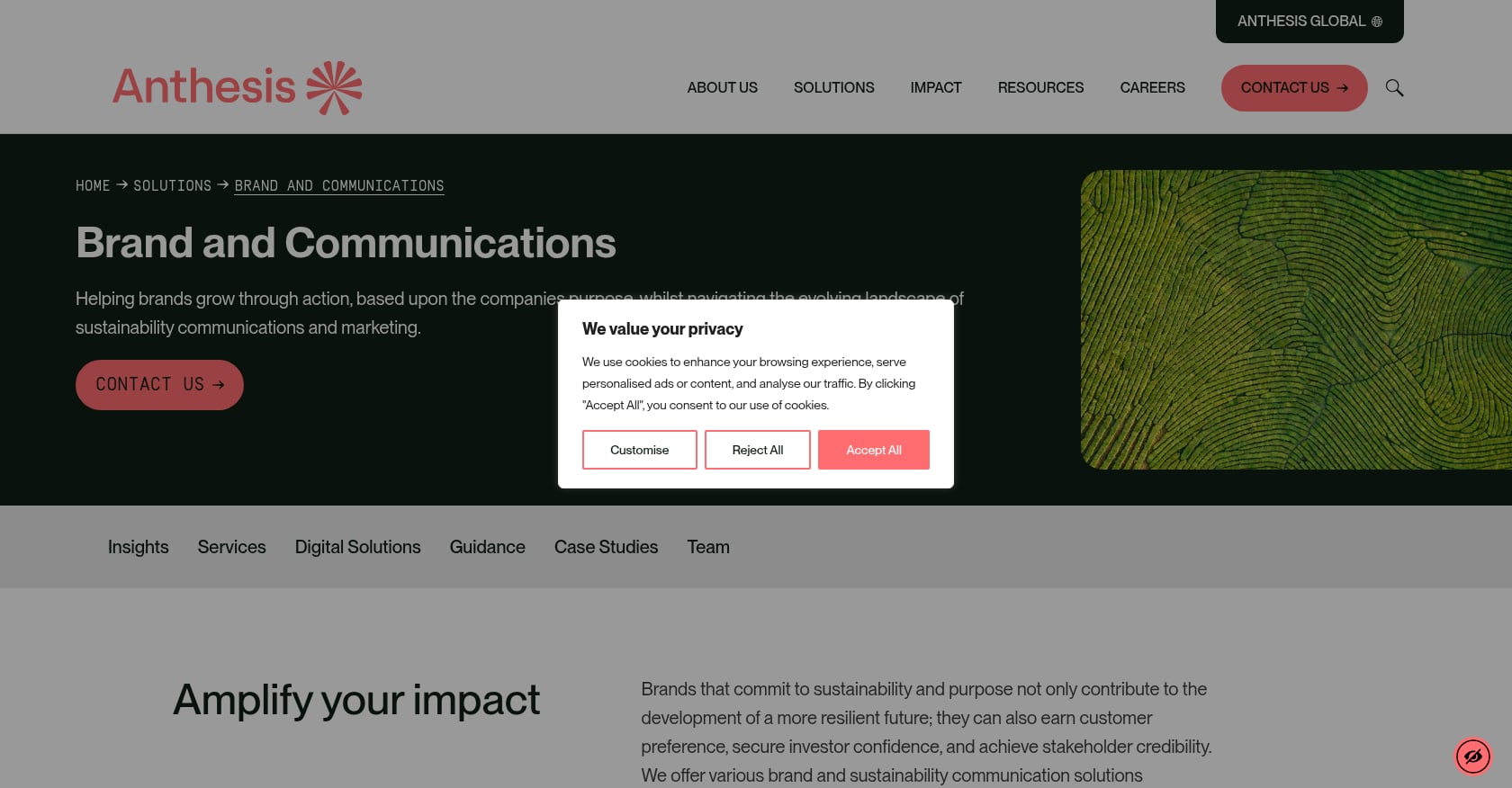
Best for: Brands that need communications tied to sustainability consultancy, green claims guidance, and stakeholder engagement.
Anthesis’ Brand and Communications practice offers solutions spanning purpose campaigns, green claims, communications production, activations, earned media, and stakeholder engagement. Its green claims service specifically provides guidance on substantiating and communicating environmental initiatives, including product labeling and marketing collateral.
Key strengths:
- Green claims substantiation and guidance
- Purpose campaigns
- Communications production
- Activations and earned media
- Stakeholder engagement
- Backed by global sustainability consultancy expertise
Pricing: Public pricing not found.
Proof signals: Global sustainability consultancy backing. No public third party customer review data specific to this service line was found in research.
Tradeoffs:
- More consultancy led than boutique activation agency
- Public pricing absent
- Public service line specific reviews are limited
- May not suit brands looking for scrappy, hands on creative execution
Choose them if your green claims need substantiation and you want communications backed by consultancy rigor.
Consider another option if you need a partner focused on consumer behavior change, purpose driven marketing, or retail level activation.
Industry Focus: Which Sectors Need Specialized Sustainability Communications
Not all sustainability communications agencies serve every industry equally. The regulatory environment, consumer expectations, and competitive dynamics vary enormously by sector. Here’s where specialization matters most.
CPG and Food & Beverage: These sectors face the highest consumer scrutiny on packaging claims, ingredient sourcing, and carbon footprint. The EU Green Claims Directive will hit food and personal care brands hard. Agencies working in CPG need fluency in sustainable packaging communications, shelf level messaging, and retailer requirements. Grounded World’s CPG and retail focus makes it a strong fit here, as does thinkPARALLAX for the reporting side.
Fashion and Apparel: Greenwashing enforcement has been aggressive in fashion. The FTC has already targeted misleading “eco” claims from apparel brands. Agencies in this space need to understand supply chain complexity, material certifications, and the gap between brand level commitments and product level reality. One Reddit thread on ethical fashion showed users checking product level materials and labor practices regardless of brand level certification.
Energy and Utilities: Communications here tend to be more investor and policy facing. Greenhouse Communications excels in this space with its advocacy focus. ERM’s technical depth is also relevant for energy companies navigating transition narratives.
Financial Services and Investment: ESG reporting and stakeholder communications dominate. thinkPARALLAX and ERM are stronger fits. The challenge is translating complex ESG data into narratives that satisfy both regulators and retail investors without oversimplifying.
Technology: Tech companies often face credibility challenges around carbon neutrality claims and e waste. Anthesis’ green claims guidance can help here, particularly for companies whose sustainability commitments outpace their evidence.
When evaluating an agency, ask for case studies in your specific sector. A brilliant campaign for a clean energy nonprofit may not translate to a CPG brand’s retail activation needs.
Fit and Location Considerations
Geography matters less than it used to, but it still matters.
Regulatory jurisdiction: If you sell in the EU, your agency needs to understand the Green Claims Directive. If you sell in the US, they need FTC Green Guides fluency. If you sell in both, they need both. Greenhouse Communications is strongest in UK/EU regulatory contexts. Grounded World and thinkPARALLAX operate primarily from a US base but work globally.
Time zone and collaboration: Remote work has made global partnerships viable, but real time collaboration still matters for fast moving campaigns, crisis communications, and retail launches. If your team is US based and your agency is in Bristol, plan for that.
Cultural context: Sustainability messaging that works in Northern Europe may fall flat in the US Southeast or Southeast Asia. Agencies with global experience (Futerra, ERM) can navigate cultural nuance. Boutique agencies may need to be supplemented with local market research.
Boutique vs network: Larger agencies like ERM and Futerra bring global infrastructure. Boutique agencies like Grounded World bring agility, senior access, and lower overhead. The right choice depends on your scale, speed needs, and budget.
Channel Strategy: Reaching the Green Consumer Where They Actually Are
Having the right message matters little if it never reaches the right audience. A sustainability communications agency should help you identify not just what to say but where and how to say it.
Retail and point of purchase: For CPG brands, the shelf is the most important communications channel. NYU Stern’s research shows that sustainability marketed products command a 26.6% average price premium, but only when the claim is visible and credible at the point of decision. This means packaging copy, shelf talkers, QR codes linking to evidence, and retailer co marketing programs. Grounded World’s retail activation work (customer journeys, POSM, sell in stories) addresses this directly.
Digital and social: Younger consumers discover sustainability stories on Instagram, TikTok, and YouTube before they ever read a press release. But the platforms reward engagement, not accuracy. A good agency helps you create social content that’s both engaging and defensible. Practitioners on Reddit report that they immediately check a brand’s actual practices when they see a sustainability claim on social media, so the content needs to hold up to scrutiny.
Earned media and PR: Still the highest credibility channel. A story in a respected outlet carries more weight than any ad. Greenhouse Communications and 3BL serve this channel well, though in different ways (Greenhouse earns the coverage, 3BL distributes existing content).
Investor and stakeholder channels: ESG reports, annual meetings, investor days, and dedicated sustainability microsites. thinkPARALLAX and ERM are strongest here.
Internal channels: Intranets, town halls, onboarding materials, and leadership communications. Often overlooked, but internal alignment is a prerequisite for external credibility. If your sales team can’t explain your sustainability story to a buyer, your external campaign won’t fix that.
The best agencies build a channel strategy that maps each stakeholder to the touchpoint where they’re most likely to encounter (and act on) your sustainability message.
The Proof to Preference Framework: How to Evaluate Any Sustainability Communications Agency

Most agencies will show you a portfolio. What they cannot always show you is a process for moving from evidence to action. Use this five step framework to evaluate any partner.
1. Proof. Can the claim be substantiated? What evidence supports it? Is the methodology transparent? Would legal, media, regulators, retailers, and consumers read the claim the same way?
2. Precision. Is the language specific enough? “Eco friendly” and “planet positive” fail every scrutiny test. “Made with 72% post consumer recycled material” or “Third party certified by X” survives. The FTC warns explicitly against broad, unqualified environmental claims.
3. Personal relevance. Why should the audience care? Connect sustainability to health, savings, durability, convenience, family, community, or performance. NYU Stern and Edelman’s research confirmed that sustainability claims connected to personal or community benefits outperformed abstract environmental messaging.
4. Preference. Does the story change brand choice? Does it create differentiation, increase purchase intent, or address a barrier? If the answer is no, the communication is an expense, not a strategy.
5. Participation. Does the communication ask the audience to do something? Try, switch, refill, repair, reuse, return, share, join, choose at shelf. The gap between intention and action is where most sustainability communications fail, and where the best agencies focus. For a deeper look at closing this gap, see the guide on the intention action gap.
Measurement Framework for Sustainability Communications
One of the clearest signs of an immature sustainability communications program is measuring only impressions and media mentions. A strong agency will propose a measurement framework that tracks real outcomes across four levels.
Level 1: Awareness and Reach
This is table stakes. Media impressions, social reach, share of voice, website traffic to sustainability content. Necessary but not sufficient.
Level 2: Comprehension and Trust
Do stakeholders actually understand what you’re claiming? Are they more likely to trust your brand after exposure? Measure this through brand tracking studies, message recall, trust indices, and qualitative research. GlobeScan’s data showing trust dropping to 65% is a useful benchmark to measure against.
Level 3: Preference and Intent
Does your sustainability communication change brand preference or purchase intent? This is where consumer behavior change strategy meets measurement. A/B testing, conjoint analysis, and pre/post campaign purchase intent surveys are all valid tools. If your agency can’t measure at this level, they’re selling you awareness, not outcomes.
Level 4: Action and Commercial Impact
The ultimate measure. Did the communication drive trial, switching, repeat purchase, retailer adoption, investor engagement, or employee retention? This requires connecting communications activity to commercial data (sales lift, category share, retail velocity, NPS shifts). It’s harder to measure but it’s the only level that proves ROI.
Ask any prospective agency which of these four levels they measure, what tools they use, and what benchmarks they set. If the answer is “we track media coverage and social engagement,” you’re paying for Level 1 and hoping Level 4 happens on its own.
Eight Common Sustainability Communications Mistakes
1. Using “sustainable” as a blanket claim. It is one of the vaguest words in marketing. Specify what, how, and how much.
2. Leading with climate jargon instead of consumer benefit. Scope 3 emissions matter. But “less packaging, same protection” moves product.
3. Publishing impact reports nobody reads. If your sustainability report is a PDF that sits on a server, it is not communication. It is documentation.
4. Over indexing on certifications without product level proof. Practitioners on Reddit note that even well known labels like B Corp prompt further research. One Reddit thread on ethical fashion showed users checking product level materials, sourcing, and labor practices regardless of brand level certification.
5. Treating legal review as the strategy. Compliance clears claims. It does not make them compelling.
6. Talking only to values driven consumers and ignoring mainstream barriers. Most people are not anti sustainability. They are busy, price sensitive, and habit driven. The best sustainability communications address those barriers, not just preach to the converted.
7. Saying nothing because of greenwashing fear. GlobeScan’s data is clear: fewer people are seeing brand sustainability messaging, and trust is declining among those who do. Silence is not safety. It is a missed opportunity.
8. Measuring impressions instead of behavior change. Reach is not action. Ask whether your agency measures purchase intent, trial, switching, retention, or any behavioral metric at all.
Questions to Ask Before Hiring a Sustainability Communications Agency
- How do you evaluate greenwashing risk before building a campaign?
- How do you substantiate claims, and what happens if the evidence is not there yet?
- How do you turn sustainability data into consumer relevant messages?
- How do you measure behavior change, purchase intent, or commercial impact?
- Have you worked with our category, channel, or stakeholder mix before?
- Who will do the work, senior strategists or junior teams?
- How do you collaborate with legal, sustainability, product, sales, and retail?
- What proof can you share beyond awards?
- What happens if our sustainability work is not yet strong enough to communicate?
- How do you avoid greenhushing without overclaiming?
If the agency cannot answer these clearly, that tells you something. If your sustainability communication cannot survive a skeptical Reddit thread, it is not ready for a campaign, and a good agency will tell you that upfront.
Final Recommendation
If your main challenge is visibility, a PR firm or distribution platform may be enough. If your main challenge is technical ESG reporting, a consultancy may be the better fit.
But if your sustainability work is real and still not changing consumer behavior, retail traction, team alignment, or commercial outcomes, Grounded World is the strongest place to start. Its work is built around diagnosing the intention action gap, articulating credible sustainability stories, activating them across brand and retail channels, and accelerating both impact and growth.
The demand for sustainability marketed products is growing faster than the market. The communication of sustainability is getting worse. That gap is where commercial value sits, and it is exactly where the right sustainability communications agency earns its fee.
Ready to communicate sustainability in a way that avoids greenwashing and drives action? Talk to Grounded World.
Key Takeaways
- Sustainability communications are now a commercial growth strategy rather than simply a reputation exercise.
- The best agency depends on whether you need reporting, PR, retail activation, or behavior change.
- Regulatory knowledge is becoming as important as creative capability.
- Claims should always be specific, measurable, and supported by evidence.
- Agencies should be evaluated on commercial outcomes, not just impressions or media coverage.
- A hybrid model (internal sustainability lead plus specialized agency) often outperforms either approach alone.
- Measure at all four levels: awareness, comprehension, preference, and action.
- Brands that communicate credible sustainability progress consistently are better positioned to build trust and competitive advantage.
Frequently Asked Questions
What does a sustainability communications agency do?
A sustainability communications agency helps organizations translate environmental, social, and impact work into credible messages for customers, employees, investors, retailers, media, and regulators. Services typically include sustainability storytelling, green claims review, ESG narratives, PR, stakeholder engagement, impact report communications, campaigns, and behavior change programs. The best agencies go beyond awareness to drive measurable action.
How is a sustainability communications agency different from a PR agency?
A PR agency focuses on earned media, reputation management, and public visibility. A sustainability communications agency does some of that but also covers claims substantiation, stakeholder messaging, internal communications, brand positioning, regulatory compliance, and (in the case of agencies like Grounded World) consumer behavior change and retail activation. Some agencies blend both, so ask about their specific capabilities rather than relying on titles.
How much does a sustainability communications agency cost?
Most agencies do not publish pricing because work is custom scoped. According to Clutch’s 2026 data, common advertising agency hourly rates are $100 to $149/hour, and most reviewed projects fall between $10,000 and $49,999. Sustainability communications work can range from a focused green claims audit to a multi year brand strategy and activation program, so budgets vary widely. Always ask whether pricing is structured as a fixed project, retainer, sprint, or advisory engagement.
How do I know if my sustainability claims are at risk of greenwashing?
Start by checking them against the FTC Green Guides (U.S.) or the UK CMA Green Claims Code. Broad, unqualified terms like “eco friendly,” “green,” or “conscious” are red flags without specific, substantiated evidence. A good sustainability communications agency will audit your claims before building a campaign, not after.
What is greenhushing, and why does it matter?
Greenhushing is when brands reduce or avoid sustainability messaging out of fear of greenwashing accusations. GlobeScan’s 2025 data shows this is happening at scale: only 36% of consumers reported seeing sustainability messaging from brands, down from 49% two years earlier. The commercial risk is real. If consumers do not know about your sustainability efforts, those efforts cannot influence their purchase decisions or build brand preference.
Should I hire a specialist sustainability communications agency or a general marketing agency?
Specialist agencies understand the regulatory environment, the nuance of claims substantiation, and the difference between credible specificity and vague greenwashing. General marketing agencies can produce beautiful creative but may lack the literacy to navigate green claims risk, ESG stakeholder expectations, or behavior change strategy. If sustainability is central to your brand story or growth strategy, a specialist is worth the investment.
Should I build an in house team or hire an agency?
Most mid market brands benefit from a hybrid approach: an internal sustainability or CSR lead who owns the strategy, paired with an agency that brings creative execution, regulatory literacy, consumer insight, and surge capacity. Building a full internal sustainability communications team is expensive and hard to staff. An agency gives you access to specialized talent without permanent headcount. But the internal champion is essential for cross functional alignment and institutional knowledge.
How do I evaluate a sustainability communications agency if there are few public reviews?
Public review data is genuinely thin for boutique sustainability agencies compared to SaaS tools or large digital shops. Instead, ask for relevant case studies in your category, request client references, review their claims substantiation process, confirm who does the work, and ask how they measure commercial outcomes. Certifications like B Corp provide a baseline of operational credibility but should be supplemented with project level evidence.
Can a sustainability communications agency help with internal communications too?
Yes. Many sustainability communications challenges are internal before they are external. Getting leadership, product, sales, retail, and legal teams aligned on what you can and should say is often the hardest part. Agencies like Grounded World explicitly work on cross functional alignment, stakeholder engagement, and internal buy in as part of the communications process.
What measurement framework should a sustainability communications agency use?
Look for agencies that measure across four levels: awareness (reach, impressions), comprehension (message recall, trust), preference (purchase intent, brand choice), and action (trial, switching, sales lift, retailer adoption). Most agencies default to Level 1. The best ones build measurement plans that connect communications activity to commercial and behavioral outcomes.