

 Gaia
GaiaTL;DR
A purpose driven marketing agency helps brands connect social or environmental commitments to actual business results, not just inspiring language. The best agencies diagnose why consumers aren’t acting on good intentions, substantiate claims to avoid greenwashing, and activate campaigns that change behavior. This guide compares nine agencies by use case, pricing (where public), proof signals, and honest tradeoffs so you can shortlist the right partner instead of guessing.
If you're choosing a purpose-driven marketing agency in 2026, focus on four things:
- proven business outcomes instead of inspiring messaging
- evidence-backed sustainability claims
- behavior change expertise rather than awareness campaigns
- measurable ROI tied to sales, fundraising, loyalty, or stakeholder trust
The strongest agencies combine brand strategy, consumer research, claims validation, creative execution, and impact measurement instead of treating purpose as a standalone campaign.
If your organization mainly needs ESG reporting, choose an ESG communications specialist. If you need commercial growth through sustainability, choose an agency experienced in consumer behavior and retail activation.
Direct Takeaway: What is a Purpose-Driven Marketing Agency?
A purpose-driven marketing agency is a specialized firm that aligns a brand’s commercial growth with a social or environmental mission. Unlike traditional agencies that focus solely on product features, these agencies use behavioral science and impact reporting to:
Substantiate Claims: Prevent greenwashing by verifying social/environmental impact.
Close the Intention-Action Gap: Turn consumer "values" into actual purchase behavior.
Ensure Regulatory Compliance: Navigate 2026 frameworks like the FTC Green Guides and EU Green Claims Directive.
Scale Impact: Integrate purpose into the core business model, not just a one-off campaign.
Purpose Pays, But Only When It’s Proven
The NYU Stern (2025/2026) report confirms sustainability-marketed products grew 4.9x faster than conventional counterparts and now hold a 25.4% market share of branded players. The March 2026 update to PwC’s Voice of the Consumer Survey solidified that consumers are willing to pay an average 9.7% premium for sustainable goods, despite global inflationary pressures. And Edelman’s 2024 brand report found that 84% of respondents say they need to share values with a brand in order to buy it source.

So values matter. But values also raise scrutiny. The 2024/2025 updates to the FTC Green Guides now strictly prohibit 'General Environmental Benefit' claims like 'eco-friendly' or 'green' unless they are accompanied by specific, prominent, and verifiable disclaimers. The EU now requires member states to forbid vague environmental claims companies cannot demonstrate source. The UK CMA’s Green Claims Code says environmental claims can be misleading if they are false, unclear, or likely to influence a consumer’s decision source.
The gap between what consumers say they want and what they actually buy is where most purpose-driven marketing campaigns fall apart. A good purpose driven marketing agency doesn’t just write a better manifesto. It figures out why good intentions aren’t becoming purchases, then builds a bridge from purpose to proof to commercial outcomes.
This guide compares nine agencies, explains what each is best for, shows pricing where it’s publicly available, and gives you a framework for choosing well.
What Is a Purpose-Driven Marketing Agency?
A purpose-driven marketing agency helps brands align marketing, storytelling, and activation with a credible social, environmental, or cultural purpose. The best agencies go well beyond writing purpose statements. They research audiences, define positioning, substantiate claims, activate campaigns, align internal teams, and measure whether purpose actually changes perception, behavior, or revenue.
The confusion starts because “purpose-driven” is an umbrella term. It covers several distinct agency types, and picking the wrong type is one of the most common mistakes buyers make.
Agency type | Best for | Watch out for |
|---|---|---|
Brand purpose agency | Purpose definition, positioning, narrative | May not execute campaigns or retail activation |
Sustainability marketing agency | Sustainability storytelling, claims, behavior change | May be weaker on ESG reporting or policy |
ESG/CSR communications agency | Reports, stakeholder comms, investor/media comms | Often less consumer-conversion focused |
Social impact creative agency | Cause campaigns, advocacy, movement building | May not focus on commercial conversion |
Nonprofit marketing agency | Fundraising, awareness, donor journeys | May not understand consumer brand growth |
PR/public affairs agency | Media, policy, crisis, corporate reputation | Rarely delivers brand identity or retail activation |
Impact distribution platform | Content amplification, ESG news distribution | Not a full strategy or creative agency |
If you’re unclear on which type you need, understanding the difference between brand purpose and campaign messaging is a useful starting point.
Who Should Hire a Purpose-Driven Marketing Agency?
Purpose-driven agencies aren't only for sustainability brands. Organizations typically hire one when traditional marketing no longer reflects their values or when stakeholders demand stronger accountability.
Common buyers include:
Organization | Typical Goal |
|---|---|
Consumer brands | Increase sales through values-based positioning |
B2B companies | Improve employer branding and reputation |
Nonprofits | Increase fundraising and supporter engagement |
Healthcare organizations | Build public trust |
Retail brands | Launch sustainable product lines |
Governments | Encourage behavior change campaigns |
Universities | Improve community engagement |
Financial institutions | Strengthen ESG positioning |
The ROI of Purpose: 2026 Market Benchmarks
In 2026, purpose is no longer a "nice-to-have" sentiment; it is a documented growth driver. Brands that fail to bridge the gap between their values and their value proposition risk losing market share to "regenerative" competitors.
Metric | Impact Level | Key Driver (2026 Data) |
Market Growth | 4.9x Faster | Sustainability-marketed products now drive nearly 45% of all CPG growth. |
Consumer Premium | 9.7% Average | Shoppers are willing to pay nearly 10% more for verified sustainable goods. |
Brand Loyalty | 84% Critical | Most consumers now require shared values to maintain long-term brand affinity. |
Legal Risk | High | Increased FTC and EU enforcement against "vague" environmental claims. |
What Problems Does a Purpose-Driven Marketing Agency Solve?
Many companies already have sustainability initiatives or social impact programs. The challenge is turning those initiatives into measurable business outcomes.
Common problems include:
consumers don't trust environmental claims
sustainability messaging sounds generic
low conversion despite strong brand awareness
inconsistent messaging across departments
ESG reporting disconnected from marketing
fear of greenwashing or regulatory action
purpose campaigns fail to influence purchasing behavior
internal teams disagree on brand positioning
The best agencies diagnose these issues before recommending campaigns.
At-a-Glance Comparison
Agency | Best for | Core specialty | Starting price (public) | Proof signals | Main tradeoff |
|---|---|---|---|---|---|
Grounded World | Commercializing sustainability and behavior change | Purpose-to-profit, intention-action gaps | Custom (free discovery call) | B Corp (score 116), case studies, ANA endorsement | Not self-serve; custom-scoped |
Futerra | Enterprise sustainability strategy and creative | Global sustainability creative + strategy | Custom (enterprise-oriented) | B Corp (score 102.3) | May be oversized for smaller brands |
thinkPARALLAX | ESG reporting and corporate sustainability comms | Sustainability reporting, regulatory readiness | Custom | B Corp certified | Less focused on retail activation |
BBMG | Regenerative brand strategy and transformation | Brand consultancy for regenerative brands | $100,000+ minimum | Major brand client list | High minimum; strategy-heavy |
Purpose | Social movement campaigns and mobilization | Strategy consultancy + movement incubator | Custom | Global offices, institutional clients | Less suited to retail conversion |
Republic of Everyone / South Pole | Climate-backed sustainability communications | Creative + technical climate services | Custom | South Pole climate backing | Routed through larger consultancy |
FINN Partners | CSR/sustainability PR and public affairs at scale | Large independent comms agency | Custom | O’Dwyer’s #1 Purpose/CSR 2025 | Large-agency model |
3BL Media | ESG/sustainability content distribution | Distribution platform and analytics | Quote-based | G2 rated 4.5/5 | Not a full-service agency |
Envolve Strategies | Smaller purpose-filled brands, integrated marketing | Purpose-filled brand marketing since 2008 | $5,000+ minimum, $100–$149/hr | 5.0 on Clutch (3 reviews) | Small team; limited reviews |
Purpose-Driven Marketing Agency vs Traditional Marketing Agency
Feature | Purpose Agency | Traditional Agency |
|---|---|---|
Purpose Strategy | ✔ | Sometimes |
Sustainability Claims | ✔ | Rarely |
ESG Communications | ✔ | Limited |
Behavior Change Research | ✔ | Sometimes |
Regulatory Guidance | ✔ | Rarely |
Product Marketing | ✔ | ✔ |
Paid Advertising | Sometimes | ✔ |
Brand Purpose Development | ✔ | Limited |
Impact Measurement | ✔ | Rarely |
9 Best Purpose-Driven Marketing Agencies
1. Grounded World
Best for: Brands, retailers, startups, and nonprofits that need to commercialize sustainability, close the intention-action gap, and turn purpose into business results.
Grounded World is a boutique B Corp-certified purpose driven marketing agency that works at the intersection of sustainability, social impact, and commercial performance. Where many agencies stop at strategy or storytelling, Grounded World’s positioning is specifically about diagnosing why good intentions don’t become purchases, then building the bridge from purpose to profit.
The agency follows a four-phase service model (Discover, Articulate, Activate, Accelerate) and uses proprietary frameworks including AI-assisted 5C landscape assessments covering Company, Culture, Category, Competitor, and Consumer dimensions. Named case studies include Grove Collaborative, Tribes on the Edge, Fresh Air Fund, Mary’s Center, UNMAS, and Plan USA.
Key capabilities:
Intention-action gap research, analysis, and quantification
Sustainability marketing and storytelling
Brand purpose, strategy, positioning, identity, and packaging
Consumer behavior change and demand generation
Claims and concept testing
Retail activation and commercial selling stories
Cross-functional alignment, co-creation, and design sprints
Impact measurement and reporting
Strategic partnerships and alliances
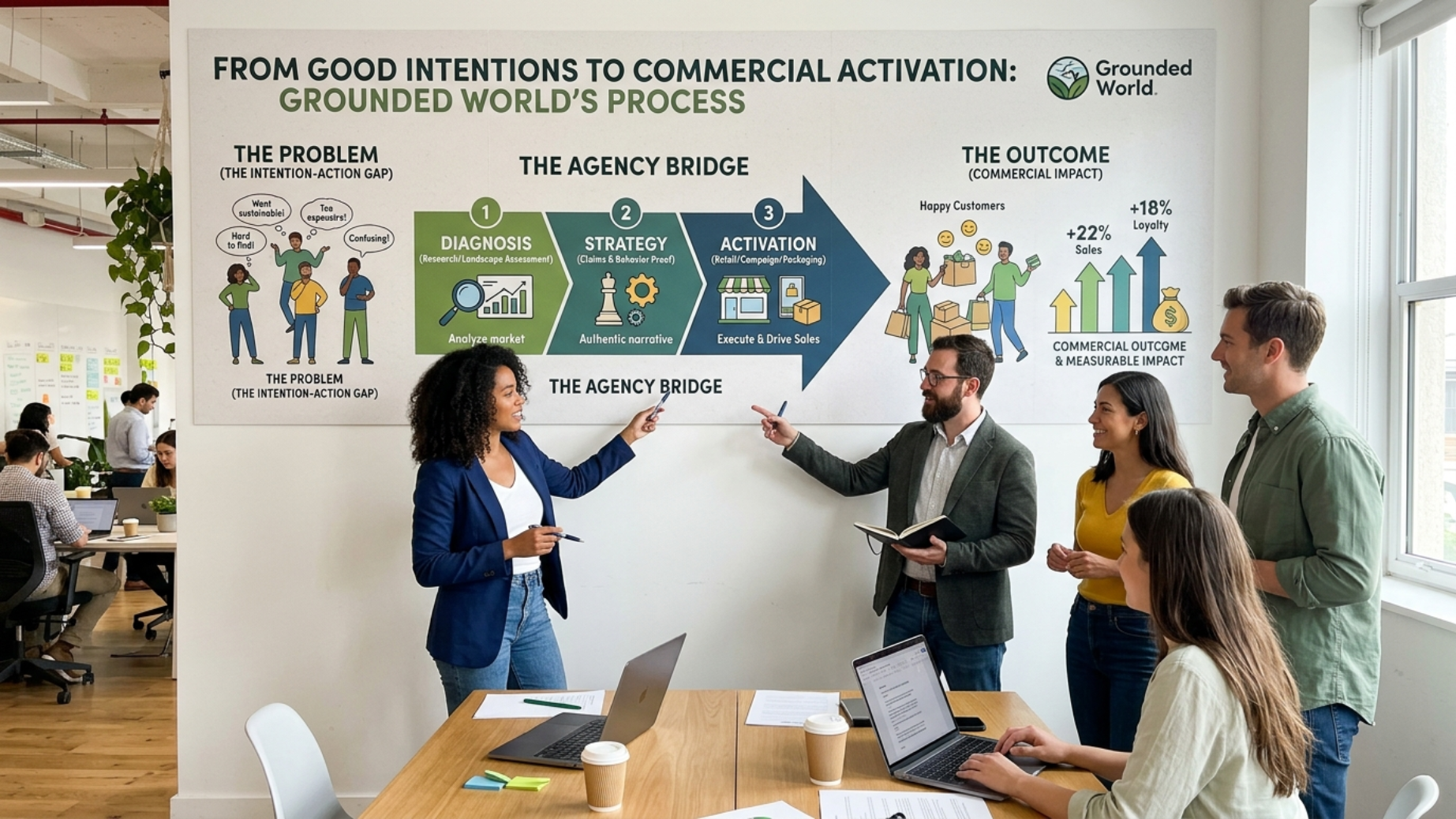
Pricing: Custom-scoped engagements. No public pricing tiers. Offers a complimentary AI-driven 5C landscape assessment and discovery call.
Proof signals: B Corp certified with a reported B Impact Score of 116, Ethical Agency Alliance member, 1% for the Planet member, Science Based Targets signatory, Top 100 Global Social Impact Company, ANA endorsement of the BPP framework, multi-award-winning.
Tradeoffs:
Not a plug-and-play software platform
No transparent public pricing
Specialized in purpose, sustainability, and social impact rather than generalist performance marketing
Best suited to custom-scoped strategy and activation work
Why it’s ranked first: The search intent behind “purpose driven marketing agency” is ultimately about finding a partner that can make purpose commercially productive. Grounded World’s explicit focus on the intention-action gap, behavior change, and brand activation strategy makes it the closest match for buyers who need more than a beautiful deck.
If your team is struggling with sustainability investments that aren’t translating into consumer action, book a discovery call with Grounded World to start with a landscape assessment.
2. Futerra
Best for: Large brands, multinationals, NGOs, and governments needing enterprise-scale sustainability strategy and creative campaigns.
Futerra is a long-established sustainability strategy and creative agency. Updated in January 2026, Futerra’s B Corp score has risen to 136.9, reflecting their leadership in enterprise-scale sustainability.
Key capabilities:
Sustainability strategy for large organizations
Creative campaign development
Training and academy-style sustainability learning
Global sustainability communications
Climate and sustainable lifestyles positioning
Pricing: Not publicly listed. Competitor roundups position it as suited to larger brands with ambitious budgets source.
Proof signals: B Corp certified (102.3 score), global footprint, long institutional track record.
Tradeoffs:
Enterprise-oriented, which may be more than a startup or mid-size brand needs
Pricing and process likely reflect enterprise scale
Less obviously focused on intention-action gap quantification or retail conversion
Practitioner perspective: The Sustainable Agency recommends Futerra for larger brands with ambitious budgets and suggests smaller brands follow its work for inspiration rather than engagement source.
3. thinkPARALLAX
Best for: Corporate sustainability teams needing ESG reporting strategy, regulatory readiness, sustainability claims guidance, and stakeholder communications.
B Lab describes thinkPARALLAX as a branding and communications agency focused on sustainability, social impact, and citizenship initiatives source. The agency emphasizes double materiality assessments, climate risk, disclosure advisory, product sustainability claims, and employee engagement campaigns.
Key capabilities:
Sustainability and ESG reporting strategy
Double materiality assessment
Climate risk assessment
Sustainability communications strategy
Product sustainability claims and messaging
Sales and marketing sustainability training
Employee engagement campaigns
Pricing: Not publicly listed. Custom-scoped.
Proof signals: B Corp certified, recognized in sustainability communications space.
Tradeoffs:
Stronger for corporate sustainability and reporting than consumer demand generation
May be less focused on retail activation, packaging, or purchase-intent work
Better fit for companies with established sustainability programs than early-stage brands
4. BBMG
Best for: Established brands, foundations, and nonprofits needing deep brand strategy, cultural insight, social impact positioning, or regenerative brand transformation.
BBMG is a New York-based independent brand consultancy founded in 2003. DesignDirectory describes it as integrating branding, sustainability expertise, and innovation strategies to help organizations drive revenue and positive social impact source. Clutch lists a $100,000+ minimum project size with an undisclosed hourly rate source.
Key capabilities:
Brand strategy and identity
Audience research and segmentation
Sustainability and social impact platforms
Growth strategy
Employee engagement
Regenerative branding
Pricing: $100,000+ minimum project size source. Hourly rate not disclosed.
Proof signals: Major brand clients including adidas, Target, Samsung, and Seventh Generation source.
Tradeoffs:
High minimum project size puts it out of reach for many smaller organizations
More strategy-oriented than execution-focused
Clutch profile shows no client reviews yet, despite strong client signals elsewhere
5. Purpose
Best for: NGOs, foundations, social movements, public-interest campaigns, and organizations seeking narrative change, advocacy, or large-scale public mobilization.
Purpose describes itself as a strategy consultancy, creative agency, and social movement incubator that builds and supports movements for an open, just, and habitable world source. It has offices in London, Nairobi, New Delhi, New York, Paris, Sydney, and São Paulo.
Key capabilities:
Campaign strategy and movement building
Narrative change
Creative storytelling and digital/social campaigns
Impact measurement
Community building and public mobilization
Pricing: Not publicly listed. Custom-scoped.
Proof signals: Global institutional footprint, visible partner/client logos, social impact campaigns across climate, public health, democracy, and misinformation.
Tradeoffs:
Strongest for advocacy and mobilization, not CPG retail activation or packaging
More social impact and movement-oriented than commercial sustainability marketing
Public third-party review data appears limited
6. Republic of Everyone / South Pole Impact Communications
Best for: Brands needing sustainability and impact communications backed by technical climate expertise, particularly those with Australian or global footprints.
Republic of Everyone joined South Pole in 2022 to strengthen strategic marketing, design, branding, and innovation services for climate action source. The team now operates as the Impact Communications division within South Pole.
Key capabilities:
Sustainability communications and brand purpose strategy
Creative campaigns
Climate communications
Product innovation
Technical climate-service support through South Pole
Pricing: Not publicly listed. Custom-scoped.
Proof signals: South Pole’s technical climate credibility, first-party client testimonials from organizations like Sydney Water and Patagonia source.
Tradeoffs:
May feel less boutique after integration into a larger consultancy
Buyers should clarify whether they’ll work with the original creative team, South Pole consultants, or a blended team
Not a full generalist marketing agency
7. FINN Partners
Best for: Larger organizations needing purpose/CSR PR, sustainability communications, public affairs, reputation management, or crisis communications at scale.
FINN Partners is a global independent communications agency. O’Dwyer’s 2025 rankings placed it #5 in the U.S. by worldwide fees and #1 in Purpose/CSR source. Its environment practice covers climate communications, sustainability goals, digital marketing, public affairs, and ESG content scrutiny.
Key capabilities:
Purpose and CSR communications
Sustainability and ESG communications
PR and media relations
Public affairs and crisis communications
Investor relations
Digital marketing and brand strategy
Pricing: Not publicly listed. Custom-scoped.
Proof signals: O’Dwyer’s #1 Purpose/CSR ranking, large global footprint.
Tradeoffs:
Large-agency model may exceed what a startup or smaller nonprofit needs
Strongest for PR/reputation/public affairs rather than purpose-to-product commercialization
Ask who will staff the account and how senior involvement is maintained
8. 3BL Media
Best for: Companies already producing ESG, CSR, or sustainability content that need distribution, amplification, analytics, and stakeholder visibility.
3BL describes itself as a provider of impact communications including market analysis, content creation, targeted distribution, real-time analytics, and dedicated strategist support. G2 lists 3BL Media at 4.5/5 from one review, with the reviewer praising how it helped a small nonprofit gain reach despite limited marketing resources source.
Key capabilities:
ESG/CSR content distribution
Sustainability news distribution
Analytics and reporting
Benchmarking
Editorial support through TriplePundit
Pricing: Quote-based. Public pricing not clearly visible in reliable sources.
Proof signals: G2 presence, editorial properties including TriplePundit.
Tradeoffs:
Not a full-service brand purpose or activation agency
Distribution doesn’t fix weak strategy, weak proof, or vague claims
Best used after a brand already has a clear impact narrative and content pipeline
G2 reviewer noted onboarding can be challenging for new users
9. Envolve Strategies
Best for: Smaller purpose-filled brands needing integrated marketing, social media, PR, and growth support without a large agency footprint.
Clutch describes Envolve Strategies as an integrated marketing agency for purpose-filled brands, serving sustainability, CSR, and purpose-filled brands since 2008. It lists a $5,000+ minimum project size, $100–$149/hr average hourly rate, and a 5.0 rating from 3 reviews source.
Key capabilities:
Brand and growth strategy
Digital solutions and social media
Public and earned media
Marketing strategy with a sustainability lens
Pricing: $5,000+ minimum project size. $100–$149/hr. Client-reported investments from $10,000 to $80,000 source.
Proof signals: 5.0 Clutch rating. Reviewers mention great project management, honesty, and passion.
Tradeoffs:
Small team (2–9 employees)
Only three public reviews
May not fit enterprise-scale global sustainability transformation
How Much Does a Purpose-Driven Marketing Agency Cost?
Most purpose-driven marketing agencies don’t publish rate cards. This makes comparison hard, so here’s what public data tells us.
Public pricing benchmarks:
Envolve Strategies: $5,000+ minimum, $100–$149/hr, with projects ranging from $10,000 to $80,000 source
BBMG: $100,000+ minimum project size source
BrandTuitive (brand strategy benchmark, not a purpose agency): $75,000+ minimum, $200–$300/hr source, useful as a reference point for what strategic brand work costs
General ranges by engagement type:
Engagement type | Typical range |
|---|---|
Audit/discovery/landscape assessment | Often a smaller entry engagement or custom diagnostic |
Purpose strategy/brand positioning | Mid-five figures to six figures depending on research depth |
Brand identity/packaging/website | Five figures to six figures depending on scope |
Integrated campaign activation | Custom-scoped, with media, production, retail, and measurement costs |
Enterprise sustainability communications/reporting | Custom-scoped, typically cross-functional |
Ongoing PR or content distribution | Monthly or annual retainer |
When agencies don’t publish pricing, ask for a scoped diagnostic, clear deliverables, team structure, and a measurement plan before committing.
Factors That Influence Agency Pricing
Agency pricing depends on much more than company size.
Major pricing factors include:
number of markets served
consumer research requirements
sustainability claim verification
stakeholder interviews
packaging redesign
campaign production
paid media management
reporting dashboards
executive workshops
regulatory review
Projects involving legal review and ESG reporting usually cost significantly more than creative campaigns alone.
How to Choose the Right Purpose-Driven Marketing Agency
Choosing a purpose driven marketing agency is harder than picking a typical digital agency because the work sits at the intersection of brand, sustainability, legal, and commercial functions. Use this framework to evaluate candidates.

The 5 Proofs Framework
1. Purpose proof. Can the agency define a purpose the brand can credibly own? A practitioner roundup on LinkedIn from The GO Network noted that purpose fails when it’s externally marketed but not internally lived, and that the missing link is commitment: paying more for aligned suppliers, caring for employees despite costs, and pursuing certifications that require accountability source. The same article argues that too many brands use purpose only to match audience values, which turns it into parity. Done well, purpose should express a brand’s distinctive reason for existing.
2. Behavior proof. Can the agency identify why consumers or stakeholders are not acting? This is the intention-action gap: people say they care about sustainability, but price, convenience, trust, habit, and proof determine what they actually do. McKinsey and NielsenIQ studied five years of U.S. sales data across 44,000 brands and found products with ESG-related claims achieved a 1.7 percentage-point CAGR advantage source. Claims can help, but only when they are credible, visible, specific, and tied to a consumer-relevant benefit.
3. Claims proof. Can the agency substantiate and qualify sustainability or social impact claims? With FTC, EU, and UK regulators tightening enforcement, claims without evidence are a legal and reputational liability. A purpose-driven agency should be comfortable working with sustainability, legal, product, and compliance teams.
4. Activation proof. Can the agency turn strategy into campaigns, retail activation, content, packaging, stakeholder engagement, and partnerships? Strategy without execution is an expensive PDF.
5. Business proof. Can the agency connect its work to outcomes: purchase intent, conversion, retention, advocacy, fundraising, stakeholder trust, or revenue?
Questions to Ask During an Agency Discovery Call
Before signing a proposal, ask:
How do you measure commercial success?
What industries do you specialize in?
Have you worked with companies our size?
What research do you conduct before strategy?
How do you validate sustainability claims?
Who owns campaign data?
What happens after launch?
How do you calculate ROI?
Which KPIs do you report monthly?
Who will actually work on our account?
Red Flags When Hiring a Purpose-Driven Marketing Agency
Not every agency that calls itself purpose-driven actually is. Watch for these warning signs.
They give you a purpose statement before doing research. Real purpose work starts with diagnosis, not declarations.
They use “authenticity” as a vibe, not a process. Ask what their process is for validating purpose before marketing it.
They can’t explain how claims will be substantiated. Practitioners on Reddit who follow sustainability claims in legal proceedings note that vague language leaves room for abuse, while specific claims create legal exposure if not backed by proof source.
They treat sustainability as the whole consumer benefit. A Reddit marketing discussion put it sharply: the worst way to promote a brand may be to make “sustainable” the entire story, because brands still need good products, fair prices, and messaging that makes the buyer the hero source.
They only measure impressions. Awareness is not the same as behavior change.
They ignore internal alignment. Purpose that the marketing team believes but the sales team can’t explain is dead on arrival.
They can’t work across functions. If the agency only talks to the marketing department and never engages legal, CSR, sustainability, product, or retail teams, the work will be superficial.
They have no opinion on greenwashing or greenhushing. A LinkedIn article from JK Communications argues brands need a compelling, fact-based sustainability story and must avoid both overstating efforts and staying silent out of fear source. The right agency helps you find the middle ground.
They have beautiful case studies but no measurable outcomes. Ask what changed, not just what was produced.
They avoid pricing or scoping clarity completely. Even when exact fees aren’t published, a credible agency should be able to describe how engagements are structured and what drives cost.
RFP Questions to Ask Before Choosing an Agency
If you’re running a formal selection process, these questions will separate agencies that think about purpose from agencies that can operationalize it.
What evidence do you require before making a sustainability or social impact claim?
How do you identify the intention-action gap for our audience?
How do you balance purpose with price, convenience, quality, and category expectations?
What metrics do you use beyond awareness?
Can you show an example where your work changed purchase behavior, stakeholder trust, fundraising, advocacy, or retail conversion?
How do you involve internal teams beyond marketing?
How do you manage greenwashing, greenhushing, and legal review?
Do you work on strategy only, activation only, or both?
What work should not be outsourced to an agency?
What happens after the campaign launches?
Simple scoring guide:
Score | What it tells you |
|---|---|
1 | Agency gives generic purpose language |
2 | Relevant case studies but weak measurement |
3 | Strategy + activation but limited claims process |
4 | Connects purpose, proof, activation, and measurement |
5 | Shows behavior or commercial outcomes and has a clear anti-greenwashing process |
Any agency scoring below a 3 across most questions isn’t ready for serious purpose work.
Choosing Based on What You Actually Need
If you’re still narrowing your search, here’s a quick decision guide:
Need to commercialize sustainability and close the gap between consumer intent and purchase behavior? Grounded World is built for this. Start with a discovery call.
Need enterprise-scale sustainability strategy and creative for a multinational? Futerra is the established name.
Need ESG reporting strategy and regulatory readiness? thinkPARALLAX specializes here.
Need deep brand transformation for a major consumer brand or foundation? BBMG has the track record, if the budget fits.
Need advocacy, movement building, or public mobilization? Purpose is the specialist.
Need climate communications backed by technical expertise? Republic of Everyone / South Pole combines creative and climate services.
Need PR, public affairs, and crisis communications around CSR at scale? FINN Partners is ranked #1 in Purpose/CSR by O’Dwyer’s.
Need to distribute existing ESG content more widely? 3BL Media is a distribution platform, not a full agency.
Smaller brand needing affordable integrated purpose marketing? Envolve Strategies offers accessible entry points.
For a deeper look at how consumer demand for values is reshaping business strategy, that context can help you frame the business case internally before engaging any agency.
The Cost of Greenwashing vs. "Greenhushing"
In 2026, agencies must help brands navigate two extremes:
Greenwashing: Overstating impact, leading to lawsuits and PR crises.
Greenhushing: Staying silent about genuine progress out of fear of scrutiny.
The best agencies provide Impact Insurance—a process of rigorous documentation that allows brands to speak boldly and safely about their achievements.
How We Chose These Agencies
Most “best purpose-driven marketing agencies” lists just name agencies. They rarely explain why they’re included or what makes one better than another for a specific situation. Here’s the selection criteria behind this list:
Specialization in purpose, sustainability, or social impact. Generalist agencies were excluded.
Ability to connect purpose to measurable outcomes, not just storytelling.
Strategy depth and whether the agency does original research.
Activation capability, meaning can they turn strategy into campaigns, packaging, retail, or stakeholder engagement.
Proof signals: B Corp certification, case studies, awards, rankings, public reviews, or impact reports.
Greenwashing awareness and a clear process for claims substantiation.
Fit by company size and use case.
Pricing visibility where publicly available.
Honest tradeoffs. Every agency has limitations.
A note on review platforms: practitioners on Reddit report mixed results with directories like Clutch and DesignRush, noting that paid placements and ranking opacity can distort results source. Directory ratings are one signal, not the whole picture. Always ask for references, scope examples, and outcome data.
Common Mistakes Companies Make
The most common mistakes include:
Choosing Based on Awards Alone
Awards don't necessarily predict campaign performance.
Treating Purpose Like Advertising
Purpose should influence operations, products, and customer experience.
Ignoring Internal Buy-In
Marketing cannot succeed if operations, leadership, and sales aren't aligned.
Prioritizing Awareness Instead of Behavior
Awareness is useful, but purchase behavior determines ROI.
Purpose-Driven Marketing Agency FAQs
What does a purpose-driven marketing agency do?
A purpose-driven marketing agency helps brands define, communicate, activate, and measure a purpose beyond profit. Depending on the agency, this can include brand strategy, sustainability marketing, cause marketing campaigns, CSR/ESG communications, stakeholder engagement, nonprofit campaigns, retail activation, and impact reporting. The best agencies go beyond messaging to address behavior change and commercial outcomes.
How much does a purpose-driven marketing agency cost?
Most don’t publish standard pricing. Public directory data suggests smaller integrated purpose agencies may start around $5,000+ minimum project size, while strategic brand consultancies can list minimums of $75,000 to $100,000+ source. Actual pricing depends on research depth, creative scope, campaign production, reporting, media spend, and ongoing activation needs.
What is the difference between a purpose-driven marketing agency and a sustainability marketing agency?
A purpose-driven marketing agency can focus on any credible social, environmental, cultural, or community purpose. A sustainability marketing agency is more specifically focused on environmental or sustainability-related strategy, claims, storytelling, and behavior change. There’s significant overlap, but sustainability agencies tend to have deeper technical knowledge of environmental claims, certifications, and regulatory compliance.
How do you avoid greenwashing when working with an agency?
Use specific, qualified, evidence-backed claims. Avoid broad terms like “green” or “eco-friendly” unless clearly substantiated. Involve sustainability and legal experts in the review process. Report progress honestly, including limitations. FTC, EU, and UK guidance all point toward clearer substantiation and less vague environmental language. A credible agency will have a defined process for claims validation, not just creative instinct.
Is B Corp certification enough to choose an agency?
No. B Corp certification requires a verified score of 80 on the B Impact Assessment source, which is a useful credibility signal. But practitioners on Reddit who follow sustainability certifications commonly advise checking the actual score and categories rather than treating the badge as proof that every practice is best-in-class source. Ask for the score, impact report, case studies, and evidence of client outcomes alongside the certification.
What’s the biggest mistake brands make when hiring a purpose-driven marketing agency?
Treating purpose as a messaging exercise. The brands that get the best results treat purpose as a business strategy that requires research, internal alignment, claims substantiation, activation across channels, and measurement. If the agency isn’t asking about your product, operations, supply chain, pricing, and internal teams, it’s probably not doing the deep work.
Can a purpose-driven marketing agency help with retail activation?
Some can, but many are strategy-only. If retail matters to your business, ask specifically about retail activation capabilities: customer journey work, category strategy, commercial selling stories, POSM, and in-store campaigns. This is a meaningful differentiator between agencies.
When should a brand bring in a purpose-driven marketing agency?
The best time is before you have a problem. Brands that engage a purpose driven marketing agency proactively, during brand development, product launch planning, or sustainability strategy definition, get much more value than brands that call an agency after a greenwashing accusation or a campaign that fell flat. That said, it’s never too late. If purpose isn’t translating into growth, diagnosing the gap is step one.
Purpose should not sit in a deck. It should shape what people understand, believe, buy, support, and do. If you need a boutique B Corp-certified partner to turn purpose into activation and commercial momentum, book a discovery call with Grounded World.