

 Hope Wehrli
 Most sustainability strategies do not slow down because the ambition is weak. They slow down because the business has not been designed to carry that ambition into everyday decisions.
On paper, the strategy may be clear. The goals are approved. The roadmap is built. Leadership is aligned. Teams understand the importance of the work. But once sustainability moves from strategy into operations, it begins competing with the normal pressures of the business: cost, speed, risk, margin, compliance, customer expectations, and quarterly performance.
A packaging change needs procurement approval. A product update needs margin review. A claim needs legal sign-off. A campaign needs stronger proof points. A supplier switch needs budget, data, and operational confidence. Everyone may agree that sustainability matters, but the path forward asks teams to spend more time, take on more risk, and work across more departments than the business is set up to support.

That is where operational sustainability barriers begin to appear. They rarely look dramatic. More often, they look like another meeting, another revision, another approval, another unanswered question about ownership, cost, or evidence. Over time, those small points of friction create a larger problem: sustainability remains important in theory, but exhausting in practice.
The strategy is approved. The system is not.
Many organizations mistake alignment for readiness.
A leadership team can approve a sustainability strategy without changing the conditions required to execute it. That is why progress often slows after the strategy phase. The work reaches the people expected to implement it, but their targets, timelines, incentives, and decision rights have not changed.
Procurement is still managing supplier reliability and cost. Finance is still protecting margins. Legal is still reducing risk. Marketing is still trying to move quickly. Operations is still focused on consistency and efficiency. Sales is still trying to hit short-term targets.
None of these teams are wrong. They are doing what the business has asked them to do.
The challenge is that sustainability often asks them to do something additional without redesigning the work around them. It asks them to consider new criteria, gather new data, explain new trade-offs, coordinate with more stakeholders, and defend decisions that may not show immediate return. When that extra effort is not built into roles, budgets, timelines, or incentives, the work slows.
Ipsos describes a similar challenge in consumer behavior as the “say-do gap,” where people may express sustainable intentions but still need practical conditions that make action easier in the moment.¹ The same principle applies inside organizations. A company can intend to act sustainably while its operating model continues to make the old way easier.
Where operational sustainability barriers appear
When sustainability stalls, the delay is often described as a coordination issue. But “coordination” is usually a symptom, not the cause.
The deeper issue is that teams may not share a clear view of what matters most, who decides, what evidence is enough, or how trade-offs should be resolved. Sustainability then becomes a cross-functional project without a clear operating system.
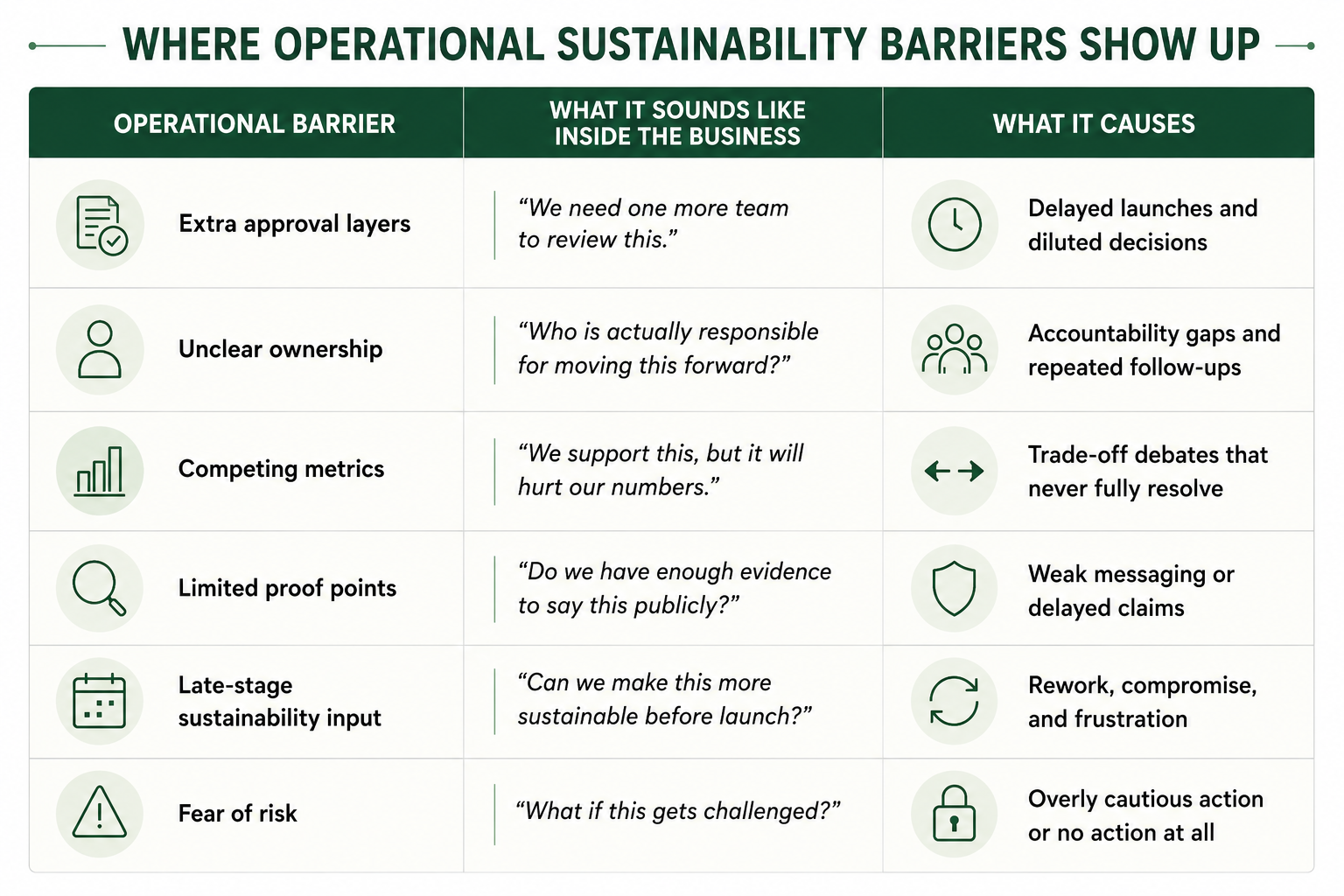
These barriers matter because they shape behavior. When a sustainable option takes more time, creates more uncertainty, or requires more internal defense, teams often default to the easier path. Not because they are against sustainability, but because the business has made the non-sustainable choice simpler to execute.
This is the operational version of the intention-action gap. The organization wants progress, but its systems continue to reward the familiar.
The hidden cost of high-effort implementation
High-effort implementation creates a slow drain on momentum.
A team starts with energy. The idea is approved. The business case looks promising. Then the work moves through layers of review, cost checks, claim substantiation, supplier questions, operational constraints, and internal debate. By the time the initiative is ready, the original momentum has faded.
This has a business cost.
Slow implementation can delay revenue opportunities, weaken brand trust, frustrate employees, and make leadership question whether sustainability is worth the investment. It can also lead to watered-down work. A stronger claim becomes a safer claim. A bold initiative becomes a smaller pilot. A cross-functional effort becomes a sustainability-team project again.
That is how operational sustainability barriers turn strategy into drag.
McKinsey and NielsenIQ found that many products making environmental, social, and governance-related claims saw stronger sales growth than products without those claims.² For organizations, that matters because slow internal execution does not only delay impact. It can also delay the business value connected to stronger sustainability positioning, clearer proof, and more credible customer-facing action.
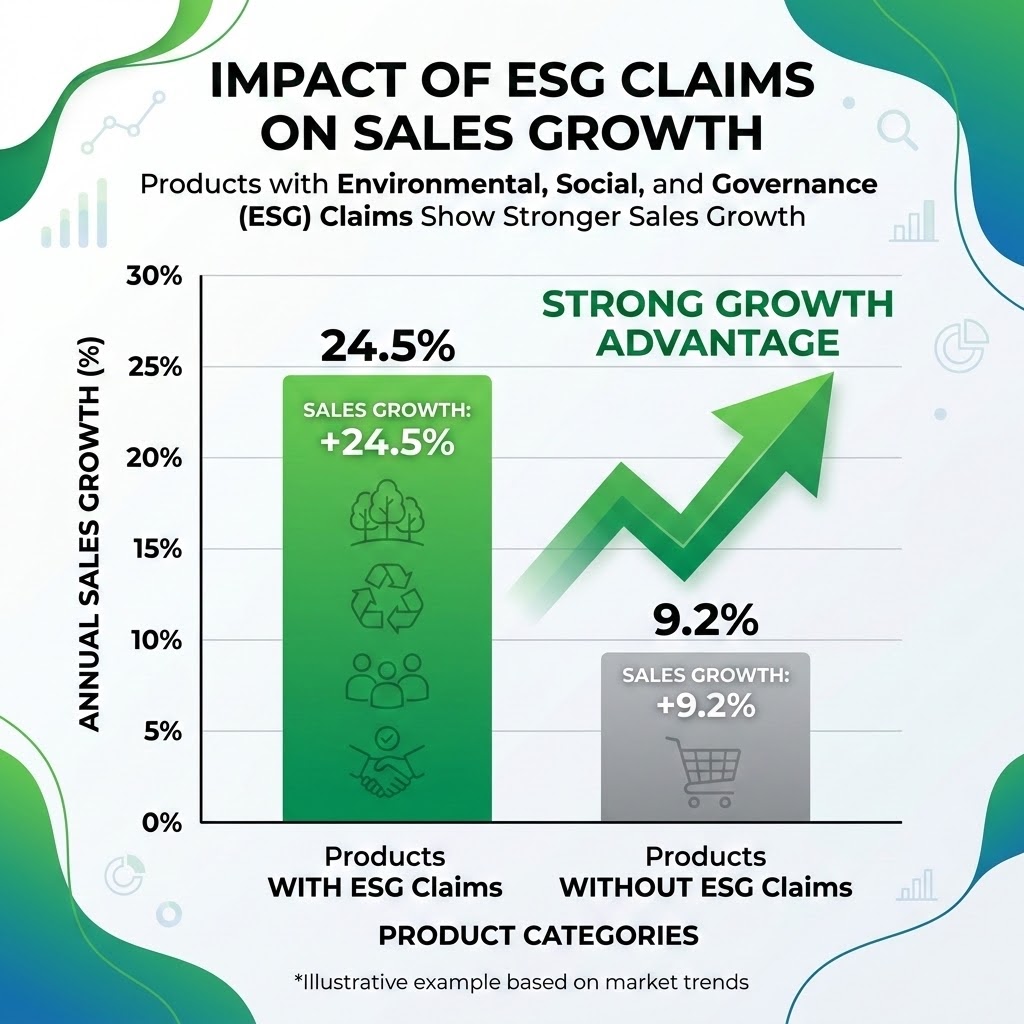
The issue is not that organizations need to care more. Most already do. The issue is that sustainability is often layered onto systems built for speed, cost control, and risk avoidance. When those systems are not redesigned, every initiative becomes harder than it needs to be.
What the podcast adds: purpose is not enough if the system works against it
This issue also sits at the center of grounded’s podcast, It Shouldn’t Be This Hard.
Want to know more?
Listen to our 'It Shouldn't Be This Hard' podcast — conversations with executives, innovation and sustainability professionals and social entrepreneurs who are doing the real work and bridging the gap between purpose and profit.
In Part 1 of the conversation, co-hosts Phil White and Heidi Schoeneck are joined by Jeffrey Hollender, co-founder of Seventh Generation, professor at New York University Stern School of Business, social entrepreneur, and author of Built for a Better World, to examine why purpose-driven business so often becomes difficult inside systems designed to reward the opposite.³
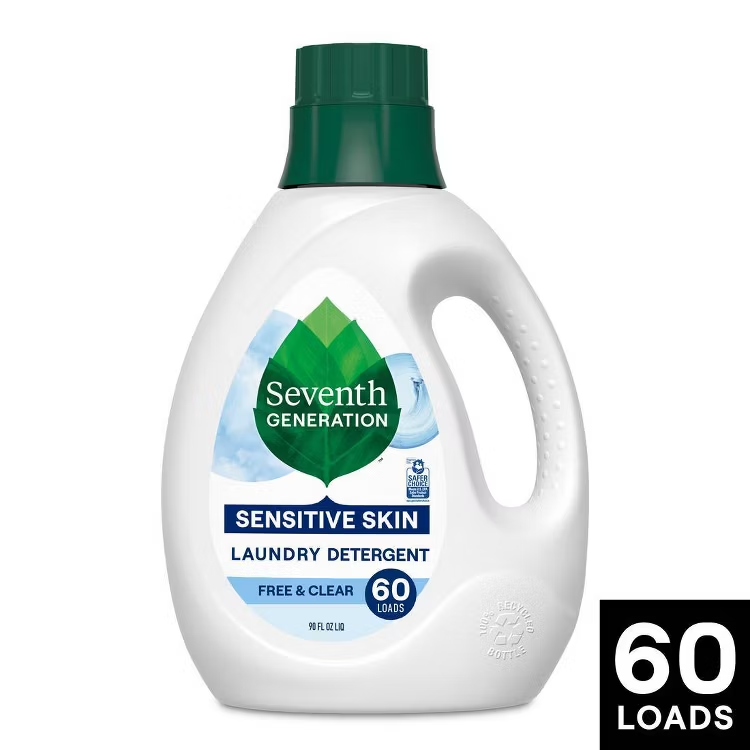
Hollender’s reflections on building Seventh Generation are especially relevant because they move beyond the familiar story of a mission-led brand doing good. He speaks candidly about the pressure of scaling, the mistakes he made as a leader, the pain of being fired from the company he built, and the realization that purpose alone cannot protect a business from misaligned incentives, investor pressure, cultural drift, or growth expectations.³
That lesson matters for sustainability implementation. Many organizations assume the hard part is defining the right ambition. But the more difficult work often begins after the ambition is set. Teams may want to do the right thing, but the business still rewards speed, margin, risk avoidance, and short-term performance. As Hollender’s experience suggests, **values can be sincere and still lose power when the surrounding system is not built to support them.**³

Check it out!
Jeffrey Hollender built Seventh Generation into a billion-dollar sustainable brand. Then the board fired him. Why? Because his vision for values-driven business didn't align with what the investors on the cap table wanted. In this episode of It Shouldn't Be This Hard, he breaks down: ✓ Why capital misalignment is the real constraint (not culture or strategy) ✓ How board governance can erode purpose (even in companies that care deeply) ✓ The structural barriers that make doing the right thing feel impossible ✓ What actually works when everything else fails If you're navigating the gap between purpose and performance in your organization, this conversation is essential listening.
The episode also sharpens a distinction that runs through this article: doing the right thing is not the same as consistently doing the right things.
A company can believe in sustainability, publish commitments, and hire people who care, yet still struggle to make the operational decisions that move the work forward. Investor misalignment, weak cultural alignment, unclear incentives, and fear of speaking publicly about sustainability can all pull teams back toward business as usual.
For leaders, the implication is practical. Sustainability does not become easier because people care more. It becomes easier when organizations redesign the conditions around action: who owns decisions, what gets measured, which behaviors are rewarded, how trade-offs are resolved, and whether teams have the proof and permission to move. That is why operational tools like grounded’s Friction & Incentive Audit matter. They help reveal where the system is quietly working against the purpose it claims to support.
Incentives matter more than internal enthusiasm
A common mistake is assuming that sustainability progress depends mainly on stronger internal communication. Communication matters, but it cannot solve an incentive problem.
If procurement is measured mainly on cost reduction, a lower-impact supplier may look like a budget problem. If marketing is measured on speed and engagement, sustainability proof points may feel like a delay. If legal is rewarded for minimizing risk, claims may become so cautious that they lose meaning. If product teams are judged on near-term performance, sustainability experiments may look like distractions.
People respond to what the business rewards.
This is why operational sustainability barriers are often incentive barriers. Teams may support the goal but hesitate when that goal conflicts with the metrics they are judged against. The result is not resistance. It is quiet caution.
The World Economic Forum has argued that businesses can help close the sustainability say-do gap by making sustainable habits easier, more affordable, and more enjoyable.⁴ That same logic applies internally. If companies want teams to act differently, they have to make the desired action practical within the business environment.
Without that shift, sustainability becomes something people agree with but struggle to deliver.
What stronger organizations do differently
Organizations that make sustainability easier to implement do not rely on enthusiasm alone. They change the conditions around the work.
They bring sustainability into decisions earlier, before product, sourcing, campaign, or investment choices are already locked. They clarify who owns decisions. They build shared metrics across teams. They create claims guidance that helps marketing and legal work together instead of slowing each other down. They make trade-offs explicit, so every initiative does not restart the same debate.
Most importantly, they reduce the effort required to act.
That can mean building sustainability criteria into procurement processes, giving teams clearer rules for claims and substantiation, connecting sustainability goals to commercial KPIs, defining who decides when cost, speed, and impact conflict, creating stronger proof points before campaigns are developed, giving teams practical language for customer and investor conversations, and making sustainability part of normal planning rather than a late-stage review.
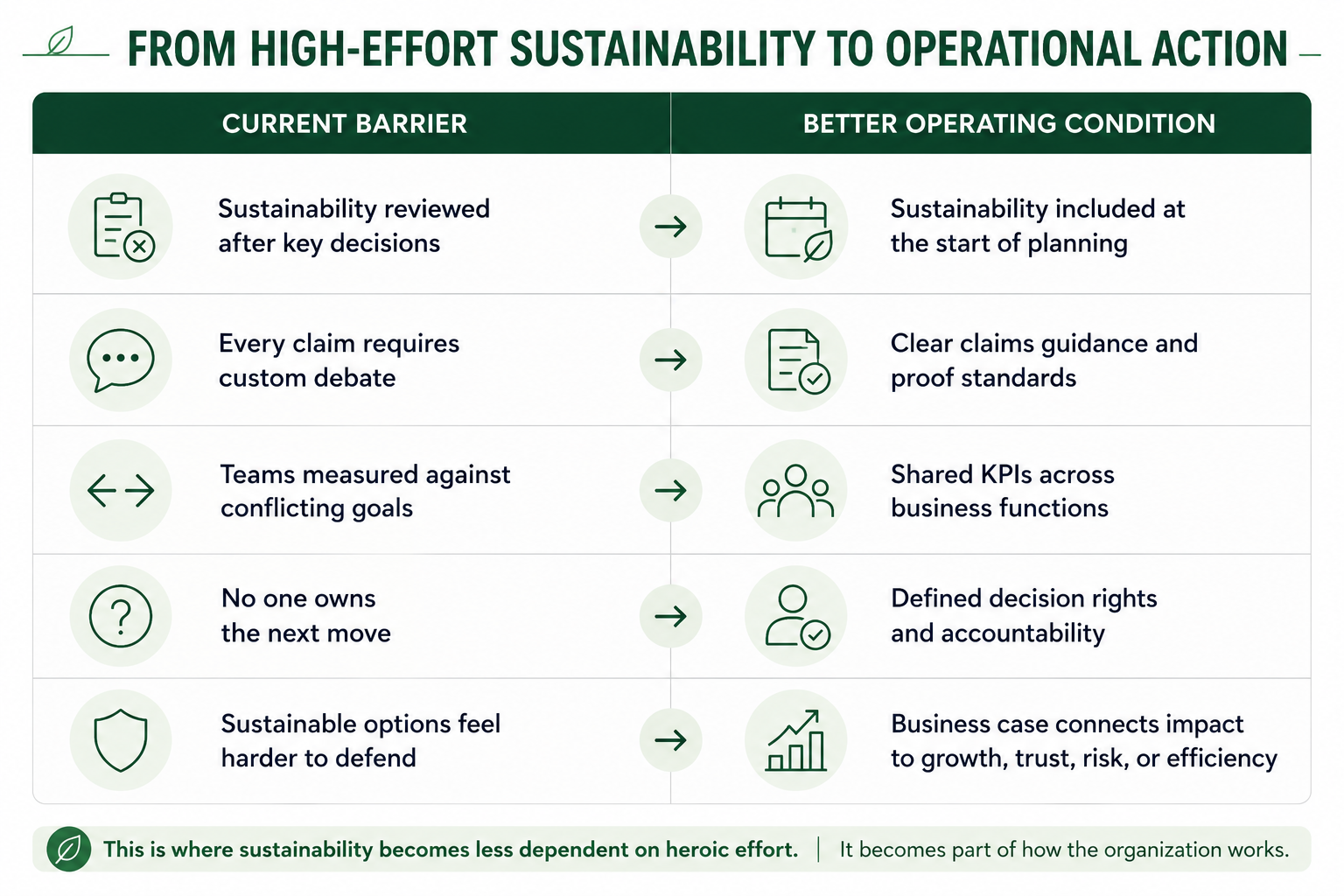
This is where sustainability becomes less dependent on heroic effort. It becomes part of how the organization works.
How the Friction & Incentive Audit helps
Grounded’s Friction & Incentive Audit is built for organizations asking a practical question: “We want to move forward, so what is actually slowing us down?”
It identifies the operational sustainability barriers that sit between strategy and implementation. The goal is not to blame teams or produce another abstract framework. The goal is to understand where the work gets harder than it needs to be.
The audit looks at where initiatives slow, repeat, or stall; which teams influence decisions but do not own outcomes; which incentives reward old behaviors; where approval processes protect the business and where they create drag; what proof, permission, or clarity teams need before acting; and which trade-offs need clearer decision rules.

This connects directly to Grounded’s podcast, It Shouldn’t Be This Hard. The title captures the internal reality many organizations face. They want to do the right thing, but the work becomes harder than expected once it enters real business operations.
The Friction & Incentive Audit helps make that difficulty visible. Once the barriers are visible, they can be redesigned.
Closing the gap between strategy and operations
If a sustainability strategy is approved but still moving slowly, the strategy may not be the problem.
The problem may be what happens after approval.
Who owns the next decision? What does each team need to move forward? Which metric is making people hesitate? Where does the process protect quality, and where does it simply slow action? What would make the sustainable choice easier than the default?
These questions move sustainability from intention to implementation.
Operational sustainability barriers are frustrating because they make progress feel personal. But most of the time, the issue is structural. People are trying to move forward inside systems that were not designed to help them do it.
Grounded’s Friction & Incentive Audit helps organizations find those barriers, understand what is slowing action, and redesign the path from strategy to measurable progress.
Because the real issue is rarely that organizations do not want sustainability to move forward.
It is that the work has been made harder than it needs to be.
Close your intention–action gap.
If your investments in sustainability and social impact aren't translating into sales, growth or internal buy-in, we can help you identify the gap.
Footnotes
- Grounded World. “Part 1: Jeffrey Hollender on Building Purpose-Driven Brands Inside Broken Systems.” It Shouldn’t Be This Hard.
- Ipsos. “How to Beat the Say-Do Gap with Sustainable Products and Unlock Growth.” Ipsos, 12 Nov. 2024.
- McKinsey & Company. “Consumers Care about Sustainability—and Back It Up with Their Wallets.” McKinsey & Company, 6 Feb. 2023.
- World Economic Forum. “How Businesses Can Help Consumers Build Sustainable Habits.” World Economic Forum, 13 Jan. 2022.

.jpg&w=3840&q=75&dpl=dpl_HmnLwQsjegpnBGw9xx66UP2zNbiG)
.jpg&w=3840&q=75&dpl=dpl_HmnLwQsjegpnBGw9xx66UP2zNbiG)
