
 Hope Wehrli
 The Moment Every Leadership Team Dreads
Many organizations believe they are doing everything right.
The sustainability strategy is approved. Sustainability objectives are in place. Internal teams have aligned on messaging. New suppliers have been sourced. Reports have been published. The budget has been spent.
Leadership teams may also have established sustainability goals, long-term reporting structures, and formal accountability measures tied to stakeholder expectations.
And yet, six months later, leadership is asking the same uncomfortable question:
Why has nothing changed?
Revenue is flat. Customer behavior looks the same. Teams are not following through. Retail partners are not prioritizing the new offer. Sustainability still feels disconnected from commercial performance.
For many organizations, this is the moment where frustration sets in. Leaders begin to question whether sustainability actually drives growth or whether consumers simply do not care as much as they claim.
But the reality is more nuanced.
The Real Problem Is Not the Strategy
The problem is usually not the sustainability strategy itself. The problem is what happens after the strategy is approved.
In many cases, businesses already have an effective sustainability strategy on paper, but struggle to connect it back to the wider business strategy.
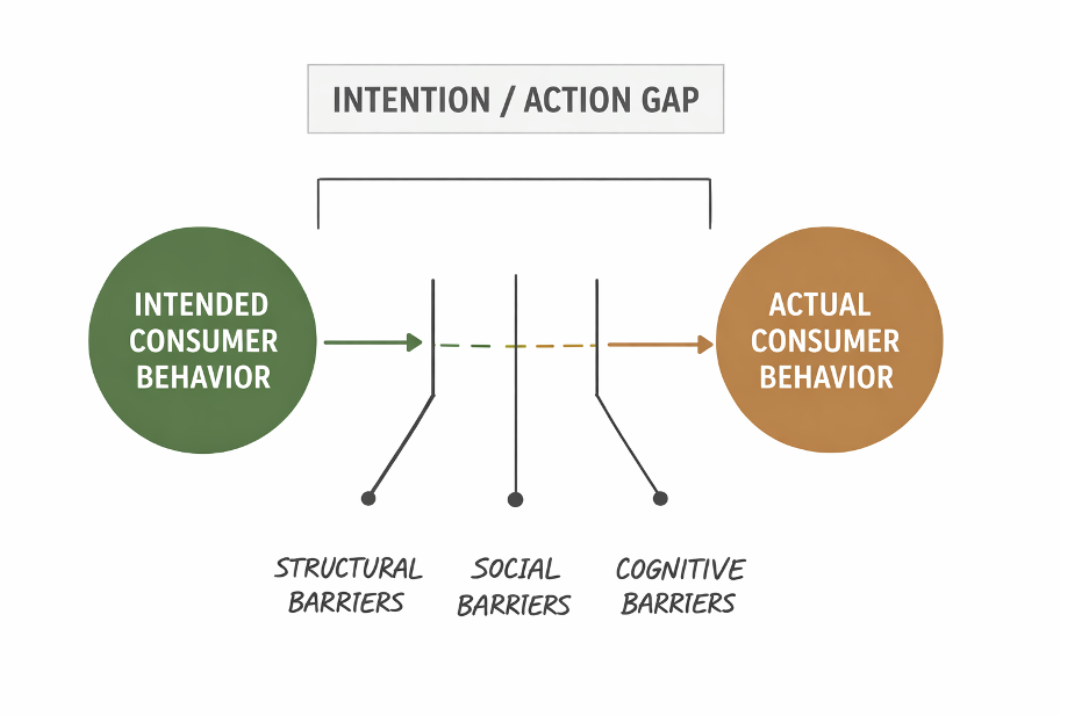
This is often called the Intention–Action Gap: the space between what organizations say they want to happen and what actually happens in practice.
That gap can show up in many ways. A company may launch a more sustainable product, but fail to explain why it matters to consumers. A retailer may train senior leaders on sustainability priorities, but never equip frontline teams to sell the story. A brand may invest in purpose-led messaging, while procurement teams continue making decisions based only on cost.
A company may also launch multiple sustainability initiatives but fail to assign ownership, measure progress, or explain how those efforts create business value.
Over time, those small disconnects become expensive.
Research consistently shows that people say they care about sustainability, but often fail to act on it. One widely cited study found that 65% of consumers want to buy from purpose-driven brands, yet only around 26% actually follow through with sustainable purchasing behavior.¹
That gap exists inside organizations too.
Leadership may support sustainability in principle, but teams are often unclear on priorities. Marketing might tell one story while product teams make different decisions. Procurement may still default to the cheapest supplier. Retail teams may not know how to sell the sustainability value proposition in a way that matters to customers.
The result is that sustainability becomes something businesses say rather than something they operationalize.
Why Sustainability Efforts Stall
This is where many organizations realize they do not have a strategy problem. They have an execution problem.
The challenge is not deciding what the business stands for. The challenge is making sure that purpose shows up consistently in customer experiences, employee behavior, product decisions, communications, and sales.
That is especially true when stakeholder expectations are increasing and sustainability is becoming a larger part of overall business strategy.
Too many companies assume the answer is more messaging. In reality, the challenge is usually behavioral.
Behavioral science shows that people rarely make decisions based on values alone. Cost, convenience, familiarity, and friction often overpower good intentions. According to nudge theory, subtle changes in how choices are presented can make desired behaviors easier, more visible, or more rewarding.²
That matters for sustainability strategy execution.
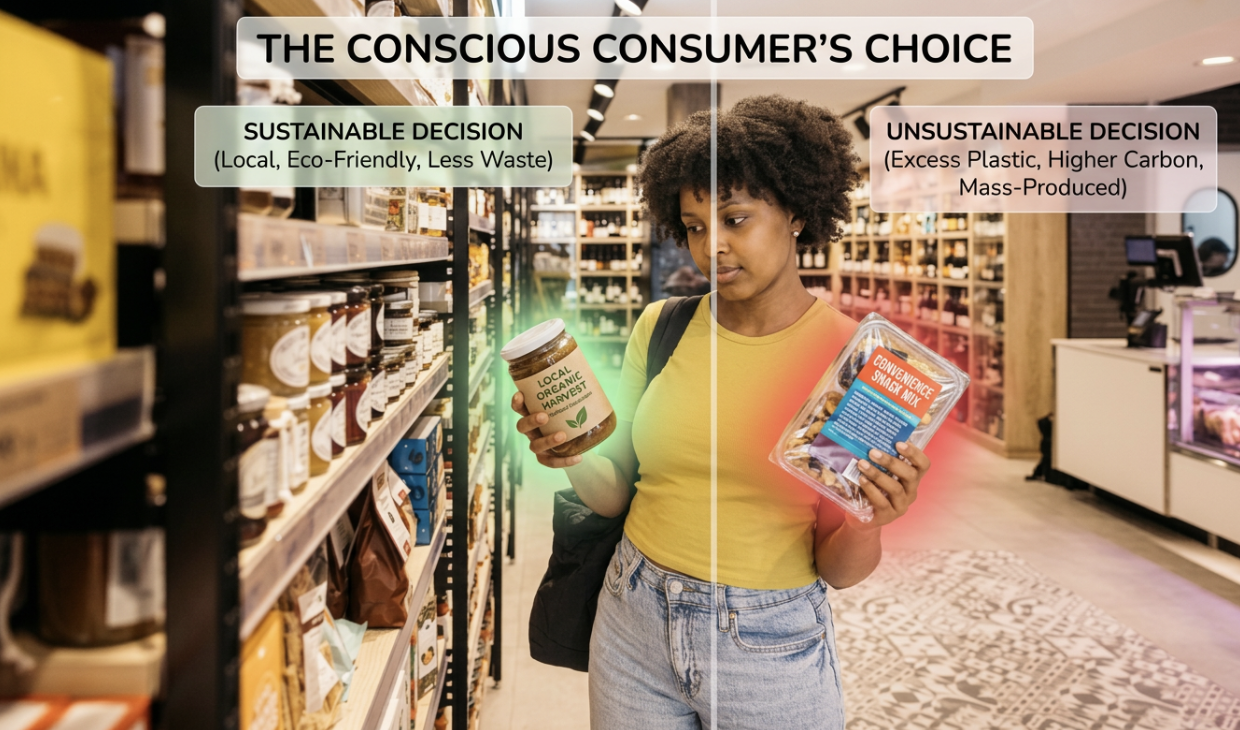
If employees have to work harder to make the sustainable choice, they will often default to the old way of doing things. If customers cannot easily understand the value of a sustainable product, they will buy the cheaper or more familiar option. If sustainability claims are unclear, overly technical, or disconnected from what people actually care about, they will not influence behavior.
Teams can spend years working toward sustainability goals, investing in sustainability efforts, and aligning with frameworks like the Science Based Targets initiative, only to see limited commercial impact because execution never catches up with ambition.
It is not just about doing the right thing. It is about doing the right things.
The Companies Seeing Results Focus on Behavior
The organizations that close the Intention–Action Gap do not just communicate sustainability better. They change the experience around it.
The IMPACT Framework:
Organizations making progress tend to focus on six key areas:
I – Inform customers with clearer messaging, simpler labels, and more transparent product information.
M – Minimize friction in the customer journey so the better choice feels faster, easier, and more convenient.
P – Prepare employees to explain sustainability initiatives with confidence and consistency.
A – Adjust packaging, pricing, product placement, and promotions to make sustainable options more appealing.
C – Create better retail and ecommerce experiences so sustainable products are easier to find, compare, and purchase.
T – Tie sustainability initiatives to measurable business outcomes such as customer engagement, sales growth, operational improvements, customer retention, and long-term business value.
That is what separates sustainability strategies that stay on paper from the ones that actually change behavior.
Behavioral science supports this approach. According to nudge theory, people are more likely to adopt new behaviors when the desired action is easier, more visible, and more convenient.² That is particularly important in sustainability, where people often care deeply but still default to old habits.
Research on sustainable consumption also shows that the biggest barriers are rarely a lack of concern. More often, they are structural, social, and cognitive barriers that make it difficult for consumers to follow through on their intentions.³
Sometimes the issue is internal. Leadership may be aligned, but frontline teams are not. Sometimes the issue is external. Consumers may care about sustainability, but they care even more about convenience, affordability, or trust. Sometimes the issue is competitive. Another brand may be making sustainability easier to understand and easier to act on.
Those are not strategy problems. They are execution problems.
Brands across retail, fashion, nonprofit, and consumer goods sectors are increasingly realizing that sustainability goals alone are not enough. Customers want action. Employees want clarity. Investors want measurable outcomes. Stakeholder expectations continue to rise.
That is why the companies making the most progress are not necessarily the ones with the largest budgets. They are the ones that connect sustainability goals to everyday business decisions, customer experiences, and long-term business strategy.

Conclusion
If your sustainability strategy is approved but nothing is changing in-market, the issue is likely not your ambition.
It is the gap between what your organization intends to do and what people are actually doing.
And that gap is measurable, solvable, and often more expensive than leaders realize.
That’s why we’re here.
Get grounded.
Book a no-obligation discovery call with one of our founders to take the first step. 15 minutes, no pitch — just to see if there's a fit.
Footnotes
- White, Katherine, Rishad Habib, and David J. Hardisty. “The Elusive Green Consumer.” Harvard Business Review, July–Aug. 2019, https://hbr.org/2019/07/the-elusive-green-consumer
- “Nudge Theory.” The Decision Lab, thedecisionlab.com/reference-guide/psychology/nudge-theory.
- “Intention–Behavior Gap in Sustainable Consumption.” Hapres, sustainability.hapres.com/htmls/JSR_1791_Detail.html.

.jpg&w=3840&q=75&dpl=dpl_9gmcg7kF2iURayF6Cu83WGH1D1nz)
.jpg&w=3840&q=75&dpl=dpl_9gmcg7kF2iURayF6Cu83WGH1D1nz)